Home University of Edinburgh Library Essentials
May 6, 2026

Yolanda Sonnabend (1935-2015)
 We were saddened to learn recently of the death of the artist and stage designer Yolanda Sonnabend, on 9 November 2015. In May 2013 we were delighted to acquire a collection of 200 or so artworks by Sonnabend, produced in collaboration with the developmental biologist C.H. Waddington, whose papers were catalogued as part of the ‘Towards Dolly’ project. This collection was first viewed in 2010 by our colleague Graeme Eddie, who visited Sonnabend in her home and took the photographs featured here.
 Yolanda Pauline Tamara Sonnabend was born on 26 March 1935 in Bulawayo, Southern
Rhodesia (now Zimbabwe) to German-Russian parents. After a cultured upbringing, Yolanda went on to study art in Geneva, and painting and stage design at the Slade School of Fine Art, London. She received her first design commission at the Royal Ballet in 1958, while she was still an undergraduate, and went on to forge a brilliant career as a stage designer. She worked closely with the choreographer Sir Kenneth MacMillan throughout the 1960s-1980s, and designed for theatre, opera and ballet shows across Europe, as well as designing Derek Jarman’s 1979 film adaptation of The Tempest. She was also an acclaimed portrait painter, whose subjects included Stephen Hawking and Steven Berkoff. In 2000 Sonnabend was awarded the Garrick/Milne Prize for theatrical portraiture.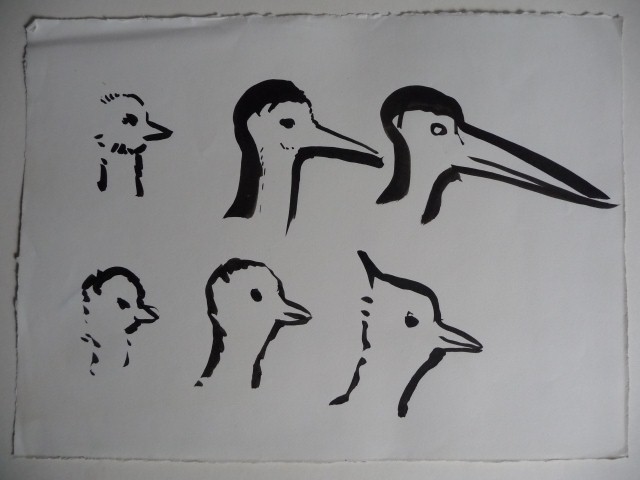
Sonnabend’s friendship and collaboration with C.H. Waddington is captured in the illustrations she produced for his book Tools for Thought: how to understand and apply the latest scientific techniques of problem solving. Waddington was a biologist and embryologist, and at the time he knew Sonnabend, was the director of the Institute of Animal Genetics in Edinburgh. However, Waddington’s interests extended far beyond the purely scientific, encompassing art, architecture, ecology, robotics and early computing; he was also committed to communicating with the wider public about these topics. Tools for Thought was his final book, published posthumously in 1977, and was intended to be a popular guide to new ways of perceiving and understanding the world’s scientific, political and ecological problems. Sonnabend’s stark and imaginative pen and ink drawings formed the perfect ‘other half’ to the book; incorporating triangles, graphs, arrows and bird heads.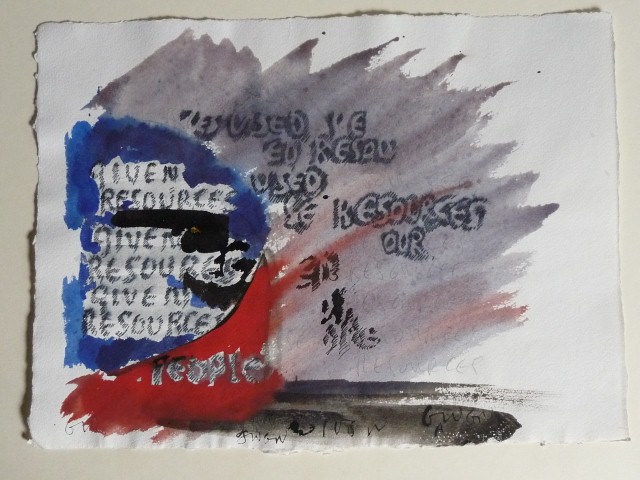
Many of Sonnabend’s designs were, sadly, not included in the final book (Waddington died during the proofing stage), but the originals exist in the collection acquired by the Library. 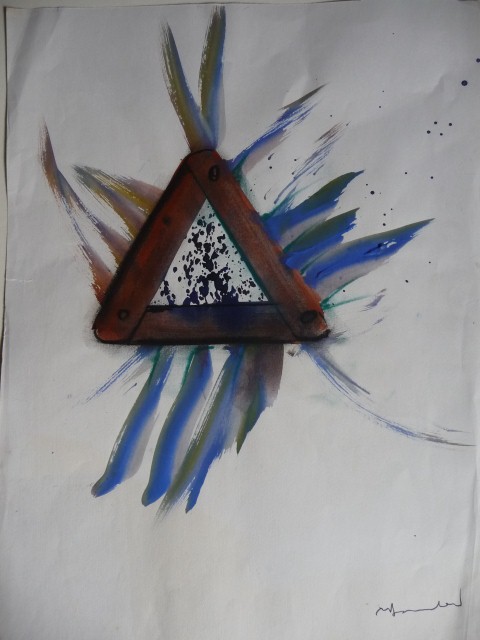 Sketches on graph paper and collages made with shredded magazine articles sit alongside completed, signed pieces. The correspondence which accompanies these works shows the affectionate and intellectual stimulating relationship Sonnabend and Waddington shared.
Sonnabend’s artistic legacy lives on in the portraits collected by the National Portrait Gallery and the Science Museum and the Design Collection at the Royal Opera House – but her work for C.H. Waddington sheds a new light on both their careers.
With thanks to Graeme Eddie and Dr Joseph Sonnabend.
Clare Button
Project Archivist
Trial access to Science of Synthesis
 We have trial access to Science of Synthesis from Thieme until 30th January 2016.
Science of Synthesis provides a critical review of the synthetic methodology developed from the early 1800s to-date for the entire field of organic and organometallic chemistry.
As the only resource providing full-text descriptions of organic transformations and synthetic methods as well as experimental procedures, Science of Synthesis is a unique chemical information tool.
Feedback and further info
We are interested to know what you think of this e-resource as your comments influence purchase decisions so please do fill out our feedback form.
A list of all trials currently available to University of Edinburgh staff and students can be found on our trials webpage.
A Christmas Celebration
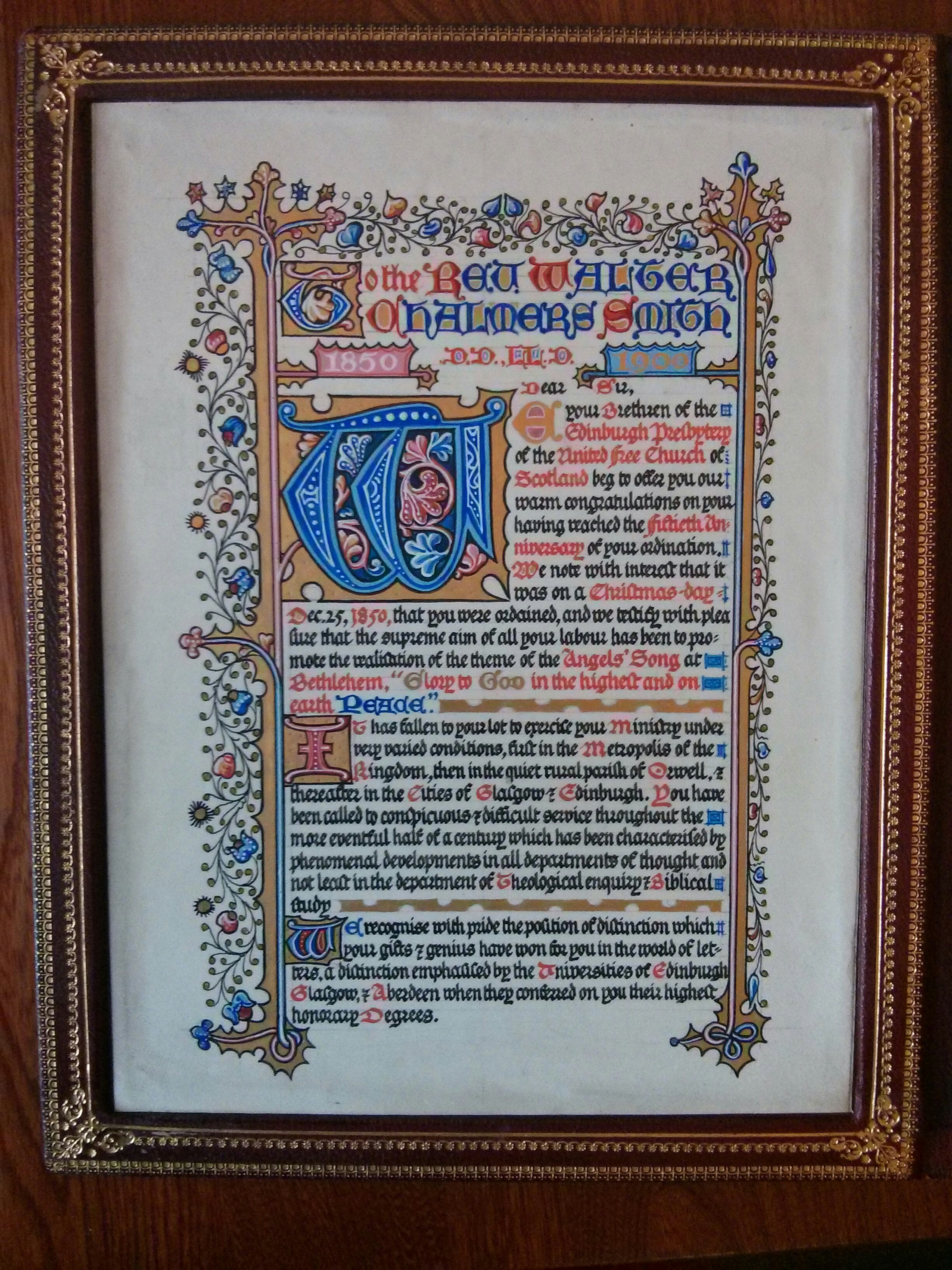
Fiftieth Anniversary Certificate – Walter Chalmers Smith. New College Library MSS SMI 4.5
New College Collections Curator Kirsty Stewart & I were delighted to find this lovely ‘illuminated manuscript’ certificate, which celebrates the fiftieth anniversary of the ordination of Rev. Walter Chalmers Smith, in the New College Library manuscript collections. Rev Walter Chalmers Smith was an alumni of New College and followed a distinguished career in the Free Church, becoming Moderator of the Free Church in 1893 and culminating in the role of minister at the Free High Kirk in Edinburgh. After further denominational reunification, the Free High Kirk building became what we now know as New College Library in 1936, so this document is a link to New College Library’s past. It’s also a fascinating glimpse into Christmas over a hundred years ago, when it was more common in Scotland for Christmas day to be a normal working day without holiday celebrations. This made it a suitable day for new minister Chalmers Smith to be ordained, as recorded on the certificate.
T. F. Henderson, ‘Smith, Walter Chalmers (1824–1908)’, rev. Lionel Alexander Ritchie, Oxford Dictionary of National Biography, Oxford University Press, 2004 [http://www.oxforddnb.com/view/article/36166, accessed 8 Dec 2015]
Highlights from the RDM Programme Progress Report: August – October 2015
The RDM Roadmap 2.0 has been completed, approved, and published online and work has started on achieving the deliverables. A copy of the Roadmap is publicly available on the RDM webpages and can be downloaded from http://www.ed.ac.uk/files/atoms/files//uoe-rdm-roadmap_-_v2_0.pdf.
The RDM Services brochure has now been published in both paper and electronic form and is proving very popular with researchers. The electronic version can be downloaded from http://www.ed.ac.uk/files/atoms/files/rdm_service_a5_booklet_0.pdf
Work on DataVault is progressing well and an interim DataVault service is now nearly complete. The Software Sustainability Institute has worked with the DataVault team to road test the interim solution, as a result some optimisations to the process were identified and are being coded up. DataVault user events have been held in both Manchester and Edinburgh, both events were well attended and the general impression of the current DataVault functionality was positive. Further, round three, funding is being sought from Jisc in December to continue this joint development effort.
Jisc has provided funding for up to nine PhD students to be employed one day per week for four months within their school. Their role will be to help researchers within their school record their research data as Datasets in the PURE system, and to direct any RDM or DMP queries to the RDM team for further support. The Dataset records in PURE will provide the Edinburgh University contribution to the national Research Data Discovery Service, this will increase the discoverability of Edinburgh data and ensure that more researchers are meeting the requirements of their research funders to make their data discoverable and reusable. Applications for the first set of three PhD student interns have been received and are currently being shortlisted, the successful applicants should be able to begin work before the end of 2015.
In October some minor questions were received about the DataShare application for Data Seal of Approval (DSA), these were responded to and DataShare has now been approved for the DSA. This is a major achievement for the entire DataShare team who have worked hard to make DataShare a Trusted Digital Repository.
Over the three month period a total of 173 staff and PGR’s have attended a RDM course or workshop, an additional 20-25 staff have attended research committee meetings or small group presentations where RDM has been on the agenda. Both regular and on demand RDM sessions (courses, workshops, & presentations) will continue to be offered and we are currently in the process of scheduling 30 courses, workshops for January to June 2016 as well as a number of presentations.
The “Data Management and Sharing” Coursera MOOC is well under way with a December launch anticipated. Sarah Jones, DCC, is our video instructor, using scripts adapted from MANTRA.
National and International Engagement Activities
10th August meeting in London with other Alan Turing Institute members to discuss RDM requirements to be provided by member institutions.
17th of August a one day RDM event was organised for Danish visitors from the University of Copenhagen to present UoE RDM services, outreach activities and ELNs.
31st August Dealing with Data conference.
7th/8th September meeting with Gottingen University to talk about digital scholarship, including RDM.
7th October DataVault engagement event at Manchester University.
29 October, Educause conference, Indianapolis. Robin Rice was on a panel with Jan Cheetham & Brianna Marshall, University of Wisconsin and Rory Macneil, RSpace: “Drivers and responses toward research data management maturity: transatlantic perspectives.
Kerry Miller
RDM Service Co-Ordinator
Trial access to South Asia Archive
We have trial access to the South Asia Archive until 1st January 2016. This has been added to our e-resources trials webpage.

The South Asia Archive is a specialist digital platform providing global electronic access to culturally and historically significant literary material produced from within, and about, the South Asian region. Contains millions of pages of digitized primary and secondary material in a mix of English and vernacular languages dating back to the start of the 18th Century, up to the mid-20th Century. Contains Journals, Reports, Books, Legislation documents and Indian Film Booklets.
Feedback and further info
We are interested to know what you think of this e-resource as your comments influence purchase decisions so please do fill out our feedback form.
A list of all trials currently available to University of Edinburgh staff and students can be found on our trials webpage.
Illustrations of ceramic vessels used in the Japanese Tea Ceremony, or ‘chanoyu’
RECENT ACQUISITION OF 19th CENTURY ILLUSTRATED JAPANESE CALLIGRAPHIC MANUSCRIPT
 Recently arrived in to the holdings of the Centre for Research Collections (CRC) is this profusely illustrated manuscript devoted to the ceramic vessels used in the chanoyu or Japanese Tea Ceremony.

Labels to the 4-volume Japanese ms (Coll-1693)
The tea ceremony, also called the ‘way of tea’ is a Japanese cultural activity involving the ceremonial preparation and presentation of powdered green tea (matcha). Zen Buddhisim was a primary influence in the development of the ceremony and the art and manner in which it is performed.

Bird illustrated in the ms showing illustrations of ceramic vessels (Coll-1693)
Tea gatherings are classified as: an informal tea gathering or chakai, offering a relatively simple course of hospitality that includes confections, thin tea, and perhaps a light meal; and a formal tea event chaji, usually including a full-course meal followed by confections, thick tea, and thin tea. A chaji can last several hours.

Ceramic vessel illustrated in the Japanese ms (Coll-1693)
Some of the utensils used in the ceremony were: kogo – small ceramic or wooden containers used to hold pieces of incense, with their use varying with the seasons (wooden ones holding the chips of incense wood for summer ceremonies, ceramic ones holding kneaded incense in winter ceremonies); and, cha ire – tea container.

Ceramic vessel illustrated in the Japanese ms (Coll-1693)
The four volumes comprising the illustrated ms on paper – and dated at circa 1850-1865 – are entitled: Ko Bon Zu-e Ko, and Meibutsu Chajin Zu-e. These are volumes containing c. 188 watercolour illustrative diagrams of regional or speciality utensils – ceramic vessels or tea caddies – for students of the tea ceremony, chajin, and illustrations of incense trays and boxes.

Label on the rather worn silk-covered folding slipcase (coll-1693)
The volumes are gathered in a cover which holds the label: Japanese manuscript (4 illustrated Vols) on Pottery (Kogo and Cha-Ire) of the Cha-No-Yu or Tea Ceremony.

Ceramic vessel illustrated in the Japanese ms (Coll-1693)
The text and images of three volumes are on both sides of concertina-bound paper. The volumes are stitched in silk covered wrappers with ms labels to the upper covers.

Ceramic vessel illustrated in the Japanese ms (Coll-1693)
Dr. Graeme D. Eddie, Assistant Librarian Archives & Manuscripts, Centre for Research Collections

Note: this blog-post was constructed using the sales literature, information on the item, and a number of relevant websites.
Cut it out!
I have been making my way through the manuscripts collection in an effort to identify material, see what conservation needs there are and generally acquaint myself with the collections. This week I have been struck by the quantity of material from the 1600s, which has, of course, come about as a result of the Covenanters. While a good proportion of the manuscripts are sermons there are a few which are copies of letters or the last words of Presbyterian martyrs.
My heart was in my mouth when I opened one such volume (ref. MSS NOT) and found that in several places pages had been cut out. As I went through the notebook in search of the name of the person who had carefully copied down sermons by Laurence Charteris and James Good, Latin tracts and proclamations, my heart resumed its usual position when, quite unusually, I found an explanation for the missing pages:
“Nota: I lent this book to Mr Samuel Nairne when he was passing his tryalls for the Ministrie which he keept four years & some more; & when removed from the parish of Moonzie and went to Arroll, he tooke the booke with him; And all the thankes I got was the cutting out of thir leaves as is to be seen in the following part hereof Which was neither done lyke a Gentleman nor a Minister. Whereupon I ame resolved here after to take heed to whom I lend the use of my booke, especially of a manuscript.”
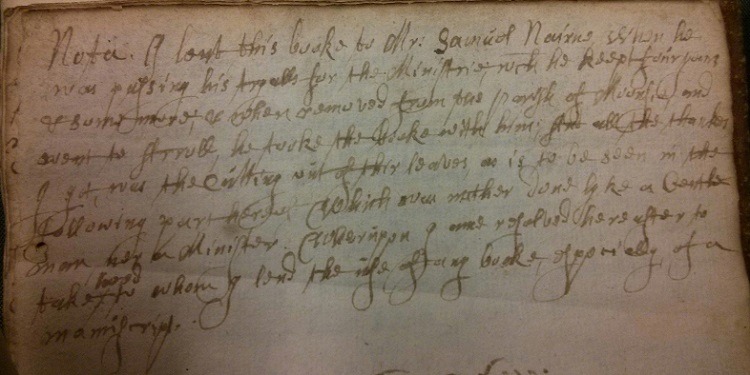
Author’s explanation for missing notebook pages.
While the notebook’s author is as yet unknown, the reference to Samuel Nairne dates it to around 1690 and one can assume that the author was living in the parish of Moonzie or nearby.
The inside cover of the notebook tells us that it was later owned by a James MacGregor. However, at another point in the notebook, where Samuel Nairne had been busy with a blade, James wrote the following:
“Fhuair Seumas McGriogair an leabhar so am Peairt am Bliadhna ar Tighearna 1778 ar son 2sc[illin]”
Translation: “James MacGregor bought this book in Perth in the Year of our Lord 1778 for 2 pence.”
Not only does this give us more about the provenance of the book but also shows that James MacGregor was literate in Gaelic.
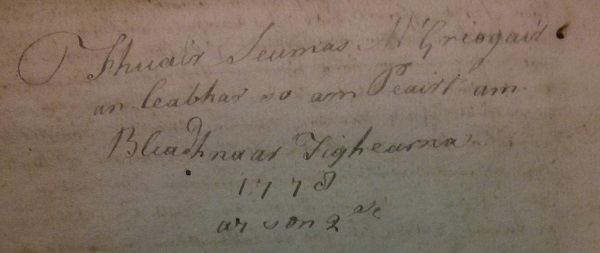
James MacGregor notes when and where he bought the notebook (ref. MSS NOT)
Missing pages can be frustrating and sometimes even heartbreaking but for our unknown Fife scribe their absence was clearly just plain annoying: annoying enough to write about it.
Kirsty M Stewart, New College Collection Curator
Information on Samuel Nairn from Fasti Ecclesiae Scoticanae , vol 5, p 169: SAMUEL NAIRNE, M.A. ; ord. before 22nd July 1690 ; trans, to Errol 12th Jan. 1692.
Trial access to Statista
 We have trial access to Statista until 30th December 2015 and this has now been added to our e-resources trials webpage.
Statista is one of the world’s largest statistics and market data platforms with access to more than 1,5 million statistics, forecasts, dossiers, reports and infographics on 80.000 topics from more than 18,000 sources. From the rabbit pet food market value in the UK, to the number of registered buses in Alaska, a survey of most needed changes for the Cuban population to the a breakdown of mobile gamers in China. The platform combines economic data, consumer insights, opinion polls and demographic trends.

All data can be downloaded within seconds in 4 different office formats. On top, every student, lecturer and member of staff receives full publication and usage rights of the data (useful if you present at a conference or want to publish sth. for example) as well as access to Statista data journalists. Automatic Citation output is included, too. Last but not least, in terms of entertainment, the infographic section can definitely compete with a youtube-evening on a cold winter evening at home!

Feedback and further info
We are interested to know what you think of this e-resource as your comments influence purchase decisions so please do fill out our feedback form.
A list of all trials currently available to University of Edinburgh staff and students can be found on our trials webpage.
Update: This trial will continue through 2016
Trial access to Medieval Family Life and Medieval Travel Writing databases
We have trial access to Medieval Family Life and Medieval Travel Writing databases from Adam Matthew until 29th December 2015. Both databases have been added to our e-resources trials webpage. Update 2016 – we have purchased Medieval Family Life
 Medieval Family Life – The Paston, Cely, Plumpton, Stonor and Armburgh Papers. This resource contains full colour images of the original medieval manuscripts that comprise these family letter collections along with full text searchable transcripts from the printed editions, where they are available. The original images and the transcriptions can be viewed side by side. Along with the letter collections themselves there are many additional features useful for teaching and research. These include: A chronology, a visual sources gallery, an interactive map, a glossary, family trees and links to other scholarly free to access digital resources useful for researching the medieval period.
 Medieval Travel Writing – this project provides direct access to a widely scattered collection of original medieval manuscripts that describe travel – real and imaginary – in the Middle Ages.
These sources tell us much about the attitudes and preconceptions of people across Europe in the medieval period, shedding light on issues of race, economics, trade, militarism, politics, literature and science. They will be welcomed by scholars in both literature and history as well as by French and German studies departments.
The project combines:
- Multiple manuscript sources, detailing the journeys of famous travellers from Marco Polo to John Capgrave, and the stories of legendary figures such as Prester John and Sir John Mandeville
- Translations and supporting materials (all of which are fully searchable)
- Maps showing the routes of the travellers
- Introductory essays by leading scholars
Feedback and further info
We are interested to know what you think of these databases as your comments influence purchase decisions so please do fill out our feedback form.
A list of all trials currently available to University of Edinburgh staff and students can be found on our trials webpage.
Trial access to Sovetskaia kul’tura Digital Archive
 UPDATE – purchased Jan. 2016
We have trial access to Sovetskaia kul’tura Digital Archive via EastView. The trial can be accessed via the e-resources trial webpage and DiscoverEd until 31st December.
Kul’tura (Culture) is an important Russian weekly newspaper previously published under the titles Rabochii i iskusstvo (1929-1930), Sovetskoe iskusstvo (1931-1941), Literatura i iskusstvo (1942-1944), Sovetskoe iskusstvo (1944-1952) and Sovetskaia kul’tura (1953-1991).
An indispensable source of information on the developing and ever changing attitudes towards arts and culture in the Soviet and Russian societies. Throughout the years the newspaper articles reviewed major events in Russian cultural life, in literature, theatre, cinematography and arts. In the Soviet period it published critical diatribes against dissident writers Pasternak, Solzhenitsyn, Aksyonov and others, infamous articles condemning modern art exhibitions, chastising avant-guard composers and abstract painters. In modern Russia its reviews and event listings often focus on the cultural life of Moscow and regions, it is known for its topical commentaries on popular culture and politics.
Further information about this database can be found at http://www.eastview.com/files/EVSovetskaiaKulturaDA.pdf
Feedback and further info
We are interested to know what you think of this database as your comments influence purchase decisions so please do fill out our feedback form.
A list of all trials currently available to University of Edinburgh staff and students can be found on our trials webpage.
Collections
 Hill and Adamson Collection: an insight into Edinburgh’s past
My name is Phoebe Kirkland, I am an MSc East Asian Studies student, and for...
Cataloguing the private papers of Archibald Hunter Campbell: A Journey Through Correspondence
My name is Pauline Vincent, I am a student in my last year of a...
Hill and Adamson Collection: an insight into Edinburgh’s past
My name is Phoebe Kirkland, I am an MSc East Asian Studies student, and for...
Cataloguing the private papers of Archibald Hunter Campbell: A Journey Through Correspondence
My name is Pauline Vincent, I am a student in my last year of a...

Projects
Cataloguing the private papers of Archibald Hunter Campbell: A Journey Through Correspondence
My name is Pauline Vincent, I am a student in my last year of a...
Archival Provenance Research Project: Lishan’s Experience
Presentation My name is Lishan Zou, I am a fourth year History and Politics student....