Home University of Edinburgh Library Essentials
June 11, 2026
I: 100th anniversary of ‘Zeppelin’ air attack on Edinburgh – A school student walks among the wreckage
A STORY FROM THE DIARY OF 15-YEAR OLD ARCHIBALD H CAMPBELL (1902-1918) WHO WOULD LATER BECOME REGIUS PROFESSOR OF PUBLIC LAW AND THE LAW OF NATURE AND THE NATIONS, EDINBURGH UNIVERSITY, 1945-1972
Over the next couple of days, and almost 100-years to the day since the first ever air assault on Leith and Edinburgh by Zeppelins of the Imperial German Naval Airship Service, our blog describes the event – on 2-3 April 1916 – as told by the diary of the young teenager Archibald Campbell, and also through interpretation of historical papers of the Royal Infirmary of Edinburgh curated by the Lothian Health Services Archive (LHSA).
Firstly… Archibald Campbell’s story…:

Airship – similar to Zeppelin L14 of the Imperial German Naval Airship Service which brought most of the damage to Edinburgh from the air in April 1916. In addition to Edinburgh, many other places on Great Britain suffered from Zeppelin raids including Kings Lynn, Gt. Yarmouth, Hull, Tyneside, Gravesend, the Midlands, London and the Home Counties. From January 1915 to end-May 1916 at least 550 British civilians had been killed (Creative Commons image).
Archibald Hunter Campbell was born 21 May 1902 in Edinburgh. He was educated at George Watson’s College in the city, at Edinburgh University, and then at University College, Oxford.

The cover of the school-boy diary kept by Archibald H. Campbell (Coll-221).
While still at school, aged 13 years, Campbell witnessed the aftermath of this first ever air attack on the city, and on Scotland as a whole, when the airships – the Zeppelins – dropped ordnance on 2-3 April 1916.

Campbell aged 13 in April 1916 had written extensive notes about the Zeppelin attack on a separate piece of paper inserted into his diary, noting that his description of the aftermath was ‘On paper’ (Coll-221).
The naval base at Rosyth in Fife and the Forth Bridge had been the focus of an attack composed of four Zeppelins but in the event only two craft reached the Scottish coast – L14 commanded by Kapitänleutnant der Reserve Alois Böcker, and L22 commanded by Kapitänleutnant Martin Dietrich. At 9.30pm on Sunday 2 April 1916 the military gave the order for the city to take air raid action, and road traffic ground to a halt, street lighting was lowered, and civilians were advised to take refuge.

Descriptive notes from the diary kept by Archibald H. Campbell and telling the story of the Zeppelin attack (Coll-221).
Leith Docks were attacked round about 11:30pm, and then the German airship crew plotted a course along the Water of Leith towards the city of Edinburgh. Just after midnight the young Campbell was awakened by the sound of bombs. He went down to the parlour where he waited until 1.10am on the morning of Monday 3 April and from the window he ‘saw blaze over Leith’. He then went to bed before rising again at 7.30am to get ready for school – George Watson’s. However he heard that a ‘bomb had fallen in front of school & smashed it up’. When he got to school he ‘mucked about’ in the bomb hole in the playground until he was ‘turned out’ of it.

Descriptive notes from the diary kept by Archibald H. Campbell and telling the story of the Zeppelin attack (Coll-221).
At noon when he got out of school he ‘went round to see bomb hole’ again. Every window in front of the school was ‘smashed’. The crater was ‘about 4′ 6” across right up against Ethel Davidson’s room which was absolutely smashed’ (the crater was just over a meter wide). He went on…:
Desks, window-frames, broken glass, stones, and piles of plaster, all smashed up, filled the room. Other front rooms about as bad.

Descriptive notes from the diary kept by Archibald H. Campbell and telling the story of the Zeppelin attack (Coll-221).
All windows smashed & street carpeted with broken glass. Bomb had landed through roof of a house.

Descriptive notes from the diary kept by Archibald H. Campbell and telling the story of the Zeppelin attack (Coll-221).

Descriptive notes from the diary kept by Archibald H. Campbell and telling the story of the Zeppelin attack (Coll-221).
It had missed the Castle by a few feet, hit the rock & brought down a small land slide.

Descriptive notes from the diary kept by Archibald H. Campbell and telling the story of the Zeppelin attack (Coll-221).

Descriptive notes from the diary kept by Archibald H. Campbell and telling the story of the Zeppelin attack (Coll-221).
Later on, when his mother had gone down to Leamington Terrace to see an uncle, Campbell ‘got a car’ (a tram) down to Leith Walk where he met his father and several teachers, and…:
Showed my bit of bomb & told them that Watson’s was still standing.

Descriptive notes from the diary kept by Archibald H. Campbell and telling the story of the Zeppelin attack (Coll-221).

Descriptive notes from the diary kept by Archibald H. Campbell and telling the story of the Zeppelin attack (Coll-221).
Saw all smashed windows & other effects of Castle bomb. Looked down into King’s Stables Road which was absolutely black with people.

Descriptive notes from the diary kept by Archibald H. Campbell and telling the story of the Zeppelin attack (Coll-221).
Owing to crumpling up of wire and that beastly developing box only one […] came out decently & even it was spotted.

Descriptive notes from the diary kept by Archibald H. Campbell and telling the story of the Zeppelin attack (Coll-221).
 Nearly all of the damage had been caused by devices dropped from Zeppelin L14. Zeppelin L22 ventured only briefly into the city and just caused minor damage after jettisoning most of its bombs in fields near Berwick-upon-Tweed. Later in the year, Alois Böcker was arrested by local policemen in Essex, England, in September 1916, when his Zeppelin (L33 on this occasion) was brought down by night fighters. Zeppelin L14 itself was destroyed by its crew on 23 June 1919 following the example of the naval scuttling in Scapa Flow.
At Bletchley Park he was a Foreign Office Civilian (Temporary Senior Assistant Officer) and worked at the Mansion, Hut 10, Block A and Block F(A), Air Section, including advanced research in the Italian sub-section. There he decrypted non-Enigma signals from German, Italian and Japanese Air Forces and produced intelligence reports. He also worked at Hut 5 and Block F, Military Section, probably Japanese, involved in decrypting and reporting on non-Enigma enemy army ciphers. This was also known as No 4 Intelligence School.
After the war he returned to Edinburgh and to the University’s Regius Chair of Public Law and the Law of Nature and the Nations which he held from 1945 to 1972. He was Dean of the Faculty of Law, 1958-64.
Professor Archibald Hunter Campbell died in Edinburgh 8 June 1989.
The diary with the separate page describing the damage across Edinburgh was ‘rediscovered’ in the A. H. Campbell material by one of our volunteers, Valentina Flex, Edinburgh University graduate, who had been creating a provisional listing of content.
A second blog post about the attack on Edinburgh 100-years ago – and from the curatorial staff of the LHSA – will go live in the next couple of days.
Dr. Graeme D. Eddie, Assistant Librarian Archives & Manuscripts, Centre for Research Collections
Notes…: In addition to the description of the events written by Archibald H. Campbell himself, freely accessible web-pages describing the events of 2-3 April 1916 (especially Scotland’s War ‘Midlothian’s War – Zeppelin raid over Edinburgh’) and a ‘Wikipedia’ list of Zeppelins, and also the website of the Bletchley Park Roll of Honour, were enlisted for the creation of this blog-post.
The image of the Zeppelin (here the P-class LZ45 ‘L13’) was obtained from Creative Commons.
The second story about the Zeppelin attack can be read here: II: Incendiary bombs and the Infirmary
Historical Statistics of the United States on trial
The Library currently has trial access to the Historical Statistics of the United States: Millennial Edition Online.
 Historical Statistics of the United States (HSUS) is a compendium of statistics about the United States and is the standard source for the quantitative facts of American history.
The Library already holds the print edition of Historical Statistics of the United States which you can find in DiscoverEd.
The online edition is fully searchable and has features that allow you to save search criteria, search within a chapter or volume, bookmark tables, view tables in PDF or HTML format, select certain years or series of years to view, create charts and graphs and much more.
Please note that during the trial period you will only be able to download and email tables, and view PDFs, in Part A: Population.
You can access the resource via the e-resources trials page. Access is available both on and off-campus.
Trial ends 1st May 2016.
Feedback welcome.
Access is only available to current students and staff at University of Edinburgh.
Caroline Stirling – Academic Support Librarian for Social and Political Science
How do we slice our LOAF (Library OA Fund)?
A number of Universities have introduced funding to support Open Access publishing in addition to external block grants. We are often asked about the rationale for our OA fund, so we have produced a short report as part of the OA Good Practice LOCH Pathfinder Project.
St Andrews Library Open Access Fund: business case and criteria
https://research-repository.st-andrews.ac.uk/handle/10023/8504
This short report describes the case for a small institutional fund to support open access publishing at the University of St Andrews. The background to the fund is an institutional commitment to ensuring the widest possible access to its research, and a belief that researchers should be free to choose the most suitable venue for their work. If an author decides that a fully open access journal is the best venue for their work, we do not want there to be any barriers to publishing. The University Library therefore proposed a model where researchers could apply for funds specifically when they wish to publish in a journal which is only available in open access form and which requires payment of a publishing fee. The report describes how the fund operates, and its ultimate aim to encourage and support a transition to open access that is sustainable and achievable.
Jackie Proven – Repository & Open Access Services Manager, University of St Andrews
What’s the Danger?
In this week’s blog Project Conservator, Katharine Richardson, discusses the challenges she has faced while reviewing the CRC’s Disaster Plan….
For the last two months I have been reviewing the Disaster Response and Recovery Plan for the University of Edinburgh’s rare and unique collections. The plan covers twelve different collection sites across the University campus that contain a large number of diverse objects and materials, including archives, anatomical specimens and musical instruments.
One of the most challenging aspects of the project has been to identify each collection’s vulnerabilities and to anticipate the risks involved in moving and handling them during a disaster response operation. Some collection items have very specific handling requirements which must be recorded in the plan, such as the School of Scottish Studies Archive’s audio visual equipment that is so sensitive to movement that they can be damaged beyond repair from one slight knock. There are also certain collections that contain items hazardous to human health, one example being the geology collections, which contain specimens of mercury and asbestos. These, too, require specialist handling instructions and a record of what personal protective equipment (PPE) is required.
A new themed double-issue of The Unfamiliar published online
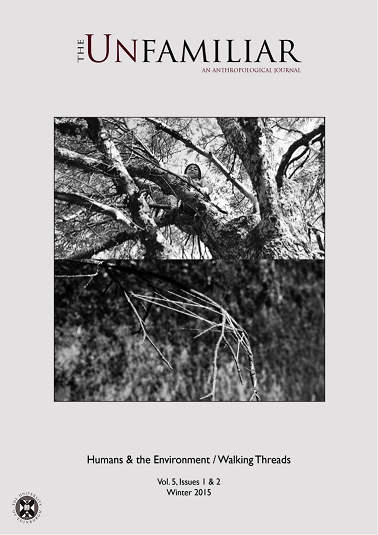 We are delighted to announce that an exciting new double-issue of the student-led open-access journal The Unfamiliar: an anthropological journal, Volume 5 (1-2), “Humans and the Environment / Walking Threads”, is now available online.
Humans and the Environment
The individual contributions to this double-issue of The Unfamiliar all explore the different and intricate relationships that exist between people and environments. The environment is here understood in its broadest sense, to also include social, economic, cultural and political aspects, all co-constitutive elements influencing how one comes to perceive and relate to the surrounding world.
Walking Threads
In continuation with the theme of Humans and the Environment, the final part of this volume is dedicated to a special section on the ongoing collaborative initiative Walking Threads. The different reflections, essays and creative interventions represented by these pieces offer a glimpse into an ongoing conversation that originated in the context of one such collaboration, between performance and anthropology, and after an unplanned communal walk with a thread in Seaton Park, Aberdeen. The contributions exemplify the value of experimentation and play, while also offering us reflections on the walk’s potential methodological implications and relevance for anthropological research – and how we come to know and connect with our surrounding environment.
Humans and the Environment
A Windswept Archipelago: Stories of Perception, Time and Landscape in the Orkney Islands
– Sara Bowman Friend
Walking Through Amazonia: An Embodied Perspective on “Natural” Environment
– Manuela Tassan
Esther’s Life Story within a Dryland Biography: Livelihood Viability in Central Pokot, Kenya.
– Paul Roden and Christoph Bergmann
Mountains as actors in the Bolivian Andes: The interrelationship between politics and ritual in the Kallawaya ayllus
– Jonathan Alderman
Becoming With, in Life and Death
– Hannah Kuemmerle
Learning Respect in the Mountains: Children’s perception of nature and its master spirits in a Mapuche community
– Gabriela Alejandra Pina Ahumada
Walking Threads
Interrupted Everyday Motions: Journeying With Threads and Lives
– Ragnhild Freng Dale
Introducing the Walking Threads Project
– Paola Esposito and Jan Peter Laurens Loovers
“Walking Threads, Threading Walk”: Embroidering reflection
– Valeria Lembo
Stepping In and Out of the Picture: A drawing-based reflection on Walking Threads
– Paola Esposito
Walking Threads: A Memory and a Reflective Speculation Inspired by Gilles Deleuze and Felix Guttari
– Brian Schultis
“Walking Threads, Threading Walk”: Weaving and Entangling Deleuze and Ingold with Threads
– Jan Peter Laurens Loovers
An intuitive walk – a thread to play along
– Gey Pin Ang
Anthropological Renga
– Caroline Gatt
Library supported publishing
The Unfamiliar is supported by the Library’s Open Journals service. The service is offered free to academic staff and students who are interested in publishing new Open Access journals or migrating existing journals to the Library’s OJS (Open Journal Systems) platform. You can find out more about the service on the Information Services website or email Library.Learning@ed.ac.uk
Angela Laurins
Library Learning Services Manager
Shen Bao Digital Archive (1872-1949)
With the kind support from the Confucius Institute for Scotland, the Library has just purchased the complete digital archive of the Shen Bao Chinese newspaper (申報) which was published in Shanghai between 1872 and 1949.

Literary Encyclopedia

The Literary Encyclopedia publishes biographies of major and minor writers; scholarly descriptions of all interesting texts written by these authors, including those often neglected; and a variety of descriptive and critical essays on literary, cultural and historical matters, which provide a finer understanding of the social contexts in which this writing was produced. Includes coverage of English, American, German, Russian, Italian, French and Classical literatures, as well as substantial and increasing coverage of Hispanic, Japanese, Canadian, East European and various postcolonial literatures. (Other major literatures to be added as resources permit.) Currently has about 7557 completed articles, with a total of about 15.77 million words with around 20-40 articles added to the Encyclopedia every month.
The Library has arranged a free trial of the LE, until 31/05/2016. The trial can be accessed via the E-Resources Trials website which also links to other database trials that can be of interest. There is maintenance work going on with the trial Feedback Form on the E-Resources Trials website at the moment. Please leave a comment in this blog or email your Academic Support Librarian for giving your feedback.
NDL launched an English-language newsfeed on Twitter (NDLJP_en)
The National Diet Library, Japan, launched an English-language newsfeed on Twitter with the account name NDLJP_en. Watch the newsfeed for the latest information in English on collections and events at the NDL on https://twitter.com/NDLJP_en.

Choco-love
All you need is love. But a little chocolate now and then doesn’t hurt.
Lucy Van Pelt (in Peanuts, by Charles M. Schulz)
Today we continued our campaign to spread Library Love by handing out Easter Eggs in the Main Library Foyer.

Many students are currently facing a lot of deadlines, so we want to show them that the Library cares about them with this popular comfort food! These statistics suggest that the people in the UK ate more chocolate than anywhere else in the world in 2011, with each person consuming 11kg on average!
While chocolate is alright occasionally, we will also be handing out some healthier, brain-boosting snacks to help students focus in the next few weeks, in the lead-up to exams. We are getting inspiration from things such as this great dessert recipe from the Lothian Health Services Archive:

Invalid fruit tart recipe, Royal Infirmary of Edinburgh School of Dietetics, c.1950. (LHSA Ref: LHB1/89/4/1). Find it here.
Follow us on Facebook and Twitter to find out more about our brain-boosting snacks, and other ways we are encouraging students to relax! Have a great Easter break!
New Nature Publishing Group e-journals available

The following 3 new e-journals have now been added to DiscoverEd.

Nature Energy is interested in all aspects of energy, from its generation and storage, to its distribution and management, the needs and demands of the different actors involved, and the impacts that energy technologies and policies have on different societies.
 Nature Microbiology is interested in all aspects of microorganisms, be it their evolution, physiology and cell biology; their interactions with each other, with a host or with an environment; or their societal significance. Nature Microbiology provides a place where all researchers and policymakers interested in microorganisms can come together to learn about the most accomplished and significant advances in the field and to discuss topical issues.
Nature Reviews Materials is dedicated to publishing reviews and perspectives across the entire spectrum of materials science and engineering.
Further Info
The library subscription to Nature Publishing includes all Nature branded e-journal titles as well as selected other titles available from Nature Publishing. These can be accessed from our e-journal AZ list located within DiscoverED.
Collections
 Hill and Adamson Collection: an insight into Edinburgh’s past
My name is Phoebe Kirkland, I am an MSc East Asian Studies student, and for...
Cataloguing the private papers of Archibald Hunter Campbell: A Journey Through Correspondence
My name is Pauline Vincent, I am a student in my last year of a...
Hill and Adamson Collection: an insight into Edinburgh’s past
My name is Phoebe Kirkland, I am an MSc East Asian Studies student, and for...
Cataloguing the private papers of Archibald Hunter Campbell: A Journey Through Correspondence
My name is Pauline Vincent, I am a student in my last year of a...
Projects
Cataloguing the private papers of Archibald Hunter Campbell: A Journey Through Correspondence
My name is Pauline Vincent, I am a student in my last year of a...
Archival Provenance Research Project: Lishan’s Experience
Presentation My name is Lishan Zou, I am a fourth year History and Politics student....