Home University of Edinburgh Library Essentials
June 11, 2026
What The Copibook Saw
Cinema at the whaling-stations, South Georgia…: another brief look into the Salvesen Archive
‘…Each man takes a turn to keep the building in a proper state of cleanliness…’

This look at cinema and film offered to the personnel of the whaling stations in South Georgia is another of our occasional forays into the Salvesen Archive.
Papers in the Christian Salvesen Archive show that cinema was an important leisure-time activity in the life of the personnel working at the whaling-stations of South Georgia. Films could be enjoyed at the ‘World’s Most Southerly Cinema…’.

Collection of season programmes for films at Grytviken Kino, South Georgia, 1960s, a cinema claiming probably correctly to be the ‘World’s most southerly cinema beyond the cinema at Ushuaia’, Argentina. In the Salvesen Archive, B2, Box 4, h.
The earliest reference to ‘cinema’ in South Georgia so far found in the Salvesen Archive is a letter from the 1920s. A copy-letter (unsigned typescript) to Edward B. Binney, Magistrate, South Georgia, dated 28 November 1925 – and presumably from the Leith Harbour station – is in effect an application ‘for permission to give Cinematograph Exhibitions’. The letter states that the ‘Cinematograph is the property of all the employees’ of the station, and that a subscription of 15 kroner is ‘being made by each man to cover cost of Machine and Films’, and also the cost of ‘books for a Library’.
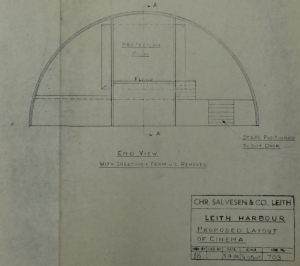
Proposed layout for the new Cinema, 1956. In the Salvesen Archive, C5. Box 2.
The letter goes on to state that the ‘Company provides the Buildings and electric Current free of charge and every precaution has been taken against the outbreak of fire’, not least through the locating of the building ‘away from the factory’. Finally, the letter tells us that: ‘Each man takes a turn to keep the building in a proper state of cleanliness’.
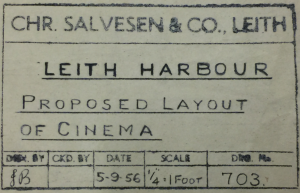
Proposed layout for the new Cinema, 1956. In the Salvesen Archive, C5. Box 2.
Indeed, at Leith Harbour, wrote Sir Gerald Elliot in his work A whaling enterprise (1998), the main recreations ‘came from the cinema, the library and the football ground’. The cinema, the library, and football field were ‘the normal amenities of civilisation’ agreed Wray Vamplew in his work Salvesen of Leith (1975). The cinema, Elliot went on, ‘got a new supply of films every season which were exchanged with the floating factories as opportunity arose’. By the mid-1950s: ‘There was a large new cinema about to be built’.
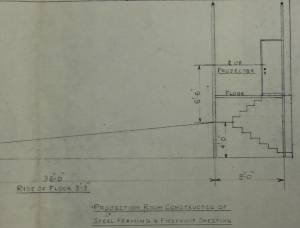
Proposed layout for the new Cinema, 1956. In the Salvesen Archive, C5. Box 2.
Examples of the variety of films acquired for the stations have been found in the Salvesen Archive. A copy-note [Norwegian] from Oslo dated 24 January 1955, and relating to 10 films sent to South Georgia in Winter 1955 via shipping agents Messrs. Ruys & Co., Netherlands, and the Fred Olsen Transport Co. A/S, lists the titles Asphalt Jungle (Asfaltjungelen, 1950), No No Nanette (Nei, Nei Nanette), Operation Pacific (1951), and Rocky Mountain (1950) among others. The films were destined for Grytviken Kino, South Georgia.
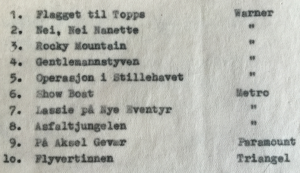
List of films sent south to South Georgia from Oslo in January 1955. In the Salvesen Archive, B2, Box 4, h.
Another letter [Norwegian] from Europafilm A/S, Oslo, to L. Klaveness A/S, Sandefjord, dated 18 January 1957, refers to the delivery of 10 films for Grytviken, 1957 Winter Season. The films were to be sent south from Oslo on 29 January 1957 on the vessel Kronprins Olav.
Europafilm A/S, Oslo, supplied 10 films to Grytviken Kino in January 1957. In the Salvesen Archive, B2, Box 4, h.
The films sent south in 1957 included Bird of Paradise (hopefully the 1951 re-make rather than the much earlier 1932 one), Botany Bay (1952), David and Bathsheba (1951), Desert Fox: the story of Rommel (1951), Roman Holiday (Prinsesse paa vift, 1954), and Star of India (1954) among others.
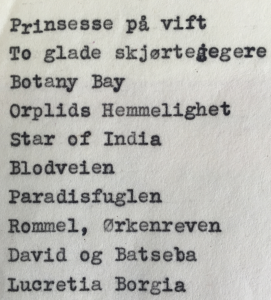
List of films sent south to South Georgia from Oslo in January 1957. In the Salvesen Archive, B2, Box 4, h.
It wasn’t only the crews of the floating factories that enjoyed the exchange of films with the shore-based stations… films were exchanged between the various shore stations themselves. In the Archive there is a note [Norwegian] from Grytviken Kino to Husvik station cinema, dated 20 February 1960, indicating that a number of films were on the way to Husvik. The same note asks Husvik ‘to please send [back] remaining films of previous lists’.
Grytviken Cinema membership card. In the Salvesen Archive, B2, Box 4, h.
Another note [Norwegian] from Grytviken Kino to Husvik, dated 7 November 1961, indicates that ‘more new movies will be sent tomorrow’, and that these should be sent on to Leith Harbour as well. The note also asks that films already watched be returned to Grytviken. In addition, the note states that the ‘film company in Oslo has asked us that care be taken of all the large coloured cinema posters inside the film cans and to make sure they don’t get lost, otherwise they will have to be paid for’.
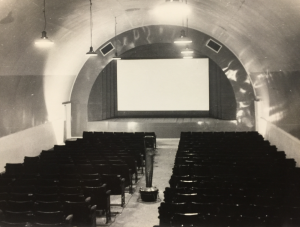
Interior of a South Georgia cinema. In the Salvesen Archive, C1, Envelope 30.
With the ending of commercial whaling and the closure of the South Georgia stations, infrastructure there has been open to the elements. A 2011 report on the state of the whaling-stations shows that the cinema buildings have not faired well at all, succumbing like the other flimsy structures to the storms and weather conditions of the Southern Ocean.
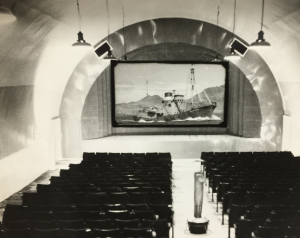
Interior of a South Georgia cinema. In the Salvesen Archive, C1, Envelope 30.
The cinema venue at Grytviken (a whaling station of Compañia Argentina) has gone – or is at least not referred to in a list of surviving buildings – and at Husvik (established by the Tønsbergs Hvalfangeri) the cinema and library were ‘in a state of collapse either partial or complete’.
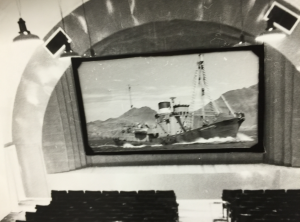
Interior of a South Georgia cinema. In the Salvesen Archive, C1, Envelope 30.
At Stromness (first established by the Sandefjord Whaling Company) the cinema is listed as one of the buildings that ‘have collapsed completely’ , and at Leith Harbour too (the Christian Salvesen station) the cinema is among those buildings ‘in a ruinous state’. At Prince Olav Harbour (Southern Whaling & Sealing Company) the cinema has ‘disappeared completely’.

Dr. Graeme D. Eddie, Assistant Librarian Archives & Manuscripts, Centre for Research Collections (CRC)
The following were used in the construction of this blog-post:
Salvesen of Leith, Wray Vamplew, p.213, published by Scottish Academic Press, Edinburgh & London, 1975.
A whaling enterprise. Salvesen in the Antarctic, Sir Gerald Elliot, p.66, p112, published by Michael Russell, Norwich, 1998.
Inspection of the disused shore-based whaling-stations for the Government of South Georgia and the South Sandwich islands, by Purcell Miller Tritton, Norwich, July 2011.
If you have enjoyed this glimpse of the Salvesen Archive, have a look at these earlier ones too: June 2014 Whale hunting: new documentary for broadcast on BBC 4; July 1914 Pipe bombs, hurt sternframes, peas, penguins, stowaways and cookery books: the Salvesen Archive; March 2015 ‘Empire Kingsley’ – 70th anniversary of sinking on 22 March 1945; November 2015 Talk given to Members of the South Georgia Association – on the Salvesen Archive; May 2016 Exploring the explorer – Traces of Ernest Shackleton in our collections – 10 May 2016 is the 100th anniversary of the safe arrival of the small boat ‘James Caird’ on South Georgia
New to the Library: Samos archaeological reports
Further to a request from staff in HCA the Library is currently in the process of trying to purchase a copy of all available volumes of the Samos series of archaeological reports published by the Deutsches Archäologisches Institut.

Samos is one of the most important archaeological sites of the ancient Mediterranean world and this series of reports on excavations of the site provides essential data for staff and students research. Read More
JoVE – new titles

We have just renewed our subscription to JoVE (Journal of Visualized Experiments) for the new academic year and have added a few more titles to this subscription. We now have access to the following sections:

Access these e-journals via DiscoverEd.
Beckett Digital Library
Beckett Digital Library now available
The Library has just subscribed to Beckett Digital Library which can be accessed via the Databases A-Z List. It has also been indexed in Database by Subject for English Literature and for French Studies. Read More
Main Library Summer Improvements 2016 – Update 3/8/2016
Work is continuing in the Main Library on a programme of works to bring significant improvements for library users through increasing the number of study spaces by 350 and providing additional power and data facilities at study desks.
Work underway this week (1st-8th August) and updates
2nd floor – Construction work to remove empty shelves and carry out electrical works is underway on the north side of the 2nd floor. The collections JV-PB are currently cordoned off and access to these items is through consultation with Helpdesk staff located on the 2nd floor or Ground Floor 9.15-4.45 Monday to Friday, or through emailing collections-management@ed.ac.uk at other times.
Move of collections 3rd floor to 2nd floor
Collections from the 3rd floor now permanently located on the 2nd floor are:
- All P Pamphlets
- All P Folios
- P books
- PA books
- PB books
Signs
The updating of shelf-end signs is currently underway and we expect this to be completed this week.
We are also working on updating the main Library signs and will have accurate signs in place at the completion of the Main Library works.
DiscoverEd Search Points
We are currently updating the information in DiscoverEd and the information retrieved will then reflect the new location of items that have moved from the 3rd floor to the 2nd floor.
Compression of Compressions
The addition of new study spaces on the 2nd, 3rd and 4th floors is made possible through the compression of the collections on the shelves to provide free shelving that can be removed. This compression of collections is now complete.
Apologies for the continuing noise and disruption – thank you for your patience while work is underway.
Amirsys Imaging Reference Center

Amirsys Imaging Reference Center is a new subscription for the academic year 2016-17.
Amirsys Imaging Reference Center offers a comprehensive source of radiology references with a combination of high-quality images, classical diagnoses, and evidence-based clinical content.
Contents include:
- 72,000 x-ray, CT, MR, and ultrasound illustrations and images.
- Expert, evidence-based content – including over 4,000 diagnoses provided by imaging experts.
- Over 40,000 journal references.
Image topics serve a wide range of medical professionals across a comprehensive list of searchable categories, including:

Amirsys Screenshot
• Brain
• Breast
• Cardiovascular
• Chest
• GI & Urology
• Gynecology
• Head & Neck
• Musculoskeletal
• Nuclear Medicine
• Obstetrics
• Pediatrics
• Spine
• Ultrasound
Access this new database via our main A-Z list, Medicine AZ list, Nursing AZ list and DiscoverEd.
Godfrey Thomson: the man who tested Scotland’s IQ
This absolutely splendid and superbly mounted exhibition on the life, work and legacy of educational researcher, Professor Godfrey Thomson (1881-1955), has just opened in the Exhibition Hall of the University’s Main Library in George Square.
Curated by Professor Ian Deary of the School of PPLS, this very rich and rewarding exhibition will certainly merit more than one visit. It features a range of fascinating artefacts from the University’s fairly recently acquired Godfrey Thomson Archive and provides a great insights into the life and work of this most remarkable man.
Spinal Cord Series and Cases – new e-journal
We now have access to Spinal Cord Series and Cases. This e-journal has been added to our Nature Publishing Group package subscription and is now available in DiscoverEd. Spinal Cord Series and Cases is an international quarterly subscription based journal, publishing original research articles, small case series, case reports and contributions of a more national or local interest that address all aspects of spinal anatomy, physiology and lesions (injury and disease). Spinal Cord Series and Cases is a multi-disciplinary forum for basic science, clinical and applied studies, psychology and epidemiology of spinal disorders, and is committed to rapid publication.
New to the Library: Church Missionary Society Periodicals
Following a successful trial earlier this year the Library has now purchased access to module 1 of Church Missionary Society Periodicals, Global missions and contemporary encounters, 1804-2009.

This resource features publications from the Church Missionary Society, the Church of England Zenana Missionary Society and the latterly integrated South American Missionary Society.
You can access Church Missionary Society Periodicals from the Databases A-Z list. Read More
Collections
 Hill and Adamson Collection: an insight into Edinburgh’s past
My name is Phoebe Kirkland, I am an MSc East Asian Studies student, and for...
Cataloguing the private papers of Archibald Hunter Campbell: A Journey Through Correspondence
My name is Pauline Vincent, I am a student in my last year of a...
Hill and Adamson Collection: an insight into Edinburgh’s past
My name is Phoebe Kirkland, I am an MSc East Asian Studies student, and for...
Cataloguing the private papers of Archibald Hunter Campbell: A Journey Through Correspondence
My name is Pauline Vincent, I am a student in my last year of a...
Projects
Cataloguing the private papers of Archibald Hunter Campbell: A Journey Through Correspondence
My name is Pauline Vincent, I am a student in my last year of a...
Archival Provenance Research Project: Lishan’s Experience
Presentation My name is Lishan Zou, I am a fourth year History and Politics student....