Home University of Edinburgh Library Essentials
March 27, 2026
Global journals for World Christianity
The University of Edinburgh subscribes to a wide range of academic journals for the School of Divinity, but we’re also active in making the most of open access journals that are freely available on the web. Anabaptist Witness is one of these, and has recently been added to DiscoverEd. This journal aims to provide global Anabaptist and Mennonite dialogue on key issues facing the church in mission.

Korea Presbyterian Journal of Theology has also recently been added to DiscoverEd. Available in Korean and English, this journal aims to create academic discourse for theology that is evangelical and Biblical, is Reformed and ecumenical, and focuses on the Korean, Asian and global contexts in theological discourse.
 Christine Love-Rodgers, Academic Support Librarian – Divinity
New Digital Collections for Divinity in 2016
We’ve been able to purchase several new digital collections to support the School of Divinity in 2016. All of the below are accessible via http://www.ed.ac.uk/is/databases-a-z and via the Divinity subject guide http://www.ed.ac.uk/is/subject-guides-divinity
Brepols Database of Latin Dictionaries
Database comprising a large number of Latin dictionaries to assist translation from Latin into modern languages and to provide semantic and etymological explanations.
 China, Culture & Society
Digital collection of rare pamphlets (c. 1750-1929) from Cornell University Library creating a very rich source for research on China, addressing Chinese history, religion, culture, and everyday life. Read More
Desk Top Power Modules
Part of the refurbishment works to create new study areas will also involve an upgrade to the existing desk top power modules on a number of new and existing desks. We are confident that these new desk top power modules will help address the many issues that users have been experiencing, each desk will be fitted with a single socket and double USB charging point.
Additional electrical enabling works have been planned to accommodate these new desk top power modules which will see a number of areas affected, these works have been scheduled in order to minimise disruption to users. These areas will be cordoned off to users whilst the work is taking place.
Please see below for details
4th Floor: from 6pm to 6am on Monday 29th August – Tuesday 30th August 2016 electrical enabling work will take place throughout the floor to prepare for the installation of additional desk top power supply units.
3rd Floor: from 6pm to 6am on Tuesday 29th August – Wednesday 31st August 2016 electrical enabling work will take place throughout the floor to prepare for the installation of additional desk top power supply units.
2nd Floor: from 6pm to 6am on Wednesday 31st August, Thursday 1st & Friday 2nd September 2016 electrical enabling work will take place throughout the floor to prepare for the installation of additional desk top power supply units.
1st Floor: from 6pm to 6am on Thursday 1st September – Friday 2nd September 2016 electrical enabling work will take place throughout the floor to prepare for the installation of additional desk top power supply units.
Around the World in 90 years- the Story of Historic Leith Improvement Scheme Photographs
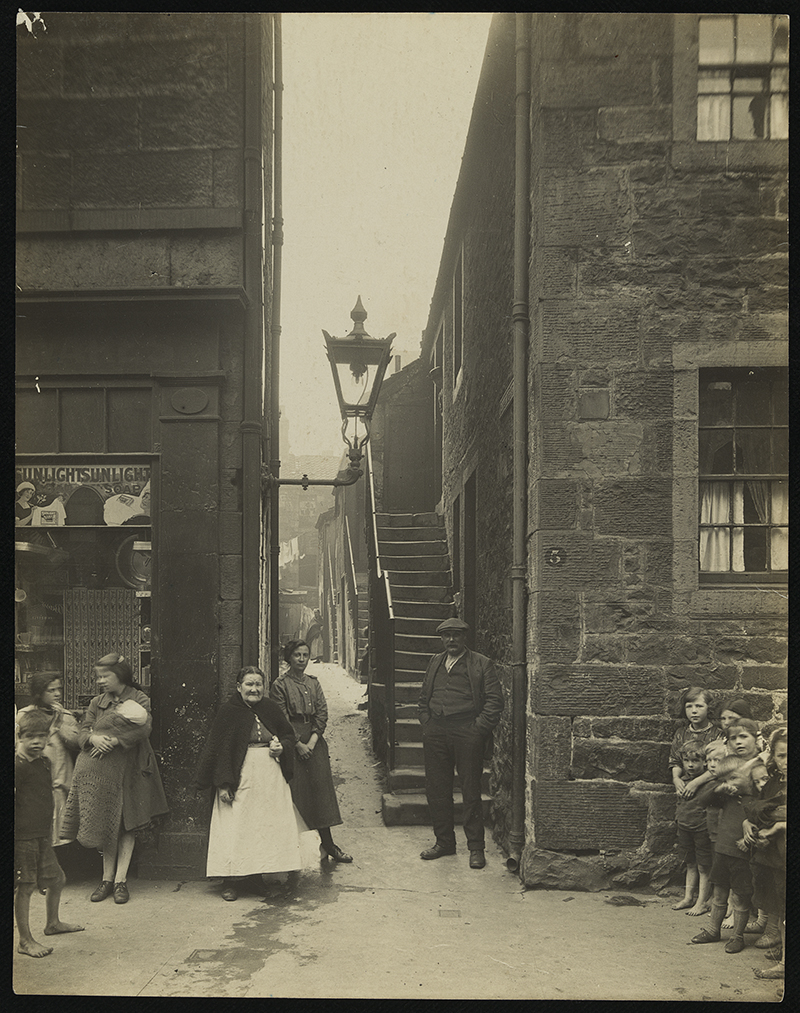 When Fraser Parkinson first contacted us about the collection of historic photographs of Leith that he had been entrusted with, my colleagues and I at the Centre for Research Collections were very excited. The photographs were taken to show the slums of Leith prior to the ‘Edinburgh (Leith) Improvement Scheme of 1924’, where large areas were to be cleared and rebuilt. Fraser tells us that:
‘The Town Council Minutes of 3rd April 1924 propose the demolition or reconstruction of ‘certain houses, courts, and alleys unfit for human habitation’.
The concerns of William Robertson, Medical Officer of health for the City and Royal Burgh of Edinburgh, were that the
‘narrowness, closeness and bad arrangement, or the bad condition of the streets and houses, or the want of light, air, ventilation or proper conveniences or other sanitary defects are dangerous or injurious to the health of the inhabitants of the buildings in the said Areas, or of the neighbouring buildings.’
The scheme involved large-scale demolition in this area of Leith, and the re-housing of most displaced residents out-with the areas covered by the scheme.
These photographs were taken as a record of the area at this time by the City Council. They provided the photographic evidence of the conditions that presented significant risk to public health at this time.’
Data Carpentry & Software Carpentry workshops
The Research Data Service hosted back to back 2-day workshops in the Main Library this week, run by the Software Sustainability Institute (SSI) to train University of Edinburgh researchers in basic data science and research computing skills.
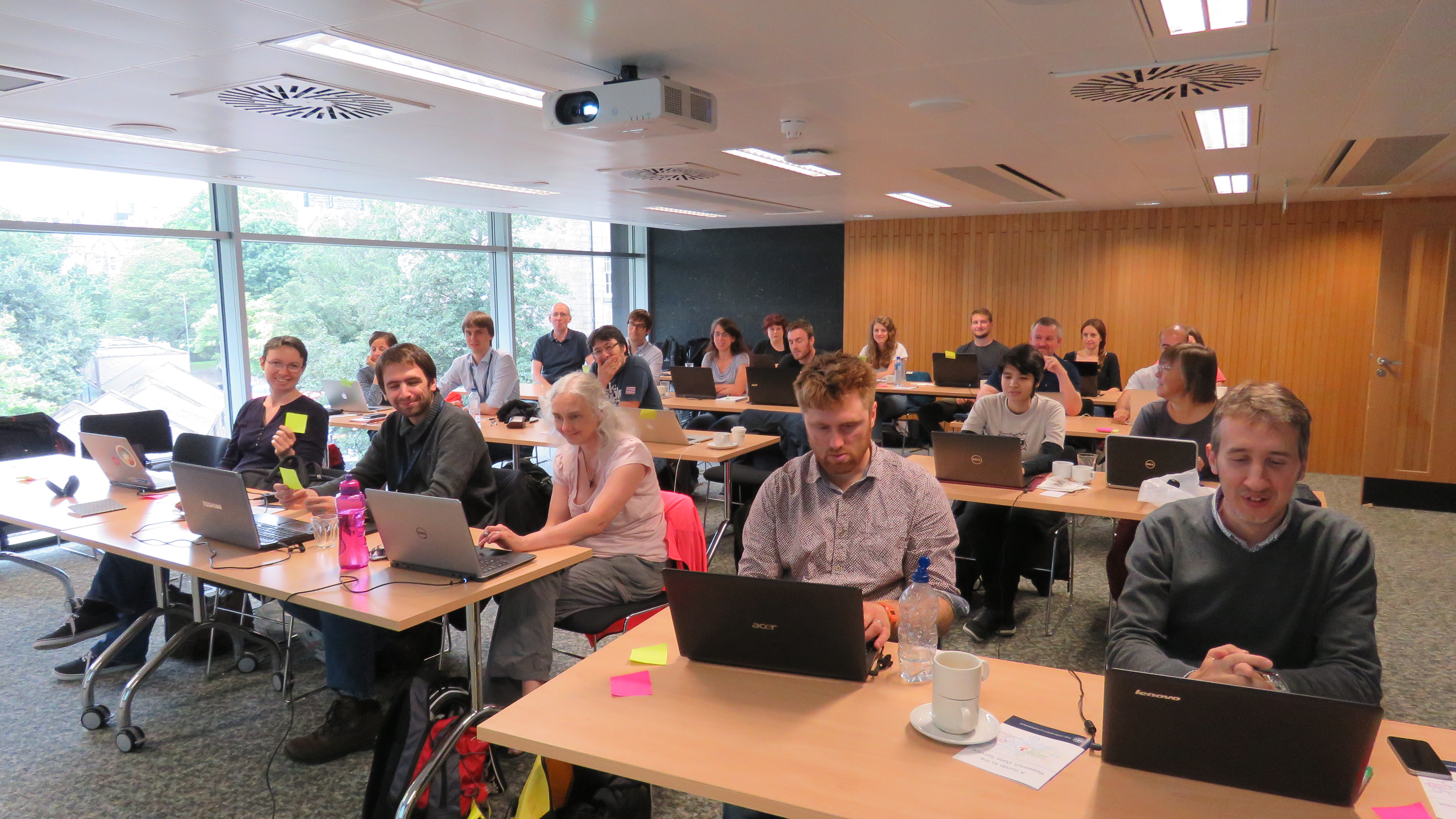
Learners at Data Carpentry workshop
Software Carpentry (SC) is a popular global initiative originating in the US, aimed at training researchers in good practice in writing, storing and sharing code. Both SC and its newer offshoot, Data Carpentry, teaches methods and tools that helps researchers makes their science reproducible. The SSI, based at Edinburgh Parallel Computing Centre (EPCC), organises workshops for both throughout the UK.
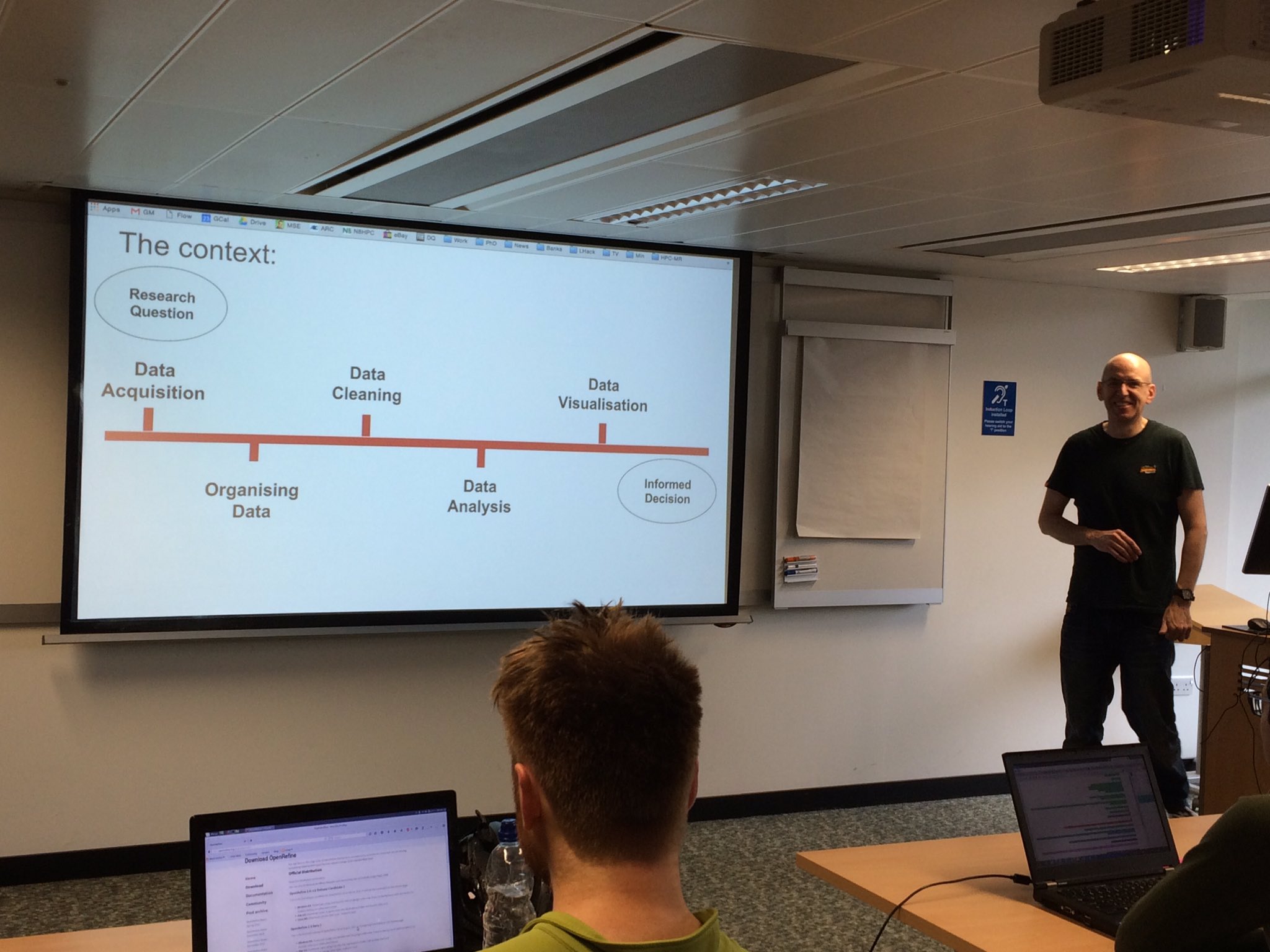
Martin Callaghan, University of Leeds, introduces goals of Data Carpentry workshop.
Each workshop is taught by trainers trained by the SC organisation, using proven methods of delivery, to learners using their own laptops, and with plenty of support by knowledgeable helpers. Instructors at our workshops were from Leeds and EPCC. Comments from the learners – staff and postgraduate students from a range of schools, included, ‘Variety of needs and academic activities/disciplines catered for. Useful exercies and explanations,’ and ‘Very powerful tools.’
Lessons can vary between different workshops, depending on the level of the learners and their requirements, as determined by a pre-workshop survey. The Data Carpentry workshop on Monday and Tuesday included:
- Using spreadsheets effectively
- OpenRefine
- Introduction to R
- R and visualisation
- Databases and SQL
- Using R with SQLite
- Managing Research & Data Management Plans
The Software Carpentry workshop was aimed at researchers who write their own code, and covered the following topics:
- Introduction to the Shell
- Version Control
- Introduction to Python
- Using the Shell (scripts)
- Version Control (with Github)
- Open Science and Open Research
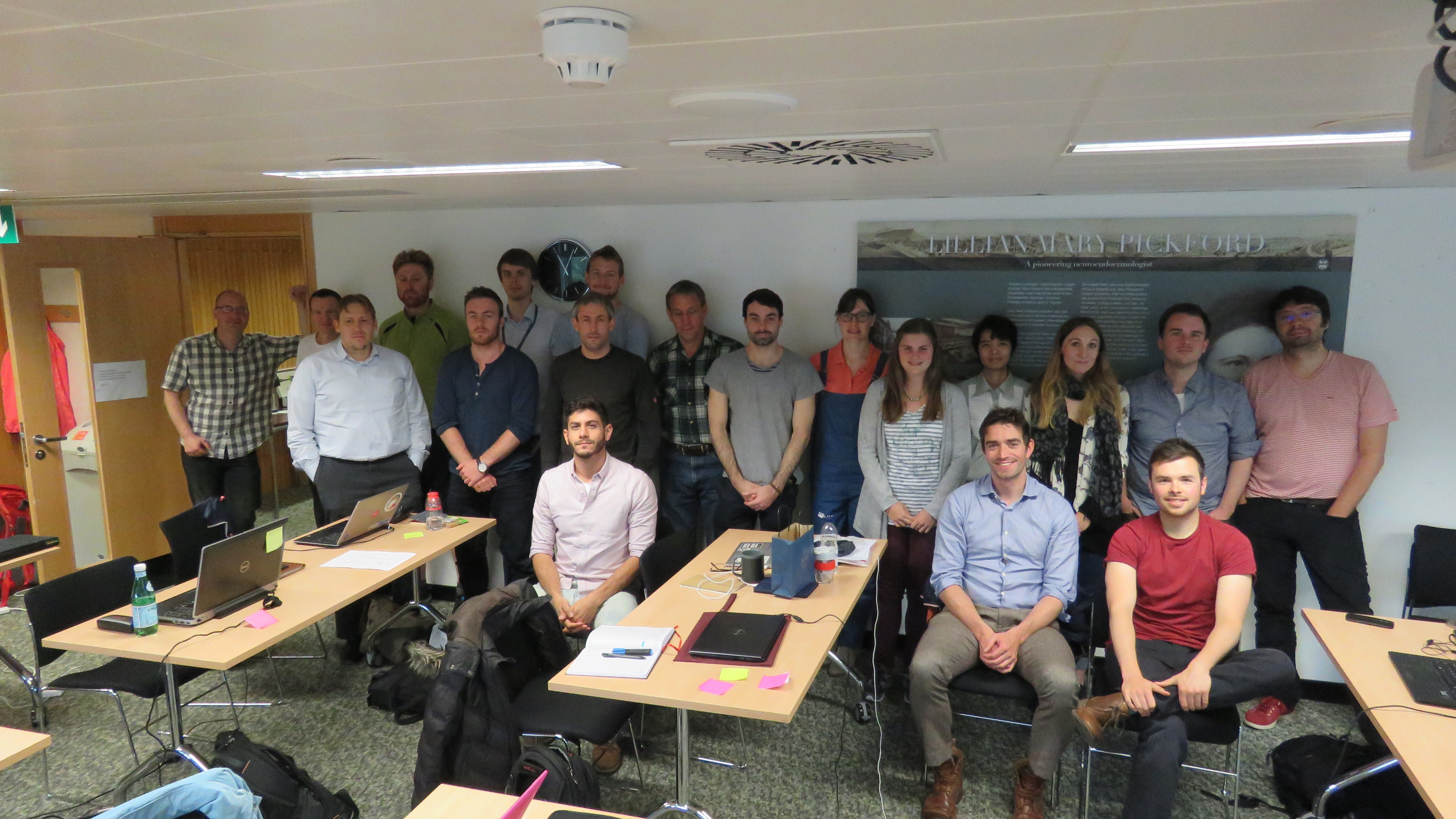
Software Carpentry learners
Clearly the workshops were valued by learners and very worthwhile. The team will consider how it can offer similar workshops in the future at a similarly low cost; your ideas welcome!
Robin Rice
EDINA and Data Library
A Passage to India – Part 2
In this week’s blog, Special Collections Conservator, Emily Hick, describes the next stage of conserving a collection of Indian paintings, and explains how she used a rigid gel to remove old tissue papers that were adhered to the front. You can read part one of this blog here.
After completing a condition report and putting together a treatment proposal, we began interventive treatment. The first step was to surface clean the paintings. This removes all loose surface dirt, which can be harmful to paper documents, and prevents the dirt from sinking further into the paper fibres during the later aqueous treatments, making it difficult to remove. To do this we used a soft goat hair brush on the painted areas and smoke sponge on the borders. We cut the smoke sponge into small pieces and used a dabbing motion to avoid removing any of the gold leaf sprinkled on the surface. A good quality Mars Staedler™ rubber was cut into thin slithers and used to remove areas of ingrained dirt on the edges of the painting.
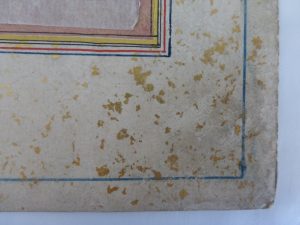
Ingrained dirt at the corner of a painting
Dawsonera downtime
 E-Books on the Dawsonera website will be unavailable for up to half an hour between 7:30am and 8:00am on Thursday 25th August 2016 while they undertake essential work on the platform. Dawsonera will be offline during this time and students should ensure they have downloaded and opened any e-books they need access to before this outage occurs. It will also not be possible to read titles which have been downloaded but not opened before the outage period.
Highlights from the RDM Programme Progress Report: February to April 2016
The membership of the Research Data Service Virtual Team across four divisions of IS was confirmed and met for the first time (to replace the former action group meetings) on 11 February where it was agreed meetings would be held approximately every six weeks for information and decision-making.
In February, the DataShare metadata was mapped to the PURE metadata and staff in L&UC and Data Library trained each other for creating dataset records in Pure and reviewing submissions in DataShare. It was agreed that staff would create records in Pure for items deposited in DataShare until the company (Elsevier) provides a mechanism for automatically inputting records into Pure.
In March, Jisc announced that the University of Edinburgh was selected as a framework supplier for their new Research Data Management Shared Service.
A review of the existing ethics processes in each college is in progress with Jacqueline McMahon at the College of Arts, Humanities and Social Sciences (CAHSS) to create a University-wide ethics template. There is also engagement with the School ethics committees at the School of Health in Social Sciences (HiSS), Moray House School of Education (MHSE), Law and School of Social and Political Science (SPS) in CAHSS.
The Research Data Management and Sharing (RDMS) Coursera MOOC opened for enrolment on 1 March 2016. This was completed in partnership with the University of North Carolina-Chapel Hill CRADLE project. Research Data Management and Sharing (RDMS) MOOC stats from the Coursera Dashboard reveal that as of 23 May 2016, there have been 5,429 visitors and 1,526 active learners; 335 visitors have completed the course.
The large data sharing investigation was completed for DataShare and reported previously. (Two new releases in DataShare defined: upload and download). Upload release (2.1) to go live 23 May 2016.
PURE dataset functionality is now included in standard PURE and Research Data Management (RDM) training. There are now 210 dataset records in PURE.
Four PhD interns were hired in mid-March to act as College representatives for the IS Innovation Fund Pioneering Research Data Exhibition. They will be employed until mid-December 2016.
A total of 363 staff and postgraduates attended RDM courses and workshops during this quarter.
There were 30 new DMPonline users and 55 new plans created during this quarter.
There are now 210 dataset metadata records in PURE.
A total of 56 datasets were deposited in DataShare during this quarter.
The total number of DataStore users rose from 12,948 in the previous quarter to 13,239 in this quarter, an increase of 291 new users.
National and International Engagement Activities
In February
- Stuart Lewis gave a DataVault presentation at the International Digital Curation Conference (IDCC) in Amsterdam.
In March
- A University news item was released to mark the launch of the Research Data Management and Sharing (RDMS) MOOC on Coursera. http://www.ed.ac.uk/news/2016/dataskills-010316
- Stuart MacDonald gave an RDM presentation to trainee physicians at the Royal College of Physicians Edinburgh Course: Critical appraisal and research for trainees, Edinburgh. http://www.slideshare.net/smacdon2/rdm-for-trainee-physicians
- Three delegates from Göttingen University were hosted here. The delegates have shared interests in RDM and visited to gain more insight into RDM support and experiences here.
- Robin Rice gave an invited talk about the RDMS MOOC and web-based Survey Documentation and Analysis (SDA) tool to Learning, Teaching and Web and elearning@Ed Showcase and Network monthly gathering.
In April
- Robin Rice attended the ATI Reproducibility and Sustainability workshop at Oxford University on behalf of IS and gave a lightning talk on use of DataShare for reproducible science.
- Stuart MacDonald gave an invited presentation on RDM and ELNs to HEIDS at University of Strathclyde: Research Data Management and ELN Information Sharing Event. http://www.slideshare.net/edinadocumentationofficer/rdm-elns-edinburgh
- Robin Rice gave a peer reviewed presentation at the Force11 2016 conference in Portland, Oregon: Overcoming Obstacles to Sharing Data about Human Subjects. http://www.slideshare.net/rcrice/overcoming-obstacles-to-sharing-data-about-human-subjects
As part of my responsibilities to cover the one year interim of Kerry Miller’s maternity leave, I will be writing blogs for this page until Kerry returns next summer.
Prior to this post, I worked the past 12 years as the geospatial metadata co-ordinator at EDINA. My primary role was to promote and support research data management and sharing amongst UK researchers and students using spatial data and geographical information.
Tony Mathys
Research Data Management Service Co-ordinator
Main Library Summer Improvements 2016 – Update 18th August
Work is continuing in the Main Library on a programme of works to bring significant improvements for library users through increasing the number of study spaces by 350 and providing additional power and data facilities at study desks.
Work underway this week (22nd – 31st August)
1st floor – construction and electrical enabling work will now begin in what was the ‘New Book Area’ and ‘Reception Desk’ to transform these area into new study spaces. In addition to these works, study desks adjacent to accessible study rooms 8 – 11 will also undergo upgrade which will include desk top power being installed to these desks. Please be aware that whilst these works are being carried out, temporary diversions will be put in place to both the meeting room suite and south side study area. Directional signage providing alternative access to these areas will be placed on 1st floor to assist you.
Lower Ground Floor – construction work has also now started in this area and will continue throughout the rest of August.
Apologies for the continuing noise and disruption – thank you for your patience while work is underway.
More DataVault presentations
It’s been a busy summer for the DataVault, with further presentations taking place.
First up was a short trip to Dublin to the Open Repositories 2016 conference in June. The presentation was scheduled to be part of the 24×7 session: 24 slides to be presented in 7 minutes – that’s a mere 17.5 seconds per slide (rather than the usual rule-of-thumb of a minute or two!) and with the slides auto-advancing for a bit of added fun!. Thomas Higgins and Stuart Lewis presented, and gave an overview of the project, the platform, and gave a demonstration.
A copy of the slides is available for download.
Then in August, Mary McDerby and Stuart Lewis attended the Repository Fringe in Edinburgh, where Stuart presented the DataVault in a session led by the DCC’s Angus Whyte, alongside Rory Macneil from ResearchSpace, looking at the subject of research data workflows, and what this means for systems such as the DataVault which sit within those workflows.
Collections
 Hill and Adamson Collection: an insight into Edinburgh’s past
My name is Phoebe Kirkland, I am an MSc East Asian Studies student, and for...
Cataloguing the private papers of Archibald Hunter Campbell: A Journey Through Correspondence
My name is Pauline Vincent, I am a student in my last year of a...
Hill and Adamson Collection: an insight into Edinburgh’s past
My name is Phoebe Kirkland, I am an MSc East Asian Studies student, and for...
Cataloguing the private papers of Archibald Hunter Campbell: A Journey Through Correspondence
My name is Pauline Vincent, I am a student in my last year of a...

Projects
Cataloguing the private papers of Archibald Hunter Campbell: A Journey Through Correspondence
My name is Pauline Vincent, I am a student in my last year of a...
Archival Provenance Research Project: Lishan’s Experience
Presentation My name is Lishan Zou, I am a fourth year History and Politics student....