Home University of Edinburgh Library Essentials
March 27, 2026
Wisdom is the Principal Thing

Last month I was asked to take some photos of the McEwan Hall which is currently undergoing a major redevelopment to bring it into the 21st century. Having previously photographed Rowand Anderson’s architectural drawings for the building, I have long been looking for excuse to see inside and was delighted to have this chance. This huge auditorium has a seating capacity of 2000 and was presented to the University in 1897 by the Brewer and Politician William McEwan. We have a lovely illustration in the collections of a holly festooned McEwan giving the Graduation Hall to the University on a platter, with Old College’s golden boy in the background.
Roll of the Fallen
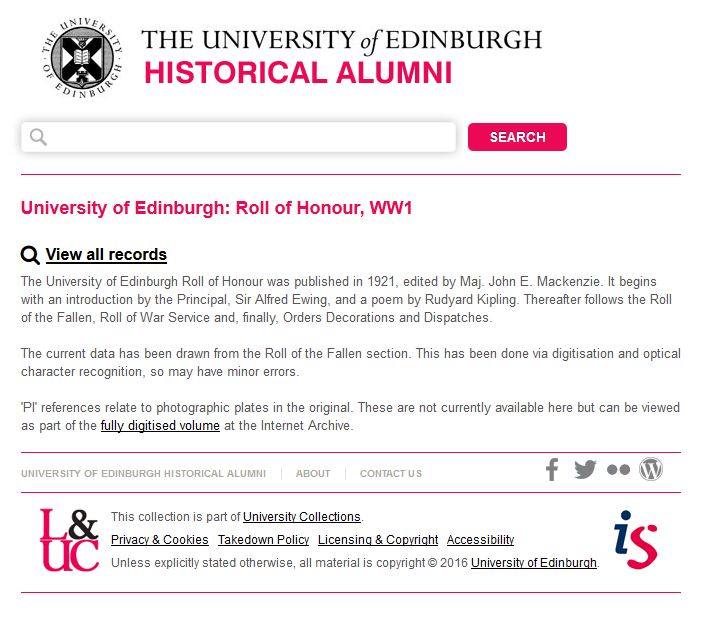
We are pleased to announce that the University’s Roll of the Fallen for the First World War is now searchable online.
Roll of Honour homepage
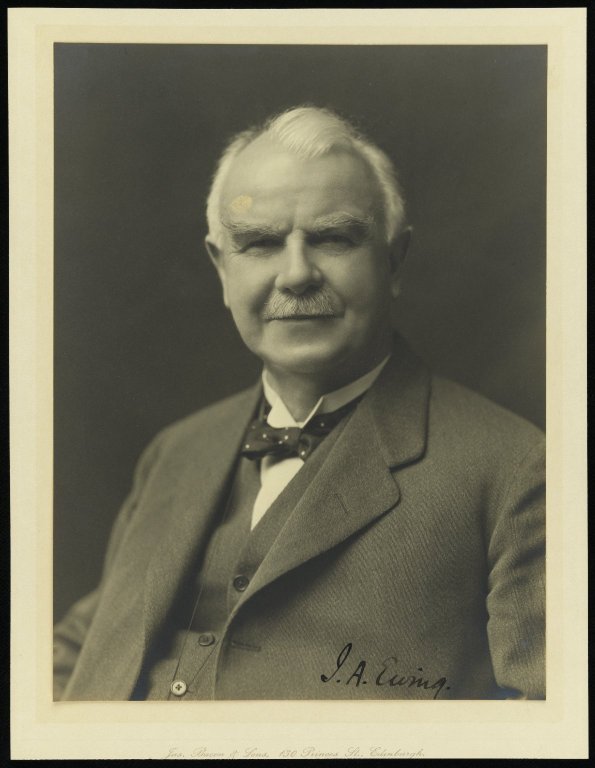
Principal James Alfred Ewing
The Roll of Honour was originally published in 1921, edited by Maj. John E. Mackenzie. In his Introduction, the then Principal and Vice Chancellor, James Alfred Ewing stated that this was to “meet a strong and general desire that the names should be recorded of those members of the University of Edinburgh who took part in the war, as well as those whose service cost them their lives.”
The volume has two principal sections. The first of these is the Roll of the Fallen, containing 944 names, with accompanying photographs for most entries. Thereafter follows the Roll of War Service, with details of around 700 individuals, not included in the previous section, who saw war service. There are also smaller lists for those mentioned in Dispatches and recipients of medals, decorations etc.
At the moment, time has only allowed us to get the Roll of the Fallen into our online database. The entire volume content is however available online at archive.org
For most of the individuals concerned, we will have the records of their studies. The list also includes members of staff and they too are likely to occur elsewhere in our archives.
Links
Trial access: Online Egyptological Bibliography and First World War primary sources
*The Library has subsequently subscribed to Online Egyptological Bibliography. Find out more at New to the Library: Online Egyptological Bibliography (OEB)*
The Library currently has trial access to the Online Egyptological Bibliography (OEB) from the University of Oxford and The First World War primary source database from Adam Matthew.
You can access all of these online resources via the E-resources trials page. Access is available both on and off-campus.
Access to OEB is only available until 17th October 2016.
While trial access to the First World War databases ends on 31st October 2016.
Online Egyptological Bibliography (OEB)

Chinese database for trial
We have been offered a free trial of 大成故纸堆 which contains a vast amount of full-text material for Chinese studies. The trial can be accessed on the University network by going to www.dachengdata.com. The trial finishes on 23rd October 2016.

The database is produced by the same company that supplies us with Duxiu and Chinamaxx. It contains the following categories of full-text material:
老旧期刊全文数据库 (containing over 7,000 full-text periodicals from the late Qing Dynasty to 1949. There are many titles that are not found in the Late Qing Periodicals 1833-1911 and Minguo periodicals 1911-1949 that we subscribe to.)
民国图书全文数据库 (39,000 digitised books published between 1911 and 1949)
中国各地古方志集 (3,400 local gazetteers published throughout China’s history before 1949, some dating back to Song Dynasty)
古籍文献全文数据库 (15,000 pre-modern and rare Chinese books)
中共党史期刊数据库 (200 full-text periodicals published by the Chinese Communist Party before 1949)
《申报》 1872-1949 全文数据库 (we have already purchased this resource – please see Database A-Z list)
Association for Supervision and Curriculum Development (ASCD) videos now available

The Association for Supervision and Curriculum Development (ASCD) content is now live in Academic Video Online: Premium (111 titles), ASCD is exclusive to Alexander Street.
ASCD is a global leader in developing and producing innovative content and services to support educational leadership and training for success in the classroom. ASCD represents a global community of 125,000 members, including superintendents, principals, teachers, and advocates from more than 138 countries. Its award-winning video catalogue illustrates classroom scenes of effective, research-based teaching practices and offers advice from top education experts to help bring school improvement ideas and strategies to life.
The ASCD catalogue of video includes a substantive list of demonstration videos, instruction, strategy, and analysis. 
Titles include:
- Unpacking the Common Core Standards Using the UbD Framework
- ASCD Master Class Leadership Series
- How to Prepare Students for Standardized Tests
- Instructional Strategies for the Differentiated Classroom
- Giving Effective Feedback to Your Students
- Integrating Literacy into Curriculum
- Best Practices in Action: Using Analogies to Enhance Background Knowledge
- A Visit to a Data-Driven School District
- Leadership Strategies for Principals
- Getting Results with Curriculum Mapping
A bibliography of the titles is available here. These will be added to DiscoverEd in due course.
Find treasure in New College Library
We’re welcoming Divinity postgraduate students today for library treasure hunt activities to help them get to know New College Library.
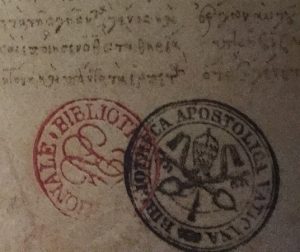
What is this? Biblical Studies students can follow the clues to discover New College Library’s treasure
Students on the five postgraduate programmes have already had access to brief video tutorials for Biblical Studies, Religious Studies, Science and Religion, Theology in History and World Christianity.
Further programme specific treasure hunt activities aim to encourage students to find material relevant to their courses in a variety of print and online locations.
Christine Love-Rodgers, Academic Support Librarian, Divinity
The Invisible Cities Of Edinburgh

[Click images for full-size view]
This study is concerned with examining the evolution of status areas in the context of Edinburgh. Status areas were defined in three period analyses in 1855, 1914 and 1962…
(Gordon, 1971, vol.1:(i))
Only the second volume of this thesis was able to be scanned at this time, and so the many maps, charts, and illustrations it contained were all discovered without the context of the main volume. Despite this, they still provide evocative snapshots of a former time.
Invisible Cities (Calvino, 1972/1974) also examines how cities change, and how they must continue to change lest they become a dead city, like Troy. Each of the snapshots below, shows a very different city with different characters and different purposes, of different smells and appearances, and very different populations: “cities of delight and desire, cities tinged with regrets, vibrant cities, failing cities, seemingly impossible cities that defy logic and time” (Yuen, 2015) and each pretending to the same name and approximate location of ‘Edinburgh’. Read More
Bloomsbury E-Books – more added

Earlier this year we purchased Hart 2014 and 2015 collection e-book packages, we have now purchased a further 3 collections – Hart 2016, Education 2015 and Second Language Acquisition Archive 2001-2012.
These have all been added to DiscoverEd. Hart 2016 titles will continue to be added to DiscoverEd until the end of the year.
Further info
The Hart 2014, 2015, 2016, Education 2015 and Second Language Acquisition Archive title lists can be found here.
Beginner’s guide to finding a book in DiscoverEd
Got a book you need to find in the Library but not sure how to search for it in DiscoverEd? This beginner’s guide should help.
If searching for a known book use a combination of title and author keywords.
For example, if you were looking for this book:
A.A.M. Duncan, Scotland: the making of the kingdom (Edinburgh, 1992).
You could do a search using the keywords “duncan”, “Scotland”, “making” and “kingdom”. DiscoverEd will look for items that include all the keywords in the item record.

New Cambridge University Press E-Books Available

We have added to DiscoverEd, 304 new monographs and 113 new coursebooks from the following subject areas: American History, American Literature, Anthropology, Archaeology, Astronomy, British History, Classical Studies, Computer Science, Drama and Theatre, Earth and Environmental Sciences, Economics, Engineering, English Literature, European and World Literature, European History, Film, Media, Mass Communication, History Cross Discipline, History Other Regions, Language and Linguistics, Law, Life Sciences, Management, Mathematics, Medicine, Music, Philosophy, Physics, Politics and International Relations, Psychology, Religion, Sociology, Statistics and Probability. Most of the e-books are published by Cambridge University Press but some of the monographs are also published by Edinburgh University Press, Boydell & Brewer and the ISEAS–Yusof Ishak Institute.
A list of the new titles can be found in this spreadsheet with the monographs on tab 1 and the coursebooks on tab 2. Columns can be filtered by subject discipline.
Further info
This is the first batch of e-books to be loaded into DiscoverEd since Cambridge University Press launched Cambridge Core. This new website replaces the separate websites they previously maintained for their e-journals, e-books, Cambridge Companions series, Cambridge Histories series, University Publishing Online.
Collections
 Hill and Adamson Collection: an insight into Edinburgh’s past
My name is Phoebe Kirkland, I am an MSc East Asian Studies student, and for...
Cataloguing the private papers of Archibald Hunter Campbell: A Journey Through Correspondence
My name is Pauline Vincent, I am a student in my last year of a...
Hill and Adamson Collection: an insight into Edinburgh’s past
My name is Phoebe Kirkland, I am an MSc East Asian Studies student, and for...
Cataloguing the private papers of Archibald Hunter Campbell: A Journey Through Correspondence
My name is Pauline Vincent, I am a student in my last year of a...
Projects
Cataloguing the private papers of Archibald Hunter Campbell: A Journey Through Correspondence
My name is Pauline Vincent, I am a student in my last year of a...
Archival Provenance Research Project: Lishan’s Experience
Presentation My name is Lishan Zou, I am a fourth year History and Politics student....