Home University of Edinburgh Library Essentials
April 11, 2026
Halloween: Sports and Spooks in the Statistical Accounts
Halloween is approaching and the nights are drawing in. So this is the perfect time to discover some spooky stories and supernatural superstitions reported in the Statistical Accounts of Scotland. There certainly are plenty!
Celebrating Halloween
Even though Halloween is widely believed to be more of an American tradition, there is a long tradition of celebrating All Hallows Eve in Scotland, and there are mentions of Halloween in both Statistical Accounts. One example is that of the parish of Logierait, County of Perth, (OSA, Vol. V, 1793 – p84) where the evening of the 31st October was marked by a special fire ceremony:
Heath, broom, and dressings of flax, are tied upon a pole: This faggot is then kindled; one takes it upon his shoulders, and running, bears it round the village; a crowd attend: When the first faggot is burnt out, a second is bound to the pole, and kindled in the same manner as before. Numbers of these blazing faggots are often carried about together, and when the night happens to be dark, they form a splendid illumination.
In the parish of Cullen, County of Banff, Halloween celebrations were sporty and involved the young people of the community and surrounding districts playing games, such as football, running, throwing the hammer and playing bowls (NSA, Vol. XIII, 1845 – p.331). Unfortunately, bowls, which was played by rolling or throwing a cannon ball, was later forbidden by magistrates as one year a man was accidentally killed by the ball! By 1845 the parishioners kept to playing golf, shinty, football and target shooting.
However, not everyone amused themselves with games and pagan ceremonies for Halloween. In the parishes of Broughton, Glenholm, and Kilbucho in Peebles, people observed Halloween with “a kind of religious scrupulosity”. (NSA, Vol. III, 1845 – p.89)

Ghosts
There are some amazing ghost stories in the Statistical Accounts. In one of my favourites, funeral mourners battle it out to ensure that their deceased loved one is not burdened with ghostly duties:
In one division of this county, where it was believed that the ghost of the person last buried kept the gate of the church-yard ’till relieved by the’ next victim of death, a singular scene occurred when two burials were to take place in one church yard on the same day. Both parties staggered forward as fast as possible to consign their respective friend in the first place to the dust. If they met at the gate, the dead were thrown down, ’till the living decided by blows whose ghost should be condemned to porter it.
(Appendix for Monquhitter, County of Aberdeen, OSA, Vol. XXI, 1799, p. 144)
In another, an unfaithful lover asks for help to posthumously fulfil a vow:
About the middle of the last century, a man was buried in the island. For several nights after, the dead man disturbed the whole neighbourhood in Glenco, calling in a most dolorous strain, on a certain individual, to come and to relieve him. The man at last set off for the island, in the dead hour of night, and having arrived at the grave, found the dead man with his head and neck fairly above the ground: “What is your business with me,” says the Glenco man “and why are you disturbing the neighbourhood with your untimely lamentations after this fashion?” “I have not,” says the dead man, “rest night or day since I lay here, nor shall I as long as this head is on my body; I shall give you the reason. In younger days I swore most solemnly, that I would marry a certain woman, and that I never would forsake her, as long as this head remained on my body. At this time I had hold of a button, and the moment we parted, I separated the head of the button from the neck, thinking that then all was right. I now find my mistake. You must therefore, cut off my head.” The other, fetching a stroke, cut off the head close to the surface of the ground; and then the dead man dragged the rest of the body back to the grave, leaving the head to shift for itself. This story is as firmly believed in Glenco this day, by some people, as any truth of holy writ.
(Laggan, County of Inverness, NSA, Vol. XIV, 1845, p. 427)
You could not make up better stories! Obviously, there are many more mentions of, ghosts and all other kinds of supernatural happenings which you could search for in the Statistical Accounts. It’s interesting to note that in both the Old and New Statistical Accounts such stories were reported with a sceptical tone as the folk tales of previous generations or as outmoded superstitions: perhaps this illustrates a growing faith in Enlightenment rationality, but it is equally likely that the Christian ministers who compiled the accounts simply refused to accept that their parishioners continued to hold ‘heathen’ beliefs. In any case, these fantastical stories and superstitions have been handed down from generation to generation, and the accounts themselves continue this process. They are part of the history of Scotland and so it is wonderful that these stories have not been lost.
Join us for webinars about BMJ resources!

Join us for webinars about BMJ resources!
BMJ Quality – 2 November 2016, 13:00-14:00 GMT
BMJ Best Practice – 16 November 2016, 13:00-14:00 GMT
BMJ Case reports – 23 November 2016, 13:00-14:00 GMT
For links to join the webinars, please see http://www.docs.is.ed.ac.uk/docs/Libraries/Main/E-Resources/Databases/BMJ-webinars-2016.pdf
Yelena Parada of BMJ will provide training for us on how to get the best out of these BMJ resources especially designed for clinicians. These resources will help you both with your clinical practice and your academic work. To access our subscriptions for these and other BMJ resources (such as BMJ Learning or Research to Publication) go via our A-Z of databases to ensure you use the correct codes.
BMJ Quality
BMJ Quality is an online toolkit that supports individuals and teams to work through quality improvement ideas, make an intervention, and publish their results while developing their knowledge and skills. The toolkit is linked to the journal, BMJ Quality Improvement Reports, a searchable repository of global quality improvement evidence and best practice.
BMJ Best Practice
BMJ Best Practice is a point-of-care tool from BMJ Evidence Centre designed to support clinical decision making from diagnosis to treatment. The latest research evidence, guidelines and expert opinion are combined in a single source and presented in a step-by-step approach, covering prevention, diagnosis, treatment and prognosis
BMJ Case reports
BMJ Case Reports delivers a peer-reviewed collection of cases in all disciplines so that healthcare professionals, researchers and others can easily find clinically important information on common and rare conditions.
Guest post by Marshall Dozier, Academic Support Librarian, Medicine
Database for the History of Contemporary Chinese Political Movements
 The Library has arranged a free trial of the Database for the History of Contemporary Chinese Political Movements, 1949 – 1976. The resource is published by the Chinese University in Hong Kong.
Click here to access the trial or go to the Library’s E-Resources Trials website. EASE login applies. The trial ends on 10 Nov 2016.
The database contains the full-text primary sources for the following four Chinese political movements after the founding of the People’s Republic of China in 1949:
- The political campaigns in the 1950sthe Chinese cultural revolution (1966-1976)from land reform to the state-private partnership (1949-1956)
- The Great Leap Forward and great feminine (1958-1964)
- The Anti-Rightest Campaign (1957- )
- The Cultural Revolution (1966-1976)
Book conservation skills for paper conservators
This week’s blog post comes from Projects Conservator, Katharine Richardson, who recently attended a workshop to learn basic book conservation techniques….
Last month I attended a two day workshop, Book Conservation Skills for Paper Conservators, at the National Library Scotland. The course aimed to teach paper conservators basic practical book conservation skills. It was led by our friend and colleague, Caroline Scharfenberg, who is an accredited, freelance book conservator based at the University of Edinburgh Conservation Studio. I was very excited to learn a bit more about Caroline’s practice, and it was a great opportunity for me to get away from my desk for a bit and learn some new interventive conservation skills.
On the first day Caroline gave a series of lectures on the theory and ethics involved in book conservation as well as a brief history of book binding. We were then able to put some of the theory into practice through a practical exercise preparing a condition assessment and treatment proposal for some of the National Library’s book collections.
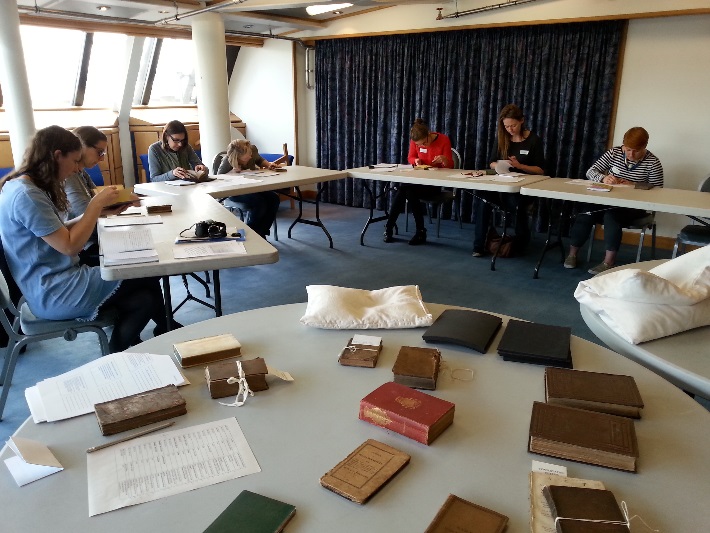
Class preparing their condition assessment and treatment proposals
Philosopher’s Index with Full-Text
The Philosopher’s Index is a current and comprehensive bibliographic database covering scholarly research in all major fields of philosophy, and is a resource to which Library have users have had access for some time.
The Philosopher’s Information Center has partnered with EBSCO to create a new, full-text version of this highly regarded database, temporary access to which is now available! Read More
Oxford Bibliographies – Music module added

We have now added the Music module to our Oxford Bibliographies collection. This can be accessed via DiscoverEd or via the Databases AZ list.
See http://oxfordbibliographiesonline.com/obo/page/music for further information about this collection.
We are Open for Business!
We are very excited to announce that the new study spaces on the Lower Ground Floor are now open!
We know how hard it can be to find a study spot, so we listened to our students and added 358 new study spaces to the Main Library over the summer, as this blog has documented. Today we celebrated the grand opening of the Lower Ground Floor, which has been renovated for student use.

Bryan MacGregor, Director of User Services and Alec Edgecliffe-Johnson, President of the Edinburgh University Students’ Association, did the honours, cutting the ribbon to officially open the new spaces.

In the coming weeks we will be running competitions in the new space, so keep your eye on our Facebook and Twitter for the chance to win prizes! We would also love to hear your feedback about the new spaces, and about any further changes you want to see in the Library, so please get in touch via Facebook or Twitter, or use the survey forms we will be distributing in the Lower Ground Floor.
We hope that these new study spaces will make the upcoming deadlines a little easier!
1066 and all that (by ‘that’ I mean Box of Broadcasts)
I’m sure all history lovers know today is the 950th anniversary of the Battle of Hastings.
Probably one of the most famous battles in England’s history, this led to the end of the Anglo-Saxon era and was the beginning of the Norman conquest of England under William, the Duke of Normandy (to be William I, also known as William the Conqueror or William the Bastard). But this defining battle didn’t just have consequences for England, it’s ramifications were felt in Scotland, Wales, Ireland and beyond down the years.
If you want to read more about the battle itself, the events leading up to it and the impact the outcome of the battle had then you can find lots of books and journal articles through the Library via DiscoverEd or some of the Library databases.
However, I wanted to take the opportunity to use Box of Broadcasts (BoB) to have a look at just some of the TV programmes (and a couple of radio programmes) available that examine at the Battle of Hastings and the events surrounding it.
Please note you will be asked for your University email address the first time you log into BoB. And like any TV recording service you will often get a few minutes of the previous programme at the beginning (that can be interesting in itself).
1066 (and all that) on BoB
First up Conquest, the second episode from series one of Simon Schama’s A History of Britain. Schama takes us through the events leading up to the battle, the battle itself and its aftermath, roughly covering the period 1000 – 1087. If you don’t know much about this time in history then this is a good starting point. Read More
Nearly there!
Everything is almost ready for the study spaces on the Lower Ground Floor of the Main Library to open, we just have a few last minute things to put in place for you and the space will be open to students on Monday 17th October.
All of the new furniture has been delivered and the new desktop power outlets have been put in place to make your studying here as easy as possible.

We’ve got new signs on the lower ground floor directing you to the space too!

Come and see the space on Monday and let us know what you think!
Getting referencing right: some useful resources
Working on your, possibly first, assignment and unsure how to do your references? Not know the difference between references and citations, endnotes and footnotes, Harvard or Chicago, etc? We’ve got a few useful online resources that should help demystify the referencing process.
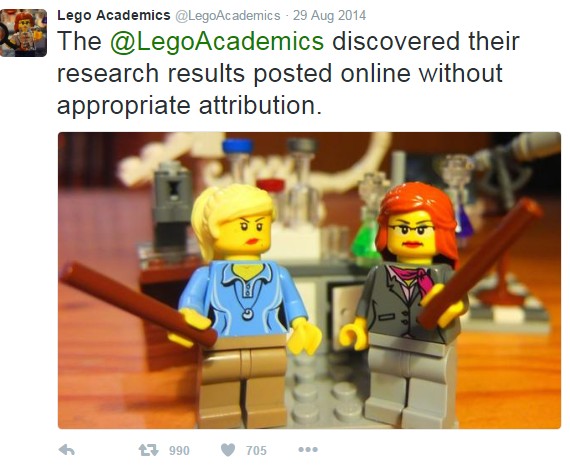
(Lego Academics, 2014)
Good referencing is essential.
Referencing the readings and material you have used for your research is vitally important. Not only does it demonstrate that you have actually spent time doing the research and using it to form your own opinions or arguments but it also means that you are not trying to make it seem that someone else’s work is your own. Read More
Collections
 Hill and Adamson Collection: an insight into Edinburgh’s past
My name is Phoebe Kirkland, I am an MSc East Asian Studies student, and for...
Cataloguing the private papers of Archibald Hunter Campbell: A Journey Through Correspondence
My name is Pauline Vincent, I am a student in my last year of a...
Hill and Adamson Collection: an insight into Edinburgh’s past
My name is Phoebe Kirkland, I am an MSc East Asian Studies student, and for...
Cataloguing the private papers of Archibald Hunter Campbell: A Journey Through Correspondence
My name is Pauline Vincent, I am a student in my last year of a...
Projects
Cataloguing the private papers of Archibald Hunter Campbell: A Journey Through Correspondence
My name is Pauline Vincent, I am a student in my last year of a...
Archival Provenance Research Project: Lishan’s Experience
Presentation My name is Lishan Zou, I am a fourth year History and Politics student....