
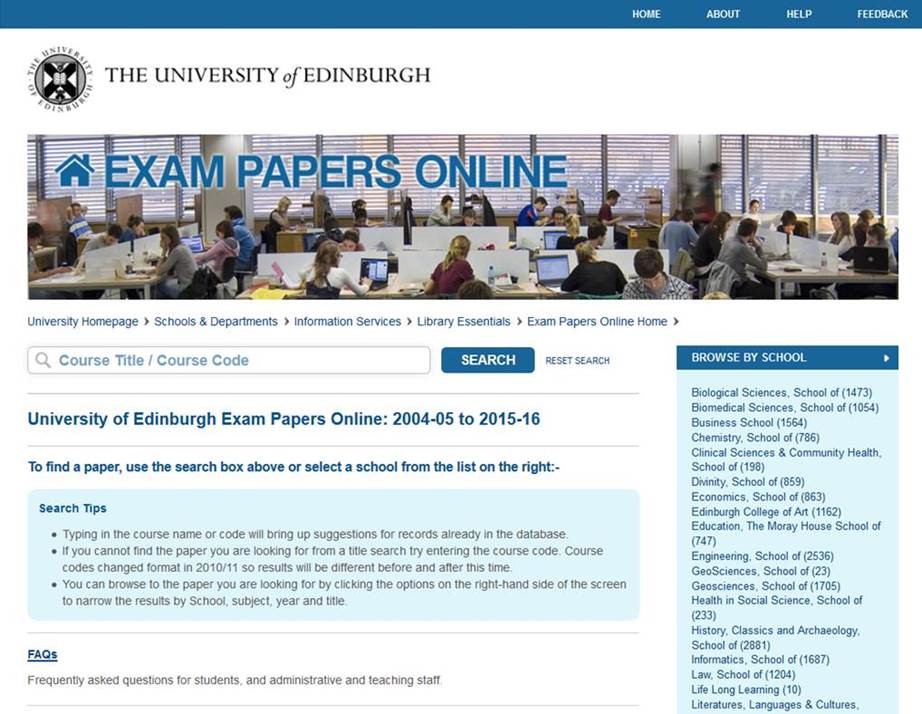
Past Exam Papers Online

Exam time is approaching again and you may find it useful to look at recent past exam papers for your course.

Our Exam Papers Online web page https://exampapers.ed.ac.uk/ provides on and off-campus access for staff and students of the University of Edinburgh to the collected degree examination papers of the University from 2004 onwards.

Following the links to the exam papers you require, you will be prompted for your EASE username and password. Remain within the same browser window and access should be seamless.

If you have any questions or comments about any aspect of Exams Online, please get in touch. Email: exam.papers@ed.ac.uk

exam-papers-2016

Posted in Collections | Comments Off on Past Exam Papers Online

New Cambridge University Press E-Books Available

CC

A further 173 e-books are available from Cambridge University Press, Edinburgh University Press and Boydell & Brewer across a wide variety of subject disciplines.  Please see the title list here.  The e-books are now available on DiscoverEd.

Posted in New e-resources, Updates | Tagged , , , , , , , , , , , , , , , , , , , , , , , , , , , , , | Comments Off on New Cambridge University Press E-Books Available

Welcome to the new and improved Statistical Accounts of Scotland online!

As you may have already noticed, the Statistical Accounts of Scotland service now has a new look as well as new and improved features. We hope you have been exploring them since the new service was launched at the beginning of November. This is the first in a series of blog posts about some of the functionality you may have come across or may not have yet discovered! Here we concentrate on the search and structure of the new website.

Improved search

We have aimed to allow searching in the same way as you would use an internet search engine. The service will look not only for direct matches but also for possible variations and related terms.

Search features include:

  • The ability to limit your search to the old statistical accounts or new statistical accounts by adding either OSA or NSA to your search terms, e.g. OSA schools. It is also possible to limit your search still further by stating the actual volume and even the specific page, e.g. OSA vol5 pg27.
  • The ability to search by geographical area, by using one of the eight cardinal compass points in your search term, i.e. N, NE, E, SE, S, SW, W, NW.
  • A subject search which allows you to search for pages which are discussing a particular topic but which may not mention the exact word. The system looks at the words you type into the search box and tries to deduce any subjects you might be interested in or you can include the subjects directly. The full list of subjects can be found on the How to get the most out of the Statistical Accounts of Scotland online page. This functionality is a little experimental at the moment, so it would be great to get any feedback on this feature.
  • The ability to search the related resources, with access to these available from the main search results page. Please note that related resources, such as digitised versions of Sinclair’s Specimens of Statistical Accounts (1793) and Analysis of the Statistical Account of Scotland (1825-1826) and related surveys such as the Stow Census, are only available to subscribers.
  • Associated words which is another experimental feature that may present words that frequently appear in proximity to your search terms. If your search term returns a box of associated word you can click on these words to explore terms related to those you are interested in.
A screen-shot of a search results page form teh Statistical Accounts of Scotland Online

Search results page showing a number of features of the new service. Screen-shot captured from the Statistical Accounts of Scotland Online on Wednesday 30th November 2016.

County and Parish Pages

We also wanted to make it easier to search for material that is related to specific places, and tried to do this by bringing together information on each parish or county on one dedicated page. These can be navigated to using the maps, as well as the search box. These pages present all the content we have that is related to that county or parish, alongside a county or parish map and a brief description, extracted from the text. From here, you can view the map in high resolution, navigate to the county page if you are on a parish page, or navigate to one of the accounts or resources related to the parish if you are on a parish page.

We hope that the improved functionality and re-design of the Statistical Accounts of Scotland will both allow you to find the relevant information quickly and to explore other related information easily. Try the new features and discover more about Scotland’s counties and parishes.

More information on all the features mentioned above, as well as others, can be found in the Statistical Accounts of Scotland Help Pages and the How to get the most out of the Statistical Accounts of Scotland online page. If you have any comments or queries please contact the EDINA Help Desk (edina@ed.ac.uk).

Posted in Uncategorized | Comments Off on Welcome to the new and improved Statistical Accounts of Scotland online!

PhD Theses Conservation

My name is Nicole and I am excited to be in my fourth week as the new digitisation project conservator working on conserving the PhD theses before digitisation. The PhDs I am working on range from 1750–1961 and are mostly bound. The volumes vary in size and material. The earlier volumes are bound in leather and hand written, while the later volumes are bound in book cloth and typed.

At present my time is split between two locations for conserving the PhDs: the Library Annex and the Main Library conservation studio.

So far I have mainly been working on the medical PhDs which include some beautiful and what must have been very time consuming drawings. The volumes also house many photographs and x-rays, including the x-ray of a shilling swallowed by a patient!

My current conservation work focuses on the volumes which had been flagged up by the survey carried out prior to my arrival. The treatments I have undertaken so far include surface cleaning, consolidation of red rot using Klucel G in IMS, inner joint repair to reattach loose or detached boards, minor paper repairs and reattaching damaged spines to volumes using a hollow made from archival paper.
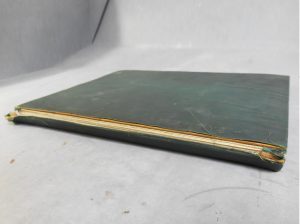
Detached spine on bound volume

Detached spine on bound volume

The aim of the conservation work is to stabilise the volumes for digitisation and to ensure the text and imagery are visible. On occasion rehousing is needed, made out of archival board.
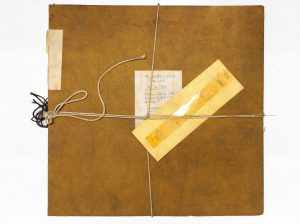
Thesis to be rehoused

Thesis to be rehoused

Keep an eye out for updates on this project!

Nicole Devereux, Projects Conservator


This blog was originally posted on the To Protect and (Con)serve blog of the University of Edinburgh Centre for Research Collections conservation studio: https://libraryblogs.is.ed.ac.uk/conservation/


Posted in Uncategorized | Comments Off on PhD Theses Conservation

PhD Theses Conservation

My name is Nicole and I am excited to be in my fourth week as the new digitisation project conservator working on conserving the PhD theses before digitisation. The PhDs I am working on range from 1750–1961 and are mostly bound. The volumes vary in size and material. The earlier volumes are bound in leather and hand written, while the later volumes are bound in book cloth and typed.

At present my time is split between two locations for conserving the PhDs: the Library Annex and the Main Library conservation studio.

So far I have mainly been working on the medical PhDs which include some beautiful and what must have been very time consuming drawings. The volumes also house many photographs and x-rays, including the x-ray of a shilling swallowed by a patient!

My current conservation work focuses on the volumes which had been flagged up by the survey carried out prior to my arrival. The treatments I have undertaken so far include surface cleaning, consolidation of red rot using Klucel G in IMS, inner joint repair to reattach loose or detached boards, minor paper repairs and reattaching damaged spines to volumes using a hollow made from archival paper.

Detached spine on bound volume

Detached spine on bound volume

The aim of the conservation work is to stabilise the volumes for digitisation and to ensure the text and imagery are visible. On occasion rehousing is needed, made out of archival board.

Thesis to be rehoused

Thesis to be rehoused


Keep an eye out for updates on this project!

Posted in Projects | Tagged , , | Comments Off on PhD Theses Conservation

Data-X Symposium

Registrations have been coming in thick and fast for the Data-X Symposium to be held on 1 December, Main Lecture theatre, Edinburgh College of Art (programme below).

Data-X is a University of Edinburgh IS Innovation Fund initiative supported by the Data Lab & ASCUS | Art & Science. It brings together PhD researchers from the arts and sciences to develop collaborative data ‘installations’.

To register visit: https://www.eventbrite.com/e/data-x-symposium-tickets-29076676121

Programme:

10.00 – 10.30: Registration & coffee

10.30 – 10.40: Welcome – Stuart Macdonald (Edina, Data-X Project Manager) & Introduction – Dr Martin Parker (Director of Outreach, Edinburgh College of Art)

10.40 – 11.20: Guest speaker: ASCUS & the ASCUS Lab: catalysts for Artiscience- Dr James Howie (Co-Founder, ASCUS)

Session 1 presentations: Chair – Dr. Rocio von Jungenfeld (School of Engineering & Arts, University of Kent)

· 11.20 – 11.35: PUROS Sound Box – Dr Sophia Banou, Dr Christos Kakalis (both School of Architecture & Landscape Architecture, Edinburgh College of Art), Matt Giannotti (Reid School of Music)

· 11.35 – 11.50: eTunes – Dr Siraj Sabihuddin (School of Engineering)

· 11.50 – 12.05: Inside the black box -Luis Fernando Montaño (Centre for Synthetic and Systems Biology) & Bohdan Mykhaylyk (School of Chemistry)

· 12.05 – 12.20: Wind Gust 42048 – Matt Giannotti (Reid School of Music)

· 12.20 – 12.30: Session 1. wrap-up

12.30 – 13.15: Lunch

Session 2 presentations: Chair – Martin Donnelly (Digital Curation Centre)

· 13.15 – 13.30: Elegy for Philippines Eagle – Oli Jan (Reid School of Music)

· 13.30 – 13.45: Feel the Heat: World Temperature Data Quilt – Nathalie Vladis (Centre for Integrative Physiology) & Julia Zaenker (School of Engineering)

· 13.45 – 14.00: o ire – Prof. Nick Fells (School of Culture and Creative Arts, University of Glasgow)

· 14.00 – 14.15: Sinterbot – Adela Rabell Montiel (Queen’s Medical Research Institute) & Dr Siraj Sabihuddin (School of Engineering)

· 14.15 – 14.25: Session 2. wrap-up

14.25 – 15.05: Guest speaker: FUSION – where art meets neuroscience – Dr Jane Haley (Edinburgh Neurioscience)

15.05 – 15.15: Closing remarks: Stuart Macdonald (Edina, Data-X Project Manager)

15.20: Close

Data-X is supported by: The Data Lab, ASCUS, Information Services

Stuart Macdonald
DATA-X Project Manager / Associate Data Librarian
EDINA

Posted in Uncategorized | Comments Off on Data-X Symposium

ProQuest e-resources trials extended!

*The Library now has permanent access to Women’s Magazine Archive I and II, News, Policy and Politics Magazine Archive and Historic Literary Criticism (via ProQuest One Literature). We also have access to all British Periodicals collections until 31st December 2021 via ProQuest Access 350.*

The Library currently has trial access to several fantastic databases from ProQuest and I’m happy to let you know our access to these databases has recently been extended until the end of December 2016.

The databases included are:

  • Women’s Magazine Archive I and II
  • British Periodicals III and IV
  • Los Angeles Times Historical Archive, 1881-1992
  • News, Policy and Politics Magazine Archive
  • Luthers Werke
  • Historic Literary Criticism.

You can access all of these trial databases via the E-resources trials page. Access is available both on and off-campus.

Trial access ends on 31st December 2016.

womens-magazine-archive Read More

Posted in Library, Online resource, Trial | Tagged , , , , , , , , , | Comments Off on ProQuest e-resources trials extended!

Student newspaper digitisation project returns!

The Student newspaper digitisation project is back! Over the next six months we’ll be digitising back issues from the late 1980s and early 1990s and making them available online at the redesigned project site: https://libraryblogs.is.ed.ac.uk/thestudent/

banner-the-student

In 2014, the Library ran a pilot project to digitise copies of The Student newspaper from the academic year 1984 / 1985. The papers were released in real-time, exactly 30 years after they were first published, and provided an interesting insight into life as a student in Edinburgh in the mid 1980s.

Now, thanks to a generous grant from the Alumni Innovation Initiative, we are able to continue the project, starting from the point at which the pilot ended in summer 1985. Second Year History student Olivia Nolan will be working with us part time from November until April – we’re delighted to have her on board!

The original project blog has been updated and content will continue to be added as we digitise the back copies. As well as all the issues from the 1984/85 pilot, October 1985 is online now: https://libraryblogs.is.ed.ac.uk/thestudent/19851986-2/

As before, we’d be really keen to hear from you about your experiences of living in Edinburgh and studying or working at the University in the 1980s. We’ll be posting on the Centre for Research Collections’ Facebook page and tweeting from its Twitter account using the hashtag #studentarchive. Please join in!

If you would like more information about the project, please email Gavin.Willshaw@ed.ac.uk

Posted in Collections, Library, Library & University Collections, Projects | Tagged , , , , | Comments Off on Student newspaper digitisation project returns!

Scanning Scanty Moustaches: some medical theses from the turn of the century

A large proportion of the earliest thesis we have digitised from the turn of the century are medical thesis. However, they little resemble the modern medical thesis being produced today. They are full of the personality of the students who wrote them and the people they studied. Sometimes it feels like we are hearing voices that no one has listened to for a very long time.

For example, one student named Donald Sutherland Murray undertook a study of an outbreak of alopecia he witnessed in the small town of 9000 people where he was practicing medicine. His study presents a cross section of the town, his patients ranged in age from 8 to 65, and were students, joiners, bakers, apprentice engineers and domestic servants. His thesis also includes beautiful portraits, such as the one below of a joiner, ages 35 with a ‘scanty moustache’. This thesis may no longer be relevant for the treatment of alopecia, but it provides information about people’s lives that would not have survived had they not suffered from alopecia.
scanty-moustacheIt is also important to remember that the people who produced the hundreds of volumes that pass through our hands and scanners every week were human beings who probably wept and had many sleepless nights in behalf of the work we are digitising. Sometimes it is rewarding to try to find out more about these individuals. A few months ago I came across a medical thesis from 1906 written by a woman called Sheila M. Ross. It is entitled Acute hallucinatory insanity – a type of the confusional insanities, with clinical notes. As female authors from this period are relatively unusual, I sought to find out a little more about Dr. Ross. I haven’t manages to find masses of information, but I did discover that she was awarded a medal from the School of Medicine in 1899 for Systemic Anatomy. The medal, along with a few others from the same time period, were sold for £170 by the auction house Dix Noonan Web. I have also found a record of her graduation in the July 1904 edition of the British Medical Journal. Of a graduating class of about 130, 7 were women, Sheila M. Ross, Aimee E. Mills, Margaret H. Robinson, Isabelle Logie, Amy M Mackintosh, Eslpeth M. McMillan, Margaret CW Young and Mildred ML Cather.

sheila

Much of the early thesis collection are MD’s, however, their value lies not just within the realm of medicine. Murray’s thesis contains a snapshot of life in a small town at the turn of the century, and is unique in that it is the only thesis on alopecia we have come across thus far. Ross’s thesis contains information about the prevalence of mental illness in Scotland and elsewhere, but it can also be used to learn more about the history of women’s participation in the University, and the School of Medicine in particular.

D.S. Murray’s thesis is being processed in the current block and should be available on Edinburgh Research Archive in the next few weeks. Once it has been uploaded a link will be added to this post. 

Posted in Uncategorized | Comments Off on Scanning Scanty Moustaches: some medical theses from the turn of the century

Thesis scanning project: six months in!

thesisshelves

Friday 28 October marked the end of the first quarter of the Library’s PhD digitisation project, with over 3,000 theses scanned to date.

After a challenging first few months, the project is now very much up to speed and the team have exceeded initial scanning and processing targets. At the end of the first quarter, 706 unique and 2,464 duplicate theses had been scanned, 29% and 27% respectively of the in-house target for the whole project. Added to this, several thousand theses are due to be outsourced, with options being explored for their digitisation.

The team has focussed on the twentieth century collection, which is largely typed (and therefore can be OCR-ed), A4 in size and single sided, although, as you will see from the team’s project posts to date, content and structure vary significantly. Following scanning and processing, the theses are uploaded to a bulk import section in ERA and then transferred to their relevant School by the Scholarly Communications team.

A few highlights since the project began:

  • We welcomed two new members to the team: Pete joined the digitisation team in August and Nicole began working as the Project Conservator earlier this month.
  • We purchased a second Kodak document scanner, allowing us to double the speed at which we are able to destructively scan duplicate theses. On just one day in September, 46 duplicate theses were scanned (still a team record)!
  • In August the team took on responsibility for the thesis scanning service, which allows readers to pay a fee for the completion of a rush order: http://www.ed.ac.uk/information-services/library-museum-gallery/crc/services/copying-and-digitisation/scanning
  • We have come across some very interesting and diverse images in the thesis collection, and hope to provide a small exhibition of these images in the main library in 2017. More details to follow!

If you would like to learn more about the project, or to arrange a tour of the set up, please do get in touch.

Gavin Willshaw | Digital Curator and PhD Digitisation Project Manager | gavin.willshaw@ed.ac.uk | @gwillshaw

Posted in Uncategorized | Tagged , , | Comments Off on Thesis scanning project: six months in!

Follow @EdUniLibraries on Twitter

Collections

Default utility Image Hill and Adamson Collection: an insight into Edinburgh’s past My name is Phoebe Kirkland, I am an MSc East Asian Studies student, and for...
Default utility Image Cataloguing the private papers of Archibald Hunter Campbell: A Journey Through Correspondence My name is Pauline Vincent, I am a student in my last year of a...

Projects

Default utility Image Cataloguing the private papers of Archibald Hunter Campbell: A Journey Through Correspondence My name is Pauline Vincent, I am a student in my last year of a...
Default utility Image Archival Provenance Research Project: Lishan’s Experience Presentation My name is Lishan Zou, I am a fourth year History and Politics student....

Archives

Subscribe to Blog via Email

Enter your email address to subscribe to this blog and receive notifications of new posts by email.

