Home University of Edinburgh Library Essentials
May 4, 2026
Trial access: Global commodities
The Library has a number of e-resources trials running at the moment and this includes trial access to the fascinating primary source database Global Commodities: Trade Exploration & Cultural Exchange from Adam Matthew Digital. Using a range of visual, manuscript and printed materials sourced from libraries, companies and trade organisations worldwide this database allows you to explore the history of fifteen major commodities and to examine the ways that these have changed the world.
You can access the database via the E-resources trials page. Access is available both on and off-campus.
Trial access ends 13th February 2017.

Trial access: Foreign Office Files for India, Pakistan and Afghanistan
The Library has been given trial access to Foreign Office Files for India, Pakistan and Afghanistan, 1947-1980 from Archives Direct. This is an interesting collection of files from the Foreign Office (later the Foreign and Commonwealth Office) and Dominions Office focusing on the political and social history of India, Pakistan and Afghanistan.
You can access the database via the E-resources trials page. Access is available both on and off-campus.
Trial access ends 13th February 2017.

Trial access: China, America and the Pacific
The Library currently has trial access to the fantastic primary source database China, America and the Pacific: Trade & Cultural Exchange from Adam Matthew Digital. The database allows you to explore the cultural and trading relationships that emerged between America, China and the Pacific region between the 18th and early 20th centuries.
You can access the database via the E-resources trials page. Access is available both on and off-campus.
Trial access ends 13th February 2017.

Trial access: Second World War primary sources
*The Library now has access to these two resource. See Archives abound in Archives Unbound*
I’m pleased to let you know that we currently have trial access to two online primary source collections from Archives Unbound that may be of particular interest to those looking at the Second World War and related subjects. The two collections are The Jewish Question: Records from the Berlin Document Centre and Nazism in Poland: The diary of Governor-General Hans Fran.
You can access both of these collections via the E-resources trials page. Access is available on and off-campus.
Trial access ends 15th February 2017.

The Jewish Question: Records from the Berlin Document Centre Read More
Images of early Islamic architecture: a record of destroyed antiquities in Iraq and Syria
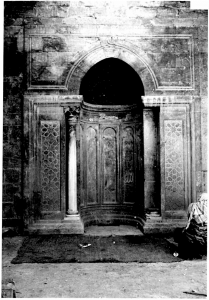
Aleppo. Madrasa al Zahariyeh
The aim of our PhD thesis digitisation project is to make available the unique research of the University of Edinburgh. This research has a greater significance when, within the pages of the theses, we uncover photos of places and buildings that no longer exist; our collection becomes important for the future preservation of world cultural heritage.
In the past year a great deal of research has been undertaken on collecting images of Palmyra that date to a period before it was damaged (in 2015), as well as of other Syrian archaeological sites.[1] Much of this work depends upon using archival images of the areas in question, often from personal collections. Such images can aid with digital, and perhaps eventually physical, reconstructions. Some of the items that we have scanned as part of our thesis digitisation project, and that are now available on ERA (Edinburgh Research Archive, by ‘Abbū ,1973 and Al-Janābī 1975), also include images of buildings destroyed or damaged in past few years, not just in Syria but also in Iraq.
In the last year much media attention was given to those buildings and archaeological sites which date to the pre-Islamic era, such as Palmyra. However, many early Islamic structures and sites have also been subject to destruction, although these are often less well publicised. Furthermore due to the turbulent situation in the areas in question it can be rather difficult to ascertain if a building has been destroyed or when damage took place.
Although there may be little that can be done to prevent this destruction, we can ensure to properly look after and maintain documents relating to the artefacts in question and make them publicly available so that these can be used for digital reconstructions. This blog will focus, in particular, on those early-Islamic buildings destroyed in 2013/14 in Aleppo (Syria), Samarra (Iraq), and in Mosul (Iraq).
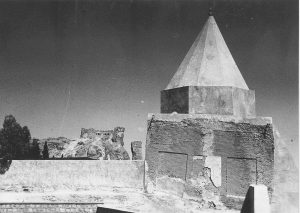
Mosul. Mausoleum of al-Imam Yayha ibn al-Qasim.
The two theses mentioned above and dating from the 1970’s, contain images of buildings in these areas: The Ayyubid domed buildings of Syria by ‘Ᾱdil N. ‘Abbū (1973) and Studies in Mediaeval Iraqi Architecture by Ṭāriq Jawād Al-Janābī (1975). Both theses present a catalogue of monuments. In the first the Ayyubid dynasty is examined over the period from AD 541-1260, focusing on the areas of Damascus and Aleppo. The second thesis covers the time period between the 6th and the 8th centuries AD and areas ranging from Baghdad, Wasit, Mosul, Al-Kifil, Kufa, Basra and Amadiya. The contents of the first chapter are wide ranging, reading: the Saljuq period, the Abbasid Caliphate during the 6th to 7th centuries A.H., the Atabikids of Iraq, the Mongol invasion and the Ilkhanid Period, the Jalairids.
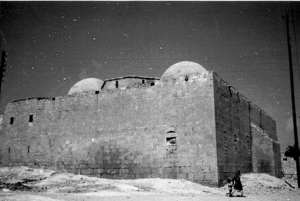
Aleppo. Madrasa al Zahariyeh
The types of monuments discussed in both works include: madrasas (koranic schools; some of these built at the request of the Sunni madhab),[2] turbas, mosques, ribats, minarets, palaces and mausolea.

These works are so important for preserving the past because they include many good quality photographs, including of the type of minor decorative details that are difficult to reproduce accurately, such as wood and stucco windows and façades.[3]
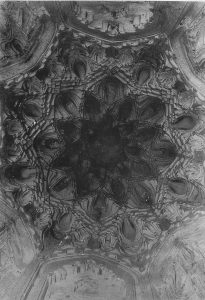
Samarra. Mausoleum of Imam Dur.
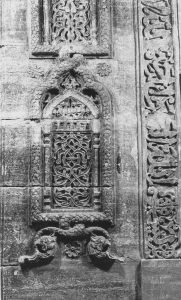
Mosul. Mausoleum of Imam Bahir.
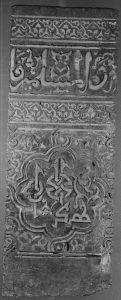
Mosul: mausoleum of Imam Bahir.
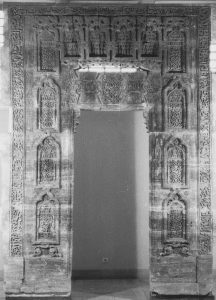
Mosul. Mausoleum of Imam Bahir.
To highlight the importance of these works a selection of photos from the theses are included, depicting buildings that are now damaged or destroyed. In Aleppo: the Al-Sultaniyeh mosque and the madrasa Al-Halawiyah. The Imam-al-Daur in Samarra. In Mosul: the masjid of al-Imam Ibrahim, the mausoleum of Imam Bahir, that of al-Immam Muhsin, the shrine of al-Imam Yahya ibn al-Qasim, and that of al-Imam ‛Awn al-Din (known as Ibn al-Hasan).
Aleppo: the Al-Sultaniyeh Mosque
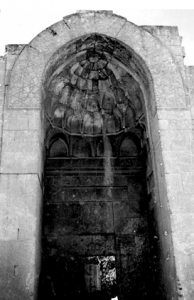
Aleppo. Madrasa al Zahariyeh
Also known as the Al-Sultaniyah Madrasa, this 12th century building incorporates several rooms around the courtyard known as the Madrasaa al Zahariyeh. It was destroyed on December 7th 2014.[4]
Aleppo: the Madrasa Al-Halawiya

This Byzantine cathedral became a madrasa (Koranic school) in the 13th century. Attempts were made in 2013 to protect one of the wooden niches dating from this time. However this work had to be abandoned due to the conflict in the area.[5] The building was damaged recently in the same incident that destroyed the great mosque, with which it shared grounds.[6]
Samarra: the Mausoleum of Imam al-Daur
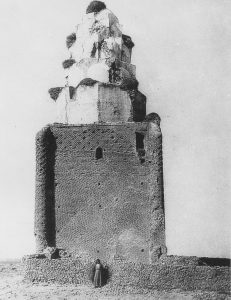
Samarra: the mausoleum of Imam al-Daur
Dating from 1085, this Shia shrine was destroyed in October 2014.[7]
Mosul: Masjid of al-Imam Ibrahim
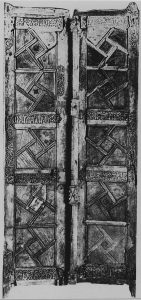
Mosul. Masjid of al-Imam Ibrahim.
This building now appears to be destroyed in satellite photography.[8]
Mosul: the Mosque and Shrine of al-Imam al-Bahir
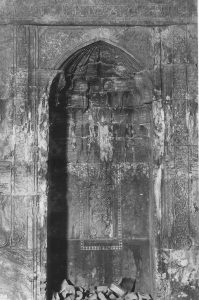
Mosul. Mosque of Imam Bahir.
This shrine was likely destroyed in September 2014.[9]
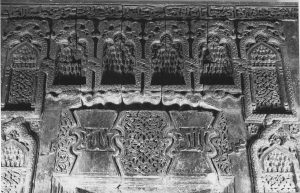
Mosul. Mausoleum of al-Imam al-Bahir
Mosul: the Mosque and Tomb of al-Imam Muhsin
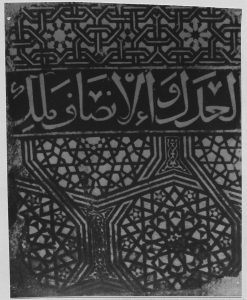
Mosul. Mosque and tomb of al-Imam Muhsin (al-Madrasa al-Nuriya)
Also known as the madrasa al-Nuriya, this 11th century site was likely destroyed between December 2014 and December 2015.[10]
Mosul: the Shrine of al-Imam Yahya ibn al-Qasim
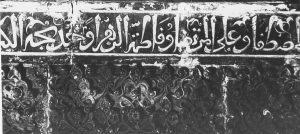
Mosul. Mausoleum of al-Imam Yahya ibn al-Qasim
This 13th century Shia shrine located on the Tigris riverbank and was destroyed as of July 2014.[11]
Mosul: Shrine of al-Imam ‛Awn al-Din (known as Ibn al-Hasan)
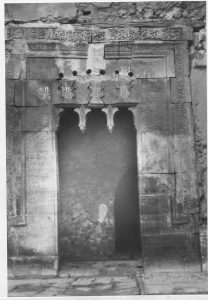
Mosul. Mausoleum of Imam ‘Awn al-Din.
One of the few structures to survive the Mongol invasion of Iraq, this 13th century shrine was reportedly destroyed on the 25th of July 2014.[12]
While it is impossible to undo the damage wreaked in some of the most archaeologically rich parts of this world, and there is frustratingly little that can be done to reverse the far greater loss of human lives, it is perhaps a small comfort to know that in some way we may contribute to the future preservation and potential reconstruction (digital or otherwise) of important monuments that are now lost.
Bibliography and further information
‘Ᾱdil N. ‘Abbū (1973) The Ayyubid domed buildings of Syria, PhD thesis, University of Edinburgh.
UNESCO on the ancient city of Aleppo: http://whc.unesco.org/en/list/21
UNESCO on Iraq: http://whc.unesco.org/en/list/21 and http://whc.unesco.org/en/news/1239/
Monuments of Mosul in danger: http://monumentsofmosul.com/
Blue Shield Press on monuments in Syria and Iraq: http://www.ancbs.org/cms/en/press-room
References
[1] Some recent examples of this work: http://futurism.com/3d-imaging-is-helping-us-save-history-for-the-future/ and http://www.pbs.org/wgbh/nova/next/ancient/digital-preservation-syria/
[2] see Abbu (1993), p. ii.
[3] Al-Janabi, (1975) chapter VI; and Abbu (1973) sections 4, 5 and 8.
[4] http://hyperallergic.com/168740/syrian-military-bombs-significant-13th-century-complex/ and http://www.syriaphotoguide.com/home/aleppo-al-sultaniyeh-mosque-%D8%AD%D9%84%D8%A8-%D8%AC%D8%A7%D9%85%D8%B9-%D8%A7%D9%84%D8%B3%D9%84%D8%B7%D8%A7%D9%86%D9%8A%D8%A9/ and http://apsa2011.com/apsanew/aleppo-partial-destruction-of-the-al-sultaniah-mosque-following-an-explosion-07-12-2014/#jp-carousel-4714
[5] http://apsa2011.com/apsanew/4074/
[6] http://www.syriaphotoguide.com/home/aleppo-great-mosque-%D8%AD%D9%84%D8%A8-%D8%AC%D8%A7%D9%85%D8%B9-%D8%A7%D9%84%D9%83%D8%A8%D9%8A%D8%B1/ and http://eamena.arch.ox.ac.uk/impact-risks/explosives/
[7] https://www.cemml.colostate.edu/cultural/09476/iraq05-057.html
[8] http://monumentsofmosul.com/list2/18-i16
[9] Current satellite image: http://monumentsofmosul.com/list2/26-i35
[10] Current satellite image http://monumentsofmosul.com/list2/27-i37 and https://www.arcgis.com/home/item.html?id=017b3a45d45f439bb5e595491b9dc826
[11] http://monumentsofmosul.com/list2/8-i4 and http://archnet.org/sites/4356 and http://www.iraqinews.com/features/urgent-isil-destroys-1400-year-old-mosque-located-west-mosul/
[12] http://monumentsofmosul.com/list2/9-i5 and https://conflictantiquities.wordpress.com/2014/07/28/syria-iraq-islamic-state-destruction-shrine-mashhad-al-imam-awn-al-din/ and http://archnet.org/sites/3841
Aerial Digimap – New E-Resource now available

We have expanded our Digimap holdings to include Aerial Digimap. Aerial Digimap provides detailed aerial imagery data from Getmapping at various fixed scales. Most data is post-2011 with updates due each year. Users will be able to view maps through their web browser, save maps for printing and download the map data for use in GIS or CAD software.
Further info
A twenty minute presentation on Aerial Digimap is available at https://youtu.be/rAiO4XXRD5Q
Aerial Digmap is available via DiscoverEd or our Databases AZ list.
Oxford Scholarship Online – new e-books added

We have added 110 new Oxford Scholarship Online e-books to DiscoverEd. A title list can be found here.
Crowdsourcing Conservation
During the Festival of Creative Learning (20-24 February 2017), we will be hosting our first ever conservation crowdsourcing event!
Over a two-day period (20-21 February), with the help of 30 participants, we aim to rehouse section II of the Laing manuscripts – the University’s most important written collection.
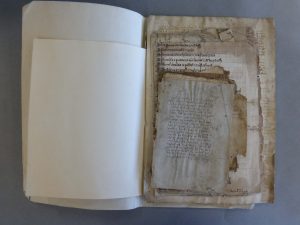
Folder from section II of the Laing manuscripts
Laing’s collection of charters and other papers is of national importance and the most distinguished of its kind in any Scottish university. It is an essential resource for the 18th century, however, it is in poor condition due to its current housing in unsuitable upright boxes and folders. It is an extremely popular collection, but it is difficult to access and there is a risk of further damage every time it is handled.
Iranian archives at Durham
Durham University is now home to three important archives containing materials relating to Iranian History, Culture and Politics. The archives originate in the work of three British scholars who worked extensively in Iran in the last century. The collection combines the work of the late Anne Lambton, the late David Brooks and Sue Wright. In future years the collection will mark Durham out as an important destination for researchers interested to know more about Iran in the 20th century.
Professor Sue Wright, Danish School of Education, Aarthus University, will give a personal reflection herself on the content and significance of these three collections on 31 January 2017, 17:00 in The Learning Centre, Palace Green Library. The public lecture is entitled: Iranian archives at Durham: A personal reflection on people, places and the public record.
Contact Professor Bob Simpson ( robert.simpson@durham.ac.uk ) for more information.
Hello!
Welcome to the first blog post from the ‘Evergreen: Patrick Geddes and the Environment in Equilibrium’ project. The Project Archivist has now begun work on cataloguing the significant Patrick Geddes collections held by Edinburgh University’s Centre for Research Collections and Strathclyde University’s Archives and Special Collections. Over the coming months we will keep you updated about project progress and will share some of the fascinating collections discoveries and highlights that are sure to be uncovered during the course of the project.
You can read more about the project in the About Us part of this blog.
Collections
 Hill and Adamson Collection: an insight into Edinburgh’s past
My name is Phoebe Kirkland, I am an MSc East Asian Studies student, and for...
Cataloguing the private papers of Archibald Hunter Campbell: A Journey Through Correspondence
My name is Pauline Vincent, I am a student in my last year of a...
Hill and Adamson Collection: an insight into Edinburgh’s past
My name is Phoebe Kirkland, I am an MSc East Asian Studies student, and for...
Cataloguing the private papers of Archibald Hunter Campbell: A Journey Through Correspondence
My name is Pauline Vincent, I am a student in my last year of a...
Projects
Cataloguing the private papers of Archibald Hunter Campbell: A Journey Through Correspondence
My name is Pauline Vincent, I am a student in my last year of a...
Archival Provenance Research Project: Lishan’s Experience
Presentation My name is Lishan Zou, I am a fourth year History and Politics student....