Home University of Edinburgh Library Essentials
April 10, 2026
Aerial Digimap data: The mapping service where it’s always sunny
The latest Digimap addition is aerial photo images, covering the whole of Great Britain to 25cm precision. The University of Edinburgh has just subscribed to Aerial Digimap, so the great news is that staff and students can now access these wonderful images, overlay them onto other map layers, and combine them with building height and topology data to make amazing and beautiful three-dimensional maps of the whole of Britain.
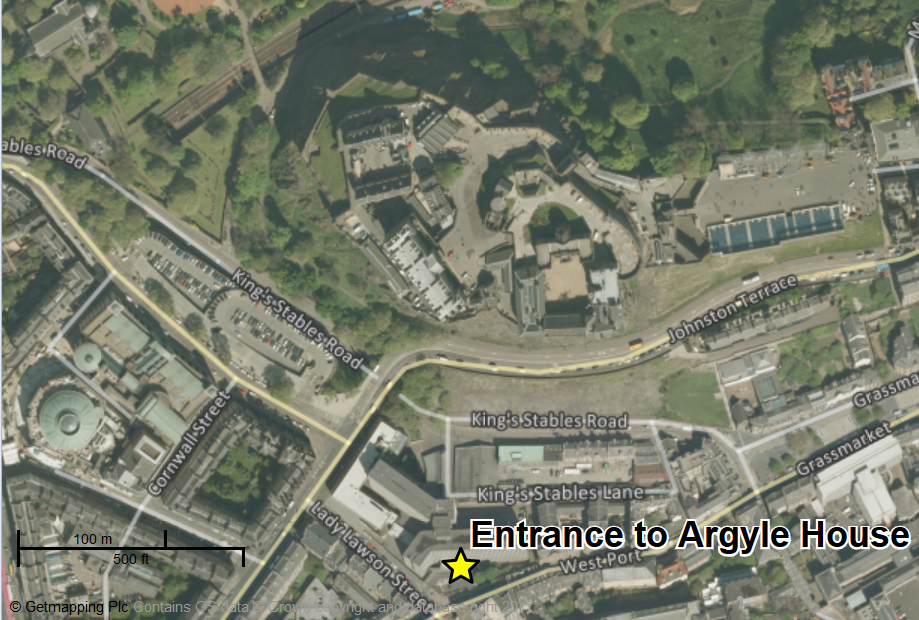
I’ve used Aerial Digimap to label the entrance to Argyle House, home of EDINA. © GetMapping and University of Edinburgh. This map contains OS data.
Digimap is a visual interface that allows users to explore, annotate and download mapping data covering the whole of Great Britain.* Digimap’s historical map data go back as far as the 1840s, while geological, marine and environmental data have been available for some time.
It’s strikingly sunny in the images of Edinburgh. The Digimap team confirmed this is a UK-wide phenomenon: “Aerial Photography can only be captured on clear days, so it’s always sunny in Aerial Roam!”
You can watch a guided tour of Aerial Digimap’s features and a demonstration of how to make the most of them by EDINA’s Ian Holmes in this recently recorded webinar:
To get started with Aerial Digimap, login with your EASE account at: http://digimap.edina.ac.uk/aerial
* For mapping data covering Northern Ireland, please see Ordnance Survey of Northern Ireland.
Pauline Ward is a Research Data Service Assistant based at EDINA, supporting staff and students at the University of Edinburgh
II: ‘The Times’ History and Encyclopaedia of the War – the 100th anniversary of the Russian Revolutions 1917, and of the declaration of Finnish independence
‘…AN ACCOUNT OF THE GREAT CONTEST NOW IN PROGRESS…’

On the approach of the 100th Anniversary of the Russian Revolutions, this second look at The Times History and Encyclopædia of the War, focuses on how the publication reported on Russia and Russian campaigns during the First World War. The blog-post nods towards the 100th Anniversary of the February Revolution 1917 – which led to the abdication of Tsar Nicholas II and which was followed by a second revolution a few months later in October 1917… and which also led to the independence of Finland.
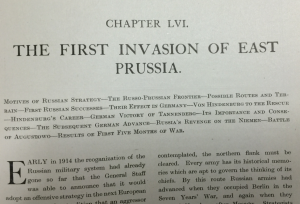
Chapter heading for a part of the history concerned with Russian action in East Prussia during the First World War, in Part 32, Volume 3, p.223.
Detailed accounts of the Eastern Front of the First World War can be read elsewhere, but this thumb-through of various issues and volumes of The Times History presents a brief description of reports and illustrations from the Front, and offers a countdown to the Russian Revolutions of February and October 1917.
In contrast to the Western Front stretching from the North Sea to Switzerland, the vast Eastern Front stretched from the Baltic Sea to the Black Sea. While action in the west focussed on Luxembourg, Belgium and France, and involved the armies of the British and French Empires against Imperial Germany, action in the east stretched deep into Central Europe and involved the armies of Imperial Germany and the Austro-Hungarian Empire (the Central Powers) against Imperial Russia and Romania, providing ‘shatter’ to the region that would pale into insignificance in a second round of destruction in the early-1940s. There was of course a Southern Front in Europe too, pitching Italian forces against the Central Powers.
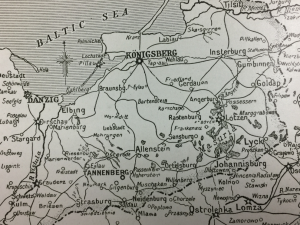
Map accompanying the account of Russian action in East Prussia during the First World War, with Tannenberg and the Masurian Lakes shown, in Part 32, Volume 3, p.224.
As the First World War opened, the Central Powers were met with a war on two fronts. On the Eastern Front, the Russian army attempted an invasion of East Prussia, striking the historical and ancestral heartlands of the German Empire. The Russians achieved some success initially but then they were beaten back at the Battle of Tannenberg in late-August 1914, with Imperial Germany securing the routes to its ports of Danzig (Gdansk, now in Poland) and of Königsberg (Kaliningrad, now a Russian exclave on the Baltic).
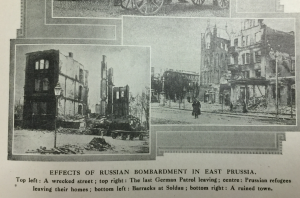
‘The Times History’ included pictures of ruined villages and towns as a result of fighting in East Prussia during the First World War, in Part 32, Volume 3, p.227.
Tannenberg saw the near complete destruction of the Russian 2nd Army, and a series of follow-up battles around the Masurian Lakes destroyed most of the Russian 1st Army as well, and knocked the country off balance until early-1915.
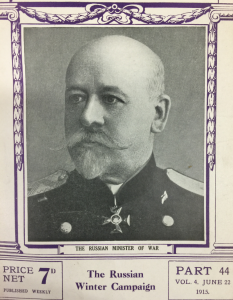
Vladimir Aleksandrovich Sukhomlinov (1848-1926), Cavalry General of the Imperial Russian Army and Minister of War until 1915, on front cover of ‘The Times History’, Part 44, Volume 4.
Early Russian defeats fell on the shoulders of the Minister of War, Vladimir Alexander Sukhomlinov, who was forced out of office in 1915 and replaced by Infantry General Alexei Andreyevich Polivanov.
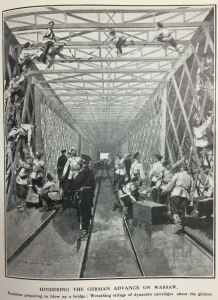
Russians preparing to blow up a bridge in order to hinder the German advance on Warsaw, in Part 61, Volume 5, p.329.
Although the Russians achieved successes in Galicia (now part of western Ukraine), and in the Carpathian Mountains, by mid-1915 they had been pushed out of ‘Russian Poland’ so removing the threat – at this very early point in the war as it would unfold – of any Russian invasion of Imperial Germany or Austria-Hungary.
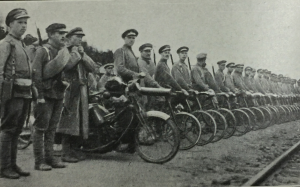
A Russian motor-cycle battalion. In 1914 the Russian Army was the largest army in the world but poor roads and railways made the effective deployment of soldiers difficult, illustration in Part 97, Volume 8, p.204.
This ‘Great Retreat’ by Imperial Russia from Polish territory – carved up between themselves, Austria-Hungary, and Prussia back in the 18th century – was a severe blow to Russian morale.
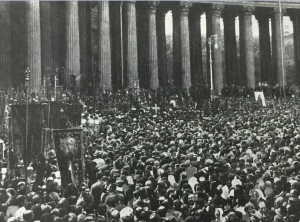
Blessing of the Russian forces at Kazan Cathedral, St. Petersburg, in Part 97, Volume 8, p.220.
Polivanov, the new Minister of War, started transforming the Russian army’s training system and tried with limited success to improve its supply and communications systems. Army losses in manpower were easily filled from the vastness of the Empire.
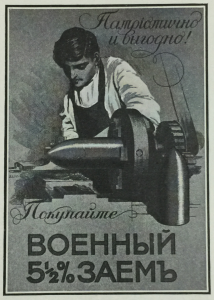
Russian war loan poster, in Part 97, Volume 8, p.226.
The huge size of the Russian population and the loyalty of large swathes of the people to the Tsar and to the Russian Orthodox Church – and thus to the protection of ‘Holy Russia’ with the Tsar at its head – meant that a formal draft of able-bodied men was unnecessary. Instead, the government of Nicholas II released pamphlets encouraging people to buy government bonds to fund the war with rates for the loans standardised at 51⁄2% return per month.
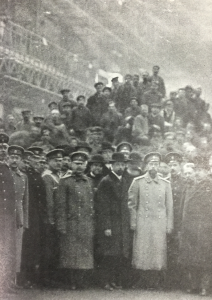
Tsar Nicholas II visiting a munitions factory, in Part 97, Volume 8, p.203.
In August 1915 Polivanov became aware of the plan by the Tsar to replace his Romanov relation Grand Duke Nikolay Nikolayevich as Commander-in-Chief of the Army and to himself lead the Russian armies at the front, and made strenuous efforts to persuade him not to. This was in vain, and in 1915 Nicholas II took personal command of the Russian armed forces and spent long periods at Mogilev (now in eastern Belarus) as Commander-in-Chief hundreds of miles from events unfolding in the capital… events on the home front.
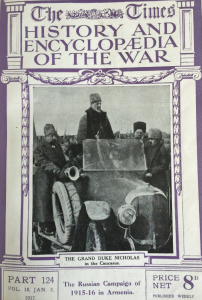
Illustration of ‘Grand Duke Nicholas in the Caucasus’ accompanying a chapter on the Russian Campaign in Armenia, 1915-1916, in Part 124, Volume 10, 2 January 1917.
Polivanov’s efforts to prevent the Tsar from taking control helped alienate him from the Tsarina, who then conspired to have him sacked. This was achieved when the Tsar dismissed the Minister of War in March 1916.
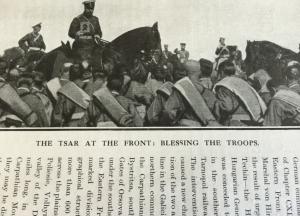
Illustration of ‘The Tsar at the Front Blessing the Troops’, in part 122, Volume 10, p.162.
On the home front, opposition and revolutionary sentiment was increasing. There were disruptions to the fuel supply, inflation was escalating, the price of meat, sugar and firewood was increasing, and there were continuous shortages of flour and coal. Added to these problems were the difficulties caused by refugees fleeing east, deeper into Russia, both from the army’s own scorched-earth policy entailing the destruction of entire villages and the indiscriminate forced removal of civilians, and from territories that had become controlled by the enemy.
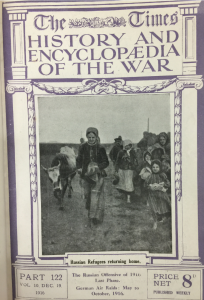
Illustration, ‘Russian refugees returning home’, from the front cover of Part 122, Volume 10, 19 December 1916.
With the collapse of food supplies, and with growing food queues, the breakdown of authority on the home front began to accelerate. Strikes and street demonstrations broke out in the first few days of March 1917 (towards the end of February in the old-style Julian calendar still retained in Russia). On 8 March strikers were joined in their protests by those celebrating International Women’s Day and those protesting against food rationing. On 9 March some 200,000 people were on the streets of Petrograd (St. Petersburg) demanding the end of the war and the abdication of the Tsar.
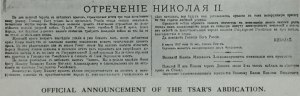
The official announcement of the Tsar’s abdication, Part 169, Volume 13, p.434.
On 10 March, from his front-line base at Mogilev the Tsar requested the Petrograd garrison commander to disperse the crowds with gunfire but this was met with reluctance among the soldiers. Rioting broke out and on 11 March the Tsar ordered suppression of the rioting by force. This was met with mutiny and by nightfall of 12 March, the Russian Imperial capital was in the hands of revolutionaries. Army Chiefs and government Ministers advised the Tsar to abdicate the throne, and this he did on 15 March 1917.
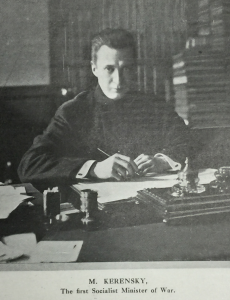
Alexander Kerensky who replaced the first head of the Provisional Government, Prince Georgy Yevgenyevich Lvov, in July 1917, in part 169, Volume 13, p.435.
On 16 March, a centre-left Provisional Government was announced and it was headed by the liberal Prince Georgy Yevgenyevich Lvov (1861-1925), although socialists had formed a rival body a few days earlier – the Petrograd Soviet (the Petrograd Soviet of Workers’ and Soldiers’ Deputies). In a power-sharing agreement, the Provisional Government and the Petrograd Soviet held ‘Dual Authority’.
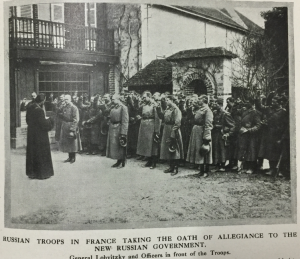
Illustration showing ‘Russian troops in France taking the oath of allegiance to the new Russian government’. It shows General Lohvitzky and officers in front of the troops, in Part 169, Volume 13, p.451.
Meanwhile the Russian communist revolutionary Vladimir Ulyanov Ilyich Lenin arrived in Petrograd in April 1917 and immediately began to undermine the Provisional Government, calling for ‘all power to the soviets’ (not simply dual power) and an end to the ‘predatory imperialist war’. Lenin did not have widespread support, even among Bolsheviks, and during the spontaneous armed demonstrations by soldiers and industrial workers – protests during the ‘July Days’ – he was unable to direct them into a organised coup against the government. Lenin was forced to flee to Finland and other Bolsheviks were arrested.
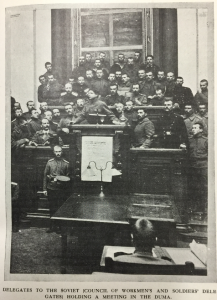
Illustration showing ‘Delegates to the Soviet (Council of Workmen’s and Soldiers’ Deputies) holding a meeting in the Duma’, in Part 169, Volume 13, p.457.
One outcome of the ‘July Days’ however was the replacement of Lvov as head of government. He was replaced by Alexander Kerensky of the Socialist Revolutionary Party. Kerensky declared freedom of speech, ended capital punishment, released thousands of political prisoners and did his best to maintain Russian involvement in the War.
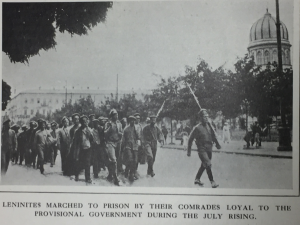
Illustration showing aftermath of the ‘July Days’ 1917, in Part 180, Volume 14, p.361.
The ‘July Days’ unrest had been precipitated by continued Russian involvement in the War. Nevertheless, in an ill-timed move, Kerensky ordered a new military offensive in July 1917 – the ‘Kerensky Offensive’, or ‘July Offensive’. It was led by General Brusilov, aided by Romania forces, and was launched against Austro-Hungarian and Imperial German armies in Galicia. The offensive was initially successful but Russian losses soon mounted and their advance collapsed. They were met with a counter-attack and in the end had to retreat around 240 kilometres. Mutiny and demoralisation within the Russian military had also played a part in the collapse.
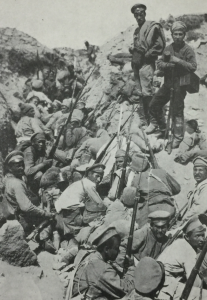
Illustration showing ‘The Russian offensive of July 1917’, part 170, Volume 14, p.23.
The events of July, coupled with continued military defeat and striking and unrest in the cities, encouraged a resurgence of right-wing forces. In August 1917, with Kerensky’s agreement initially, General Lavr Kornilov, Commander-in-Chief of the Provisional Government forces, directed an army to Petrograd with the intention of restoring order to the country. However fearing an army putsch Kerensky reversed his agreement for this, but Kornilov pressed forward with his plans anyway. Kerensky was forced to turn to the Petrograd Soviet for help, the outcome of which was the rearming of the Bolshevik Military Organization and the release of Bolshevik political prisoners, including Leon Trotsky. Bolsheviks, Mensheviks and Socialist Revolutionaries confronted Kornilov and convinced the army to stand down.
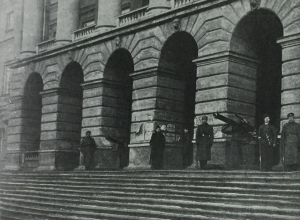
Illustration showing ‘The Smolny Institute, Petrograd, Headquarters of the Bolsheviks and guarded by Red Guards and Militia-Police’. The Smolny was Lenin’s residence for several months until national government was moved to Moscow and the Kremlin in March 1918. Image in Part 180, Volume 14, p.387.
The ‘Kornilov Affair’, was followed by renewed military action and the fleeing of Russian forces from Riga (now capital of Latvia) when the city was attacked and captured by advancing German troops in September 1917. Throughout September and October there were mass strike actions by the Moscow and Petrograd workers, miners in Donbas, metalworkers in the Urals, oil workers in Baku, textile workers in the Central Industrial Region, and railway workers throughout the Russian network. More than a million workers took part in strikes, and workers took control over production and distribution in many factories and plants in a social revolution. In September, Lenin had returned to Petrograd too.
On 7 November 1917 (or 25 October in the old-style Julian calendar) the Bolsheviks led their forces in the uprising in Petrograd against the Kerensky Government – the October Revolution. On 6 December 1917, Finland – an Imperial Russian Grand Duchy since 1809 and before that part of a greater Sweden from the 12th and 13th centuries – declared itself independent. After the revolutions, both countries would undergo deeply rending civil wars.
A further look at The Times History and Encyclopædia of the War will be taken in the next few months… possibly looking at reporting by the publication on heavy industry and armaments.
Dr. Graeme D. Eddie, Assistant Librarian Archives & Manuscripts, Centre for Research Collections (CRC)
Future Teacher
Future Teacher is a themed programme that focuses on the big issues and the range of new technologies that will have an impact on teaching over the next few years. 
These interactive and informative sessions offer opportunities for discussion as well as practical help for getting started with a range of tools and technologies.
Trial access: primary source resources from Gale Cengage
*The Library now has access to Nineteenth Century Collections Online: The Corvey Collection.*
Until the 27th February the Library has trial access to 4 extensive primary source databases from Gale Cengage: China from Empire to Republic, Making of the Modern World: Part I and Part II and Nineteenth Century Collections Online: The Corvey Collection.
You can access the database via the E-resources trials page. Access is available both on and off-campus.
Trial access ends 27th February 2017.
**Access to Making of the Modern World Part I and II and Nineteenth Century Collections Online: The Corvey Collection has now been extended until 14th March 2017**
#1lib1ref at the University of Edinburgh
On Friday 20 January, staff from across Information Services took part in Wikimedia’s #1lib1ref campaign, adding 63 edits to the encyclopaedia throughout the day – almost double last year’s total!
My blog about the day was published on Wikimedia UK’s website:
https://blog.wikimedia.org.uk/2017/02/1lib1ref-at-the-university-of-edinburgh/
Highlights from the RDM Programme Progress Report: May to July 2016
The following key results were highlighted in the RDM Programme Progress Report:
- There were 42 new users and 69 data management plans created with DMPOnline.
- An additional 1.5PB has been procured for DataStore’s general capacity expansions.
- The Roslin Institute has deposited 16 datasets into Data Vault.
- DataShare upload release (2.1) went live on 23 May 2016.
- There are now 334 dataset records in PURE, an increase of 124 records from the last reporting period (February to April 2016).
- 54 datasets have been deposited into DataShare.
- The University of Edinburgh was recommended as a preferred supplier on the Framework for the Research Data Management Shared Services for Jisc Services Ltd (JSL) for the following Lots:
- Lot 2: Repository Interfaces
- Lot 3: Data Exchange Interface
- Lot 6: Research Data Preservation Tools Development
- Lot 8: User Experience Enhancements
- A total of 390 staff and postgraduates attended RDM courses and workshops during this quarter.
- A total of 3,649 learners enrolled for the 5-week RDMS MOOC rolling course from March through July, 2016 and a total of 461 people completed the course in the same time frame.
- There were 5,198 MANTRA sessions recorded from May to July with 58 to 60 percent identified as new users.
- Set up an RDM Forum in collaboration with College of Arts, Humanities and Social Sciences (CAHSS) Research Officer and Research Outputs Co-ordinator. The first RDM forum is scheduled for Wednesday, 7 September 2016.
Data Management Planning highlights
We currently hold sample data management plans for grant applications submitted to the Arts and Humanities Research Council (AHRC) the Economic and Social Research Council (ESRC) and the Medical Research Council (MRC).
Active Data Infrastructure highlights
DataStore
An additional 1.5PB has been procured for general capacity expansions. This capacity will primarily be deployed to the College of Medicine & Veterinary Medicine (CMVM) and the College of Science & Engineering (CSE).
MRC Institute of Genetics & Molecular Medicine (IGMM) has purchased an additional 1.2PB of capacity, and this is now deployed in their dedicated file system.
Data Stewardship highlights
DataShare
The large data sharing investigation was completed for DataShare and reported previously. Upload release (2.1) went live on 23 May 2016. Download release planned following ‘embargo release’ and ShareGeo spatial data migration.
Data Vault
There was a soft release of Data Vault in February 2016, with the Roslin Institute depositing 16 datasets during this quarter.
PURE
There are now 334 dataset records in PURE, an increase of 124 records from the last reporting period (February to April 2016).
Research Data Discovery Service (RDDS)
Two PhD interns are working on School engagement activities (dataset records into PURE / datasets into DataShare) for Divinity & Division of Infection and Pathway Medicine; contracts end 16 September 2016. One PhD intern retrospectively added DataShare metadata to PURE for data deposits prior to PURE Data Catalogue functionality; contract to end 16 September 2016. A fourth PhD intern (to work with School of Informatics) is awaiting for approval.
Data Management Support highlights
A total of 390 staff and postgraduates attended RDM courses and workshops during this quarter.
Other related research data management support activities to highlight
- ‘Working with sensitive data in research’ guide was written for research staff and students in social sciences.
- Another guide is being written on ‘Sharing and retaining data’ for research staff and students in social sciences.
- Set up an RDM Forum in collaboration with College of Arts, Humanities and Social Sciences (CAHSS) Research Officer and Research Outputs Co-ordinator. The first RDM forum is scheduled for Wednesday, 7 September 2016.
Other activities to highlight
The outcome of Jisc RDM Shared Services bid that was submitted in March 2016
The Procurement Panel has recommended University of Edinburgh as a preferred supplier on the Framework for the Research Data Management Shared Services for Jisc Services Ltd (JSL) for the following Lots:
- Lot 2: Repository Interfaces
- Lot 3: Data Exchange Interface
- Lot 6: Research Data Preservation Tools Development
- Lot 8: User Experience Enhancements
Unfortunately, the Procurement Panel has decided not to recommend University of Edinburgh for the following Lots:
- Lot 1: Research Data Repository
- Lot 4: Research Information and Administration Systems Integrations
National and International Engagement Activities
From May to June
Çuna Ekmekcioglu gave a talk on ”Understanding and overcoming challenges to sharing personal and sensitive data’ at the Recon: Research Communication & Data Visualisation Conference, 24th June 2016, The Edinburgh Centre for Carbon Innovation (ECCI).
Stuart MacDonald and Rocio von Jungenfeld ran three workshops for the IS Innovation Fund project, Data-X: Pioneering Research Data Exhibition, with PhD students from across the University. Introduction to Data-X: Pioneering Research Data Exhibition.
In June
Stuart MacDonald presented peer-reviewed presentation to IASSIST conference, Bergen: Supporting the development of a national Research Data Discovery Service – a Pilot Project.
Robin Rice presented a poster at Open Repositories 2016, Dublin: Data Curation Lifecycle Management at the University of Edinburgh.
Pauline Ward presented a lightning talk at Open Repositories 2016, Dublin: Growing Open Data: Making the sharing of XXL-sized research data files online a reality, using Edinburgh DataShare.
Stuart MacDonald was an invited speaker at NFAIS (National Federation of Abstracting and Information Services) Fostering Open Science Virtual Seminar: NFAIS Fostering Open Science Virtual Seminar.
In July
Robin Rice gave two presentations (invited and peer-reviewed) at LIBER 2016, Helsinki: University of Edinburgh RDM Training: MANTRA & beyond; Designing and delivering an international MOOC on Research Data Management and Sharing.
Robin Rice filled in for Stuart Lewis as invited speaker for JISC-CNI 2016, London: Managing active research in the University of Edinburgh.
This is the last quarterly report as the Research Data Management (RDM) Roadmap Project (August 2012 to July 2016) came to a close on 31 July 2016.
There will be discussions with the RDM Steering Group to decide how future reporting will be conducted. These reports will be released on the Research Data Blog as well.
Tony Mathys
Research Data Management Service Co-ordinator
New to the Library: Oxford Classical Dictionary
I’m very pleased to let you know that following a request from staff in Classics the Library now has a subscription to the Oxford Classical Dictionary (online) from Oxford University Press.

The Oxford Classical Dictionary is seen as one of the leading resources for online research in Classics and contains over 6,000 full-text articles from the 4th Edition, with new and updated articles added each month.
You can access the Oxford Classical Dictionary via DiscoverEd. Read More
Introducing our New Projects Conservator – Helen Baguley
This week’s blog comes from Helen Baguley, the newest member of the conservation team…
I have been recently employed by the University of Edinburgh on a 12-month contract as a Projects Conservator. This exciting and varied role means I am predominantly located in the University Collections Facility (UCF), and off-site storage building in South Gyle. I will be working within the rationalisation project, looking at the collections which are currently housed there, such as rare books and university archives. I will also be assisting the musical instrument conservator and art department in their work. This will consist of carrying out conservation work and supervising volunteers under the direction of the Preventive Conservator, Katharine Richardson.

Collection items on a shelf at the University Collection Facility
Trial access: British Records on the Atlantic World, 1700-1900
From today the Library has trial access to the primary source collection British Records on the Atlantic World, 1700-1900 from British Online Archives. So for a limited time only you can access the wealth of material in this database spanning two centuries of Britain’s colonisation, commercial, missionary and even literary relations with Africa and the Americas.
You can access the database via the E-resources trials page (under the title British Online Archives: Atlantic Studies Collection). Access is available on-campus. For off-campus access please use the University’s VPN service.
Trial access ends 1st March 2017.

JoVE update

We have now added some more titles to our JoVE collection of video journals. These can be accessed via DiscoverEd or our E-Journal AZ list.
JoVE Biochemistry publishes experiments that investigate the structure, function, and interactions of biological molecules. The video articles in this section demonstrate methods to study nucleic acids, proteins, carbohydrates and lipids as well as enzyme function, protein folding, molecular interactions and biochemical reactions.
JoVE Cancer Research illustrates experimental approaches in biomedical research and clinical practice aimed at understanding, detecting, treating and preventing cancer. The video articles in this section demonstrate methods to study the cellular and molecular mechanisms of cancer, animal models of cancer research, development of new therapies and diagnostics, tumor imaging, chemical and radiation treatments, surgical procedures and improvements in therapy. These video articles offer researchers and clinical practitioners an efficient way to learn the technologies and experimental methods in cancer research.
JoVE Genetics publishes video articles demonstrating experimental approaches to investigate gene function and regulation. This includes methods to study gene expression, mutagenesis, epigenetics, genetic determinants of development, genetic disorders, population genetics and evolution.
Further Info
We have access to these JoVE sections:

Collections
 Hill and Adamson Collection: an insight into Edinburgh’s past
My name is Phoebe Kirkland, I am an MSc East Asian Studies student, and for...
Cataloguing the private papers of Archibald Hunter Campbell: A Journey Through Correspondence
My name is Pauline Vincent, I am a student in my last year of a...
Hill and Adamson Collection: an insight into Edinburgh’s past
My name is Phoebe Kirkland, I am an MSc East Asian Studies student, and for...
Cataloguing the private papers of Archibald Hunter Campbell: A Journey Through Correspondence
My name is Pauline Vincent, I am a student in my last year of a...

Projects
Cataloguing the private papers of Archibald Hunter Campbell: A Journey Through Correspondence
My name is Pauline Vincent, I am a student in my last year of a...
Archival Provenance Research Project: Lishan’s Experience
Presentation My name is Lishan Zou, I am a fourth year History and Politics student....