Home University of Edinburgh Library Essentials
March 26, 2026
New books in the Library for Social and Political Science
Thanks to recommendations from members of staff and requests via RAB from students the Library is continually adding new books to its collections both online and in print. Here are just a (very) small number of the books that have been added to the Library’s collections in semester two, 2016/17 for the School of Social and Political Science and these demonstrate the wide range of subjects being taught, studied and researched within School.
–> Find these and more via DiscoverEd.
 The crisis of the European Union: a response by Jürgen Habermas ; translated by Ciaran Cronin (shelfmark: JN40 Hab. Also available as e-book).
Women, work, and politics : the political economy of gender inequality by Torben Iversen and Frances Rosenbluth (shelfmark: HQ1236 Ive.)
The Sage handbook of resistance edited by David Courpasson and Steven Vallas (e-book).
Gandhi in political theory: truth, law and experiment by Anuradha Veeravalli (shelfmark: DS481.G3 Vee. Also available as e-book).
Traces of the future: an archaeology of medical science in Africa edited by Paul Wenzel Geissler, Guillaume Lachenal, John Manton and Noémi Tousignant ; with special contributions by Evgenia Arbugaeva and Mariele Neudecker (shelfmark: R651 Tra.)
Digital labor: the Internet as playground and factory edited by Trebor Scholz (shelfmark: HM851 Dig. Also available as e-book). Read More
Printmaking: Identification, Preservation and Creation
Immerse yourself in all things print! Join our conservators, Emily and Katharine, for an evening of preservation and printmaking. For centuries artists have been using different printing techniques to depict the world around them. In this workshop, you will get to study a range of prints from the University of Edinburgh’s Art Collection and learn how to identify them. You will find out about their unique conservation issues, and discover the best way to preserve them, before creating your own linocut to take home and treasure.
Date: Friday 19 May
Time: 6pm – 8pm
Cost: £5 (Advanced booking required) Book here.
Location: St Cecilia’s Hall, Niddry Street, Cowgate, Edinburgh, EH1 1NQ
For more info, please contact: 0131 651 1438 (9am-5pm Mon-Fri only)
www.edunifom.wordpress.com/
Organised by The University of Edinburgh Museum Collections

Print from the Thomson-Walker Collection depicting Giuseppe Atti (1753-1826)
Voyages of Discovery
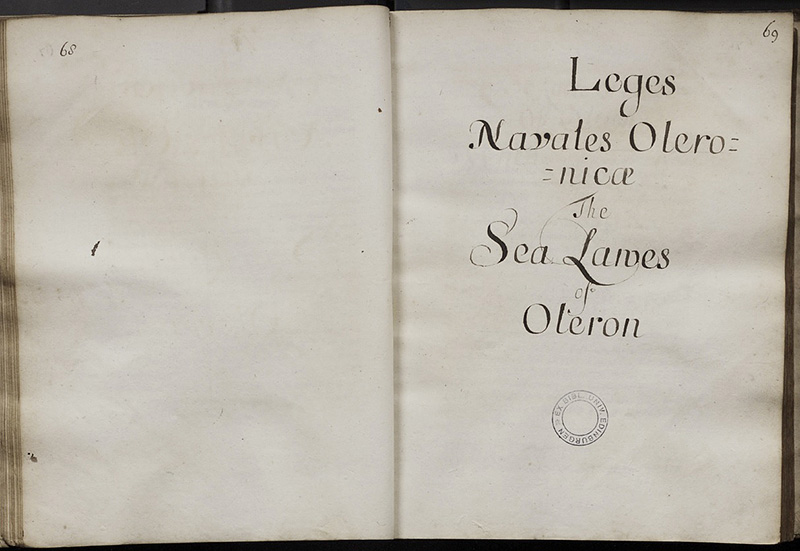 In this weeks’ blog post we are pleased to welcome our newest member of staff, Juliette Lichman. When not working on new orders, she has been preparing old ones to go into our Open Books Repository https://openbooks.is.ed.ac.uk/ Juliette has been discovering how easy it is to get drawn in to the complex and fascinating histories of the books…
The university’s cherished Laing collection is an invaluable resource of important historical documents, and is a frequent subject on this blog. The fact that there are still so many unknown works and exciting discoveries to be made within the collection is astounding. I was lucky enough to experience this first-hand several weeks ago, during an afternoon of working through a deeply buried folder of book scans. I came across a Laing collection document that had incorrect and missing metadata. It appeared to be an unassuming manuscript (date unknown) with handwriting that was ornately scribed but difficult to decipher, though certainly English.
Read More
Research Data Management Forum: Third meeting – 28/03/2017
Harkening back to a bygone era of libraries, when books were printed on paper and research data management meant not accidentally burning your notes with your candle, the third meeting of the university RDM forum was held in the impressively aged Old Library in Geography’s Old Infirmary building at the end of March.
As a regular participant, I find the RDM forum is a very useful platform for everyone who has an interest in supporting research data management. It is an opportunity for me to update myself on the support and services that the university has in place in this area, to ask the daft questions but get a sensible answer and more generally, to meet the others in the university who are working in the same area as myself and face the same issues and challenges.
This edition of the RDM forum was no different. After a quick introduction of the participants, Cuna, leading the forum, took us through the following agenda:
- Cuna Ekmekcioglu – RDM update
- Dominic Tate – DataVault update
- Pauline Ward – DataShare new features
- Cuna Ekmekcioglu – development of Data Safe Haven
The session began with the RDM update which went into detail about the RDM Sharepoint site and some of the tools and documents that have been uploaded to the site. There are some useful threads looking to collect information about the different types of data that we have, as well as some guidance on recording datasets in PURE, RDM journey flowchart and sample Data Management Plans amongst other things. The Sharepoint site can be accessed by request, and can be found here: https://uoe.sharepoint.com/sites/rdmforum (access is only for UoE staff and students).
We had updates on the existing services such as DataShare and details about the development of both DataVault and the future Data Safe Haven, a system which will allow the storage and analysis of very sensitive data. There were some discussions around the new systems and practical issues such as cost and training/guidance for the new services.
It was a very worthwhile event and I shall be looking forward to the next forum.
Michelle O’Hara
Research Data & Information Officer
School of Social and Political Science
Finding my way around the map and atlas collection
We catch up with Helen, our Projects Conservator at the University Collections Facility (UCF), in this week’s blog…
As the Rationalisation Projects Conservator my role is to make sure that the risk of damage to the objects which are housed at the UCF is minimised during the project. It is my job to make sure that the objects can be safely handled by the cataloguing team and any readers who come to visit. I am currently working on a collection of maps and atlases which date from around 1840. Many of these objects are beautifully illustrated and are an excellent example of the craftsmanship of the time.
Celtic Knot – Wikipedia Language Conference
Registration is now open for the Celtic Knot – Wikipedia Language Conference that will be taking place on Thursday 6th July 2017 in the Edinburgh Business School. Read More
New books in the Library for History, Classics and Archaeology
Thanks to recommendations from members of staff and requests via RAB from students the Library is continually adding new books to its collections both online and in print. Here are just a (very) small number of the books that have been added to the Library’s collections in semester two, 2016/17 for the School of History, Classics and Archaeology and these demonstrate the wide range of subjects being taught, studied and researched within School.
 Mesopotamia: ancient art and architecture by Zainab Bahrani (shelfmark: Folio N5370 Bah.)
JFK and the masculine mystique: sex and power on the New Frontier by Steven Watts (shelfmark: HQ1090.3 Wat.)
A social history of tea: tea’s influence on commerce, culture & community by Jane Pettigrew and Bruce Richardson (shelfmark: GT2907.G7 Pet.)
The culture of clothing: dress and fashion in the ‘ancien régime’ by Daniel Roche ; translated by Jean Birrell (shelfmark: GT857 Roc.)
Sicily: culture and conquest by Dirk Booms and Peter Higgs (shelfmark: DG865 Boo.) Read More
The perils of Christian mission : writing from the New World
Guest curator Suzi Higton writes about her current display in the Funk Reading Room case
In their quest to spread the Word of God, missionaries have for centuries traversed continents to reach some of the most isolated and hostile places on earth. Currently on display at New College Library is a mere handful of the wealth of literature written by those who risked their lives to introduce Christianity to nations only recently acquainted with Western influence.
Dating from the mid-1850s to the turn of the nineteenth century, these titles are notable not only for their vivid Victorian book bindings, but for the captivating stories of enduring hardship and inherent peril of which they tell.
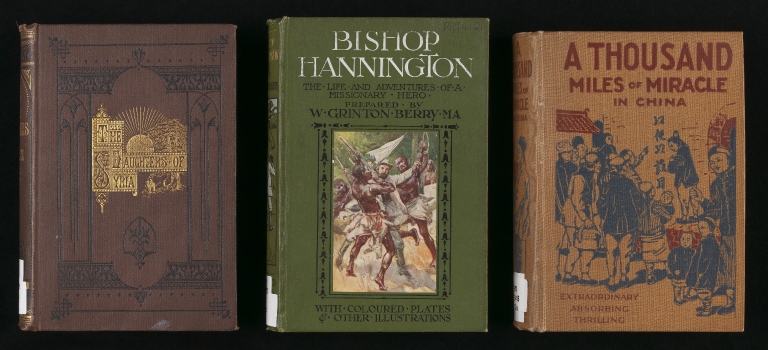
The daughters of Syria : a narrative of efforts by Mrs. Bowen Thompson for the evangelization of the Syrian females; Bishop Hannington : the life and adventures of a missionary hero; A thousand miles of miracle in China; . From New College Library
A Thousand Miles of Miracle in China first published in 1904, recounts the personal experience of Archibald D. E. Glover, a missionary who witnessed first-hand the brutality of the Boxer Uprising of June 1900, an unrelenting attack on Western missionaries and Chinese Christian converts. Glover recalls half of the missionaries in the Shan-si region were murdered and that he and his family were lucky to escape with their lives.
The Cross and the Dragon or Light in the Broad East focuses on an earlier era of missionary work in China as described by the Reverend Benjamin Couch Henry. A Princeton graduate, Henry travelled to Canton (now Guangzhou) in 1874 and describes in detail the deeply unwelcoming reception of Western missionaries. Labelled as ‘foreign devils,’ it was widely believed they had brought misfortune to the country, including drought and famine.
The story of James Hannington, who became the first bishop of East Equatorial Africa, begins on a decidedly light-hearted note but ends ultimately in tragedy. The Life and Adventures of Bishop Hannington documents in often comical detail the Anglican minister’s travels to Zanzibar and Uganda between 1883 and 1885. Accompanied by striking colour illustrations and formed in part by humorous letters written to his young nephews, Hannington’s eventual kidnap and murder by tribesmen is recorded from his own pocket journal recovered by a later expedition after his death.
A number of missionary accounts from the period are noteworthy for their inclusion of foldable maps as seen in Fiji and the Fijians. Measuring just 18cm in length, the map included in this account which spans two volumes charts the cluster of islands as they would have appeared in the mid-nineteenth century to the missionaries who first arrived there. Missions to this region however were not without risk as demonstrated by the fate of English missionary Thomas Baker who was killed and eaten by cannibals in Nabatautau, Fiji in 1867.
The Daughters of Syria recounts the tireless work of female missionary Mrs Elizabeth Bowen. Following the outbreak of civil war which resulted in the massacre of thousands of Christians, Mrs Bowen travelled alone to Lebanon in 1860. Her efforts resulted in the establishment of the British Syria Schools in Beirut, providing a lifeline to the many widows and children left destitute by the conflict.
The diversity of missions undertaken during the Victorian era is perhaps best demonstrated by Village Work in India, the account of Normal Russell of the Canada Presbyterian Church. The Reverend’s mission to Madhya Pradesh, Central India between 1890 and 1902 is accompanied by a number of photographs taken during his often perilous travels.
Today, missionaries continue to travel the world and although many still encounter great danger, the fascinating yet harrowing accounts of these first missions provide unique insights into unexplored lands and of the lives of those who lived there.
Suzi Higton, School of Divinity
Do we have access to the British Newspaper Archive?
A question I get asked quite a lot is if we have access at the Library to the British Newspaper Archive. And it is the sort of question that I would usually be able to give a yes or no answer to but in the case of the British Newspaper Archive it isn’t quite as simple.
In fact the answer I would normally give is either “Yes, BUT…” or “No, BUT…”and I’ll try to explain why.
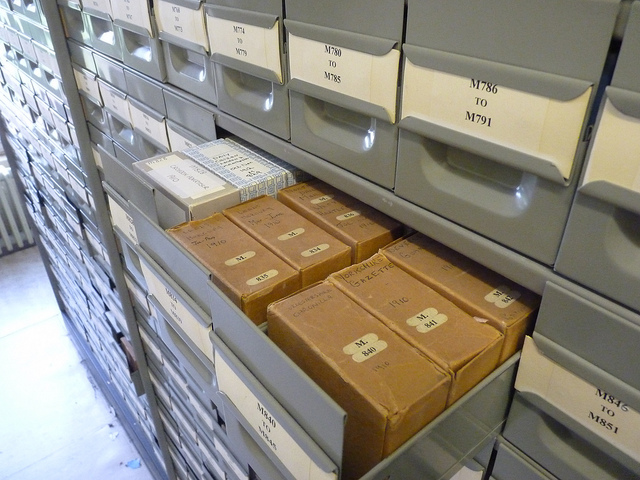
“Drawers” (https://flic.kr/p/gaUXpW) by Luke McKernan (https://flic.kr/ps/vNbEP) is licensed under CC BY 2.0 (https://creativecommons.org/licenses/by-sa/2.0/).
EDINA’s ShareGeo Open content into DataShare
Many fascinating datasets can be found in our new ShareGeo Open Collection: http://datashare.is.ed.ac.uk/handle/10283/2345 .
This data represents the entire contents of EDINA’s geospatial repository, ShareGeo Open, successfully imported into DataShare. We took this step to preserve the ShareGeo Open data, after the decision was taken to end the service. Not only have we maintained the accessibility of the data but we also successfully redirected all the handle persistent identifiers so that any existing links to the data, including those included in academic journal articles, have been preserved, such as the one in this paper: http://dx.doi.org/10.1007/s10393-016-1131-y .
Similarly, should the day ever arrive when DataShare was to be closed, we would endeavour to find a suitable repository to which we could migrate our data to ensure its preservation, as per item 13 of our Preservation policy.
We were able to copy the content of almost all metadata fields from ShareGeo to DataShare. The fact both repositories use the Dublin Core metadata standard, and both were running on DSpace, made the task a little easier. The University of Edinburgh supports the Dublin Core Metadata Initiative. DataShare’s metadata schema can be found at https://www.wiki.ed.ac.uk/display/datashare/Current+metadata+schema setting out what our metadata fields are and which values are permitted in them.
Our EDINA sysadmin (and developer) George was very helpful with all our questions and discussions that took place while the team settled on the most appropriate correspondence between the two schemas. The existing documentation was a great help too. George then produced a Python script to harvest the data, using OAI-PMH to get a list of ShareGeo items, then METS for the metadata and bitstreams. He then used SWORD to deposit them all in DataShare.
The team took the opportunity to use DSpace’s batch metadata editing utility and web interface to clean up some of the metadata: adding dates to the temporal coverage field and adding placenames and country abbreviations to the spatial coverage field, to enhance the discoverability of the data.
For example “GB Postcode Areas” can be found using the original handle persistent identifier: http://hdl.handle.net/10672/51 as well as the new DOI which DataShare has given it – DOI: 10.7488/ds/1755. Each of the 255 items migrated to our ShareGeo Open Collection contains a file called metadata.xml which contains all the metadata exactly as it was when exported from ShareGeo itself. I have manually added placenames in the spatial coverage field (which was used differently in ShareGeo, with a bounding box i.e. “northlimit=60.7837;eastlimit=2.7043;southlimit=49.8176;westlimit=-7.4856;”). Many of these datasets cover Great Britain, so they don’t include Northern Ireland but do include Scotland, England and Wales. In this case I’ve added the words “Scotland”, “England” and “Wales” in Spatial Coverage (‘dc.coverage.spatial’), even though these are already implicit in the “Great Britain” value in the same field, because I believe doing so:
- enhanced the accessibility of the data (by making the geographical extent clearer for users unfamiliar with Great Britain) and…
- enhanced the discoverability of the data (users searching Google for “Wales” now have a chance of seeing this dataset among the hits).
James Crone who compiled this “GB Postcode Areas” data is part of EDINA’s highly renowned geospatial services team.
Part of James’ work for EDINA involves producing census geography data for the UK DataService. He has recently added updated boundary data for use with the latest anonymised census microdata (that’s from the 2011 census): see the Boundary Data Selector at https://census.ukdataservice.ac.uk/get-data/boundary-data .
Pauline Ward is a Research Data Service Assistant for the University of Edinburgh, based at EDINA.

Detail from GB Postcode Areas data, viewed using QGIS.
Collections
 Hill and Adamson Collection: an insight into Edinburgh’s past
My name is Phoebe Kirkland, I am an MSc East Asian Studies student, and for...
Cataloguing the private papers of Archibald Hunter Campbell: A Journey Through Correspondence
My name is Pauline Vincent, I am a student in my last year of a...
Hill and Adamson Collection: an insight into Edinburgh’s past
My name is Phoebe Kirkland, I am an MSc East Asian Studies student, and for...
Cataloguing the private papers of Archibald Hunter Campbell: A Journey Through Correspondence
My name is Pauline Vincent, I am a student in my last year of a...
Projects
Cataloguing the private papers of Archibald Hunter Campbell: A Journey Through Correspondence
My name is Pauline Vincent, I am a student in my last year of a...
Archival Provenance Research Project: Lishan’s Experience
Presentation My name is Lishan Zou, I am a fourth year History and Politics student....