Home University of Edinburgh Library Essentials
May 3, 2026

Research Data Service highlights to report: August to December 2016
Research Data Service
New Research Data Service Website
The Research Data Service’s redesigned website was released in December. The new website is more accessible and includes new and updated content in support of RDM. The new website can be visited at http://www.ed.ac.uk/information-services/research-support/research-data-service
RDM Forum Meetings
There were two RDM forum meeting held during the autumn term (7 September and 23 November). This is part of a collaborative effort that Çuna Ekmekcioglu (L&UC) and Jacqueline McMahon and Ewa Lipinska (College of Arts, Humanities and Social Sciences) organised to invite staff from CAHSS and other Colleges and Schools to meet and have discussions about RDM activities, and how these can be supported. There were almost 25 people in attendance for each meeting with another one scheduled for 28 March 2017.
A RDM forum SharePoint site has also been created to accommodate RDM resources including papers, presentation slides, work flow diagrams, guides and a collection of sample data management plans.
Visits
The Research Data Service welcomed visitors from seven universities during the autumn term with two visits from Kyoto University.
The purpose of their visits was to learn more about the services and resources we provide in support of research data management at the University of Edinburgh. The Digital Curation Centre (DCC) and senior IS staff also participated during some of the visits, which included meetings, presentations and tours.
- Nanyang Technological University: 3 – 4 August
- University of Auckland: 14 September
- Kyoto University (National Institute of Informatics): 26 September
- Malmö University: 10 – 11 October
- University College Cork: 21 September
- John Hopkins University: 21 September
- Kyoto University (Kyoto University Library): 26 October
- University of Malaya: 22 November
Data Management Planning
DMPonline had 57 new registered users and was used to create 115 data management plans (DMPs); in total, 256 DMPs were created in 2016.
There were 25 data management plan consultations from August to December.
Data Management Support
MOOC and MANTRA
A total of 1,817 learners enrolled for the 5-week RDMS MOOC rolling course from August to December, with a total of 5,466 learners enrolled for the year (2016); the MOOC started in March 2016.
2016 concluded with 22,544 MANTRA sessions recorded for the year, slightly lower than in 2015, when MANTRA had 22,950 sessions.
Active Data Infrastructure
DataStore
Active users remained consistent throughout the 2016 year with data stored on a steady rise. There was a natural decline over the summer break, which has been observed in previous years.
In 2016, the College of Arts, Humanities and Social Sciences (CAHSS) activity was distinct from other Colleges with a spike in usage.
DataSync
DataSync usage includes the following stats that were reported at the end of 2016:
- Number of active users: 1,740
- Number of distinct clients (IPs 2017): 5,423
- Total DataSync storage: 3TB
- Number of mappings to DataStore areas: 294
Data Stewardship
Pure
In 2016, 326 Pure records for datasets were created, which surpass the number of records created in 2014 (31) and 2015 (32).
DataShare
202 datasets were deposited into DataShare.
DataVault
DataVault closed the year with 21 deposits for 2016. There was a soft release of DataVault in February 2016 and plans are to commit resources to DataVault so that there can be a release in mid 2017.
3D Printing and Additive Manufacturing – new subscription

We have a new e-journal subscription – 3D Printing and Additive Manufacturing.
3D Printing and Additive Manufacturing is a peer-reviewed journal that provides a forum for world-class research in additive manufacturing and related technologies. The Journal explores emerging challenges and opportunities ranging from new developments of processes and materials, to new simulation and design tools, and informative applications and case studies. Novel applications in new areas, such as medicine, education, bio-printing, food printing, art and architecture, are also encouraged.
The Journal addresses the important questions surrounding this powerful and growing field, including issues in policy and law, intellectual property, data standards, safety and liability, environmental impact, social, economic, and humanitarian implications, and emerging business models at the industrial and consumer scales.
The Gaelic Liturgy; the only copy in Scotland
This unassuming little book is of the greatest national importance: it is the only copy in Scotland of the first book printed in Gaelic (Gaelic Liturgy; year 1567; shelfmark Dd.10.44.). After the Reformation there was a strong impetus, sponsored primarily by the Campbell Earls of Argyll, to evangelise the Highlands and Islands, where Gaelic rather than Scots was spoken. John Carswell, Bishop of the Isles, adapted John Knox’s Book of Common Order into Scottish Gaelic. It was a hugely ambitious undertaking, particularly considering it would be another two centuries before the New Testament was finally published in vernacular Gaelic. This copy has clearly been well-used.

Psalms in public and private
New College Library welcomes the General Assembly of the Church of Scotland this week with a display of early psalm books.
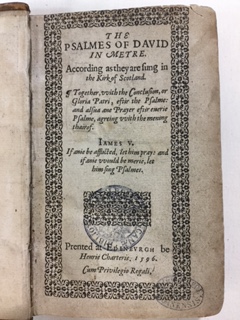
The psalmes of David in metre : according as they are sung in the Kirk of Scotland … Edinburgh, 1596. tUR 77 1596
During the period 1564-1644, around 70 editions of the Psalme Buik were produced for used in the Church of Scotland. Read More
5 things to remember if using the Library this summer, 2017
I wrote a “5 things to remember if using the Library this summer” post last year and it is the second most viewed post on this site. So shamelessly clinging to the coat-tails of that post, this is an updated version for 2017.
We’re creeping ever closer to the official end of the academic year (Friday 26 May) and while some of you may already have finished, to those that haven’t, keep going you are almost there!
While many of you are probably thinking the last thing you’d want to do is use or visit the Library over your summer break, there will be a large number of students who want to or need to use the Library during the summer vacation period to continue with their studies or research.
So if you are one of the many who is planning on using Library facilities or services over the summer then read on. And for those of you who aren’t planning on this maybe you should read on anyway just in case (particularly if you have not returned borrowed books).
1) The Main Library and other site libraries remain open throughout the summer vacation period.

Opening hours and Helpdesk staffed hours will be reduced in some libraries so keep an eye on the opening hours web site and follow the Library on social media for updates e.g. @EdUniLibraries, @EdUniMainLib, Facebook, etc. Read More
On trial: Secret Files from World Wars to Cold War
Following a request from staff in History the Library has been able to secure trial access to Secret Files from World Wars to Cold War: Intelligence, Strategy and Diplomacy from The National Archives and Taylor & Francis. This provides access to British government secret intelligence and foreign policy files from 1873 to 1953, with the majority of files dating from the 1930s and 1940s.
You can access this online archive via the E-resources trials page. Access is available both on and off-campus.
Trial access ends 26th June 2017.

Spanning four key twentieth century conflicts, with a spotlight on the Second World War, the material, sourced from The National Archives, enables research into intelligence, foreign policy, international relations, and military history in the period of Appeasement, through the Second World War, and into the early Cold War. Read More
Thomson-Walker Internship – Round 3!
In this week’s blog we hear from Clàudia Callau Buxaderas, who is the third in a series of interns to work on the Thomson-Walker collection…
It has been almost eight weeks since I started my internship at the CRC and sadly, this is already my last week working here. After graduating in conservation at the University of Barcelona, I worked as an intern in other institutions and studios around Spain and now I feel extremely lucky to have had the opportunity to work on the Thomson-Walker collection, a large collection of 2700 prints. I am the third conservator to work on this project, which has definitely been an advantage as I was able to start my work on the very first day. I have to thank the two interns before me for that, Samantha Cawson and Victoria Haddock, as they have provided detailed reports to help the future interns on this project. This information has been essential for me to get into the rhythm and way of working in the studio. In the same way, I hope to provide other interns in the future with some new ideas. Given the size the collection, it is always beneficial to find new ways and methods to speed up the work and to get the most of these (very short!) weeks.

Clàudia working in the studio
ClinicalKey – new subscription

Following a successful trial, we now subscribe to Elsevier’s ClinicalKey.
ClinicalKey is a clinical search engine that helps health professionals make decisions anywhere, anytime, in any patient scenario. It allows you to access the latest (indexed daily), evidence-based answers in every medical and surgical speciality and contains:
* Full-text medical and surgical books and journals
* First Consult point-of-care monographs
* Customizable patient education handouts
* Drug monographs from Gold Standard
* Thousands of videos, including those from Procedures Consult
* Millions of images
* Practice guidelines
* Clinical trials from clinicaltrials.gov
* Fully indexed MEDLINE
A full list of the content on ClincialKey can be found at https://elsevierresources.com/clinicalkey/clinicalkey/content/
A user guide can be accessed from https://www.clinicalkey.com/info/uk/wp-content/uploads/sites/15/2017/05/ClinicalKey_UserGuide.pdf
Personalisation and App access
Choose “Other institution login” or “Remote Access” to set a personal account. This will allow you to save articles/images, searches/search history, change language, store presentations, set up table of contents alerts etc.

Further info
ClinicalKey can be accessed via the Medicine Databases A-Z list and DiscoverEd. The individual e-book and e-journal titles have been added to DiscoverEd. Where there is a restriction on downloading an e-book for offline reading from the ClinicalKey website, we will maintain access on the Elsevier e-Library website where this is allowed – both links will be displayed in DiscoverEd.
ClinicalKey is also available to our alumni – see the full list of Alumni E-Resources at http://www.ed.ac.uk/information-services/library-museum-gallery/finding-resources/library-databases/databases-subject-a-z/alumni-e-resources
Introducing new support team members
Since mid-January, two new Research Data Service Assistants have joined the busy ‘virtual team’ working across divisions of Information Services to provide user support for RDM and Data Library enquiries and to quality assure DataShare submissions. You may have already come in contact with them, but a brief welcome is in order nonetheless.
Both new team members have a research background but surprisingly, from the same field and institution! Nevertheless they had not met until they arrived at our offices in Argyle House for their first day of work. Diarmuid joins us full-time, commuting daily from Glasgow, and Bob works half-time, taking advantage of a short walk from home.
 Diarmuid McDonnell has taught a variety of research design, data management and analysis courses across a number of Scottish universities and levels. He is proficient in the use of Stata, SPSS and SAS for research and teaching purposes and is particularly experienced in the use of administrative data for social science research, which he used for his recently completed PhD thesis at Stirling University.
 Bob Sanders recently completed his PhD at Stirling University looking at the relationship between dependency and care receipt in later life. He has extensive experience undertaking quantitative research, including the routine and advanced management and statistical analysis of large-scale longitudinal data. He is capable of conducting end-to-end data preparation, management and analysis using syntax-driven commands in Stata, with experience using other statistical software packages such as SPSS and Excel.
In addition to their repository and user support work for EDINA and Data Library, they have already made unique contributions to the service. Diarmuid has revised and taught our Data Handling in SPSS half-day workshop, as well as piloted an Introduction to Statistical Literacy workshop for Humanists. Bob has joined the Data Safe Haven development project, helping to work out operational processes and user documentation, as well as giving the online MANTRA course a thorough editing job.
Robin Rice
Data Librarian and Head, Research Data Support
EDINA and Data Library
My dear Playfair
A guest post from Eleanor Rideout, Helpdesk Assistant – New College Library

Letter of Henry Cockburn to William Playfair. Box 49.1.7, New College Library
One of my favourite things about working with historical collections is the unexpected find, like this letter of Henry Cockburn to William Playfair discovered while shelving.
9 Dec [18]41
My Dear Playfair
No one can rejoice more cordially than I do; & chiefly on your account. It will do you so much honor, – to say nothing of anything else. It is the best recipe for all your ailments. Get it up while I have eyes to see, – & God bless you.
Ever
Cockburn
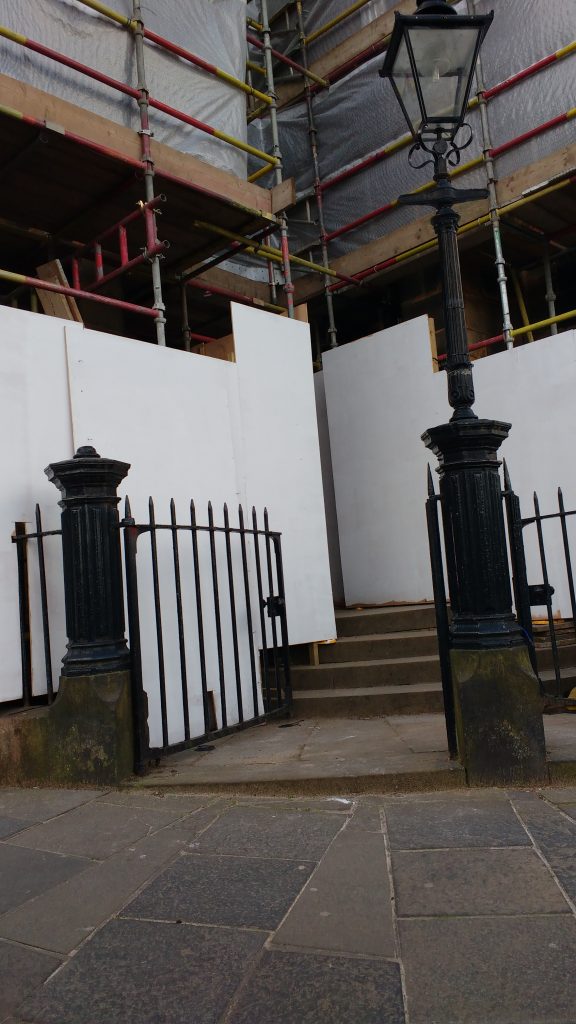
New College Library through the scaffolding, April 2017
New College is currently deep under scaffolding for cleaning works so a message to the original architect stood out. Henry Cockburn’s name is also familiar – he was a prominent advocate for conservation in Edinburgh and nearby Cockburn Street is named for him.
I had hoped that Cockburn’s excitement was about New College itself, but swiftly realised that the key date of the 1843 Disruption rather prevented this. Checking Playfair’s entry in the Dictionary of Scottish Architects showed that at this time he was working on Donaldson’s Hospital.[1] Getting final design approval seem to have been a difficult process but on 7 December 1841 his plans were finally accepted.[2]
Cockburn for one was impressed: even before work was completed in 1852 he described the building as ‘of itself sufficient to adorn a city’.[3] He lived to 1854, so did indeed get to see the result with his own eyes.
[Donaldson’s image: https://commons.wikimedia.org/wiki/File:Edinburgh_Donaldson%27s_School_view_from_SE.JPG]
Eleanor Rideout
[1] http://www.scottisharchitects.org.uk/architect_full.php?id=100290
[2] David Walker, ‘The Donaldson’s Hospital Competition and the Palace of Westminster’, Architectural History, Vol. 27 (1984)
[3] Henry Cockburn, A letter to the Lord Provost on the best ways of spoiling the beauty of Edinburgh (1849)
Collections
 Hill and Adamson Collection: an insight into Edinburgh’s past
My name is Phoebe Kirkland, I am an MSc East Asian Studies student, and for...
Cataloguing the private papers of Archibald Hunter Campbell: A Journey Through Correspondence
My name is Pauline Vincent, I am a student in my last year of a...
Hill and Adamson Collection: an insight into Edinburgh’s past
My name is Phoebe Kirkland, I am an MSc East Asian Studies student, and for...
Cataloguing the private papers of Archibald Hunter Campbell: A Journey Through Correspondence
My name is Pauline Vincent, I am a student in my last year of a...


Projects
Cataloguing the private papers of Archibald Hunter Campbell: A Journey Through Correspondence
My name is Pauline Vincent, I am a student in my last year of a...
Archival Provenance Research Project: Lishan’s Experience
Presentation My name is Lishan Zou, I am a fourth year History and Politics student....