Home University of Edinburgh Library Essentials
June 12, 2026
E-learning with Employ.ed
Today we hear from Sophie, our first ever Employ.ed student in the conservation studio…
Hi, my name is Sophie Lawson and I am currently the Conservation E-learning intern at the Centre for Research Collections at the University of Edinburgh. During my time of ten weeks here in the Conservation Department I will be creating an electronic learning resource on the subject of Integrated Pest Management (IPM). My internship is part of the Employ.ed programme, which is a University run scheme that supports students’ career development, providing work experience whilst working towards attaining the Edinburgh Award. I am currently going into my third year of my undergraduate degree in History and have an interest in special collections, particularly in digitisation and use of technologies in the heritage sector.
The University’s IPM plan is integral to the storage of rare and unique collections, being a tested method to monitor and control insect pests and mould activity in collections that, if left unmonitored or untreated, could cause irreversible and expensive damage to collection items. As part of a preventive conservation programme, IPM is an effective way to reduce damage and cost, and to minimise intervention with special collection items. An effective IPM plan will enable institutions to have greater control over and knowledge of pest activity in their facility, making pest prevention and treatment much more effective. One of my goals through creating this e-learning resource is to aid this accumulation of knowledge of pest activity throughout the department, with the hope that the resource will be used for internal staff training for a basic overview of our IPM plan, how it works and why it is so important.
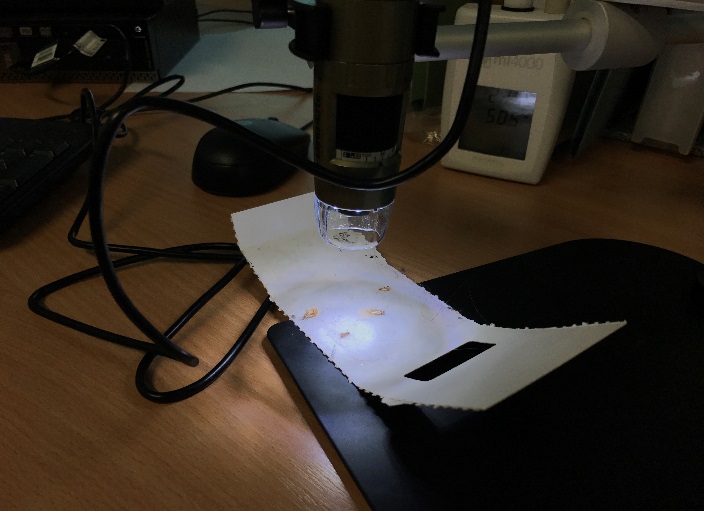
Using a microscope to identify pests
So far in my internship I have been able to gain invaluable insight into the field of Conservation, having spent some time in the Historic Environment Scotland’s Conservation Studio, as well as our own in the CRC, and even being able to try my hand at some surface cleaning and making boxes for rehousing books! More specifically I have gained a great deal of knowledge about Preventive Conservation, having researched Integrated Pest Management and the theory behind it for the content of my e-learning resource. In addition to this, I have been able to shadow my supervisor, Katharine Richardson, as she carried out pest trap inspections as part of our IPM Plan – and was even able to get a closer look at the kind of pests we found!
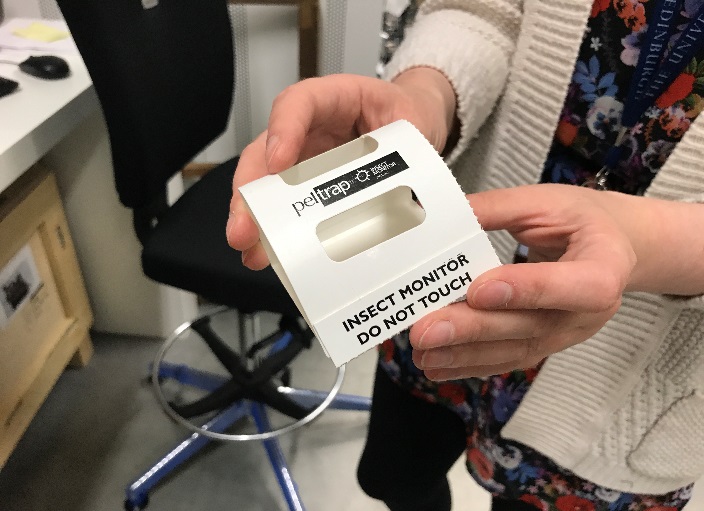
Trap used to monitor for pest activity
For the remainder of my internship I aim to create a user directed, interactive program, and experiment with implementing different types of media such as games and video tutorials to create an engaging and educational resource. I hope that through the completion of this project we are able to generate a broader knowledge of IPM and its importance amongst the University’s Centre for Research Collections staff, as well as introduce new methods of e-learning and training styles to be used in the department in future projects.
Japanese e-books in EBSCOhost eBook Collection
The University Library has for the first time purchased some Japanese e-books which are available to read on the EBSCOhost eBook Collection platform. Once on the platform, click “Choose Databases” at the top of the page, and then select both “Audiobook Collection” and “eBook Collection”, close the “Choose Databases” page, and then search for Japanese titles. Alternatively, just go to the pre-selected Japanese e-books list by clicking here.
At the moment there are 56 Japanese e-books in total but the number will grow.
Why football banned women
In this week’s blog I’m using some of the Library’s online resources to find primary source material relating to the popularity of women’s football during and just after the First World War and the decision by the FA to ban it.
The other night on catch-up I watched the Channel 4 documentary When Football Banned Women, programmed to coincide with the Women’s EURO 2017 (which Channel 4 just happens to be showing, it’s like they thought about their programming or something!) This interesting documentary looked at the rise in popularity of women’s football during the First World War and the subsequent decline after the decision by The Football Association (FA) to ban the women’s game in 1921.
If you’ve not seen it you can watch it on Box of Broadcasts (BoB).
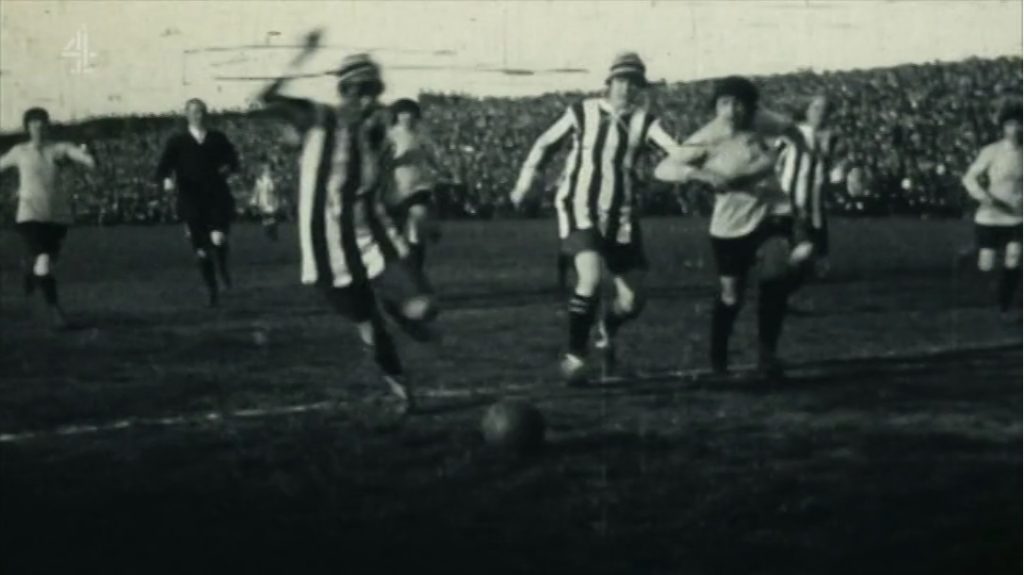
Screenshot from ‘When Football Banned Women’ (Channel 4).
As I am always looking for an excuse to use some of the University Library’s fantastic online primary source collections, I decided this was a perfect story to try and find out more about from our online archives.
While I primarily used some of the online newspaper archives the Library has access to for that period, I did do some searching in some other primary source collections that covered the period in question. You can find a list of the specific databases I used at the end of the post.
Women’s football in the First World War
With 1000s of men being called up to fight in the First World War, women were expected to take on roles as never before in the workplace and with this came other opportunities. Women’s football teams began to form, often put together or sponsored by the industries and companies now employing the vast female workforce. These teams began to play matches with the primary aim of raising money for charity and while spectators may have originally attended to help raise money and to watch what they thought of as a novelty, they continued to attend as the matches were good and the teams had skill. Read More
Introducing ‘Body Language’
‘Body Language: movement, dance and physical education in Scotland, 1890-1990’ is a new Wellcome Trust Research Resources-funded project between Edinburgh University Library Special Collections and the Fergusson Gallery, Perth with the support of Moray House School of Education, Margaret Morris Movement International and Scottish Gymnastics. I am the archivist on this project and over the next two years I will be cataloguing, preserving and making available these three significant collections relating to movement, dance, physical education and gymnastics in Scotland:
- The archives of Margaret Morris Movement International

Margaret Morris (1891-1980) established her own system for dance training, Margaret Morris Movement, which focuses on breathing techniques, posture and strength training with co-ordinated movements. Margaret Morris Movement International works today with mentally and physically disabled persons using Morris’s systems and techniques. The archives contain costume designs, music scores, choreography notes, scripts, sketchbooks, diaries, teaching and publicity materials, photographs and around 8,000 items of correspondence from individuals including Edward Elgar, Stanley Baldwin and Charles Rennie Mackintosh.
- The records of Dunfermline College of Physical Education
 Dunfermline College of Physical Education, founded in 1905, was one of the first training colleges for women students of physical education and had an important influence on developing the role of movement and the body in educational practice. The records comprise governance, staff and student records, teaching materials, artefacts
including costumes and uniforms, photographs, and a collection of performance and
educational films. It also incorporates the records of DCPE’s Old Student Association.
- The archives of Scottish Gymnastics
 Scottish Gymnastics was founded in 1890 as a voluntary organisation representing a number of Scottish gymnastic and athletic clubs. Broadening its initial focus from military fitness to general health and wellbeing, it was significant for promoting and supporting gymnastics in Scotland and abroad. The archives contain minute books, correspondence, instructional material, photographs, rare books, journals and other printed material.
We are fortunate to have the support and collaboration of a number of academics on our Project Board who will be using the collections for research and raising awareness of this material to wider academic and public groups.
I’m looking forward to getting started working with these collections and sharing what I find in this blog!
Clare Button
Project Archivist
New Springer Nature E-Journals Available

We now subscribe to 5 newly published e-journals from Springer Nature:
 Nature Astronomy is a truly multidisciplinary journal for the field, representing — and fostering closer interaction between — all of the key astronomy-relevant disciplines, by publishing the most significant research, review and comment at the cutting edge of astronomy, astrophysics and planetary science.
 Nature Biomedical Engineering publishes original research, reviews and commentary of high significance to the biomedical engineering community, including bench scientists interested in devising materials, methods, technologies or therapies to understand or combat disease; engineers designing or optimizing medical devices and procedures; and clinicians leveraging research outputs in biomedical engineering to assess patient health or deliver therapy across a variety of clinical settings and healthcare contexts.

Nature Ecology & Evolution is interested in the full spectrum of ecological and evolutionary biology, encompassing approaches at the molecular, organismal, population, community and ecosystem levels, as well as relevant parts of the social sciences. Nature Ecology & Evolution provides a place where all researchers and policymakers interested in all aspects of life’s diversity can come together to learn about the most accomplished and significant advances in the field and to discuss topical issues.
 Nature Human Behaviour will publish research of outstanding significance into any aspect of human behaviour, its psychological, biological, and social bases. Nature Human Behaviour will feature a broad range of topics, including (but not limited to) perception, action, memory, learning, reward, judgment, decision-making, language, communication, emotion, personality, social cognition, social behaviour, neuropsychiatric/neurodevelopmental/neurological disorders, economic & political behaviour, belief systems, social networks, social norms, social structures, behaviour change, collective cognition and behaviour, culture, public policy.
 Nature Reviews Chemistry aims to cover both the traditional core subjects of the field — organic, inorganic, physical and analytical chemistry — while also providing insight to non-specialists where chemistry is a significant component of interdisciplinary research. These topics may include but are not limited to: chemical biology, chemical physics, materials science and nanotechnology. The journal also aims to bring to the attention of its readers topics beyond academic research with particular focus on chemistry education and research outside the academic environment.
Further info
Access to these new e-journals is now available via DiscoverEd:
New i2S CopiBook V-Shape Scanner in the DIU
Last week the i2S CopiBook V-Shape arrived in the Digital Imaging Unit where it was installed and demoed by Pascale Thuilliez from i2S. This high-quality bookscanner was bought with the view to being used for the next phase of the Session Papers Project (read my previous blog here for more information on the project itself).

New College Library is open throughout the Edinburgh Festival 2017
Edinburgh Festival time is coming, and the Assembly Hall on the Mound will once again be a Festival venue. As well as the Assembly Hall, the Rainy Hall and various other rooms at New College will be used during this year’s Festival Fringe from Friday 21st July to Friday 1st September 2017.The Quad will also be in use as a bar and the box office will be located on Mound Place.
 New College Library remains open throughout the Festival season. Should you see any sign at the gates saying ‘This Venue is Closed’, this will apply only to the Festival Fringe venues and will not restrict your own access to the Library, which you can enter as usual. During Fringe performance times, access to the Quad will be controlled by Fringe staff and you are advised to carry your staff or student card, to facilitate your entry and to minimise any inconvenience.
If you are visiting Edinburgh, you are welcome to register for visitor reference access to New College Library. Please bring two forms of identity with you. We require photographic proof of identity, confirmation of current address, and a passport size/style colour photograph to register for a reference card.
New! The Encyclopedia of Political Thought
I’m happy to let you know that following requests from staff in Politics & International Relations the Library has purchased access to The Encyclopedia of Political Thought online from Wiley Blackwell. The Encyclopedia examines the history of political thought, contemporary political theory, and political philosophy.
 You can access The Encyclopedia of Political Thought via DiscoverEd.
The Encyclopedia offers over 900 A-Z entries, including shorter definitions and biographies as well as extended treatments of major topics, from over 700 contributors from around the world. Examining the history of political thought from antiquity to contemporary political theory and political philosophy, the Encyclopedia also reflects diverse traditions in the evolution of political theory and political science. Read More
New to the Library: Presidential Recordings Digital Edition
The Library now has access to the fascinating Presidential Recordings Digital Edition. This rich resource includes transcripts and corresponding audio of secretly recorded conversations in the Oval Office from Presidents John F. Kennedy, Lyndon B. Johnson and Richard M. Nixon.

You can access Presidential Recordings Digital Edition via the Databases A-Z list and relevant Databases by Subject lists e.g. Primary Sources, Politics, etc. and you can access it via DiscoverEd.
Presidents Franklin D. Roosevelt through to Richard M. Nixon all secretly recorded many of their conversations in the Oval Office. The resulting 5,000 hours of telephone and meeting tape recorded during their time in the White House capture some of the most significant moments in modern American political history. From Birmingham to Berlin, from Medicare to My Lai, from Selma to SALT, and from Watts to Watergate, the presidential recordings offer a unique window into the shaping of U.S. domestic and foreign policy. Read More
Spotlight on Fiddles at St Cecilia’s Hall
Guest post from Olivia Thorne, a museums placement student at St Cecilia’s Hall
As a classically-trained cellist, the image that springs to mind for me when I hear the word ‘fiddle’ is a violin used by folk musicians to play jigs and reels. However, as I discovered during my internship at St Cecilia’s Hall, the fiddle family encompasses so much more. Organologists (that’s musical instrument specialists) use the term ‘fiddle’ to refer to any string instrument played with a bow. The more formal classification ‘bowed lute’ also applies to this class of instrument. Fiddles can be played held under the chin like a violin, held upright and rested on the knee, or played standing, propped on a spike. A wide variety of materials are used to make fiddles, from coconut shell to snakeskin to maple, ebony and ivory, and instrument designs vary from the simple to extremely complicated. Fiddles are a worldwide phenomenon, with most cultures possessing their own variation on the instrument, and fiddle-playing traditions connect groups of people from different corners of the globe. Over the course of this blog post, I will highlight some of the wacky and wonderful fiddles in the collection at St Cecilia’s Hall, and share some of the surprises that emerged during my research with these instruments. The examples discussed also reveal some insights into the process of identifying musical instruments, and the ongoing collection research which goes on behind the scenes in any museum.
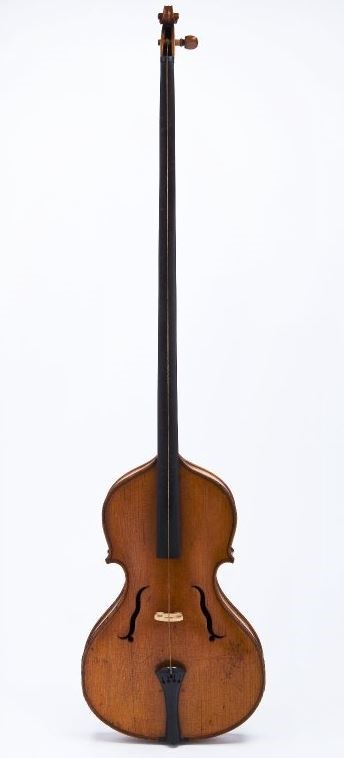
One-string fiddle
A circus runaway – the mysterious case of the one-string fiddle
When I first unwrapped this instrument from storage, I was confronted with an enigma. What was this instrument? It seemed to be a chimaera of the string instrument world, borrowing elements from lots of different instruments to make one very unusual fiddle. The top half is shaped like a violin, with a wide, rounded lower half which more closely resembles a 19th-century guitar. The soundholes are in a shape commonly seen on the viola d’amore – a member of the viol family popular in the 17th and 18th centuries. The very long neck and single string presented even more of a mystery. Single-string bowed instruments are rare worldwide, and even more so in the Western classical tradition to which the violin and viol family belong. However, string instruments have been the subject of experimentation for centuries, and the form of even the violin continues to evolve. Could this be an example of experimental innovation? Little information was collected about this instrument when it entered the museum’s collection in 1982. Luckily, the National Music Museum in South Dakota holds a perfect match within their collection. Documentation from the NMM revealed this to be a ‘violon du cirque’ – a circus violin – made in France c. 1900. This explains the motivation behind the maker’s experimental design – creating an instrument with a high novelty, entertainment and humour factor. The details of the circus routines in which this highly unusual fiddle might have played a part can only be imagined!
Looks can be deceiving

Złóbcoki

Baton-shaped kit
At first glance, this narrow-bodied instrument resembles a kit – a miniature fiddle popular as a portable instrument for private dancing tutors during the 17th and 18th centuries. Kits come in two basic categories – those shaped like miniature violins and those with long narrow bodies described as ‘baton-shaped’ by some authors and ‘gondola-shaped’ by others. However, this example is too large to be a kit, and doesn’t quite conform to the usual shape of the baton-style version. In fact, this is a złóbcoki, and has a completely different cultural context to the kit. While you would find a kit at home in the refined drawing rooms of London polite society in the 18th century, the złóbcoki is the folk fiddle of the Górale people of the Tatra Mountains in Poland. The złóbcoki was traditionally played at celebrations, weddings and marches, alongside a drum or basy (a Polish bass fiddle broadly comparable to the cello), and sometimes local bagpipes. This example demonstrates that within the twisting family tree of musical instruments, two instruments with very similar forms may have very different cultural contexts. However, the baton-shaped kit is thought to have evolved as a modification of the older rebec, a bowed instrument played widely in Europe during the Medieval and Renaissance eras. It is possible that future research may reveal that both the złóbcoki and the kit have their origins in the rebec – however without further data we can only speculate.
An imposter amongst the fiddles – identifying a Tibetan lute

Sgra-snyan
To tell the global story of music, musical instrument museums often collect examples from around the world. This means that organologists sometimes need to identify instruments from cultures other than their own, which can be confusing work. This striking red string instrument is carved from a single piece of wood, with a round resonator covered in hide which amplifies the sound of the strings. It was previously identified in museum records from the 1990s as a pi-wang, a type of bowed string instrument from Tibet. However, after a little research it became clear that this instrument did not have the cylindrical sound box of a pi-wang, and also had more than the standard two strings. Utilising the power of the internet, which makes finding reference images a breeze, I determined that it was definitely the wrong shape to be a pi-wang. After some further reading, another possible candidate emerged – the Himalayan plucked instrument called sgra-snyan (the name means ‘pleasant sound’). Traditionally, one of the roles of the sgra-snyan was to accompany nang-ma songs, associated with the music of the Dalai Lama’s court in the Tibetan city of Lhasa. Today, ensembles featuring the sgra-snyan along with the pi-wang and traditional flutes are played by the Tibetan community in exile in Bhutan and India, where the nang-ma repertory has been revived. Having revealed its true identity, this particular instrument can no longer be considered a fiddle. However, this example goes to show how the abundance of reference images and information on the internet has changed the task of musical instrument research between the 1990s and today. Understanding a museum collection is an ongoing process – there is always more to learn!
The varieties of fiddle held in the collection at St Cecilia’s Hall are far too numerous to research in a four-week internship, or cover in a single blog post. To explore more of the fascinating world of fiddles, visit the Laigh Hall or the Wolfson Gallery at the newly redeveloped museum.

Olivia Thorne
Further Reading
Cooley, T 1997, Ethnography, Tourism and Music-culture in the Tatra Mountains: Negotiated Representations of Polish Gorale Ethnicity, Doctoral Thesis submitted to Brown University, Rhode Island, accessed via ProQuest.
Durkin, R 2017, ‘The Dancing-Master’s Toolkit: a summary of the pochette of the seventeenth and eighteenth centuries and its role in society’, The Galpin Society Journal, no. LXX, pp. 65-79.
Halfpenny, E and Grame, TC 2017, ‘Stringed instrument’, Encyclopaedia Britannica Online, viewed 13th July 2017, accessible at <https://www.britannica.com/art/stringed-instrument#toc53709>.
Helffer, M 2000, ‘Tibetan Culture in South Asia’, in A. Arnold (ed.), The Garland Encyclopedia of World Music, Vol. 9, Garland, New York and London.
Henrion-Dourcy, I and Dhondup, T 2017, ‘Instruments – Tibetan Music’, in Grove Music Online, viewed 11th July 2017, accessible via Oxford Music Online.
Remnant, M 1984, ‘Kit’, in Grove Music online, viewed 13th July 2017, accessible via Oxford Music Online.
Stęszewski, J 2017, ‘Instruments – Poland’, in Grove Music Online, viewed 10th July 2017, accessible via Oxford Music Online.
Collections
 Hill and Adamson Collection: an insight into Edinburgh’s past
My name is Phoebe Kirkland, I am an MSc East Asian Studies student, and for...
Cataloguing the private papers of Archibald Hunter Campbell: A Journey Through Correspondence
My name is Pauline Vincent, I am a student in my last year of a...
Hill and Adamson Collection: an insight into Edinburgh’s past
My name is Phoebe Kirkland, I am an MSc East Asian Studies student, and for...
Cataloguing the private papers of Archibald Hunter Campbell: A Journey Through Correspondence
My name is Pauline Vincent, I am a student in my last year of a...

Projects
Cataloguing the private papers of Archibald Hunter Campbell: A Journey Through Correspondence
My name is Pauline Vincent, I am a student in my last year of a...
Archival Provenance Research Project: Lishan’s Experience
Presentation My name is Lishan Zou, I am a fourth year History and Politics student....