Home University of Edinburgh Library Essentials
April 9, 2026
Sydney Goodsir Smith Stands for Rector
In 1951, students voting for a new Rector of Edinburgh University faced a choice between a quite extraordinary range of candidates. The election of actor Alistair Sym in 1948 had put an end to a long tradition of electing career politicians or military men. This time, in the wake of Sym’s success, nominees included Nobel-prize winning scientist Sir Alexander Fleming, novelist Evelyn Waugh, music hall entertainer Jimmy Logan, and politician and spiritual leader, Sir Sultan Muhammed Shah, Aga Khan III.
Also on the ballot was Lallans poet Sydney Goodsir Smith, who had come to prominence three years earlier through his collection Under the Eildon Tree, one of the most significant works of the Scottish Literary Renaissance. Edinburgh University Archives have recently purchased a copy of Smith’s campaign leaflet, adding to our major collection of Smith papers (Coll-497).
Smith was born in New Zealand but moved to Scotland in 1928 when his father Sir Sydney Alfred Smith (1883-1969) was appointed Professor of Forensic Medicine at Edinburgh University. Smith himself began a medical degree at Edinburgh University but soon abandoned it to study Modern History at Oxford. The ‘Message from the Candidate’ in the campaign leaflet alludes to his brief Edinburgh career:
During my short and somewhat hectic time as a medical student here, I must have been inoculated with the bug of not exactly ‘study’ so much as just ‘being a student’, for I seem to have remained a student, of one thing or another, ever since.
Smith thus presents himself as ‘a real student’s rector’, who, unlike his ageing and out-of-touch rivals, will provide an ‘effective student voice’ on the University Court. There is a second strand to his campaign, however, which voters may have struggled to reconcile with his stance as a spokesman for student interests.
The ‘Message from the Candidate’ also states that Smith’s nomination is:
single evidence of the increased regard held for Scottish literature – too long the Cinderella of Scottish life and thought – by the student body of what used to be Scotland’s capital in fact as well as name
The leaflet, in fact, foregrounds Smith’s literary credentials. The cover photo portrays Smith in his study, resplendent in a smoking gown, and surrounded by tottering piles of books. Beneath the caption ‘Sydney Goodsir Smith: Poet, Scholar, Artist, Wit’ are endorsements from major literary figures of the day, Edith Sitwell, Neil M. Gunn, Duncan Macrae, Sorley Maclean, and Hugh MacDiarmid.

Conspicuously, the least political endorsements are placed first. Sitwell claims that ‘it would honour poetry should [Smith] be elected’, Gunn declares that ‘to vote for a Scots poet of so rare a vintage as Sydney Goodsir Smith I should find irresistible’. For actor Duncan Macrae, Smith is alone among the candidates in possessing ‘the distinction of genius’. Maclean too credits Smith with ‘creative genius’ along with an ‘irresistible personality’ and a place among ‘the very finest critical intelligences’.
Only the final endorsement from Hugh MacDiarmid, himself a rectorial candidate in 1935 and 1935, gives a hint of Smith’s political position. Presenting Smith as ‘an outstanding figure in the Scottish Renaissance Movement’, MacDiarmid describes him as:
A scholar, a lover of all the arts, a great wit, a well-informed Scot with all his country’s best interests at heart and above all a passionate concern for freedom and hatred of every sort of cant or humbug, he typifies all that is best in the Scottish National Awakening now in progress and is contributing magnificently thereto.
The rest of the leaflet does not so much explain how a commitment to the Scottish Literary Renaissance will shape Smith’s rectorial work, as set the two strands of his campaign side-by-side, leaving the voter to trace a connection. For example, it gives the following ‘Four Reasons for Supporting Sydney Goodsir Smith’:
- His distinction is that of real creative genius.
- He would be sure to give a worthwhile and amusing address.
- He is a Scotsman who believes in his own country.
- He would be a real students’ rector.

In places, the leaflet is a little self-contradictory. Students are asked to vote for Smith because ‘a Scottish university should first of all honour the great men of its own country’. They should not vote for Fleming, however, because he may be ‘a great scientist and benefactor of mankind’ but the ‘rectorship is an office of spokesman for the student body, not an honour per se‘.
Perhaps, in fact, the strongest claim that emerges from the leaflet is the likelihood of Smith delivering a colourful rectorial address. His credentials as ‘wit and humorist’ are illustrated in a series of put-downs of rival candidates. Particularly acerbic barbs are directed at Jimmy Logan (‘information scanty but supposed to be a comedian’), politician Sir Andrew Murray (‘nicely groomed ex-provost … non-allergic to limelight’), Evelyn Waugh (‘hobby – writing blue books for naughty, naughty Catholics’), and the Aga Khan (‘but who can’t?’).
Since acquiring the leaflet, we have discovered that another recent purchase, the archives of the Edinburgh student literary magazine The Jabberwock (Coll-1611), contains a draft version of Smith’s ‘Message from the Candidate’, together with the original manuscripts of the endorsements by Hugh MacDiarmid and Edith Sitwell. The Jabberwock’s editor Ian Holroyd evidently worked as Smith’s campaign manager, and the archive also contains a letter from veteran Scottish writer Compton Mackenzie, regretting that he cannot endorse Smith’s candidature, as he has been approached by two other candidates with equal claims on his support.
The draft of Smith’s ‘Message from the Candidate’ contains a substantial amount of text omitted from the published version. One deleted paragraph reads:
If this were a political election (which I am told it is not to be, this time), I think my sentiments would be well-known to some of you as those of a man who wished to restore the ancient dignity of Scotland – all-out, in fact, and only falling somewhat short of bombs in letter-boxes and Customs at the Border. However, as this is not to be political, and as we are unfortunately unlikely as yet to get the chance of reducing the tax on whisky, I come to you with no ‘policy’ at all. I have none, in the circumstances, for I believe it would not be proper (in the happy event of my election) or my place to represent any other body than the students of this University and to be their spokesman on the University Court.
Was it the hints of political extremism, the allusion to Smith’s drinking habits, or the cheery admission of having no policy, that most alarmed Smith’s campaign manager? Also deleted is the postscript ‘I am truly sorry Groucho refused – he’d have unstuffed a few more shirts’. Groucho Marx had, in fact, been asked to stand as a rectorial candidate, but sadly declined.

In the end, Sir Alexander Fleming, who enjoyed the near unanimous support of medical students, won a resounding victory. Smith’s backers may over-estimated the average Edinburgh student’s interest in literature. Canvassers for Evelyn Waugh commonly met with the response: ‘Who’s she?’
For more on the 1951 Rectorial campaign, see Donald Wintergill, The Rectors of the University of Edinburgh 1859-2000 (Edinburgh: Dunedin Academic Press, 2005), pp. 127-35. Although Smith was never to stand again, his father Sir Sydney Smith won the next Rectorial election in 1954.
Paul Barnaby, Acquisition and Scottish Literary Collections Curator
UPDATE: Subsequent research in our C. M. Grieve Archive has revealed that Sydney Goodsir Smith was invited to stand for Rector by the university’s recently formed Scottish Renaissance Society. In a letter to Hugh MacDiarmid, dated 14 October 1951, Ian Holroyd writes that ‘we thought Sydney a very good choice as a Scottish literary candidate in that he can draw support from the medical faculty as son of the dean and a former student as well as appealing to the nationally-conscious Scottish undergraduates’ (MS 2951.6/6-7).
Victorian Veterinary Journals

The Anatomy of the Horse. Stubbs, George.
Recently I worked on digitising a small number of volumes of The Veterinary Journal from the late 19th century and late 20th century. Almost 100 years apart, the earlier volumes from 1889-1898 had some questionable advice and cures for ailments including the free use of toxic chemicals and even a few drams of whisky for a horse’s stomach ache! We view these archaic methods nowadays with humour – after all, some absurdities are expected from a late Victorian medical journal.
Student interns in Stack III this summer
 Over this summer, our three student interns, Thomas, Holly and Mila have been hard at work behind the scenes in New College Library’s Stack III. Their task was to work with the X Collection, a collection of large (folio) early printed books. Over the years this collection had gathered a layer of dust, which our interns carefully removed with a museum book hoover. Having our interns handling each of these books was also a great opportunity to learn more about them, and to understand how the collection was composed in terms of date, language and place of publication. These details were logged using methodology adapted from projects on collections in National Trust Houses.
We’re delighted to say that that our interns have tackled three full bays of the X Collection, and cleaned and logged over 1600 books. We now know that the collection (as logged so far) is almost entirely pre-1800 in date, predominantly in English and Latin and pretty equally split between European and UK imprints. All this information will help us to develop future projects to catalogue this collection online.
It was a pleasure to work with our student interns, and through their enthusiasm to rediscover these collections. Hope to do it all again next year!

Christine Love-Rodgers, Academic Support Librarian – Divinity.
With thanks to Margaret Redpath, NCL Library Services Manager and Karen Bonthron, ECA/NCL Helpdesk Team Lead
Alexander Murray Drennan – pioneer of Eusol
Alexander Murray Drennan – or Murray to his friends – was born in Glasgow on 4th January 1884, and grew up in Helensburgh before coming to Edinburgh in 1901 to study medicine. Murray was a keen letter writer, and his letters to his sweetheart ‘Nan’ (Marion Galbraith, who would later become his wife) give an insight into the life of a young aspiring medical student:
Our first class begins at 8am so we have to be up betimes in the morning. From 8 to 10 I have anatomy and then at 11 I go over to the Infirmary; nominally we leave there at 1pm but on Operation days, twice a week at least, it is often 3 before I get away as I have the pleasure of being the instrument clerk and as such have to see after the instruments.
– GD9/45
It wasn’t all hard work, though. Murray’s letters to Nan and his family recount evenings spent at enjoying Edinburgh’s cultural offerings (“I went to see Faust on Monday night. It is rather a ‘creepy’ sort of opera but the music is very fine”); attending dinners (“at night there was a complimentary dinner given to Professor Beattie in the Caledonian Hotel … Beattie was very popular when he was here and no wonder for he was an exceptionally nice man and knew his work thoroughly”) and afternoons spent playing tennis and golf with fellow students as well as professors (“Professor Schӓfer had the goodness to ask me down to North Berwick to golf with him … a most enjoyable day’s golf in the most delightful weather. We went back to the house and had tea and then I had just time to get the 6.43 train back”).

Royal Infirmary of Edinburgh Residents, Summer 1907. Drennan is seated front row, far right.
After graduating MB ChB in 1906, Murray took up a practical apprenticeship as a Resident of the Royal Infirmary of Edinburgh. In between visiting patients and supervising the various nurses, clerks, dressers and medical students who attended the wards, the Residents made time to enjoy themselves (you can find out more about their antics over on the LHSA blog). In one letter to Nan, Murray related a night out for the ‘Mess’:

RIE Residents on a bus, ready for an outing.
Friday … evening at 9pm, the Mess having chartered a visitor bus (& driver) set out for Peebles. It created quite a sensation when at the appointed time one of these large buses labelled “Jeffery’s Lager” rolled up to the door & we all embarked. The inside was converted into smoking room, saloon bar, while the upper deck was occupied by the sightseers. It was very funny going out Dalkeith Rd, several people tried to get on board thinking it was a public conveyance, needless to say their attempts to mount our machine were not encouraged by word or deed. The run out was delightful as it was a clear warm evening & the road lies through pretty country. We got to Peebles shortly after 11pm & found supper all ready for us at the ‘Cross Keys’ inn. As usual the Mess meeting was constituted & we did full justice to the repast, reembarking again about 12.40am.”
– GD9/46
Following his residency Murray stayed close to home, working in the by-now familiar Pathology Department of the University of Edinburgh. When war broke out in 1914, he signed up as an official Pathologist with the Royal Army Medical Corps (R.A.M.C), and in 1915 he had to postpone an imminent appointment as the first full-time Professor of Pathology at the University of Otago in New Zealand and instead make his way to the R.A.M.C. Depot in Aldershot. In a letter home dated October 1915, he describes some of the men he will serving with and the set-up of their team:
The staff seem all very decent men, one or two are well over forty & must have been in practice. There are several Edinburgh graduates amongst them … on the whole I think we should work well together … There are two or three surgical specialists, one medical specialist, several radiologists, several anaesthetists and one bacteriologist … there is a little man Brown who has done a little in that way & I shall try & get him on to help, but he does not profess much technical knowledge!
– GD9/7
In early November 1915 Murray’s unit was deployed to Mudros, on the island of Greece. He would later describe how this previously “bare, stony island” was overtaken by military personnel:
As the occupation spread the whole of the harbour side of the island was dotted with tents from Mudros East to Condia on the west. It was a shifting population, today 10000, next week perhaps 60000. The only permanent fixtures, so to speak, being the various H.Q.s, the Base depots and the Hospitals.
To the north a little outside Mudros East were several stationary hospitals situated on a sun-baked flat, and there they bore the burden of the day; blinded with dust and flies and crowded up with cases of dysentery, the staff often sick, they cheerily toiled along. In the neighbourhood also were numerous camps of combatant units; and one bright spot, facetiously known as the “dogs’ home”, where extra medical officers were kept on the chain and supplied as required to the Peninsula or to units on the island.
– GD9/38
Murray’s letters home to Nan and their children from this time paint rather a relaxed picture of life in war time. Reading them, one is left with the impression that he only wanted to recount activities that his wife would be familiar with, rather than the full realities of a life in an overseas field hospital. One letter, for example, describes how they spend their evenings: “After dinner we had our usual games at whist. It is quite an institution and we have played every evening after dinner, always Richards and Thuilliers against the Colonel and me, and so far the games have been very even”. In another letter, Murray talks of attending a garden party: “it was just quiet tea in the Fergusons’ little garden, a shady spot with palms, & bougainvillea, & such things growing about. … We had tea & chatted & then left in small batches”.

Alexander Murray Drennan in Cairo, 1915
By 1915 some of Murray correspondents had already been stationed abroad for some time, and his incoming letters give insights into some very different military experiences. Murray’s younger brother James Stewart Drennan (who had joined the Royal Horse and Field Artillery in 1912) described life in Salonika and a close encounter with a German zeppelin:
It has been beastly hot here again the last few days and we have now chucked working in the middle of the day, instead we lie on our beds in a more or less nude condition and curse the flies, luckily it is still nice and cool at night.
Salonica [sic] had another visit from a Zepp. three or four days ago, just before daylight. All the guns and searchlights in the place got on to it at once and it was brought down before it had a chance of dropping any bombs. It came down in the marshes at the mouth of the Vardar River and the men were captured, so were felt rather bucked at having bagged a Zepp in this corner of the world.
– GD9/10
A letter from Tom Graham Brown, physiologist and mountaineer, gives an insight into the life of medical personnel at home:
Write me a decent letter and tell me all your news. I wish I was out there with you. I am at present fixed in this hospital which is one for shock cases – mostly men who are pretty badly shaken or bad mentally after bombardments. Very many of them get well – tho’ we get a good many early G.P.I’s before they are diagnosed.
I wish all the same that I could get out. It isn’t any catch being in this country. However I must trust to luck.
– GD9/4
Yet another perspective was provided by Dr John Fraser (later Prof. Sir John Fraser, Principal of University of Edinburgh). Dr Fraser was stationed in Northern France, and his letters describe the long, difficult days the staff there endured:
Lately we have been deluged with work: you can probably imagine what Monday was like. I was in the theatre from 10am to 12 midnight, and in that time there were 6 craniotomies: an amputation and 2 gas gangrene: in addition to others. One doesn’t feel much inclined for reading or writing after such days.
– GD9/100
There were benefits to working in such tough conditions, however. War often brings about significant advances in technology and medicine: as well as the greater incentive to improve the health of fighting forces, the need to take risks and experiment can also increase.
Many of the battles of WW1 took place on muddy farmland, and it could sometimes be days before a soldier was transported to a clearing hospital for comprehensive treatment. This meant the risk of already-traumatic wounds becoming infected was high, with gangrene claiming many lives.
For some time prior to his deployment Murray had been working with colleagues in the Pathology Department at the University of Edinburgh “to find an antiseptic which could be applied as a first dressing in the field to prevent sepsis”[1], and in 1915 they published a paper in the British Medical Journal on their experiments with ‘Eusol’, or Edinburgh University Solution of Lime. This was a combination of bleaching powder and boric acid, and early experiments both in the wards and in the field showed great success at reducing infection and speeding up healing.
In gathering accounts of these experiments, Murray relied on other colleagues who were using the Eusol treatment. This letter from Dr Fraser sets out the dilemma faced by many front-line surgeons, and his experience using Eusol:
Since I last wrote you I have had a run of gas gangrene cases, all of them I have treated with Eusol and in each case I have been thoroughly satisfied with the result. With one case I was exceedingly impressed. Lt. Col. —- had been infected 5 days before admission to the Hospital – on admission there was most gangrene to the lower of the knee: from this knee to the groin there was the gas infection of the tissues which precedes the tissue necrosis. One was faced with three possibilities – 1. Leaving him alone to die 2. Doing a flapless amputation at the hip joint: a mutilating operation from which few recover 3. Amputation through the centre of the thigh, in other words, through the centre of the gas infected area, and risking it.
I chose the last: I did the operation under Special Anaesthesia and as I was doing the operation I remarked that it ought to satisfy the criteria as regards the use of Eusol. I amputated through the thigh and not only so but I made flaps and partly closed the wound, a thing one had never dared to attempt previously… The result was a complete success: no trace of gangrene appeared subsequently.
– GD9/100
A further hurdle to be overcome in wartime was the difficulty in communicating such advances. Recognising the delays to the mail that could occur, Murray devised a system for himself and Nan:
I sent off my last to you on Sunday afternoon, & I labelled it no.1 as I explained so that you would know by the number if a letter was missing, of course I have sent several to you before I began the numbering. This is a recapitulation in case you didn’t get my last letter.
– GD9/4
Murray also kept a small diary in which he recorded letters sent and received – an absolute dream for archivists and researchers!

There are roughly 6 archive boxes of letters like this – thankfully Drennan had a system by which to organise them!
No such system was in place for the medical men, however, and correspondence over a number of weeks between Murray, J. Lorrain Smith and Fraser details the somewhat arduous process of getting an article published.
I am sorry to have been so lazy in getting this note away, but during the last week the pace of work has increased and although [things are quieter] at present, if I do not get these away now it may be a long while before I have another opportunity.
– Fraser to Drennan, 17 Sep 1915
For the past fortnight I have been cut off from all correspondence and your letter and the manuscript were awaiting me here on my return. I have handed the manuscript to the Colonel and he has approved of it: he forwards it to the DMS [Director of Medical Services] and who if he approves will forward to the War Office: the WO will notify the BMJ or Dr Fletcher to proceed with the publication. The ways of the army are wonderful but there they are!
– Fraser to Drennan, 5 Dec 1915
By 1916 Eusol was an established means for treating septic wounds, and even today[1] hypochlorus acid forms a backbone to attempts to accelerate wound healing.
After being discharged from service in 1916, Murray was finally able to take up his place in New Zealand, with his wife and children joining him shortly after. They remained there until 1929 when Professor Drennan took up the Chair of Pathology at Queen’s University in Belfast, and in 1932 he returned to his alma mater to take up the Chair at the University of Edinburgh, where he remained until his retirement in 1954. Professor Drennan died in 1984, a few weeks after his 100th birthday.
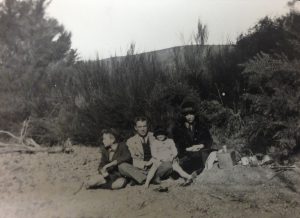
Alexander Murray Drennan and family on a picnic in Dunedin, New Zealand.
References
[1] http://www.pmfanews.com/media/4762/pmfaas17-cleansing-new.pdf
[1] 2 Smith JL, Drennan AM, Rettie T, Campbell W. Experimental observations on the antiseptic action of hypochlorous acid and its application to wound treatment. BMJ 1915;ii: 129-36.
New College Library Collections go under wraps during essential maintenance work

Essential maintenance work is being undertaken in September and October on the New College heating system. We will be installing protective coverings in the Library to manage risks of leaks from the heating pipes which run through the New College Library collections on all the Stack floors. This means that public access to library collections in Stack I and Stack II is likely to be restricted between Monday 28 August and Wednesday 20 September. The Library Hall and the David Welsh Reading Room will be open as usual, and we will be running a fetch on demand service for library users with hourly collections. We regret that there is likely to be some noise disruption from the works during September and October, and we will continue to provide earplugs for anyone who needs them.
Updates and further information on New College Library
Christine Love-Rodgers, Academic Support Librarian – Divinity
New E-Resource – Climate Change and Law Collection
 Following a successful trial, we have purchased Brill’s Climate Change and Law Collection.
This comprehensive collection of climate change and law documents contains original source, non-edited and non-redacted “grey literature.” Incorporated in the category of ‘law’ is any discipline of law which addresses climate change, including corporate law, environmental law and human rights law. Materials in the collection originate from a wide range of organizations in the public and private sector, institutions, and/or individuals, world-wide.
This collection will continue to grow and covers the following subject areas:
- Carbon Emissions
- Climate Change and Conflict
- Climate change and Corporate Social Responsibility/Sustainable practices
- Climate Change and Finance
- Climate Change and Food Security
- Climate Change and Health
- Climate change and human rights
- Climate Change and Indigenous Rights
- Climate change and law/environmental law/human rights law/land rights
- Climate change and market-based instruments
- Climate Change and Natural Disaster
- Climate Change Negotiations
- Climate Justice
- Environmental law
- Global Environment Change/Global climate change
- Human rights law and environmental/climate change
- Sustainable development
Access this collection via DiscoverEd, or our Law databases AZ list.
Archives abound in Archives Unbound
Exciting major online primary source database now available at the Library.
I’m really pleased to let you know that the Library has got a 1-year subscription to the fantastic primary source database Archives Unbound from Gale Cengage. Archives Unbound currently has 265 collections of primary source material, with new collections added every year. It is a huge database and covers a wide range of subject areas and time periods.

You can access Archives Unbound from the Databases A-Z list and appropriate Database by Subject lists. The Library has already previously purchased permanent access to 9 collections from Archives Unbound and you can find out more about these at Spotlight on Archives Unbound.
What is Archives Unbound?
Archives Unbound presents topically-focused digital collections of historical documents that support the research and study needs of students and academics. Collections cover a broad range of topics from the Middle Ages forward-from Witchcraft to the Second World War to 20th century political history and the collections are chosen for Archives Unbound based on requests from scholars, archivists, and students.
In Archives Unbound you can search through all 265 collections at one time or you can choose to search/browse individual collections or groups of collections.
What’s in Archives Unbound?
More Wiley E-Books now available

We have signed up for a one year deal with Wiley publishing which gives access to most of their e-book content on Wiley Interscience. At the end of the deal, some of these titles will be retained permanently.
We have loaded 19,556 e-book records across all subject disciplines to DiscoverEd and will continue to add further titles on a monthly basis. Click the image link below to start browsing your subject area!

Further info
We also have a SHEDL deal which gives us access to the e-journal content.
On trial: Early European Books
*The Library has access to all Early European Books collections until 31st July 2024 as part of ProQuest Access 350.*
Following a request from staff in History the Library currently has trial access to all collections available in ProQuest’s Early European Books, a database that aims to trace the history of printing in Europe from its origins to 1700.
While the Library already gives you access to Collections 1-4, this trial period gives you access to the further 7 collections currently available in Early European Books.
You can access this resource via the E-resources trials page. Access is available both on and off-campus.
Trial access ends 15th September 2017.

Building on the success of Early English Books Online (EEBO) – which the Library already has access to – Early European Books is set to encompass all European printed material, and material printed in European languages, from the early modern period. Read More
Nature Reviews Neurology – archive access now available
 The Library has purchased the archive of Nature Reviews Neurology 2005-2011, (published as Nature Clinical Practice Neurology from 2005 – 2009). We now hold a full run of this journal online.
Nature Reviews Neurology publishes content written by internationally renowned clinical academics and researchers targeted towards readers in the medical sciences, from postgraduate level upwards.
Access this e-journal via DiscoverEd.
Collections
 Hill and Adamson Collection: an insight into Edinburgh’s past
My name is Phoebe Kirkland, I am an MSc East Asian Studies student, and for...
Cataloguing the private papers of Archibald Hunter Campbell: A Journey Through Correspondence
My name is Pauline Vincent, I am a student in my last year of a...
Hill and Adamson Collection: an insight into Edinburgh’s past
My name is Phoebe Kirkland, I am an MSc East Asian Studies student, and for...
Cataloguing the private papers of Archibald Hunter Campbell: A Journey Through Correspondence
My name is Pauline Vincent, I am a student in my last year of a...
Projects
Cataloguing the private papers of Archibald Hunter Campbell: A Journey Through Correspondence
My name is Pauline Vincent, I am a student in my last year of a...
Archival Provenance Research Project: Lishan’s Experience
Presentation My name is Lishan Zou, I am a fourth year History and Politics student....