Home University of Edinburgh Library Essentials
March 24, 2026

3 things we can do to make open access better
Open access is being pulled and pushed in different directions by groups who each have their own intentions and motivations:
- Research funders want to maximize their investment and – by holding the purse-strings – are the change instigators accelerating the pace of adoption of open access. Some are more proactive than others pushing scholarly communication towards Gold OA in certain subject disciplines, whilst other funders are less active preferring change to be more organic.
- Publishers, as gate-keepers of the scholarly written record, influence how open access happens through innovation (developing new business models and products), control of intellectual property (open licensing or imposing journal embargoes) and controlling the spiraling costs. Some publishers are profit-driven and seek the highest returns that the market can burden. Others are more motivated by the academic community
- Libraries are change agents who can help to enable open access in institutions, for example through implementing repository platforms and offering support services and expertise. Their motivations to be involved are many; Library core values are well-aligned with open scholarship, they have a strong interest in and are well-placed to ensure institutional funds are efficiently allocated, and there is a drive to enhance their relevance through redefining roles within research institutions.
- Academics. It is easily to fall in to the trap that academics are passive actors in all of this. It feels like the silent majority go along with the status quo as research is their prime concern, and scholarly communication is a side-show with which they have little interest in how it works. Because publishing is increasingly being outsourced they lack a sense of agency or ownership. However, some researchers are driven to innovate and change their scholarly communication practices.
The interaction of each of these players in the scholarly communication game has led to the development of a system driven by interlocking policies, platforms and processes, which we have shown over the course of the last few blog posts, is unnecessarily complex, expensive, inefficient and increasingly at risk of being not fit for purpose.
What steps should libraries be doing to improve scholarly communication?
1. Remove complexity
The problem with Green OA is – it’s not immediate (journals embargoes are far too long), it’s not compliant with all funders policies and it’s unnecessary complexity (checking and matching funders policies and journal embargoes) is inefficient and has many hidden costs.
Help your institution to adopt the UK-Scholarly Communications Licence and most of these problems are diminished. [Read more here]
2. Reduce OA publishing costs
Hybrid OA Gold is the most popular and expensive route for paid open access. A side effect of lowering embargoes is that authors can comply with their research funders open access policies via Green OA.
Where possible, stop paying Hybrid OA costs, and use the open access block grants for pure Gold OA only. [Read more here]
3. Innovate and nurture academic-led publishing
Academic and National Libraries should support academic-led publishing and open access initiatives that are inclusive and open to scholars who do not have budgets for publishing.
Help your staff and students set up their own open access journals using software like Open Journal Systems. Support initiatives like the Open Library of Humanities by becoming a supporter member, and if you are from a larger institution then you should offer to support at a higher rate. [Read more here]
E-Resource trials ending tomorrow
Last chance to try out some potential new e-resources – our iLaw Maritime and Illustrated London News trials both end tomorrow.
iLaw Maritime covers publications, forms & documents, legislation, practice notes & events relating to maritime law.
The Illustrated London News Historical Archive gives students and researchers unprecedented online access to the entire run of the ILN from its first publication on 14 May 1842 to its last in 2003.
Access these and our other currently running trials from our Trials Webpage.
Nikkei Asian Review through Factiva and Nexis UK
Some colleagues and students have asked about online access to Nikkei Asian Review, a weekly magazine in English published by Japan’s leading business and information company which provides timely corporate, economic news from Japan and the Asian region.
The good news is that the full text of Nikkei Asian Review is fully covered in two news source databases that the Library is subscribing to. Factiva provides full text content of this publication from 21 Nov. 2013 onwards, and in Nexis UK from 3 June 1980 onwards. Update schedule is same day as publication. Both databases are indexed in the Library’s Databases A-Z list (www.ed.ac.uk/is/databases-a-z).
Copernicus x Smith

The University’s Iconics Collection holds some of the institution’s most valued and treasured items, and the recent push for more digitisation of the University of Edinburgh collections has meant that the Iconic items are a high priority.
Recently I digitised Copernicus’ De Revolutionibus Orbium Coelestium (The Revolutions of the Heavenly Spheres). Copernicus is regarded as one of the central figures of the Scientific Revolution for his heliocentric theory. It is considered one of the key works in the history of western astronomy as it brought forth a new theory about the Universe and our place in it at a time where it was widely believed that everything in the Universe orbited a motionless, central Earth. It was also the first open criticism against Aristotelian and Ptolemic systems, which in addition to claiming Earth was central, employed the classical ideal of ‘celestial motions’ being eternally uniform and circular. Read More
Academic-led publishing
Our last #openaccess week blog post finished with the observation that publishers are increasingly becoming in control of scholarly infrastructure, and that it is now more important than ever for academics to retain control over their research and publishing activities. To help with this we made the recommendation that Academic and National Libraries should support ‘low cost and no cost’ Gold OA – meaning open access initiatives that are inclusive and open to scholars who do not have budgets for publishing. To paraphrase Martin Eve who could articulate this better than I could ever hope to:
“….the economics of the humanities are different. The majority of research in the humanities remains unfunded except through institutional time. For this reason, Article Processing Charges are not a palatable option for these disciplines.“
Compared against STEM subjects and the lifesciences, commercial publishers have not made much headway with Gold OA in the arts and humanities disciplines. Partly in response, I believe in recent years this has led to lots of academic-led publishing initiatives being set up. You can read more in this excellent paper by Adema & Stone:
Open Library of Humanities
One of my favourite initiatives in the humanities is the Open Library of Humanities. It is funded through a model of library partnership subsidies which collectively funds the platform and its array of journals. A large number of libraries and institutions worldwide already support the OLH, which makes for a sustainable, safe platform.
The annual cost for supporting libraries is less than one Gold OA article processing charge which is excellent value for money – if you had £1000 would you prefer to provide open access to one article or for a whole suite of journals? If your institution hasn’t already signed up – you can check here (https://www.openlibhums.org/plugins/supporters/) – then I would wholeheartedly recommend that you sign up to be a supporting member. In fact, if you are from a larger institution then you should offer to support at a higher rate (which is STILL cheaper than one Hybrid Gold OA publishing fee):
University of Edinburgh further supports OLH
Edinburgh University Library Open Journals
Edinburgh University Library supports the publication of academic and student-led open access journals by providing a journal hosting service using the Open Journal Systems software. The Open Journal service is available to University of Edinburgh students and academics and is provided free of charge.
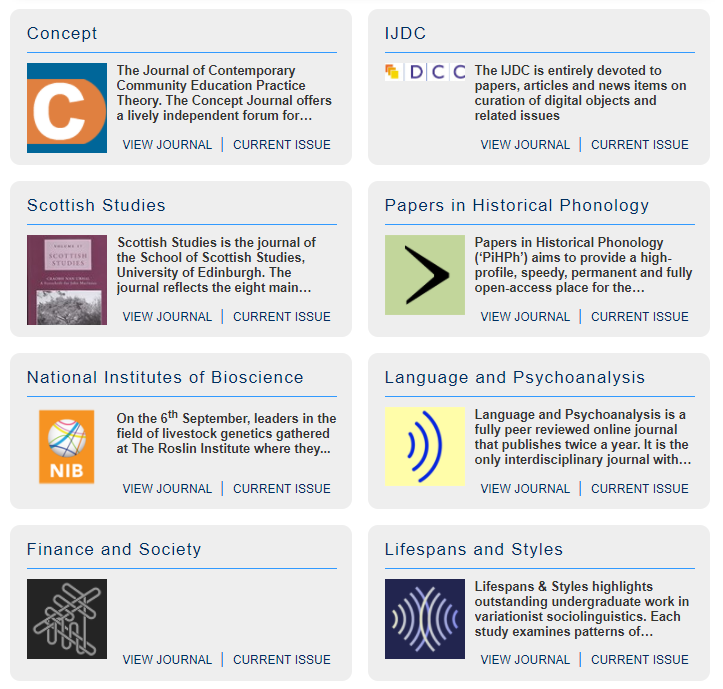
The Library helps with the initial set up of all new journals and provides ongoing support. We:
- Provide the service free of charge on the condition that journals requirements can be met without additional cost or time to the Library.
- Provide advice and support to help editorial teams set up their journal and training on using OJS
- Provide limited customisation of the new journal according to the design brief supplied by the journal editorial team. Provide initial training and documentation and ongoing support
- Provide training (as required) for new publishing staff
- Consult with experts in the Library to offer copyright advice
- Set up a Google Analytics account for each journal. Please note, the Library may make appropriate use of the statistical data
- Manage (and pay for) Digital Object Identifiers (DOIs) which use the Library’s DOI prefix: 10.2218
- Apply for an ISSN on behalf of the journal
- On publication, apply to DOAJ (Directory of Open Access Journals).
Currently there are 16 journals on the platform and we are looking to grow the service over the new two years.
On trial: primary source databases
I’m happy to let you know that Adam Matthew Digital are very kindly giving us trial access to 7 of their fabulous primary source databases. This gives you a unique opportunity to access some extensive digitised primary source collections that between them cover the 16th to the 21st century.
So if you’re interested in the history of the book or history of publishing, theatre history, socialism in the 20th century, Japan in the 20th century, social and cultural history, 17th to 19th century poetry, Shakespeare, Wordsworth, etc., there may be something here for you.
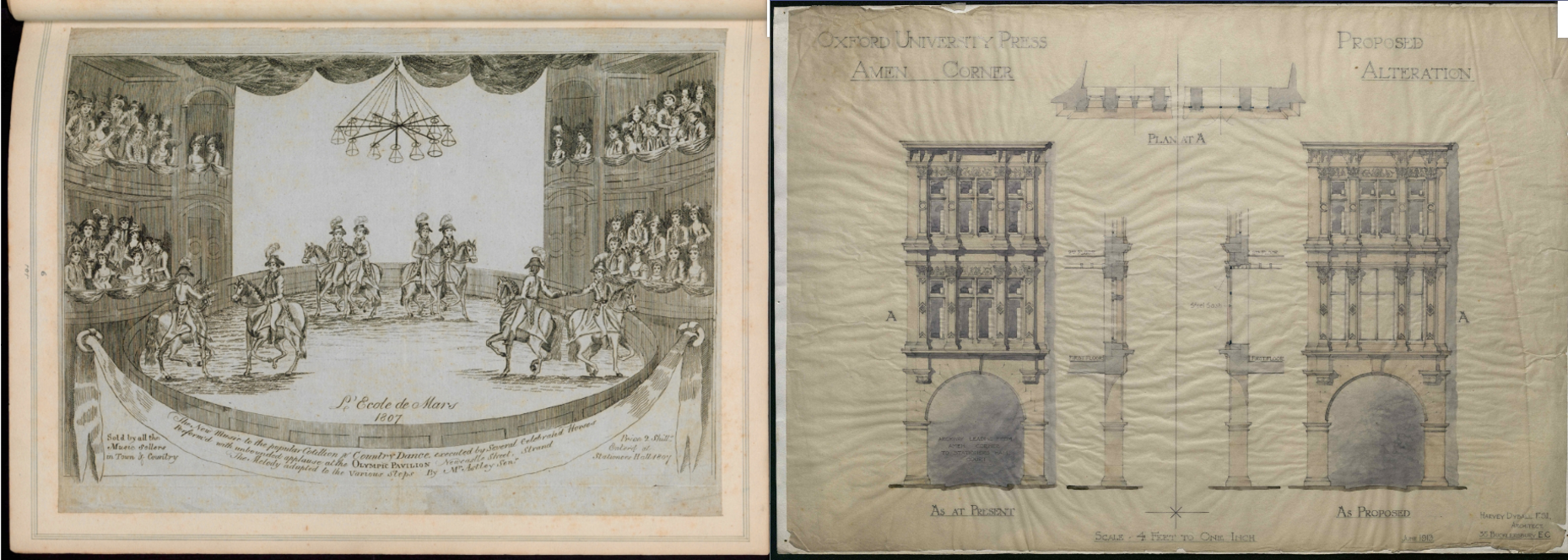
Left: Advertisement for the New Music of Country Dance executed by several celebrated horses at the Olympic Pavilion (1807) from Eighteenth Century Drama. Right: Architectural plan for Oxford University Press, Amen Corner (1913) from Literary Print Culture.
All the databases can be accessed via the E-resources trials page.
Access is available on and off-campus.
Trial access to all the Adam Matthew Digital databases ends 20th November 2017.
I’ve already highlighted Socialism on Film and Foreign Office Files for Japan in previous blog posts so this post will round up the further 5 databases available to us for the trial period. Read More
On trial: Foreign Office Files for Japan
Are you interested in Japanese history in the twentieth century? Do you want to know more about Anglo-Japanese ties in the first half of the twentieth century?
The Library currently has trial access to Foreign Office Files for Japan, 1919-1952 from Adam Matthew Digital. This database makes available extensive coverage of British Foreign Office files dealing with Japan between 1919 and 1952.

You can access the database via the E-resources trials page.
Access is available both on and off-campus.
Trial access ends 20th November 2017. Read More
UK Scholarly Communications Licence (UK-SCL)
In the first blog post in this series we set out the position that – whilst Gold OA is an important component of future scholarly communications – Hybrid Gold OA as it currently stands is too expensive to be adopted sector wide, and we recommend alternative paths to openness, like Green OA. The second post in the series highlighted a successful implementation of Green OA in a large research-intensive institution. However, we pointed out a number of problems with Green OA – it’s not immediate (journals embargoes are far too long), it’s not compliant with all funders policies and it’s unnecessary complexity (checking and matching funders policies and journal embargoes) is inefficient and has many hidden costs. In this third blog post of the series we are going to introduce a potential solution to these problems – the UK-Scholarly Communications Licence (UK-SCL).
Motivation and policy
The UK-SCL is an attempt to fix the problems of Green OA and provide a one-step deposit action by which researchers can comply with multiple funder policies. It is a model open access policy with a standard set of actions which can easily be adopted by UK HE Institutions. If adopted institutions will:
- Make accepted manuscripts of scholarly articles of its staff available online
- on or shortly after the date of first publication, be it online or in any other medium
- with a Creative Commons licence that allows non-commercial reuse as long as the authors are fully credited (CC BY NC 4.0)
- Allow authors and publishers to request a temporary waiver for applying this right for up to 12 months for AHSS and 6 months for STEM (aligned to REF panels).
- Where a paper is co-authored with external co-authors, the institution will:
- Automatically sub-licence this right to all co-authors credited on the paper and to their host institutions.
- Not apply the licence if a co-author (who is not based at an institution with a UK-SCL-based model policy) objects.
- Honour waiver requests granted by other institutions which have adopted the UK-SCL model policy.
- Where an output is available immediately on publication with a CC-BY licence, the accepted manuscript will remain on closed deposit.
Implications
If we adopted the policy today what would happen? Well, immediately it would enable institutions and researchers to comply with sixteen research funders by deposit in institutional repositories without further action. This simplification – of messages we give to authors, and to our processes – will lead to efficiency savings in staff time and cost.
Long journal embargoes would be a thing of the past and research could be legally shared without having to resort to methods where copyright is infringed, for example by using Sci Hub or uploading papers to ResearchGate.
Researchers funded by the RCUK wouldn’t be beholden to pay for Hybrid Gold OA anymore. The authors can make their own choice whether they want to pay the APCs or not. If they think it is good value for money they can pay to have their research published, but if they think the APC is too expensive they can also choose to go green.
Response
We have immediately seen a push back from the Publishers Association who seem to have three main concerns:
- Cancellations to journal subscriptions because embargoes are removed/lowered
- Loss of income from Hybrid Gold OA charges.
- Loss of control in the scholarly communication process
In my experience the first point is a complete red herring. The fear from publishers is that because something is available for free then their product won’t be bought. What is not being mentioned is that a lot of this content is already available for free – via SciHub, or #icanhazPDF, or other illegal sharing methods – and subscriptions have not dropped. Additionally, a number of significant academic publishers (including the Royal Society, Cambridge University Press, Emerald and SAGE) already have zero month embargoes for selected titles and they are not affected by cancellations.
The loss of income from Hybrid Gold OA charges is a legitimate concern and to be honest publishers should be worried about this. The thing is, over the last 5 years Hybrid Gold OA has been a bonus to many publishers. It is an additional income stream on top of subscription charges. The total cost of publication has risen something like 25% in the last five years directly due to Hybrid Gold OA. The behaviour we have seen from many commercial academic publishers is that it is their unalienable right to extract as much profit from the open access block grants given to UK universities. As an administrator of one of these funds I am well aware that the block grants are given to us from charitable organisations, and taxpayers money, via the government. We have to make sure that these funds are used responsibly and that we receive maximum value for money. I would like to see the open access block grants used only for pure Gold OA charges and to stop paying unnecessary Hybrid Gold OA charges.
The final point about loss of control in the scholarly communications process comes at a time where many large academic publishers are aggressively diversifying from their traditional publishing activities. Their aim is to be an integral part of the entire research process – from the inception of research via lab notebooks, pre-print servers and academic social networks, through to its conclusion via research data management, repository platforms, and research information management. I am not against paying for useful services, however when researchers are prevented from sharing their work because profit is more important, then something has clearly gone wrong with the system. It is now more important than ever for academics to retain control over their own research and publishing and this topic will be discussed in tomorrow’s blog post – academic-led publishing.
Conservation Volunteers in the Collections Rationalisation Project
This week our Project Conservator, Helen, talks about the great work volunteers have done as a part of the Collections Rationalisation project…
Some of the main aims of the Collections Rationalisation project at Edinburgh University is to ensure that the library space is being used as efficiently as possible and that collections housed at the University Collections Facility (UCF) are stable and safe to be handled. For this project, priority collections which require conservation have been identified and highlighted. So far the main focus of the project has been on the special collections, in particular the rare books.
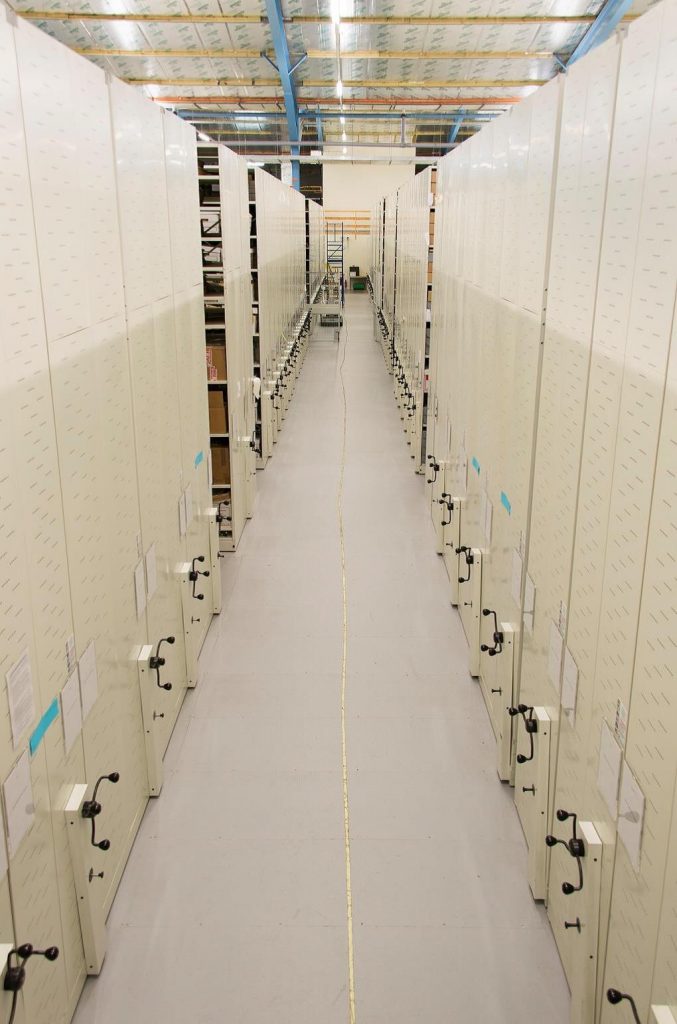
Roller racks at the UCF
Dawsonera e-book download changes

From the 1st November, e-books (both PDF’s and ePub’s) downloaded from the Dawsonera website will require installation of Adobe Digital Editions or the Bluefire app for mobile devices. As many of our e-books are already set up this way, most users will be unaffected. If you do need to install Adobe Digital Editions, some useful links are below:
- Installation page for Adobe Digital Editions – http://www.adobe.com/uk/solutions/ebook/digital-editions/download.html
- Dawsonera userguide on installing ADE – http://libraryservices.bertrams.com/DawsonBooks/InstallingAdobeDigitalEditions.pdf
- Dawsonera guide on creating an Adobe ID- https://youtu.be/BYw95y4jXQs
Further info
Further info about the main e-book platforms we use can be viewed at our e-book AZ lists.
Collections
 Hill and Adamson Collection: an insight into Edinburgh’s past
My name is Phoebe Kirkland, I am an MSc East Asian Studies student, and for...
Cataloguing the private papers of Archibald Hunter Campbell: A Journey Through Correspondence
My name is Pauline Vincent, I am a student in my last year of a...
Hill and Adamson Collection: an insight into Edinburgh’s past
My name is Phoebe Kirkland, I am an MSc East Asian Studies student, and for...
Cataloguing the private papers of Archibald Hunter Campbell: A Journey Through Correspondence
My name is Pauline Vincent, I am a student in my last year of a...

Projects
Cataloguing the private papers of Archibald Hunter Campbell: A Journey Through Correspondence
My name is Pauline Vincent, I am a student in my last year of a...
Archival Provenance Research Project: Lishan’s Experience
Presentation My name is Lishan Zou, I am a fourth year History and Politics student....