Home University of Edinburgh Library Essentials
March 24, 2026
On trial – Enhanced Electronic Grammars (EEG)
 Overview
- Specially designed for the needs of general linguists and typologists.
- Enables simultaneous complex searches across dozens of languages on hundreds of linguistic phenomena.
- Naturalistic examples illustrate each linguistic phenomenon, together with interlinear glossing and free translation.
- There is a focus on small and endangered languages.
- Permits access to unlimited number of simultaneous users.
- User guide available.
- Trial access available until 31st March 2018.
Daily Mail Historical Archive trial access
*The Library has now purchased access to the Daily Mail Historical Archive (1896-2004). See New to the Library: Daily Mail Historical Archive.*
I’m pleased to let you know that thanks to a request from a student in HCA the Library currently has trial access to the Daily Mail Historical Archive (1896-2004) from Gale Cengage. Whatever your feelings about the Daily Mail this is a fascinating archive providing access to over 100 years of the newspaper, while also providing an important alternative perspective to newspapers such at The Times, The Guardian, etc.

You can access the database via the E-resources trials page.
Access is available both on and off-campus.
Trial access ends 9th February 2018. Read More
10,385 theses down, 2,115 to go!
The Library’s project to digitise its entire collection of PhD and doctoral level theses is now entering its final phase, with the team on track to have all 17,000 volumes scanned by May and online by the end of 2018.
To date, the team has digitised 10,385 individual theses out of an internal target of 12,500 – in total, over 2.6 million pages have been scanned, making this the largest digitisation project the Library has ever undertaken. In addition to the work in-house, approximately 4,500 volumes were outsourced to Autodocs, our scanning partner, in 2017.
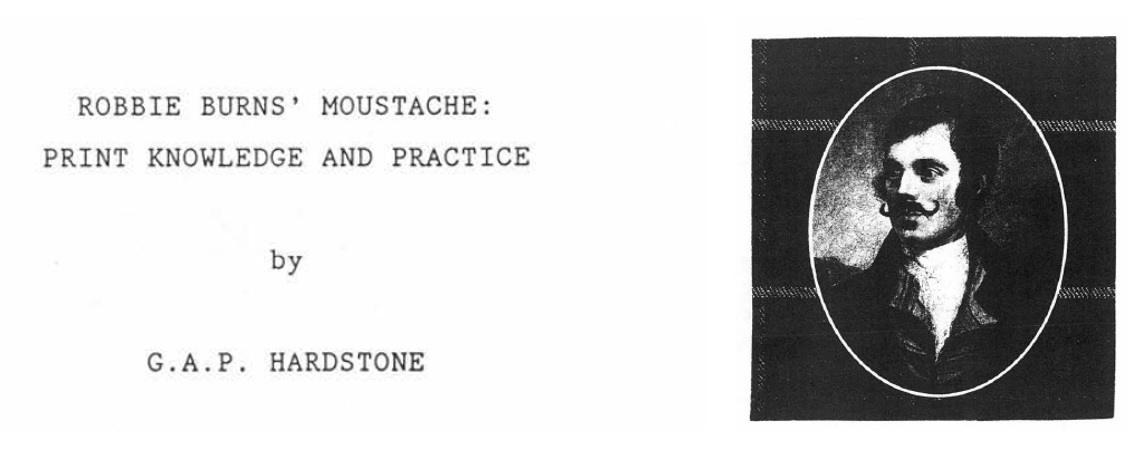
Robbie Burns’ Moustache: one of the 10,385 theses digitised to date. Accessible at https://www.era.lib.ed.ac.uk/handle/1842/21286
We have now almost completed the scanning of the 20th and 21st century collections, and the 19th century handwritten theses are due to be digitised by the end of January. The final three months of the project will then be dedicated to digitisation of the older printed Latin volumes – medical theses dating from the mid 18th to mid 19th centuries. A small collection of even earlier theses, dating from as far back as 1599, will be photographed by our colleagues in the Digital Imaging Unit.
After digitisation, the theses are uploaded to the Edinburgh Research Archive (ERA), where they are available to download for free. We have now uploaded over half of the collection to ERA, and by the end of January we will be ahead of our target to have all Edinburgh PhDs online by the end of 2018.
Theses digitised by this project are currently being downloaded over 3,000 times per month, with the most popular to date being The Social differentiation of English in Norwich by Peter Trudgill, which has been accessed almost 350 times since it was added to ERA last year. Other popular titles include Myo-Mint’s Study of the interpersonal dimension of narrative fiction with specific reference to power and control in Muriel Spark’s Memento mori and its implications for the teaching of English literature in a TEFL context (272 downloads) and Ji-Hwan Song’s Business ethics and the corporate manipulation of expressions (256 downloads).
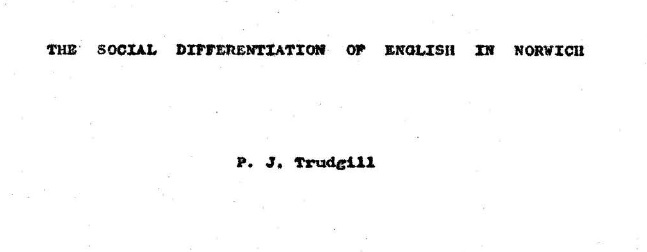
Title page for Peter Trudgill’s PhD – The Social Differentiation of English in Norwich. Accessible at https://www.era.lib.ed.ac.uk/handle/1842/16333
We will be showcasing some of these works in an exhibition that will be running in the CRC at the end of the year. As well as telling the story of the Edinburgh PhD from the earliest 16th century disputations through to the modern, A4, typed and bound thesis, the exhibition will feature examples of interesting authors, unusual topics and highlight some of the more surprising things we have found within the humble PhD volumes.
Giulia’s recent blog post mentioned some of these – we’ve also come across items ranging from the grisly (laminated slices of human lung) to the darkly comedic (a bullet in a thesis which the author had accidentally shot himself with). And that’s not even mentioning the test tubes, vials and envelopes of mysterious white powder that have been unearthed by the team over the last two years…
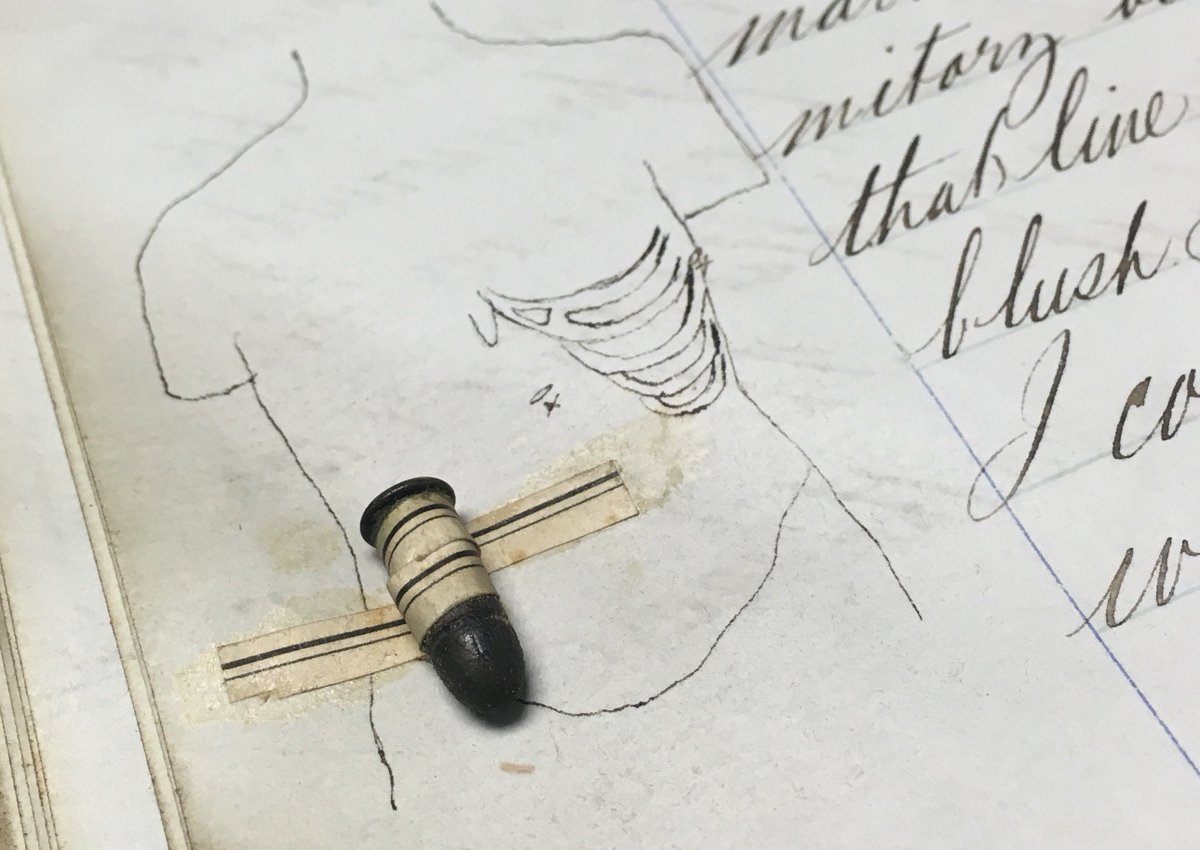
Bullet in a thesis
Now that the project is entering its final phase, we are beginning to discuss how the content might best be used once all digitised theses are online. There is already strong demand for researchers for digital theses but we are keen to explore other ways that we can make use of, and open up, this large data set. In addition to work we’ve already undertaken with uploading a thesis to Wikisource, our Digital Scholarship Developer Mike Bennett is exploring how we can match digitised theses to their author pages on Wikipedia using authority records, as well as working on a tool which enables the bulk generation of Wikidata records for theses.
Keep an eye out for further updates as we enter the final stages of the project.
Gavin Willshaw (gavin.willshaw@ed.ac.uk)
Crowdsourcing Conservation 2018
Due to the success of last year’s ‘Crowdsourcing Conservation’ event, we are repeating the session on 19 and 20 February 2018! You can read more about last year’s event here.
This year, we will continue to work with the Laing collection, this time rehousing section IV. Over the two-day period we aim to rehouse 96 boxes, completing the boxing of the Laing manuscript material.

Boxes from the Laing II collections, before (left) and after (right) rehousing
Damage has been caused to these collections due to the current storage in vertical boxes. Folders have slumped in under-filled boxes, and caused planar distortion of the papers. Tearing and creasing has occurred due to the lack of internal protection. To solve this problem, we want to rehouse the collection in acid-free folders and boxes.
Spotlight on Gale Cengage digital primary sources
On Tuesday 30th January we’ll be holding a Discovery Day event in the Main Library where representatives from 3 publishers of digitised primary source collections and our very own Centre for Research Collections will be on hand to help you navigate through and find useful material in the huge range of primary sources you have access to at the Library. Gale Cengage are one of the publishers who will be attending and this blog post highlights the fantastic collections the Library has access to through them.
The Library has access to a large and broad range of primary source collections that can be accessed via the Primary Source database list or the separate Newspapers & Magazines list and Images & Moving Images list.
 The Library is very lucky to have access to 12 of these types of databases from Gale Cengage, a leader in education, learning, and research resources online. This actually gives you access to around 300 collections of primary source material. Gale’s digital collections span 500 years of history and a wide breadth of topics, including politics, society, business and leisure. Read More
Nature Journals 2018 renewal
With the 2018 renewal of our Nature journals collection, we gain access to 3 new titles.

Nature Catalysis – this new journal will bring together research from across all chemistry and related fields, incorporating both fundamental and applied studies. With Nature Research Group’s focus on the grand societal challenges, this journal will have a particular interest in applied work that advances our knowledge and informs the development of sustainable industries and processes.

Nature Electronics – publishing both fundamental and applied research across all areas of electronics, from the study of novel phenomena and devices, to the design, construction and wider application of electronic circuits. The core focus of this journal will be the development of new technologies and understanding the impact of these developments on society.

Nature Sustainability – this new journal will publish research contributing to a deep understanding of the ways in which we organise our lives in a finite world and the multiple impacts our actions have. Beyond fundamental research, the journal aims to publish studies of policies and solutions to ensure human well-being now and in the future, facilitating important cross-disciplinary dialogues to respond to the greatest challenges of our time.
Further info
All 3 titles are available via our e-journals AZ list or DiscoverEd.
Museums sites go IIIF
 The main portal into Library and University Collections’ Special Collections content, collections.ed.ac.uk, is changing. A design overhaul which will improve discovery both logically and aesthetically is coming very soon, but in advance, we’ve implemented an important element of functionality, namely the IIIF approach to images.
Two sites have been affected to that end: Art (https://collections.ed.ac.uk/art– 2859 IIIF images in 2433 manifests across 4715 items) and Musical Instruments (https://collections.ed.ac.uk/mimed– 8070 IIIF images in 4097 manifests across 5105 items)) now feature direct IIIF thumbnails, embedded image zooming and manifest availability. A third site, the St Cecilia’s Hall collection (https://collections.ed.ac.uk/stcecilias) already had the first two elements, but manifests for its items are now available to the user.
What does this all mean? To take each element in turn:
Direct IIIF thumbnails
The search results pages on the site no longer directly reference images on the collections.ed servers, but bring in a LUNA URL using the IIIF image API format, which offers the user flexibility on size, region, rotation and quality.

Embedded image zooming
Using IIIF images served from the LUNA server and the OpenSeadragon viewer, images can now be zoomed directly on the page, where previously we needed an additional link out to the LUNA repository.
Manifest availability
Based on the images attached to the record in the Vernon CMS, we have built IIIF manifests and made them available, one per object. Manifests are a set of presentation instructions to render a set of images according to curatorial choice, and they can be dropped into standard IIIF viewers. We have created a button to present them in Universal Viewer (UV), and will be adding another to bring in Mirador in due course.

Watch this space for more development on these sites in the very near future. The look-and-feel will change significantly, but the task will be made easier with IIIF as a foundation.
Scott Renton, Digital Development
Conserving Patrick Geddes
I am very excited to be working on the ‘Evergreen: Patrick Geddes and the Environment in Equilibrium’ project as Project Conservator which runs for 10 months. During my first month on the project I have been getting to grips with the collection which is split over Strathclyde University in Glasgow and Edinburgh University. Whilst looking through the collections I have come across a variety of different media including photograph albums, photographs, glass plate negatives, and transparent paper, loose sheets of correspondence and drawings.
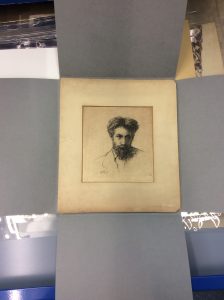
A portrait of Patrick Geddes
The majority of the collection requires rehousing, flattening and minor paper repairs. Tearing of the paper collection has been caused by years of handling and inappropriate storage. To repair them remoistenable tissue with gelatine is being used. This method is being used because of the different types of inks used throughout the collection which are sensitive to moisture. It is also a faster repair method for a larger collection. The rehousing will consist of new archival folders for the collection housed in 180 archival boxes and three different sizes of melinex sleeves for the larger items in plan chests. We also hope to set up a crowdsourcing event to help rehouse the 180 boxes.

Survey Graphic magazine in need of paper repairs
Digital Library Team’s 12 highlights for Christmas
It has been a very busy year in the Digital Library teams with lots happening both with new projects and changes to existing services.
Here is a run down of some of the highlights of 2017:
1. One new responsive DiscoverEd user interface. New look and feel for DiscoverEd blog post.
2. Two new websites for the refurbished St Cecilia’s Hall, Musical Instrument’s Museum and Concert Hall http://www.stcecilias.ed.ac.uk and https://collections.ed.ac.uk/stcecilias.
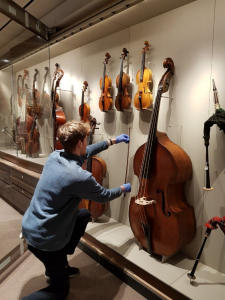
Installation of musical instruments at St Cecilia’s Hall
3. 46,000 images are now online at http://images.is.ed.ac.uk all are available via IIIF.
4. Theses digitisation has been continuing with 1.6 million images produced and 8,783 digitised theses loaded into ERA PhD Digitisation Blog.
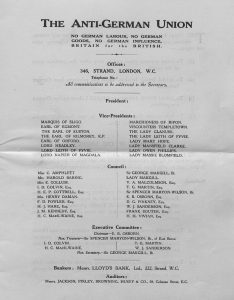
The Anti-German Union pamphlet found in a 1916’s thesis
5. The Royal Observatory was migrated from Voyager to the University of Edinburgh’s ALMA and Primo instances https://discovered.ed.ac.uk.
6. 72 metres of the Mahabharata scroll have been photographed, come back next year to see them all. Challenge of photographing the Mahabharata blog post.
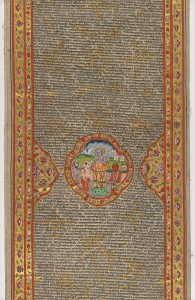
Section of the Mahabharata Scroll
7. The UCreate Studio team has joined the Digital Library section and has delivered over 150 workshops and 200 inductions http://www.ucreatestudio.is.ed.ac.uk
8. 3 libraries are now available on the LibraryMaps site through DiscoverEd https://www.librarymaps.is.ed.ac.uk
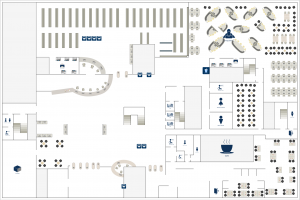
Library Map of Main Library
9. 14 attendees from across Europe joined Library and University Collections’ Knowledge Exchange Week, you can sign up for next year’s here: Knowledge Exchange Week 2018
10. EResource issue highlighting is now available through DiscoverEd.
11. Scottish Session Papers project has moved to a second stage with approximately 13,000 digitised pages and OCR processing of text, using the School of Informatics Geoparser, after image cropping.
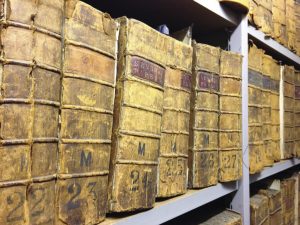
Volumes of Session Papers in the Signet Library, Edinburgh
12. 9 interns and many volunteers have been working within the Digital Library teams, for example one summer intern helped develop the Metadata Games (EASE login required) https://librarylabs.ed.ac.uk/games/.
13. For a baker’s dozen, 9 new iconic items are now digitised, including the Indian Primer.
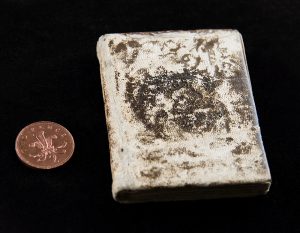
The Indian Primer is a tiny book containing Christian instruction, mainly in the native American Algonquian language
Have a Merry Christmas and Happy New Year,
From the Digital Library
New books in the Library for History, Classics and Archaeology
Thanks to recommendations from members of staff and requests via RAB from students the Library is continually adding new books to its collections both online and in print. Here are just a (very) small number of the books that have been added to the Library’s collections in semester one, 2017/18 for the School of History, Classics and Archaeology and these demonstrate the wide range of subjects being taught, studied and researched within School.
–> Find these and more via DiscoverEd.
 Early Greek portraiture: monuments and histories by Catherine M. Keesling (shelfmark: NB1296.3 Kee. Also available as e-book).
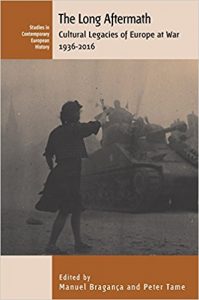
The long aftermath: cultural legacies of Europe at war, 1936-2016 edited by Manuel Braganca and Peter Tame (shelfmark: D744.7.E8 Lon. Also available as e-book).
Race relations at the margins: slaves and poor whites in the antebellum Southern countryside by Jeff Forret (shelfmark: F220.A1 For.)
Beyond conflicts: cultural and religious cohabitations in Alexandria and Egypt between the 1st and the 6th century CE edited by Luca Arcar (shelfmark: BR127 Bey.)
Drawing Lithic artefacts by Yannick Raczynski-Henk (shelfmark: GN799.T6 Rac.) Read More
Collections
 Hill and Adamson Collection: an insight into Edinburgh’s past
My name is Phoebe Kirkland, I am an MSc East Asian Studies student, and for...
Cataloguing the private papers of Archibald Hunter Campbell: A Journey Through Correspondence
My name is Pauline Vincent, I am a student in my last year of a...
Hill and Adamson Collection: an insight into Edinburgh’s past
My name is Phoebe Kirkland, I am an MSc East Asian Studies student, and for...
Cataloguing the private papers of Archibald Hunter Campbell: A Journey Through Correspondence
My name is Pauline Vincent, I am a student in my last year of a...
Projects
Cataloguing the private papers of Archibald Hunter Campbell: A Journey Through Correspondence
My name is Pauline Vincent, I am a student in my last year of a...
Archival Provenance Research Project: Lishan’s Experience
Presentation My name is Lishan Zou, I am a fourth year History and Politics student....