Home University of Edinburgh Library Essentials
June 14, 2026
Times Higher Education – now available
 University of Edinburgh current staff and students now have access to the Times Higher Education via a library subscription.
With our institutional subscription, you will be able to read online articles and digital editions using the THE website, and you will also be able to download the THE app to your device.
This service provides access to the latest weekly edition, and you can also access full text dating back to January 2013. An archive of earlier articles can be searched, and you have the option to set up a weekly email alerting you when the new edition is available.
Access is enabled via a personal account which is associated with the University using your official University e-mail address (ending .ed.ac.uk)
Registering as a first time user
You can register for an account to access our institutional subscription from 1st June onwards.
If you are registering to access the Times Higher Education for the first time please follow these instructions so that your personal THE account is associated with the University’s institutional subscription:
- From the Times Higher Education website click on the user account icon (i.e. the red person icon towards the top right)
- Register using your University of Edinburgh email address ending @ed.ac.uk
- Choose a username and password (please note that your username will appear in public facing parts of the site – for example if you choose to leave comments on articles)
- Click on Join us at the bottom and you will be logged in
- You will receive a confirmation email
Once you have successfully registered your personal account, just click on Login the next time you use the service.
Access digital editions
- To access digital editions of Times Higher Education, go to the magazine’s homepage at https://www.timeshighereducation.com.
- Click the “Professional” tab, then click “Digital Editions”.
- Then simply select the issue you want to view.
Download the app
- The Times Higher Education app is available on iOS, Android and Kindle Fire. Visit your app store provider to download it to your device.
- Select the edition you would like to view (e.g. UK or Global).
- Log in by clicking on the icon in the top right corner.
- Select Account, then click “Existing THE account”.
- Enter your username and password.
Still need help?
If you require further information about setting up your access for the library subscription to Times Higher Education then please:
Contact us via the IS Helpline
IIIF Conference, Washington, May 2018

Washington Monument & Reflecting Pool
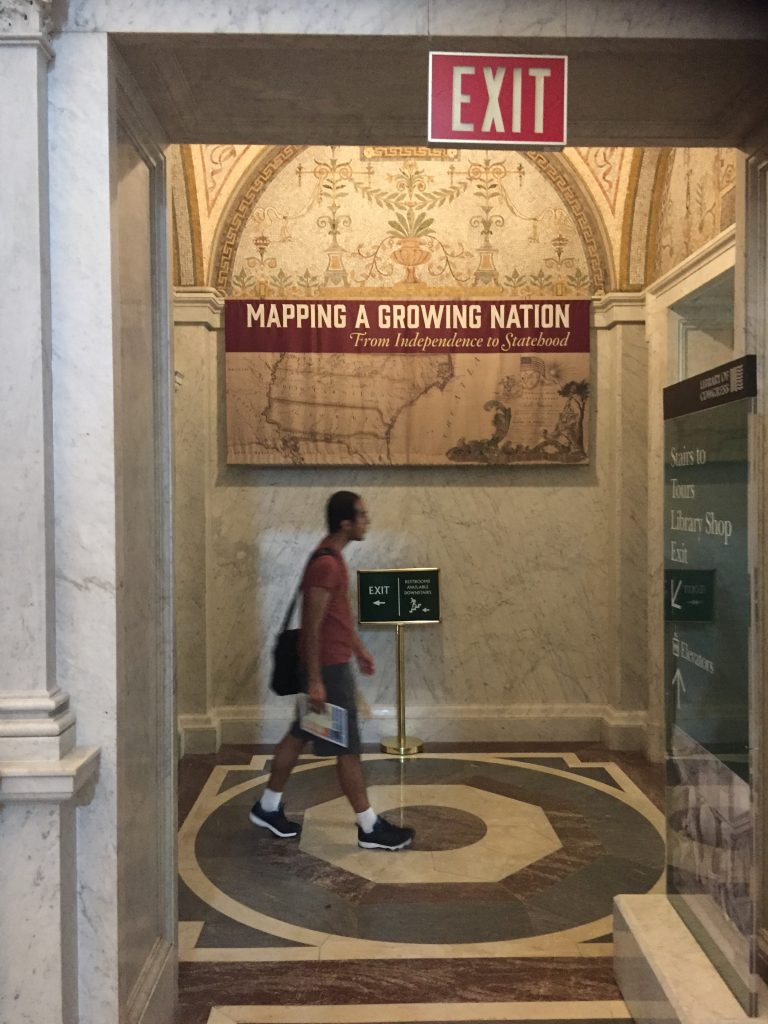
We (Joe Marshall (Head of Special Collections) and Scott Renton (Library Digital Development)) visited Washington DC for the IIIF Conference from 21st-25th May. This was a great opportunity for L&UC, not only to visit the Library of Congress- the mecca of our industry in some ways- but also to come back with a wealth of knowledge which we could use to inform how we operate.
Edinburgh gave two papers- the two of us delivering a talk on Special Collections discovery at the Library and how IIIF could make it all more comprehensible (including the Mahabharata Scroll), and Scott spoke with Terry Brady of Georgetown University showing how IIIF has improved our respective repository workflows.
From a purely practical level, it was great to meet face to face with colleagues from across the world- we have a very real example of a problem solved with Drake from LUNA, which we hope to be able to show very soon. It was also interesting to see how the API specs are developing- the presentation API will be enhanced with AV in version 3, and we can already see some use cases with which to try this out; search and discovery are APIs we’ve done nothing with, but these will help the ability to search within and across items, which is essential to our estate of systems, and 3D, while not having an API of its own, is also being addressed by IIIF, and it was fascinating to see the work that Universal Viewer and Sketchfab (which the DIU use) are doing to accommodate it.
The community groups are growing too, and we hope to increase our involvement with some of the less technical areas- Manuscripts, Museums, and the newly-proposed Archives group in the near future.
Among a wealth of great presentations, we’ve each identified one as our favourite:
Scott: Chifumi Nishioka – Kyoto University, Kiyonori Nagasaki – The University of Tokyo: Visualizing which parts of IIIF images are looked by users
This fascinating talk highlighted IIIF’s ability to work out which parts of an image, when zoomed in, are most popular. Often this is done by installing special tools such as eyetrackers, but the nature of IIIF- where the region is displayed as part of the URL- the same information can be visualised by interrogating Apache access logs. Chifumi and Kiyonori have been able to generate heatmaps of the most interesting regions on an item, and the code can be re-used if the logs can be supplied.
Joe: Kyle Rimkus – University of Illinois at Urbana-Champaign, Christopher J. Prom – University of Illinois at Urbana-Champaign: A Research Interface for Digital Records Using the IIIF Protocol
This talk showed the potential of IIIF in the context of digital preservation, providing large-scale public access to born-digital archive records without having to create exhaustive item-level metadata. The IIIF world is encouraging this kind of blue-sky thinking which is going to challenge many of our traditional professional assumptions and allow us to be more creative with collections projects.
It was a terrific trip, which has filled us with enthusiasm for pushing on with IIIF beyond its already significant place in our set-up.
Joe Marshall & Scott Renton
Library Of Congress Exhibition
EU copyright, quo vadis?
 This month our copyright expert Eugen attended a one day conference in Brussels to keep up to date with the latest developments in Intellectual Property law. “EU copyright, quo vadis? From the EU copyright package to the challenges of Artificial Intelligence” was a one-day conference held at Université Saint-Louis in Brussels on 25th May 2018. It was organised by the European Copyright Society, which is a platform for critical and independent scholarly thinking on European Copyright Law and policy.
There were over 100 participants from almost every European country and almost every area where Intellectual Property has an important contribution: many academics and researchers, practitioners from law firms such as Allen & Overy, consultants from Deloitte, media companies such as Channel 4 Television, ARD or Google, collective societies as ZAiKS Poland and from law courts such as the Ghent Court of Appeal.
The morning session was focused on the ongoing reform of the EU Copyright, the directive proposal that will be debated in the EU Parliament on 21 June 2018. There were presentations (text & data mining, education & libraries, the newly created right for press publishers) by academics highlighting the improvements brought by this proposal and its numerous shortcomings followed by interesting debates between the audience and a group of officials from the European Commission (Copyright Unit I.2, DG CNECT) invited to explain their vision and defend their point of view. Despite this, the general opinion in the room was that the copyright landscape will be polarised between rights-holders, who’s position will be greatly strengthened and enhanced, and a strictly regulated ‘small island of free access’ limited to libraries and universities and not much in between. Some participants were so critical of this proposed directive that they label it as ‘not fit for purpose’.
In the afternoon, the speakers discussed about the looming challenges that Artificial Intelligence (AI) poses to various key notions of copyright therefore the debates were both dry and technical. One particularly interesting debate was about the (proposed) ownership of copyright in machine generated data. Some participants commented that from the point of view of the European car-manufacturers this will balance out the GDPR (which prevents them to use data generated by increasingly sophisticated automobiles) while also preventing overseas competitors to use this data when designing autonomous cars.
There was also a book launch – P.B. Hugenholtz (ed.), Copyright Reconstructed, 2018 (with contributions of five members of the European Copyright Society).
It was extremely interesting to hear the strengths and weaknesses of the forthcoming EU copyright directive and to have a fairly clear idea of what is to come. The conference being organised in Brussels (this year) ensured a wide participation which vigorously (and belatedly) tested the EU officials. It will definitely help if academics and organisations like European Copyright Society, as a part of the civil society, will be more involved in the EU legislative process.
Read all about it!
Read all about our ‘Evergreen: Patrick Geddes and the Environment in Equilibrium’ project news in our latest newsletter – out now! All the updates; international visitors; collection discoveries (see below); what we’ll be doing next, and even some statistics (for those of you that like that sort of thing)! We hope you enjoy it. Newsletter 2 – May 2018 Previous newsletters can be found on our Newsletters page

A cyanotype of unidentified plant within botany collections of the Papers of Sir Patrick Geddes held at the University of Strathclyde Archives and Special Collections (Ref: T-GED/18/6/5b)
Scotland’s languages: Etymology
What are the languages of Scotland? There are three official languages: English, which is the main language spoken, then the minority languages Scots, which is spoken by roughly 30% of the population and Scottish Gaelic, spoken by about 1% of the population. There are also many other languages spoken by migrant communities, such as Polish, Italian, Urdu, Punjabi and Arabic, and by people living and working in Scotland, such as French, German and Spanish. Of course, this situation hasn’t always been the case. In this series of posts on Scotland’s languages, we will look at: the country’s etymology, in particular with regard to place names; what languages people spoke at the time of the Statistical Accounts of Scotland; the idea of language purity; pronunciation and intonation; and the changes in languages used, including the rise of the English language.
Scotland’s etymology
The origins of Scotland itself can be found in its place names, which provide a fascinating reflection of Scotland’s history. Most, if not all, parish reports give the origin of place names found in the area. The majority of names are derived from the Gaelic language, but there are also some of Scandinavian, Scotch and Anglo-Saxon/English origin.
The Gaelic language
Scottish Gaelic, sometimes known as Erse, is a Celtic language which was originally spoken by the Gaels. At one time, this was the language of most of Scotland. In Garvock, County of Kincardine, it was reported that “indeed, the Gaelic language, though long since banished to the Highland glens and mountains of the west of Scotland, was the court language in the reign of Malcolm III. who died 1093, and spoken in a parliament held at Ardchattan in the reign of Robert (Bruce) I., who died 1329.” (NSA, Vol. XI, 1845, p. 40). As noted by the parish of Dunbarny, County of Perth, “most of the names of places in this district, as well as in Fife, Kinross, &c. are of Celtic origin. This need not excite surprise when we remember, that the Gaelic language was spoken, even in the lowlands of Scotland, from A.D. 843 to 1097, and to a considerably later period. Even so late as the beginning of the sixteenth century, Major the historian and Munster informs us, that one-half of the Scottish people spoke Gaelic.”(NSA, Vol. X, 1845, p. 807) So, it is no wonder that most place names in Scotland are Gaelic in origin. Here are some examples:
Gigha and Cara, County of Argyle – “In the former Statistical Account, the name of this parish is said to be derived from the two Gaelic words, Eilean, island, and Dia, God, written in the Gaelic Eilean Dhia, signifying God’s Island. It is, however, more likely that the name Gigha is derived from the Gaelic word Geodhap, a “creek,” since the island abounds in creeks and bays favourable for keeping boats in ; whereas the opposite coast of Kintyre, to a great extent is much exposed to the Atlantic, and without any creeks or ports where vessels could lie in safety. Cara is supposed to signify a monastery.” (NSA, Vol. VII, 1845, p. 394)
Kilmuir and Suddy, County of Ross and Cromarty – “All the names of the heritors places of residence in this parish, are derived from the Gaelic: Thus; Allangrange, or, Allan-Chrain, “a fertile field of corn, Suddy, or Sui-us-sbin, “a good place to settle in,” Belmaduthy, or Ball-ma-duich, “a good country town,” or Ball-ma-duth, “a good black “town,” from its being situated hard by a black moor.” (OSA, Vol. XII, 1794, p. 267)
Moy and Dalarossie, County of Inverness – “The names of all the places in them are evidently of Gaelic derivation, and descriptive of their situation, or some other property. Accordingly, Moy, in Gaelic, Magh, signifies a meadow or plain, which is the nature of the place; Dalarossie, or Dalfergussie, is Fergus’s valley. The ancient name is Starsach-na-gal, i. e. the Threshold of the Gaels, or Highlanders, being the pass, by which the Highlanders entered to the Low Country, so narrow between high mountains, that a few men could defend it against numbers.” (OSA, Vol. VIII, 1793, p. 499)
Kiltarlity, County of Inverness – “The names of places are all obviously derived from the Gaelic, and are descriptive of the situation, the nature of the ground, or something remarkable near the place, by which it is distinguished. As, for example, Belladrum, in Gaelic, “Bal an drom,” “the town on the emi”nence;” Brunach, a corruption of “Breagh-achadh,” “the beautiful “field;” “Eskadale,” “the dale of the waters;” here two rivers partly surround the arable ground, and often overflow a great part of the same.” (OSA, Vol. XIII, 1794, p. 522)
Strathblane, County of Stirling – “The parish of Strathblane takes its name from the river Blane, which rises in it, and runs through its whole extent. Blane is a contraction of two Gaelic words, signifying warm river. The literal interpretation of the word Strathblane, consequently is, “the valley of the warm river;” a name fitly appropriated to this parish, which from its situation, enjoys a peculiarly mild atmosphere.” (OSA, Vol. XVIII, 1796, p. 563)

Strathblane by Joseph Adam, and Robert Henry Roe, date unknown. Glasgow Museums; http://www.artuk.org/artworks/strathblane-83006
Sometimes, it is not a hundred percent clear what the source of a place name is. There is a very interesting discussion on the etymology of Lanark, County of Lanark, which, in at least one quarter, was thought to be derived from the Welsh language! (OSA, Vol. XV, 1795, p. 6-9)
It is not just place names which are Gaelic. Vocabulary derived from Gaelic was also used by inhabitants of various parishes, such as Lanark:
“… Bink, a stone or green sod or seat before a door, is pure Gaelic. Cromie a cow with crooked horns, also a crooked stick, from Cromadh bended. Body, a clown or silly person, Bodach. Pluck, a carbuncle on the face, Plucain. Eirack, a chicken, Eira. Stock-in-horn, a pipe with a horn used by the shepherds, from Stoc a pipe. Kinning, a Rabbit, Coinain. Brock, a Badger, Broc. Brat, a cover or scuri, also a piece of cloth, Brat. To toom, empty, Taomam. To ding, overcome, Dingam. Glar, puddle or filth, Gaor. Ingle, the fire, Aingeal. Gairtai, garter, Gairtain. Groset, gooseberry, Grosaid. Guitar, a gullyhole, Guitar. Haggis, a dish, Taiggis. Inch, invariably used for an island, Innse or Innis. Clachan, a village, Clachan. Loch, a Lake, Loch. Carameile or Caparcile, the orobus tuberosus, being the root so much used in diet by the ancient Caledonians.” (OSA, Vol. XV, 1795, p. 8)
In the next post on Scotland’s languages we will look more in-depth at the languages spoken in different parishes. If you would like to find out more about the Gaelic language itself, there is a very detailed description of its grammar in the parish report for Callander, County of Perth. (OSA, Vol. XI, 1794, p. 613)
Here, it is very interesting to note that, as reported by the parish of Kildonan, County of Sutherland, many Gaelic words used in the realm of religion had their roots in the Latin spoken by the early monks, “Almost all the words now used in the Gaelic language connected, with religious establishments, have been borrowed from there old monkish Latin used by the first Christian missionaries in the Highlands, to denote new offices terms not previously known. Thus the Gaelic of church is Eaglais, from the Latin Ecologia, the Gaelic of Bishop is Easbuig, from Episcopus; the Gaelic of abbot, is Abb, from Abbas; the Gaelic of priest is Sagart, from Sacerdos; and the Gaelic of a chapel, or the primitive resting place of a Christian missionary, was Cill, pronounced Kil, from Cella, a chapel or cellar.” (NSA, Vol. XV, 1845, p. 133)
Scandinavian influence
In the north of Scotland there are several parishes whose place names are Scandinavian in origin. These include:
Duirinish, County of Inverness – “There is a striking proof of the complete subjugation of the Island of Skye to the Norwegian invaders in the fact, that very many of the proper names still used in it are traceable to a Norse origin. The inhabitants have Tormoid, Harold, Olaus, and Manus,-all Norwegian names, still common among them. But it is much more remarkable than this, that nearly every farm, every hill, every stream, has a Norwegian appellation, while, at the same time, not the remotest trace of Norse can be discovered in any part of the language of the country, except the proper names.”(NSA, Vol. XIV, 1845, p. 332)
North Uist, County of Inverness – “Uist is taken from the Scandinavian word, uist, signifying west in the English language, a name given to it by the Danes, when in possession of these countries, on account of its westerly situation.” (OSA, Vol. XIII, 1794, p. 300)

Looking back from the ferry MV Hamnavoe towards Stromness Harbour, Mainland Orkney, Scotland. Photograph taken by <p&p>photo, 2011. [via Flickr – https://creativecommons.org/licenses/by-nc-nd/2.0/]
Stromness, County of Orkney – “These islands having been so long and repeatedly in the possession of the Danes and Norwegians, many of the names of places and persons are derived from the Danish or Scandinavian language. Stromness and Sandwick are names to be found in Sweden, Denmark, and Iceland. The first of these may derive its name from Strom, or Straum, and Ness; this last meaning an extended point of land, and Strom the strong side off that point. The parish of Sandwick, as well as the parish of the same name in the Shetland isles, of a similar situation, may derive its name from Sand and Wick, as there is a sandy bay on the west side of this parish, Wick signifying a bay or inlet of the sea.” (OSA, Vol. XVI, 1795, p. 410)
Bower, County of Caithness – “The name of Bower, as of most places in this country, seems to be derived from the Danish language, and is said to denote a valley, (or what in Scotch is called a carse).” (OSA, Vol. VII, 1793, p. 521)
In the County of Shetland, “the ancient language was a dialect of the Norse, being similar to what is now spoken in the Faroe Islands; but, for more than a century, it has been disused, and is now quite forgotten.” (NSA, Vol. XV, 1845, p. 154) However, it’s influence could still be felt. “The language is English, with the Norse accent, and many of its idioms and words. The old names of places are Scandinavian.” (NSA, Vol. XV, 1845, p. 156)
Again, as for Gaelic, words which were Scandinavian in origin could be found in people’s everyday vocabulary. As mentioned in a previous blog post, in Cross and Burness, County of Orkney, “a good many words are peculiar to the north isles, and some of them are evidently of Scandinavian origin. A few are given in alphabetical order…” (NSA, Vol. XV, 1845, p. 95)
Some place names also have particular stories attached to them. In the parish of Jura, County of Argyle, it was reported that “according to a tradition still believed in the Hebrides, Corryvreachkan, or the Caldron of Breachkan, received its name from a Scandinavian Prince, who, during a visit to Scotland, became enamoured of a Princess of the Isles, and sought her for his bride. Her wily father, dreading the consequences of the connection, but fearful to offend the King of Lochlin, gave his consent to their marriage, on condition that Breachkan should prove his skill and prowess by anchoring his bark for three days and three nights in the whirlpool. Too fond or too proud to shrink from the danger, he proceeded to Lochlin to make preparations for the enterprise. Having consulted the sages of his native land, he was directed to provide himself with three cables, one of hemp, one of wool, and one of woman’s hair. The first two were easily procured; and the beauty of his person, his renown as a warrior, and the courtesy of his manners had so endeared him to the damsels of his country, that they cut off their own hair to make the third, on which his safety was ultimately to depend; for the purity of female innocence gave it power to resist even the force of the waves. Thus provided, the Prince set sail from Lochlin and anchored in the gulf…” Visit the Statistical Accounts of Scotland to find out what happened next! (NSA, Vol. VII, 1845, p. 536)
English and Scotch names
In the parish of Peterhead, County of Aberdeen, there are several place names of English, as well as Gaelic, origin. “Thus, Alehouse-hill, (a house which the family of Raven’s Craig used to frequent as a tavern), Myreside, Hayfield, Newseat, Mount-pleasant, Scotch-mill are English; likewise, Stay the Voyage, (a place where the family of Marischal used to halt in their way from Inverugie to Peterhead), another Stay the Voyage, from a tenant of the former place having carried the name of his first place of residence to a house in the opposite side of the parish; Cross-fold, from a place of worship having been in that field before the Reformation. Invernettie, Auchtiegall, Glendevny, and Balmuir, I am informed are Gaelic; and Blackhouse, which was supposed to be English, I am informed, is likewise Gaelic; Blackhouse being derived from Blockhouse, which signifies a place of defence in front of a castle.” (OSA, Vol. XVI, 1795, p. 592)
This is also the case for the parish of Newtyle, County of Forfar, where “names of places are chiefly derived from the English; but there are also instances of derivation from the Gaelic.” (OSA, Vol. III, 1792, p. 401)
In Dundee, County of Forfar, on the other hand, “the names of places in the parish are partly in this language [broad Scots], and partly Gaelic. Of the former kind are Blackness, Coldside, Clepingtown and Claypots, Balgay, Dudhope, Drumgeith, Duntroon, Baldovie, and various others are examples of the latter.” (OSA, Vol. VIII, 1793, p. 193)
An intermixture
The examples of Peterhead and Dundee given above illustrate that throughout Scotland there was a real mix of people and languages which shaped Scotland’s parishes. Here are some other examples:
In Reay, County of Caithness, “the names of places are mostly of Gaelic derivation. Some ending in ster, as Shebster, Brubster, &c. are supposed to be of Danish origin. Reay, the name of the parish, is thought to be a corruption from Urray, the name of a Pictish hero who inhabited the castle, to this day called Knock Urray.” (OSA, Vol. VII, 1793, p. 579)
“The present parishioners of Wick are an intermixture of the Celtic, Pictish, Norwegian, and, latterly, again of the Celtic races. This is evident, both from the names and from the physical character, of the people” (NSA, Vol. XV, 1845, p. 144)
Considering how people moved about and influenced others in their ways and language, it is not surprising that some place names are derived from more than one language. For example, in Gigha and Cara, County of Argyle, “The point which extends farthest into the sea is called Ardminish point, on the north side of the bay of that name, from the Gaelic words Ard, a height, meadhon, middle, and ness, (Danish) a point going out into the sea.” (NSA, Vol. VII, 1845, p. 396)
In the parish of Kilmuir, County of Inverness, it was noted that “in this and in most other parishes of the Hebrides the names of hamlets, hills, bays, promontories, &c. are evidently, for the most part, of Scandinavian origin. In some cases, however, Gaelic roots with Scandinavian terminations, and vice versa, are to be met with. It is a remarkable fact, that the names given to certain localities by the natives of a foreign land, have been retained for so many ages and generations, as is the case here and elsewhere. When the prevalence of Scandinavian names is taken into consideration, and the great disproportion which they bear to those of Celtic origin, it will appear evident, that the number, power, and influence of the aboriginal population was but small in comparison with that of the Norwegian invaders.” (NSA, Vol. XIV, 1845, p. 241)

Provost Ross’ House, Shiprow, Aberdeen. By AberdeenBill [CC BY-SA 3.0 (https://creativecommons.org/licenses/by-sa/3.0)], from Wikimedia Commons.
Surnames
While researching languages and place names I came across instances of surnames specific to a particular area. As well as those of Scandinavian origin mentioned above (NSA, Vol. XIV, 1845, p. 332), the following were found:
Kildonan, County of Sutherland – “The clan Gun have at all times been considered throughout the North Highlands as descended from the Norwegian Kings of Man; and Lochlin, the Gaelic name for ancient Scandinavia, or, perhaps, in a more limited acceptation, for Denmark, is still named by the few natives of the Highlands who now recollect the traditions of their fathers,-as the Parent country of the Guns, the Macleods and the Gillantlers.” (NSA, Vol. XV, 1845, p. 140)
Tundergarth, County of Dumfries – “Johnstone is the most prevalent surname in this parish; and the old castle of Tondergarth was once the principal seat of the Johnstones. The language of this parish has always been a purely Saxon dialect of the old Lowland Scottish. Tondergarth is a compound Saxon word, signifying the Castle of the Garden, or rather, perhaps, the Castle of the Sanctuary.” (OSA, Vol. XIX, 1797, p. 445)
Cromarty, County of Ross and Cromarty – “It is worthy of notice, that there is a peculiar surname, Mustard, among the people here, not common elsewhere.” (OSA, Vol. XII, 1794, p. 254)
Conclusion
The etymology of Scotland’s place names gives us a fascinating picture of both the history and landscape of the county, with origins found in the Gaelic, Scandinavian, Scotch and English languages. A large number of ancient place names are derived from Gaelic (the country’s majority language at that time) and describe its geographical or geological situation or some other property of that place. What is particularly interesting is the mix of etymology we get within the same parish, showing how people moved around and influenced others through their language.
In our next post, we take a closer look at the languages spoken throughout Scotland’s parishes.
e-Marefa Arabic databases for trial
E-Marefa is an integrated database of full-text academic journals, statistics, articles, dissertations, e-books, book reviews, conference proceedings and abstracts about the Arabic World. The database is produced by Knowledge World Compahy for Digital Content in Jordan in partnership with many universities in the Arab world.
The database contains 1900 academic & statistical periodicals (full text) in English & Arabic, 400,000 articles & statistical reports (full text) in English & Arabic, 25,000 theses & dissertation, 14,000 e-books & book reviews, 6500 Arabic Reviews for International Theses, and e-Marefa DataBank for Islamic Economics and Finance which Offers a broad range of full text and bibliographic databases.
The trial of these databases can be accessed on the University network from the web links below:
- e-Marefa services: http://e-marifah.net
- e-Marefa DataBank for Islamic Economics & Finance: idatabank.e-marefa.net
- e-Marefa Database for the Publications of the Center for Arab Unity Studies: http://www.e-book.e-marefa.net/caus/en
- e-Marefa Database for the publications of Obeikan: http://www.e-book.e-marefa.net/obeikan/en
- e-Marefa Database for Arab Polls: http://polls.e-marefa.net/en
Trial ends: 20 June 2018
Margaret Morris and “La Divine” Suzanne Lenglen (1899-1938)

Suzanne Lenglen and Margaret Morris demonstrating a tennis exercise, c.1937. Margaret Morris Collection, Fergusson Gallery, Perth
Today marks the birthday of the tennis star Suzanne Lenglen, who was born in Paris in 1899. Regarded by some as the greatest female tennis player in history, Lenglen won 31 Championship titles between 1914 and 1926. She was also one of the first female international sports personalities and was nicknamed “La Divine” (The Goddess) by the French press. As a child however, she suffered numerous health problems including chronic asthma. Her father Charles suggested that it would be good for her to build up her strength by playing tennis and developed various exercises for her. Only four years later she was competing in the final of the 1914 French Championships, aged only 14.
Charles Lenglen’s approach would have found favour with Margaret Morris, who believed strongly that movement and exercise could be applied to improve the health, wellbeing and physical strength of anyone and everyone. She gave the first demonstration of her Margaret Morris Movement technique to doctors in 1925 and went on to train in Physiotherapy at St Thomas’s Hospital, London, passing with distinction in 1930.
Morris began to notice the striking similarity between the physical positions in her own exercises and those which occur in sports such as football, cricket and tennis. She demonstrated that all athletic movements were based on the opposition of one group of muscles to another. This idea of ‘opposition’ was fundamental to Morris’s technique – and indeed the development of free dance as a whole – and was heavily influenced by the teachings of Raymond Duncan (brother of the famous dancer Isadora) on the ‘Greek positions’ based on the Parthenon sculptures.

Dancer Jack Skinner and cricketer Donald Bradman. Illustrations from the prospectus of the Basic Physical Training Association, 1938. Margaret Morris Collection, Fergusson Gallery, Perth
Morris began to illustrate her demonstrations of opposition exercises with photographs of athletes, including Suzanne Lenglen. At one lecture in Paris, Lenglen, who by now had retired and was running a tennis school in the city, happened to be in the audience. Realising the potential for Morris’s exercises to be specially adapted for tennis and used as basic preparatory training, Lenglen invited Morris to collaborate with her. The pair developed exercises over a course of visits to Lenglen’s flat in Passy, where Morris was introduced to some of her tennis star friends.
Before leaving Paris, Morris taught the exercises to one of her teachers who worked each day at Lenglen’s school. It became compulsory for all of her pupils to learn the strokes by doing the exercises before they were allowed to pick up a tennis racket, as well as practicing the special breathing exercises developed by Morris. Lenglen apparently declared that results were obtained much faster and that the pupils had more endurance. Hearing of this, some of her tennis star friends, including “Bunny” Austin, began private lessons with Morris to improve their own style and technique.
Encouraged by this, Lenglen and Morris approached Heinemann’s to publish their exercises in book form and Tennis By Simple Exercises first appeared in 1937. It went into two editions and was later published in France under the title Initiation au Tennis. The Margaret Morris archive at the Fergusson Gallery in Perth has a number of first editions of the book, including Morris’s personal copy, as well as draft manuscripts, notes and correspondence between Morris and Lenglen.

‘Tennis By Simple Exercises’, Suzanne Lenglen and Margaret Morris (Heinemann, 1937), 1st edition. Margaret Morris Collection, Fergusson Gallery, Perth
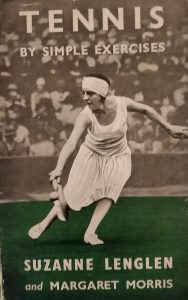
‘Tennis By Simple Exercises’, Suzanne Lenglen and Margaret Morris (Heinemann, 1937), 2nd edition. Margaret Morris Collection, Fergusson Gallery, Perth
Morris later recalled being invited with Lenglen to a tennis party given by the politician and tennis player Domini, Lady Crosfield, and asked to demonstrate the exercises for the guests. When they had finished, Morris was surrounded by an admiring crowd clamouring “Now, of course, we are just longing to see you play!” Embarrassed, Morris was obliged to reply “But I don’t!” and had to explain to a sea of astonished faces that her varied and busy career gave her little opportunity to play any games herself!
Sadly, Suzanne Lenglen was diagnosed with leukemia in June 1938 and died only a month later, aged just 39. Reminiscing about their collaboration, Morris recalled:
She was a dynamic personality, stimulating to work with, and I never saw a sign of the violent temper she was reputed to possess.

Suzanne Lenglen and Margaret Morris demonstrating a tennis exercise, c.1937. Margaret Morris Collection, Fergusson Gallery, Perth
References
Margaret Morris, My Life in Movement (London: Peter Owen Limited, 1969)
“Suzanne Lenglen”, Wikipedia, https://en.wikipedia.org/wiki/Suzanne_Lenglen, accessed 17 May 2018.
Clare Button
Project Archivist
Celebrating women pioneers for ordained ministry in the Church of Scotland
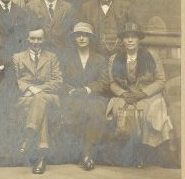
Dr Elizabeth Hewat, first woman to receive a PhD from New College, who argued for women’s ordination
This blog post is written by Dr Lesley Orr, School of Divinity
In the year in which the Church of Scotland has welcomed the Very Revd Susan Brown of Dornoch Cathedral as its new Moderator of the General Assembly, the Church also celebrates the 50th anniversary of the ordination of women.
On Wednesday 22 May 1968, the Fathers and Brethren of the General Assembly of the Church of Scotland voted by a large majority to extend eligibility of ordination to Ministry of Word and Sacrament to women, on the same terms as men. New College students, graduates and staff played a significant role throughout the half century when the question of women’s role, rights and equality in the Church was one of the most persistent and controversial issues for debate – not only in the Assembly but in wider Church and Scottish society. During this fiftieth anniversary year of women in ordained ministry, a commemorative project has been based at New College, supported by the Centre for Theology and Public Issues and in partnership with the Church of Scotland Ministries Council. Publications and photographs which tell a little of these events are currently on display in New College Library. But the story goes back much further.
On trial: The Age of Exploration
Thanks to a request from staff in HCA the Library currently has trial access to a brand new digital primary source collection from Adam Matthew Digital, Age of Exploration. This database allows you to discover through archive material the changing shape of exploration through five centuries, from c.1420-1920.

You can access this online resource via the E-resources trials page.
Access is available both on and off-campus.
Trial access ends 18th June 2018.
Read More
18th Century German Literature Online & Historical Dictionary of Rhetoric
The Library has arranged a free trial for the following two German resources. The trial is valid from 15 may until 16 July 2018. The two trials can be accessed via the Library E-resources Trials website. The following direct links also work on the University campus or through VPN connection for off-campus access.
18th Century German Literature Online – Deutsche Literatur des 18. Jahrhunderts Online

A database of primary source works of the German and Swiss Enlightenment. Comprised of scanned and digitized first editions in original typeface and first published complete editions by 642 German-speaking authors of the 18th century. As well as leading figures, also contains the writings of hundreds of authors who were less well-known, but who contributed to the literary Enlightenment with their lyrical, dramatic and epic works. The Gothic script is full-text searchable, across multiple search criteria, and downloadable. Search results will take you to the high-lighted word in the original text.
Search the database here: http://db.saur.de/DLO/autologin?user=uniedin
Search help: http://db.saur.de/DLO/language/en/html/Inhaltsverzeichnis.html
Introductions: http://db.saur.de/DLO/language/en/html/introductions.html
User guide (in English): DLO_2010_ENG
Historical Dictionary of Rhetoric – Historisches Wörterbuch der Rhetorik

The Historisches Wörterbuch der Rhetorik [Historical Dictionary of Rhetoric] is the only comprehensive academic reference work in the field. For specialists and practitioners, this tool provides all current knowledge about Rhetoric in an electronically searchable form for the first time. Various search criteria (lemma, keyword, person, literature, etc.) allow targeted research and make the 1,300 articles easily accessible, also for scholars in related disciplines. The articles are thematically linked to each other so as to provide the reader with comprehensive information.
Search the database here: https://www.degruyter.com/databasecontent?dbid=hwro&dbsource=/db/hwro
User guide (in English): https://www.degruyter.com/staticfiles/content/dbsup/HWRO_03_UserGuide_English.pdf
Search help: https://www.degruyter.com/staticfiles/content/dbsup/HWRO_00_Search_Help.pdf
Feedback welcome!
Collections
 Hill and Adamson Collection: an insight into Edinburgh’s past
My name is Phoebe Kirkland, I am an MSc East Asian Studies student, and for...
Cataloguing the private papers of Archibald Hunter Campbell: A Journey Through Correspondence
My name is Pauline Vincent, I am a student in my last year of a...
Hill and Adamson Collection: an insight into Edinburgh’s past
My name is Phoebe Kirkland, I am an MSc East Asian Studies student, and for...
Cataloguing the private papers of Archibald Hunter Campbell: A Journey Through Correspondence
My name is Pauline Vincent, I am a student in my last year of a...
Projects
Cataloguing the private papers of Archibald Hunter Campbell: A Journey Through Correspondence
My name is Pauline Vincent, I am a student in my last year of a...
Archival Provenance Research Project: Lishan’s Experience
Presentation My name is Lishan Zou, I am a fourth year History and Politics student....