Reading the Reformation : Luther

On 14, 15 and 16 February 2017, the Cunningham Lectures at New College will mark the 500th Luther anniversary, with lectures by Professor Kaufmann covering Europe, Reformation and Luther.

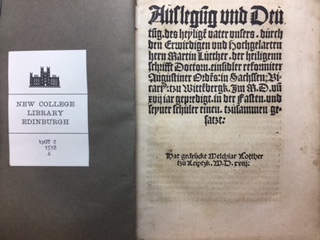
New College Library holds outstanding Reformation collections that support the theme of the first lecture, Book, Print and Reformation. This includes examples of Luther’s pamphlets like the one below, from the early part of his career at the University of Wittenberg.

Luther, Martin. Auslegung und Deutung des heylige vater unsers … Leipzig, 1518. New College Library tpGT 2 1518

Each pamphlet, printed using the newly developed printing press technology, was cheaply produced and easily distributed, allowing the ideas they contained to spread quickly. Continue reading

Travel writing from the Holy Land : The William Fulton Jackson Collection

A post by guest curator Suzi Higton, School of Divinity

The books of intrepid travel writers whose adventures span from Jerusalem to Cairo feature throughout the collections at New College Library and in particular, those gifted to the library by William Fulton Jackson. A selection from this collection is now on display in New College Library.

Born in 1855, Jackson, recently uncovered as the donor of the W. F. Jackson (WFJ) collection, was the General Manager of the North British Railway Company. His interest in and passion for travel, particularly the Holy Land and Egyptology is reflected both in his numerous books on the subject and detailed photograph collection which is held by the Glasgow University Library Archives.

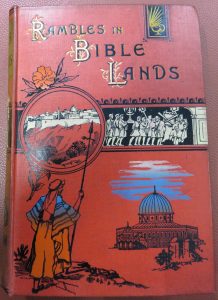
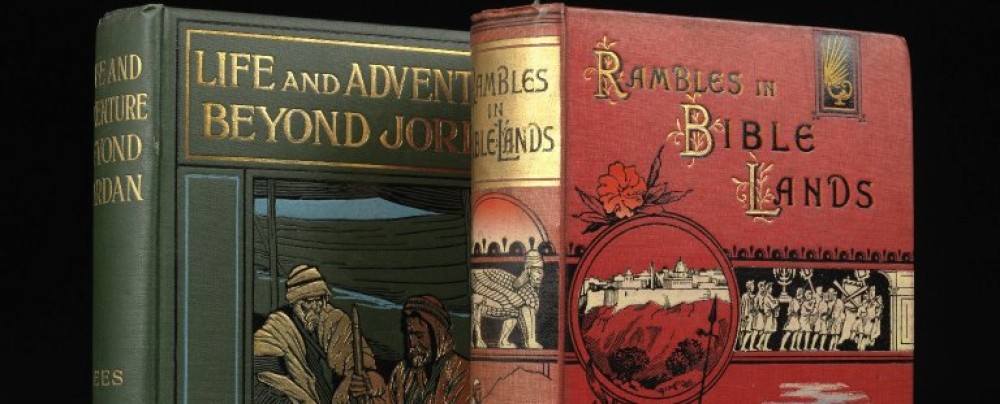
Newton, Richard. Rambles in Bible Lands Edinburgh: Gall and Inglis, New College Library, WFJ. 3.166

Newton, Richard. Rambles in Bible Lands Edinburgh: Gall and Inglis, New College Library, WFJ. 3.166

When selecting books from the WFJ collection to display, the eye is immediately drawn to the books’ beautiful cover designs, maps and illustrations. Rambles in Bible Lands stands out, not just for its intricate artwork but for being aimed at a younger audience. Written by the Reverend Richard Newton, it was published initially whilst he was editor of the American Sunday-School Union, and is based on a series of letters written to Sunday-School World and A Child’s World whilst travelling through Syria, Israel, Lebanon and Egypt. Continue reading

New College Library books recommended by students

Inherit the Holy Mountain: Religion and the Rise of American EnvironmentalismStudent recommendations are in at New College Library! The recently purchased Inherit the Holy Mountain: Religion and the Rise of American Environmentalism, edited by Mark Stoll, is available as an ebook via DiscoverEd.

Worship on the way : exploring Asian North American Christian experience

Other student recommendations in the library include: Worship on the way : exploring Asian North American Christian experience by Russell Yee, at BR563.A82 Yee.
Continue reading

Find treasure in New College Library

We’re welcoming Divinity postgraduate students today for library treasure hunt activities to help them get to know New College Library.

Follow the clues to discover New College Library's treasure

What is this? Biblical Studies students can follow the clues to discover New College Library’s treasure

Students on the five postgraduate programmes have already had access to brief video tutorials for Biblical Studies, Religious Studies, Science and Religion, Theology in History and World Christianity.

Further programme specific treasure hunt activities aim to encourage students to find material relevant to their courses in a variety of print and online locations.

Christine Love-Rodgers, Academic Support Librarian, Divinity


‘W’ Collection provides a window into the world of eighteenth-century India

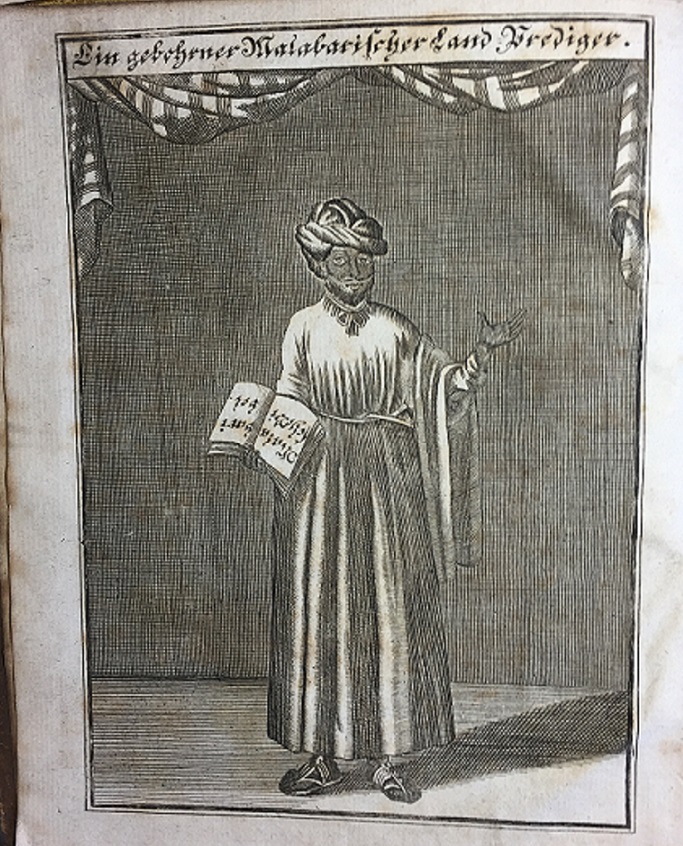
One of the current Special Collections cataloguing projects at New College Library is the W4/5 section which includes works on ecclesiastical history and theology. In this collection we were pleased to discover three volumes of the Halle reports, a Protestant missionary magazine from a Danish mission to India in the eighteenth century.

Image from : Dansk-hallensiske mission (Tranquebar, India) Der Königl. Dänischen Missionarien aus Ost-Indien eingesandter ausführlichen Berichten. Erster ( -neunter) Theil. 1718-1772 New College Library W.169-171

Image from : Dansk-hallensiske mission (Tranquebar, India) Der Königl. Dänischen Missionarien aus Ost-Indien eingesandter ausführlichen Berichten. Erster ( -neunter) Theil. 1718-1772 New College Library W.169-171. Image courtesy of Paul Nicholas

Advised by Dr. A. H. Francke (1663–1727), a professor of divinity in the University of Halle in Saxony, King Frederick IV of Denmark sent two missionaries from Halle to Tranquebar in India. In all over 60 missionaries were sent from Halle in the course of the eighteenth century, and they published their reports as Der Königl. Dänischen Missionarien aus Ost-Indien eingesandter ausführlichen Berichten. Continue reading

Steps towards equality in New College Library Class Photographs

A guest post by Chloe Elder, New College Library Special Collections Digitisation intern

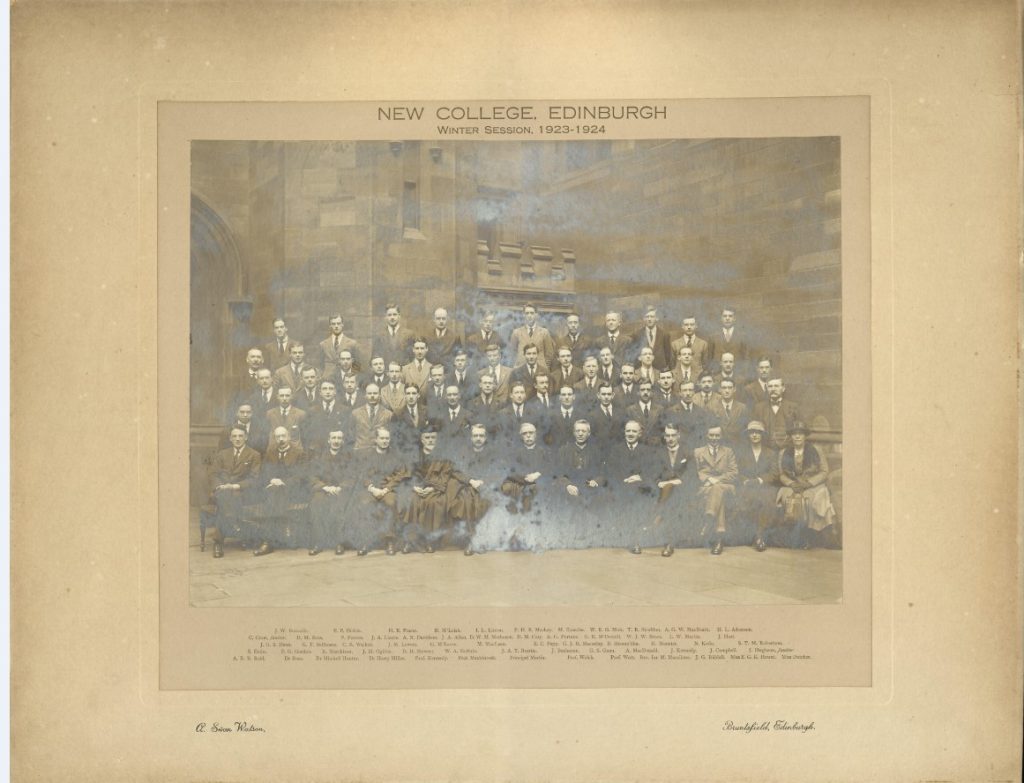
From the depths of New College Library’s archives, a selection of class photographs from 1857 to 1930 has been digitised and uploaded to the Open Books website, accessible at openbooks.is.ed.ac.uk. The photographs show the students and staff of New College’s past, each of whom make up a part of the School’s long history. You may recognise, for example, Principal Robert Rainy, who lends his name to the College’s Rainy Hall, sat front and centre of every photo during his time as principal from 1874 to 1900. And behind Rainy and succeeding principals stand rows of students, ascending the same courtyard steps that today welcome over 400 undergraduate and postgraduate students to the School of Divinity.

New College Library Class Photo Winter Session, 1923-1924

New College Library Class Photo Winter Session, 1923-1924

Continue reading

Global journals for World Christianity

The University of Edinburgh subscribes to a wide range of academic journals for the School of Divinity, but we’re also active in making the most of open access journals that are freely available on the web. Anabaptist Witness is one of these, and has recently been added to DiscoverEd. This journal aims to provide global Anabaptist and Mennonite dialogue on key issues facing the church in mission.

Anabaptist Witness

Korea Presbyterian Journal of Theology has also recently been added to DiscoverEd. Available in Korean and English, this journal aims to create academic discourse for theology that is evangelical and Biblical, is Reformed and ecumenical, and focuses on the Korean, Asian and global contexts in theological discourse.

KPJTChristine Love-Rodgers, Academic Support Librarian – Divinity


New Digital Collections for Divinity in 2016

We’ve been able to purchase several new digital collections to support the School of Divinity in 2016. All of the below are accessible via http://www.ed.ac.uk/is/databases-a-z and via the Divinity subject guide http://www.ed.ac.uk/is/subject-guides-divinity

Brepols Database of Latin Dictionaries

Data­base comprising a large number of Latin dictionaries to assist translation from Latin into modern languages and to provide semantic and etymological explanations.

China, Culture & SocietyChina, Culture & Society

Digital collection of rare pamphlets (c. 1750-1929) from Cornell University Library creating a very rich source for research on China, addressing Chinese history, religion, culture, and everyday life. Continue reading

“Sorry, Foakes Jackson, I am for real”*

Aside

Our colleague, Patrick Murray, has begun work cataloguing the W. F. Jackson collection, initially, as part of the Funk Cataloguing Project. This collection has been at New College for many decades but with the need to fill in accurate data about the material, it was soon apparent that no one knew very much about William Foakes Jackson or W. J. Jackson as he had carefully and clearly inscribed in each book.

The closest match that could be found was a Frederick John Foakes-Jackson, who was an eminent scholar of Judaism, something which connected with the first tranche of books. However, after that the trail went cold and, as the archivist, I was asked if I could give any advice on where to look next.

Away from the office, searches on Google, ScotlandsPeople and Ancestry.co.uk all drew a blank on proffering a sibling or son to Frederick John Foakes Jackson, who might have owned and donated these books.

In the New College Library Archives, there are boxes of library correspondence from throughout the 20th century some of which relate to the deposit of collections (ref. AA.2.1). As these records are in varying states of arrangement I decided to look at some of W. F. Jackson’s books for any other clues before delving into the correspondence.

The first couple of books seemed devoid of any details about the owner but, unexpectedly, out of the fourth book I looked at fell a scrap of an envelope on which was written: ‘[-] F Jackson, Suffolk House, 18 Suffolk Road, Edinburgh’ and postmarked 1929. The key to it all.
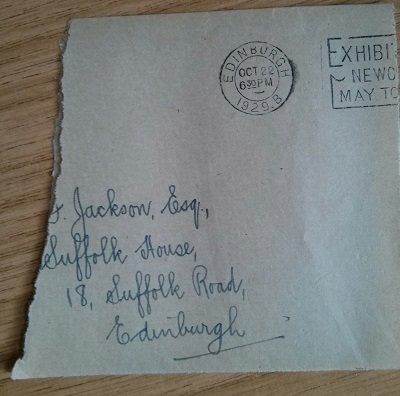
Scrap of an envelope found in the W. F. Jackson collection of books.

Scrap of an envelope found in the W. F. Jackson collection of books.

A quick visit to ScotlandsPeople searching for the death certificate for a W. F. Jackson after 1929 and there was William Fulton Jackson, in 1931, passing away at Suffolk House, 18, Suffolk Road, Edinburgh. That narrowed down the correspondence search nicely and quite quickly I found a note from his niece, Janet Cameron, depositing the records at New College Library (ref. AA.2.1.104a).
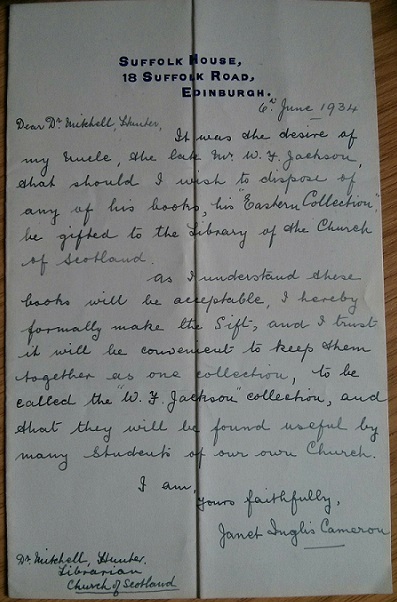
Suffolk House, 18 Suffolk Road, Edinburgh. 6th June 1934 Dear Dr Mitchell Hunter, It was the desire of my uncle, the late Mr W. F. Jackson, that should I wish to dispose of any of his books, his “Eastern Collection” be gifted to the Library of the Church of Scotland. As I understand these books will be acceptable, I hereby formally make the Gift, and I trust it will be convenient to keep them together as one collection, to be called the “W. F. Jackson” collection, and that they will be found useful by many students of our own Church. I am, Yours faithfully, Janet Inglis Cameron Dr, Mitchell Hunter, Librarian Church of Scotland.

Letter from Janet Inglis Cameron, niece of W. F. Jackson, to Dr Mitchell Hunter, Librarian, New College, making a gift of his “Eastern Collection” of books.

Transcript of letter:

Suffolk House,
18 Suffolk Road,
Edinburgh.

6th June 1934

Dear Dr Mitchell Hunter,
It was the desire of my uncle, the late Mr W. F. Jackson, that should I wish to dispose of any of his books, his “Eastern Collection” be gifted to the Library of the Church of Scotland.

As I understand these books will be acceptable, I hereby formally make the Gift, and I trust it will be convenient to keep them together as one collection, to be called the “W. F. Jackson” collection, and that they will be found useful by many students of our own Church.

I am,
Yours faithfully,
Janet Inglis Cameron

Dr, Mitchell Hunter,
Librarian
Church of Scotland.

To the railway historian, the name William Fulton Jackson will be familiar. He was born in 1855 to John Jackson, a grain merchant, and Mary Fulton, in 73, South Wellington Street, Glasgow. In 1883 he married Maggie McJannet Lattimer, at her home in 14, St James Street, Glasgow. In 1891 he was listed as a railway clerk living in Coltbridge Avenue, Edinburgh and by the 1901 census, he had become the General Manager of the North British Railway Company, living at 24, Royal Terrace, Edinburgh. It appears that Jackson was appointed as General Manager in 1899, after his predecessor, John Conacher, stepped down in the wake of a boardroom scandal.

Further internet searches revealed that some of his photograph albums had been deposited at Glasgow University Archives, and that he was an active member of the Young Men’s Christian Association (YMCA).

The 1911 census provides us with a mystery, outwith our remit, in that on the night the census was taken he and many others were staying in the same place as Arthur Conan Doyle and his family: “Rothsay” in Bournemouth, Dorset, on the south coast of England. Is this a connection or a coincidence?

Whatever the answer, after many years of this valuable collection of books being known as the “Foakes Jackson Collection” and thanks to an envelope scrap, finally we are able to give the real W. F. Jackson – William Fulton Jackson, Esq., the credit he is due.

Kirsty M. Stewart, New College Collections Curator

Notes
As the books in the W.F. Jackson collection are catalogued their entries will become available on the University of Edinburgh’s discovery service: http://discovered.ed.ac.uk

University of Glasgow material:
https://www.flickr.com/photos/uofglibrary/sets/72157644176571389/ http://www.gla.ac.uk/news/archiveofnews/2007/july/headline_31062_en.html

*With apologies to hip-hop duo, “OutKast”.
Digital explorations in New College Library : James Kirkwood’s vision today

A guest post from Chloe Elder – New College Library Special Collections Digitisation Intern

Considering the ease with which most of us have access to information, it can be easy to forget the long way society has come in its efforts to provide resources for the public. For example, I’ve written this post on my very portable laptop in my Wi-Fi enabled flat and with my iPhone in constant peripheral vision. As we all know, before the days of the internet, our search for information required a trip to the library, but public libraries as we know them today did not exist before the middle of the nineteenth century. In the centuries preceding, the library has evolved from storehouses for records and archives, to ecclesiastical and academic cloisters, and the private collections of the elite and learned. And beginning in the late seventeenth century history, history saw a shift from the relative seclusion of these repositories toward a trend that supported the public dissemination of knowledge. One pioneer in this effort in Scotland was James Kirkwood, who is best known for his determination to provide Bibles to the parishes of the Scottish Highlands and for advocating for the establishment of parish libraries throughout Scotland in the late seventeenth and early eighteenth centuries.

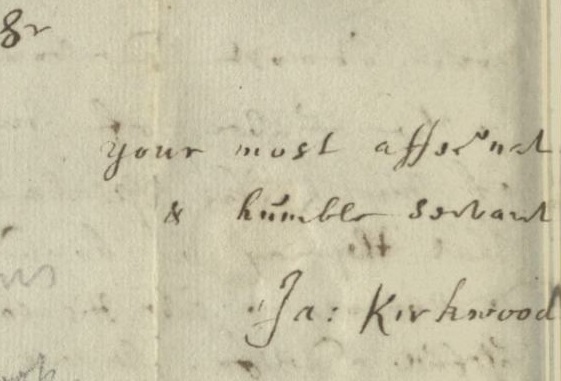
James Kirkwood's signature. MSS KIR, New College Library

James Kirkwood’s signature. MSS KIR 3.1, New College Library

Continue reading