Home University of Edinburgh Library Essentials
April 8, 2026
Welcome to New College Library 2018 #edwelcome

Welcome to all new and returning staff and students from New College Library at the beginning of the academic year.
We’re looking forward to meeting you. To help you get started with Library & IT services at the University, check out this Get Connected to the University page. Don’t forget to collect your University card from the Main Library in George Square.
You can find out more about New College Library at http://www.ed.ac.uk/is/new-college-library and about library resources for Divinity at : http://www.ed.ac.uk/is/subject-guides-divinity.
I’ll be running library tours that are open to all UG and PG students on Wednesday 19 September at 1.15pm and on Wednesday 26 September at 1.15pm. If you’d like a library tour or introductory meeting and these dates don’t suit you, please do get in touch with me to make other arrangements.
Have a look at the Divinity Library Newsletter 2018 which includes
- Successful pilot leads to extended Library opening hours
- New digital collections for Divinity
- New journals for Divinity
Christine Love-Rodgers, Academic Support Librarian, Divinity
Thomas Chalmers and The West Port Experiment
Those with an interest in Scottish church history are likely to be very familiar with Thomas Chalmers and the role he played in the Disruption of 1843 but how many know much of his West Port experiment? Read More
New to Library: Greek Tragedy and Latin Poetry
I’m happy to let you know that the Library now has access to two further modules from Oxford Scholarly Editions Online (OSEO). This gives us online access to a further 101 texts covering Greek Tragedy and Latin Poetry, including works by Euripides, Aeschylus, Sophocles, Ovid, Virgil and Horace.

You can access the individual texts by searching DiscoverEd. Or you can access OSEO via the Databases A-Z list, Classics databases list or Classics subject guide. Read More
New! More Springer Protocols added to DiscoverEd

Used primarily in the life sciences, protocols provide individual sets of instructions to allow scientists to recreate experiments in their own laboratories. These documents provide written procedural methods in the design and implementation of experiments that describe the safety, bias, procedures, equipment, statistical methods, reporting, and troubleshooting standards to be used in order to successfully conduct the experiment.
We have purchased over 800 new Springer Protocols – covering copyright years 2014, 2015, 2016, 2017 and 2018. These have been loaded to DiscoverEd in time for the new semester and for the remainder of 2018, we will continue to add newly published protocols. A title list is available from https://experiments.springernature.com/download-source-titles-list.
Further info
Springer Protocols can also be accessed at http://www.ezproxy.is.ed.ac.uk/login?url=https://experiments.springernature.com which will allow you to cross-search our other subscriptions from SpringerNature (Nature Protocols, Nature Methods) as well as the open access repository Protocol Exchange.
New! Sage Research Methods Videos and E-Books
Just in time for the new academic year, we now have access to new Sage e-resources…

Sage Research Methods Video: Practical Research and Academic Skills – This newest collection of streaming video on the SAGE Research Methods platform offers support on the practical skills that researchers need to successfully complete their research. Key areas such as writing a research proposal, planning and designing a research project and securing ethical approval are explicitly covered. Practical skills such as project management, writing for publication, presenting work, and building networks are also presented through helpful explanatory videos. This video collection will give researchers the confidence to successfully navigate their research work, take responsibility for their professional development and identify the transferable skills they need to progress their careers.
Further info
A title list can be found here and there is a user-guide at http://sagepub.libguides.com/c.php?g=453083&p=5996497

We have expanded our coverage of Sage Knowledge content and now have access to over 4000 e-books in Business & Management, Counselling, Criminology, Education, Geography, Health & Social Care, Media & Communication, Politics & International Relations, Psychology and Sociology. Additional titles will be added to DiscoverEd as records become available.
An internship in the Research Data Service: Towards tailored Research Data Support
For four weeks in July and August 2018, I did an internship in the Research Data Support (RDS) of the University of Edinburgh’s Information Services (IS). Otherwise, I am working as a librarian trainee in Bern University Library in Switzerland. There, as well as in other parts of Europe, research data is an issue which constantly gains momentum, and libraries are, among others, at the forefront of the changing scene. IS has a very good reputation for their work in this field, and so, as a librarian to be, the internship in the RDS was an outstanding opportunity for me to get first hand insights and experiences.
The project I was working on was about tailoring guidance for researchers writing their Data Management Plans (DMP) with the tool dmponline. As a basis for this, I had to gather information about the practices and needs of academic and support staff around research data management (RDM) and DMP. I was to work with staff from all three colleges. (In fact, I found that my project had quite some similarities to Clarissa’s who was just finishing her project when I joined the team.)
My first step was to get in touch with the school support staff, which was essential to get an overall impression of how RDM worked in each school, and to arrange my contacts with researchers. From this, along with information gathered from each schools’ websites, I created an interview questionnaire as well as an online survey. These served to capture researchers’ and support staff’s experience with RDM. For me, conducting interviews was a new and valuable experience. I gained confidence, and I was inspired by the staff’s willingness to share their experience with RDM. I think that interviewing is a very useful skill to develop, because finding out what school staff think and what they need is important in almost every sector of library work.
From the interviews and surveys, I also learnt a lot about researchers’ different practices and challenges in the context of research data management. I analysed the responses and documented my findings in reports for IS and school support staff. Unfortunately, my internship was too short for me to complete the tailored guidance part of the project, but I hope that my work will serve as a basis for the teams’ endeavours to further adapt their DMP support.
Summing everything up, my internship was an inspiring experience which was at times intense but also hugely enriching. This was due in large part to the fantastic team who were welcoming and supported me most effectively whenever needed (this is true, too, for my contact persons in the schools). I would have loved to learn even more about their various experiences, but, after all, I am really grateful for the opportunity I have been given to participate in their work and to learn so much about RDM.
Gero Schreier
Research Data Service Project Assistant
Librarian in training, University Library, University of Bern (Switzerland)
New to the Library: S&P Capital IQ for Company and Finance Data.

The Library has approved a subscription to S&P Capital IQ. Capital IQ is widely used in industry and combines deep global company information, credit ratings and research and market research with tools for risk assessments. It provides access to both real-time and historical information and:
• Global Company Data: financials, fixed income, estimates and ownership
• Qualitative Data: key developments, transactions, profiles, people, relationships, private equity
• Macroeconomic and commodity data
Content and coverage is similar to Bloomberg, Eikon or Datastream but with the advantage of multiple user access online and offsite. This accessibility makes it a perfect choice for classroom teaching. Staff and students also have access to support resources within Capital IQ and can contact Capital IQ specialists direct for assistance.
Capital IQ will be available from September 2018 from the Library A-Z list of databases. If you would like a preview now, please contact hub@business-school.ed.ac.uk for a trial account.
Women in Scotland: Servants and Miners
We continue our series on women in the Statistical Accounts of Scotland, with a particular focus on employment. The existence of women servants is not a surprise, but women miners may well be! We also look at some of the other jobs women undertook which have not already be mentioned.
Servants
In our previous post on women in Scotland, we mentioned the fact that it was hard to employ people as servants during the summer months because they earned more working on the land. However, there were still those who were not willing or able to work in agriculture. In Cross and Burness, County of Orkney, “women-servants receive from L. 2, 1Os. to L. 3 per annum ; but as they are much engaged at home in the plaiting of rye-straw for bonnets, they are unwilling to work in the field, and are generally employed, only in the care of cattle or as house-servants.” (NSA, Vol. XV, 1845, p. 100)
Conversely, farmers in Kinnell, County of Forfar, found it hard to employ women who were working in the weaving industry. “For the farmers, finding it difficult to induce women to leave the loom for the working of the green crop, have been constrained to bring workers from the northern counties. The engagement of these workers is generally for a certain period, at about 8d. or 9d. a day till harvest, when higher wages are necessarily given.” (NSA, Vol. XI, 1845, p. 404)

Morland, Henry Robert; A Lady’s Maid Soaping Linen, c.1765-82. Picture credit: Tate.
Many women had to move away from their parishes to work as servants, such as those in Kirkinner, County of Wigton. “Many of the young women go out as servants to Edinburgh, but particularly to Glasgow and Paisley.” (NSA, Vol. IV, 1845, p. 17) In Walls and Sandness, County of Shetland, “many of the young women, in the character of servants, go to London, Edinburgh, Etc. in the Greenland ships.” (OSA, Vol. XX, 1798, p. 106)
As an aside, in Stornoway, County of Ross and Cromarty, there was a very interesting custom involving women servants! “The people of the town seldom have menservants engaged for the year; and it is a curious circumstance that, time out of remembrance, their maidservants were in the habit of drinking, every morning, a wine glass full of whisky, which their mistress gave them; this barbarous custom became so well established by length of time, that if the practice of it should happen to be neglected or forgotten in a family, even once, discontent and idleness throughout the day, on the part of the maid or maids, would be the sure consequence. However, since the stoppage of the distilleries took place, the people of the town found it necessary to unite in the resolution of abolishing the practice, by withholding the dear cordial from their female domestics, but not without the precaution of making a compensation to them in money for their grievous loss; and it is said, that even this is not satisfactory, and that, in some families, the dram is still given privately, to preserve peace and good order.” (OSA, Vol. XIX, 1797, p. 258)
Mining
Women of all ages, even during the time of the Old Statistical Accounts of Scotland, worked in the mines, carrying the coal up to the surface on their backs! This was particularly prevalent in Alloa, County of Clackmannan and Tranent, County of Haddington. “The depth of a bearing pit cannot well exceed 18 fathom, or 108 feet. There are traps, or stairs, down to these pits, with a hand rail to assist the women and children, who carry up the coals on their backs.” (OSA, Vol. VIII, 1793, p. 615) The women were called “bearers”, who carried about 1 1/2 cwt. on their backs, and ascended the pit by a bad wooden stair. In the deeper pits, the coals were carried to the bottom of the shaft by women, and then raised in wooden tubs by means of a “gin” moved by horses.” (NSA, Vol. II, 1845, p. 287) In Liberton, County of Edinburgh, “the stones from the mine or quarry were formerly carried to the bank-head by women with creels fastened on their backs, and when the works were in full operation, probably fifty women were thus employed.” (NSA, Vol. I, 1845, p. 19) As reported in Hamilton, County of Lanark, “at Quarter, the first bed worth working is the 10 feet or woman’s coal, so called because it was once wrought by females. This is a soft coal, which burns rapidly; and although called the 10 feet coal, is in reality from 7 to 14 feet in thickness.” (NSA, Vol. VI, 1845, p. 258)

For the actual numbers who worked in the colliery of Alloa in 1780 you can take a look here: OSA, Vol. VIII, 1793, p. 619. There are also figures given for those working at the coal mines in the parish of Dunfermline, County of Fife. (OSA, Vol. XIII, 1794, p. 476) In Lasswade, County of Edinburgh, “there are from 90 to 100 colliers, (pickmen). Women are still employed as bearers below ground; their number may be from 130 to 150.” (OSA, Vol. X, 1794, p. 281)
In the later Alloa parish report, found in the New Statistical Accounts of Scotland, mining was equated to slavery. It was reported that the condition of colliers had, in the last thirty years, improved “since the women were relieved from the most disgraceful slavery of bearing the coals, and the workman from all charge of the coals, the instant they are weighed at the pit. From, the circumstance of the wives remaining at home to attend to the domestic economy, the houses are much more comfortable and better furnished than they formerly were, and the whole style of living has been improved.” (NSA, Vol. VIII, 1845, p. 33) It was felt that not having women working down the pits improved both the character and habits of the people. In the parish report of Tranent, County of Haddington, it was noted that “among a population of colliers, it cannot be expected that the habits of the people should be cleanly; and the injurious practice of women working in the pits as bearers, (now happily on the decline with the married females,) tends to render the houses of colliers most uncomfortable on their return from their labours, and to foster many evils which a neat cleanly home would go far to lessen.” (NSA, Vol. II, 1845, p. 295)
Other jobs!
Here are some other jobs undertaken by women found in the Statistical Accounts of Scotland.
- Boot-binding
Linlithgow, County of Linlithgow – “Thirty women are also employed as women’s boot-binders, whose weekly wages average 4s. 6d.” (NSA, Vol. II, 1845, p. 180)
- Fuel manufacture
Rathven, County of Banff – “It is the province of the women to bait the lines; collect furze, heath, or the gleanings of the mosses, which, in surprising quantity, they carry home in their creels for fuel, to make the scanty stock of peats and turfs prepared in summer, last till the returning season.” (OSA, Vol. XIII, 1794, p. 424)
Kirkinner, County of Wigton – “The day-light, during the winter, is spent by many of the women and children in gathering elding, as they call it, that is, sticks, furze, or broom, for fuel, and the evening in warming their shivering limbs before the scanty fire which this produces.” (OSA, Vol. IV, 1792, p. 147)
Appendix for Kincardine, County of Perth – “The women declare they can make more by working at the moss than at their wheel and such is their general attachment to that employment, that they have frequently been discovered working by moon-light.” (OSA, Vol. XXI, 1799, p. 175)
Snizort, County of Inverness – “The fuel is peats, which the women carry home in creels on their backs, from a very great distance.” (NSA, Vol. XIV, 1845, p. 295)
Lismore and Appin, County of Argyle – “Peats are the only fuel in both parishes. The process of making them in Lismore is difficult beyond conception, as they are first tramped and wrought with men’s feet, and then formed by the women’s hands. There is a necessity for this; because the substance of which they are made contains no fibres to enable them to cohere or stick together. This tedious operation consumes much of the farmer’s time, which, in a grain country, might be employed to much better advantage; and affords serious cause of regret that the coal-duty is not taken off, or lessened, which would remove the everlasting bar to the success of the fishing villages, and to improvements in general over all the coasts of Scotland.” (OSA, Vol. I, 1791, p. 490)
- Varnishing wooden boxes
Old Cumnock, County of Ayrshire – “One set of artists make the boxes, another paint those beautiful designs that embellish the lids, while women and children are employed in varnishing and polishing them. The process of varnishing a single box takes from three to six weeks. Spirit varnish takes three weeks, and requires about thirty coats; while copal varnish, which is now mostly used, takes six weeks, and requires about fifteen coats to complete the process. When the process of varnishing is finished, the surface is polished with ground flint; and then the box is ready for the market.” (NSA, Vol. V, 1845, p. 486)
- Plaiting straw
Orphir, County of Orkney – “Almost all the young women have, for many years, been employed in winter in plaiting straw for bonnets.” (NSA, Vol. XV, 1845, p. 20)
Stromness, County of Orkney – “There are a few straw plait manufacturers, who employ a number of women in the town as well as in the country. This manufacture has been, for some time past, upon the decline; and, being at all times dependent upon the caprice of fashion, has lately afforded a scanty subsistence to the many young females who totally depend on it for their support. They are now allowed to plait in their own homes, which has been found more conducive to their health and morals, than doing so collectively, in the houses of the, manufacturers, which was the original custom. -There is a small rope manufactory, where ropes of various kinds are made, both for the shipping and for country, use. From the former Account, it appears there was a considerable quantity of linen and woolen cloth manufactured. This business has now wholly ceased here, being superseded by the perfect machinery now in use.” (NSA, Vol. XV, 1845, p. 32)
- Salt sellers
Duddingston, County of Edinburgh – “Their labours afforded employment to above 40 carriers, all women, who retailed the salt in Edinburgh, and through the neighbouring districts.” (OSA, Vol. XVIII, 1796, p. 368)
- Lace makers
Hamilton, County of Lanark – “The lace trade, established here about eight years ago by a house at Nottingham, which sent down a number of English women, who took up schools and taught the tambourers here the art, is now in a thriving state, and is contributing greatly to the happiness and comfort of the community.” (NSA, Vol. VI, 1845, p. 294) “From a census taken some months ago, and which seems to be accurate, there has been an increase [in population] of 309, which may be attributed to the introduction and flourishing condition of a lace-manufactory, which now employs a great many females.” (NSA, Vol. VI, 1845, p. 276)
- Potato-starch makers
Spott, County of Haddington – “The only thing of this sort [manufactures] carried on in the parish, is a manufactory of potato-starch, or flour, on the farm of Easter Broomhouse. It employs six women for six months in the year. The flour is principally used by manufacturers of cloth; and sometimes by bakers and confections in large towns.” (NSA, Vol. II, 1845, p. 230)
For a fascinating insight into the industries found in Scotland in the nineteenth century take a look at the book ‘The industries of Scotland; their rise, progress, and present condition‘ by David Bremner, published in 1869.
Conclusion
The last three blog posts illustrates just how important the role was for women in society. They worked in all sorts of sectors, including manufacturing, agriculture, fishing, and even mining at one point. They supported themselves and helped support their families, showing resourcefulness, adaptability, and willingness to work hard.
We will continue this series on women in Scotland by looking more generally at the impact women’s work had on society, as well as the impact society had on women.
“Ye are many—they are few”: Exploring the Peterloo massacre through our library resources
Next year on this day, 16th August, it will be the 200th anniversary of the Peterloo Massacre. The ironic name given to events at St Peter’s Fields in Manchester on 16th August 1819 when the cavalry charged into a peaceful crowd of 50,000-80,000 people who were attending a mass demonstration for political reform. Between 10-20 people were killed and 100s were injured. In this week’s blog post I have pulled together just a small selection of Library resources, digital and physical, that will help you explore Peterloo, the events leading up to it and the aftermath.
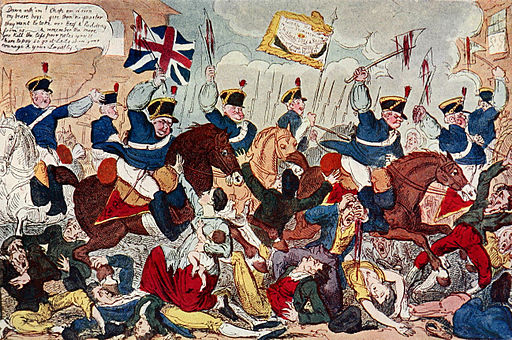
The Massacre of Peterloo. George Cruikshank [Public domain], via Wikimedia Commons
Bigger and Better Things
In this week’s blog, Sarah MacLean, an MA Conservation of Fine Art student from Northumbria University, describes a two-week work placement she undertook with us in July 2018…
During my time studying Fine Art at Undergraduate level, I always did big things; used metre upon metre of canvas, and sculpted near-immovable forms twice my height. Now, as an MA Conservation of Fine Art student at Northumbria University, large format works are still where my interests lie, and I’ve had the opportunity during my work placement at the CRC to work on a wide variety of those.
The works I’ve been able to conserve so far during my time here are part of the Patrick Geddes Collection. Geddes (1854-1932) was a Scottish-born polymath with interests and expertise in biology, sociology, geography, and urban planning, and it’s for his pioneering work in this latter field that he is best known. As such, the large format plans on which I’ve worked within the Collection so far are mainly hand-drawn and coloured mappings of urban developments in locations everywhere from Dunfermline to Imperial Delhi.
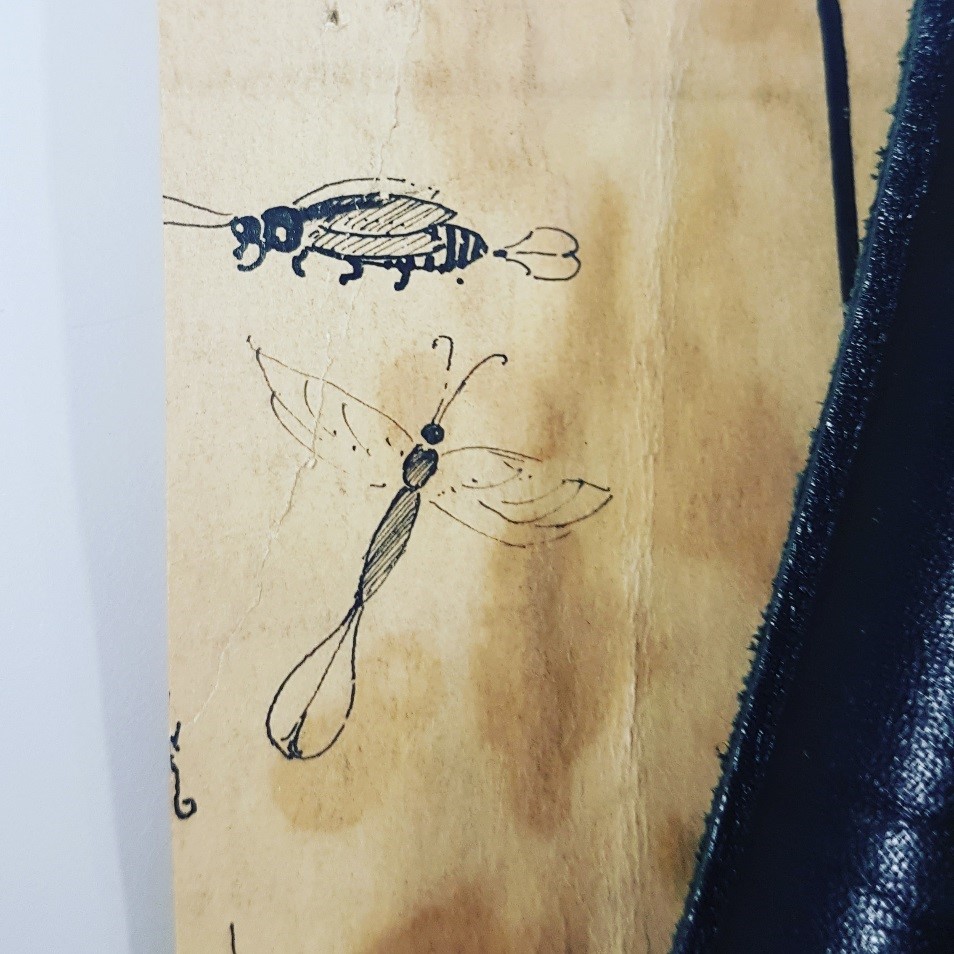
A pleasant and unexpected feature of hand-drawn and coloured works of art on paper – timorous marginalia beasties!
Collections
 Hill and Adamson Collection: an insight into Edinburgh’s past
My name is Phoebe Kirkland, I am an MSc East Asian Studies student, and for...
Cataloguing the private papers of Archibald Hunter Campbell: A Journey Through Correspondence
My name is Pauline Vincent, I am a student in my last year of a...
Hill and Adamson Collection: an insight into Edinburgh’s past
My name is Phoebe Kirkland, I am an MSc East Asian Studies student, and for...
Cataloguing the private papers of Archibald Hunter Campbell: A Journey Through Correspondence
My name is Pauline Vincent, I am a student in my last year of a...
Projects
Cataloguing the private papers of Archibald Hunter Campbell: A Journey Through Correspondence
My name is Pauline Vincent, I am a student in my last year of a...
Archival Provenance Research Project: Lishan’s Experience
Presentation My name is Lishan Zou, I am a fourth year History and Politics student....