Home University of Edinburgh Library Essentials
March 21, 2026
Research Data Management Training for University of Edinburgh staff and students, Spring 2019
Following on from our blog post on the benefits of RDM training which was posted on the 15th of November, we have scheduled our in-person training courses for the Spring 2019 semester. A description of each course and its intended audience can be found on our Training and support resources webpage, alongside details of online training offerings. Courses can usually be booked through MyEd Event Booking approximately four weeks beforehand.
| Course | Dates & Times | Location |
| Creating a Data Management Plan | 16/01/2019@10:30-12:30 | Seminar Room 3, Chancellor’s Building (Little France) Map |
| 28/02/2019@14:00-16:00 | Murchison House, Room G.12 (Kings Buildings) Map | |
| 27/03/2019@14:00-16:00 | Appleton Tower, Room 2.07 (Central Area) Map | |
| Working with Personal and Sensitive Data | 13/02/2019@14:00-16:00 | Seminar Room 3, Chancellor’s Building (Little France) Map |
| 21/03/2019@10:00-12:00 | G.69 Joseph Black Building (Kings Buildings) Map | |
| 01/05/2019@14:00-16:00 | High School Yards, Classroom 4 (Central Area) Map | |
| Good Practice in Research Data Management | 24/01/2019@13:30-16:30 | Murchison House, Room G.12 (Kings Buildings) Map |
| 22/02/2019@ TBC | TBC | |
| 05/03/2019@13:30-16:30 | EW11, Argyle House, 3 Lady Lawson Street (Central Area) Map | |
| 05/04/2019@09:30-12:30 | Seminar Room 6, Chancellor’s Building (Little France) Map | |
| Managing Your Research Data | 17/01/2019@10:00-12:00 | Room B.09, Institute for Academic Development, 1 Morgan Lane, (Holyrood) Map |
| 05/02/2019@10:00-12:00 | Lister Learning and Teaching Centre – Room 1.3 (Central Area) Map | |
| 15/03/2019@10:00-12:00 | Seminar Room 5, Chancellor’s Building (Little France) Map | |
| 12/04/2019@10:00-12:00 | Room B.09, Institute for Academic Development, 1 Morgan Lane, (Holyrood) Map | |
| 25/04/2019@14:00-16:00 | G.69 Joseph Black Building (Kings Buildings) Map | |
| 18/06/2019@10:00-12:00 | Room B.09, Institute for Academic Development, 1 Morgan Lane, (Holyrood) Map | |
| Handling Data Using SPSS | 12/02/2019@13:30-16:30 | Room 1.08, First Floor, Main Library, George Square (Central Area) Map |
| 02/04/2019@13:30-16:30 | EW10, Argyle House, 3 Lady Lawson Street (Central Area) Map | |
| Data cleaning with OpenRefine | 07/02/2019@13:30-16:30 | Lister Learning and Teaching Centre ,2.14 – Teaching Studio, (Central Area) Map |
—
Kerry Miller
Research Data Support Officer
Research Data Service
Library and University Collections
Crime and punishment in late 18th-early 19th century Scotland: Causes of crime and crime prevention
This is the second in our series of posts on crime and punishment in 18th-19th century Scotland. This time we are looking at what the parish reporters thought were the causes of crime, as well as what measures were being put in place help prevent crime. There are some very interesting opinions on both these subjects found in the Statistical Accounts.
Reasons for crime
- Alcohol
It is not surprising to read that crime was mostly attributed to alcohol, or, more specifically, drunkenness! There are some very damning views shared in the parish reports. The Rev. Mr Thomas Martin wrote in the parish report for Langholm, County of Dumfries, “let the distilleries then, those contaminating fountains, from whence such poisonous streams issue, be, if not wholly, at least in a great measure, prohibited; annihilate unlicensed tippling-houses and dram-shops, those haunts of vice, those seminaries of wickedness, where the young of both sexes are early seduced from the paths of innocence and virtue, and from whence they may too often date their dreadful doom, when, instead of”running the fair career of life” with credit to themselves, and advantage to society, they are immolated on the altar of public justice.” (OSA, Vol. XIII, 1794, p. 605)
In Tinwald and Trailflat, County of Dumfries, it was reported that “there are at present 2 small dram-shops in the parish which we have the prospect of soon getting rid of. They have the worst possible effect upon the morals of the people: and there is scarcely a crime brought before a court that has not originated in, or been somehow connected with, one of these nests of iniquity.” (NSA, Vol. IV, 1845, p. 50)

‘A drunken brawl in a tavern with men shouting encouragement’, 19th century wood engraving after A. Brouwer. [Wellcome Images, [CC BY 4.0 license (https://creativecommons.org/licenses/by/4.0)], via Wikimedia Commons]
The cheap cost of alcohol, as well as the number of ale-houses in existence, was believed to be a factor in the higher level of crime. In the parish of Orwell, County of Kinross, “in consequence of the low price of spirits within these last six or eight years, there have been more petty crime and drunkenness than was formerly known.” (NSA, Vol. IX, 1845, p. 66)
It is fascinating to read the parish report from Hutton and Corrie, County of Dumfries, which states that “in 1834, the House of Commons appointed a Select Committee of their number to take evidence on the vice of drunkenness. The witnesses ascribe a large proportion, much more than the half of the poverty, disease, and misery of the kingdom, to this vice. Nine-tenths of the crimes committed are considered by them as originating in drunkenness… The pecuniary loss to the nation from this vice, on viewing the subject in all its bearings, is estimated by the committee, in their report to the House of Commons, as little short of fifty millions per annum. ” (NSA, Vol. IV, 1845, p. 550)
- Itinerant workers
In the parish of Corstorphine, County of Edinburgh, “the persons there employed are collected from all the manufacturing towns in England, Ireland, and Scotland. They are continually fluctuating; feel no degree of interest in the prosperity of the place; and act as if delivered from all the restraints of decency and decorum. In general, they manifest a total disregard to character, and indulge in every vice which opportunity enables them to perform” and is further noted that “the influence of their contagious example must spread” to others in the parish. (OSA, Vol. XIV, 1795, p. 461)
- Lack of religious upbringing and instruction
In some corners, crime was also attributed to a lack of religious upbringing and instruction. As mentioned above, there was a report made to the House of Commons on drunkenness and its affect on crime. “In London, Manchester, Liverpool, Dublin, Glasgow, and all the large towns through the kingdom, the Sabbath, instead of being set apart to the service of God, is made by hundreds of thousands a high festival of dissipation, rioting, and profligacy.” (NSA, Vol. IV, 1845, p. 550)
Govan, County of Lanark, was seen as a district “where there is no civil magistrate to enforce subordination, and to punish crimes, what can be expected, but that the children should have been neglected in their education; that many of the youth should be unacquainted with the principles of religion, and dissolute in their morals; and that licentious cabal should too often usurp the place of peaceable and sober deportment.” (OSA, Vol. XIV, 1795, p. 295) It was also noted that “if neighbouring justices were, at stated intervals, to hold regular courts in so large villages, they might essentially promote the best interests of their country. They would be a terror to evil doers, and a protection to all that do well.”
In the parish report for Ardrossan, County of Ayrshire, it was remarked that “we have certainly too many among us who have cast off all fear of God, and yield themselves up to the practice of wickedness in some of its most degrading forms, yet the people in general are sober and industrious, and distinguished for a regard to religion and its ordinances. Not only is the form of godliness kept up, but its power appears to be felt, by not a few among them maintaining a conversation becoming the gospel.” (NSA, Vol. V, 1845, p. 199)
Crime prevention
So, according to the parishes throughout Scotland, how best could crimes be prevented? As the parish report of Langholm, County of Dumfries, mentions, “it is much more congenial to the feelings of every humane and benevolent magistrate to prevent crimes by all possible means, than to punish them… Remove the cause, and the effects in time will cease.” (OSA, Vol. XIII, 1794, p. 605) In the parish report of North Knapdale, County of Argyle, correcting criminal behaviour is preferable to punishment. “Such evil consequences can never be prevented without knowledge and education; and for this reason men, in power and authority, should pay particular attention to the subject.” (OSA, Vol. VI, 1793, p. 265)
In some quarters, punishments were considered too lenient. In the parish of Fetlar and North Yell, County of Shetland, “the punishments inflicted for such crime of theft, in particular, are so extremely mild, that they rather excite to the commission of the crime than deter from it.” (OSA, Vol. XIII, 1794, p. 285) In some parishes trouble-makers and criminals were simply expelled from that city, town or parish, instead of being punished! As pointed out in the parish report of Muirkirk, County of Ayrshire, “this is neither more nor less, than to punish the adjacent country for sins committed in the town, to lay it under contribution for the convenience of the city, and free the one of nuisances by sending them to the other.” (OSA, Vol. VII, 1793, p. 609) (Although in the parish of Killin, County of Perth, “the turbulent and irregular [were] expelled the country to which they were so much attached, that it was reckoned no small punishment by them.” (OSA, Vol. XVII, 1796, p. 384))
In Liberton, County of Edinburgh, it was felt that “nothing can remove the evil of assessments now, (which would be ten times greater, but for the efforts of the kirk-session,) but the subdivision of parishes, the diffusion of sound instruction and Christian principle amongst the people, and the removal of whisky-shops. Crime, drunkenness and poverty are always found together, and expending money upon the poor, except for the purpose of making them better, will as soon cure the evil as pouring oil upon a flame will quench it.” (NSA, Vol. I, 1845, p. 27)
In the parish reports there is no lack of suggestions on how to deter crime and punish criminals.
- Suggestions
– Restrictions on selling alcohol
A very interesting suggestion was made in the parish report for Callander, County of Perth in November 1837. ” Considerable improvement has taken place within these few years in the management of the police of the country; yet there are many crimes allowed to pass with impunity. Would it not tend much to diminish crime if there were fewer licenses granted for selling, spirits, and more attention paid to the character of the persons to whom licenses are given?” (NSA, Vol. X, 1845, p. 360) A similar observation is made in the report for the parish of Stirling, County of Stirling, where “granting of licenses, without sufficient inquiry as to the character of the applicant” is believed to be one of the reasons for crime. (NSA, Vol. VIII, 1845, p. 448)
In the report made to the House of Commons on drunkenness and its affect on crime “a great many of the witnesses recommended the prohibition of distillation, as well as of the importation of spirits into the kingdom.” The report also stated that religious institutions had a big part to play in “rooting out drunkenness, now appearing in every part of the kingdom”. (NSA, Vol. IV, 1845, p. 550)
In Kennoway, County of Fife, “the grand remedy, if it could be applied, would be to lay a restriction on the improper use of ardent spirits. Drunkenness is certainly the prevailing vice amongst us ; and is the originator, or at least inciting cause, to almost every mischief. Imprisonment for violent assault under its influence has of late been in two instances inflicted.” (NSA, Vol. IX, 1845, p. 381)
– Law enforcement and confinement
In the parish of Gargunnock, County of Stirling, a problem with vagrants is reported. “They spend everything they receive at the first ale-house; and for the rest of the day they become a public nuisance. The constables are called, who see them out of the parish; but this does not operate as a punishment, while they are still at liberty. It would be of great advantage, if in every parish, there was some place of confinement for people of this description, to keep them in awe, when they might be inclined to disturb the peace of the town, or of the neighbourhood.” (OSA, Vol. XVIII, 1796, p. 114)

Walker, Frederick; The Vagrants; 1868. Picture credit: Tate.
The parish of Carluke, County of Lanark, reports specific measures taken against vagrancy. “The inconvenience and loss by acts of theft, etc. which many sustain by encouraging the vagrant poor of
other parishes, we have endeavoured to prevent here, not only by making liberal provision for the poor of this parish, and restraining them from strolling, under the penalty of a forfeiture of their allowance; but also by following out strictly the rule of St. Paul, “If any would not work, neither should he eat.” (2 Thess. iii. 10.) and the laws of our country with respect to idle vagrants.” (OSA, Vol. VIII, 1793, p. 140)
Some parishes did not have any sort of, or very little, law enforcement in place.
Drymen, County of Stirling – “There is not a justice of peace, nor magistrate of any kind resident within the bounds of this parish neither is there a jail or lock-up house from the most westerly verge of the county onward to Stirling,–a distance of nearly fifty miles. The consequence is, that crime and misdemeanor frequently go unpunished, the arm of the law not being long enough nor strong enough to reach so far.” (NSA, Vol. VIII, 1845, p. 114)
Stromness, County of Orkney – “There is no prison in Stromness. This greatly weakens the authority of the magistrates, and is unfavourable to the morals of this populous district. Were an efficient jail erected, it would intimidate the lawless, and be an effectual means of preventing crime, and the lesser delinquencies.” (NSA, Vol. XV, 1845, p. 38)
Thurso, County of Caithness – “at present the smallest misdemeanor cannot be punished by imprisonment, without sending the offender to the county jail of Wick, at the distance of 20 miles from Thurso, which necessarily occasions a heavy expense to the prosecutor, public or private, and, of course, is the cause of many offences passing with impunity, which would otherwise meet their due punishment.” (OSA, Vol. XX, 1798, p. 545)
Langholm, County of Dumfries – “Instead of banishing delinquents from a town or county for a limited time… would it not tend more to reclaim them from vice, to have a bridewell, upon a small scale, built at the united expense of the 5 parishes, where they could be confined at hard labour and solitary confinement, for a period proportioned to their crimes… The dread of solitary confinement, and the shame of being thus exposed in a district where they are known, would operate in many instances as a powerful preventive.” (OSA, Vol. XIII, 1794, p. 613)
Kilmaurs, County of Ayrshire – “Two bailies are chosen annually, but their influence is inconsiderable, having no constables to assist in the execution of their authority; the disorderly and riotous therefore laugh at their threatened punishments.” (OSA, Vol. IX, 1793, p. 370)
Employers and proprietors also had a role to play in deterring crime.
Kilfinichen and Kilviceuen, County of Argyle – “The Duke of Argyll, upon being informed of this complaint, gave orders to his chamberlain to intimate to his Grace’s tenants, and all the kelp manufacturers upon his estate, that whoever was found guilty of adulterating the kelp, would find no shelter upon his estate, and that they would be prosecuted and punished as far as the law would admit. This will have a good effect upon his Grace’s estate, and is worthy of imitation by the Highland proprietors of kelp shores.” (OSA, Vol. XIV, 1795, p. 182)
St Cyrus, County of Kincardine – “poaching for game has become much less common of late years, from the active measures employed by a game-association, instituted among the principal landed gentlemen of the county, for the punishment of this species of delinquency.”(NSA, Vol. XI, 1845, p. 286)
- Increased religious instruction/services – spiritual and moral improvement
In Langton, County of Berwick, there were parochial visitations when there was discussion about any issues affecting the congregation between the presbytery and the elders, and then the congregation itself. “It is impossible to conceive a system more fitted to promote the diligence and faithfulness of ministers, or the spiritual and moral improvement of parishes. Its effects, accordingly, were visible in a diminution of crime, and an increase of personal and family religion among the surrounding districts.” (NSA, Vol. II, 1845, p. 244)
In Hamilton, County of Lanark, “much has been said of the happy influence of Sunday schools in other places. If there were people of wealth and influence heartily disposed to strengthen virtue, to encourage good behavior, and to discountenance vice and irregularity, by establishing that institution here, in order to rescue the children of dissolute parents, from the danger of bad habits, to instruct them in the principles of religion, and a course of sobriety and industry, it is probable, they might be the happy means of restoring and improving the morals of all the people in this populous district.” (OSA, Vol. II, 1792, p. 201)
An interesting observation is made in the parish report of Hawick, County of Roxburgh. “The cases of gross immorality which occurred during the course of about thirty years before the Revolution, and when Episcopacy was predominant, were about double the number that took place during the course of thirty years after it, and when Presbytery was restored, which may justify the conclusion, that the exercise of discipline according to the constitution of the Church of Scotland is of signal efficacy in restraining the excesses of profligacy and crime.” (NSA, Vol. III, 1845, p. 392)
- Better street lighting
In Edinburgh, County of Edinburgh, “the frequent robberies and disorders in the town by night occasioned the town-council to order lanterns or bowets to be hung out in the streets and closes, by such persons and in such places as the magistrates should appoint,–to continue burning for the space of four hours, that is, from five o’clock in the evening till nine, which was deemed a proper time for people to retire to their houses.” (NSA, Vol. I, 1845, p. 627)
Better street lighting was also identified as a form of crime deterrent in Dundee, County of Forfar. “In consequence of the rapid increase of the population of Dundee and surrounding district, and the ordinary provision of the law for preserving the public peace having become inadequate for the purpose, in 1824, the magistrates, with the concurrence of the inhabitants at large, applied to Parliament for an act to provide for the better paving, lighting, watching, and cleansing, the burgh, and for building and maintaining a Bridewell there… The police establishment has been of essential service to the inhabitants, with respect to the protection of their persons and property; although it cannot be denied that the streets are not much improved. The number of watchmen is too limited for the extent of the bounds, and the suburbs, which are generally haunts of the disorderly, are but poorly lighted.” (NSA, Vol. XI, 1845, p. 8)
________________________________
Conclusion
Writers of the parish reports had very clear opinions on the causes of crime and ways to tackle it. Alcohol and the resulting drunkenness was by far and away the most cited cause. It was deemed such a problem that, in 1834, the House of Commons appointed a Select Committee to investigate and report on ‘the vice of drunkenness’. some also blamed the lack of religious upbringing and moral and spiritual standards. As pointed out in our last blog post, a number of parishes reported that their citizens as, in the main, law-abiding, using such words as honest, sober, industrious, religious and moral. With regards to crime prevention, many parishes reported that the criminal system needed improving, including the building of bridewells and prisons, and the increasing of law enforcement. Specific measures against the licensing to sell alcohol and the cheap pricing of alcohol were also suggested. All this information that we find in the Statistical Accounts provides us with a fascinating insight into crime and its causes at that particular time. It allows us to think about how the causes of crime and preventative measures have changed (or stayed the same!) since the late eighteenth – early nineteenth centuries.
In our next post we will be looking at different types of punishment handed out to criminals in eighteenth and nineteenth century Scotland and how this correlates to the types of crime committed.
New to the Library: The Baltimore Afro-American
I’m happy to let you know that the Library now has access to the digital archive of The Baltimore Afro-American (1893-1988) from ProQuest Historical Newspapers. Founded in 1892 it is the most widely circulated black newspaper on the Atlantic coast and the longest-running family-owned African American newspaper in the United States.

You can access The Baltimore Afro-American (1893-1988) via the Databases A-Z list and Newspapers & Magazines database list. You can also access the title through DiscoverEd* Read More
Trial access to Chinese newspapers of modern China
 Shanghai Library has provided us with a trial access to the digital archives of 6 modern Chinese newspapers, until 16 Feb 2019. The trial can be accessed on the same database platform as the Late Qing Dynasty Periodical Full-text Database 1833-1911 and Chinese Periodical Full-text Database 1911-1949, both of which are in the Library’s Databases A-Z list and Databases and the Databases by Subject for East Asian Studies list, or simply go directly to http://www.cnbksy.com.ezproxy.is.ed.ac.uk/search/advance (EASE login is required).
The six Chinese newspaper archives are:
《小报》The Tabloids (1897~1949)
《新闻报》Sin Wan Pao (1893~1949)
《时报》The Eastern Times (1904~1939)
《大公报》(1902~1949/1952)Ta Kung Pao(1902~1949/1952)
《大陆报》The China Press (1911~1949)
《字林洋行中英文报纸全文数据库》The North-China Daily News & Herald Newspapers and Hong Lists (1850~1951)
Shanghai Library is digitising other Chinese and English newspapers of modern China. We will arrange a free trial when they are ready in 2019.
Personal data: What does GDPR mean for your research data?
It falls upon me to cover the ‘hot topic’ of research data and GDPR (European privacy legislation) just before a cold winter holiday break. This makes me feel like the last speaker in a session that has overrun – ‘So, I’m the only thing between you and your lunch …’ But none of this changes the fact that the General Data Protection Legislation – codified into British Law by the UK Data Protection Act, 2018 – is a very important factor for researchers working with human subjects to take into account.
This is why the topic of GDPR and data protection arose out of the case studies project that my colleagues completed this summer. This blog post introduces the last in the series of these RDM case studies: Personal data: What does GDPR mean for your research data?
Dr. Niamh Moore talks about how research has evolved to take data protection and ethics into account, focusing on the time-honoured consent form, and the need to take “a more granular approach” to consent: subjects can grant their consent to be in a study, but also to have their data shared–in the form of interview transcripts, audio or video files, diaries, etc., and can choose which of these they consent to and which they do not.
Consent remains a key for working with human subjects ethically and legally, but at the University of Edinburgh and other HEIs, the legal basis for processing research data by academic staff may not be consent, it may simply be that research is the public task of the University. This shifts consent into the ethical column, while also ensuring fair, transparent, and lawful processing as part of GDPR principles.
I was invited to contribute to the video as well, from a service provider’s perspective because our Research Data Support team advises and trains researchers on working with personal and sensitive data. One of my messages was of reassurance, that actually researchers already follow ethical norms that put them in good stead for being compliant with the Law.
Indeed, this is a reason that the EU lawmakers were able to be convinced that certain derogations (exceptions) could be allowed for in “the processing of personal data for archiving purposes in the public interest, scientific or historical research purposes or statistical purposes,” as long as appropriate safeguards are used.
Our short video brings out some examples, but we could not cover everything a researcher needs to know about the GDPR – the University of Edinburgh’s Data Protection Officer has written authoritative guidance on research and data protection legislation for our staff and students and has also created a research-specific resource on the LEARN platform. Our research data support team also offers face to face training on Working with Personal and Sensitive Data which has been updated for GDPR.
I have tried to summarise how researchers can comply with the GDPR/UK Data Protection Act, 2018 while making use of our Research Data Service in this new Quick Guide–Research Data Management and GDPR: Do’s and Don’ts. Comments are welcome on the usefulness and accuracy of this advice!
Robin Rice
Data Librarian and Head, Research Data Support
Library & University Collections
New books in the Library for History, Classics and Archaeology
Thanks to recommendations from members of staff and requests via RAB from students the Library is continually adding new books to its collections both online and in print. Here are just a (very) small number of the books that have been added to the Library’s collections in semester one, 2018/19 for the School of History, Classics and Archaeology and these demonstrate the wide range of subjects being taught, studied and researched within School.
–> Find these and more via DiscoverEd.
 Agent of change: print culture studies after Elizabeth L. Eisenstein edited by Sabrina Alcorn Baron, Eric N. Lindquist, and Eleanor F. Shevlin (shelfmark: Z124 Age.)
Pomodoro!: a history of the tomato in Italy by David Gentilcore (shelfmark: TX803.T6 Gen.)
From frontiers to football: an alternative history of Latin America since 1800 by Matthew Brown (shelfmark: F1410 Bro. Also available as e-book).
Neolithic bodies edited by Penny Bickle and Emilie Sibbesson (shelfmark: GN776.2.A1 Neo.) Read More
Edinburgh hosts international IIIF event

Jointly with the National Library of Scotland, the University hosted the annual IIIF Showcase and Working Meeting from December 3-6. As consortial members, it was a good opportunity for both institutions to raise their profile within this fast-growing community, and for delegates from all over the world to see Edinburgh in winter while making the most of face-to-face discussions regarding recent developments and the future direction of the framework.
The Showcase took place in the Royal Society of Edinburgh, and this reasonably light-touch session offered an introduction to the concepts and tools and for the host institutions to talk about what they’ve produced so far. It was also IIIF’s new managing director Josh Hadro’s first week in the job: a great way for him to see the community in action! The afternoon saw candidates repair to the NLS and Main Library for breakout sessions in key content areas (Archives, Museums, Digital Scholarship) as well as deeply technical and ‘getting started’ sessions. To finish, everyone then made for St Cecilia’s Hall for a round-up of the day; this was an appropriate setting, as we’ve employed IIIF in the museum’s corresponding collections site.
The Working Group meeting ran over the succeeding three days, in the ECCI and Main Library. This was a smaller undertaking than the Showcase, but it still attracted 70 delegates. There were some really meaty discussions about the direction of the framework: cookbooks and use cases; updates to the Mirador viewer; enhancing the APIs and registries (including more work on authentication and various types of search), and looking at the amazing potential of 3D and AV (e.g. subtitle support, musical notation written as a piece plays), which is something we at the University are well placed to start work on. Discussions about the direction of the community and outreach group took place, as well; this session was led by our (until very recently) very own Claire Knowles, now Assistant Director at Leeds University Library. The first meeting of the Technical Review Committee, which rubber-stamps the specs, took place at the event too, in the huge Dining Room at Teviot.
With increasing engagement across the industry, IIIF’s future looks very bright indeed.
Thanks to everyone that helped out over the week, with a particularly big round of applause to IIIF’s Technical Co-ordinator Glen Robson, who is well-known to many people in the Library due to his previous incarnation as Development Manager at the National Library of Wales.
To (self-indulgently) end the post, here is a little hi-res illustration of the work that we have done at Edinburgh with IIIF.
This is heavily annotated! If you click the speech bubbles, you will turn on annotations, some of which link out to relevant websites (links have a dotted line under the text). Also, the Mirador viewer does comparison very well, so if you
- click the four-square icon in the top left
- select ‘Add Slot Right’
- click ‘Add Item’
- double click the manifest (‘IIIF Highlights…’)
- select the right image
…you can see the previous version of this picture to see where improvements were made. All of this will go better if you make it full-screen!
New books in the Library for Social and Political Science
Thanks to recommendations from members of staff and requests via RAB from students the Library is continually adding new books to its collections both online and in print. Here are just a (very) small number of the books that have been added to the Library’s collections in semester one, 2018/19 for the School of Social and Political Science and these demonstrate the wide range of subjects being taught, studied and researched within School.
–> Find these and more via DiscoverEd.
 The Blood telegram: Nixon, Kissinger, and a forgotten genocide by Gary J. Bass (shelfmark: E855 Bas.)
Where underpants come from: from checkout to cotton field: travels through the new China and into the new global economy by Joe Bennett (shelfmark: HD9736.C62 Ben.)
Taxing Africa: coercion, reform and development by Mick Moore, Wilson Prichard and Odd-Helge Fjeldstad (shelfmark: HJ3021 Moo. Also available as e-book).
Peace for Lebanon?: from war to reconstruction edited by Deirdre Collings (shelfmark: DS87 Pea.)
Town twinning, transnational connections and trans-local citizenship practices in Europe by Andreas Langenohl (e-book). Read More
Doodles and Discoveries: Scottish Court of Session Papers
 We are now well in the midst of the Scottish Court of Session Papers Phase 2 Pilot. In this stage of the project, we are concentrating on digitising three hundred volumes from the collections of the three institutions involved; The Faculty of Advocates, The Signet Library and the Edinburgh University Library. Week seventeen has passed, workflows have been tinkered with, scanner issues are being ironed out and we are gradually seeing the fruits of our labour as fascinating and soon to be accessible digital content builds up. In this blog post, project staff Joanne and Daisy report back on some of the more interesting discoveries they’ve made within these volumes.
Dealing With Data 2018: Summary reflections
The annual Dealing With Data conference has become a staple of the University’s data-interest calendar. In this post, Martin Donnelly of the Research Data Service gives his reflections on this year’s event, which was held in the Playfair Library last week.
One of the main goals of open data and Open Science is that of reproducibility, and our excellent keynote speaker, Dr Emily Sena, highlighted the problem of translating research findings into real-world clinical interventions which can be relied upon to actually help humans. Other challenges were echoed by other participants over the course of the day, including the relative scarcity of negative results being reported. This is an effect of policy, and of well-established and probably outdated reward/recognition structures. Emily also gave us a useful slide on obstacles, which I will certainly want to revisit: examples cited included a lack of rigour in grant awards, and a lack of incentives for doing anything different to the status quo. Indeed Emily described some of what she called the “perverse incentives” associated with scholarship, such as publication, funding and promotion, which can draw researchers’ attention away from the quality of their work and its benefits to society.
However, Emily reminded us that the power to effect change does not just lie in the hands of the funders, governments, and at the highest levels. The journal of which she is Editor-in-Chief (BMJ Open Science) has a policy commitment to publish sound science regardless of positive or negative results, and we all have a part to play in seeking to counter this bias.
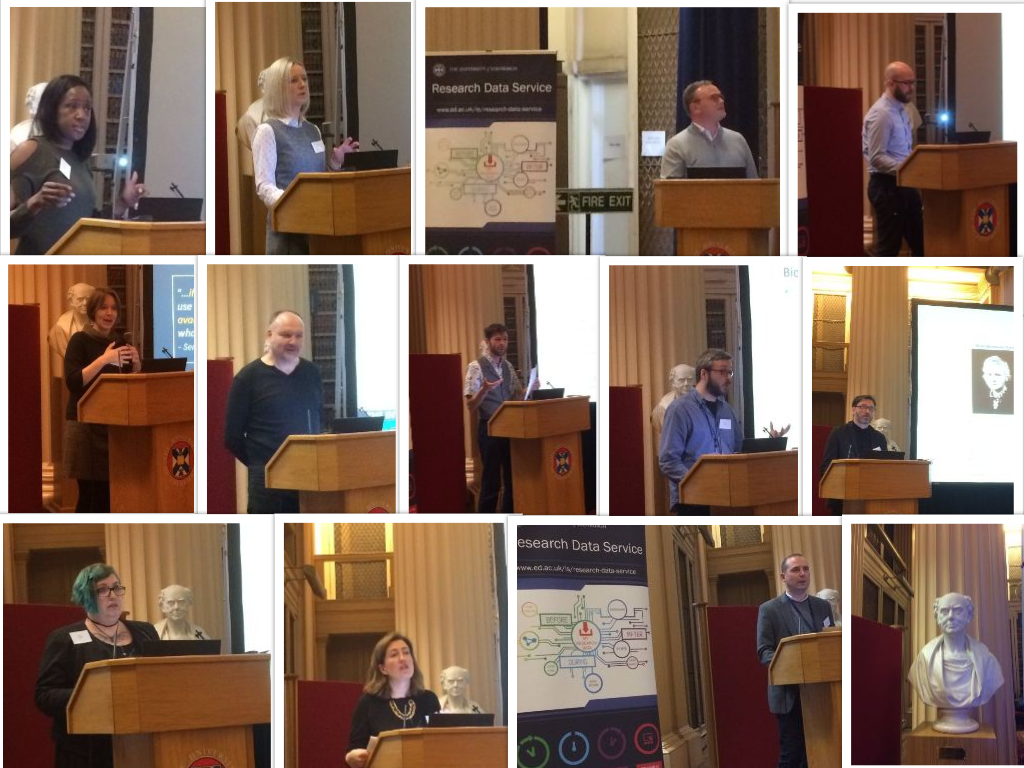
A collage of the event speakers, courtesy Robin Rice (CC-BY)
In terms of other challenges, Catriona Keerie talked about the problem of transferring/processing inconsistent file formats between heath boards, causing me to wonder if it was a question of open vs closed formats, and how could such a situation might have been averted, e.g. via planning, training (and awareness raising, as Roxanne Guildford noted), adherence to the 5-star Open Data scheme (where the third star is awarded for using open formats), or something else? Emily earlier noted a confusion about which tools are useful – and this is a role for those of us who provide tools, and for people like myself and my colleague Digital Research Services Lead Facilitator Lisa Otty who seek to match researchers with the best tools for their needs. Catriona also reminded us that data workflow and governance were iterative processes: we should always be fine-tuning these, and responding to new and changing needs.
Another theme of the first morning session was the question of achieving balances and trade-offs in protecting data and keeping it useful. And a question from the floor noted the importance of recording and justifying how these balance decisions are made etc. David Perry and Chris Tuck both highlighted the need to strike a balance, for example, between usability/convenience and data security. Chris spoke about dual testing of data: is it anonymous? / is it useful? In many cases, ideally it will be both, but being both may not always be possible.
This theme of data privacy balanced against openness was taken up in Simon Chapple’s presentation on the Internet of Things. I particularly liked the section on office temperature profiles, which was very relevant to those of us who spend a lot of time in Argyle House where – as in the Playfair Library – ambient conditions can leave something to be desired. I think Simon’s slides used the phrase “Unusual extremes of temperatures in micro-locations.” Many of us know from bitter experience what he meant!
There is of course a spectrum of openness, just as there are grades of abstraction from the thing we are observing or measuring and the data that represents it. Bert Remijsen’s demonstration showed that access to sound recordings, which compared with transcription and phonetic renderings are much closer to the data source (what Kant would call the thing-in-itself (das Ding an sich) as opposed to the phenomenon, the thing as it appears to an observer) is hugely beneficial to linguistic scholarship. Reducing such layers of separation or removal is both a subsidiary benefit of, and a rationale for, openness.
What it boils down to is the old storytelling adage: “Don’t tell, show.” And as Ros Attenborough pointed out, openness in science isn’t new – it’s just a new term, and a formalisation of something intrinsic to Science: transparency, reproducibility, and scepticism. By providing access to our workings and the evidence behind publications, and by joining these things up – as Ewan McAndrew described, linked data is key (this the fifth star in the aforementioned 5-star Open Data scheme.) Open Science, and all its various constituent parts, support this goal, which is after all one of the goals of research and of scholarship. The presentations showed that openness is good for Science; our shared challenge now is to make it good for scientists and other kinds of researchers. Because, as Peter Bankhead says, Open Source can be transformative – Open Data and Open Science can be transformative. I fear that we don’t emphasise these opportunities enough, and we should seek to provide compelling evidence for them via real-world examples. Opportunities like the annual Dealing With Data event make a very welcome contribution in this regard.
PDFs of the presentations are now available in the Edinburgh Research Archive (ERA). Videos from the day are published on MediaHopper.
Other resources
—
Martin Donnelly
Research Data Support Manager
Library and University Collections
University of Edinburgh
Collections
 Hill and Adamson Collection: an insight into Edinburgh’s past
My name is Phoebe Kirkland, I am an MSc East Asian Studies student, and for...
Cataloguing the private papers of Archibald Hunter Campbell: A Journey Through Correspondence
My name is Pauline Vincent, I am a student in my last year of a...
Hill and Adamson Collection: an insight into Edinburgh’s past
My name is Phoebe Kirkland, I am an MSc East Asian Studies student, and for...
Cataloguing the private papers of Archibald Hunter Campbell: A Journey Through Correspondence
My name is Pauline Vincent, I am a student in my last year of a...

Projects
Cataloguing the private papers of Archibald Hunter Campbell: A Journey Through Correspondence
My name is Pauline Vincent, I am a student in my last year of a...
Archival Provenance Research Project: Lishan’s Experience
Presentation My name is Lishan Zou, I am a fourth year History and Politics student....