Home University of Edinburgh Library Essentials
May 21, 2026
Dissertation Week Reflection
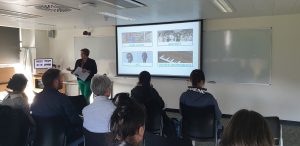
Dissertation Fair : #WeHaveGreatStuff – Rachel Hosker, Archives Manager and Deputy Head of Special Collections
It’s the final day of our very first Dissertation week at Edinburgh University Library. Here are some reflections and impressions of how it all went.
What we did
Our Dissertation week highlighted over 20 events delivered by the Library Academic Support Team, Research Data Management Team, Centre for Research Collections, Institute for Academic Development and Digital Skills team which could help students make the most of their dissertation experience. With some of these being delivered online, these events were able to reach a wide audience. A Dissertation Week guide https://edinburgh-uk.libguides.com/dissertation supported a timetabled social media campaign and will form a curated collection of the rich range of resources and support. We were able to incorporate student voices into these resources, with the School of LLC supplying a video clip on dissertation tips written by Francesca Triggs, a former LLC student, as well as including ‘Data Mindfulness’ videos by PhD student Candela Espeso Sanchez-Rodilla.
At the heart of Dissertation Week was a brand new Dissertation Fair event, which focused on exploring what library resources are available to support a research question, and managing the bibliographic and research data students find. The stalls at the fair featured not only our University teams but also digital resource suppliers, the National Library of Scotland and National Museums Scotland Libraries. Over 100 staff and student attended the Dissertation Fair and the programme of bookable presentation sessions which accompanied the Fair.
What staff thought
We were pleased that several Dissertation Course Convenors for Schools and Subject areas across the University were able to attend the event and delighted with their obvious enthusiasm. These academic staff spent time talking to Dissertation Fair stallholders and at the staff preview lunch. “Absolutely brilliant” was the comment from a paediatric surgeon who spent at least an hour there. One member of staff had moved his timetabled classes so that his students would be able to attend the Dissertation Fair. Others talked about how they wanted to integrate the event into their future programmes for dissertation students. One commented, “We’d like to be part of a discussion about how we can make as much of this as possible available to our online students”.
What students thought
We had 122 pre-registrations for the Dissertation Fair event which was encouraging, and on the day, students were engaged and enthusiastic. One commented that the most useful part of the event had been “Talking with all the stalls. Found out so many things and places to research I didn’t think about”. Lots of students had positive comments about the presentation sessions which gave in-depth introductions to digital resources.
What we thought
Planning this event, in close collaboration with the Centre for Research Collections and the Research Data Management team, generated a lot of energy and creativity in the Library Academic Support Team. This was rewarded by the successful turnout to events, but even more so by the depth of engagement that we had with visitors to the Dissertation Fair day. One colleague commented, “Of all the student & staff facing events I have been involved in over the years – and there have been many – I felt that we were making a very real impact yesterday.”
What we’ll do next
We received 67 feedback responses from the 171 attendees across all of the Dissertation Fair events on 14 November, and we’ll be taking time to look at these and learn from them. We’d like to run the Dissertation Week and Fair again, potentially in semester 2, 2020. Next time around we think we can make it bigger and better, and we’d like to have greater student involvement in planning and developing Dissertation Week. Watch this space.
If you would like to get in touch about Dissertation Week, please contact Christine Love-Rodgers Christine.Love-Rodgers@ed.ac.uk
Collaborating on data in a modern way
Between mid-September and mid-October, the Research Data Support team hosted an international visitor. Dr Tamar Israeli, a librarian from Western Galilee College in Israel, spent four weeks in Edinburgh to increase her experience and understanding around research data management. As part of this visit, Tamar conducted a study into our researchers’ collaborative requirements, and how well our existing tools and services meet their needs. Tamar’s PhD thesis was on the topic of file sharing, and she has recently published another study on information loss in Behaviour & Information Technology: “Losing information is like losing an arm: employee reactions to data loss” (2019). Tamar is also a representative of the Israeli colleges on the University Libraries’ Research Support Committee.
Tamar carried out a small-scale study in order to gain a better understanding of the tools that researchers use to collaborate around data, and to explore the barriers and difficulties that prevent researchers from using institutional tools and services. Six semi-structured interviews were conducted with researchers from the University of Edinburgh, representing different schools, and all of whom collaborate with other researchers on a regular basis on either small- or large-scale projects. She found that participants use many different tools, both institutional and commercial, to collaborate, share, analyse and transfer documents and data files. Decisions about which tools to use are based on data types, data size, usability, network effect and whether their collaborators are in the same institution and country. Researchers tend to use institutional tools only if they are very simple and user friendly, if there is a special requirement for this from funders or principal investigators (PIs), or if it is directly beneficial for them from a data analysis perspective; sharing beyond the immediate collaboration is only a secondary concern. Researchers are generally well aware of the need to keep their data where it will be safe and backed-up, and are not concerned about the risk of data loss. A major issue was the need for tools that answer projects’ particular needs, therefore customisability and scope for interlinking with other systems is very important.

We’d like to thank Tamar for the great work she did, and for the beautiful olive oil and pistachios that she brought with her! Tamar’s findings will key into our ongoing plans for the next phase of the Research Data Service’s continual development, helping us assist researchers to share and work on their data collaboratively, within and beyond the University’s walls.
—
Martin Donnelly
Research Data Support Manager
Library and University Collections
Top 5 tips if you’re stuck with your dissertation literature search
Are you stuck with the literature search for your dissertation or final year project? Not finding as much on your topic as you hoped? Here are 5 suggestions to help you move forward.

1. Look again at your search strategy.
By this I mean identifying terminology and keywords – also geographical or date limits for your search . Consider alternative terminology e.g. synonyms, alternative spellings, variant terminology, changes in terminology over time, abbreviations, etc. Increase the number of relevant keywords and you increase the potential of finding good material. Read More
Edinburgh Research Archive Statistics: October 2019

How using a reference manager can help you manage the references for your dissertation
Finding literature and gathering references from here, there and everywhere? Don’t want to get to a few days before hand in and realise you don’t have the full details of one (or more) important articles/books/etc., to cite properly? Find typing up your citations and bibliographies time consuming? Well, reference managers may be exactly what you are looking for.
 Why do you need to use a reference manager?
When you are collecting information from a variety of sources, it can all overwhelm before you know it! A reference manager can help you by providing a space to keep all your references in one place. You can both create references manually or import from external source such as database. You then have the option to annotate them and/or keep them in different folder.
It gets better!
When you are working on your dissertation, you can cite your reference in your work as you write. The reference manager will insert the references for you in your particular style, e.g. Harvard, MLA, Chicago, APA, etc., and create your bibliography at the same time. Read More
Centenary of Hamish Henderson
Yesterday a plaque was unveiled at the School of Scottish Studies Archives celebrating the centenary of Hamish Henderson, who was born in Blairgowrie on 11 November 1919. As a songwriter, song-collector, poet, and political activist, Henderson is widely acclaimed as the father of Scotland’s post-war Folk Revival. He was appointed as a lecturer and research fellow at the newly founded School of Scottish Studies in 1951, where his fieldwork and his many writings, both academic and non-academic, provided a major catalyst for the movement.
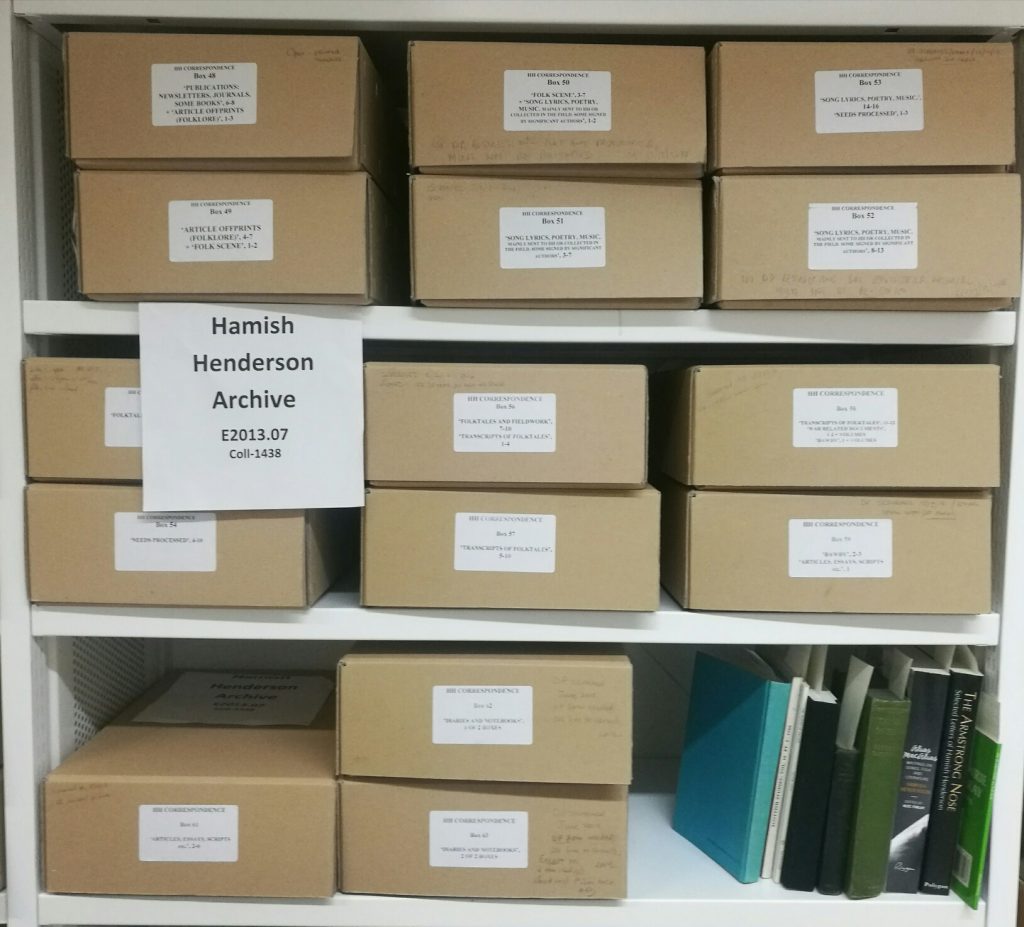
Just part of Edinburgh University’s Hamish Henderson Archive
The Papers of Hamish Henderson (Coll-1438), amounting to over 60 boxes of material, are one of Edinburgh University’s most important archival collections. Original manuscripts by Henderson in the collection include poems, songs, essays, articles, talks, lectures, letters to the press, and translations. There are also fieldwork notes, including many transcripts of songs, and a wide range of materials relating to Henderson’s work for the School of Scottish Studies. Henderson’s political life is reflected in papers connected to the Campaign for Nuclear Disarmament, the Anti-Apartheid movement, and the Campaign for a Scottish Assembly. In addition, there are a number of personal papers, including materials relating to Henderson’s service in the Second World War.
There is extensive incoming correspondence from major figures in the worlds of literature, folk music, and scholarship, illustrating the extraordinary breadth of Henderson’s interests and the extent of his influence. There are letters from:
- Writers such as George Mackay Brown, Helen Cruickshank, Ian Hamilton Finlay, W. S. Graham, Tom Leonard, Norman MacCaig, Hugh MacDiarmid, Naomi Mitchison, and Tom Scott
- Singers, songwriters and musicians including Martyn Bennett, Shirley Collins, Lizzie Higgins, Ewan MacColl, Jean Redpath, Jean Ritchie, Jeannie Robertson, Peggy Seeger, and Pete Seeger
- Folklorists and song-collectors including Margaret Bennett, John Lorne Campbell, Peter Kennedy, A. L. ‘Bert’ Lloyd, Alan Lomax, Iona and Peter Opie, and Duncan and Linda Williamson
- Figures from the world of screen and theatre including Joan Littlewood, Dolina Maclennan, and Jonathan Miller
- Historians and cultural commentators such as Richard Hoggart, Tom Nairn, E. P. Thompson, Philip Toynbee, and Raymond Williams.
There are also numerous manuscripts of songs collected by or submitted to Henderson, as well as original verse by writers including Joe Corrie, T. S. Law, Norman MacCaig, Hugh MacDiarmid, Naomi Mitchison, and Tom Scott.
There is further material of Henderson interest in other archival collections held by Edinburgh University Library, including letters from Henderson to Helen Cruickshank (Coll-81), Maurice Lindsay (Coll-56), Michael Sharp (Coll-1492), and Hugh MacDiarmid (Coll-18). Considering the pair’s much publicized disagreements on the role and significance of folksong, there is a surprising wealth of Henderson materials in our MacDiarmid Collection. Together with 70 letters from Henderson, there are manuscripts of poems and songs by Henderson, including the anti-Apartheid anthem ‘Rivonia’, an impassioned plea for the release of Nelson Mandela.
For more information on the Papers of Hamish Henderson see:
Paul Barnaby
Acquisition and Scottish Literary Collections Curator
Getting Beyond Google Scholar – great tools to help you find information for your dissertation
Are you planning on consulting Google Scholar to find literature for your dissertation? While it is very easy to use and can be a good place to start, particularly since you can set it to retrieve what we have in the Library, it does have its limitations. As its coverage is not clear, you cannot be sure just what you might be missing with Google. Which is where the Library can help!

Details from the ceiling space of the McEwan Hall during the 2016 refurbishment of the building. © The University of Edinburgh
We offer a whole range of electronic ‘finding’ tools and resources, across a broad range of subject areas, to help you locate the research literature and other information for your topic. Although we have pulled them together as ‘databases’, you will find they present a mixture of bibliographic databases and other searchable full-text resources.
So why use them?
Dissertation Week Starts today
#DissertationWeek is here!
All this week we will be posting about the resources, services, workshops, training, events, etc., that are available at the Library and through other support teams at the University to help support you with your dissertation or final year project.
Take a look to see events on this week: https://edinburgh-uk.libguides.com/dissertation/WeekCalendar
Lyell, Landscape and a Lorry
We’ve done it. They’re finally here. Late last week I was lucky enough to go down to London and pick up the Lyell notebooks.

The first step in gaining custody was to head to Sotheby’s on New Bond Street with the paperwork to prove they could be released. It’s a curious process of heading down to pre-sales to prove ownership and then be given a token for collection. I was then taken to their manuscripts and rare books department to pick up the archive. There I got my first glimpse of them.
Their scale surprised me. They are more compact and very consistent compared to even the pictures I’d seen of them and with my love of palaeography and our plans for deciphering them, I had to have a look at the content. Having been to Catania in Sicily last year, I picked the Sicily volume and was immediately struck by the depiction of the landscape around Mount Etna and the flow of his hand across the page providing detail. I know we’re going to have a lot of fun making these available in the future!
I had to draw myself back from getting immersed as our colleagues George and Ryan had arrived from Constantines, who were going to look after me and the notebooks, getting us back to Edinburgh securely. And wow what a large lorry, for small notebooks, down the tiny London lanes!
After checking every volume and packing in order securely, I signed the final piece of paperwork and we could take the notebooks on the next stage of their journey.
They were taken to a secure location, through the streets of London in our rather large lorry, with me sat up top in the cab with a birds eye view. I wondered what Lyell’s view of London was, having lived there in the 1830s and how very different the environment and landscape was now.
The next day we were at the secure location at 6am ready to leave. While the team were getting ready, I chatted to a curator from the British Museum, taking items for exhibition out to the Far East. Never thought, at 6am I’d be meeting such interesting people and sharing our experiences of couriering our rare and unique items throughout the world!
George, Ryan and myself soon set off through London, watching it wake and get busy. Over the next 9 ½ hours we drove north through the changing landscape, with all kinds of weather, from rainbows and hail to bright sunshine, looking at moors and hills, farmland planes to forests. I wondered again what Lyell would have thought, interpreted and seen.

At about 3:30pm we arrived back in Edinburgh, after a very smooth journey (worst bit was the traffic in Edinburgh!) and were met by Grant and Norman, with these photos being taken, so we could show you their arrival.


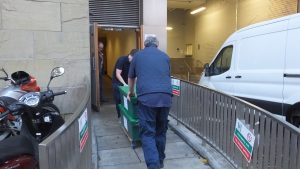
So, they are here and the next part of our work begins with our archivists and conservators checking and listing them over the next couple of weeks. I’ve delighted to have had my Lyell adventure, picking up these notebooks, so they now can be made available to the world.
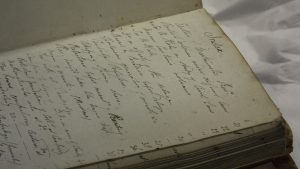


Thanks to George and Ryan from Constantines who were consummate professionals and looked after the notebooks and myself with good humour and brilliant driving skills, getting us to Edinburgh safely.

Rachel Hosker
Archives Manager and Deputy Head of Special Collections
Conserving the Mackinnon Collection
This week, Claire Hutchison describes the start of her eight-week internship working to conserve the Mackinnon collection…
I am four weeks into my internship at the CRC and absolutely loving it! I have been given the task of conserving and rehousing the Mackinnon collection. This project has been generously funded by the National Manuscripts Conservation Trust. This collection comprises of the lecture notes, learning materials and other such scribbles of Professor Donald Mackinnon, the first Chair in Celtic at the University of Edinburgh. He made quite the mark during his professional life by translating many Gaelic texts that include poetry, medieval manuscripts and religious texts. Through his work, primary sources of Gaelic language and literature could finally be shared.
Collections
 Hill and Adamson Collection: an insight into Edinburgh’s past
My name is Phoebe Kirkland, I am an MSc East Asian Studies student, and for...
Cataloguing the private papers of Archibald Hunter Campbell: A Journey Through Correspondence
My name is Pauline Vincent, I am a student in my last year of a...
Hill and Adamson Collection: an insight into Edinburgh’s past
My name is Phoebe Kirkland, I am an MSc East Asian Studies student, and for...
Cataloguing the private papers of Archibald Hunter Campbell: A Journey Through Correspondence
My name is Pauline Vincent, I am a student in my last year of a...
Projects
Cataloguing the private papers of Archibald Hunter Campbell: A Journey Through Correspondence
My name is Pauline Vincent, I am a student in my last year of a...
Archival Provenance Research Project: Lishan’s Experience
Presentation My name is Lishan Zou, I am a fourth year History and Politics student....