Home University of Edinburgh Library Essentials
March 19, 2026
How to be Popular (in Edinburgh Research Explorer)
Edinburgh Research Explorer • www.research.ed.ac.uk
These are conclusions from a survey of the Top 100 MOST POPULAR downloads from Edinburgh Research Explorer in August 2019, it contains some VERY obvious biases and doesn’t reflect the breadth, depth, or usefulness of the repository as a whole; and shows that whilst OPEN ACCESS can reach a wider audience, it can also be ignored by a wider audience.
1. STEER CLEAR OF SCIENCE

Research items from science-related schools made up 18% of the Top 100, dropping to 12% in the Top 50 and 0% in the Top 10.
2. DON’T COLLABORATE

With each additional author, the number of items and the average number of downloads decreased.
3. YOU DON’T HAVE TO WRITE IN ENGLISH, BUT IT HELPS
In the Top 100, one item was written in Italian, the remainder in English:
that was also one of only five items that month, that failed to find an audience outwith the UK.
4. GO OPEN-ACCESS
8 of the Top 100 items didn’t offer Open-Access Permissions, they averaged 25% fewer downloads than the overall average.
LLC related database trials
There are quite a few database trials going on at the moment that are relevant to subject areas in the LLC School. The trials can be accessed from the Library’s E-Resources Trials website.

On trial: Bayeux Tapestry Online
*The Library now has access to this resource. Find out more at New to the Library: Bayeux Tapestry Digital Edition.*
Thanks to a request from staff in HCA I’m pleased to let you know the Library currently has trial access to the Bayeux Tapestry Online from Scholarly Digital Editions. This online version allows you to scroll through the entire Tapestry and zoom in on the Tapestry to the level of the actual weave.

You can access from the E-resources trials page.
Access is available on and off-campus.
Trial access ends 31st December 2019. Read More
On trial: Medical Services and Warfare
Further to a request from staff in the Medical School the Library currently has trial access to the digital primary source database Medical Services and Warfare from Adam Matthew. This resource tells the story of medical advances during warfare from the mid-nineteenth century to the outbreak of the influenza epidemic in 1918 and the discovery of penicillin in 1927.

You can access Medical Services and Warfare from the E-resources trials page.
Access is available on and off-campus.
Trial access ends 16th December 2019.
Medical Services and Warfare allows you to explore multiple perspectives on the history of injury, treatment and disease on the front line. Chart scientific advances through hospital records, medical reports and first-hand accounts, and discover the evidence of how war shaped medical practice across the centuries. Read More
On trial: London Low Life
*The Library has now purchased access to London Low Life. This can be accessed via Digital Primary Source and Archive Collections or the Databases A-Z.*
Thanks to a request from a HCA student the Library currently has trial access to the digital primary source database London Low Life from Adam Matthew. This wonderful digital collection brings to life the teeming streets of Victorian London, inviting you to explore the gin palaces, brothels and East End slums of the nineteenth century’s greatest city.

You can access London Low Life from the E-resources trials page.
Access is available on and off-campus.
Trial access ends 16th December 2019.
From salacious ‘swell’s guides’ to scandalous broadsides and subversive posters, the material sold and exchanged on London’s bustling thoroughfares offers an unparalleled insight into the dark underworld of the nineteenth century city. Children’s chapbooks, street cries, slang dictionaries and ballads were all part of a vibrant culture of street literature. Read More
Research Data Service achieves ISO 27001 accreditation for Data Safe Haven facility
Following a five day on-site audit by Lloyd’s Register, the Information Security Management System (ISMS) which forms the basis for the Data Safe Haven facility for University of Edinburgh researchers has been officially certified to the ISO/IEC 27001:2013 standard. In a few weeks we will receive a certificate from UKAS (United Kingdom Accreditation Service).
The Data Safe Haven (DSH) team, comprised of members of Research Data Support in L&UC and Research Services in ITI, and with input from the Information Security team and external consultants, has been working toward certification since 2016. The system, designed by ITI’s Stephen Giles, has been extensively and successfully ‘white box penetration tested’ by external experts, one of the many forms of proof provided to the auditor. (White box means the testers were given access to certain layers of the system, as opposed to a black box test where they are not.)
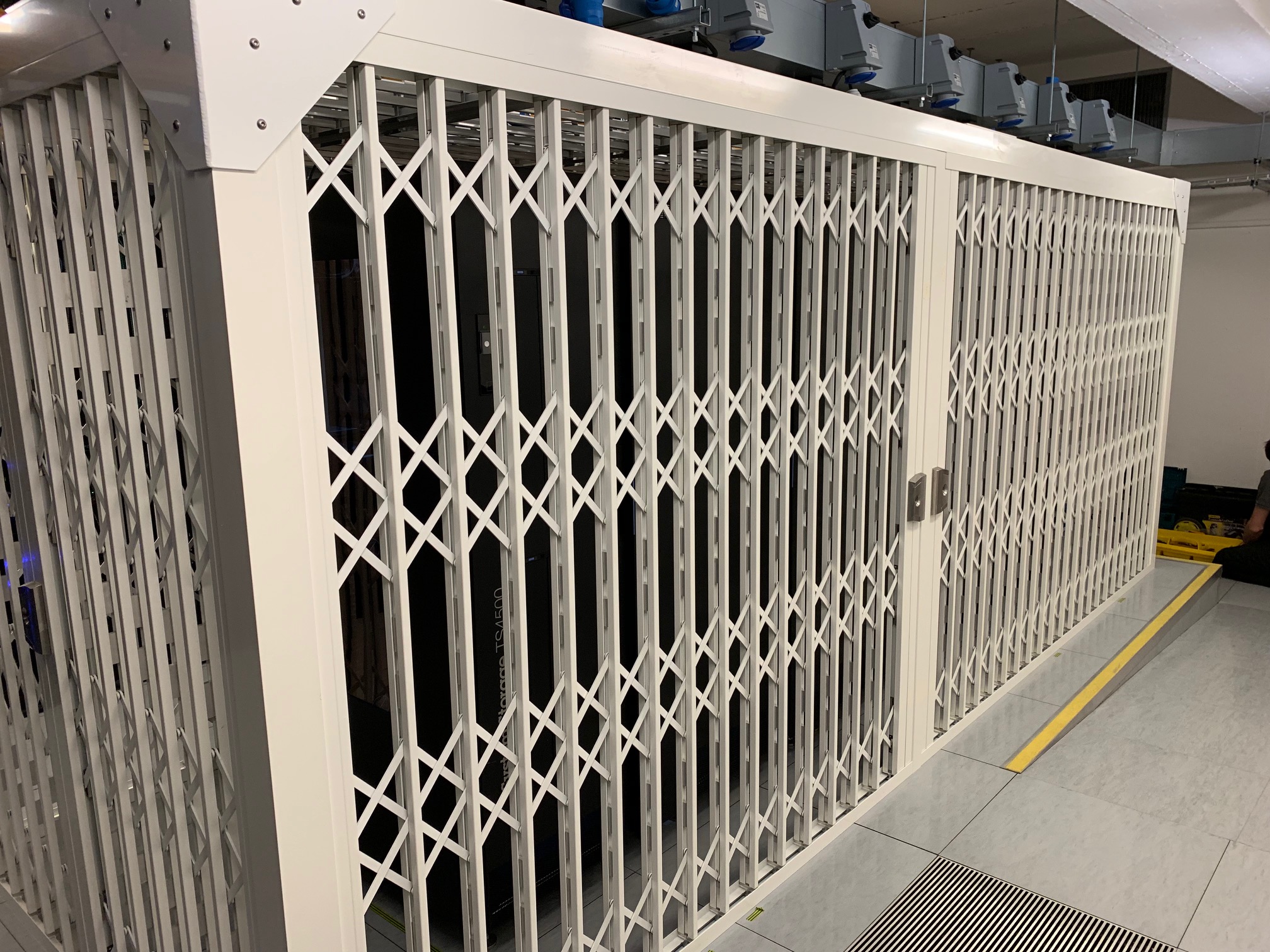
The steel cage surrounding Data Safe Haven equipment in one of the University data centres.
In addition to infrastructure, a proper ISMS is made up of people who perform roles and manage procedures, based on organisational policies. The Research Data Support team work with research project staff to ensure their practices comply with our standard operating procedures. The ISMS is made up of all the controls needed to ensure that it is sensibly protecting the confidentiality, availability, and integrity of assets from threats and vulnerabilities. Over 150 managed and versioned documents covering every aspect of the ISMS were written, discussed, practiced, reviewed and signed off before being examined and questioned by the auditor.
The auditor stated in the final report, “The objectives of the assessment were achieved and with consideration to any noted issues or raised findings, the sampled areas of the management system demonstrated a good level of conformance and effectiveness. The management system remains supportive of the organisation and its business and service management objectives.” On a slightly more upbeat note, Gavin Mclachlan, Vice-Principal and Chief Information Officer, and Librarian to the University said by email, “Congratulations to you and the whole team on the ISO 27001 certification. That is a great achievement.”
The Digital Research Services programme has invested in the Data Safe Haven to allow University researchers to conduct cutting edge research, access sensitive data from external providers and facilitate new research partnerships and innovation. Researchers are expected to include Data Safe Haven costs in funded grant proposals to achieve some cost recovery for the University. To find out if your project is a candidate for use of the Data Safe Haven contact data-support@ed.ac.uk or the IS Helpline.
Robin Rice
Data Librarian and Head, Research Data Support
L&UC
Incunabula: Fables, foliage and a female Pope

Hortus sanitatis, Fol.101 verso
I was lucky enough to be involved in the Incunabula pilot project here in the Digital Imaging Unit. This project helped to create a digitisation workflow for Incunabula collection items using the i2S CopiBook v-shape scanner. These bound volumes are printed using a variety of early printing methods including wood block printing resulting in beautifully crafted and illustrated objects. This project afforded an opportunity to get up close and personal with these beautiful and often entertaining treasures, that were quite literally being brought into the light through the capture of images.
Beginning of a new ERA
We are pleased to announce that the Edinburgh Research Archive (ERA) has recently had a lot of work done to improve it’s looks, add new functionality and clean up some of our collections data.

For those of you who are not familiar with ERA it is is a digital repository of original research produced at The University of Edinburgh. The repository contains documents written by, or affiliated with, academic authors, or units, based at Edinburgh that have sufficient quality to be collected and preserved by the Library, but which are not controlled by commercial publishers. Holdings include around 27,000 full-text digital doctoral theses, 1,500 masters dissertations, and numerous other project reports, briefing papers and out-of-print materials. In October 2019 we recorded 223,000 visitors to ERA who downloaded 51,984 items.
Details of some of the improvements are listed below:
| Software upgrade | The DSpace platform was upgraded from version 4.2 to 6.3 | ||
| Face lift | Visual redesign and styling ERA to make it more appealing | ||
| DOI allocation | New functionality to assign DOIs to deposited items | ||
|
New domain |
New URL => era.ed.ac.uk | ||
| Fix subject terms | Change scanning metadata information to be stored in dc.relation.ispartof and not dc.subject. |
✔ |
|
| Log-in expiry time | Set login expiry time to an hour. |
✔ |
|
| Date-format | Go from yyyy-mm-dd to dd-mm-yyyy |
✔ |
|
| UX improvements |
Move Edit Item button up, to the top of the bar, customise drop down list to have most used elements at the top. |
❌ |
|
| Default language boxes | Give “en” as default to language boxes. |
Of all the new improvements I am most excited about the new functionality to assign Digital Object Identifiers (DOIs) to items deposited in ERA. All new items will be automatically assigned a DOI, and we will investigate how to do this for the rest of the nearly 35,000 items already online.
Dissertation Week Reflection
Dissertation Fair : #WeHaveGreatStuff – Rachel Hosker, Archives Manager and Deputy Head of Special Collections
It’s the final day of our very first Dissertation week at Edinburgh University Library. Here are some reflections and impressions of how it all went.
What we did
Our Dissertation week highlighted over 20 events delivered by the Library Academic Support Team, Research Data Management Team, Centre for Research Collections, Institute for Academic Development and Digital Skills team which could help students make the most of their dissertation experience. With some of these being delivered online, these events were able to reach a wide audience. A Dissertation Week guide https://edinburgh-uk.libguides.com/dissertation supported a timetabled social media campaign and will form a curated collection of the rich range of resources and support. We were able to incorporate student voices into these resources, with the School of LLC supplying a video clip on dissertation tips written by Francesca Triggs, a former LLC student, as well as including ‘Data Mindfulness’ videos by PhD student Candela Espeso Sanchez-Rodilla.
At the heart of Dissertation Week was a brand new Dissertation Fair event, which focused on exploring what library resources are available to support a research question, and managing the bibliographic and research data students find. The stalls at the fair featured not only our University teams but also digital resource suppliers, the National Library of Scotland and National Museums Scotland Libraries. Over 100 staff and student attended the Dissertation Fair and the programme of bookable presentation sessions which accompanied the Fair.
What staff thought
We were pleased that several Dissertation Course Convenors for Schools and Subject areas across the University were able to attend the event and delighted with their obvious enthusiasm. These academic staff spent time talking to Dissertation Fair stallholders and at the staff preview lunch. “Absolutely brilliant” was the comment from a paediatric surgeon who spent at least an hour there. One member of staff had moved his timetabled classes so that his students would be able to attend the Dissertation Fair. Others talked about how they wanted to integrate the event into their future programmes for dissertation students. One commented, “We’d like to be part of a discussion about how we can make as much of this as possible available to our online students”.
What students thought
We had 122 pre-registrations for the Dissertation Fair event which was encouraging, and on the day, students were engaged and enthusiastic. One commented that the most useful part of the event had been “Talking with all the stalls. Found out so many things and places to research I didn’t think about”. Lots of students had positive comments about the presentation sessions which gave in-depth introductions to digital resources.
What we thought
Planning this event, in close collaboration with the Centre for Research Collections and the Research Data Management team, generated a lot of energy and creativity in the Library Academic Support Team. This was rewarded by the successful turnout to events, but even more so by the depth of engagement that we had with visitors to the Dissertation Fair day. One colleague commented, “Of all the student & staff facing events I have been involved in over the years – and there have been many – I felt that we were making a very real impact yesterday.”
What we’ll do next
We received 67 feedback responses from the 171 attendees across all of the Dissertation Fair events on 14 November, and we’ll be taking time to look at these and learn from them. We’d like to run the Dissertation Week and Fair again, potentially in semester 2, 2020. Next time around we think we can make it bigger and better, and we’d like to have greater student involvement in planning and developing Dissertation Week. Watch this space.
If you would like to get in touch about Dissertation Week, please contact Christine Love-Rodgers Christine.Love-Rodgers@ed.ac.uk
Collaborating on data in a modern way
Between mid-September and mid-October, the Research Data Support team hosted an international visitor. Dr Tamar Israeli, a librarian from Western Galilee College in Israel, spent four weeks in Edinburgh to increase her experience and understanding around research data management. As part of this visit, Tamar conducted a study into our researchers’ collaborative requirements, and how well our existing tools and services meet their needs. Tamar’s PhD thesis was on the topic of file sharing, and she has recently published another study on information loss in Behaviour & Information Technology: “Losing information is like losing an arm: employee reactions to data loss” (2019). Tamar is also a representative of the Israeli colleges on the University Libraries’ Research Support Committee.
Tamar carried out a small-scale study in order to gain a better understanding of the tools that researchers use to collaborate around data, and to explore the barriers and difficulties that prevent researchers from using institutional tools and services. Six semi-structured interviews were conducted with researchers from the University of Edinburgh, representing different schools, and all of whom collaborate with other researchers on a regular basis on either small- or large-scale projects. She found that participants use many different tools, both institutional and commercial, to collaborate, share, analyse and transfer documents and data files. Decisions about which tools to use are based on data types, data size, usability, network effect and whether their collaborators are in the same institution and country. Researchers tend to use institutional tools only if they are very simple and user friendly, if there is a special requirement for this from funders or principal investigators (PIs), or if it is directly beneficial for them from a data analysis perspective; sharing beyond the immediate collaboration is only a secondary concern. Researchers are generally well aware of the need to keep their data where it will be safe and backed-up, and are not concerned about the risk of data loss. A major issue was the need for tools that answer projects’ particular needs, therefore customisability and scope for interlinking with other systems is very important.

We’d like to thank Tamar for the great work she did, and for the beautiful olive oil and pistachios that she brought with her! Tamar’s findings will key into our ongoing plans for the next phase of the Research Data Service’s continual development, helping us assist researchers to share and work on their data collaboratively, within and beyond the University’s walls.
—
Martin Donnelly
Research Data Support Manager
Library and University Collections
Collections
 Hill and Adamson Collection: an insight into Edinburgh’s past
My name is Phoebe Kirkland, I am an MSc East Asian Studies student, and for...
Cataloguing the private papers of Archibald Hunter Campbell: A Journey Through Correspondence
My name is Pauline Vincent, I am a student in my last year of a...
Hill and Adamson Collection: an insight into Edinburgh’s past
My name is Phoebe Kirkland, I am an MSc East Asian Studies student, and for...
Cataloguing the private papers of Archibald Hunter Campbell: A Journey Through Correspondence
My name is Pauline Vincent, I am a student in my last year of a...

Projects
Cataloguing the private papers of Archibald Hunter Campbell: A Journey Through Correspondence
My name is Pauline Vincent, I am a student in my last year of a...
Archival Provenance Research Project: Lishan’s Experience
Presentation My name is Lishan Zou, I am a fourth year History and Politics student....