Home University of Edinburgh Library Essentials
March 19, 2026
New: DOI minting for PhD theses

We are pleased to announce that from January 2020 all new PhD theses submitted to the Edinburgh Research Archive (ERA) will be assigned a Digital Object Identifier (DOI). The Library will be using the DataCite DOI registration agency to provide this service.
What is a DOI?
A DOI is a character string (a ‘digital identifier’) used to uniquely identify and provide a permanent link to a digital object, such as a journal paper or other scholarly work.
Benefits of having a DOI
Assigning DOIs to PhD means that researchers are able to confidently cite theses alongside traditional journal articles knowing that a link will be persistent. The benefits for authors include gaining due academic credit for their efforts to produce these valuable research outputs and the ability to track and measure online attention via alternative metrics like Plum X or Altmetric.
Which PhD theses will get DOIs?
In the first instance the Library will give all new PhD theses a DOI once the final version has been submitted to Pure and graduation has occurred. Before a DOI is registered the PhD thesis must be archived fully in ERA. Some PhD theses submitted for Winter 2019 graduation which have not yet appeared online in ERA will be assigned a DOI.
We aim to roll out and assign DOIs for all of the PhDs in the existing online collection, but since the collection is large (>20,000) we will have to approach this in stages.
High Rises and Lows: Emotions in an Edinburgh Suburb
In 1957 three professionals, a GP, a minister and a headteacher, approached the University of Edinburgh’s Social Science Research Centre requesting a study of the North Edinburgh communities in which they worked; they were concerned they were failing. These communities, some of the most deprived in the city, were the product of a programme of social housing which the council had begun in the 1930s. Many of the residents had been relocated from the slum clearances of Leith which was incorporated into the city of Edinburgh by the controversial Boundaries Extension Act 1920.
The Social Environment Research Unit was established and a team of university researchers spent three years interviewing, observing and interacting with local residents and organisations. The project yielded over 400 interviews with residents and non-residents, local events and community meetings.

Cherry Suites and Coal Fires
The audio recordings unfortunately do not survive but the researchers summarised each interview and meeting that took place using a technique known as “Process Recording”. This technique means they included observations about the interviewees’ surroundings and also incidental occurrences. In many instances they also record family background and circumstances. This technique paints an anecdotal picture of the interior and exterior landscape of these new estates: Cherry 3 piece suites, brand new televisions, coal fireplaces, artificial fruit, TB, hire purchase salesmen, enyclopaedia britannicas, Wagon Train and Emergency Ward 10. The legacy of the Second World War looms large, with fractured families, fathers on disability allowance unable to work, and memories of mothers bringing up children alone and on little income.
The results of the project were collated in “Social Environment in Suburban Edinburgh” by the SERU’s Director Geoffrey Hutton and Edinburgh University’s Professor Tom Burns. But what can these summaries tell us about how residents in these communities felt about their new lives and the communities from which they were forcibly resettled? This post explores some of the emotions frequently in evidence in these interviews.
Anxiety
One of the most prevalent emotions in the summaries is anxiety, social anxiety in particular. Many of the residents were relocated from slum areas in the city centre and were anxious to hide their past. This in turn lead some of them to isolate themselves from their neighbours.
The increased space, while an obvious improvement on their previous accommodation which often saw whole families sharing one room, residents found themselves with more rooms to furnish and became targets for the persistent hire purchase salesmen peddling the latest modern conveniences or fashionable wares. One interviewee remarked that her young daughter was anxious and frightened going to sleep in a room by herself having been used to sleeping with her siblings. Sleep disturbance was in fact common and is referred to as the cause or symptom of some of the anxiety. The soundproofing in the new houses was bad, perhaps due to the underfloor heating, with residents reporting they could hear the television from several flats above them. Neighbours would use the rubbish chutes at all times of the night, children played in and around the stairs and vans selling groceries and other goods would drive round with their hooters blaring, all contributing to the level of noise often the source of disagreements between neighbours.
The contraceptive pill was not yet widely available and with many interviewees avoiding birth control altogether for religious reasons, married women, already struggling with large families, faced the monthly anxiety of potential pregnancies. One interviewee confided that her GP had recommended birth control to her as a method of alleviating her anxiety and she hoped her husband might agree if there was a health benefit for her. Teenage pregnancy was also an underlying concern for families with older children with rumours rife about the behaviour of pupils at the local senior school.

Nostalgia
Many of the residents were re-housed from Leith and with a few exceptions they all remembered the area fondly, despite the appalling living conditions. They felt neighbourly relations were better, there was no competition, no suspicion. Whole families often occupied the same block of flats for generations, there was a shared history. One of the researchers dismisses this as fantasy and believes that in fact neighbours were in and out of each others flats in Leith out of necessity not necessarily out of friendliness. With more space on the new estates and with less shared history there was less need for this sort of dependency and indeed some residents welcomed a rest from the constant social interaction synonymous with tenement living.
Loneliness and Boredom
However, the new estates were not well served by public transport or local amenities and in an age before mobile phones and widespread car ownership, they could be lonely places. Young mothers and the elderly, in particular, reported feeling isolated.
“In a tenement you feel closer to your neighbour. In a house on your own you’re really on your own”
They had been used to being a short walk from shops or relatives and friends but now found themselves cut off from others for most of the day.
One of the interviewers noted the boredom experienced by young mothers stuck at home with young children and nowhere to go, many expressed a desire to go out to work when their children started school. A local health visitor remarked on the widespread use of tranquilisers for bouts of weeping, irritability and sleeplessness.
The interviewers appear to be exasperated at what they perceive to be a lack of activity or participation in hobbies. They continually ask about clubs and pastimes but fail to acknowledge that such participation often requires money, transport and community space.
Anger
The summaries allude to a lot of anger directed towards the Corporation. Many of the residents were given no choice about the type of house they were allocated and were often relocated with no assistance or instruction. One family commented that they had been in their house several weeks before they discovered how to work the heating. Many were not given the chance to view their new home prior to moving in. They found themselves with gardens to care for with no appropriate tools or equipment; some of the gardens were not planted or divided up and it was up to the tenants themselves to erect fences. The pram lockers were damp and not fully enclosed allowing in dirt and dust. They had complaints about the workmanship of the housing – badly fitting do0rs, windows rusting, dampness – the lack of local shops, bus shelters, post boxes and safe outside space for children to play. Those residents in newer estates such as Pilton and Muirhouse expressed dismay at the sheer volume and density of the housing, something they hadn’t been made fully aware of prior to moving. One of the residents, who was hoping to move as soon as possible, noted that there was “a distinct air of disgruntlement” throughout the area and referred to the “sheer physical dourness”.
Happiness
There is, however, also happiness and joy to be found within the interviews and many residents were clearly overjoyed with their new accommodation. For some it was an opportunity to escape the dirt and overcrowding of the city centre. Parents hoped it would be a healthier environment for their children. They had space, indoor bathrooms, and privacy for the first time. One of the residents living near the top of one of the high rises is quoted as saying:
“What more could you want, to look out of the front windows onto the Pentland Hills, look out the back windows over the Firth of Forth – beautiful, beautiful”
New College Library is moving!

Outside the David Hume Tower
A major Estates project means that we must move the New College Library collections and services.
What this means for you
• New College Library (NCL) closed at 5.00 pm on Friday 20st December 2019. It will re-open at David Hume Tower (DHT) in George Square on 13th January 2020, providing access to General Collections.
• Archive material and some Special Collections (selected in consultation with the School of Divinity) will be available at the Centre for Research Collections at the Main Library in George Square. Remaining Special Collections will be unavailable until the Library returns to New College in Summer 2021.
• The School of Divinity are planning to make the NCL Reserve Collection available in the Semple’s Close Wing of New College from 13th January 2020. Read More
New to the Library – Struggles for Freedom: Southern Africa (Aluka)
I’m happy to let you know that following a request from a member of HCA staff the Library now has a subscription to the digital primary resource Struggles for Freedom: Southern Africa (Aluka) from JSTOR. This extensive and fascinating resource contains 20,000 objects and 190,000 pages of documents and images documenting the liberation struggles in Angola, Botswana, Mozambique, Namibia, South Africa and Zimbabwe.

You can access Struggles for Freedom: Southern Africa (Aluka) via the Databases A-Z list and the Digital primary source and archive collections guide. You can also access it via DiscoverEd. Read More
New e-journal – Annual Review of Developmental Psychology

The Library now subscribes to the Annual Review of Developmental Psychology.
The Annual Review of Developmental Psychology covers the significant advances in the developmental sciences, including cognitive, linguistic, social, cultural, and biological processes across the lifespan. The invited reviews will synthesize the theoretical, methodological, and technological developments made over the past several decades that have led to important new discoveries relevant beyond psychology, including education, cognitive science, economics, public health, and public policy.
Access this journal via DiscoverEd or our e-journals AZ list.
Further info
The Library subscribes to all e-journals published by Annual Reviews.
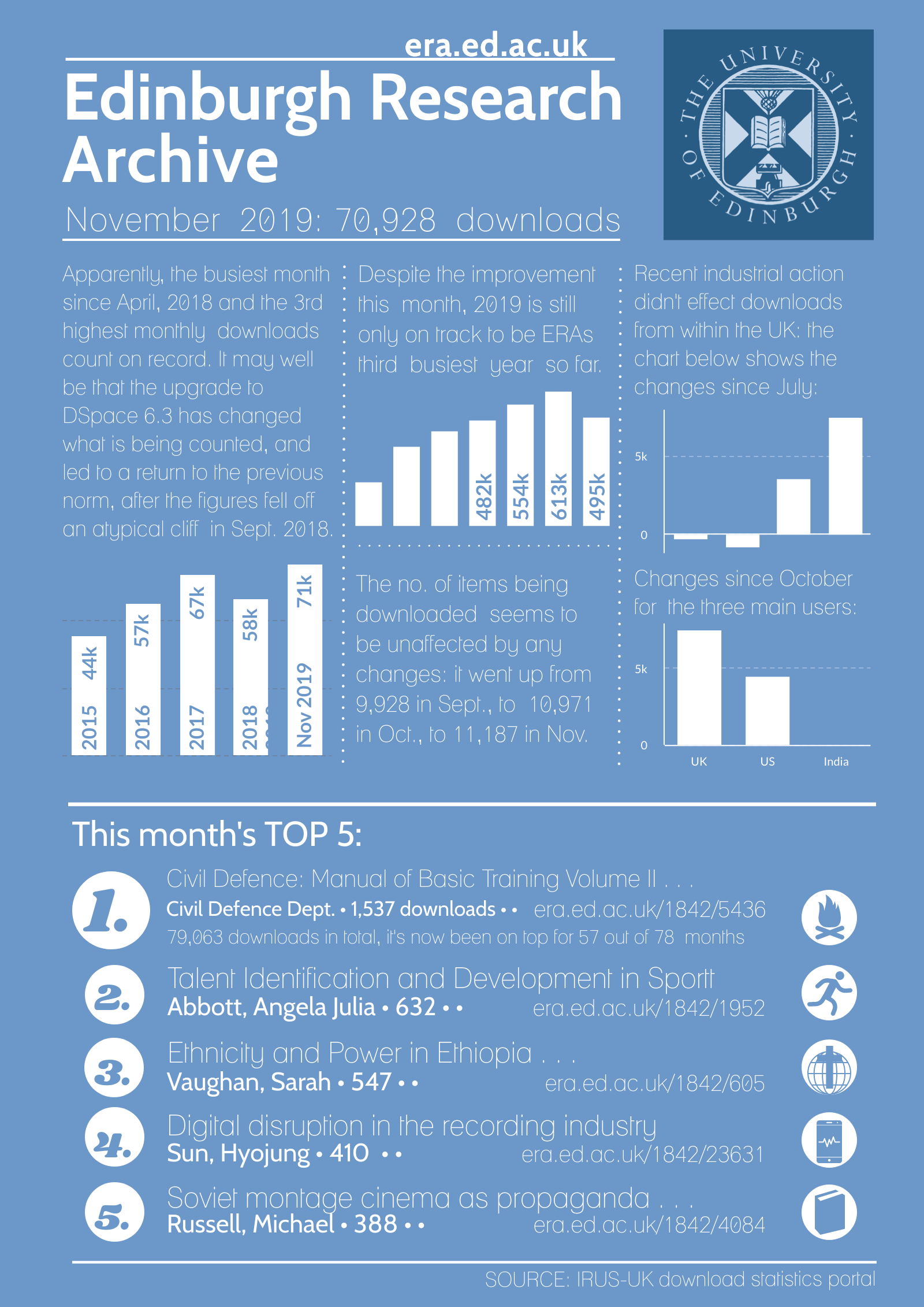
Edinburgh Research Archive Statistics: November 2019
The Christmas Book Flood

Image: Engraving by F. Barnard from Christmas Books by Charles Dickens, (LRA.S.6660/1). Title page.
Here at the UCF, things are feeling firmly festive – the tiny office tree has been bedecked, mince pies are heaped in the break room, and staff are sporting some of their best knitwear – it’s definitely almost Christmas! Beyond all the feasting and gift-giving, one of my favourite moments of the season is having the time to slow down and relax, to cosy up in front of a warm fire and read a good book by the glow of fairy lights. And this is exactly the Christmas custom in Iceland. Every year in the few months approaching December, publishers release all their new titles in the prevailing tradition of Jólabókaflóðið, or the “Christmas book flood”. This practice dates back to World War II, where currency restrictions limited the amount of imported giftware. This did not extend to paper however, and therefore the humble book became the default gift. Christmas Eve is the main gift-giving day in Iceland, and after receiving their crisp new books many Icelanders spend the night cosied up and reading away, as in my idyllic winter image.
In the same spirit, I hope to introduce you to a deluge of Christmas books held here at the UCF. Amongst the more literary offerings, there are some unexpected instructive volumes; The history of the Christmas card (.74168 Bud.) for example, a guide to eradicating Christmas tree pests (Reference seq.) and the slightly less seasonal, An investigation of the coconut-growing potential of Christmas Island (F 634.616 Dir.). I’m not sure those titles are exactly what I’m hoping to find under my tree this year!
Offering us a more festive read is Robert Louis Stevenson’s A Christmas Sermon (LRA.S.3773). First appearing in the pages of Scribner’s Magazine in 1888, these musings were subsequently published in their own slim little volume by Chatto & Windus in 1906. Here, Stevenson considers how Christmas is a period of both reflection and celebration:
“There is no cutting of the Gordian knots of life; each must be smilingly unravelled. To be honest, to be kind – to earn a little and to spend a little less, to make, upon the whole, a family happier for his presence, to renounce when that shall be necessary and not be embittered, to keep a few friends, but these without capitulation – above all, on the same grim condition, to keep friends with himself – here is a task for all that a man has fortitude and delicacy. He has an ambitious soul who would ask more; he has a hopeful spirit who should look in such an enterprise to be successful…But Christmas is not only the mile-mark of another year, moving us to thoughts of self-examination: it is a season, from all its associations, whether domestic or religious, suggesting thoughts of joy (p. 14-16)”
A handwritten inscription in the opening pages, “With much love from…” shows us that this book too was originally given as a gift, which is a cheering thought.
Furthermore, I cannot think of Christmas and not think of Dickens. This may be because The Muppet Christmas Carol is the most beloved film in my household at this time of year, but I am firmly of the opinion that in this tale, Dickens created the best and most enduring Christmas story of all time. We hold several editions of this classic at the UCF, including within a collection of Dickens’ Christmas books published in 1892 by Chapman & Hall (LRA.S.6660/1). In the preface, Dickens writes of the volume: “My chief purpose was, in a whimsical kind of masque which the good-humour of the season justified, to awaken some loving and forbearing thoughts, never out of season in a Christian land.” Bound in an appropriate holly-green with gold lettering on the spine, this beautiful volume is further illustrated inside with 28 engravings by F. Barnard. Above you may see the decorative title page, whilst below is Ebenezer Scrooge encountering the ghost of Jacob Marley, and a transformed Scrooge carrying Tiny Tim through the streets on Christmas day.

Image: Christmas Books, opposite title page.

Image: Christmas Books, p. 8.
My family will most definitely be receiving some rectangular-shaped packages this Christmas, although perhaps not a first edition Dickens. During my most recent bookshop trip I even accidentally picked up a little gift for myself – Stuart Kells’ The Library: a catalogue of wonders (Counterpoint, 2018). The blurb calls it, “A love letter to libraries and to their makers and protectors”, and I can’t think of anything better to curl up with on Christmas Eve. A Merry Christmas to us all, and happy reading!
Daisy Stafford, UCF Library Assistant
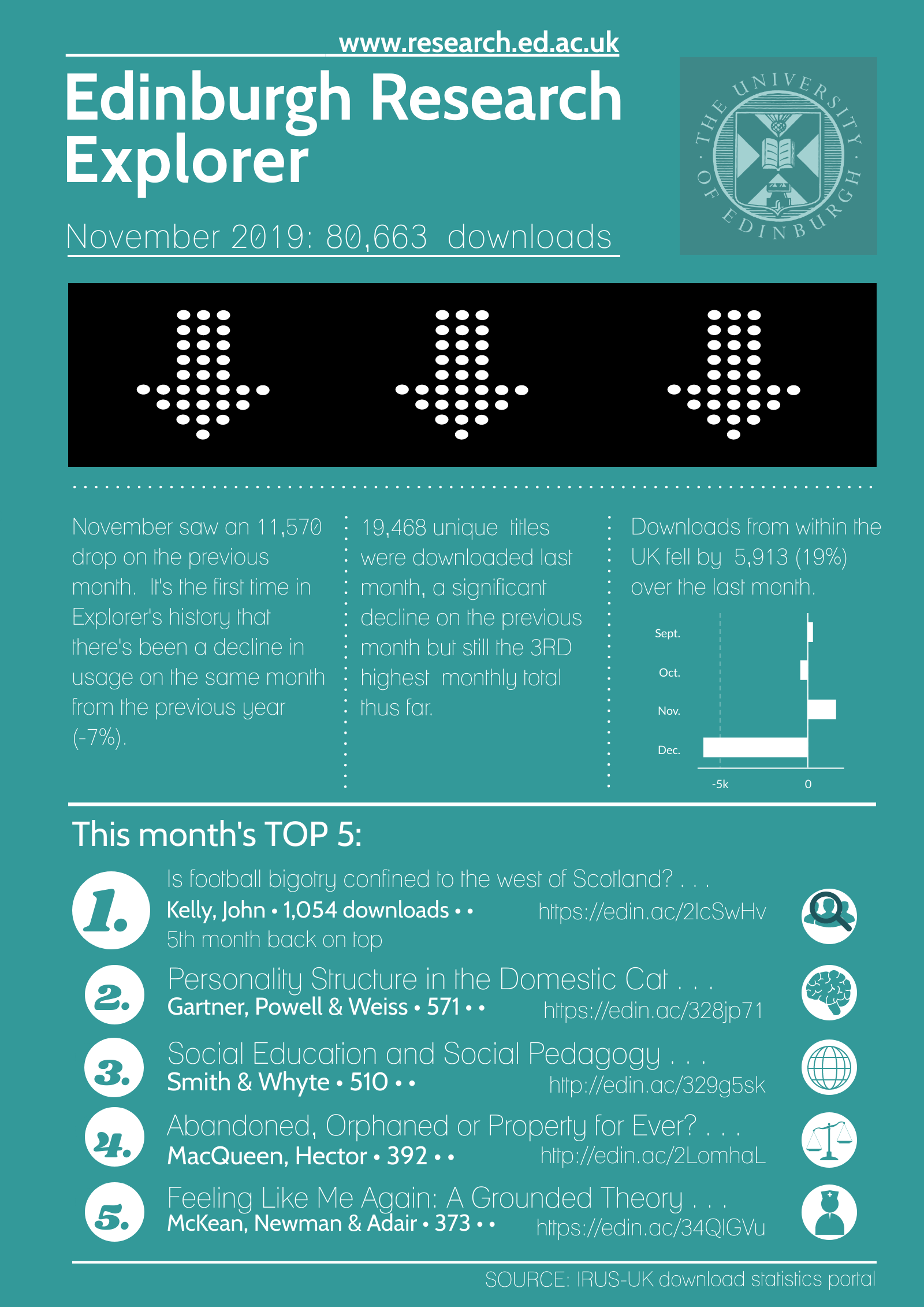
Edinburgh Research Explorer Statistics: November 2019
DataVault user roles let you share access to archived data
The Edinburgh DataVault is a secure long-term retention solution for research data.
Thanks to the hard work of our software developers in the Digital Library and EDINA, the Edinburgh DataVault now facilitates five different user roles. This means busy PIs can delegate the work of depositing and retrieving data, to members of their team or other collaborators within the University. It also allows PIs to nominate support staff to deposit and retrieve data on their behalf, or grant access to new members of their team.
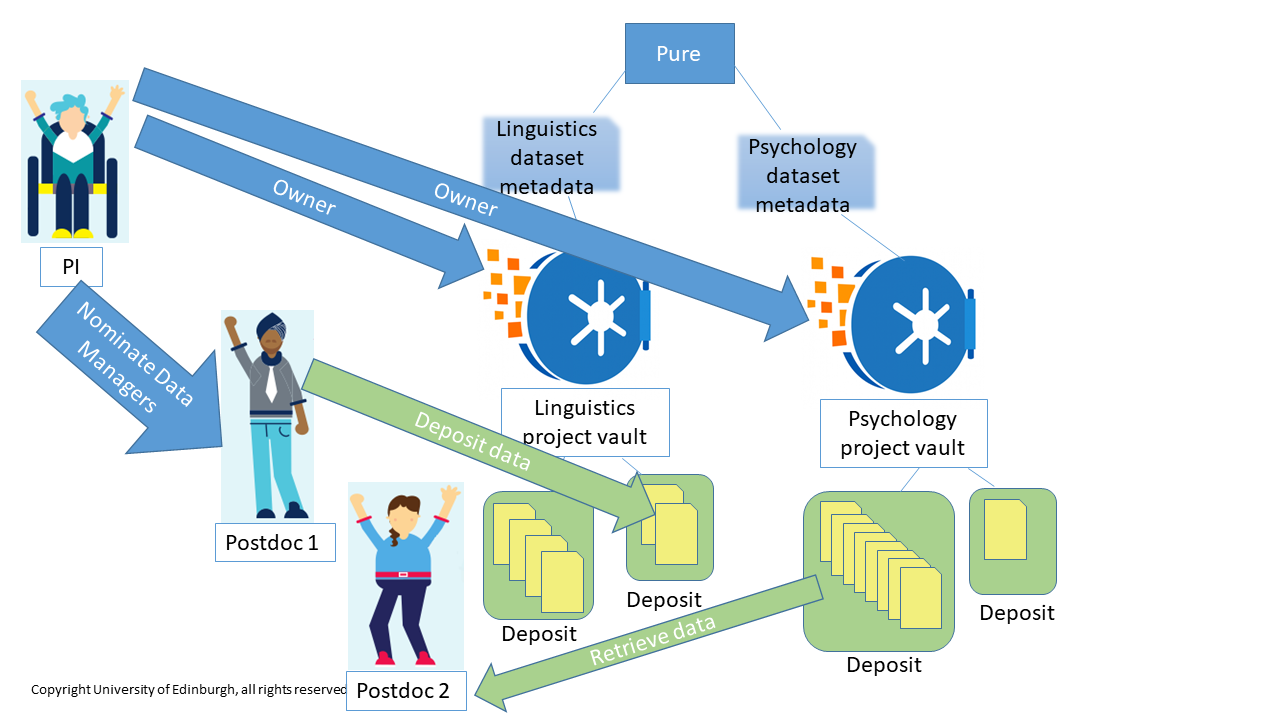
Diagram representing a PI and two postdocs using the roles of Owner and Nominated Data Manager to share access to data in the DataVault
There are five user roles:
- Data Owner
Usually the Principal Investigator. Can add/remove other users to their vault(s). - Nominated Data Manager (of a given vault)
Can view and edit metadata fields, deposit data and retrieve any deposit in the vault. May add/remove Depositors to the vault. - Depositor (of a given vault)
Can view the vault contents, deposit data and retrieve any deposit in the vault. - School Support Officer
Acting on behalf of the Head of School, may view all vaults and associated deposits belonging to the School. - School Data Manager
Assigned only with the express permission of the Head of School, may view, deposit into and retrieve data from any vault belonging to the School.
Full details of the permissions associated with each role:
Roles and permissions
Support staff who need to view reporting data for their School, or admin access to their School’s vaults, should attend our training – Edinburgh DataVault: supporting users archiving their research data.
Further information on why and how to use the DataVault is available on the Research Data Service website:
DataVault long-term retention
If you have any questions about using DataVault please don’t hesitate to contact the Research Data Support team at data-support@ed.ac.uk.
Pauline Ward, Research Data Support Assistant
Library and University Collections
@PaulineData
New research data management tool on one-year trial: protocols.io
Information Services aims to offer a research data service that meets most of the data lifecycle needs of the majority of UoE researchers without interfering with their freedom to choose tools and technologies which suit their work. In some cases cloud tools that are free to individual users are offered commercially as enterprise versions, allowing groups of researchers (such as lab groups) to work together efficiently.
The service’s steering group has agreed a set of criteria to apply when a tool is put forward by a research group for adoption. The criteria were developed after our two-year trial of the electronic lab notebook software, RSpace, and have been most recently applied to protocols.io. The protocols.io trial begins this month and will run for one year. An evaluation will determine whether to continue the enterprise subscription and how to fund it.
protocols.io is an online platform for the creation, management, and sharing of research protocols or methods. Users can create new protocols within the system, or upload existing methods and digitise them. Those with access to a protocol can then update, annotate, or fork it so that it can be continually improved and developed. There is interoperability with Github and RSpace, and long-term preservation of protocols through CLOCKSS.
Users can publish their protocol(s) making them freely available for others to use and cite or, with the enterprise version, keep them private. The tool supports the Open Science / Open Research agenda by helping to ensure that methods used to produce data and publications are made available, assisting with reproducibility.
Subscribing to the University plan will allow research groups to organize their methods and ensures that knowledge is not lost as trainees graduate and postdoctoral students move on. There are currently over 70 University of Edinburgh researchers registered to use protocols.io. You may follow these instructions to move your current protocols.io account to the premium university version. For more information contact data-support@ed.ac.uk.
Kerry Miller and Robin Rice
Research Data Support team
Collections
 Hill and Adamson Collection: an insight into Edinburgh’s past
My name is Phoebe Kirkland, I am an MSc East Asian Studies student, and for...
Cataloguing the private papers of Archibald Hunter Campbell: A Journey Through Correspondence
My name is Pauline Vincent, I am a student in my last year of a...
Hill and Adamson Collection: an insight into Edinburgh’s past
My name is Phoebe Kirkland, I am an MSc East Asian Studies student, and for...
Cataloguing the private papers of Archibald Hunter Campbell: A Journey Through Correspondence
My name is Pauline Vincent, I am a student in my last year of a...

Projects
Cataloguing the private papers of Archibald Hunter Campbell: A Journey Through Correspondence
My name is Pauline Vincent, I am a student in my last year of a...
Archival Provenance Research Project: Lishan’s Experience
Presentation My name is Lishan Zou, I am a fourth year History and Politics student....