Home University of Edinburgh Library Essentials
April 7, 2026
2020 World Book Day
Do you know today is World Book Day? Originally designated by UNESCO on 23rd April, World Book Day in the UK has been celebrated on the first Thursday in March since 1995 and is a celebration of reading, authors, illusatrators and of course, books!
Here at the University Collections Facility, we definetely don’t want to miss out this opportunity to appreciate our beloved collections and share some of them with you!
Who said an academic library can only be solemn? At the UCF we have a wide range of collections including those science fiction fans’ favorite. The Jim Burns Portfolio is a collection of 28 Jim Burns’ best known works.

This folio contain full-page images which represent the work of Burns, including his work between 1978 and 1989, and also Burn’s words to his supportive fans.

What’s your ideal book to spend a whole weekend reading on your cozy couch? We have The Ideal Book for you! Written by William S. Peterson ( 1939-) the Ideal Book records essays and lectures by William Morris ( 1834-1896) written on book art. On World Book Day, let’s all read through the book which contain the wisdom from Morris, whose novelty theories and views on book art made a siginificant impact on modern design.

The book also includes four interviews with Morris, which not only provide a first hand record of Morris and his works but also a valuable chance to learn about him as an individual.

What’s your favorite book, and how are you celebrating World Book Day? Do share with us in the comments below. If you want to find out more about the University Collections Facility and our collections, please visit our webstite.
The University Collections Facility
Sandy Lin, UCF Library Assistant
Rock Star Event
On Friday 28th February, over 100 guests attended an event at the Geological Society in London’s Mayfair to celebrate the University’s successful campaign to buy the Charles Lyell notebooks.

Eight of the notebooks were taken south for guests to view at the event, carefully transported by a team from the Library’s Centre for Research Collections. David McClay, Philanthropy Manager for the Library and University Collections team, introduced the speakers: Richard Hughes, Executive Secretary, Geological Society of London, and Professor David Stocker, National Hertitage Memorial Fund.

Peter Mathieson, vice-chancellor and principal of the University, thanked all those present for their support in acquiring the notebooks and presented gifts to Richard Hughes and Professor Secord.
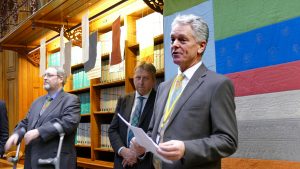
Richard Hughes, Executive Secretary, Geological Society of London
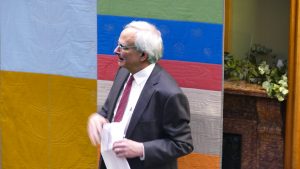
Professor Jim Secord, University of Cambridge
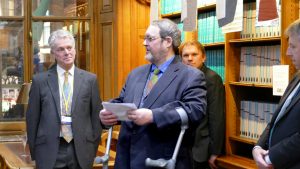
Professor David Stocker, National Heritage Memorial Fund

February 2020 Journal Club : AI and Metadata

Photo credit Gavin Tracy, free to use at https://www.pexels.com/photo/artificial-intelligence-cgi-computers-low-poly-1162566/
What do cataloguing and cars have in common? One answer is that developments in artificial intelligence are changing both of them. Our February Journal Club discussed three recent articles about metadata and AI, and what these meant for us.
Our first article from the Economist(1) in 2019 looked at self-driving cars, an AI development which is highly visible in the news. We talked about the differences between automation and AI. The ordinary cars we drive are already automated and reliant on technology, but they are not making decisions about where to drive. This is a key issue – people don’t like the idea of machines making decisions. Also, people feel that humans are fallible and machines shouldn’t be – people have higher expectations of machines than they have expectations of people. Until people’s expectations and perceptions of AI change, the impact will be limited. For example, the evidence is that Google self driving cars are very safe, but self driving cars have safety drivers because human legislators make it a requirement. Read More
The Japanese Garden
Journey with us to 1908 as Patrick Geddes and Frank Mears’ look to Japan and the East for urban planning inspiration. Archives volunteer and MSc Library and Information Studies student, Tara Copic, shares with us her collection highlights from the Patrick Geddes Archives.

Archives cataloguing volunteer, Tara Copic, reading one of her favourite discoveries from the Patrick Geddes correspondence: A letter from Frank C. Mears to Patrick Geddes, 22 Jan 1908, which discusses the Japanese Garden. (Ref: T-GED9/818).
Since October 2019 I have been volunteering with the Universities of Edinburgh and Strathclyde’s collaborative archives cataloguing project ‘Evergreen: Patrick Geddes and the Environment in Equilibrium’. I am an MSc Library and Information Studies student at the University of Strathclyde and I volunteer with the project for a few hours once a week at the University of Strathclyde Archives and Special Collections. When I started volunteering, I received training on how to use professional archive description standards and cataloguing software AToM.
After 5 months of volunteering with the project, I am now familiar with and have practical experience in working with professional archive catalogue standards and systems. I have enjoyed working with a series of correspondence, identifying correspondents, correcting inaccuracies and adding content. In total, I have helped to enhance over 120 catalogue descriptions, making the collection more accessible and easy to navigate.
Working through this series of correspondence (currently I’m in 1908!), has given me a fascinating insight into the rich life and work of Patrick Geddes. I am getting to know better his wide network of friends, colleagues and associates, that range from teachers and academics, to scientists and more. One of my favourite discoveries is a letter from Geddes’ son-in-law, the architect and town planner, Sir Frank Charles Mears (1880-1953) to Patrick Geddes at the Outlook Tower. In the letter, Mears discusses the beauty of the Japanese garden in relation to Japanese Town Planning Practice:

Extract from a letter from architect and son-in-law, Frank C. Mears (1880-1953) to Patrick Geddes (1854-1932) discussing the Japanese garden.
“I don’t think the idea of a Garden City could occur to a real Japanese, since with them every garden, and even flower vase is a microcosm, embodying their land and philosophy in one:- so, one would assume their towns are laid out in the same way.”
“The so-called irregularity of the Japanese lay-out seems to me to be of a high coordination, far above that of either the haphazard, or the formal methods of the West today. I think therefore that a great deal could be learned there which would be useful to the “Cities” movement here – ”
Frank C. Mears (1880-1953) to Patrick Geddes (1854-1932), 22 January 1908. (Ref: T-GED9/818).
Two new films on Charles Lyell and his notebooks
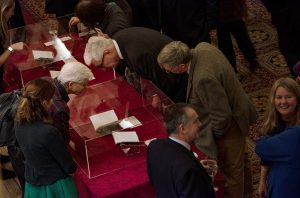
Professor Withers and others viewing a selection of Charles Lyell notebooks, University of Edinburgh’s Playfair Library, February 2020
There are two new films on Charles Lyell and his notebooks: The Travels of His Own Mind – Travels of His Own Mind where Professor Charles Withers, Emeritus Professor of Geography, University of Edinburgh and Geographer Royal for Scotland, discussing the importance of Charles Lyell’s notebooks.
Also ‘Two Hundred and Ninety Four Notebooks, One Thousand One Hundred Donors’ – 294 notebooks, 1,100 donors where Professor Withers and Jacky MacBeath, Head of Centre for Research Collections and Head of Museums, University of Edinburgh, on why we are excited about Lyell!
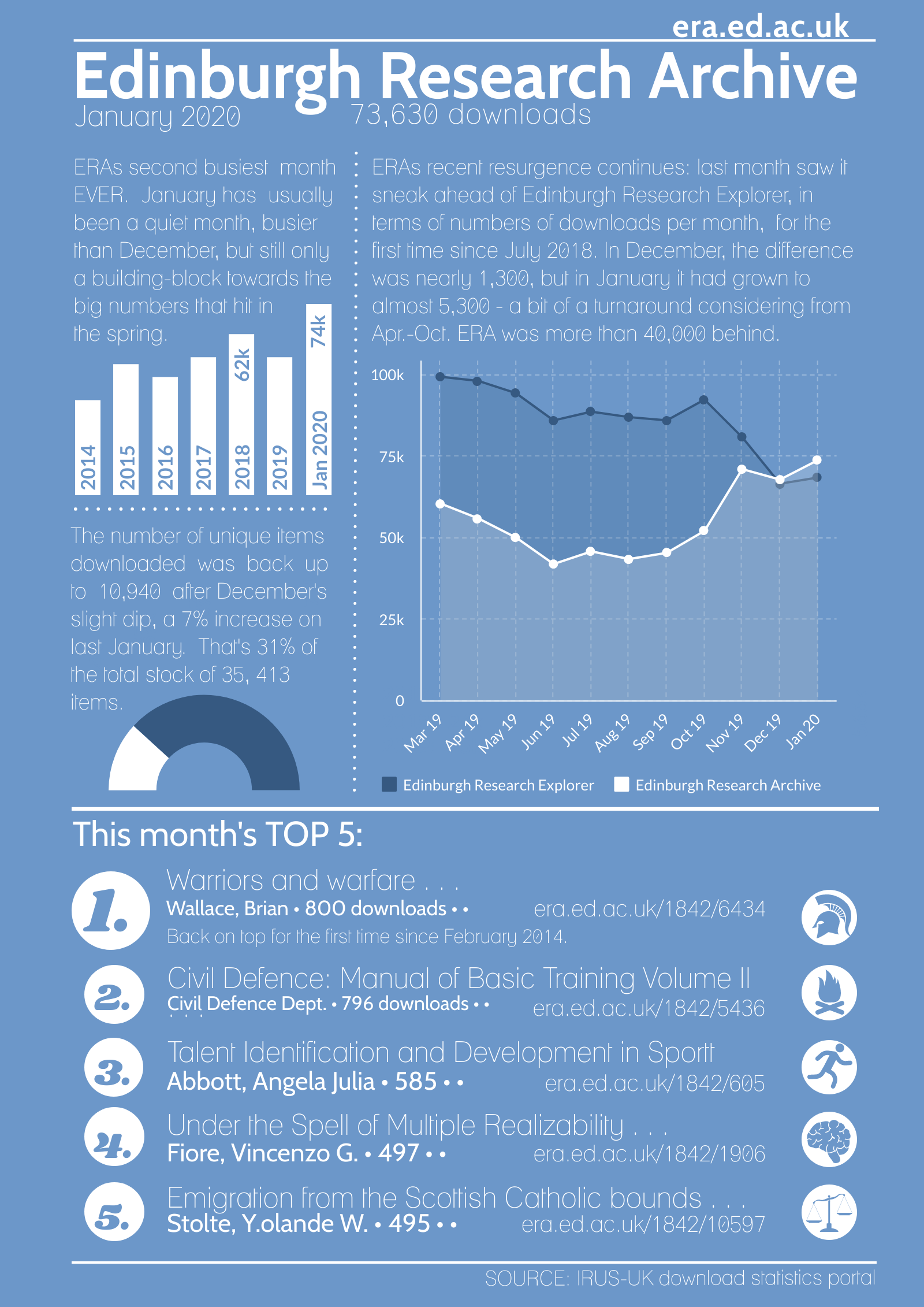
Edinburgh Research Archive Statistics: January 2020
On trial: Paris Peace Conference and Beyond, 1919-1939
Thanks to a request from HCA staff the Library currently has trial access to Paris Peace Conference and Beyond, 1919-1939 from British Online Archives (BOA). The Paris Peace Conference was a meeting of Allied diplomats that took place in the aftermath of the First World War. Its purpose was to impose peace terms on the vanquished Central Powers and establish a new international order. This fascinating digital primary source database gives you access to official and personal papers relating to this conference and the treaties that came from it.

You can access this database from the E-resources trials page.
Access is available on and off-campus.
Trial access ends 17th March 2020.
The First World War gave rise to a complex system of alliances and antagonisms. The various treaties imposed by the Allied powers in its aftermath settled conflicts with Germany, Bulgaria, the Ottoman Empire (later Turkey), Austria, and Hungary. Paris Peace Conference and Beyond contains documents that cover the treaties of Versailles, Saint-Germain-en-Laye, Neuilly-sur-Seine, Trianon, Sèvres, Lausanne, and Locarno, as well as the foundation of the League of Nations. Read More
Spotlight on: Archives of Sexuality and Gender
It’s LGBT+ History Month in the UK and there are a number of events being run around the University by the Staff Pride Network and the Students’ Association. However, if you’re interested in delving into the archives to find out more about LGBT+ history in the UK then the Archives of Sexuality and Gender may be just the place to start.
Archives of Sexuality and Gender spans the 16th to the 20th century and is the largest digital collection of primary source materials relating to the history and study of sex, sexuality and gender. Documentation covering social, political, health and legal issues impacting LGBT+ communities around the world is included, as well as rare and unique books on sex and sexuality from the sciences to the humanities.
This extensive resource is made up of 3 databases, LGBTQ History and Culture Since 1940 Part I, LGBTQ History and Culture Since 1940 Part II and Sex and Sexuality, Sixteenth to Twentieth Century, which between them cover 54 collections that are international in their scope and coverage. But I want to highlight those collections that specifically look at LGBT+ history in the United Kingdom.
Gay Activism in Britain from 1958: The Hall-Carpenter Archives
Spanning the period from 1958 to 1990, this collection chronicles the activities of the Albany Trust, an organisation that was initially focused on decriminalising homosexuality and increasing social acceptance of gay people. The Albany Trust centered its work on counseling services, research, and public education, helping to steer society and the law away from older, traditional ideas regarding homosexuality. Read More
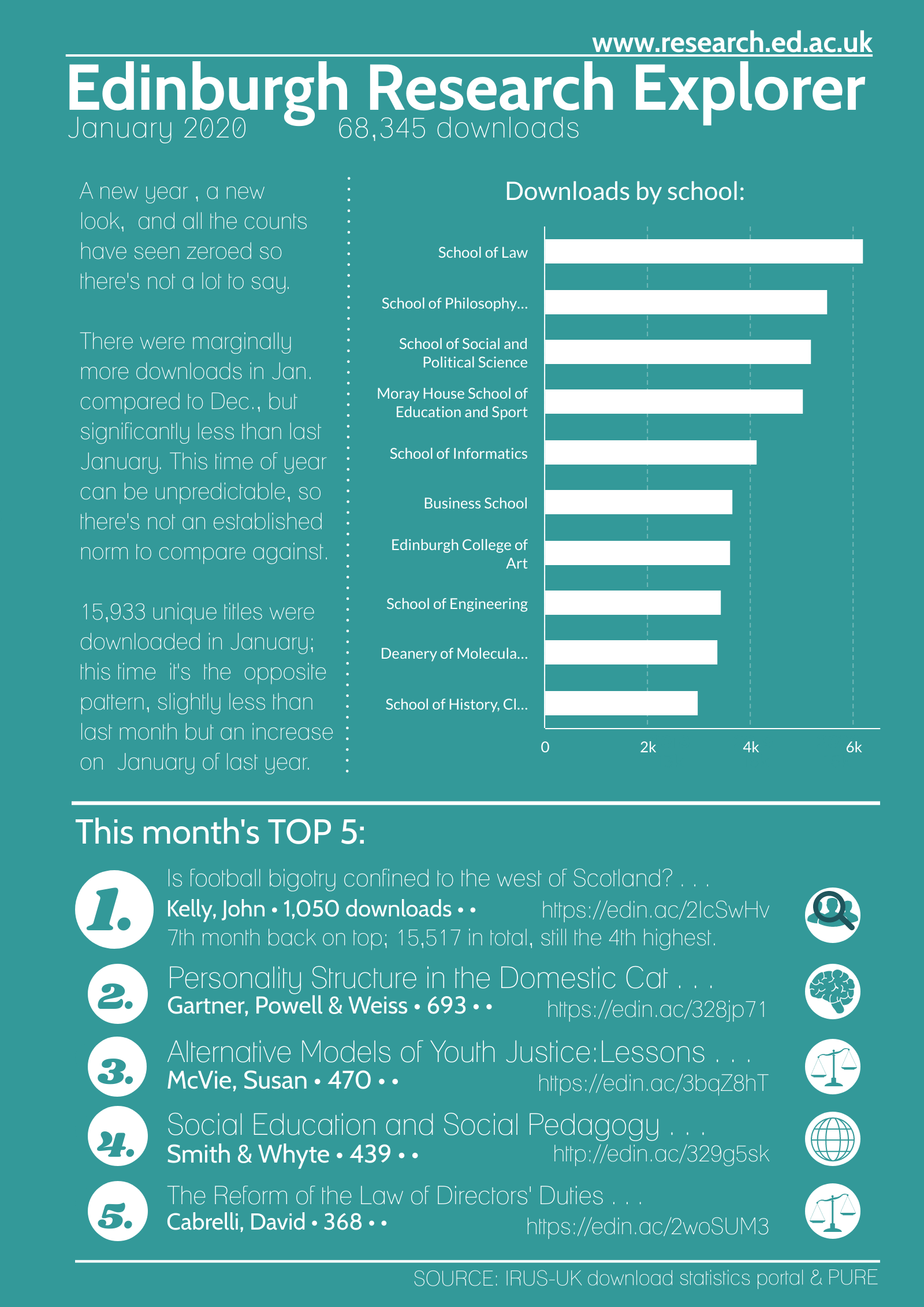
Edinburgh Research Explorer Statistics: January 2020
African and South Asian newspaper archives: on trial
*The Library has now purchased access to African Newspapers, Series 1. See New! African Newspapers, Series 1 1800-1922*
Thanks to a request from UncoverEd I’m pleased to let you know that we currently have trial access to 3 digital newspaper archives from Readex covering African and South Asian titles. The 3 databases are African Newspapers: The British Library Collection, World Newspaper Archive: African Newspapers, Series 1 1800-1922 and World Newspaper Archive: South Asian Newspapers 1864-1922.

You can access all 3 databases via the E-resources trials page.
Access is available both on and off-campus.
Trial access ends 13th March 2020. Read More
Collections
 Hill and Adamson Collection: an insight into Edinburgh’s past
My name is Phoebe Kirkland, I am an MSc East Asian Studies student, and for...
Cataloguing the private papers of Archibald Hunter Campbell: A Journey Through Correspondence
My name is Pauline Vincent, I am a student in my last year of a...
Hill and Adamson Collection: an insight into Edinburgh’s past
My name is Phoebe Kirkland, I am an MSc East Asian Studies student, and for...
Cataloguing the private papers of Archibald Hunter Campbell: A Journey Through Correspondence
My name is Pauline Vincent, I am a student in my last year of a...
Projects
Cataloguing the private papers of Archibald Hunter Campbell: A Journey Through Correspondence
My name is Pauline Vincent, I am a student in my last year of a...
Archival Provenance Research Project: Lishan’s Experience
Presentation My name is Lishan Zou, I am a fourth year History and Politics student....