Home University of Edinburgh Library Essentials
June 20, 2026
Light Night in Edinburgh – New College Library closing early
 New College Library will close early at 5pm on Thursday 29 November as installations and road closures for ‘Light Night‘ mean that readers will not be able to exit the building through the main gates after this time.
The ‘Light Night’ performance, including firework display and aerobatics, is scheduled on the grassy area at the top of the Mound at around 5pm to 6pm on Thursday 29th November, with a rehearsal in the early afternoon. There will be a full road closure in place all day, with pedestrian access to enter and exit the building through the main Quad gates throughout the day until 5pm.
Remembering the life of Guru Nanak
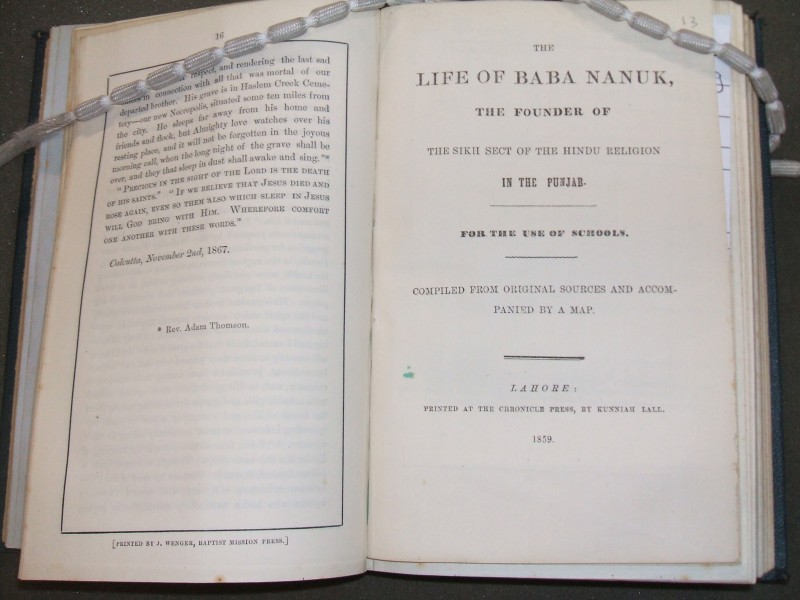
The life of Baba Nanuk, the founder of the Sikh sect of the Hindu religion in the Punjab : for the use of schools : compiled from original sources and accompanied by a map. Lahore : The Chronicle Press, by Kunniah Lall, 1859. New College Library P.g.21.13/2
Sikhs around the world will celebrate the birthday of Guru Nanak on Wednesday 28 November. Guru Nanak (1469-1539) was the founder of the Sikh religion.
The life of Baba Nanuk, from New College Library’s Pamphlets collection aims to give an introduction for schools to Sikhism’s founder and the early history of the religion. New College is the only library in Scotland to hold a copy of this work.
This item was catalogued as part of the Funk Cataloguing Projects at New College Library.
Thanks for reading NewCollegeLibrarian
This blog is six months old now and has had over 3,000 hits – thank you! I’d love to know a bit more about who out there is reading my blog, so I’d appreciate it if you could fill in this 5 second poll. Thanks again!
Brill’s Encyclopedia of Hinduism Online on trial now
 On trial now for University of Edinburgh users is Brill’s Encyclopedia of Hinduism Online . Brill’s Encyclopedia of Hinduism presents the latest research on all the main aspects of the Hindu traditions in essays written by the world’s foremost scholars on Hinduism. The encyclopedia encompasses a variety of regional traditions as well as the global world religion. The fully searchable, dynamic digital format currently includes volume I of ultimately five volumes – vols II and III are due to be added in December. Access via Brill Reference Online.
University of Edinburgh users can access the trial on the E-resources trials page.
The trial ends on 18 December.
A prayer for a pudding?

The booke of the common prayer and administracion of the Sacramentes : and other rites and ceremonies of the Churche, after the vse of the Churche of England.1549. New College Library DPL 70
25 November 2012 is traditionally Stir Up Sunday, when cooks plan to make their Christmas puddings so they have time to mature before eating on Christmas Day.
This tradition is linked with the opening words of the collect for the day in the Book of Common Prayer of 1549, which reads ‘Stir up, we beseech thee, O Lord…’ Always read just before Advent, this became remembered as a reminder to start stirring up the puddings for Christmas.
New College Library holds this copy of the Book of Common Prayer printed in London in 1549, the year the Book of Common Prayer was adopted by the Church of England. We can see the exhortation to “Stir up ..” , spoken over 450 years ago in the reign of Edward VI of England, about two thirds of the way down the page.
This book is part of the Dumfries Presbytery Library, currently being catalogued as part of the Funk Cataloguing Projects at New College Library. It bears the signature of Dr John Hutton, who donated the collection of books that form the foundations of the Dumfries Presbytery Library.
Psalms for St Cecilia’s Day
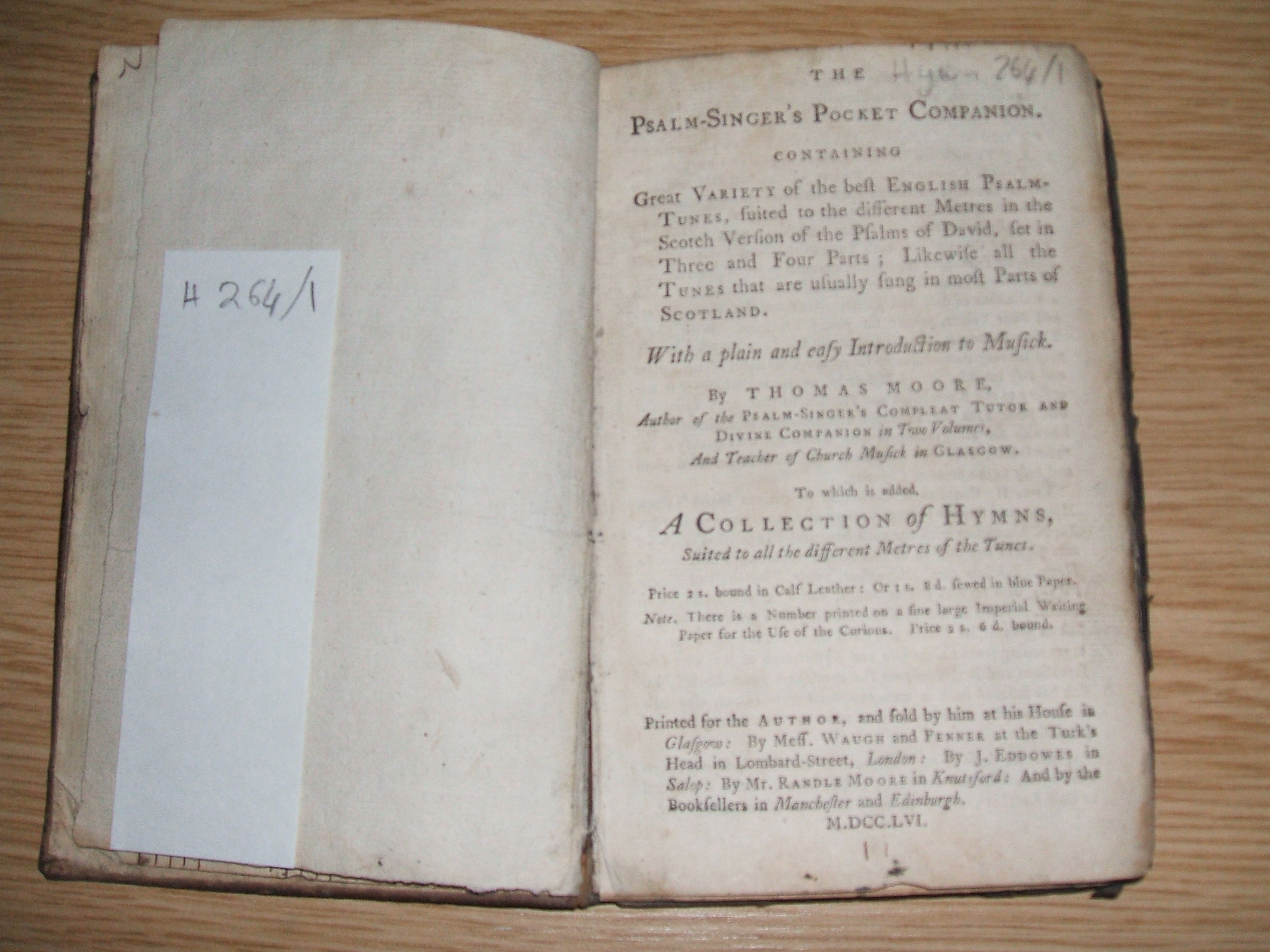
Moore, Thomas “Psalm singers’ pocket companion”, Glasgow 1756. Hymn 264/1
The feast of St Cecilia’s Day is traditionally celebrated on November 22nd. A 3rd century martyr, St Cecilia is known as the patron saint of musicians. Her legend relates that, as a young Christian, she was betrothed to a pagan but she had already vowed her virginity to God. As the organs played at at her wedding feast, Cecilia sang (in her heart) to the Lord, asking that her heart remain pure.
Here’s a book of Psalms to remember her by. Thomas Moore’s Psalm singers’ pocket companion is a publication from the revival era known as Gallery Psalmody, where leading singers and choir were located in a loft of the church. The new style lasted for about a century from 1755, and its main features were choirs singing in harmony of usually three parts, with some solo sections. Thomas Moore (- d. 1792) was a music teacher from Manchester Cathedral who came to Glasgow to teach singing.
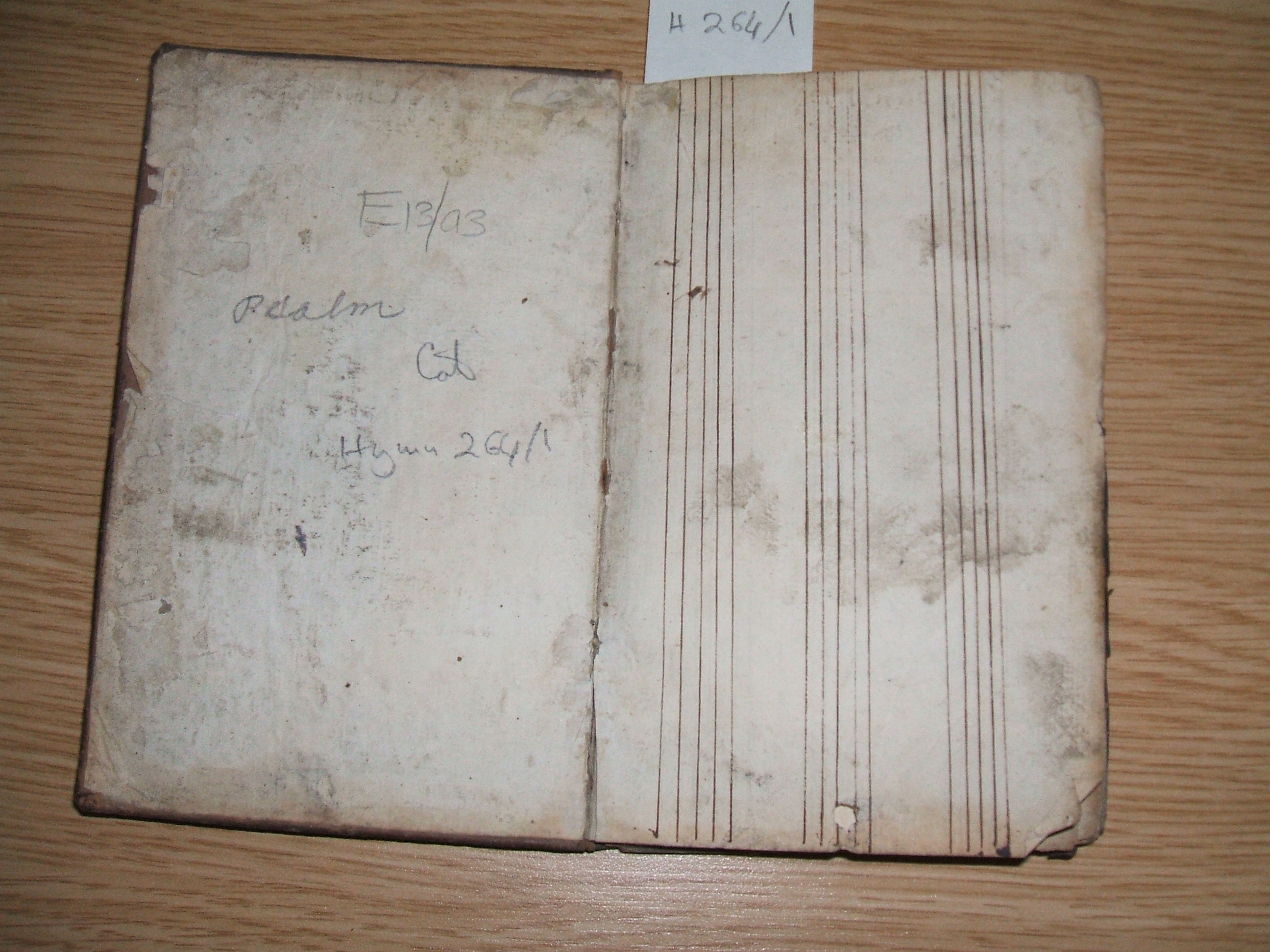 This item is small, or pocket sized, and contains a number of manuscript doodles which may testify to the singer’s mind wandering elsewhere. Also interesting are the pages of handwritten music staves, perhaps to allow the singer to make notes of new tunes or harmonies.
The Psalm singers’ pocket companion belongs to the Hymnology Collection, and was catalogued as part of the Funk Cataloguing Projects. With thanks to our Project Cataloguer, Oreste de Tommaso, for supplying details of this item.
New College Library image collections online
 I’m very pleased to be able to tell you that over 200 images from New College Library’s collections are now available online through the University of Edinburgh Image Collections database.
The collection includes images from some of New College Library’s iconic items such as the first edition of Calvin’s Institutes of Religion (1536) and the manuscript of Covenanter James Renwick’s last speech in 1688.
This is a growing collection, as New College Library items catalogued as part of the Funk cataloguing projects which are found to be unique on ESTC are being photographed and their images added to the database.
Manchester Contributes to the Friedberg Genizah Project
A growing resource for Jewish / Ancient World Studies – I see that as well as the digitized images of Genizah collections at Cambridge and Birmingham there are links to related open access journals and pdfs of all the 8 volumes of “Ginzei Kedem” – a Journal devoted to Genizah research and published by the Ben-Zvi Institute.
New College Library’s earliest Bible

Novum Testamentum Graece, Strassburg 1524. New College Library B.r.316.
This Greek New Testament Novum Testamentum Graece, is the earliest Bible held at New College Library.
It was printed in Strassburg in 1524, and in his preface the printer speaks of this edition as the first fruits of his Strassburg press. Combined with the same printer’s Greek Old Testament of 1526 it forms a complete Bible, but this New Testament appears to have been first issued separately.
This New Testament was published in Strassburg during the period that Protestant reformer Martin Bucer was active there. Bucer was part of a significant group of reformers including Matthew Zell and Wolfgang Capito, and he corresponded with the theologians Martin Luther and Huldrych Zwingli. During his time in Strassburg he is known to have taught classes on books of the Bible so may have used a Greek Testament like this one.
This copy has a number of manuscript inscriptions testifying to its former ownership and a printed book plate from James Walker, Christ Church. It is likely to have been donated to New College Library in the early years of its foundation. Part of the Early Bibles Collection, it was catalogued as part of the Funk Cataloguing Projects here at New College Library.
With thanks to our Rare Books cataloguer Finlay West for supplying details of this item.
Top ten tips for finding theses
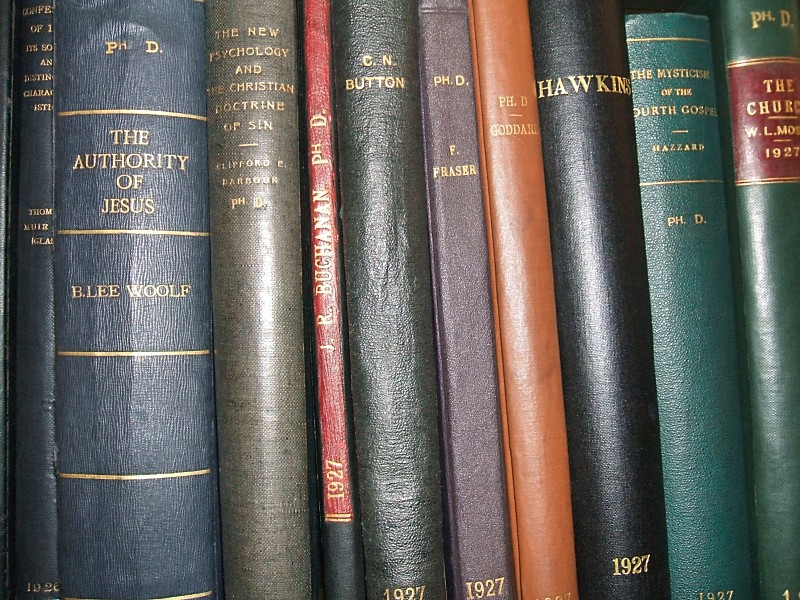
Postgraduate students often ask me about how to find theses. Unfortunately there’s no single source for information on all theses worldwide.
However here are a few tips that might help …
1. All Divinity theses and post 1984 other University of Edinburgh theses are now catalogued onto the online catalogue. See my earlier blog post for tips on searching for New College theses …
2. Older University of Edinburgh theses are listed in sheaf-binder indexes, which are held in the CRC Research Suite – see the useful CRC Guide to Theses
3. Remember that most University of Edinburgh printed theses are kept as archival copies and can only be read in the Library.
4. The Edinburgh Research Archive (ERA) has full text online versions of all Edinburgh University theses submitted from 2005.
5. Go to the Theses subject guide on the University of Edinburgh Library website to find a gateway to information sources from universities worldwide – such as …
6. [University of Edinburgh restricted] … The Index to Theses database finds details of UK & Ireland theses from 1715- present (no full text)
7. [University of Edinburgh restricted] The Dissertations and Theses database from ProQuest finds details of primarily US & Canada theses. Currently the University of Edinburgh has not subscribed to the full text option, but if you want the full text you could apply for an inter-library loan.
8. New to me is the Networked Library of Theses and Digital Dissertations – SCIRUS Search. This freely available search of public domain theses will include subscribed content from University of Edinburgh subscriptions if you’re on a University network machine, or going through MyEd or VPN at home (No need to alter settings as you would for Google scholar). There’s more full text here than I’d expected.
9. The DART Europe E-Theses portal – at the time of writing, this is offering access to 362030 open access research theses from 523 Universities in 27 European countries.
10. For theses from further afield, you could try the Center for Research Libraries Global Resources Network.
Collections
 Hill and Adamson Collection: an insight into Edinburgh’s past
My name is Phoebe Kirkland, I am an MSc East Asian Studies student, and for...
Cataloguing the private papers of Archibald Hunter Campbell: A Journey Through Correspondence
My name is Pauline Vincent, I am a student in my last year of a...
Hill and Adamson Collection: an insight into Edinburgh’s past
My name is Phoebe Kirkland, I am an MSc East Asian Studies student, and for...
Cataloguing the private papers of Archibald Hunter Campbell: A Journey Through Correspondence
My name is Pauline Vincent, I am a student in my last year of a...
Projects
Cataloguing the private papers of Archibald Hunter Campbell: A Journey Through Correspondence
My name is Pauline Vincent, I am a student in my last year of a...
Archival Provenance Research Project: Lishan’s Experience
Presentation My name is Lishan Zou, I am a fourth year History and Politics student....