Home University of Edinburgh Library Essentials
May 10, 2026
Sharing Edinburgh’s RDM lessons with other Scottish HEIs
In the interest of sharing Research Data Management (RDM) lessons with the wider community, Edinburgh University hosted a seminar for Higher Education Information Directors Scotland (HEIDS) and Scottish Confederation of University and Research Libraries (SCURL) in April, bringing together IT directors and librarians from Scottish universities.
The presentations (with links below) covered the range of RDM activities that Edinburgh University is currently engaged in:
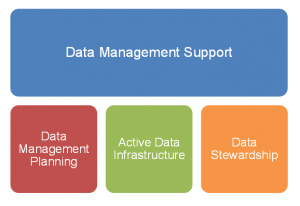 Stuart Lewis – RDM policy and roadmap
- Sarah Jones – Data management planning and DMPonline
- Tony Weir – Active data services and storage infrastructure
- Robin Rice – University data repository: Edinburgh DataShare
Much of the discussion covered the potential for collaboration, from sharing lessons and models in these early stages to potentially offering shared services in the future. Senior managers emphasised that IS would need to look after its own users as a primary concern.
The audience appeared to take a lot of ideas away from the day and were keen for a follow-up session later in the year. Since the event, the University of Edinburgh has approved a business case, committing significant resource to invest in RDM infrastructure and staffing. Watch this space for further updates!
Sarah Jones, DCC
Curriculum development for digital curators
The Framing the Digital Curation Curriculum Conference, held in the grand surroundings of Banca CR Firenze, Florence on 6-7 May 2013, was organised by the DigCurV project funded by the European Commission’s Leonardo da Vinci programme to establish a curriculum framework for vocational training for digital curators in the library, archive, museum and cultural heritage sectors.
The aim of the conference was to promote discussion and consensus-building amongst stakeholders about criteria and requirements necessary to develop training courses for professionals in digital curation and preservation in the cultural heritage sector.
It is possible to argue that digital curation curriculum development in North American library schools is at a more advanced stage than their UK equivalents nevertheless there was a strong Scottish presence at the conference with thought-provoking presentations by William Kilbride (Executive Director, Digital Preservation Coalition) – A future with no history meets a history with no future: how much do we need to know about digital preservation and by Laura Molloy and Ann Gow (HATII, University of Glasgow) – the Curriculum Framework as well as a presentation on the ‘DIY’ RDM Training Kit for Librarians, developed at EDINA & Data Library in conjunction with User Services Division, given by yours truly.
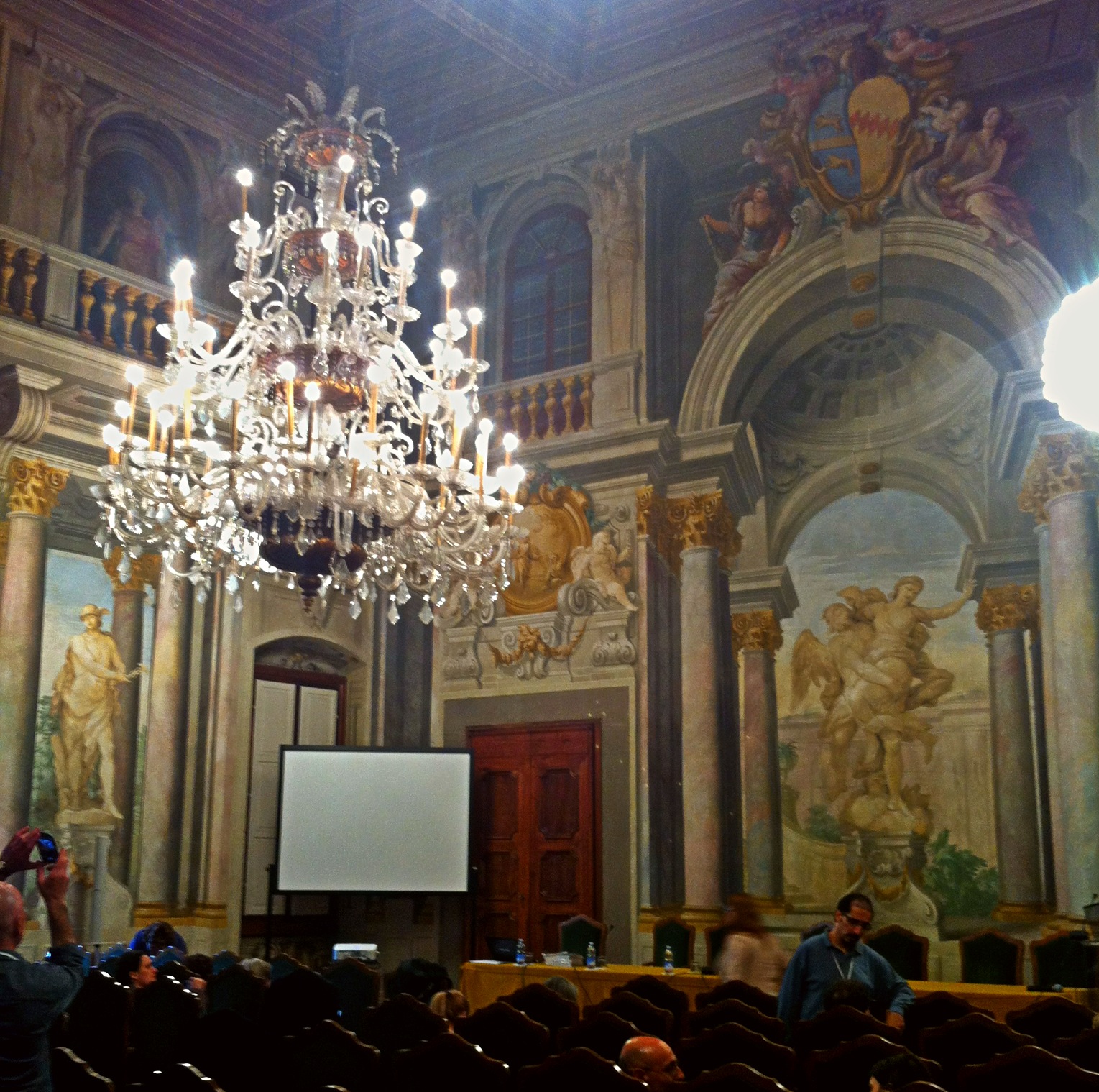
In keeping with this preservation theme there’s a commonly accepted theory that you will not find the British royal family in the same place at the same time in case of an assasination attempt, terrorist attack, or natural disaster. With this, and the threateningly large, heavy yet impressive chandelier in mind (see picture above), it was encouraging to observe that the assembled digital curation curriculum and preservation expertise was dispersed throughout the auditorium lest a loose ceiling screw could have resulted in all existing knowledge in this area being lost in one fell swoop!!
All presentations are available on the conference website: http://www.digcur-education.org/eng/International-Conference/Programme
Stuart Macdonald
Associate Data Librarian
11th Century Manuscript Digitisation Complete

Notices of David Laing, 1878, Stevenson, Thomas George. Etching of the collector David Laing reading from Ms 12.
Hello & welcome to our very first Post!
It seems appropriate to kick off this blog with the exciting news that we have just completed the digitisation of one of the Special Collections oldest manuscripts- Ms 12, an 11th Century manuscript of Four Gospels from Germany.
When Bibliotheca Laureshamensis http://www.bibliotheca-laureshamensis-digital.de/ got in touch to discuss the possibility of photographing all 510 pages of the manuscript our Rare Books Librarian was thrilled by the re-emergence of this wonderful document & a joint digitisation project was soon agreed.
We hope to have this available soon in a book reader format, but in the meantime you can get a flavour of it at http://images.is.ed.ac.uk/luna/servlet/view/all/what/Ms%2012?sort=Work_Title,Work_Creator_Name,Work_Shelfmark

f.122r of Ms 12, Four Gospels, 11thC. German.
ECA Collection at the Annexe : Storage
A series of articles on the relationship between the Library Annexe and the ECA.
The Annexe provides a great space to store, sort, preserve and work on collections.
Improvements to the storage of materials are always on-going. Recently staff from the ECA have been working hard out at the Annexe lining shelves with Plastazote, a hard foam, to protect the paintings.

Volunteers, Siobhan & Catriona, lining shelves with Plastazote to protect paintings stored at the Library Annexe
Plastazote is used in conservation for many purposes. It is used for packaging and the protection of various fragile objects and artifacts. Also, to create book rests and display supports.
So what is it? Plastazote foam sheets are a high density light weight chemically neutral and inert polyethylene foam material. Catch all of that? This means that the foam is inert and acid free so it won’t react chemically with any conservation material it comes into contact with. The high density foam can be cleanly cut and sculptured to most shapes. Both of these factors make it great for packing archival boxes to fit the object, such as rare books and other valuable items that are subject to potential damage.

The finished product.
By lining the shelves out at the Annexe, we are creating a more secure, safe, preserving space for the ECA Collection to ensure that the Collection will be in top condition to be enjoyed for many years to come.
Stephanie Farley (Charlie), Library Annexe Assistant
Where the data people meet: IASSIST
Last week I had the pleasure of attending IASSIST 2013 in Cologne, the annual conference of an international membership organisation of data librarians and data archivists, hosted by GESIS, the German social science data archive. Since 1974 this close-knit but dispersed community has been sharing knowledge and experience of provision of academic data services. Data Library staff have served in various elected and appointed posts over the years, and have hosted the conference twice in Edinburgh.
Corresponding with new jobs for data curators, data scientists and data managers, IASSIST has grown from an intimate group of regulars (such as those of us working in the Data Library and the UK Data Archive) to a conference of nearly 300 delegates from 29 countries, with three or four parallel tracks of presentations running across three days plus a training day for workshops.
 Whatever the conference theme–this time it was Data Innovation: Increasing Accessibility, Visibility, and Sustainability— the programme never fails to be an indicator of the latest trends, albeit with a slant towards whichever European or North American country is hosting the conference. One speaker noted that Big Data may have seen its peak, as it was no longer necessary to cram the term into every presentation.
This year there was a noticeable increase in talks about data enclaves and means of providing access to sensitive personal and corporate data, including a keynote by Tim Mulcahy of NORC on record linkage. Tim set up the first data enclave in the US in 2004. After returning home I learned of a new proposal from the ESRC to fund four administrative data centres in the four UK countries, affirming this important trend towards secure access of sensitive data. As Tim pointed out, it’s much better for researchers than the status quo of not getting access at all.
The most number of talks appeared in the Research Data Management strand (RDM), including my colleague Stuart Macdonald’s presentation of our RDM Roadmap work here at UoE. Attention to RDM has exploded in recent years as research funders have applied more stringent rules to how data is created, managed and shared, to get the most value out of publicly funded research for themselves, researchers and the public. It was gratifying to hear praise by other speakers for MANTRA – our online course for PhD students to learn RDM basics—which has become well-known as an RDM primer.
Another strand covered more long-standing interest in data standards and tools – especially those around the DDI (Data Documentation Initiative) standard used in archiving social science data, which was invented and developed by IASSIST-ers. Data libraries serving a single institution were amply represented by a strand called Data Public Services/Librarianship. As part of a Pecha Kucha set of lightning talks I presented our work in training liaison librarians in RDM and outlined an openly licensed “training kit” that other small groups of librarians anywhere can use to train themselves.
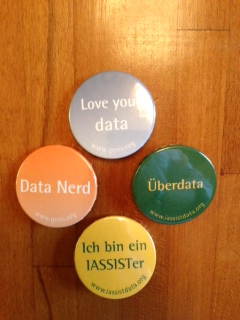
IASSIST has been branching out from the social sciences as institutions such as ours grapple with how to support the data lifecycle across the University and its multitude of disciplines. As I sat on a panel discussing how data libraries and national data archives such as the UKDA can work together, I wondered what the future would bring for a mature set of data-related services that interoperate across an institution (as we’re trying to create through the RDM Roadmap work) and across institutions and the internet. The future for data – and data nerds – seem bright.
Robin Rice
Data Librarian
New books at New College Library – June

 New College Library has a regular display of new books at the far end of the Library Hall, close to the door to the stacks.
New in this month – and already out on loan – is Augustine and science / [edited by] John Doody, Adam Goldstein, Kim Paffenroth. on the shelf at BR65.A9 Aug.
Also new is Creating life in the lab : how new discoveries in synthetic biology make a case for the Creator / by Fazale Rana, at BL255 Ran.
These titles were purchased for the MSc in Science and Religion at the School of Divinity, University of Edinburgh.
You can see an regularly updated list of new books for New College Library on the Library Catalogue – choose the New Books Search and limit your search to New College Library. Here’s a quick link to new books arriving in the last few weeks. A word of caution – some of the books listed here may still be in transit between the Main Library (where they are catalogued) and New College Library, so not on the shelf just yet.
Online resources for Byzantine research on trial now
Two research resources for Byzantine history and culture are now on trial until 8 July for University of Edinburgh users.

 The Prosopographie der mittelbyzantinischen Zeit Online/Prosopography of the Middle Byzantine Period Online (PMBZ Online) is a comprehensive biographical dictionary for the Byzantine Empire in the early Medieval Period (641-1025 AD) documenting more than 20,000 persons. PMBZ Online is based on the print edition of the Prosopographie der mittelbyzantinischen Zeit which appeared in two parts 1998 and 2013. PMBZ Online documents all persons mentioned either by name or anonymously in the relevant Byzantine and non-Byzantine sources, and secondly all persons mentioned in the Byzantine sources both from Western Europe and from the Arabic and Slavonic areas, together with those from the Christian East.
The Byzantinische Bibliographie Online includes the bibliographic sections of the Byzantinische Zeitschrift from volume 98 (2005) up to the present day. It contains around 30,000 entries in total, and each year about 4,000 entries will be added. The entries are organized systematically by subject area and enriched by short discussions and references to relevant review articles.
Access to the database is via http://www.ed.ac.uk/is/databases-trials. University of Edinburgh users have IP based access on campus, or off campus via the VPN.
Bar Ilan Global Jewish Database now on trial
 The Bar Ilan Global Jewish Database is now on trial until 20 June. The Bar Ilan Responsa Project is the world’s largest electronic collection of Torah literature of its kind. The database includes the Bible and its principal commentaries, the Talmud Bavli and Talmud Yerushalmi with commentaries, Midrash, Zohar, Halachic Law (Rambam, Shulchan Aruch with commentaries), a large Responsa collection of questions and answers and the Talmudic Encyclopedia.
Access to the database is via http://www.ed.ac.uk/is/databases-trials. University of Edinburgh users have IP based access on campus, or off campus via the VPN, and clicking on search or browse should allow access to the content.
ECA Collection at the Library Annexe: Student Paintings
A series of articles on the relationship between the Library Annexe and the ECA.
When the Edinburgh College of Art merged with the University of Edinburgh in August 2011, they brought with them a fantastic collection of art and archives. Including a large collection of paintings which were stored off site in Livingston and have now been moved to the Library Annexe.

ECA Collection
What are these paintings and where do they come from?
The vast majority of the ECA paintings at the Annexe are student works from final year degree shows. The additional storage space provided by the Library Annexe has been a boon to the ECA. This space allows room for the expansion and growth of the collection.

Safe, secure, storage.
In an exciting move, the ECA will this year re-start acquiring final year student work from the Degree show as part of a purchase prize.
If you are interested in art and would like to have a look at what our student’s are creating, the Edinburgh College of Art Degree Show 2013 is currently taking place until Sunday 9 June 2013. Check it out!
Don’t fear though, if you miss the Degree show, the ECA Post Graduate Degree Show 2013 will be happening from Saturday 17 August to Sunday 25 August 2013.
Stephanie Farley (Charlie), Library Annexe Assistant
The Case of Mr. Ebenezer Erskine, founder of the Secession church in Scotland

The Case of Mr Ebenezer Erskine
B.a.b.1912
Ebenezer Erskine (1680–1754), a founder of the Secession church, died in Stirling on 2 June 1754. A celebrated preacher, his opposition to patronage, when a local landowner could choose the parish minister without the approval of the people of the parish, set him against the established Church of Scotland. In 1733 Erskine joined other Scottish ministers to form the Associate Presbytery, remaining in active ministry in Stirling. By 1742 the number of seceder congregations in Scotland had grown to twenty.
New College Library holds this pamphlet from 1733, recently catalogued online as part of the Funk Cataloguing Projects, which is typical of Erskine’s sermons published during the controversial times of the early 1730s. New College Library also holds Erskine’s manuscript notebooks in the archives.
Sources
David C. Lachman, ‘Erskine, Ebenezer (1680–1754)’, Oxford Dictionary of National Biography, Oxford University Press, 2004 [http://www.oxforddnb.com/view/article/8853, accessed 27 May 2013]
Collections
 Hill and Adamson Collection: an insight into Edinburgh’s past
My name is Phoebe Kirkland, I am an MSc East Asian Studies student, and for...
Cataloguing the private papers of Archibald Hunter Campbell: A Journey Through Correspondence
My name is Pauline Vincent, I am a student in my last year of a...
Hill and Adamson Collection: an insight into Edinburgh’s past
My name is Phoebe Kirkland, I am an MSc East Asian Studies student, and for...
Cataloguing the private papers of Archibald Hunter Campbell: A Journey Through Correspondence
My name is Pauline Vincent, I am a student in my last year of a...
Projects
Cataloguing the private papers of Archibald Hunter Campbell: A Journey Through Correspondence
My name is Pauline Vincent, I am a student in my last year of a...
Archival Provenance Research Project: Lishan’s Experience
Presentation My name is Lishan Zou, I am a fourth year History and Politics student....