Home University of Edinburgh Library Essentials
December 15, 2025
Get Connected with University of Edinburgh Information Services
 Get Connected drop in sessions for Freshers Week are running in the Main Library mezzanine (above the entrance gates) on 9th-13th September between 10am-4pm. No appointments necessary, just turn up.
Take the opportunity to connect up your own personal devices e.g. laptops, phones and tablets/pads to the University network. Staff will be on hand to help and guide you – I’ll be there myself 1-2pm.
You can also find out more at : www.ed.ac.uk/is/new-students
Welcome to New College Library
A big welcome to all students starting and returning to the University of Edinburgh today, at the beginning of Freshers week 2013. We’re looking forward to meeting you. To help you get started at University, check out this guide for new students to Library & IT services.

If you want to get ahead with using New College Library, you could start with the Virtual Tour.
There will be a programme of tours for students at New College Library – students please watch your email for details. There will also be events happening all over the University Library to help you get connected with your IT and Library services.
How open should your data be?
The RECODE project is looking at open data policy for EU-funded research. I attended a workshop in Sheffield yesterday for a diverse stakeholder group of researchers, funders and data providers. Along with a nice lunch, they delivered their first draft report, in which they synthesised current literature on open research data and presented five case studies of research practice in different disciplines. The format was very interactive with several break-out groups and discussions.
The usual barriers to data sharing were trotted out in different forms. (Forgive my ho-hum tone if this is a newish topic for you – our DISC-UK DataShare project summarised these in its 2007 ‘State-of-the-Art-Review’ and the reasons haven’t really changed since.) The RECODE team ably boiled these down to technical, cultural and economic issues.
The morning’s activity included a small-group discussion about disciplinary differences in motivations for data sharing. One gadfly (not me) questioned the premise of the whole topic. While differences in practice around treatment of data is undeniable, are the motivations for sharing or not sharing data really different amongst groups of researchers?
This seemed a fair point. For any given obstacle – be it commercial viability, fear of being scooped, errors being found or data being misinterpreted, desire to keep one’s ‘working capital’ for future publication, lack of time to properly prepare the data and documentation required for re-use coupled with lack of perceived academic rewards, lack of infrastructure, or disappearance of key personnel (including postgrads) – these are all disincentives for data sharing wherever they crop up.
On the flip-side, motivations to share – making data easily available to one’s colleagues and students, adding to the scholarly record, backing up one’s reported results, desire for others to add value to a treasured dataset, increasing one’s impact and potential citations, passing off the custodianship of a completed dataset to a trusted archive, or mere compliance with a funder’s or publisher’s policy are reasons that transcend disciplinary boundaries.
“Reciprocal altruism” was a new one to me. I’m not sure I believe it exists. I’ve seen more than one study showing that researchers (also teachers, where open educational resources are concerned) crave open access to other people’s ‘stuff’ whether or not they feel obliged to share their own (and more don’t than do).
An afternoon discussion focused on how open data needed to be, to be considered open. This was an amusing diversion from the topic we were given by the organisers. The UK Data Archive funded by ESRC, while a bulwark in the patchy architecture of data preservation and dissemination, does not make any of its collections available without a registration procedure that not only asks you who you are, but what you intend to do with the data. If the data are non-sensitive in nature, how necessary is this? Does the fact that the data owner would like to collect this information warrant collecting it?
A recent consensus on a new jiscmail list, data-publication, was that this sort of ‘red tape’ routinely placed in the way of data access was an affront to academic freedom. Would you agree? Would your answer depend on whether you were the user or the owner?
Edinburgh DataShare has so far resisted the temptation to require user registration for any data deposited with us, because the service was established to be an open data repository for the use of University depositors and for re-use by other researchers as well as the public (which, in most cases paid for the research). We offer our depositors normal website download statistics, and provide a suggested citation to each dataset to encourage proper attribution. We encourage use of an open data licence which requires attribution of the data creator. For depositors who do not wish to use an open licence they are free to provide their own rights statement.
The ODC-attribution licence that we offer by default is compatible with the Budapest Open Access Initiative (BOAI), but is one step less open than “CC0″ (pronounced CC-zero) where rights to the data are waived in the interest of complete freedom for data re-users. Some argue that data – as opposed to publications – should be made completely open in this way to allow pooling of numerous datasets for analysis and machine-processing.
For example, Professor Carol Goble has just written in her blog that “BioMed Central’s adoption of the Creative Commons CC0 waiver opens up the way that data published in their journals can be used, so that it can be freely mined, analysed, and reused.”
While I agree BioMed Central’s decision is good news and that CC0 licences may be the state of the art for open data, as a repository manager I have yet to meet an academic who does not wish to be attributed for data collected by the ‘sweat of the brow’ to use a phrase from copyright case law. It is slightly easier for me to persuade researchers to share their data openly with the reassurance that an open-attribution licence brings than to persuade them to waive their rights to be attributed.
The University Research Data Management Policy asserts, “Research data of future historical interest, and all research data that represent records of the University, including data that substantiate research findings, will be offered and assessed for deposit and retention in an appropriate national or international data service or domain repository, or a University repository.”
In practice, it has been acknowledged that this would be difficult to enforce for ‘legacy’ research data, but from now on researchers embarking on a new research project are expected to create a data management plan in which the short and long term management of the data are considered before they are collected: “All new research proposals… must include research data management plans or protocols that explicitly address data capture, management, integrity, confidentiality, retention, sharing and publication.
How open will you make your next dataset? 
New books at New College Library – September

 New College Library has a regular display of new books at the far end of the Library Hall, close to the door to the stacks.
New in this month is For and against David : story and history in the books of Samuel / edited by A. Graeme Auld and Erik Eynikel, available at BS1325.52 For.
Also new is the 3rd edition of Mark as story : an introduction to the narrative of a gospel by David Rhoads, Joanna Dewey and Donald Michie, at BS2585.2 Mar.
These titles were purchased for Biblical Studies at the School of Divinity, Edinburgh University.
You can see an regularly updated list of new books for New College Library on the Library Catalogue – choose the New Books Search and limit your search to New College Library. Here’s a quick link to new books arriving in the last few weeks. A word of caution – some of the books listed here may still be in transit between the Main Library (where they are catalogued) and New College Library, so not on the shelf just yet.
Repository Fringe 2013
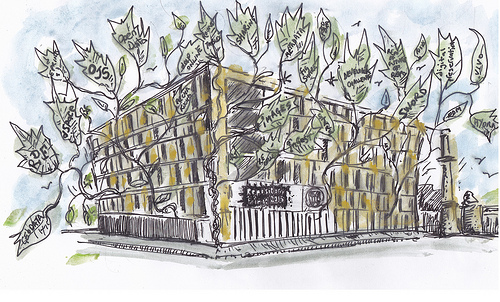
Repository Fringe 2013 ran from July 31- August 2 in the Dugald Stewart Informatics Building. It was, yet again, a successful event, with around 85 attendees over the three days.
Highlights included:
- Inspiring keynote lectures from Jacqui Taylor (Flying Binary) and Mark Hahnel (Figshare)
- Informative workshops from Chris Gutteridge (Southampton) and Chris Awre (Hull) discussing Linked Data and a Repository for the Future respectively
- Pecha Kuchas and presentations on a wide variety of subjects pertaining to development tools, open source issues, and upcoming challenges in the repository arena
- A lively developers challenge, which served up interesting solutions for metadata extraction, preservation techniques and copyright embedding. It was won by Russell Boyatt (Warwick), with an interesting approach to MOOCs.
- The OJS day was effectively part of the event too.
Slides and videos from Repository Fringe are available at: http://rfringe13.blogs.edina.ac.uk/programme/
Thanks to Claire Knowles, Robin Taylor, Theo Andrew and Norman Rodger, from the Research and Learning area, who were heavily involved in the organisation of the event, which was unflappably chaired by Nicola Osborne (Edina).
Darwin’s voyage of discovery
Rare Books & Manuscripts has begun a mini-project to catalogue our new collection of first editions of the works of Charles Darwin. This collection, generously presented by the Heiskell Bibliographical Foundation, complements our existing holdings of lifetime editions of the scientist, giving us more than 100 volumes – mostly in outstanding condition. Darwin, whose medical studies at the University of Edinburgh were a formative influence on his later work, is now highly collectable and this is a unique opportunity to develop such a collection. It includes two copies of the first edition of his masterpiece, “On the origin of species” (1859). The books will be catalogued to the highest standard over the next few weeks and made available in the Centre for Research Collections.
New Buddhism e-book collection now available
 Last spring, we were successful in bidding for a range of new online resources for Divinity. I’m pleased to announce that one of these, 47 titles from the Routledge Critical Studies in Buddhism series, is now available. University of Edinburgh users can find and access the titles via the online library catalogue, such as Buddhist and Christian? : an exploration of dual belonging by Rose Drew.
Networks Nuremberg & Tracing Early Dürer
This week, our post comes from Volunteer Jessica Macaulay and is about some of the exciting finds she has discovered while working on enriching the metadata in our Image Collection online http://images.is.ed.ac.uk/ . As this is Jessica’s last week, we would like to thank her for all her wonderful work & wish her all the best for her return to Canada.
When I first set out to write a blog post for the DIU I had originally wanted to focus on those works closely connected to Albrecht Dürer (1471-1528), the famous Renaissance artist out of Nuremberg. What I came across instead was collection of incunabula that represented the veritable network of key figures that were highly influential in Dürer’s early development. The most notable of these connections is that of Anton Koberger (1445-1513), who was not only Dürer’s godfather, but helped to arrange Dürer’s apprenticeship in the workshop of Michael Wolgemut (1434-1519).

The University of Edinburgh has a surprisingly large and varied collection of Koberger’s books shared between the CRC and New College Library. These collections include three different printings of Koberger’s Latin bible, and a copy of the stunning 1483 German bible (Inc.45.2) http://images.is.ed.ac.uk/luna/servlet/s/z1s8m5 which reused 82 of the 109 woodcuts used by Henrich Quentell in his 1478 Low German bible printed in Cologne. Although these woodcuts predate Dürer’s apprenticeship, elements of their composition can be seen in his later works.
Another major work produced by Koberger, and perhaps the one that he is the most famous for, is that of the Nuremberg Chronicle. It was to my great delight to discover that the University ownsnot one of these books, but four, in a range of quality and finish (Inc.48.1/2 and Inc.48*). It is a rare opportunity to have so many of the same rare book at hand for ready comparison including one that has been stripped down that shows the book anatomically.
Michael Wolgemut and his stepson Wilhelm Pleydenwurff are known to have been responsible for woodcuts illustrating the Nuremberg Chronicle, and there has been considerable debate over whether or not Dürer is also responsible for some of the compositions. While many scholars suggest that the contract between Koberger and the patrons signed in 1491 was well after Dürer completed his apprenticeship at Wolgemut’s workshop, Loura Brooks reminds us that drawings for the woodblocks began in 1484. Dürer would have been apprenticing in Wolgemut’s workshop during this time and did contribute to the compositions, an account of which can be found in The Making of the Nuremberg Chronicle by Adrian Wilson.
Another item that I came across with interesting ties to Dürer is Sebastian Brant’s Stultifera Navis or the Latin translation of Ship of Fools (Inc.13) http://images.is.ed.ac.uk/luna/servlet/s/a8126x . While the copy owned by the University of Edinburgh is a pirated copy printed by Johann Reinhard of Grüningen in 1497, it demonstrates the vast popularity of printed texts and particularly those with illustrations. Grüninger’s edition was published very shortly after one of Brant’s official editions, and within a few months Brant has printed another version with an additional section condemning pirated texts. Dürer worked closely with Brant to design the woodcuts accompanying the text, and nearly two thirds of the woodcuts in the first edition are attributed to Dürer. 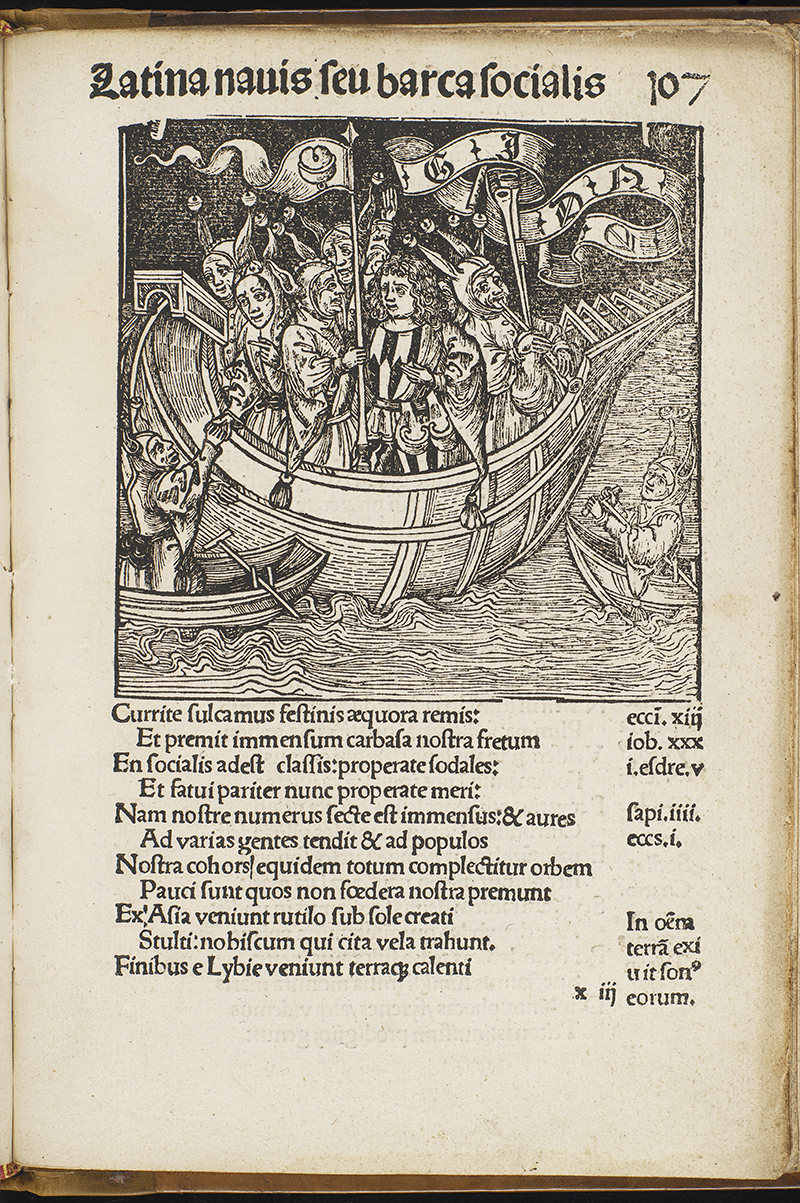
Though there is very little of Dürer’s actual work housed in the collections there is much that informs on the network that helped to shape Dürer’s career, evidence of his early influences, and many exemplars from those that he worked with later in his career. Whether looking at Koberger’s bibles, the Nuremberg Chronicle, or Ship of Fools there are plenty of opportunities for new and exciting research.
Many thanks to Loura Brooks for fielding my many questions.
Jessica Macaulay
Piping treasure on display in ‘The Piper’s Whim’ Exhibition
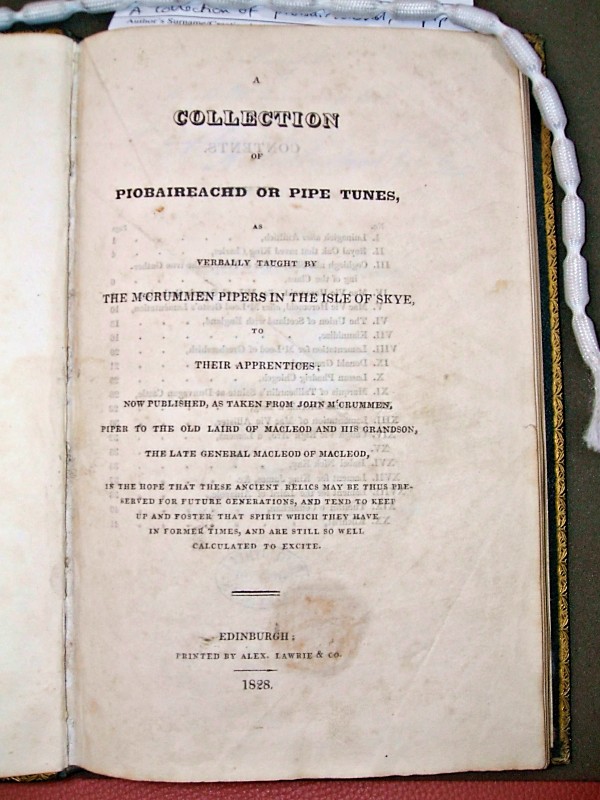
A collection of piobaireachd, or pipe tunes : as verbally taught by the M’Crummen pipers in the Isle of Skye to their apprentices / now published, as taken from John M’Crummen … [by Neil MacLeod, Gesto]. Edinburgh : Printed by Alex. Lawrie & Co., 1828. New College Library Gaelic Collections 137
The volume is on display as part of THE PIPER’S WHIM: Exhibition of Historic Bagpipes from Scotland, England and Ireland, a special exhibition showing the full variety of bagpipes played in Britain from the past 250 years. These include Lowland and Border pipes, the more familiar Highland bagpipe, Northumberland smallpipes and Irish union or uillean pipes. The exhibition explores the traditions of piping, pipemaking and bagpipe ownership.
Rare books all sorted out in new strongroom
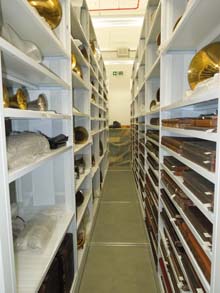
Our new strongroom holds some 760 shelves of rare and early printed books – over 10,000 individual volumes. These were moved back from the Library Annexe earlier this year and are now all properly arranged and findable. This was a big task and has uncovered some amazing finds, ranging from modern prints by Ian Hamilton Finlay to a hand-coloured folio on Brazilian monkeys. See our CRC Facebook page for some more images: https://www.facebook.com/crc.edinburgh. The rare books now live happily alongside other collections including archives, sculptures, paintings and historic musical instruments, some of which can be seen in this picture. The collections are available for use in the Centre for Research Collections.
Collections
 Hill and Adamson Collection: an insight into Edinburgh’s past
My name is Phoebe Kirkland, I am an MSc East Asian Studies student, and for...
Cataloguing the private papers of Archibald Hunter Campbell: A Journey Through Correspondence
My name is Pauline Vincent, I am a student in my last year of a...
Hill and Adamson Collection: an insight into Edinburgh’s past
My name is Phoebe Kirkland, I am an MSc East Asian Studies student, and for...
Cataloguing the private papers of Archibald Hunter Campbell: A Journey Through Correspondence
My name is Pauline Vincent, I am a student in my last year of a...

Projects
Cataloguing the private papers of Archibald Hunter Campbell: A Journey Through Correspondence
My name is Pauline Vincent, I am a student in my last year of a...
Archival Provenance Research Project: Lishan’s Experience
Presentation My name is Lishan Zou, I am a fourth year History and Politics student....