Home University of Edinburgh Library Essentials
April 8, 2026
New Photography for Main Library Exhibition – Collect.ed
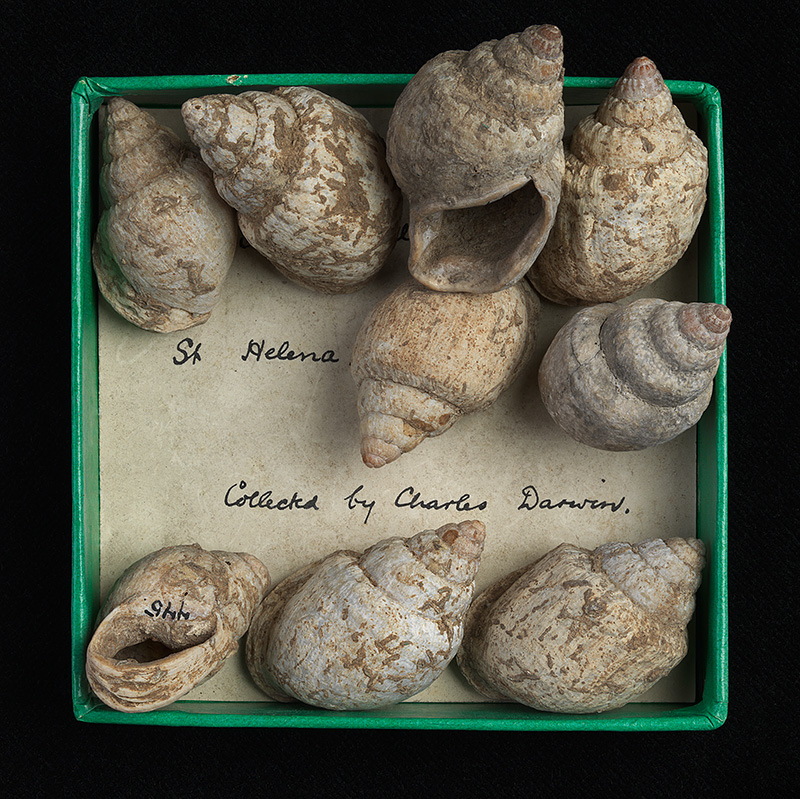
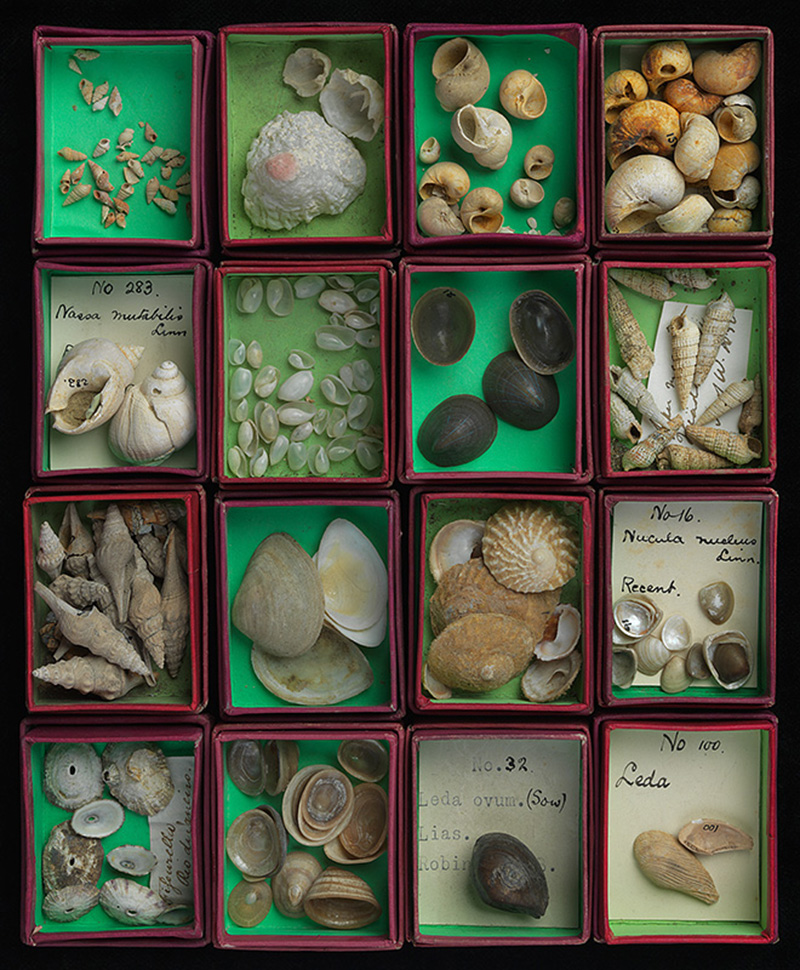
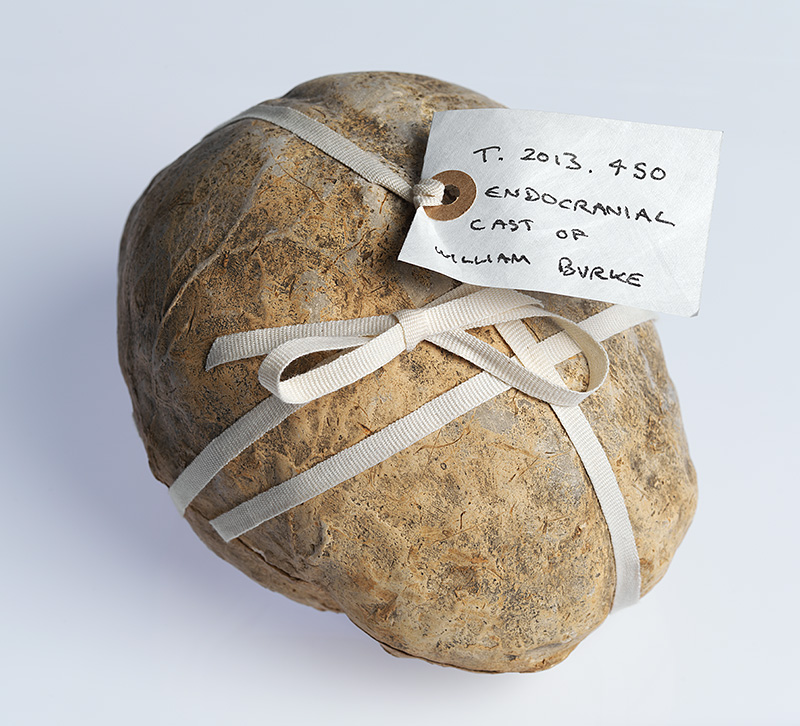
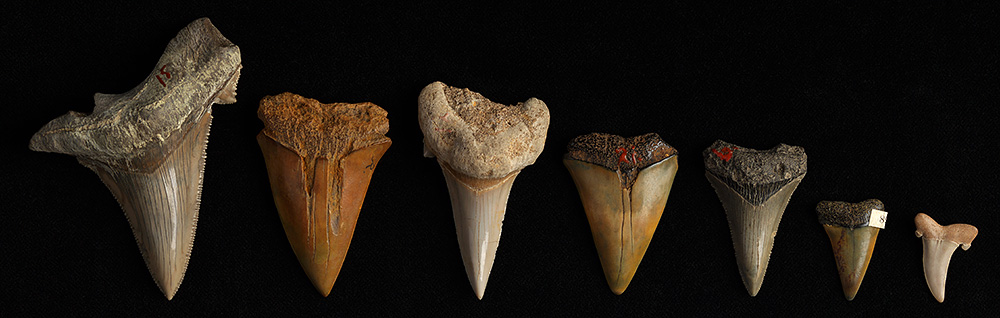
The Digital Imaging Unit have been working on an amazingly diverse range of material recently thanks to a new exhibition being prepared for the Main Library by exhibitions intern Emma Smith. Collect.ed is the title of the exhibition described as “Curiosities from the University’s collections”. This work has presented the challenge of photographing a cast of the serial killer Burke’s brain, seven prehistoric shark’s teeth and a fabulous box of shells collected by Charles Darwin himself. Collect.ed will open on 5th December 2013 and run until 1 st March 2014, Monday to Friday 10.00am – 5.00pm, Saturday 10.00am – 1.00pm, Free Admission!
Malcolm Brown
New Book Display: Black History Month
During October, the Main Library have been displaying books which have been donated to the Library by the University’s African Caribbean Society (in association with EUSA Global). There are approximately 40 books being displayed as part of Black History Writers Month, these are part of the New Books Display in the 4 bays near the door to the 1st Floor landing.
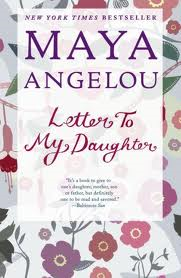
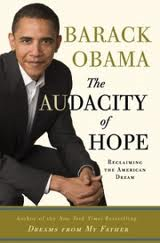
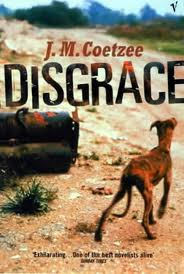
Each October, Black History Month aims to raise awareness and facilitate conversation among the University community to mark the achievements of Black people through history and today, and we are delighted to support this initiative. There is a great assortment of books, which we’re sure you’ll find interesting.
If there are any queries about the display, please contact Nicola Moncur: (nicola.moncur@ed.ac.uk)
Many thanks to Shenxiao Tong, Maria & Agnieszka from Collections Management and Melissa Moncrieffe from EUSA for making this possible.
For more information on Black History Month, please check out the following link:
http://www.eusa.ed.ac.uk/getinvolved/eusaglobal/globalevents/blackhistorymonth/events/
The Edinburgh Research Archive is 10 years old!
 It may seem strange but back in 2003 Open Access was a relatively new ‘thing’. Prior to 2003 many people still used the term Free Online Scholarship interchangeably with Open Access.
The launch of the Budapest OA Initiative in late 2001/early 2002 helped crystallise the international movement that we see today and cemented the term Open Access in our vocabulary.
In the UK, one of the early supporters of the Open Access movement was JISC who funded the ground breaking Focus on Access to Institutional Resources (FAIR) programme.
The FAIR programme supported a number of projects in UK institutions that investigated and developed services based on the (at the time) brand new Open Archive Initiative. Edinburgh was involved in two of these projects – Theses Alive! and SHERPA.
The Theses Alive! project (2002-2004) showed, by building a proof-of-concept service, that an electronic theses programme is a viable proposition for most UK HE institutions. The findings of this project were carried forwards by the EThOS project, in which Edinburgh University Library was a developmental partner.
The original SHERPA project (2002-2006) originally consisted of 7 development partners and successfully developed a vanguard network of institutional repositories in the UK. The SHERPA partnership now consists of 34 partners and affiliates overall, comprising 32 HE institutions, the STFC and the British Library.
The lasting legacy of these two projects is the Edinburgh Research Archive. Over time the scope and focus of ERA has changed from being a blended open access repository containing all research outputs. Some of this functionality has now been taken over by our Current Research Information System PURE. Now the remit of ERA is to look after documents written by academic authors based or affiliated with Edinburgh that have sufficient quality to be collected and preserved by the Library, but which are not controlled by commercial publishers. Holdings include full-text digital doctoral theses, masters dissertations, project reports, briefing papers and out-of-print materials.
Currently there are over 7000 full text items archived in ERA, and over 100,000 visitors a month. Over a decade of service we calculate that’s well over 10 million people served.
Here’s to another 10 (years and million downloads!).
Edinburgh College of Art Collections

Please forgive the takeover of the Library & Collections blog by ECA Collections! We thought you might like to see a few highlights from our posts over on the ECA blog.
We can also be found on Twitter @ECAcollections.
Mystery Children’s Book Illustrations
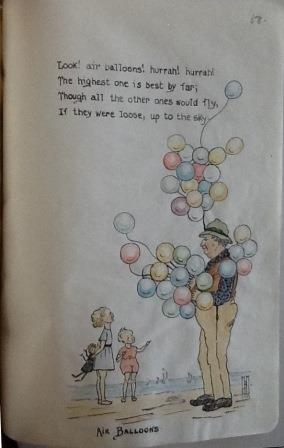
We can’t find anything about the author/ illustrator M. B. Matheson from Lockharton Crescent, Edinburgh so far in staff and student lists. So we’re asking for your help.
Do any of you know who this illustrator is? There is one clue in the volume entitled Quaint Tales in Line and Rhyme. Written at the front is ‘These children’s books were written in order to try and recall Donald’s back memory which was blank after the accident’.
Whether we find out who Matheson is or not, we thought we’d share an image of the ballons on this blustery day! Enjoy!
First published 16.4.2013
From the Art Collection #75

Mastaba by James McGlade
First published 3.10.2013
From the Art Collection #73
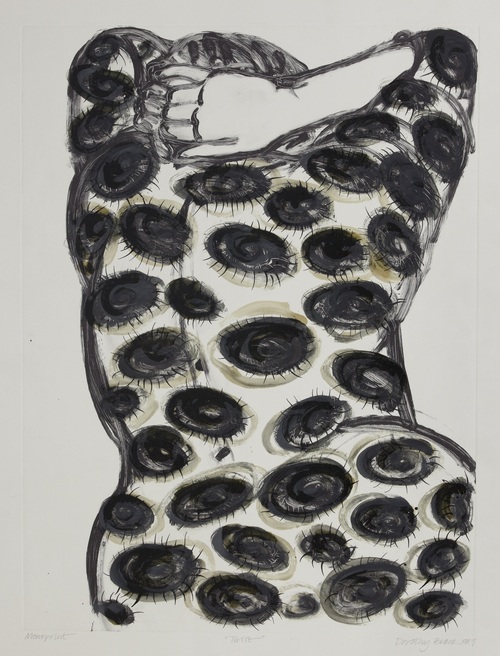
Twist by Dorothy Black
Today’s From the Art Collection has been selected by our new Museums Galleries Scotland intern, Colette Bush. She writes:
I started last week as the new MGS intern for Edinburgh University Museums, moving here the week before from Essex. I will be based both at the Centre for Research Collections, and Musical Instrument Museums Edinburgh at St. Cecilia’s Hall for the next year.
I studied English Literature at Aberystwyth University, which was a great experience. I enjoyed living in a new place and studying subjects that I found interesting. I am now looking forward to getting to know another new place, and the opportunities and challenges that I will face over the coming year.
The MGS internship programme appealed to me due to the many training and development sessions throughout the programme; I will be taking advantage of everything I can throughout this process. I was initially drawn to this internship because it was a collections based one. The collections care side of museum work has interested me since finding out more about it during a voluntary placement I had at The British Postal Museum & Archive.
I decided to apply for this specific internship over the others because of the prospect of working with two very different collections with very different needs. The work at St. Cecilia’s will give me the opportunity to discover musical instruments, a topic which is quite new to me, whilst also working at a museum as it prepares for a large renovation project will provide an incredibly valuable experience. Working with the art collections, I will gain knowledge of Scottish artists and art movements and how exhibitions and learning material are put together.
I began my first week by meeting many of the people that work at the CRC and have been finding out about what their roles entail. I have also taken a look at some of the collections the University holds and visited some of the museums and galleries.
On Thursday I attended the MGS conference in Glasgow. This was a good opportunity for me to meet lots of the other MGS interns and people who work within museums and galleries across Scotland. I enjoyed the conference, and was interested in hearing about different projects and strategies being run in Scotland to get people involved their local museums.
I have also been looking at some former ECA students’ prints in the collection and trying to identify the artists. I have then started to collect information on the artists, what they are doing now and started to create a fact-file on them. This has been an interesting challenge and introduced me to some new artists.
Of these prints, I have chosen Twist by Dorothy Black for From the Art Collection.
First published 16.9.2013
From the Art Collections #43
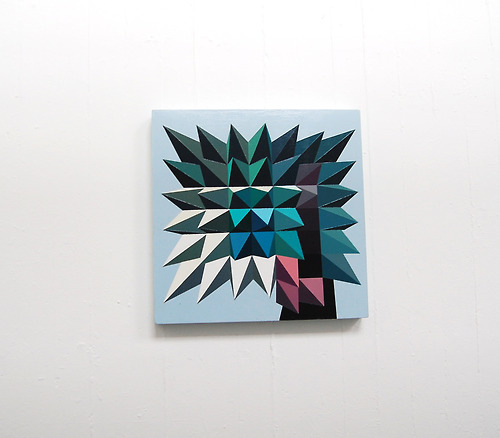
Extrude by Charlotte Roseberry
It has been a very exciting few days for ECA Collections as, for the first time since the curatorial team started, works have been formally collected for the ECA Art Collection from the annual Degree Show, which opens to the public on Saturday 1st of June.
The new ECA Collections Purchase Prize highlights outstanding works from across ECA for acquisition into the art collections and recent graduates now find their work sitting happily alongside other former students such as Anne Redpath, Eduardo Paolozzi and S.J. Peploe, among others.
The first works that we confirmed for the collection are by Charlotte Roseberry. Two of Charlotte’s paintings are now in the ECA Collection, Nugget and Extrude (pictured) and we were delighted to secure both of them.
This is an important first step for us and part of a larger desire to built an outstanding contemporary art collection for The University of Edinburgh, of which ECA graduates will be a vital element.
First published 30.5.2013
Library Quality survey – check your inbox!
The Library launched the LibQUAL +2013 quality survey today.
Check your inbox!
If you have been randomly selected to participate, you will have received an email this morning which contains a link to the survey.
Please take 15 minutes to complete the survey and tell us what you think of the Library service we provide. Your feedback is incredibly important to us. You could also win one of two iPad minis.
Responses are confidential and no identifying links between responses and individuals are retained.
A reminder email will be sent on 8th November and responses should be submitted by 18th November when the survey closes.
More information on LibQUAL+ , the 2011 report and the Library’s response: http://edin.ac/16D1JCb
If you have any questions about the survey, please contact Angela Laurins, (LibQUAL+ survey Co-ordinator) Library-QualitySurvey@ed.ac.uk
Bibliometrics in Libraries, 12 September 2013
On the 12 September, I attended the second Bibliometrics in Libraries workshop hosted by the University of Sussex, this was a one day event sponsored by Elsevier for those who support researchers with bibliometrics.
The Speakers were:
Peter Darroch, SciVal Consultant, Elsevier – Looking past the usual metrics to help researchers demonstrate excellence to support Grant applications Peter started off the day looking at bibliometrics from a researcher’s angle, suggesting this was a controversial area and that metrics needed to be used in more positive ways. He went on to say that academics need to engage more in bibliometrics but use different metrics for different levels of research and engage with SciVal to decide what metrics to use http://info.scival.com/
Enrico Motta, Professor of Knowledge Technologies, Open University – An introduction to Rexplore http://technologies.kmi.open.ac.uk/rexplore/ was again looking at bibliometrics from a user perspective and talked about understanding research dynamics, Rexplore can be used to see relationships across research.
Allan Frey, Thomson Reuters – Citation evaluation beyond journals http://wokinfo.com/products_tools/multidisciplinary/bookcitationindex/ discussed the Book Citation Index which up until now has been largely ignored and is very important. Currently 10, 000 books being added annually from 2005 onwards.
Jean Liu, Altmetrics – Article-level and alternative metrics: tracking other indicators of impact online http://www.altmetric.com/ Jean gave a really interesting talk on looking at new ways of measuring different kinds of impacts and looking at how alternative metrics can be used to complement traditional metrics.
Stephen Pearson, Research Information Analyst, University of Manchester Library – What does a bibliometrician do all day? Stephen is the University’s dedicated bibliometrician providing local support for faculties, handling enquiries on citation impacts and providing training. Academics will be given access to SciVal Strata to assist with bibliometrics although it likely this will be used by support staff.
Ian Rowlands, Research Services Manager and Bibliometrician, University of Leicester – The h-index. Friend or Foe? Ian is also a dedicated bibliometrician and like Stephen provides training for staff on bibliometrics. Leicester displays the h –index of researchers/academics on their CRIS, IRIS but is currently considering removing it as depending on the source, i.e. Scopus, Web of Science; the index can vary resulting in academics losing faith in its accuracy
Clari Gosling, Bibliometrician, The Open University – Tips for improving citations gave a general overview on tips for improving citations. Some of these tips included search engine optimisation, publishing in open access journals as this increases citations and using social media, which has been shown to increase citations.
The slides from the workshop are available at: http://www.sussex.ac.uk/library/research/seminarsandevents/bibliometricsinlibraries
Collections
 Hill and Adamson Collection: an insight into Edinburgh’s past
My name is Phoebe Kirkland, I am an MSc East Asian Studies student, and for...
Cataloguing the private papers of Archibald Hunter Campbell: A Journey Through Correspondence
My name is Pauline Vincent, I am a student in my last year of a...
Hill and Adamson Collection: an insight into Edinburgh’s past
My name is Phoebe Kirkland, I am an MSc East Asian Studies student, and for...
Cataloguing the private papers of Archibald Hunter Campbell: A Journey Through Correspondence
My name is Pauline Vincent, I am a student in my last year of a...
Projects
Cataloguing the private papers of Archibald Hunter Campbell: A Journey Through Correspondence
My name is Pauline Vincent, I am a student in my last year of a...
Archival Provenance Research Project: Lishan’s Experience
Presentation My name is Lishan Zou, I am a fourth year History and Politics student....