Home University of Edinburgh Library Essentials
April 5, 2026
A game of two halves
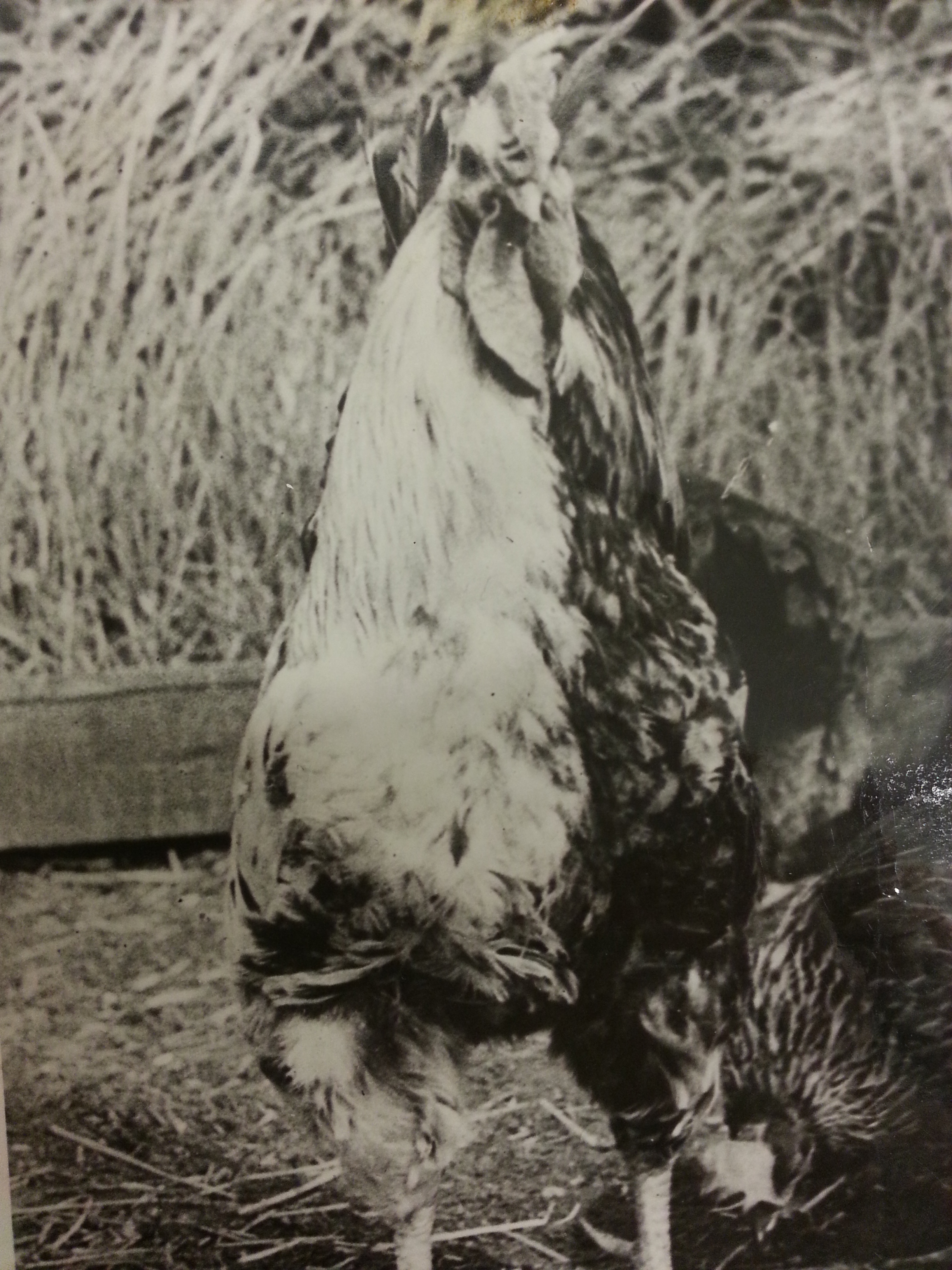 One of the photographs in the Alan Greenwood collection depicts a chicken. This is hardly unusual in itself, seeing as Greenwood was director of the Poultry Research Centre. However, a closer look reveals that this is no ordinary chicken: it is coloured and shaped differently on each side: in fact, it looks more like two separate chickens stitched together. This chicken is a ‘halfsider’. Halfsiders – also called bilateral gynandromorphs – are birds whose colour, plumage, size and even gender is different on each side. Halfsiders are most commonly encountered in budgerigars, although they can occur in other birds too, including domestic chickens.
The phenomenon which produces halfsiders is is actually part of a larger phenomenon of ‘mosaicism’. Mosaics are organisms of a ‘patchwork’ phenotype and/or genotype generally only found in domesticated species (although a wild gynandromorphic Northern Cardinal was discovered on the east coast of America in 2009). F.A.E Crew at the Institute of Animal Genetics was one of the first geneticists to write on gynandromorphy in birds, with Greenwood and colleagues continuing to study it at the Poultry Research Centre.
Halfsiders are so interesting for genetics because they contradict the theory that sexual development in birds and mammals follows the same course, with the embryonic cells being ‘unisex’, the gender being determined at around seven weeks by signals sent by hormones. However, chicken cells apparently ‘know’ which sex they are at the time of fertilisation, and scientists have had to propose an entirely separate model for avian sexual development.
Early explanations for how halfsiders happen usually posited gene mutation or embryo damage in the early stages of cell division, or else the loss of a chromosome.. However, a study in 2010 (Zhao, McBride et al) found that halfsider chickens are in fact nearly perfect male:female chimeras comprised of normal female cells (with ZW chromosomes) on one side and normal male cells (with ZZ chromosomes) on the other side. Therefore, halfsiders appear to result from an abnormal ovum containing two pronuclei, fertilised by two sperm, which then results in both a Z and W chromosome–containing nucleus. As the cells develop, and are subject to exactly the same hormones, they respond according to their own chromosomes rather than signals being given out by the gonads, as with mammalian development. This in essence means that the two ‘halves’ develop entirely separately, at the same time.
Although the phenomenon producing halfsiders is genetic in origin, it is not heritable and so cannot be intentionally bred (in any case, gynandromorphs are nearly always sterile). It is estimated that 1 in 10,000 domestic chickens is a gynandromorph.
Library and University 2014 calendar
The new Library and University 2014 calendar is now on sale. This year’s theme is Bygone Edinburgh, with all images coming from the mid-19th to early 20th centuries. Highlights include some of the work of Scottish pioneers of photography, Hill and Adamson, and this image taken by an unknown photographer around 1887.

The three gentlemen shown demonstrating the cantilever principle for the Forth Bridge are engineers Sir John Fowler, Kaichi Watanabe and Sir Benjamin Baker.
The calendar is on sale in the Library at the front desk and at the CRC reception on the 6th Floor, priced £8.
Further information on the calendar is available at collections.ed.ac.uk
The four quadrants of research data curation systems
[Reposted from https://libraryblogs.is.ed.ac.uk/blog/2013/12/06/the-four-quadrants-of-research-data-curation-systems/]
The University of Edinburgh, like many other universities, is currently undertaking extensive work to build infrastructure that supports and enables good practice in the area of Research Data Management. This infrastructure ranges from large-scale research storage facilities to data management planning tools.
One aspect of Research Data Management highlighted in the University’s RDM Roadmap is ‘Data stewardship: tools and services to aid in the description, deposit, and continuity of access to completed research data outputs.’
To help describe how these systems fit together yet how they differ from each other, I use a model with two axes to differentiate what they hold, and who can access them. The first axis is used to differentiate between systems that hold only metadata from those that hold files (typically with some level of metadata), while the second differentiates between private systems and public systems.
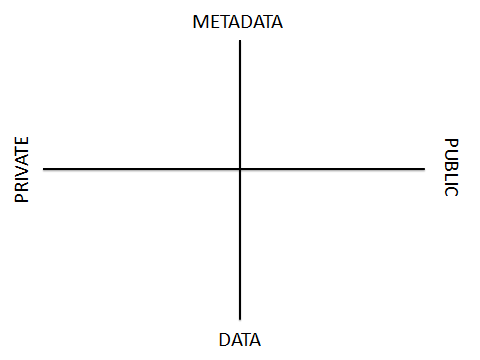
Research information and data management and associated systems aren’t a new phenomenon. We have been offering services in these areas for some time. To demonstrate this, we have two existing systems that provide services in two of the areas:
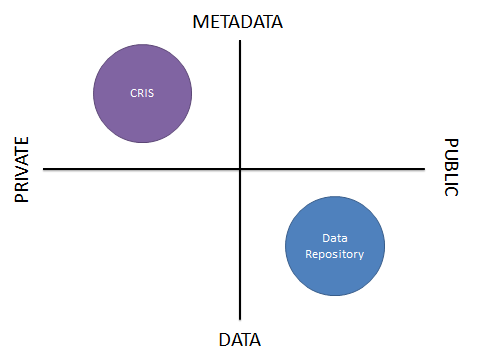
- PURE is our Current Research Information System (CRIS). It is a private system for the University to record the research outputs it generates. It therefore falls into the metadata / private quadrant. (It can hold files, and has a public interface, but this is primarily for Open Access publications rather than research data).
- DataShare is our open research data repository. It holds and curates data (and associated metadata) for public consumption on behalf of the data creators. It therefore falls into the data / public quadrant.
What about the other two quadrants? Are there systems or infrastructure needed to fill these? Is there a case where we need a public store of metadata about research data, or a private store of finished data sets?
The rest of this blog post will argue that there is a need for these, and will describe two pieces of infrastructure that could fill them. Further blog posts will be written that start to unpick the requirements of these systems in more depth.
Public Metadata: Not only is it good practice for a research institution to know what research data it is creating, some research funders require us to do so. In addition the University’s RDM policy requires
“Any data which is retained elsewhere, for example in an international data service or domain repository should be registered with the University.”
The following is an extract from the EPSRC’s expectations for research data management:
“Research organisations will ensure that appropriately structured metadata describing the research data they hold is published (normally within 12 months of the data being generated) and made freely accessible on the internet; in each case the metadata must be sufficient to allow others to understand what research data exists, why, when and how it was generated, and how to access it. Where the research data referred to in the metadata is a digital object it is expected that the metadata will include use of a robust digital object identifier (For example as available through the DataCite organisation – http://datacite.org/).”
This need can be fulfilled by the creation of a Data Asset Register.
Private Data: Whilst some data will be suitable for public sharing, for various reasons some will not, or will need to have access controlled by the data creator. Therefore there is a need for a safe place for keeping data that will be kept secure, both in terms of access and change. Once lodged/archived there, files should only be accessible by the data creator or data manager, and it should not be possible to change files, but only to create newer versions or to remove/delete them.
This need can be fulfilled by the creation of a Data Vault.
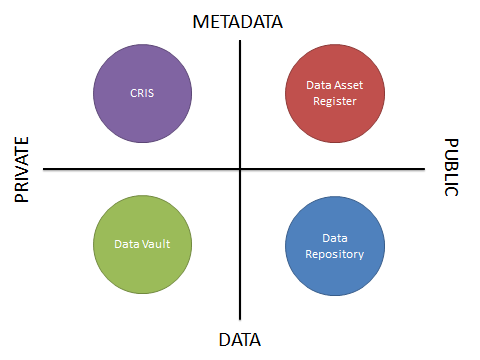
Systems however do not live in isolation, and become more powerful, more useful, and more likely to be used if they are able to integrate with each other. With the ever-growing number of ‘systems’ provided by a large research-intensive university, the last thing that a research data management programme wants to do is to introduce further systems that need to be fed with duplicate information. This means that some or all of the components will need to be integrated together.
There are three obvious integrations between these systems, as shown below:
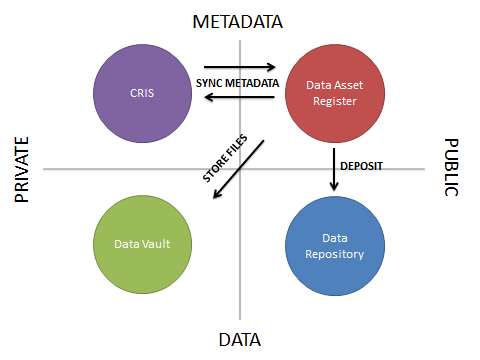
First, because PURE is the master system for holding data and relationships about research outputs (THIS grant, funded THAT piece of equipment, which was used to create THIS data set, that was described in THESE journal articles), records of data sets need to exist within it. However if some or all of these are being created in the Data Asset Register, then they will need to be pushed into PURE. Equally if some data are being registered directly in PURE, it will be useful to pull this out of PURE and into the Data Asset Register.
Secondly, because the Data Asset Register may become the main user interface for entering details of data sets, it could also be the main administrative user interface for uploading files into the Data Vault. If that is the case, then the Data Asset Register and the Vault will need to be integrated.
Finally, for instances where metadata is held in the Data Asset Register, corresponding files are held in the Data Vault, and the data owner decides to make the data openly available, then the Data Asset Register should be able to deposit these as a new item in the Data Repository.
The next challenge will be to describe the requirements for the Data Vault and Data Asset Register. We have some early thoughts about this, and will share these in future blog.
Images available from http://dx.doi.org/10.6084/m9.figshare.873617
Related blog posts:
Stuart Lewis, Head of Research and Learning Services, Library & University Collections.
The four quadrants of Research Data Curation Systems
The University of Edinburgh, like many other universities, is currently undertaking extensive work to build infrastructure that supports and enables good practice in the area of Research Data Management. This infrastructure ranges from large-scale research storage facilities to data management planning tools.
One aspect of Research Data Management highlighted in the University’s RDM Roadmap is ‘Data stewardship: tools and services to aid in the description, deposit, and continuity of access to completed research data outputs.’
To help describe how these systems fit together yet how they differ from each other, I use a model with two axes to differentiate what they hold, and who can access them. The first axis is used to differentiate between systems that hold only metadata from those that hold files (typically with some level of metadata), while the second differentiates between private systems and public systems.
Research information and data management and associated systems aren’t a new phenomenon. We have been offering services in these areas for some time. To demonstrate this, we have two existing systems that provide services in two of the areas:
- PURE is our Current Research Information System (CRIS). It is a private system for the University to record the research outputs it generates. It therefore falls into the metadata / private quadrant. (It can hold files, and has a public interface, but this is primarily for Open Access publications rather than research data).
- DataShare is our open research data repository. It holds and curates data (and associated metadata) for public consumption on behalf of the data creators. It therefore falls into the data / public quadrant.
What about the other two quadrants? Are there systems or infrastructure needed to fill these? Is there a case where we need a public store of metadata about research data, or a private store of finished data sets?
The rest of this blog post will argue that there is a need for these, and will describe two pieces of infrastructure that could fill them. Further blog posts will be written that start to unpick the requirements of these systems in more depth.
Public Metadata: Not only is it good practice for a research institution to know what research data it is creating, some research funders require us to do so. In addition the University’s RDM policy requires
“Any data which is retained elsewhere, for example in an international data service or domain repository should be registered with the University.”
The following is an extract from the EPSRC’s expectations for research data management:
“Research organisations will ensure that appropriately structured metadata describing the research data they hold is published (normally within 12 months of the data being generated) and made freely accessible on the internet; in each case the metadata must be sufficient to allow others to understand what research data exists, why, when and how it was generated, and how to access it. Where the research data referred to in the metadata is a digital object it is expected that the metadata will include use of a robust digital object identifier (For example as available through the DataCite organisation – http://datacite.org/).”
This need can be fulfilled by the creation of a Data Asset Register.
Private Data: Whilst some data will be suitable for public sharing, for various reasons some will not, or will need to have access controlled by the data creator. Therefore there is a need for a safe place for keeping data that will be kept secure, both in terms of access and change. Once lodged/archived there, files should only be accessible by the data creator or data manager, and it should not be possible to change files, but only to create newer versions or to remove/delete them.
This need can be fulfilled by the creation of a Data Vault.
Systems however do not live in isolation, and become more powerful, more useful, and more likely to be used if they are able to integrate with each other. With the ever-growing number of ‘systems’ provided by a large research-intensive university, the last thing that a research data management programme wants to do is to introduce further systems that need to be fed with duplicate information. This means that some or all of the components will need to be integrated together.
There are three obvious integrations between these systems, as shown below:
First, because PURE is the master system for holding data and relationships about research outputs (THIS grant, funded THAT piece of equipment, which was used to create THIS data set, that was described in THESE journal articles), records of data sets need to exist within it. However if some or all of these are being created in the Data Asset Register, then they will need to be pushed into PURE. Equally if some data are being registered directly in PURE, it will be useful to pull this out of PURE and into the Data Asset Register.
Secondly, because the Data Asset Register may become the main user interface for entering details of data sets, it could also be the main administrative user interface for uploading files into the Data Vault. If that is the case, then the Data Asset Register and the Vault will need to be integrated.
Finally, for instances where metadata is held in the Data Asset Register, corresponding files are held in the Data Vault, and the data owner decides to make the data openly available, then the Data Asset Register should be able to deposit these as a new item in the Data Repository.
The next challenge will be to describe the requirements for the Data Vault and Data Asset Register. We have some early thoughts about this, and will share these in future blog.
Images available from http://dx.doi.org/10.6084/m9.figshare.873617
Volunteer of the Month – November 2013

Emma Smith
Exhibitions Intern and Volunteer
I was the Exhibitions Intern based in the CRC during the summer and I was tasked with the planning, design and curation of an exhibition which would be on display in the Main Library Exhibition Room over the winter. I used this opportunity to design an exhibition which is based on the theme of “cabinets of curiosity” and highlights the breadth of the University’s Collections. I have had a chance to work with a number of the collection curators and other staff within the CRC to help create the Collect.Ed exhibition.
As an undergraduate keen to develop a career in the museums and heritage sector, this has been a fantastic opportunity for me to gain valuable skills and experience in this highly competitive field. I hope that this exhibition will give other students, staff and visitors an opportunity to see some of the amazing items in the University’s collection and will be enjoyed as much as I enjoyed its creation and realisation.
Collect.Ed will be open in the Main Library Exhibition Room until 1 March.
Ivanhoe in Belgium
 Last weekend I was in Leuven at the Annual Conference of the Belgian Association of Anglicists in Higher Education (BAAHE), where I’d been invited to give a paper on translations of Walter Scott in our Corson Collection. While there, I took the opportunity to display two images from another University Collections item which vividly illustrates the extent of ‘Scottomania’ in 1820s Belgium. These are from an album of hand-coloured lithographs by Marcellin Jobard (later Belgium’s first photographer) showing the Ivanhoe-inspired costumes for a fancy dress ball hosted by the Prince and Princess of Orange in Brussels on 5 February 1823.
Belgium was then part of the United Kingdom of the Netherlands, whose court resided in The Hague and Brussels in alternate years. A report in the Lady’s Monthly Museum (May 1823) noted that while the Queen’s balls were very ‘showy and stately’, those held by the Crown Prince and Princess were ‘recherché and graceful’. The 5 February ball was held in honour of the British community, to whom the young royals were ‘remarkably attentive’. Three weeks notice was given
during which period, you may be sure, the hammers of the armourers of old, on the eve of a battle, were never plied with more skill and industry than were our own fancies and our maids’ needles, to prepare for these promised fêtes
 A party of thirty-two guests went as characters from Ivanhoe, dancing a quadrille which caused such a sensation that they were invited to repeat the performance at the next Queen’s Ball. Three months later, a report in The Repository of Arts, Literatures, Fashions, Manufactures, &c declared that the Ivanhoe costumes remained ‘the principal topic of conversation at Brussels’. They clearly made sufficient impression for the costumes to be immortalized by the country’s leading lithographic press. The images show the costumes for Ivanhoe himself, for the ‘Black Knight’ (aka Richard the Lionheart), and for their rivals Prince John and Maurice de Bracy. We also hold hand-coloured engravings for a similar Scott-inspired costume ball in Vienna in 1826.
Paul Barnaby
Calling all ECA alumni!
The Power of Google…
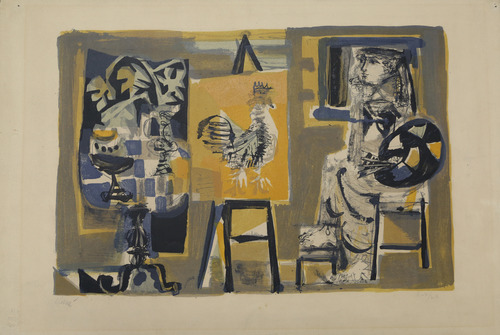
We’ve been using Google Inside Search to help us identify some prints in the collection. All you have to do is upload a photo and magically it can find it in seconds! Whilst looking through some folders of posters and facsimiles we came across this lithograph. We uploaded it onto Google and were able to identify the artist as Antoni Clavé, a contemporary of Picasso and one of Spain’s best loved artists.
Clavé was born in Barcelona in 1913 and was trained at the School of Fine Arts from the age of thirteen, working as a house painter to support himself. He was a painter, sculptor and printmaker but is best known for working with collage.
He is also well-known for his theatrical costume and set designs which have appeared on stages across the world (famously in Roland Petit’s ballet, Carmen). He been has also nominated for two Academy Awards for his work on the film Hans Christian Anderson (1952)
During the Spanish Civil War, Clavé served as a Draughtsman in the Republican Army. When the Nationalists took power in 1939, he fled to France to escape persecution and began working as a book illustrator. It was in Paris that he met Picasso who he became heavily influenced by and his style became gradually more abstract. His series Hommage à Picasso in the 1980s is testament to this.
This lithograph entitled, Femme Peintre au Coq (1950), depicts a woman sitting and painting. It is widely believed to be of Clavé’s mother, Maria Sanmarti, a well-known painter and lithographer. She was partially paralyzed and begun painting to encourage her son to pursue a career in art.
Colette Bush, MGS Collections Intern
Divinity Student Recommendations now available
Divinity students have been active in recommending new books for the library, some of which are being made available as e-books. Here’s just two of the titles they recommended.

 New this month is Echoes of the call : identity and ideology among American missionaries in Ecuador / by Jeffrey Swanson, available online to University of Edinburgh users. Currently in the New College Library new books display is The Ending of Time, by J. Krishnamurti.
Students can recommend books using the online Request a Book form for students. You can see an regularly updated list of new books for New College Library on the Library Catalogue – choose the New Books Search and limit your search to New College Library.
FAE Crew’s Off-Prints (1814-1940)
In addition to the off-prints of the various past organizations that made up the Roslin Institute, we have FAE Crew’s collection. The majority of the off-prints in his collection, found in 39 bound volumes, were written by other authors such as Conrad Hal Waddington, Leonard Darwin, and Alan Greenwood among others and some of the articles were even previously owned by Arthur Darbishire. The non-Crew authored material dates between 1814 and 1936 and Crew’s articles date between the years of 1930 to 1940 and he organized the bound off-prints into series: Fowl (18 volumes- GB 237 Coll-1496/1-18); Birds (2 volumes – GB 237 Coll-1496/19-20); Pigeons (2 volumes -GB 237 Coll-1496/21-22); Genetics General (9 volumes – GB 237 Coll-1496/23-31); and General Biology (8 volumes – GB 237 Coll-1496/32-39). There is a wealth of fascinating articles found in this collection – especially in the Genetics General and General Biology volumes which show Crew’s wide-ranging interests including animal genetics, human genetics, eugenics, evolution (both scientific and philosophical), teaching medical students and ethics. A few particular highlights are Major Leonard Darwin’s article Organic Evolution: Outstanding Difficulties and Possible Explanation, Cambridge University Press, 1921; 
Condemned for Teaching Lies: the following is a speech prepared by William Jennings Bryan for delivery in closing argument for the State in the Evolution Case at Dayton, Tennessee, July 21, 1925;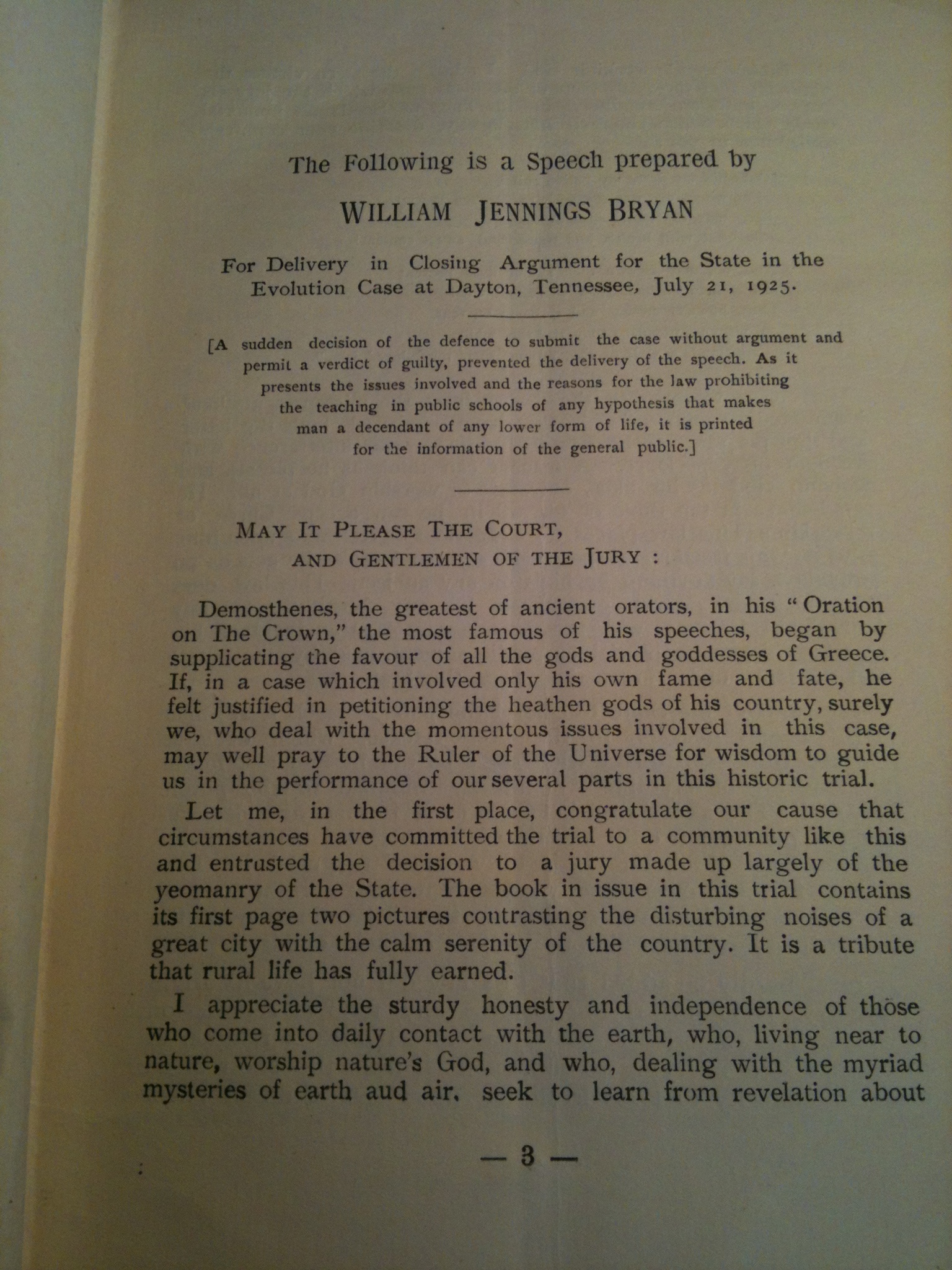
and H. Muller’s Lenin’s Doctrines in Relation to Genetics, Academy of Sciences, USSR, 1934.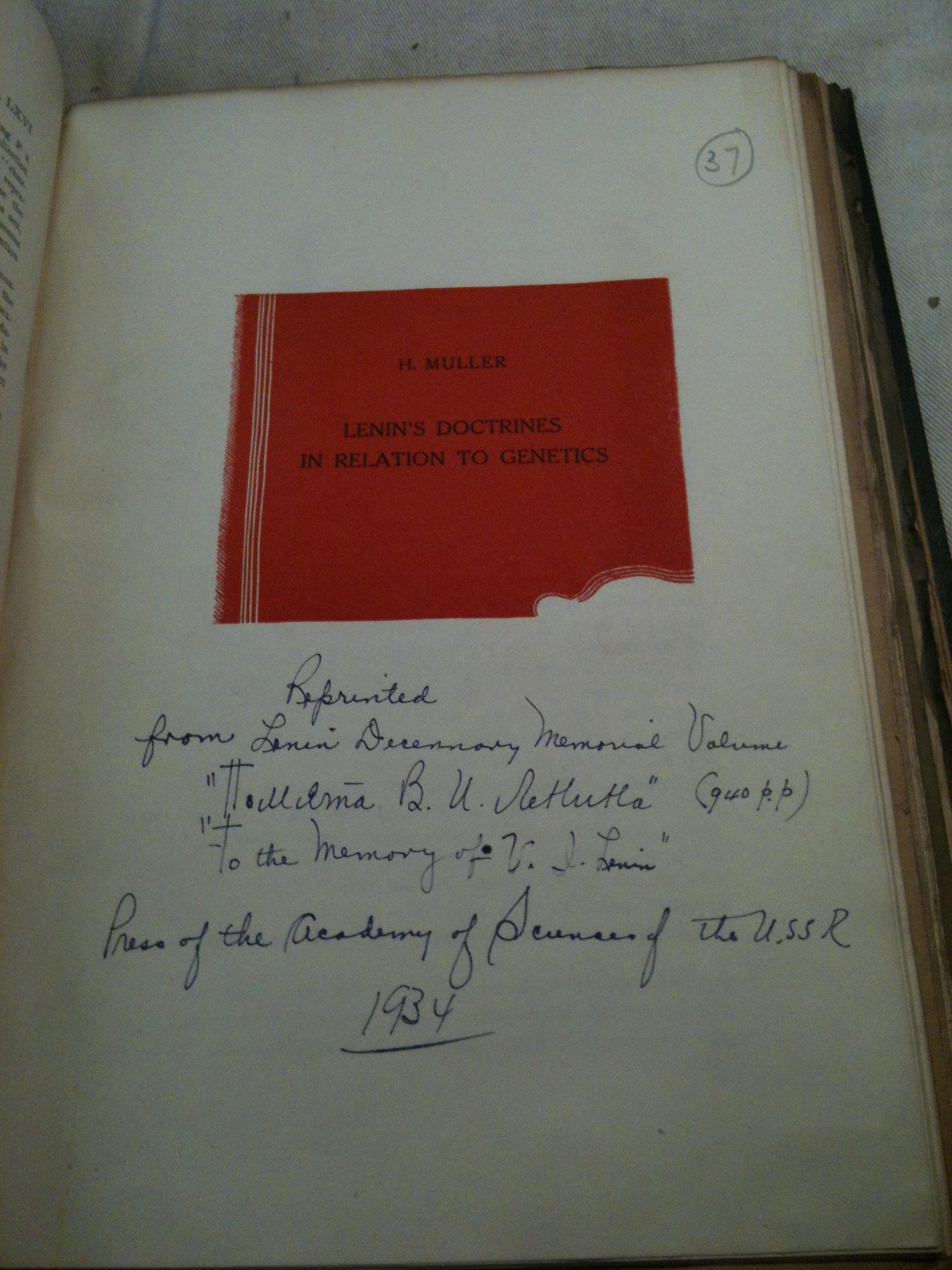
In addition to the articles collected by Crew for his research, there is a box of un-bound off-prints authored by Crew himself (GB 237 Coll-1496/40/1-70). 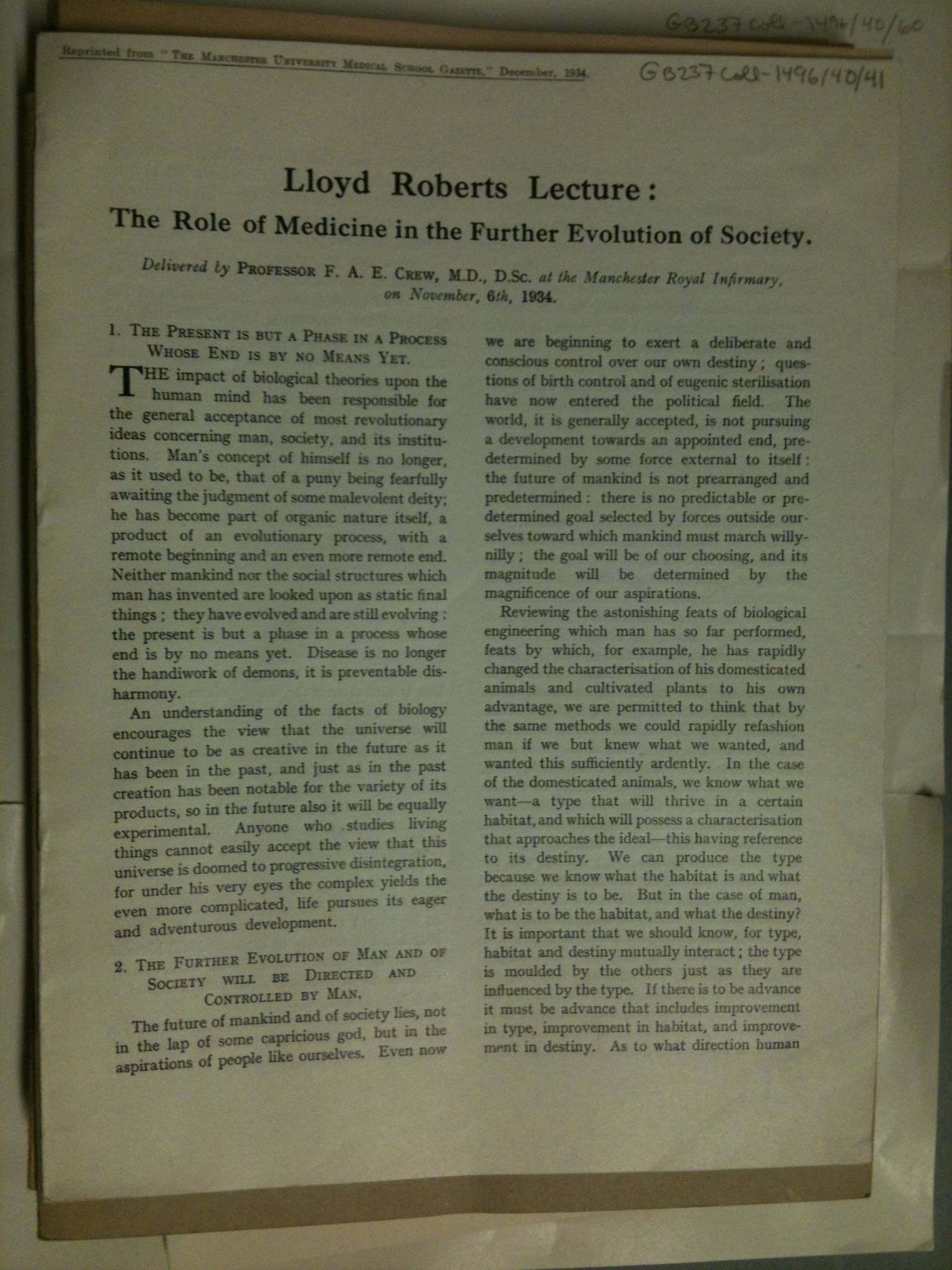 These articles span the years between 1930 and 1940 and discuss such topics as: animal breeding, sterilisation, eugenics, heredity versus environment and other genetic based topics. The last article in the collection is quite interesting since it’s Crew’s thoughts on war when he was a Lieutenant-Colonel in the British Army,
  The war and ourselves in the Journal of the British Army Medical Corps, 1940 (GB 237 Coll-1496/40/74).
This material, the collected offprints of other scientists, offers a fascinating insight into the research interests of FAE Crew by showing his diverse interests which helped to inform his work as seen in the same collection in his self-authored papers.
Collections
 Hill and Adamson Collection: an insight into Edinburgh’s past
My name is Phoebe Kirkland, I am an MSc East Asian Studies student, and for...
Cataloguing the private papers of Archibald Hunter Campbell: A Journey Through Correspondence
My name is Pauline Vincent, I am a student in my last year of a...
Hill and Adamson Collection: an insight into Edinburgh’s past
My name is Phoebe Kirkland, I am an MSc East Asian Studies student, and for...
Cataloguing the private papers of Archibald Hunter Campbell: A Journey Through Correspondence
My name is Pauline Vincent, I am a student in my last year of a...

Projects
Cataloguing the private papers of Archibald Hunter Campbell: A Journey Through Correspondence
My name is Pauline Vincent, I am a student in my last year of a...
Archival Provenance Research Project: Lishan’s Experience
Presentation My name is Lishan Zou, I am a fourth year History and Politics student....