Home University of Edinburgh Library Essentials
April 4, 2026
“New” Staff Member: Ianthe Sutherland
Ianthe Sutherland has re-joined Library & University Collections in the role of Library Digital Developer in Claire Knowles’ team. There are loads of projects for her to get started on including the CRC Kiosk for image ordering, MediaWiki installation for the UoE Our History project, setting up WebArchiving and implementing the new design for the Journals front page.
Since leaving us in 2011, Ianthe has been off developing VLEs for the Learning Technology Section in MVM and getting married in August last year. Ianthe is excited to be part of the team again and is looking forward to helping improve the discoverability of some of our many collections. We are happy to have her back!

Ianthe at a Hack Weekend in 2013
Lewis Grassic Gibbon on display in Centre for Research Collections
The new exhibition in the CRC Display Wall features books by leading Scottish novelist Lewis Grassic Gibbon. Gibbon, whose real name was James Leslie Mitchell, is best known for his trilogy A Scots Quair, which was completed in 1934 with the publication of Grey Granite. Sunset Song, the first book in the trilogy, is now established as a modern Scottish classic for its evocation of a vanished Scotland, as well as its original use of Scots language.
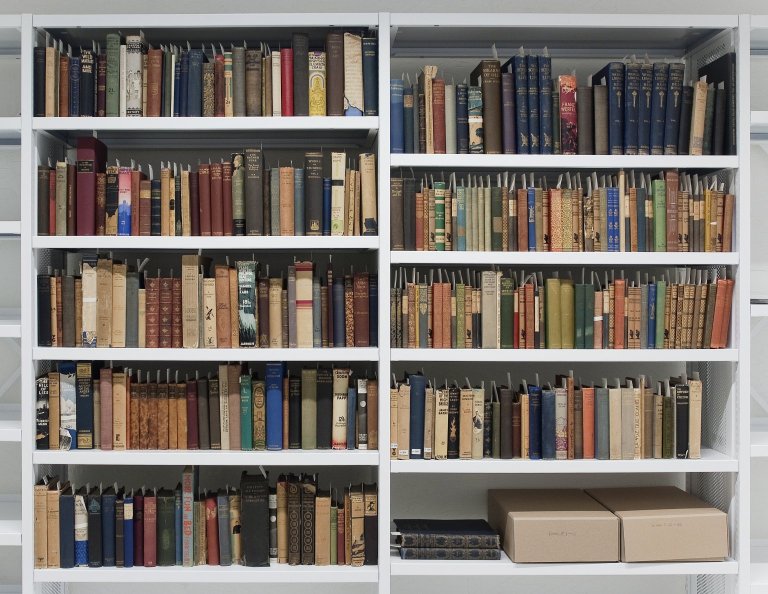
The display includes rare first editions and examples of books from Gibbon’s own private book collection which is kept together in Special Collections – as shown here. They will be on show until the end of March 2014.
Annual Review Inspiration
The Research and Learning Services team welcomed Ruth Miller, Learning and Development Delivery Specialist, to their weekly meeting this morning. Ruth led the team through a quiz about the Annual Review process, which focused the attendees on how to get the best out of their ADR, reminding them what it is and what it is not, and impressing its importance to all concerned!
She then introduced the team, in pairs, to an exercise in which one person would draw something and the other try to draw the same thing- with their backs to one another, and only the first person allowed to speak, describing what they’re drawing. The idea was that this would promote the importance of the reviewer setting clear objectives, and communicating the big picture to the reviewee. It also showed how easy it is to go off in another direction if you don’t communicate well, and how hard it is to collaborate effectively if you can’t have a two-way discussion.
With ADRs coming up shortly, obviously this was very timely, so thanks to Ruth for giving up some of her time for us. Many thanks, also, to Claire Knowles for organising it.
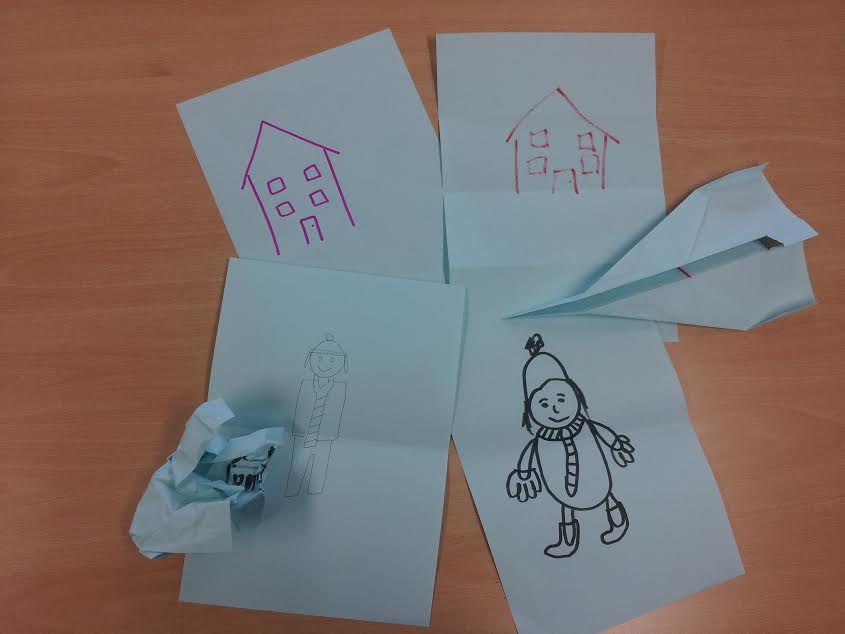
Houses by Ianthe Sutherland and Robin Taylor; bescarved persons by Malcolm Brown and Kerry Miller; paper aeroplane by Theo Andrew; scrunched ball by Norman Rodger.
What would you work for?
One of the benefits of a blog as a publishing platform, is that we can use it for a whole range of tasks, from publishing news about new acquisitions or services, to showcasing iconic items in our collections, or to throw out new ideas. Blog posts can cover a whole range of subjects from the serious to the silly.
This post is on the later end of the spectrum, but may have a serious point!
In many areas of life, and certainly in libraries with significant collections, there is often a large amount of enrichment that can take place in order to better exploit something. If that enrichment or input can be split up into many small tasks, then the burden or effort can be split up among many people.
A word has been coined for this: ‘Crowdsourcing’. Of course crowdsourcing is not really a brand new idea, and is already being successfully used in many ways, whether that is for funding of new product developments (Kickstarter), the classification of galaxies (GalaxyZoo), transcribing menus (What’s on the menu?) assisting with optical character recognition (reCAPTCHA) or checking the output of an automated building inspector (Building Inspector).
Often, the projects that are used to enrich collection data rely on the goodwill or interest of the general public to get involved. Other mechanisms are available where micro-payments (a few pence at a time) are offered for online participants to undertake small tasks such as this. A good example of this is Amazon’s Mechanical Turk.
One area we could use crowdsourcing in the library is to enhance the metadata of items, in particular images. Very often our image collections are cataloged with where the image came from, who created it, and when they created it, but the data doesn’t always include details of what is in the image. Another related issue is that we have many old photos of Edinburgh, and it would be great to work out where they all are (see other blog posts about this).
However I received an email this afternoon from an electronics company who love to mix the physical and the electronic. They detail a project they have built as a kiosk, where a user approaches, undertakes a task, and is rewarded with a bar of chocolate. The title of their blog post is ‘Will Work 4 Candy‘.
Here comes the slightly silly part…! How effective might a chocolate-bar-dispensing-image-description-kiosk-booth be? Let’s say we had one in the library foyer, and in return for describing the contents of three images you were rewarded with a chocolate bar? If each chocolate bar costs 30p, we could describe 10,000 images for only £1,000 which would seem quite cost effective!
Would the incentive of a chocolate bar be enough to divert someone from their daily activity for 5 minutes of their time? Or would it divert people too much, or divert them for the wrong reasons and we end up with very low quality descriptions because all they are interested in is the reward?
Whilst thought processes like this can seem a bit silly, it can sometimes be that from these come good ideas. So if anyone fancies a chocolate bar in return for their thoughts, let me know!!!
What would YOU work for?!
Happy New Year!
Have you been doing too much of this recently?

And started the year with a splitting headache…

Or maybe you got stranded by the winter storms….
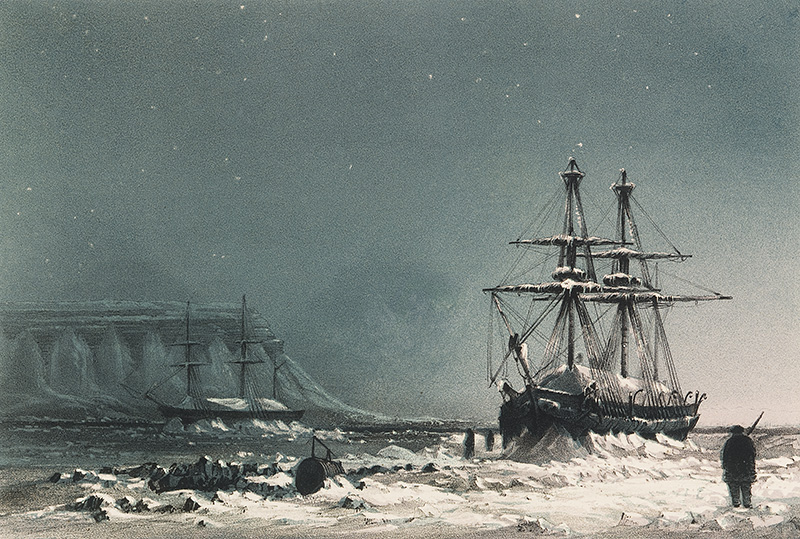
And had to be looked after by others…

Either way, now that we have started a new calendar

The DIU team hope that 2014 will bring you manna from heaven!

Searcher Review 2014

The library is working on a review of Searcher, our branded EBSCO Discovery Service (EDS).
Over the next few months the Library will make a series of changes to Searcher. Some of these will be obvious changes to the look and feel, others may be less obvious ‘back end’ changes. Whatever we do, we hope, all changes will improve your experience of using Searcher.
We want to make sure we are providing the best discovery solution we can and that you are confident using Searcher to find the books, e-books, journal articles and database content you need for your research and study.
We made the first changes to Searcher on Monday 13th January:
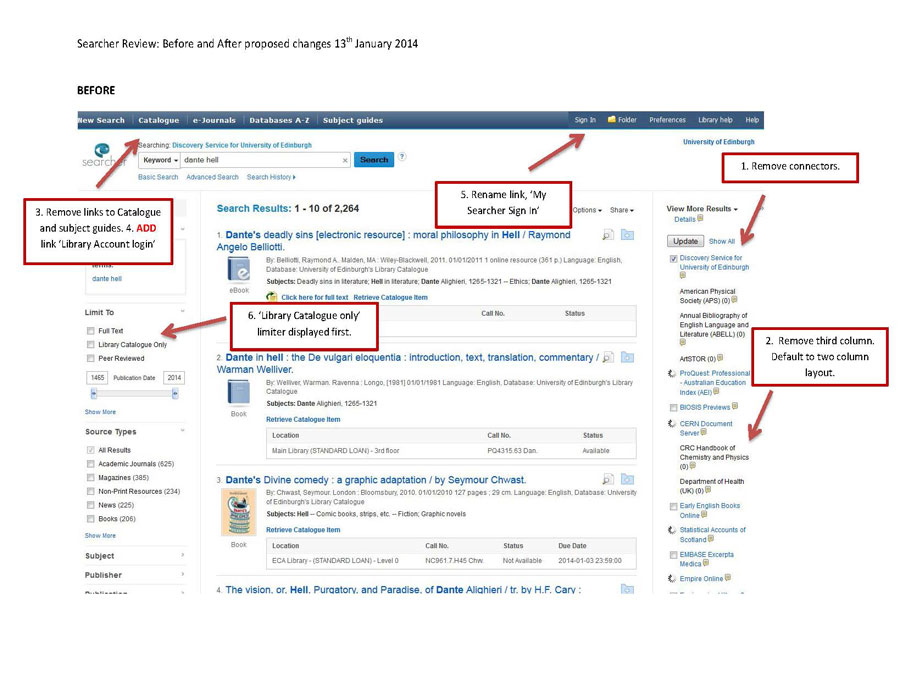
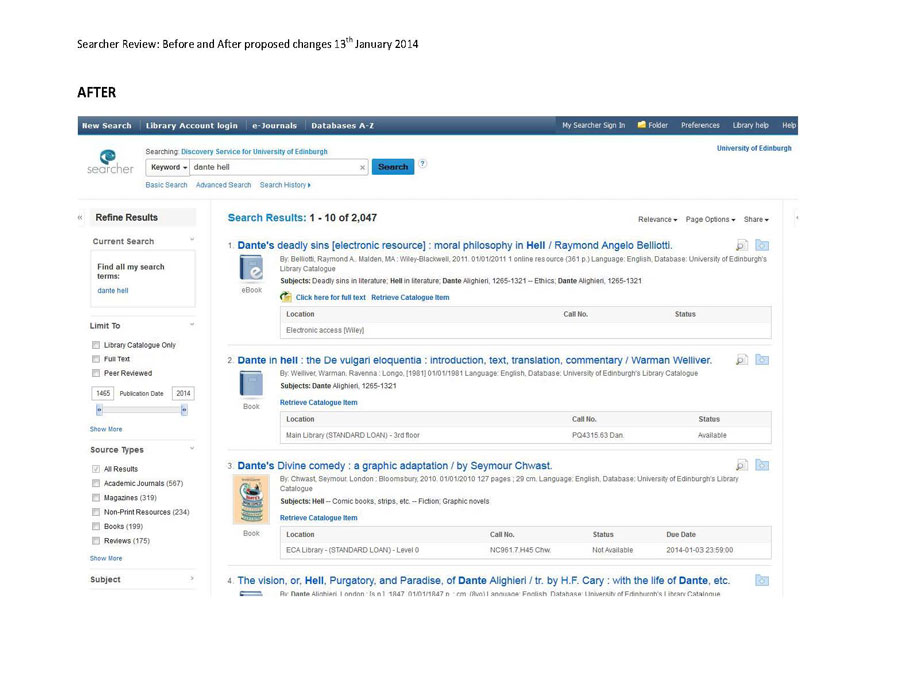
1. We removed connectors. The connectors were what you saw in the third column on the right of the screen. Our statistics show this functionality was seldom used. All resources which were available via connectors, are accessible via the database A-Z webpages.
2. The search results screen now defaults to a two column layout, making the screen less cluttered and results more prominent.
3. On the results screen, the option to limit your search to items from the ‘Library Catalogue only’ appears first.
4. We removed links to ‘Catalogue’ and ‘Subject guides’ in the top navigation bar.
5. And added a link, ‘Library Account login’.
6. We changed the link to your Searcher account from ‘Sign In’ to ‘My Searcher Sign In’ in order to distinguish the link from the Library account login.
BEFORE
AFTER
All changes to Searcher are being made in consultation with representatives from across the various Library teams. We will publish regular review updates and details of the changes we make to Searcher on the Library blog.
Searcher: http://searcher.is.ed.ac.uk or use the search box on the Library homepage
Beautiful Bindings


As part of our Thesis Scanning Service, when we come across a request for a thesis that has beautiful binding we make sure to scan and include these images in the digitised content.
A recent example of this is the beautiful golden marble effect shown above on William David Osler’s ‘Thesis on Rickets’ awarded in 1896.
The digitised copy of this thesis is available for download from the Edinburgh Research Archive (ERA), Edinburgh University’s digital repository of original research produced at The University of Edinburgh.
Download and view ‘Thesis on Rickets’ from the ERA archives’.
More information on our digitisation service can be found on our Thesis Scanning service page.
Stephanie Farley (Charlie), Library Annexe Assistant
Standing on the shoulders of giants: Phonetics Recording Archive
The University of Edinburgh’s proud heritage of academic and research achievements is underpinned by the calibre of the outstanding staff that have worked and taught within its walls.
One such individual of note was the late Elizabeth Theodora Uldall, a pioneering phonetician who spent over 30 years at the University. Elizabeth, or as she was more commonly known as, Betsy, came to work at the University in 1949, after postings for the British Council both during and after the Second World War. Indeed these postings and her subsequent academic work meant that by the time she came to Edinburgh, she had already worked on five continents.
The primary interest of her research was phonetics and at her time in Edinburgh made many valuable contributions to this field, both through her research and teaching, and a touching obituary was published in the Scotsman, when she sadly passed away in 2004.
The Data Library are very happy to announce that recently, with the co-operation from the Linguistics and English Language department, we were able to gather for preservation and sharing, some of the recently digitised research outputs from Betsy Uldall, David Abercrombie, and other distinguished researchers’ work into The University of Edinburgh Phonetics Recording Archive, mid-late 1900s collection on DataShare.
This collection contains five items, containing phonetic and linguistic research including the research outputs and recordings from Betsy Uldall:
Although DataShare was not available for University staff at the time of Betsy Uldall’s retirement in 1983, it would seem that right up until the end, she remained conscious of her responsibilities and the value of her work to other researchers:
“Betsy Uldall, spoke to me before she died asking for this archive to be preserved, and with your help it will be preserved and accessible to people who can use it. – Many many thanks”
We are of course very happy to have played a part in meeting her request, and that her research data is now available to all who wish to study and build upon it.
David Girdwood
EDINA & Data Library
The Lysenko Controversy: Soviet Genetics and Edinburgh
 Britain has been fortunate in the freedom it has enjoyed to carry out scientific research; something which has not always been the case with other parts of the world. The animal genetics archives here are full of individual stories of persecution, government interference and other threats to research and human life. In fact, in the 1930s the Institute of Animal Genetics became a haven for many refugees escaping the rise of fascism (not least H.J Muller and Charlotte Auerbach), but there was trouble on the left side of the political spectrum too.
The Seventh International Congress of Genetics was planned to be held in Moscow in 1937, but interminable delays in the planning process meant that eventually a decision was made to relocate to Edinburgh at the later date of August 1939, where the Congress would be hosted by the Institute of Animal Genetics and organised by its director, F.A.E Crew. The exact reasons for such a delay from the Russians were not made apparent to the Congress’ international planning committee, but it would have been clear to anyone with a vague idea of what was afoot in the Soviet Union at that time.
Trofim Lysenko had been director of the Soviet Union’s Lenin All-Union Academy of Agricultural Sciences since the 1920s, where he claimed to have developed a new agricultural technique which promised to solve the Soviet Union’s agricultural crisis and famines. ‘Vernalisation’ seemed like the magic solution, and Lysenko was hailed as a Soviet hero (although his theory did not produce the results he claimed and was backed by fake experimental data). However, the practice did not produce anywhere near the increase in crop yields that he had predicted. Lysenko’s theories were based on the grounds that characteristics that were acquired by an organism during a lifetime could be passed on to the next generation – a theory which went against evolutionary theory and Mendelism.
Once Lysenko was in a position of power, his influence was disastrous for Soviet scientists. He began a campaign of denouncing theoretical genetics and all biologists who did not hold his views. In 1949, genetics was officially declared ‘a bourgeois pseudo-science’ and all geneticists were dismissed from their jobs and genetics research discontinued. Many were also arrested; some were sentenced to death. One victim of the arrests was Nikolai Vavilov, who was to have been Chairman at the Congress of Genetics in Moscow. Once the Congress was relocated to Edinburgh, Vavilov and some 50 Russian geneticists planned to travel over to present their papers. However, less than a month before the Congress was due to begin, Crew and his organising committee learned that the Russians had been forbidden to come; Vavilov was ultimately arrested and died in prison in 1943. Although the Congress went ahead without the Russian delegates, it was much overshadowed by the outbreak of war across Europe. (In fact, Britain declared war on Germany while the Congress was still in progress, and Crew laboured to ensure that all foreign delegates returned safely home, or else sought refuge elsewhere.)
One British geneticist who took a good deal of interest in the ‘Lysenko Controversy’ as it became known, was Geoffrey Beale, best known as the founder of malarial genetics. Beale, who worked within the Institute of Animal Genetics from 1947 until his retirement in 1978, had a lifelong interest in the Russian language. His personal papers and library, currently being catalogued here at Edinburgh University Library Special Collections, contains many examples of his reading and research into Russia and Russian science particularly. His best known article on the subject was ‘The cult of T.D Lysenko: thirty appalling years’, a review (published in the Science Journal, October 1969) of I.M. Lerner’s translation of Z.A. Medvedev’s book The Rise and Fall of T.D Lysenko.
Lysenkoism remained established in many countries in the Eastern Bloc, and in China until the late 1950s. The ban on genetics research was finally lifted in the Soviet Union in 1964 when Lysenko retired from his post. In Beale’s words, the Lysenko affair was ‘the most extraordinary, tragic and in some ways absurd, scientific battle that there has ever been.’
The e-Journal of East and Central Asian Religions publishes first issue
The e-Journal of East and Central Asian Religions has published its first issue supported by the University’s Journal Hosting Service . The Library now supports seven journals on the platform.

The e-Journal of East and Central Asian Religions is edited by Dr Ian Astley, Senior Lecturer in Japanese at the University of Edinburgh, and is concerned with the way in which the religious cultures of East and Central Asia have interacted historically and continue to interact in the present. In particular the journal seeks to disseminate original research on primary sources that span both geographical and disciplinary boundaries.
The journal will publish once a year. The first volume, Buddho-Daoist interaction in China, presents papers derived from a workshop on Buddho-Daoism, held in the Summer of 2012 under the auspices of the Käte Hamburger Kolleg at Ruhr University, Bochum, for the study of religious exchanges. As such, Buddho-Daoism is a term that has been coined to signal a variety of primary practices and beliefs endorsed by both traditions. The idea behind this meeting was to provide further perspectives on Buddhist and Daoist exchanges and mutual appropriations in order to get a better understanding of the close and continuous relationship that has persisted between the two religions from early on.
The e-Journal of East and Central Asian Religions is available here: http://journals.ed.ac.uk/ejecar
Collections
 Hill and Adamson Collection: an insight into Edinburgh’s past
My name is Phoebe Kirkland, I am an MSc East Asian Studies student, and for...
Cataloguing the private papers of Archibald Hunter Campbell: A Journey Through Correspondence
My name is Pauline Vincent, I am a student in my last year of a...
Hill and Adamson Collection: an insight into Edinburgh’s past
My name is Phoebe Kirkland, I am an MSc East Asian Studies student, and for...
Cataloguing the private papers of Archibald Hunter Campbell: A Journey Through Correspondence
My name is Pauline Vincent, I am a student in my last year of a...
Projects
Cataloguing the private papers of Archibald Hunter Campbell: A Journey Through Correspondence
My name is Pauline Vincent, I am a student in my last year of a...
Archival Provenance Research Project: Lishan’s Experience
Presentation My name is Lishan Zou, I am a fourth year History and Politics student....