Home University of Edinburgh Library Essentials
December 14, 2025
The ‘Z’ Factor New College Special Collections Project now complete

—Prayers written at Vailima, by Robert Louis Stevenson, 1910. New College Library Z.2233.
![[Newton, John] / An authentic narrative of some remarkable and interesting particularas in the life of ********* ... London, 1786.New College Library Z.1188](https://libraryblogs.is.ed.ac.uk/newcollegelibrarian/files/2013/07/z-1188-300x225.jpg)
[Newton, John] / An authentic narrative of some remarkable and interesting particularas in the life of ********* … London, 1786.New College Library Z.1188
We’re pleased to announce that the Z Collection at New College Library, which numbers almost 5,000 Special Collections items, has now been completely catalogued online as part of the Funk Cataloguing Projects.
The Z Collection is formed out of recent donations and out of New College Library books formerly in the General Collections sequence which were identified as Special Collections during a stock management exercise. We follow the criteria used by the Centre for Research Collections at the University of Edinburgh, in particular that all books published before 1850 should be classed as Special Collections.
A big thank you to our Z Collection cataloguers, Janice Gailani, Finlay West and Patrick Murray.

Stark, John. Biographia scotica, or, Scottish biographical dictionary. 1805. New College Library, Z. 1650
A Sample of the Roslin Institute’s Cloning Research Post-Dolly: 1998 and 2007

As mentioned in a previous post, Dolly, the sheep caused a media sensation in 1997 as the first cloned animal using a nuclear transfer process and so, I thought it would be interesting to highlight several articles that I came across on Dolly and cloning at the Roslin Institute in 1998 and then again in 2006. I wondered what cloning research had developed over the years since Dolly, the sheep’s birth in 1996 and surprisingly, or not, the articles I came across (that evoked Dolly) dealt with the issue of eating cloned animal meat and the ethical debate of cloning humans for medical purposes.
Note: these four articles are just a sampling of the articles produced by the Roslin geneticists on the issues, debates and research surrounding Dolly, nuclear transfer, animal and human genetics, cloning purposes (medical, agricultural, genetic conservation, etc..) to illustrate what way being discussed at the time. For more articles on these subject, please consult the Roslin Institute off-prints for 1998 and 2006 at GB237 Coll-1362/4/.
 In the 1998 Roslin off-print bound volumes, I found Harry Griffiths report, ‘Update on Dolly and nuclear transfer’ in the Roslin Institute, Edinburgh: Annual Report April 1, 97-March 31 (GB 237 Coll-1362/4/1848) and Sir Ian Wilmut’s article, ‘Cloning for Medicine’ in Scientific American, December 1998 (GB 237 Coll-1362/4/1897). Griffiths report describes Dolly’s creation by the Roslin geneticists and notes that their breakthrough caused several other groups to ‘take advantage of public interest in cloning to advertise their successes …. Calves cloned from adult animals were reported from Japan and from New Zealand.’ The New Zealand clone was from ‘the last surviving animal of a rare breed’ which highlighted the use of cloning to preserve endangered species. He continues with discussing Intellectual Property issues in relation to Professor Yanagimachi and his colleagues at the University of Hawai’i ‘Honolulu Cloning Technique’ and closes with a couple of paragraphs on human cloning. He notes the UK Human Genetics Advisory Commission and the Human Fertilisation and Embryology Authority’s report ‘Cloning issues in Reproduction, Science and Medicine’ from 7 December, 1998 which recommends that ‘there should be a continued ban on all ‘reproductive cloning’ – the cloning of babies – but gives cautious support to the cloning of human cells for therapeutic purposes.’
 Wilmut’s article in Scientific American reports on the how biomedical researchers are developing ways to use genetically modified mammals for medical purposes. He mentions the sheep, Megan and Morag who were the first mammals cloned from cultured cells. A technique that allows cloned sheep to carry human genes and such animals produce milk that can be processed to create therapeutic human proteins. The sheep, Polly, is a transgenic clone of a Dorset sheep and ‘a gene for a human protein, factor IX, was added to the cell that provided the lamb’s genetic heritage, so Poly has the human gene.
In the 2006 Roslin off-print bound volumes, I found two fascinating articles:– Sir Ian Wilmut’s ‘Human cells from cloned embryos in research and therapy’ in BMJ Vol. 328, February 2004 and J. Sark, et al.’s ‘Dolly for dinner? Assessing commercial and regulatory trends in cloned livestock’ in Nature Biotechnology, Vol. 25, No. 1, January 2007.
 Sir Ian Wilmut’s article ‘Human cells from cloned embryos in research and therapy’ in BMJ Vol. 328, February 2004 is one of the more contemporary papers in the collection that discusses stem cell technology and human cloning issues. He cites studies of human genetic diseases and how cloned cells ‘will create new opportunities to study genetic disease in which the gene(s) involved has not been identified’, specifically describing work with motor-neurone diseases. Then, Wilmut notes how stem cells could be used in treatments for a variety of degenerative diseases, i.e. cardiovascular disease, spinal cord injury, Parkinson’s disease and Type I diabetes. Finally Wilmut discusses the differences in regulation of nuclear transfer and human cloning in various countries, noting that in the United Kingdom, ‘project to derive cells from cloned embryos may be approved by the regulatory authority for the study of serious diseases. By contrast human reproductive cloning would be illegal.’
 Then, in 2007, the article by and J. Sark, et al’s ‘Dolly for dinner? Assessing commercial and regulatory trends in cloned livestock’ in Nature Biotechnology, ‘reviews the state of the art in cloning technologies; emerging food-related commercial products; the current state of regulatory and trading frameworks, particularly in the EU and the United states and the potential for public controversy.’
As you can see by these four examples there are a range of issues and concerns that have been discussed over the years. While advances are made in cloning and genetic modification, there are still ethical debates to be had and more research to be done. In reading over these and other similar articles in the Roslin off-prints, I enjoyed learning about the different uses of transgenic animals.
New voices join the St Cecilia’s Hall fundraising canon!
A fundraising update by Leisa Thomas, Development Officer
Fundraising continues to go from strength to strength and we are delighted to announce three major grants from Scottish Trusts that have helped us reach the halfway mark in our fundraising endeavours. Arts philanthropists, the Dunard Fund, and Scottish stalwarts, the Wolfson Foundation, along with city locals, Edinburgh World Heritage, have each committed significant grants in support of St Cecilia’s Hall. The financial backing of these charitable bodies lends strength to the importance of our vision for Scotland’s oldest concert hall and what it means for our country’s musical heritage. We would like to extend our thanks to everyone who has supported the project and helped us attain this fantastic milestone!
Damnation and Divinity
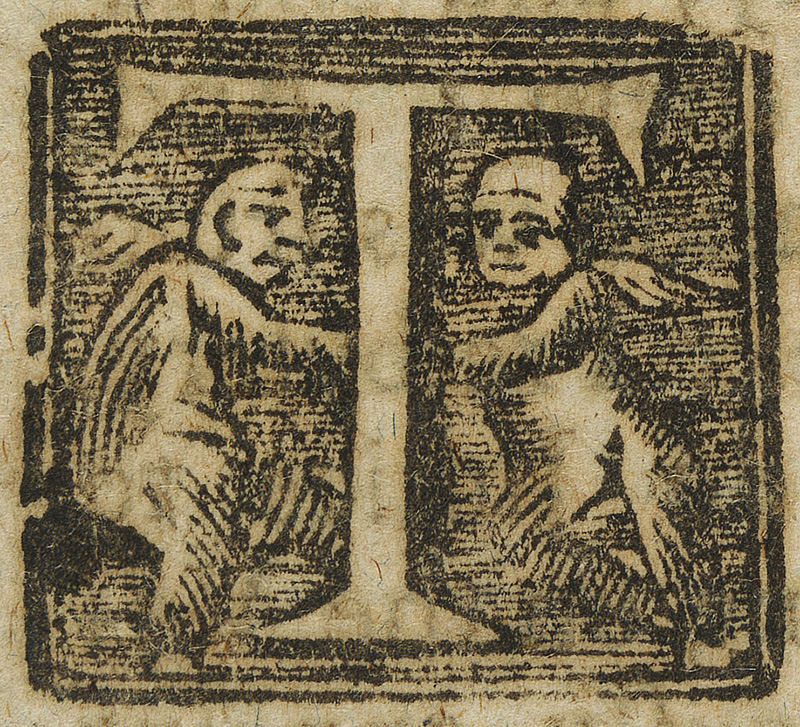
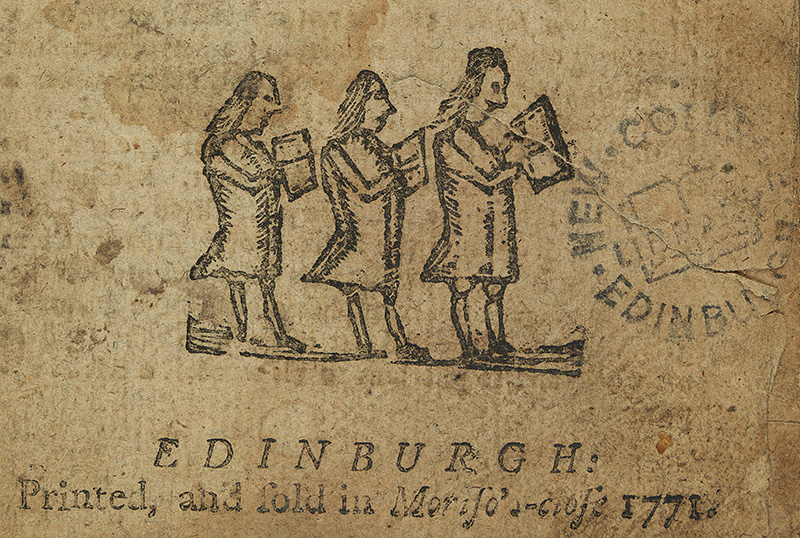
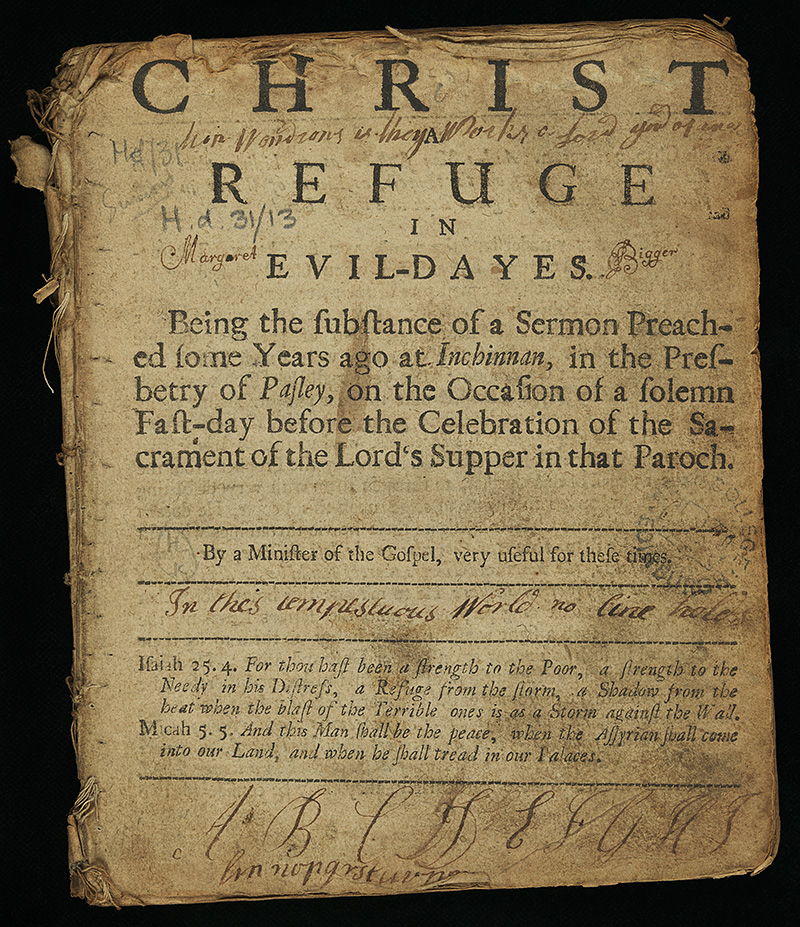
More Religious pamphlets for the English Short Title Catalogue (ESTC) came our way this week, mostly from New College Library. I always find the titles so fascinating, and some of them have lovely woodcut details too. The following are some of my favourites.
For more information about the ESTC see http://estc.bl.uk/F/GFIV3P5UCLQIQIHNQC1EQBU4HFL4Q9YYCCQ5XD4QM8XJRAED8Q-13504?func=file&file_name=catalogue-options
Susan Pettigrew

Chinese calligraphy on display at New College Library

Mustard Seed Garden Manual of Painting. New College Library, Inglis 23.
On display in the New College Library entrance this week is the beautiful Mustard Seed Garden Manual of Painting (Inglis 23). This is a classic treatise of calligraphic art on silk, by calligraphers Wen-Yuan T’ang and Chin-Ch’ang in 1682.
This volume is one of the five volume set, bound in silk, which was given to New College Library in 1921 by the Rev. James W. Inglis, Missionary to Manchuria for the United Free Church of Scotland.
Building for a New Audience
A post by Sarah Deters, Audience Development Assistant, MIMED
Why is the St Cecilia’s Hall Redevelopment project so important to Musical Instrument Museums Edinburgh (MIMEd)? There are a number of reasons. Through the redevelopment, we will be able to preserve and conserve St Cecilia’s Hall, the oldest concert hall in Scotland. By expanding the building, we will finally be able to bring together our musical instrument collections into one museum, displaying our objects in new galleries and allowing us to show the history of musical instruments under one roof. And with this improved St Cecilia’s, we can engage and embrace a new audience by expanding our opening hours, improving our facilities, providing exciting public programming, and interpreting our museum objects with a fresh perspective.
The opportunity to create an engaging space for our visitors is incredibly exciting for me as the A udience Development Assistant. Throughout the past year, I, along with the SCH Redevelopment Group and Jura Consultants, have been working hard on developing a robust Activity Plan. This plan outlines all of the programmes, relationships, and engagement opportunities that will occur at St Cecilia’s Hall. The plan has already been set in motion and will continue to gather speed throughout the redevelopment process. It is a great time to be involved with Musical Instrument Museums Edinburgh and I look forward to continuing to update everyone on the project.
New Chinese journal at New College Library

I’m pleased to be able to say that the journal Sino-Christian Studies is now available at New College Library at Per S.
Sino-Christian studies : an international journal of Bible, theology & philosophy = Han yu jidu jiao xue shu lun ping = 漢語基督敎學術論評 is a bilingual journal, published twice a year by the Institute of Sino-Chinese Studies, Chung Yuan Christian University, Taiwan.
This journal is one of a number of Chinese journals being purchased this year to support developing areas of research and teaching in World Christianity, in the School of Divinity.
Geoffrey Herbert Beale
 Two weeks ago, when we posted about the Lysenko Controversy in Soviet Russia, mention was made of Geoffrey Beale’s interest in and knowledge of the Russian language and scientific history. Beale was based at the Institute of Animal Genetics in Edinburgh from 1947 until 1978 and is best known as the founder of malaria genetics. His personal archive, which takes up some 40 boxes and contains notebooks, correspondence, publications and drafts, is currently being catalogued here in Edinburgh University Library Special Collections, so a brief biography may be in order to shed some light on this humane and fascinating man.
Beale, born in Wandsworth, London in 1913, developed a keen interest in Botany while a student in Imperial College, London, despite his parents’ opposition to a scientific career (he was even made to sit a psychological examination which recommended that he become a tax inspector instead!). In his third year of university, Beale completed a summer course in plant genetics given at the John Innes Horticultural Institute, which would shape the course of his future career. Beale was eventually offered a job at the John Innes, receiving his PhD in 1938 and studying, among other things, the chemistry of flower colour variation until being called up to the army in 1941.
Due to having what he called a ‘smattering’ of languages, including Russian, Beale was drafted into the Intelligence Corps (Field Security) and posted to Archangel and then Murmansk, Russia, where he had the opportunity to improve his Russian. Beale was awarded an MBE for his military service in 1947.
After the war, Beale wondered how he would get back into science after his five year absence. Fortunately, he was offered a job at Cold Spring Harbor working with Escherichia coli. Beale also worked for a spell with geneticist Tracy Sonneborn at Bloomington, Indiana, and it was then Beale developed his lifelong interest in the protozoan Paramecium. The award of a Rockefeller Fellowship necessitated his return to the UK in 1947, where he was duly offered a lectureship by C.H. Waddington, who had just arrived in Edinburgh as director of the genetics section of the National Animal and Genetics Research Organisation within the Institute of Animal Genetics. At the Institute, Beale became close friends with Henrik Kacser and Charlotte ‘Lotte’ Auerbach, about whom he would later write an account, and gained funding to design and build dedicated research laboratories, including the Protozoan Genetics building for his research group. This group worked on the genetics of Paramecium and on protozoan parasites, and attracted visiting scientists from all over the world. Beale was appointed a Royal Society Research Professor in 1963, a position he held until his retirement.
In the mid-1960s, Beale developed an interest in malaria genetics, gaining a grant from the Medical Research Council in 1966. Together with programme leader David Walliker, who would become a renowned malariologist, they established a mosquito colony, built an insectary, collected parasite strains and established rodent facilities for African tree rats. The work of another researcher, Richard Carter, helped establish the parasite genetic markers, and the foundations of genetic analysis in malaria parasites were laid. Later research covered the genetic analysis of drug resistance, virulence and the classification of rodent malarias into species and subspecies. He continued his malaria work during a six month visiting professorship at Chulalongkorn University in Bangkok, establishing a collaborative research programme with Professor Sodsri Thaithong as well as a malaria research laboratory which achieved World Health Organisation Collaborating Centre status. This phase of Beale’s career laid the groundwork for many other scientists working on parasite diversity and genetics. In 1996 Beale was awarded an honorary DSc from Chulalongkorn University, one of the first foreigners to be so honoured.
Beale married Betty MacCallum in 1949 (they were divorced in 1969) and he would often take their three sons to the laboratory with him on Sundays where they would learn about science and film printing techniques. Beale continued to work at the laboratory every day well after his retirement. After 1998 he began work on a new book on Paramecium to show the advances and new directions of research in the area. However, his health was deteriorating and much of the later writing was done by co-author John Preer. The book, Paramecium: Genetics and Epigenetics, was published in 2008, when Beale was 95 years old. Geoffrey Beale died in Edinburgh on 16 October 2009.
We’ll be posting up items of interest from the Beale collection as cataloguing progresses, with the finished catalogue being mounted online on our newly-launched project website at: http://www.archives.lib.ed.ac.uk/towardsdolly/
References:
J. R. Preer Jr and Andrew Tait, ‘Geoffrey Herbert Beale MBE’, Biographical Memoirs of Fellows of the Royal Society, 57: 45-62 (2011)
Geoffrey Beale, ‘Autobiograpy (written July 1997)’, in Coll-1255, EUL Special Collections.
SCAPE workshop (notes, part 1)
The aim of the SCAPE workshop was to show participants how to cope with large data volumes by using automation and preservation tools developed and combined as part of the SCAPE project. During the workshop, we were introduced to Taverna workbench, a workflow engine we we installed with a virtual machine (Linux) in our laptops.
It has taken me a while to sort out my notes from the workshop, facilitated by Rainer Schmidt (Austrian Institute of Technology, AIT), Dave Tarrant (Open Planets Foundation, OPF), Roman Graf (AIT), Matthias Rella (AIT), Sven Schlarb (Austrian National Library, ONB), Carl Wilson (OPF), Peter May (British Library, BL), and Donal Fellows (University of Manchester, UNIMAN), but here it is. The workshop (September 2013) started with a demonstration of scalable data migration processes, for which they used a number of Raspberry Pis as a computer cluster (only as proof of concept).
Rainer Schimdt (AIT)
 Here is a summary of the presentation delivered by Rainer Schmidt (AIT) who explained the SCAPE project framework (FP7 16 organizations from 8 countries). The SCAPE project focuses on planning, managing and preserving digital resources using the concept of scalability. Computer clusters can manage data loads and distribute preservation tasks that cannot be managed in desktop environments. Some automated distributed tasks they have been investigating are extraction of metadata, file format migration, bit checking, quality assurance, etc.
During the workshop, facilitators showed scenarios created and developed as part of the SCAPE project, which had served as test bed to identify best use of different technologies in the preservation workflow. The hands-on activities started with a quick demonstration of the SCAPE preservation platform and how to execute a SCAPE workflow when running it in the virtual machine.
SCAPE uses clusters of commodity hardware to generate bigger environments to make preservation tasks scalable, to distribute the power required for computing efficiently, and to minimise errors. The systems’ architecture is based on partitions. If failure occurs, it only affects one machine and the tasks that it performs, instead of affecting a bigger group of tasks. The cluster can also be used by a number of people, so only a specific part of the cluster gets affected by the error and thereby only one user.
A disadvantage of distributing tasks in a cluster is that you have to manage the load balancing. If you put loads of data into the system, the system distributes the data among the nodes. Once the the distributed data sets have been processed, the results are sent to nodes where the results are aggregated. You have to use a special framework to deal with the distribution environment. SCAPE uses algorithms to find and query the data. The performance of a single CPU is far too small, so they use parallel computing to bring all the data back together.
The Hadoop framework (open source Apache) allows them to deal with the details of scalable preservation environments. Hadoop is a a distributed file system and execution platform that allows them to map, reduce and distribute data and applications. The biggest advantage of Hadoop is that you can build applications on top, so it is easier to build a robust application (the computation doesn’t break because a node goes down or fails). Hadoop relies on the MapReduce programming model which is widely used for data-intensive computations. Google hosts MapReduce clusters with thousands of nodes used for indexing, ranking, mining web content, and statistical analysis, Java APIs and scripts.
The SCAPE platform brings the open source technologies Hadoop, Taverna and Fedora together. SCAPE is currently using Hadoop version 1.2.0. Taverna which allows you to visualise and and model tasks, make them repeatable, and use repository technology such as Fedora (http://www.fedora-commons.org/). The SCAPE platform incorporates the Taverna workflow management system as a workbench (http://www.taverna.org.uk) and Fedora technology as the core repository environment.
You can write your own applications, but a cost-effective solution is to incorporate preservation tools such as Jhove or METS into the Taverna workflow. Taverna allows you to integrate these tools in the workflow, and supports repository integration (read from and distribute data back into preservation environments such as Fedora). The Taverna workflow (sandpit environment) can be run on the desktop, however for running long workflows you might want to run Taverna on the internet. More information about the SCAPE platform and how Hadoop, Taverna and Fedora are integrated is available at http://www.scape-project.eu/publication/1334/.
Setting up a preservation platform like this also entails a series of challenges. Some of the obstacles you might encounter are mismatches in the parallelisation (difference between desktop and cluster environment). Workflows that work for repositories might not work for web archiving, because they use different distributed environments. To avoid mismatches use a cluster that is centred on specific workflow needs. Keeping the cluster in-house is something of which institutions are wary, while on the other hand they may be reluctant about transferring big datasets over the internet.
Related links:
http://openplanetsfoundation.org/
http://wiki.opf-labs.org/display/SP/Home
http://www.myExperiment.org/
New acquisition: Further papers of Alexander Craig Aitken
 The mathematician, statistician, writer, composer and musician, Alexander Craig Aitken, was born in Dunedin, New Zealand on 1 April 1895. He was of Scottish descent. He attended Otago Boys’ High School from 1908 to 1912. On winning a university scholarship in 1912 he went on to study at the University of Otago in 1913, enrolling in Mathematics, French and Latin. Studies were cut short by the 1914-1918 War however and he enlisted in 1915 serving with the Otago Infantry. Aitken saw action in Gallipoli and Egypt, and he was wounded during the Battle of the Somme. After his hospitalisation, he returned to New Zealand in 1917.
On the completion of his studies in 1920, Aitken became a school-teacher at Otago Boys’ High School and the same year he married Winifred Betts the first lecturer in Botany at the University of Otago where he also did some tutoring. Then, encouraged by a professor of mathematics at the University, he gained a postgraduate scholarship which brought him to Edinburgh University in 1923. His thesis on statistics gained him the degree of D.Sc. in 1925 when he also joined the University staff as a lecturer in Statistics and Mathematical Economics. In 1937 he was promoted to Reader, and in 1946 was appointed to the Chair of Mathematics.
Aitken’s publications include: jointly with H. W. Turnbull, The theory of canonical matrices (1932); with D. E. Rutherford, a series of Mathematical Texts; wartime experiences in Gallipoli to the Somme: Recollections of a New Zealand infantryman (1963); and, posthumously To catch the spirit. The memoir of A.C. Aitken with a biographical introduction by P.C. Fenton (1995). He made many important contributions to the many fields of his subject, particularly in the theory of Matrix Algebra and its application to various branches of mathematics. In his time, Professor Aitken was one of the fastest mathematical calculators in the world.
While at school, Aitken had learned to play the violin, and later on in life he played both the violin and viola and composed pieces for performance by university groups. He died in Edinburgh on 3 November 1967.
Shortly before Christmas we acquired a further tranche of Aitken’s papers. These include a number of original mathematical manuscripts, correspondence, legal documents, offprints, publications and photographs. Amongst these is a review by Aitken of Sara Turning’s “Alan Turing”.

At the moment we still have to look through the collection, box it up and create a basic handlist. Once this is done it will be available for consultation.
Collections
 Hill and Adamson Collection: an insight into Edinburgh’s past
My name is Phoebe Kirkland, I am an MSc East Asian Studies student, and for...
Cataloguing the private papers of Archibald Hunter Campbell: A Journey Through Correspondence
My name is Pauline Vincent, I am a student in my last year of a...
Hill and Adamson Collection: an insight into Edinburgh’s past
My name is Phoebe Kirkland, I am an MSc East Asian Studies student, and for...
Cataloguing the private papers of Archibald Hunter Campbell: A Journey Through Correspondence
My name is Pauline Vincent, I am a student in my last year of a...
Projects
Cataloguing the private papers of Archibald Hunter Campbell: A Journey Through Correspondence
My name is Pauline Vincent, I am a student in my last year of a...
Archival Provenance Research Project: Lishan’s Experience
Presentation My name is Lishan Zou, I am a fourth year History and Politics student....