Home University of Edinburgh Library Essentials
April 4, 2026
Out of the mouths of babes…
Special Visitors at our Cabinet of Curiosities
On February 6 the exhibitions team at the Main Library Exhibition Gallery welcomed the P3 and 4’s from Campie Primary School in Musselburgh. From a narwhal tusk to meteorites, the exhibition offers a unique opportunity to see some of the more unusual items from the University’s collections. As well as a community outreach project, we trialled an idea to provide an alternative audio guide for the exhibition. We recorded the children talking about particular exhibits and describing what they liked and didn’t like about the exhibition. We were very impressed not only with the fantastic guide the children created for us, but also how beautifully behaved they were throughout their visit.
The Campie Primary School Guide to Collect.ed is now playing in the Main Library Exhibition Guide until the exhibition closes March 1. There’s only 2 more Saturdays left to step inside our exhibition from a bygone era, admission is free.
Innovative Learning Week – Online Quiz
 We’ve been running an online quiz during Innovative Learning Week with questions based on many of our different online resources. The first nine questions have already been posted on the CRC Facebook page, the 10th and final question will be posted at 3pm this afternoon ( https://www.facebook.com/crc.edinburgh ). For anyone who has missed the questions so far, here is a quick recap:
Question 1: Looking at our image collections here: http://images.is.ed.ac.uk/ In the Roslin Institute Collection, what is Mr Anthony H Wingfield riding?
Question 2: Using the English Short Title Catalogue (http://www.ed.ac.uk/schools-departments/information-services/library-museum-gallery/finding-resources/library-databases/databases-a-z/databases-e ), search for “Perverting divine truth”. What is the title of the book you find, and where is the nearest copy located?
Question 3: In 1915, father and son William Henry and William Lawrence Bragg won the Nobel Prize for Physics for their foundational work published in the book “X-rays and crystal structure”. Using the library catalogue, where is the 1915 edition of this book held? http://catalogue.lib.ed.ac.uk/vwebv/searchBasic?sk=en_US
Question 4: Reputedly, we have the first drawing of a Native American in the Laing Collection in http://images.is.ed.ac.uk/ . What is his name?
Question 5: Using the Archives and Manuscripts catalogue (http://www.archives.lib.ed.ac.uk/), which post would Arthur Darbishire have filled had he not died in the First World War?
Question 6: Browse through the UoEArtandArchives blog (http://uoeartandarchives.tumblr.com/). Who was Monster Hunting in 1934?
Question 7: Bugles are instruments that have been used as signalling devises in the military for generations. MIMEd has a bugle in its collection that is said to have been taken off of a German soldier at the battle of the Somme. Using the MIMEd website http://www.ed.ac.uk/schools-departments/information-services/library-museum-gallery/museums-and-galleries/musical-instrument-museums/mime , can you find the name of the maker and the German town in which it was made in c 1914?
Question 8: What was title of the article/paper that was prepared for the University Court by a Rector who went on to become Prime Minister? The date the paper was laid before the Court was 26th May 1975. Again look in the archive resources here: http://www.archives.lib.ed.ac.uk/
Question 9: Which collections held by Lothian Health Services Archive (http://www.lhsa.lib.ed.ac.uk/) were inscribed into the UNESCO Memory of the World Register in 2011?
To submit your answers at the end of the week, use the form here: http://www.emailmeform.com/builder/form/1HI905dJ87
Need help with your research?
 Do you need help or are interested in finding current news, theses or historic newspapers?
- Are you worried about getting your references right or avoiding copyright issues when using images, charts, tables, etc., in your presentations?
- Do you need help identifying resources for your literature review or want to find out how to conduct a systematic literature review?
If so, the Academic Support Librarians team are running library and research-based information skills session this semester that you can book onto via MyEd. Most sessions run for 1 hour and are held in the Main Library. These sessions are open to all students across the University. Sessions become available to book 1 month prior to being held.
The following sessions are available:
- Finding current news
- Finding historic newspapers
- Finding theses
- Managing a systematic literature review (this session is 1.5 hours)
- Study resources for literature reviews (this session is 2 hours)
- Your presentations – avoid the copyright trap
- Your references – get it right first time
For more information on what the sessions will cover, where and when the sessions will take place and how to book please see the IS Skills website.
While on the IS Skills website why not take a look around the wide range of training courses available to students and staff at the University.
Top Tips for Finding Theses #ILW2004
 Need to find out what research has already been conducted in your topic area? Some PhD research ends up being published but not all, so doing a specific search for theses may be the only way that you will come across it. This Innovative Learning Week seminar will cover search techniques for theses in online and print form.

Today, 15:00-16:00, New College – Room 1.07.
Can’t attend today’s session? Book on the IS Skills Finding Theses seminar, or explore the Theses Subject Guide online.
Hidden faces of New College Library #ILW2014

Student cataloguers who worked on the 1893 printed library catalogue. Image from New College Library Archives.
There’s still time to come to the Innovative Learning Week Session : Library Pecha Kucha – Our Favourite Things. Six members of staff will be allowed just 5 minutes to present their work to you. I’ll be presenting on the hidden faces of New College Library, showing that New College Library’s collection story is not just about men and ministers but also women, ordinary people and students.
The session is today, Tuesday 18 February, 11.30-12.20, Main Library – Room 1.11.
Dusting for prints…
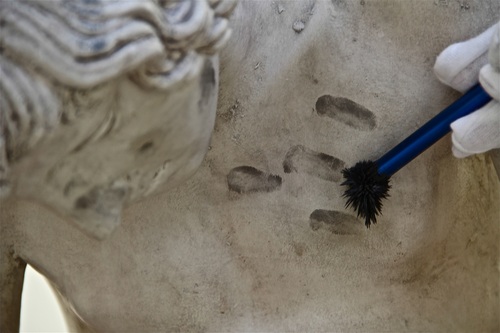
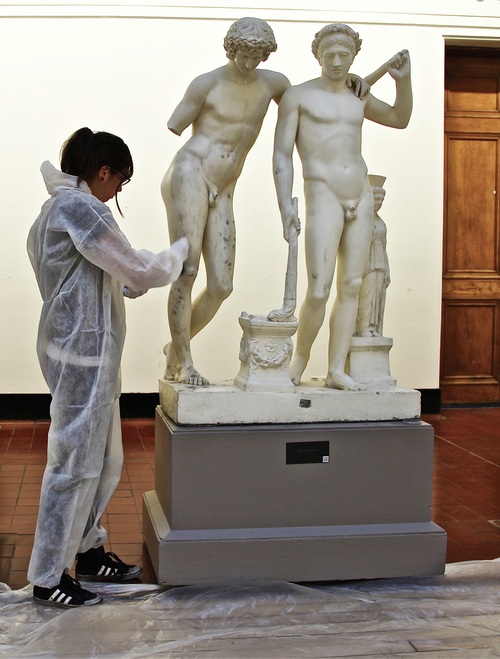
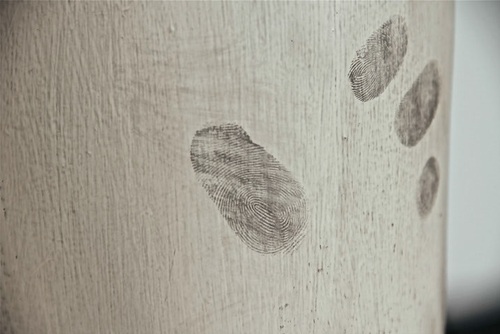
We all like to pretend that no-one touches the things in museums. Fact is, like it or not, people do. We have been working with ECA Postgraduate student Morgan Kinne for a little over a year to find a way for her to fingerprint parts of the ECA Cast Collection. We eventually found a solution that in no way harmed the casts and Morgan began dusting earlier this month. I’m delighted to say that this worked extremely well, as these images show. Morgan says of the project:
“I recently carried out a project in the sculpture court that involved myself dusting three of ECA’s plaster casts – Spinario, Dying Gaul and Castor and Pollux – for fingerprints. The prints reveal a part of the statues’ history that has gone unnoticed and stand as a record of the interactions between people and these statues and reveal a relationship between the art students and the art historical objects.”
The Cast Collection at ECA was originally used for the purposes of formal drawing instruction at the College. While this is not the case today, projects like Morgan’s, and also Krijn de Koning’s Land, utilise the collection in exactly the same way – to support teaching and provide inspiration.
Meet the SPS Librarians at Librarians’ Question Time today #ILW2014
 It’s Innovative Learning Week at the University of Edinburgh and both your SPS Librarians will be in the Main Library Foyer this morning at the Librarians Question Time event, 11.30-12.30. We’ll be there to answer your questions about library resources and services for Social & Political Sciences so come and say hello!
South Asia Archive online trial extended
 Have you heard about the trial of the South Asia Archive for University of Edinburgh users? Scroll down the page to find the link at: http://www.ed.ac.uk/is/databases-trials. This trial access has now been extended to 31 March.
The South Asia Archive is an extensive resource for students and scholars across the humanities and social sciences. The historical documents within the Archive are truly interdisciplinary, reflecting the varied range of knowledge production in colonial and early post-colonial India and the wider sub-continent.
Comprising material sourced from collectors and archivists by the South Asia Research Foundation, this Archive brings together a wealth of important and unique primary and secondary content.
Document download is not possible on the free trial product, meaning you will need to use the Image Viewer to view the documents. However, documents can be downloaded into pdf format on the full version of the site. Online tutorials are available at: http://southasiaarchive.com/help/help-videos.
Studying relationships? New SPS e-journals available
Two new SPS e-journals are now available to University of Edinburgh library users via the online library catalogue.
 Families, Relationships and Societies – an international Journal of research and debate is a new social science journal exploring family life, relationships and generational issues from interdisciplinary, social science perspectives. It aims to encompass the fluidity, complexity and diversity of contemporary social and personal relationships and their need to be understood in the context of different societies and cultures.
 The Journal of Sexual Medicine aims to serve as an interdisciplinary forum to integrate the exchange among disciplines concerned with the whole field of human sexuality. It covers the best and latest research in basic science and clinical research in male, female, and couple’s sexual function and dysfunction.
New Graduate Trainee post in Centre for Research Collections
We are for the first time offering a one-year Graduate Trainee post:
https://www.vacancies.ed.ac.uk/
Many libraries and colleges offer traineeships – this is unique in that the successful candidate will get the chance to work with all the different archives, rare books, museum and art collections curated through CRC. This will enable them to go on to professional study in any of these areas.
Collections
 Hill and Adamson Collection: an insight into Edinburgh’s past
My name is Phoebe Kirkland, I am an MSc East Asian Studies student, and for...
Cataloguing the private papers of Archibald Hunter Campbell: A Journey Through Correspondence
My name is Pauline Vincent, I am a student in my last year of a...
Hill and Adamson Collection: an insight into Edinburgh’s past
My name is Phoebe Kirkland, I am an MSc East Asian Studies student, and for...
Cataloguing the private papers of Archibald Hunter Campbell: A Journey Through Correspondence
My name is Pauline Vincent, I am a student in my last year of a...
Projects
Cataloguing the private papers of Archibald Hunter Campbell: A Journey Through Correspondence
My name is Pauline Vincent, I am a student in my last year of a...
Archival Provenance Research Project: Lishan’s Experience
Presentation My name is Lishan Zou, I am a fourth year History and Politics student....