Home University of Edinburgh Library Essentials
December 16, 2025

How do I get hold of the book I need?
 Whether an item is already out on loan or is not available in the Library there are options available to you so you can get the material that you need.
Is the book (or other item) you want already out on loan to another user?
You can place a request on the item yourself via the Library Catalogue. If the item is “Charged” i.e. out on loan, then you can simply click on the Request Charged or Annexe item link to request the item. You must have your library barcode number to do this (this appears on your staff/student card and starts 20150…). You will receive an email when the item is available for you to borrow and you must collect this from the Requested items for collection shelves (in the Main Library these are in the HUB collection on the ground floor). This means that you can collect items any time the Main Library building is open.
- For more information about this service and how to use it see www.ed.ac.uk/is/self-requests
How do you get hold of a book (or other item) that is held at the Library Annexe?
The Library Annexe is the Library’s offsite store and they offer a couple of request options so you can get hold of material from here. These requests can be done via the Library Catalogue. You can request for a whole book or journal volume to be brought from the Annexe to the Library for you to borrow (click on Request Charged or Annexe item link in the catalogue record). Or you can request for a journal article or book chapter to be scanned and sent to you electronically (click on Library Annexe scan request in the catalogue record).
- For more information on the Library Annexe and the request services they provide please see www.ed.ac.uk/is/library-annexe
Does the Library not hold the book that you require?
Through RAB (Request a Book) students can tell the Library about books that are not available in the Library’s collections and the Library will try to buy it.
- Go to www.ed.ac.uk/is/book-recommendations and click on Request a Book (RAB) (Students).
- Staff can also recommend books on the above book recommendations site by clicking on their relevant College.
If you require the book quickly or if it is a journal article or other material you are looking for then you may want to try the Inter-Library Loans (ILL) service instead. The ILL service can try to borrow an item from another library for you to use, in the case of journal articles they will try to get a copy of the article for you. ILL requests are all done online via ILLiad, you must click on the first time user link to register if you have never used this service before.
- For more information on the ILL service please see the ILL website.
Alternatively, you may wish to visit another library in-person to view material that they hold, see using other libraries.
Caroline Stirling – Academic Support Librarian for Social and Political Science.
Behind the Scenes at New College Library #ILW2014
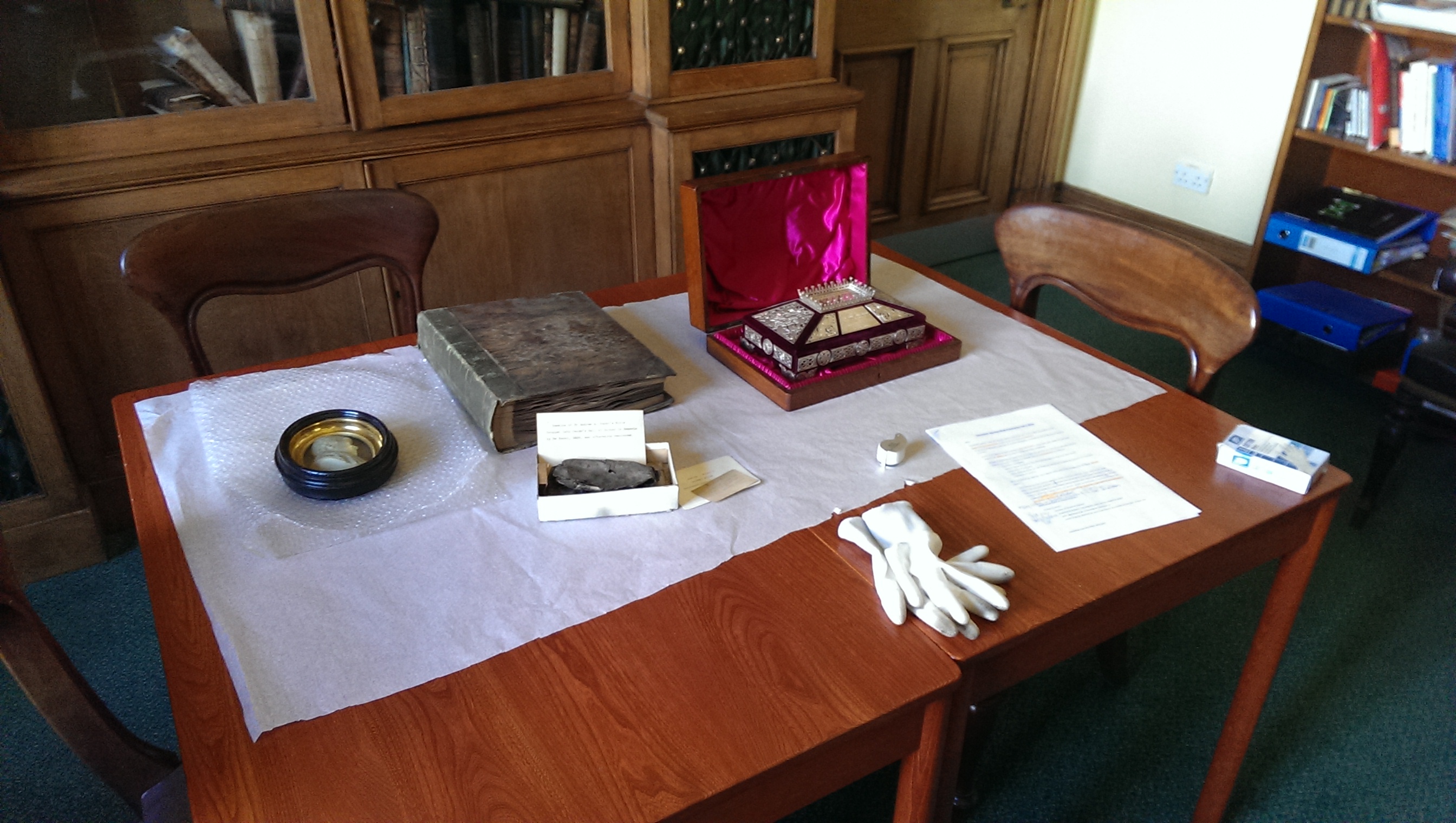 A guest post from Liz Louis, student on the MLitt in Museum and Gallery Studies at the University of St Andrews and volunteer at New College Library Object Strongroom. Liz presented on a selection of New College objects as part of the Behind the Scenes at New College Library Innovative Learning Week event.
I want to show you some of the highlights of the collection and also how the resources which New College Library can provide us with are invaluable to my research.
New College Library’s impressive holdings on Thomas Chalmers, chair of theology at Edinburgh University and first Principal of New College include many portraits of Chalmers in the form of paintings, photos and prints. As an art historian, the Wax Relief Portrait of Thomas Chalmers is interesting because it is intensely sculptural and ‘photorealistic’: with wax best suited to imitate human skin and most eerily similar to the moment of arrested life. No paper trail for the original paper has been discovered as of yet, although I have found a label which suggests that the portrait was made by Mme Tussaud’s. We do know that it was given to Prof Hugh Watt (Principal 1946-50) by Margaret Macphail, who was given the object by her friend who inherited it from Chalmers’s goddaughter.
Many objects in the strong room reflect the nineteenth century interest in sciences. The album with dried plants has a handwritten inscription on first page: In Memoriam / A Flower, a Plant, or a Weed, / gathered from every place/ mentioned in the Bible / which I visited in Palestine / 1852 / W.D. (William Dickson) 1852. This makes it particularly interesting for us: we’re not often lucky to have name and date of objects ON an object. We know that it was donated by his sons to complete New College’s Dickson collection of objects related to Middle East. It was addressed to John Duns (Professor of Natural Science at New College, 1864-1909). To a modern eye one thing that stands out is that the names written in pencil next to the plant never refer to the plant itself, but always to the place where it was found, e.g. ‘Place where they stoned Stephen’; ‘Gethsemane’.
New College Library’s objects collection contains other objects collected by travellers to the East, and the written accounts of their experiences are equally marked by the influence of their reading & knowledge of the Bible. One of these is Bonar’s Bible, a Bible dropped in (and subsequently retrieved from) Jacob’s Wellin Samaria near the city of Sychar (north of Jerusalem). We know about this because the owner, Andrew Alexander Bonar, documented the event in his Narrative of a Visit to the Holy Land, and Mission of Inquiry to the Jews[1] This trip to Middle East in April 1839 was the first mission sent by Church of Scotland to Palestine, making Bonar’s Bible part of the story of the Church of Scotland’s efforts to convert the Jews. [2]
 And finally one of our favourite objects, a casket presented to the Rev. John Sinclair McPhail. It contains an illuminated letter from the Members of the United Free Presbytery of Skye congratulating McPhail on his 50th anniversary of being ordained, praising his devotion and adherence to the Church’s Principles as well as his personal qualities and ‘sound wisdom’.
It’s one of the few objects in the collection that we know when and where it was made thanks to the marks. We know where because of the Assay mark is applied by the Assay Office as a guarantee for the purity of the precious metal (here: silver) according to national and international standards. The casket’s mark has three towers with one at front and two at back, the symbol of the Edinburgh Assay Office. We know when from the assay mark, indicated by a single letter and font – here, sans serif Y: probably 1880-1. And we know who made it from the maker’s mark MC&Co = Mackay,Cunningham and Company, Edinburgh, in the second half of the nineteenth century. In addition, the sovereign’s head, (in this case profile of Queen Victoria) aka duty mark certifies payment of tax to the Crown; Scottish thistle=silver standard mark: Sterling .925 for Edinburgh.
All of this shows how objects can begin to tell us stories if we know how to read them. So why are we doing all of this?
Firstly, to establish and record the collection that New College Library holds. This should enable collaboration with other institutions through shared knowledge and resources, and also enable preservation of sensitive objects and information about them as ethical obligation towards future generations (so nobody has to do my job all over again). Revealing the hidden stories should enable the University student and staff community to access basic information on objects as part of their own research, and make objects available to researchers for exploring new topics.
[1] Rev. Andrew A. Bonar, D.D., & Rev. R. M. M’Cheyne, Narrative of a Visit to the Holy Land, and Mission of Inquiry to the Jews (Edinburgh: William Oliphant & Co., 1878), pp.211.2
[2] Michael Marten, Attempting to Bring the Gospel Home. Scottish Missions to Palestine, 1839-1917 (London & New York: Tauris Academic Studies, 2006), pp.9-26.12.
Printed Material Highlights from the Roslin Collection
With phase I of the Towards Dolly project ending for me, the Rare Books Cataloguer, I thought to look back over the material I’ve worked with and to highlight a few of my favourites from the three different mediums – offprints, rare books and glass plate slides. One of the most interesting things I found when cataloguing this material was the range of topics of interest – the geneticists collected a wide-range of subjects from specifically dealing with animal genetics to ethnography and botany that opens this material to a variety of researchers.
In the offprint series the two – out of thousands – that I’d like to feature are:
 From the Roslin Institute offprints, Harry D. Griffin’s article, Update on Dolly and nuclear transfer, Roslin Institute, Edinburgh: Annual Report from 1 April 97 to 31 March 98, (GB237 Coll-1362/4/1848) which discusses the advances in nuclear transfer technology a year after Dolly, the sheep’s birth.
 From the FAE Crew offprint series, William Jennings Bryan’s closing argument in the Scopes evolution case in Tennessee from 1925. (GB 237 Coll-1496/33 – General Biology 2). Bryan was the prosecuting attorney in the ‘Scopes Monkey Trial’ who argued against the teaching of evolution in schools with Clarence Darrow for the defence.
Two from the rare book collection:

The beautifully illustrated cover contains an interesting map, text and illustrations of the Chinese Langshan fowl in A. C. Croad’s book, The Langshan fowl: history and characteristics from 1899. (Roslin.S.10)
 Another beautifully illustrated cover, is a favourite of mine from the nine volume series, The horse : its treatment in health and disease, with a complete guide to breeding training and management, 1905 (Roslin.S.50). Some of the volumes have pop-up style inserts showing the physiology of hooves and mouths layer-by-layer.
And two from the glass plate slides collection:
 This is one of my absolute favourites from the Roslin glass plate slides collection simply for its oddity – ostriches and pigs in a field of pumpkins with farm houses in the background in the early 20th century. (Coll-1434/1177).
 Coffee is a passion of mine and so I was thrilled to find this image of a coffee ranch in Vera Cruz, Mexico in the early 20th century. The image shows a family standing in front of their thatched hut, a man on a horse and two men carrying coffee bean baskets on their back with trees and bushes in the background. (Coll-1434/1103.
Each of these are personal favourites, as well as being a representative sample of the diversity of the collection. I hope you enjoy it as much as I have!
Donate library fines to Book Aid International

It is nearly World Book Day! To celebrate it in conjunction with RAG Week, Edinburgh University Library has agreed to donate all library fines paid on Thursday 27th February to Book Aid International. Why? Because books change lives. Book Aid International sends over half a million brand new books each year to schools, universities, youth clubs, orphanages and refugee camps in twelve different countries in sub-Saharan Africa. It also helps to set up community and mobile libraries. It provides training for librarians and teachers, as well as helping in the distribution of medical, agricultural and legal information to local practitioners and the wider community. In so doing, it transforms lives by offering people of all ages the chance to read, write and learn and to lay the foundations for a stronger future.
If books matter to you, please take this opportunity to help them matter to others, by paying your library fine on 27th February. Thank you!
Out of the mouths of babes…
Special Visitors at our Cabinet of Curiosities
On February 6 the exhibitions team at the Main Library Exhibition Gallery welcomed the P3 and 4’s from Campie Primary School in Musselburgh. From a narwhal tusk to meteorites, the exhibition offers a unique opportunity to see some of the more unusual items from the University’s collections. As well as a community outreach project, we trialled an idea to provide an alternative audio guide for the exhibition. We recorded the children talking about particular exhibits and describing what they liked and didn’t like about the exhibition. We were very impressed not only with the fantastic guide the children created for us, but also how beautifully behaved they were throughout their visit.
The Campie Primary School Guide to Collect.ed is now playing in the Main Library Exhibition Guide until the exhibition closes March 1. There’s only 2 more Saturdays left to step inside our exhibition from a bygone era, admission is free.
Innovative Learning Week – Online Quiz
 We’ve been running an online quiz during Innovative Learning Week with questions based on many of our different online resources. The first nine questions have already been posted on the CRC Facebook page, the 10th and final question will be posted at 3pm this afternoon ( https://www.facebook.com/crc.edinburgh ). For anyone who has missed the questions so far, here is a quick recap:
Question 1: Looking at our image collections here: http://images.is.ed.ac.uk/ In the Roslin Institute Collection, what is Mr Anthony H Wingfield riding?
Question 2: Using the English Short Title Catalogue (http://www.ed.ac.uk/schools-departments/information-services/library-museum-gallery/finding-resources/library-databases/databases-a-z/databases-e ), search for “Perverting divine truth”. What is the title of the book you find, and where is the nearest copy located?
Question 3: In 1915, father and son William Henry and William Lawrence Bragg won the Nobel Prize for Physics for their foundational work published in the book “X-rays and crystal structure”. Using the library catalogue, where is the 1915 edition of this book held? http://catalogue.lib.ed.ac.uk/vwebv/searchBasic?sk=en_US
Question 4: Reputedly, we have the first drawing of a Native American in the Laing Collection in http://images.is.ed.ac.uk/ . What is his name?
Question 5: Using the Archives and Manuscripts catalogue (http://www.archives.lib.ed.ac.uk/), which post would Arthur Darbishire have filled had he not died in the First World War?
Question 6: Browse through the UoEArtandArchives blog (http://uoeartandarchives.tumblr.com/). Who was Monster Hunting in 1934?
Question 7: Bugles are instruments that have been used as signalling devises in the military for generations. MIMEd has a bugle in its collection that is said to have been taken off of a German soldier at the battle of the Somme. Using the MIMEd website http://www.ed.ac.uk/schools-departments/information-services/library-museum-gallery/museums-and-galleries/musical-instrument-museums/mime , can you find the name of the maker and the German town in which it was made in c 1914?
Question 8: What was title of the article/paper that was prepared for the University Court by a Rector who went on to become Prime Minister? The date the paper was laid before the Court was 26th May 1975. Again look in the archive resources here: http://www.archives.lib.ed.ac.uk/
Question 9: Which collections held by Lothian Health Services Archive (http://www.lhsa.lib.ed.ac.uk/) were inscribed into the UNESCO Memory of the World Register in 2011?
To submit your answers at the end of the week, use the form here: http://www.emailmeform.com/builder/form/1HI905dJ87
Need help with your research?
 Do you need help or are interested in finding current news, theses or historic newspapers?
- Are you worried about getting your references right or avoiding copyright issues when using images, charts, tables, etc., in your presentations?
- Do you need help identifying resources for your literature review or want to find out how to conduct a systematic literature review?
If so, the Academic Support Librarians team are running library and research-based information skills session this semester that you can book onto via MyEd. Most sessions run for 1 hour and are held in the Main Library. These sessions are open to all students across the University. Sessions become available to book 1 month prior to being held.
The following sessions are available:
- Finding current news
- Finding historic newspapers
- Finding theses
- Managing a systematic literature review (this session is 1.5 hours)
- Study resources for literature reviews (this session is 2 hours)
- Your presentations – avoid the copyright trap
- Your references – get it right first time
For more information on what the sessions will cover, where and when the sessions will take place and how to book please see the IS Skills website.
While on the IS Skills website why not take a look around the wide range of training courses available to students and staff at the University.
Top Tips for Finding Theses #ILW2004
 Need to find out what research has already been conducted in your topic area? Some PhD research ends up being published but not all, so doing a specific search for theses may be the only way that you will come across it. This Innovative Learning Week seminar will cover search techniques for theses in online and print form.

Today, 15:00-16:00, New College – Room 1.07.
Can’t attend today’s session? Book on the IS Skills Finding Theses seminar, or explore the Theses Subject Guide online.
Hidden faces of New College Library #ILW2014

Student cataloguers who worked on the 1893 printed library catalogue. Image from New College Library Archives.
There’s still time to come to the Innovative Learning Week Session : Library Pecha Kucha – Our Favourite Things. Six members of staff will be allowed just 5 minutes to present their work to you. I’ll be presenting on the hidden faces of New College Library, showing that New College Library’s collection story is not just about men and ministers but also women, ordinary people and students.
The session is today, Tuesday 18 February, 11.30-12.20, Main Library – Room 1.11.
Dusting for prints…
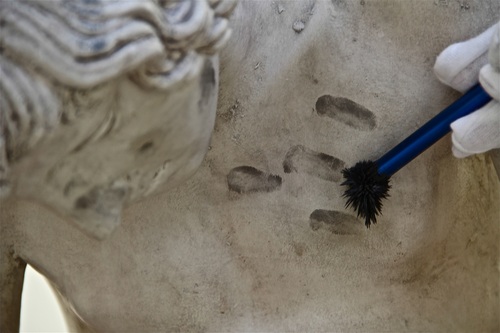
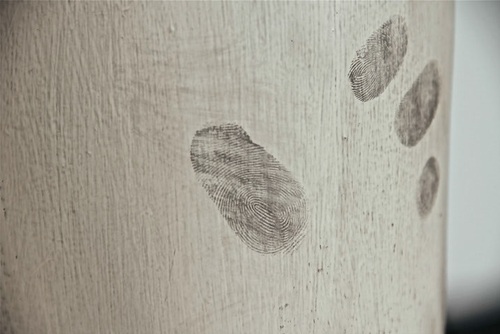
We all like to pretend that no-one touches the things in museums. Fact is, like it or not, people do. We have been working with ECA Postgraduate student Morgan Kinne for a little over a year to find a way for her to fingerprint parts of the ECA Cast Collection. We eventually found a solution that in no way harmed the casts and Morgan began dusting earlier this month. I’m delighted to say that this worked extremely well, as these images show. Morgan says of the project:
“I recently carried out a project in the sculpture court that involved myself dusting three of ECA’s plaster casts – Spinario, Dying Gaul and Castor and Pollux – for fingerprints. The prints reveal a part of the statues’ history that has gone unnoticed and stand as a record of the interactions between people and these statues and reveal a relationship between the art students and the art historical objects.”
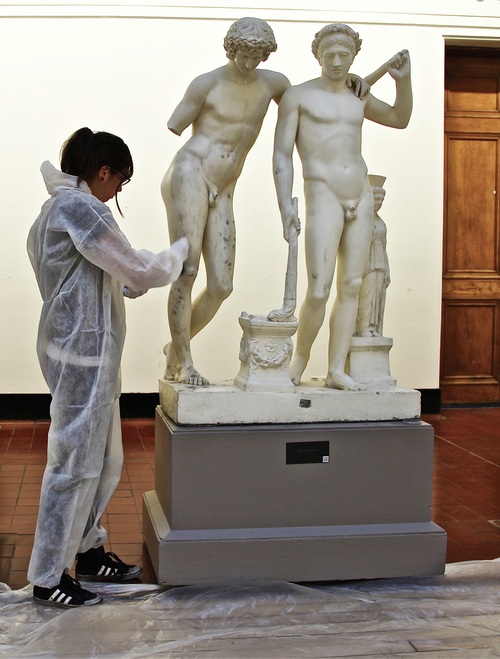
The Cast Collection at ECA was originally used for the purposes of formal drawing instruction at the College. While this is not the case today, projects like Morgan’s, and also Krijn de Koning’s Land, utilise the collection in exactly the same way – to support teaching and provide inspiration.
Collections
 Hill and Adamson Collection: an insight into Edinburgh’s past
My name is Phoebe Kirkland, I am an MSc East Asian Studies student, and for...
Cataloguing the private papers of Archibald Hunter Campbell: A Journey Through Correspondence
My name is Pauline Vincent, I am a student in my last year of a...
Hill and Adamson Collection: an insight into Edinburgh’s past
My name is Phoebe Kirkland, I am an MSc East Asian Studies student, and for...
Cataloguing the private papers of Archibald Hunter Campbell: A Journey Through Correspondence
My name is Pauline Vincent, I am a student in my last year of a...

Projects
Cataloguing the private papers of Archibald Hunter Campbell: A Journey Through Correspondence
My name is Pauline Vincent, I am a student in my last year of a...
Archival Provenance Research Project: Lishan’s Experience
Presentation My name is Lishan Zou, I am a fourth year History and Politics student....