Home University of Edinburgh Library Essentials
April 5, 2026
Trial – Loeb Classical Library Online

We have trial access to the Loeb Classical Library Online for 2 months.
The Digital Loeb Classical Library contains more than 520 volumes of Latin, Greek and English texts aiming to be a virtual library of all that is important in Greek and Latin Literature, epic and lyric poetry, history, travel, philosophy and oratory, medical writers and mathematicians, and the Church Fathers who make particular use of pagan culture. Readers can browse, search, bookmark, annotate and use a Greek keyboard.
Feedback and further info
We are interested to know what you think of this collection and platform as your comments influence purchase decisions so please do fill out our feedback form.
A list of all trials currently available to University of Edinburgh staff and students can be found on our trials webpage.
Update – we have now taken out a subscription
Conservation, with Honours
With Fresher Week just past, it seems fitting that this post should be based around diplomas – even if graduating does seem a long way off for these new students!

Archival Box containing rolled diplomas from ‘Toward Dolly’ Project.
Several months ago, I was presented with an interesting conservation challenge by ‘Towards Dolly’ Project Archivist, Clare Button, namely a box of tightly rolled diplomas and certificates. As Clare explains these are “certificates for many of Edinburgh’s leading biological scientists, giving an insight into their training, education and society memberships”. There are medical degree certificates for James Cossar Ewart who became Professor of Natural History at the University of Edinburgh in 1882, and who established the teaching of genetics in Edinburgh. There are also Alan William Greenwood’s undergraduate and doctoral certificates in Science from the University of Melbourne. Greenwood emigrated to Edinburgh in 1923 to study poultry genetics and he later became Director of the Poultry Research Centre. Finally, the honorary degree and association membership certificates for Charlotte Auerbach, a pioneering mutation researcher at the Institute of Animal Genetics, show the respect she garnered from colleagues and institutions around the world.
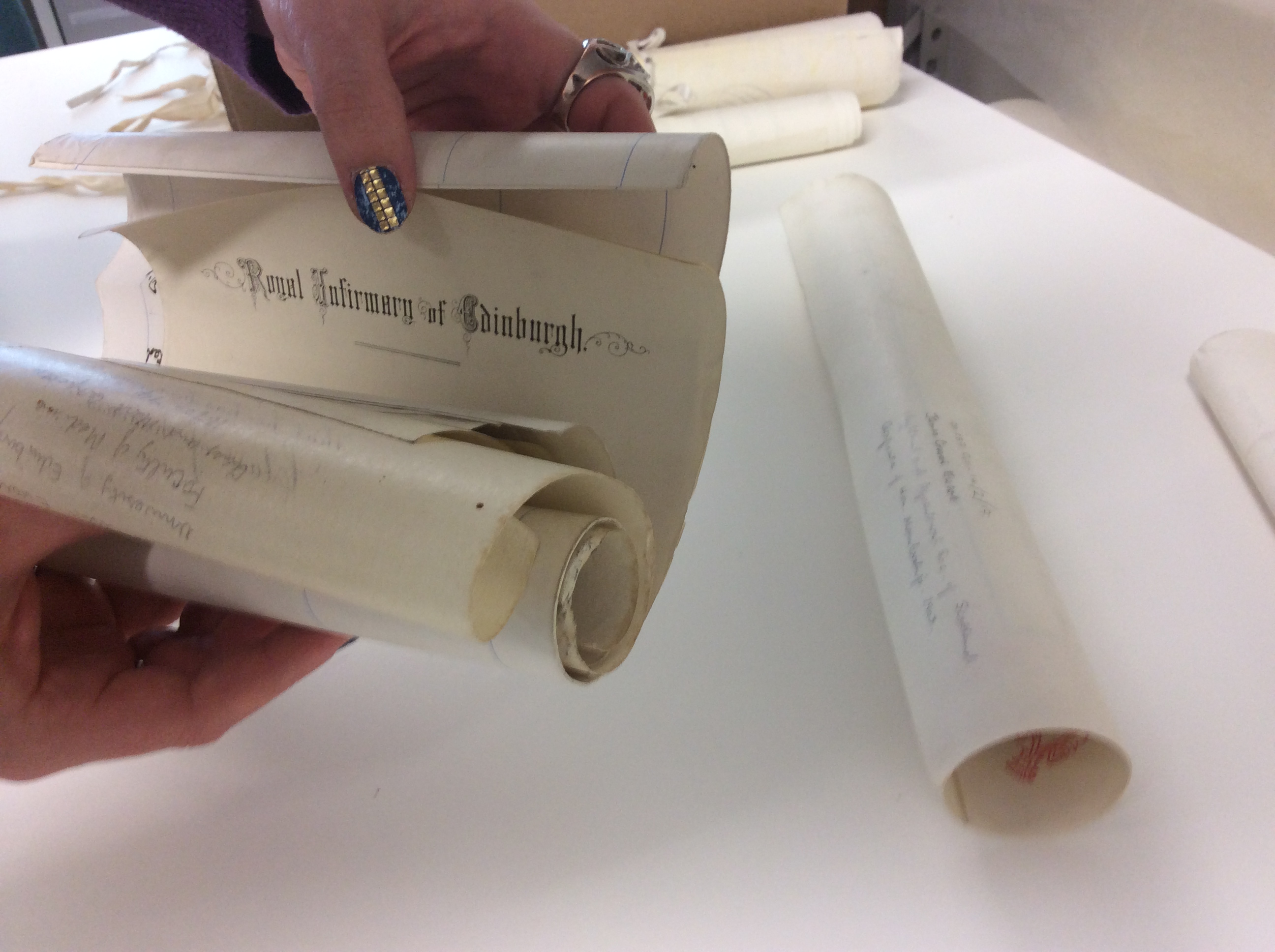
Rolled diplomas and certificates proving difficult to handle
The diplomas and certificates in their existing rolled format proved to be very difficult to handle and view, even with the aid of weights. This was particularly problematic in those rolls consisting of multiple documents, with anything up to eleven sheets – and undoubtedly it is always the one in the centre that is required! It was therefore deemed appropriate to unroll and flatten them in order to improve handling and enable them to be more accessible to potential readers.
On examining the documents, it soon became apparent that dry pressing the sheets would not be sufficient to flatten them satisfactorily. Prior to any pressing, the sheets would first need to be ‘relaxed’ through humidification – a method by which moisture is slowly and carefully introduced to the document in a controlled environment, relaxing the paper and slowly flattening the sheet. I humidified the objects by laying each document upon a layer of Gore-tex® which, in turn, is place on a sheet of non-woven fabric which has been wetted. The Gore-tex® acts as an interleaving layer and, due to its micro-porous nature, gently introduces moisture to the object above. Finally, a layer of transparent Polyester is placed above this set-up and, with the aid of weights, a make-shift chamber is created to maintain a humid environment. This method ensures moisture is kept to minimum, thereby lowering the risk of distortion or disrupting potential water soluble inks. A very close eye was kept on the documents during this process all the same….
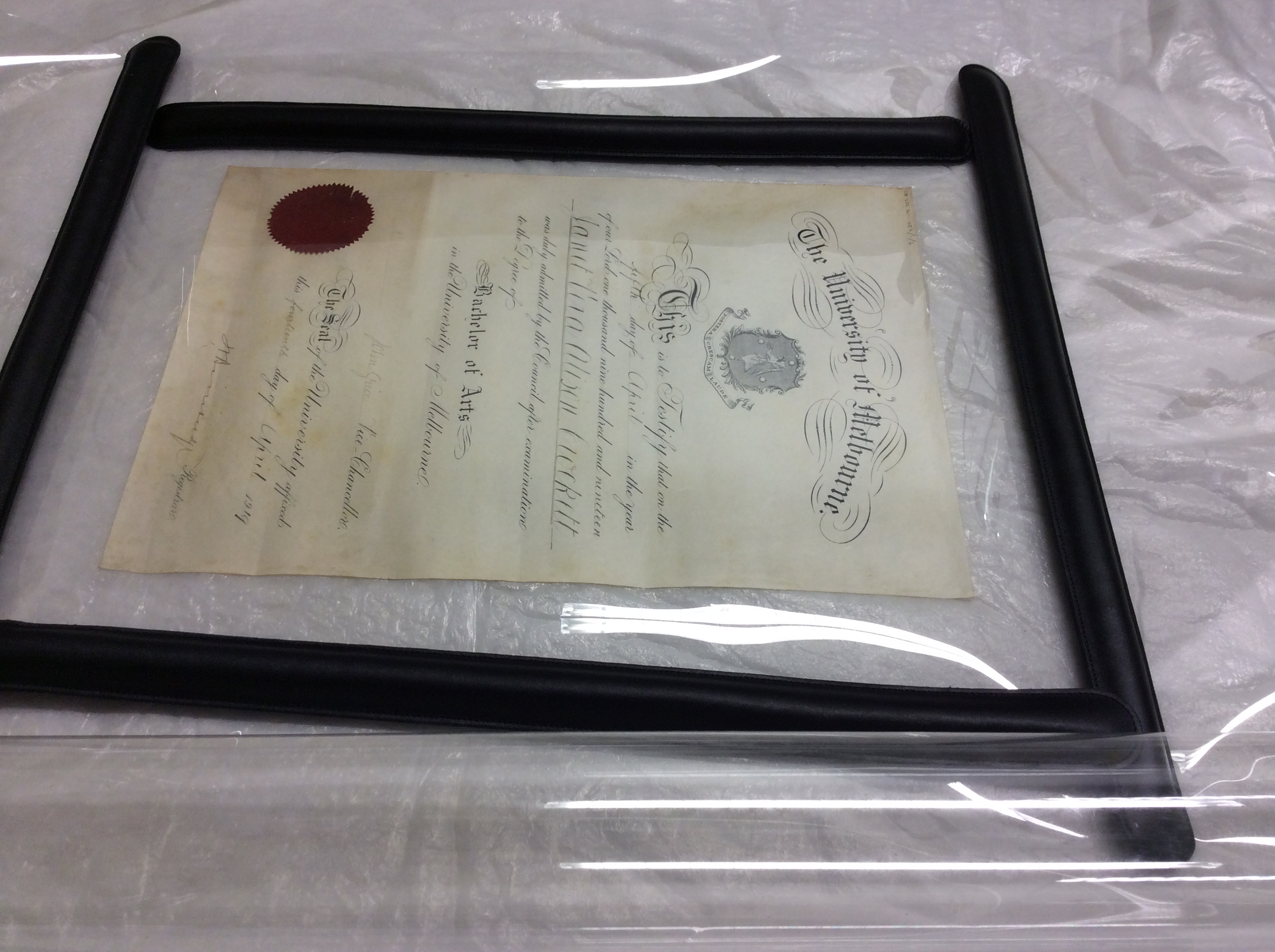
Humidification process
When the paper was suitably relaxed and unrolled, the diplomas were placed on a low pressure table which uses suction to remove excess moisture whilst gently restraining and manipulating the sheet to lay flat during this drying process. This is a quick (but very noisy) method, which was subsequently followed up with a period under weight in the press.
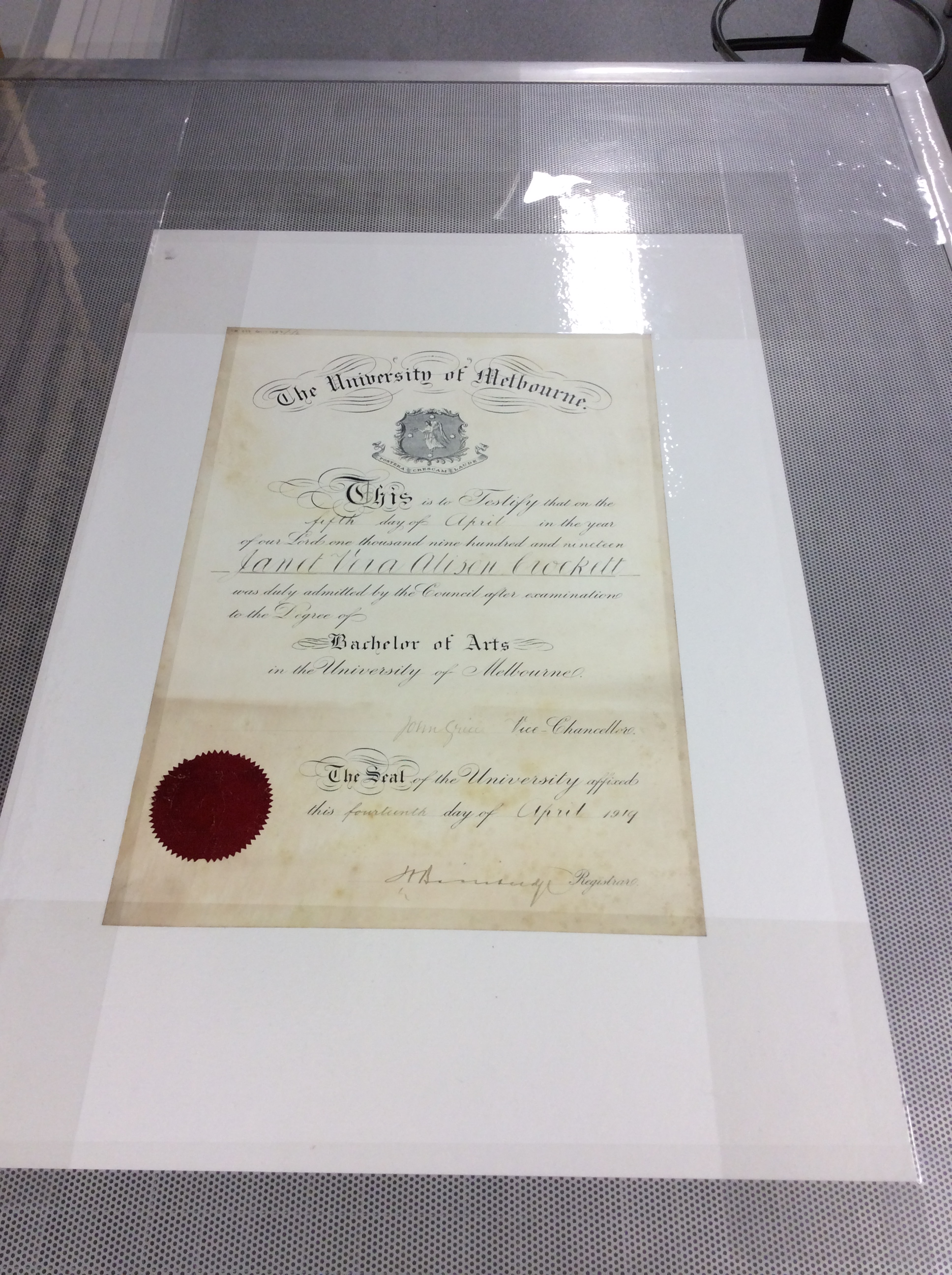
drying and flattening diploma on low-pressure table
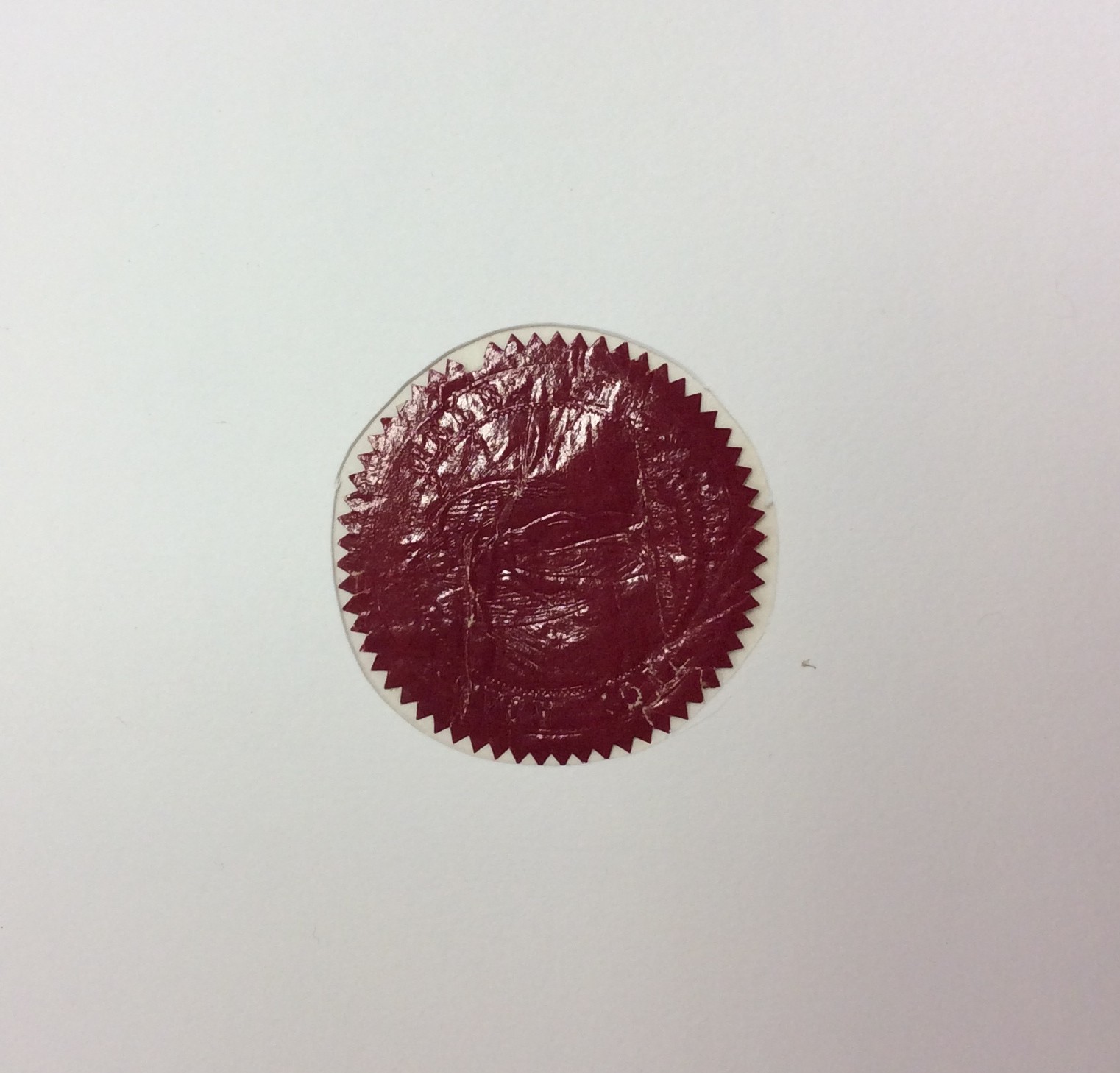
Blotter surround used to protect embossed seal during pressing
Whilst pressing, extra care had to be taken with those diplomas with embossed stamps or paper seals. Tracings were taken of the seals, the shape of which was cut out of the blotting paper used to sandwich the object during pressing. This ensured the rest of the sheet remained flat, whilst avoiding the stamps and seals in order to retain their raised design. The sheets were pressed for several months to ensure that the diplomas did not retain their ‘memory’ of their previous existence as a rolled document.
Once pressed, the final step was to place the diplomas and certificates into transparent Polyester sleeves, allowing them to be housed safely and, most importantly, flat in acid-free archival boxes. As Clare adds about the ‘Towards Dolly’ project, “these collections are not only an invaluable resource for research on the history of science and medicine, but they also speak to all of us by revealing the fascinating human story behind the science”.
Definitely something to remember when walking up to collect your graduation certificates….
There’s no business like show business
Tiina Lilja recently graduated in Drawing and Painting at Edinburgh College of Art. Earlier this year, we acquired two of Tiina’s paintings for the University Art Collection as she was an artist we had been following with interest for some time. As well as the physical art works, Tiina has been providing us with unique insights into her career after graduation so that we get a sense of her working life post-Art School. In the second of these updates, Tiina writes about the opening night of the ECA Degree Show and where she’s at now with her work.
On the evening of the 22nd of May, I was standing alongside my paintings, all dressed up, preparing for the biggest night of my life as an art student: the Opening Night of the Edinburgh College of Art Degree Show. I was suddenly incredibly aware how this was the day the work I had cradled in the safety of my studio would be exposed to an audience of strangers. I was not nervous… a little late for that. As it normally goes at times of extreme adrenaline levels, I was more focused on finer details i.e. did I order enough business cards and why was I not dressed in more comfortable footwear. My feet were killing me.
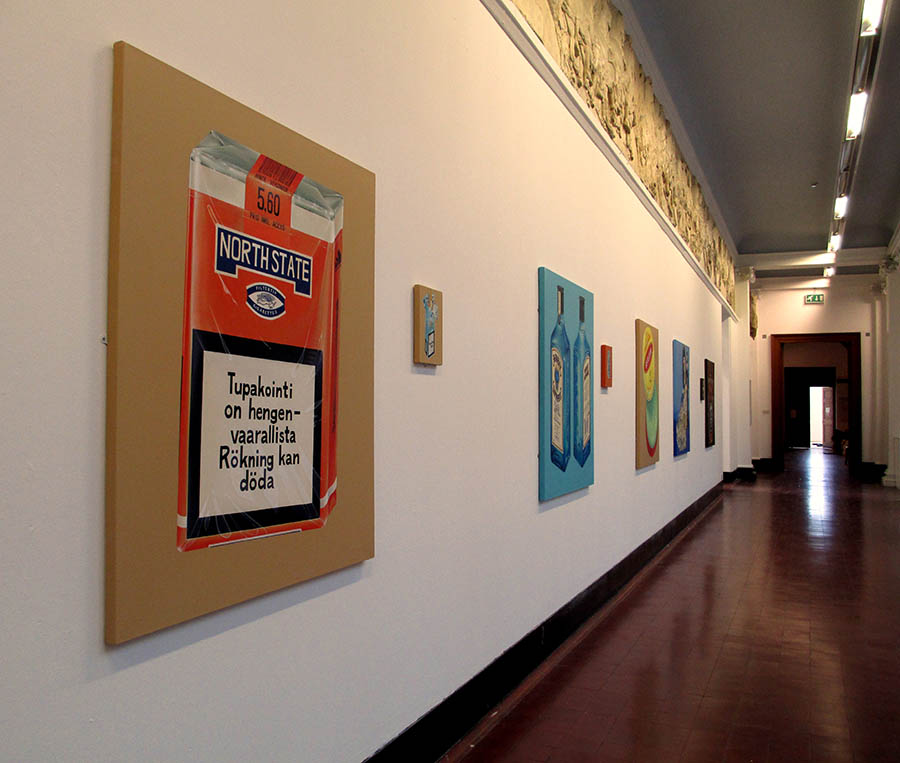
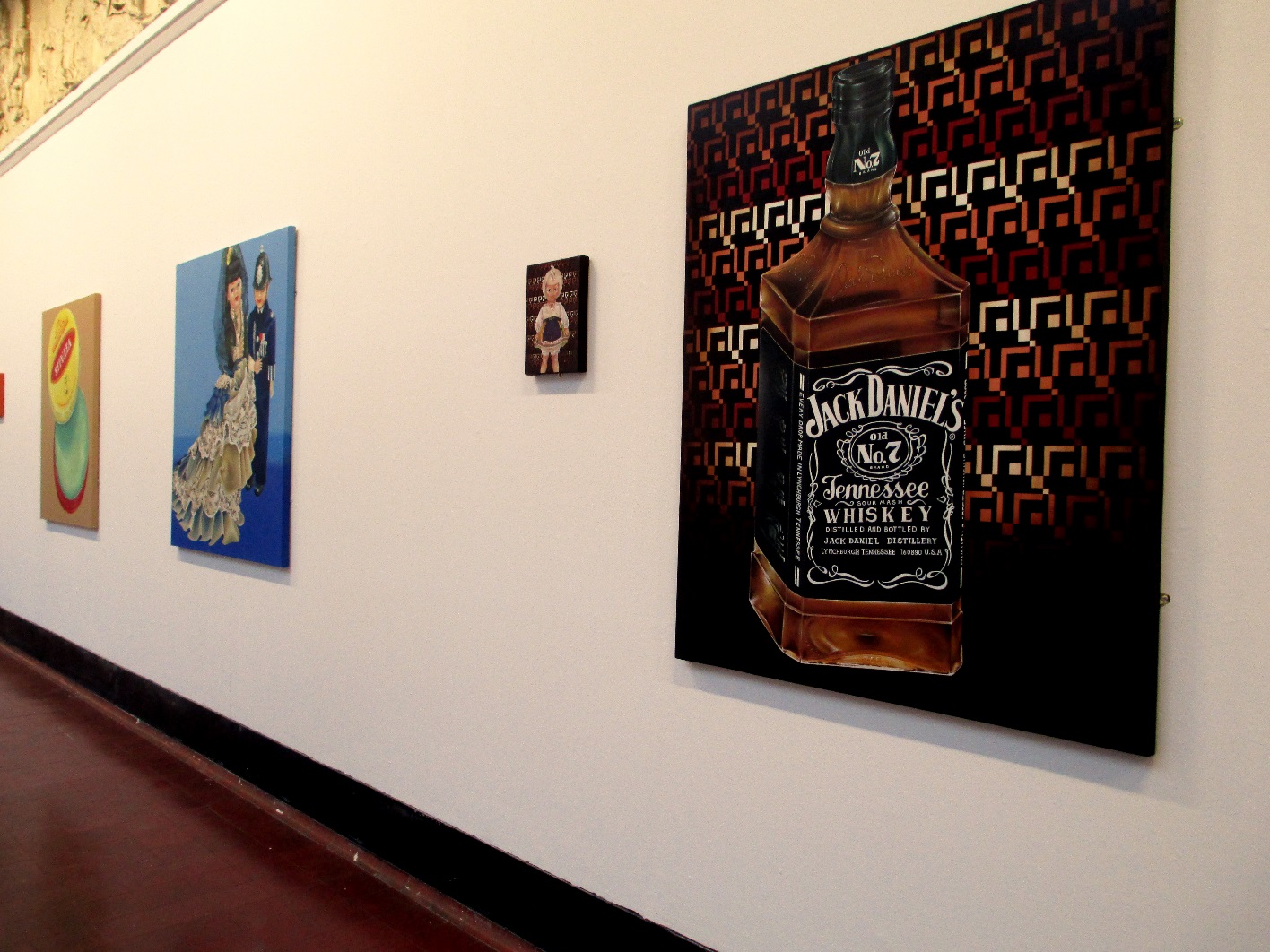
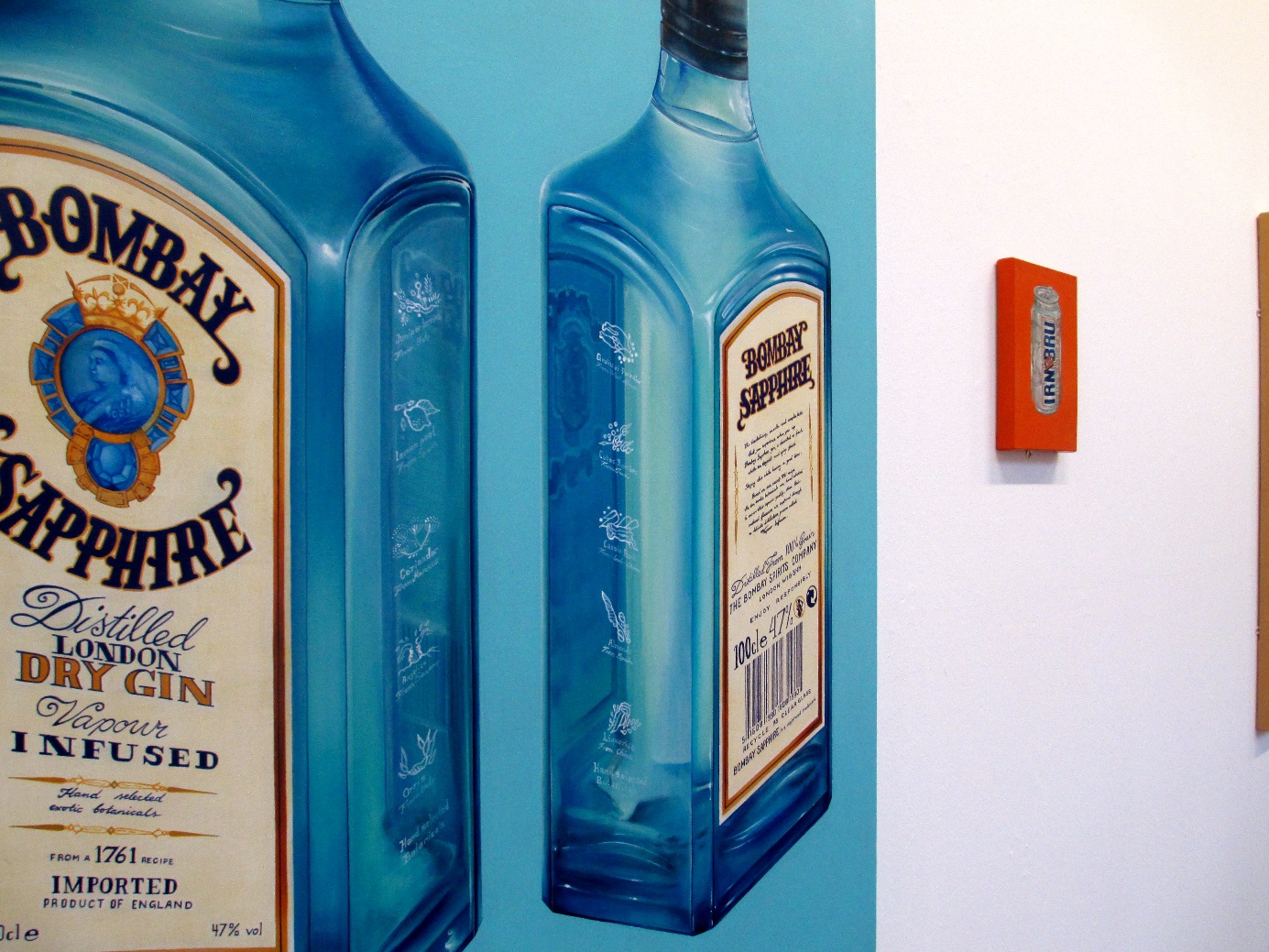
Overview of my year’s work in the Edinburgh College of Art Degree Show
The night rushed by: a lot of handshakes, introductions, congratulations and (shrug) selfies. The day concluded in the award ceremony of the annual Astaire Prize, me accepting one of the runner up prizes. (The nibbles were Waitrose by the way.) In fact, most of my fellow artists either sold some work, few for the first time, received awards or were invited into collectives or to show work in exhibitions. Yes, I do think we were a strong year – but in a major show like the Degree Show where all departments are represented, there is something for every taste. So remember to check it out next year!
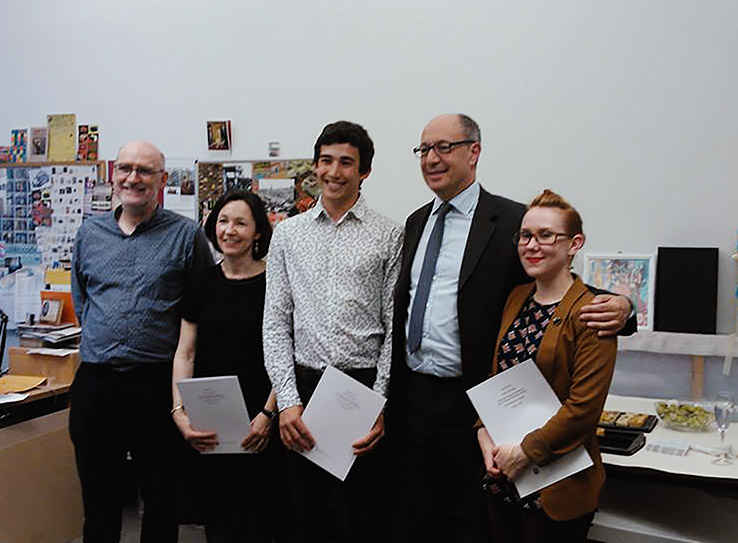
Award ceremony of the Astaire Prize: (From right to left) Me (runner up), Mark Astaire, Theo Shields (runner up), Magi Sinclair (first prize) and Gordon Brennan.
Couple months on, I think the experience was vastly educational. The reviews of the show were mostly encouraging, I made my mother proud by being mentioned by name in a couple of them – or the misspelled version of my name anyway, and so was the feedback. I met a lot of people that wanted to share their thoughts on my work and many more that did not. The average time a viewer spends in front of a piece seems to be less than you would take to choose between bottled and tap water! From the number of people who took my card, roughly every fiftieth got in touch – some thinking about buying or exhibiting my paintings, a few just to ask about my process of painting or the inspiration behind the pieces.
After the show was finished my work got some additional exposure by being kept up for the ECA open day, one last perk of having hung it in the Sculpture Court!
Friday the 13th of June marked the opening of the first exhibition I was in as a graduated professional artist, La Gallerie 1940’s Summer Exhibition and I also got to exhibit my Bombay Sapphire in Glasgow, at the Six Foot Gallery for their Best of The Degree Shows-exhibition. All these events are what makes the life of an artist seem so very glamorous – the tricky bit is to remember that this is only a small fraction of the job.
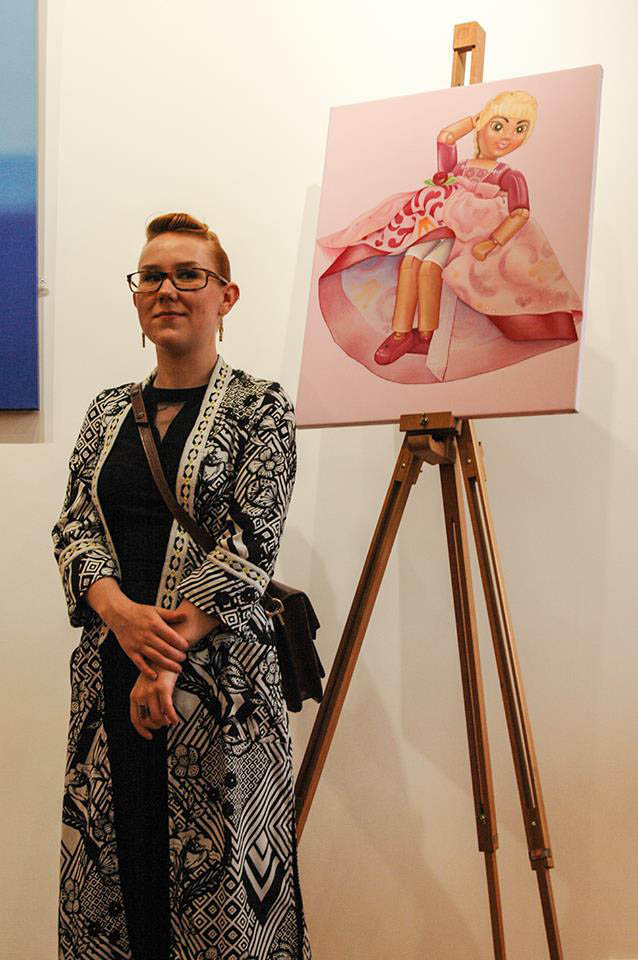
Opening night of the Summer Exhibition, La Gallerie 1940
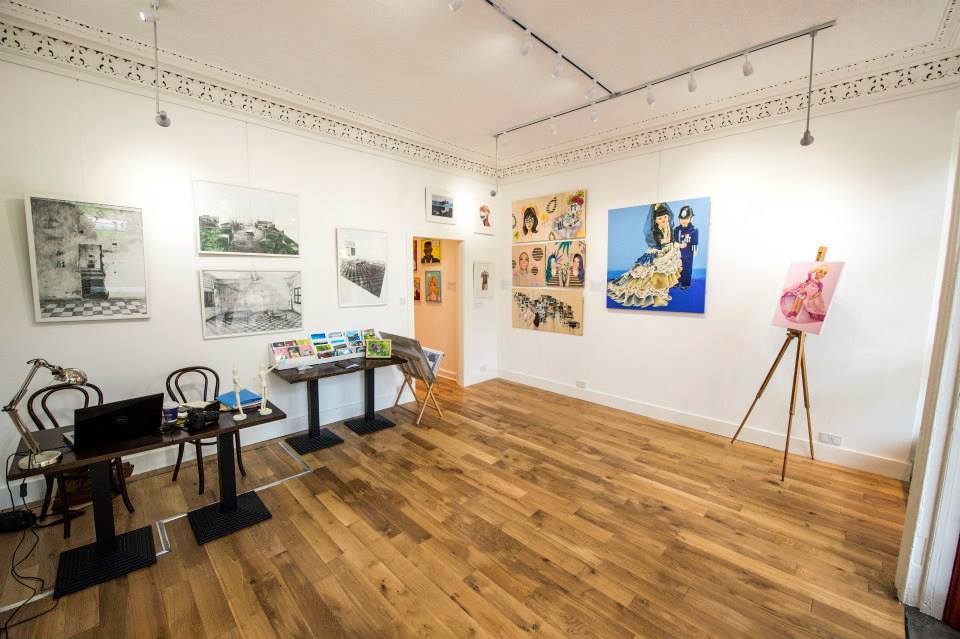
Overview of the Summer Exhibition
It was surprising to notice how many galleries are willing to exhibit the work of an emerging artist like myself. There appears to be a genuine interest from the public to see new art and fresh perspectives. But a word of caution: contemporary art world can be like the Project Runway: one day you’re in and the next day you’re out. The competition is fierce, the art market callous and the rights of an artist today leave a lot of room for improvement. Yet there is a whole community of creative people that are in it for the art: the passionate gallerists, curators, volunteers, producers… and the artists of course. That is what convinces me to keep painting. Blisters in the soles of your feet will heal and the feedback you get, how you analyse it, keeps you improving.
And what’s next? – I am settling into my new studio in the North of France, but that is a different story altogether.
Tiina Lilja
Cite Them Right – downtime Sat.20th
 Cite Them Right will experience downtime on Saturday 20th September between 9am and 5pm while the publishers migrate their content to new servers.
Resources Plus

Or: “How do I get hold of the book I need??”
Is the book you want already out on loan? Does the Library not have the book or journal you need? What’s the Library Annexe? If you have questions like these, read on…
Over the next few weeks, the library Helpdesk will be running a series of Pop-up Library sessions called ‘Resources Plus’. The idea of these sessions is for us to give out advice and show you how to get hold of resources that are either already out on loan, at the Annexe, or the Library doesn’t own or subscribe to. For example, this might include how to use the Interlibrary Loan system, the Request a Book service, or place a request on a book that is currently out on loan. We can also advise on using the SCONUL access scheme to visit other University libraries; and tell you all you need to know about visiting the National Library of Scotland for the first time.
And much more besides!
So if you have any questions about things you want, but can’t get – or if you just want to find out more for future reference, we’ll be on the first floor of Main Library this Tuesday (7th October), 2-4pm, and 2-4pm on Tuesday 21st October. Pop Up and see us!
Louise Gilchrist, Helpdesk Assistant, Main Library.
Referendum
So, what have our collections to say about the referendum? More than you may think. The Referendum is not an isolated event but sits within a historic time-line. Our collections intersect with that timeline at numerous points, directly and indirectly, and have a lot to say about the context of how we got to where we are now.
On Referendum day, join Dr Joseph Marshall (Head of Special Collections) and Grant Buttars (Deputy University Archivist) for a light-hearted look at some of these collection items. The session runs from 14.00-16.00.
To close, a hint of what might be included.


Smart Searching with Searcher
You have your reading list, so now how do you find those books, e-books and e-journal articles?
Don’t use Google, use Searcher!
Searcher is the Library’s discovery service – think of it like a library version of Google, searching the vast majority* of the Library’s resources at the same time, including books, e-books and e-journal articles.
Pop up to the 1st floor of the Main Library tomorrow, ask us how to find stuff on your reading list and we’ll give you some expert tips on how to use Searcher.
Pop up Library, Wednesday 17th September 2-4pm 1st floor, Main Library
- What is Searcher?
- How to find stuff on your reading list
- How to find books, e-books, ejournals and more
- What exactly am I searching?
* A wee disclaimer. Using Searcher you can search across the majority of resources the Library subscribes to. There are a few exceptions, notably Law databases: Lexis Nexis and Westlaw. Access Lexis Nexis and Westlaw via the Databases A-Z
Angela Laurins, Library Learning Services
St Cecilia’s Hall Museum of Instruments is now closed to allow redevelopment work to begin. We plan to re-open in September 2016
11th century Celtic Psalter – new book reader object in LUNA
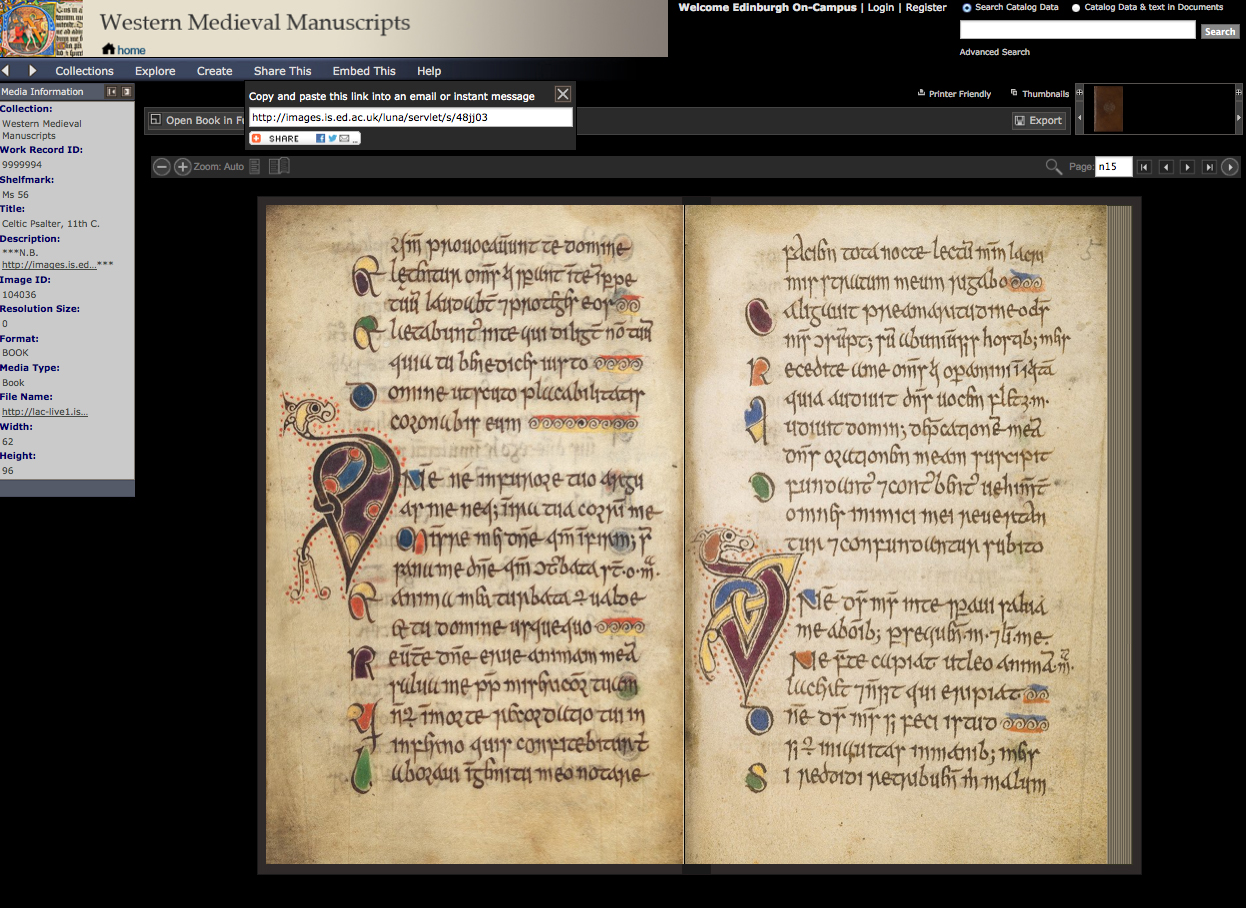
One of the real treasures of Special Collections is the 11th century Celtic Psalter (Ms 56)- at nearly 1000 years old, it is referred to as the oldest book in Scotland.
This beautifully-decorated manuscript is now available virtually, using the LUNA page turning software, so please take this opportunity to view it for yourself here. Please note, the images for book reader objects are reduced in resolution for ease of use, so if you wish to see the individual pages at full resolution, you can find them here.
The Digital Development team only did the last piece of work- getting it online. The hard work of measuring and cropping the existing TIFFs and getting them to snugly fit the needs of the software was all done by the Digital Imaging Unit.
Scott Renton- Library Digital Development
Fifty Shelves of Gray (and Nelson)

The Laird of Glenfernie by Mary Johnston (Nelson’s Continental Library)

Springtime by H. C. Bailey
While the cover of Fifty Shades of Grey displays a degree of restraint, publishers and consumers of the romance genre did not always have such a taste for understated dust-jackets. Instead, they favoured a more direct approach.

The Prize-Winner. A comedy in one act by Macdonald Watson (Repertory Plays. no. 86.)

The King’s Wooing by Conal O’Riordan (Repertory Plays No. 71)
In these examples from Gowans and Gray’s playbooks of the 1910s to 30s and Nelson’s Novels from the 20s onwards, it’s clear that previous generations wanted to get right to the action.

Marcella by Mrs. Humphry Ward
Over 500 books from the Nelson publishing archive have been shelf-marked and catalogued by rare books cataloguing interns Beth and Fiona. There are only around another 9,500 left to go!
The books in the collection reflect the decades of the 20th century- beginning with the staid, uniform editions of the New Century Library; progressing through stylish art deco illustrations; austere WWI and WWII paper; bright, pulpy dust-jackets from the ‘40s and ‘50s; and into rainbow-hued classics of the later decades.
Interesting examples of the changing book styles of the 20th century will be exhibited in the 6th floor display wall at the Centre for Research Collections next year.

The Thomas Nelson Archive contains these Gowans and Gray playbooks; a handsome series of repertory plays with fragile glassine dust wrappers.
Fiona Mowat and Beth Dumas , CRC Cataloguing Interns
Collections
 Hill and Adamson Collection: an insight into Edinburgh’s past
My name is Phoebe Kirkland, I am an MSc East Asian Studies student, and for...
Cataloguing the private papers of Archibald Hunter Campbell: A Journey Through Correspondence
My name is Pauline Vincent, I am a student in my last year of a...
Hill and Adamson Collection: an insight into Edinburgh’s past
My name is Phoebe Kirkland, I am an MSc East Asian Studies student, and for...
Cataloguing the private papers of Archibald Hunter Campbell: A Journey Through Correspondence
My name is Pauline Vincent, I am a student in my last year of a...
Projects
Cataloguing the private papers of Archibald Hunter Campbell: A Journey Through Correspondence
My name is Pauline Vincent, I am a student in my last year of a...
Archival Provenance Research Project: Lishan’s Experience
Presentation My name is Lishan Zou, I am a fourth year History and Politics student....