Home University of Edinburgh Library Essentials
April 6, 2026
Exhibitions site now live!
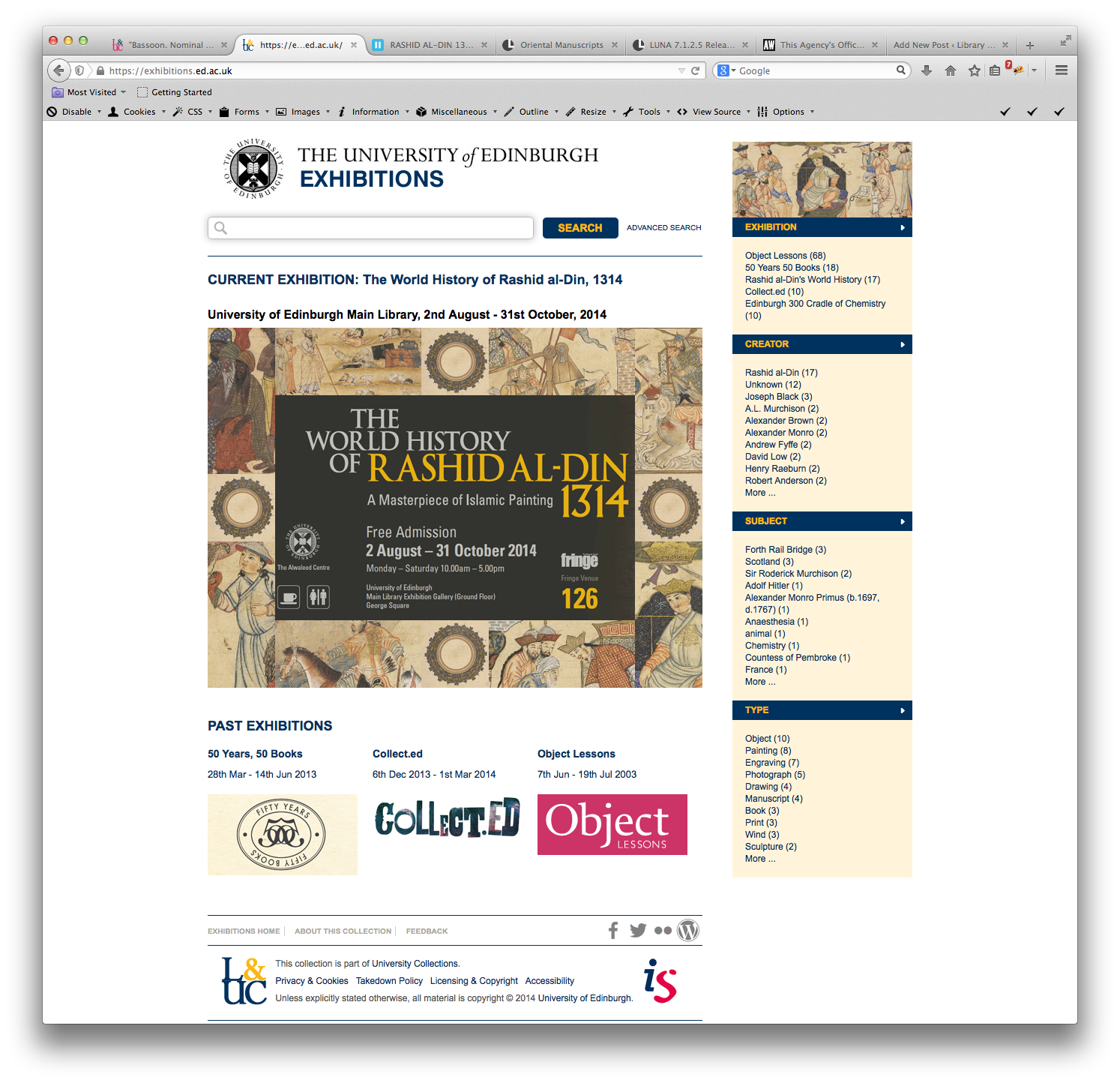
Development on our collections continues apace! Following on from the successful launch of collections.ed.ac.uk, we’re delighted to announce https://exhibitions.ed.ac.uk, which showcases displayed items from our current, and past, exhibitions.
Building on the same technology as collections.ed.ac.uk (Dspace + Skylight), our intention is to make available objects from the current exhibition (in this case Rashid al-din’s World History, which runs till 31st October), coupled with a look and feel which matches the exhibition’s branding. The site follows the collections.ed.ac.uk structure, which allows searching and facet browsing, and supports video and audio where appropriate.
Our intention is to relaunch the site in tandem with the physical show each time a new exhibition commences, and henceforth, the new material will be illustrated by photography from the people that we feel do it best: our own Digital Imaging Unit. From a development point of view, we like to think that the relatively quick turnaround of this site shows that the architecture we’re using is flexible and reusable; there are more such sites in the pipeline.
As many past exhibitions as possible will be sourced and searchable on the site. Currently, we’ve got data loaded for 50 Years 50 Books (2014), Object Lessons (2003), Collect.ed (2013) and Cradle of Chemistry (2013), with more exhibitions to follow. Watch this space for updates.
Thanks to Emma Smith, Gavin Willshaw and the CRC staff in general for helping make this a straightforward and enjoyable process.
Scott Renton- Digital Library Development
Postscript! The eagle-eyed (or people with absurdly high-performance memories) among you may recall we launched exhibitions.ed.ac.uk some time ago, for the 50 Years 50 Books show. This was a good interim solution which served that particular exhibition reasonably well, but it was hosted by Google, and there were a number of limitations as to how we could present our material. We knew we could take exhibitions to the next level with the in-house Skylight infrastructure, and that’s what we’ve done, but the Google site is still available from the 50 Years 50 Books homepage, should you be particularly fond of it!
Finding a thesis
Visit us today at the Pop Up Library on level 1 of the Main Library to get ideas and advice around theses. We’ll be there between 10am and noon.
- Learn what resources you can use to find out about theses on topics you’re researching.
- Find out how you can read a thesis you know is of interest.
If you can’t make it on the day, have a look a the Subject Guide to Theses or get in touch with your Academic Support Librarian.
Finding and using China-related library resources

Are you curious about China? Do you need to find relevant resources but don’t quite now where to start? Are you looking for primary sources?
If any of these questions have popped up, please come along on Monday, 6 October, 10-12pm to the First Floor of the Main Library for our Pop-up Library session!
 We will tell you all about both Western and Chinese language materials available through the Library. We will show you how to use our different databases on China, which contain both English materials (for example, British Foreign Office Files on China, Chinese laws, etc) and Chinese sources (classics, e-books, newspapers, journal articles, etc).
Whether you are just curious about China or need some help with a specific research question: we are there to help, so please ‘pop up’ to the First Floor on Monday!
Engage: #LibraryPop
Decanting
We are now well in to the decanting process and some of our much loved loans of works of art have gone back to their owners.


The clock, lent by the National Trust, has been carefully packed and returned to London and the paintings and prints from the National Gallery of Scotland have been collected.


We are very grateful to everyone who has loaned us items over the years which have helped to give St Cecilia’s Hall its period feel. The hall is looking rather bare now but we are at an exciting stage and things are moving along quickly.
Finding a thesis
Visit us at tomorrow at Library Pop Up on level 1 of the Main Library to get ideas and advice around theses. We’ll be there between 10am and noon..
- Learn what resources you can use to find out about theses on topics you’re researching.
- Find out how you can read a thesis you know is of interest.
If you can’t make it on the day, have a look a the Subject Guide to Theses or get in touch with your Academic Support Librarian.
Unique New College theses going digital
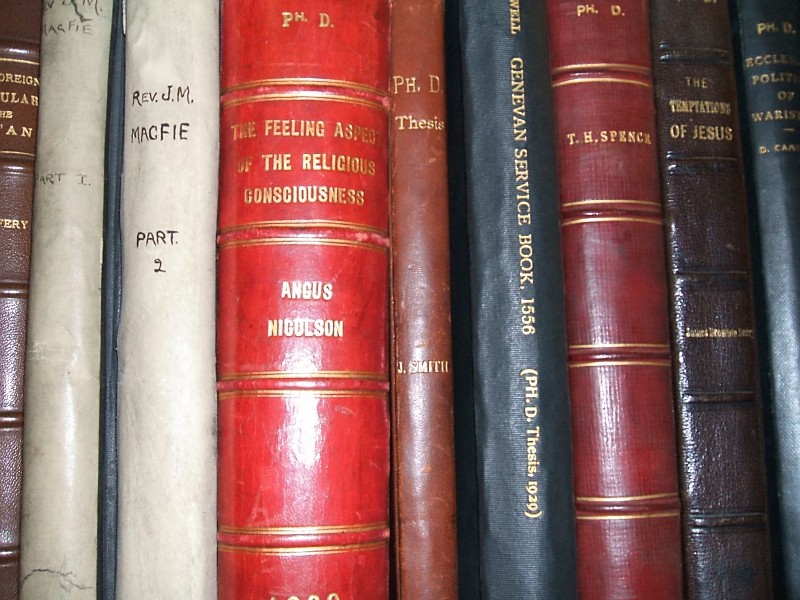 Over two hundred theses from the New College Library collection will soon be available online. We’ve been successful in a small project bid to digitise 200 theses dating 1921-1950. While later theses are held in 2 copies, one at the Main Library, we believe that New College Library holds the only copy of theses from this early period. Digitised theses will be uploaded to ERA, and the project is scheduled to be complete by January 2015. The New College Theses collection was catalogued online in 2012 as part of the Funk Projects. Please note that from now until January 2015, these theses will be unavailable to users whilst they are being scanned.
Christine Love-Rodgers – Academic Support Librarian, Divinity
Planning for Open Access in REF2020 – Some Thoughts
I’ve been back in the office a couple of days since Friday’s excellent workshop on implementing HEFCE’s policy and have finally had time to look at my notes and gather my thoughts. A number of good points were raised on the day, some of which I mentioned in yesterday’s blog post. Today I would like to think more specifically about what I would like to do here at the University of Edinburgh, to help prepare us for April 2016:
Firstly, it is clear that we need a detailed plan. I’m happy to start writing this up, but it will need plenty of input from other stakeholders within the University. The plan will need to identify a number of milestones and identify the pathway to achieving our goal of 100% of research publications being eligible for inclusion in the next REF. We need to think of this whole exercise as a project deliver it as such. We need to plan the work and then work the plan.
We will need to think carefully about the support needed to deliver the implementation of these requirements, and what the implications will be for staffing. We know from our experience with the University of Edinburgh’s Open Access Implementation Project that providing adequate administrative support (even at a junior level) can make a world of difference to the number of research publications added to a repository.
Marketing will be key. We are currently working on a design for a website which is aimed at delivering a simple message to academics regarding the new requirements and what they will need to do to ensure their work is eligible for inclusion in the REF. We plan to highlight that the task is an easy one (upload takes a couple of minutes) but that it is essential to make the upload at the right time and not put it off until later. Once the design is finalised, we are considering a campaign to send postcards all academics detailing the new policy and directing them to the new website. We hope to licence the text and design as CC-BY as part of the LOCH project to enable other universities to replicate it.
The Scholarly Communications Team is in the process of planning an advocacy campaign for the next two semesters and will aim to contact all Schools over the course of this academic year. We will write more about our experiences as these meetings take place.
Dominic Tate, University of Edinburgh
Art Exposed
A chance to experience rarely seen paintings and objects from the University’s Art Collection
*UPDATE: Now with added Paolozzi*

Recently we learned that the most searched for term on our brand new Art Collections website was ‘Male Nude’ – we’ve decided to go with the assumption that it’s all the Classics students taking their studies very seriously indeed…
But, in honour of all you weirdos out there, we’re giving you the chance to get up close and personal to the slightly racier side of the University’s Art Collection.
Anna and Jill will be around to talk to you about the items on view, how you can access the artworks yourselves, and also let you know about some of the brilliant volunteering opportunities available to anyone interested in curatorial or wider museum work.
So come along to the Art Collections Library Pop session tomorrow, we’ll be around from 10 until 3 in the 1st Floor reception area of the Main Library.
Search the collection: http://collections.ed.ac.uk/art
Follow us: @UoEArtArchives
Engage: #LibraryPop
Help ma’ BoB
An innovative online off-air TV and radio recording service for education
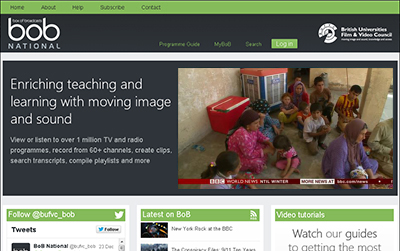
The University subscribes to BoB (Box of Broadcasts) National to help enrich teaching and learning with moving image and sound. BoB enables all staff and students to record any upcoming programme from over 60 TV and radio channels. It also allow users to search a growing archive of media (currently more than 1 million programmes).
We, the Main Library Helpdesk staff, are running 2 BoB sessions, as part of our pop-up library events. Please ‘pop up’ to the 1st floor, Main Library, to discover more about BoB National.
The 2 sessions will be on:
Thursday 2 Oct 2pm – 4pm
Thursday 16 Oct 10am – 12noon
We will demonstrate how to:
- access this service
- choose and record upcoming programmes
- request missed programmes from a 30 day buffer
- edit programmes into clips
- search BBC and other archives
- create playlists
- and much more!
Detailed information about this service is available at www.ed.ac.uk/is/bob
Rong Flynn, Helpdesk Assistant, Main Libary
SRUC: Another Institutional Repository
Scotland’s Rural College (SRUC) is the latest Scottish Digital Library Consortium (SDLC) partner to use our services to host their institutional repository. The SRUC are based at King’s Buildings, but have sites all over Scotland, and this repository hosts all of their research papers, which centre on all aspects of agriculture and rural issues. Currently they have opted against attaching PDFs of their papers to their records, but for the most part, Digital Object Identifiers (DOIs) are available, to summarise the research.
The repository is the first to be released using the DSpace 3.1 infrastructure, and, while this doesn’t look markedly different to our other repositories, there is improved functionality available for OAI_PMH (harvesting), batch import for various bibliographic formats, and statistics (based on Solr indexing).
The URL for the new repository is openaccess.sruc.ac.uk. Let us know what you think!
Thanks to Theo Andrew for guidance on data mapping, and for assisting in training the SRUC staff. Thanks also to Jarlath Flynn, Heather Shirra and Rachel Atkinson from SRUC for their assistance in getting everything implemented.

SRUC Repository
Scott Renton- Digital Development
Collections
 Hill and Adamson Collection: an insight into Edinburgh’s past
My name is Phoebe Kirkland, I am an MSc East Asian Studies student, and for...
Cataloguing the private papers of Archibald Hunter Campbell: A Journey Through Correspondence
My name is Pauline Vincent, I am a student in my last year of a...
Hill and Adamson Collection: an insight into Edinburgh’s past
My name is Phoebe Kirkland, I am an MSc East Asian Studies student, and for...
Cataloguing the private papers of Archibald Hunter Campbell: A Journey Through Correspondence
My name is Pauline Vincent, I am a student in my last year of a...

Projects
Cataloguing the private papers of Archibald Hunter Campbell: A Journey Through Correspondence
My name is Pauline Vincent, I am a student in my last year of a...
Archival Provenance Research Project: Lishan’s Experience
Presentation My name is Lishan Zou, I am a fourth year History and Politics student....