Home University of Edinburgh Library Essentials
April 10, 2026
Research Data Spring – blooming great ideas !
The University of Edinburgh have been busy putting ideas together for Jisc’s Research Data Spring project, part of the research at risk co-design challenge area, which aims to find new technical tools, software and service solutions, which will improve researchers’ workflows and the use and management of their data (see: http://researchdata.jiscinvolve.org/wp/2014/11/24/research-data-spring-let-your-ideas-bloom/).
Library and University Collections in collaboration with colleagues from the University of Manchester have submitted an idea to prototype and then develop ann open source data archive application that is technology agnostic and can sit on top of various underlying storage or archive technologies – see: http://researchatrisk.ideascale.com/a/dtd/Develop-a-DataVault/102647-31525)
EDINA & Data Library have submitted two ideas, namely:
A ‘Cloud Work Bench’ to provide researchers in the geospatial domain (GI Scientists, Geomaticians, GIS experts) with the tools, storage and data persistence they require to conduct research without the need to manage the same in a local context that can be fraught with socio-technical barriers that impede the actual research (see: http://researchatrisk.ideascale.com/a/dtd/Cloud-Work-Bench/101899-31525)
An exploration of the use of Mozilla Open Badges as certification of completion of MANTRA (Research Data Management Training), a well-regarded open educational resource (see: http://researchatrisk.ideascale.com/a/dtd/Open-Badges-for-MANTRA-resource/102084-31525)
Please register with ideascale (http://researchatrisk.ideascale.com/) and VOTE for our blooming great ideas!!
Stuart Macdonald
RDM Service Coordinator
Downtime alert – Emerald insight
 Emerald Insight will be unavailable for up to 2 hours on Friday 9 January 2015, between 23:00 GMT and 03:00 GMT. This affects both e-books and e-journals. If you access the website during this time you will receive a ‘connection timeout’, or similar message, within your browser.
Looking back, looking forward
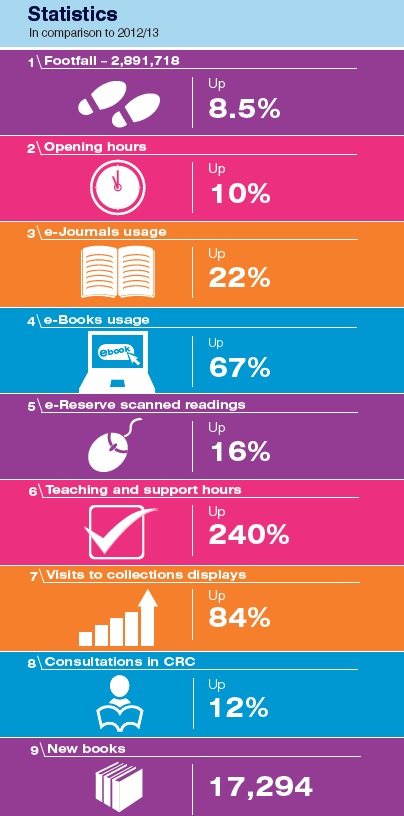
At the start of a new year, it is always nice to think back about the achievements of the previous year, and what lies ahead in the coming year. Not only is it good to think about what we have done, it is also important to consider the impact it has had. In order to do this, Library & University Collections published a Impact Report for 13/14 at the end of last year. It is great to be able to see the range of services the Library provides to the University, and how this contributes to the work of the institution.
Here are some highlights from the report, which can be viewed online as a PDF, or picked up from one of our libraries:
High Quality Collections
- University’s rare and unique collections now discoverable online at collections.ed.ac.uk
- Satisfying over 13,000 Interlibrary loan requests
- Providing access to over 50,000 e-journals and 365,400 e-books… any time, any place
- More than 15,600 books acquired in response to user requests
- Preserving and making accessible UNESCO- awarded HIV/AIDS collections
- 2,400 new hi-resolution photographs added to collections.ed.ac.uk
- The National Student Survey showed 90% of our students felt our physical and online collections met their study needs
Delivering Excellent Services
- Acquired more than 700 books and prepared over 5,000 journal articles for submission to REF 2014
- Helped the University achieve a 64% RCUK Open Access rate with 30,000+ full text items now held in our repositories
- HLF-funded collaboration with RNIB Scotland to improve access to archives for blind and partially sighted people
- Library opening hours extended in response to student feedback
First Rate Engagement
- Libraryblogs.is.ed.ac.uk: sharing our projects, services and collections
- @EdUniLibraries: building relationship networks on social media
- Engaging with students at Innovative Learning Week: seven events attended by over 100 people
- 24 interns and 70 volunteers gave us 15,000 extra hours’ work on our collections
- Rashid exhibition showcased the Library’s rarest manuscript
Attracting External Investment
- £820,000 secured from Heritage Lottery Fund for St Cecilia’s Hall redevelopment
- Five Wellcome Trust funded projects supported
- Europeana Cloud secured €37,000 in funding from EU programme
- £33,000 awarded by Jisc for the ‘Lessons in Open Access Compliance in Higher Education’ project
The coming year will be an exciting one for Library and University Collections. Many of our programmes will continue, and our exhibition schedule is already planned, including “Out of the Blue” – a celebration of the colour blue highlighting a mixture of interesting and thought provoking items from our collections. We will continue to provide access to a growing number of online collections through our showcase website collections.ed.ac.uk
We will also be undertaking some major projects, including the procurement and implementation of a new Library Management IT System. This will enable us to further enhance the student experience of Library course collections, utilising new approaches in how we provide access to e-resources. Such projects will enable us to review and streamline many of our internal processes, continually improving the library services that we offer.
Building work will begin on St Cecilia’s Hall early in the new year, embarking on a £6.5 million refit and renovation to create a world-class museum to house and display our important collection of historical musical instruments.
These are only a few of the highlights that we look forward to delivering over the coming, very exciting, year as we continue to provide high quality collections, and deliver excellent services and first-rate engagement.
Stuart Lewis
Acting Director of Library and University Collections
Jisc MediaHub – ETV collection reinstated
 We have received notification from JISC that the ETV (Educational and Television Films) Collection which had been removed from Jisc MediaHub following the end of the licence period has now been reinstated for a further 12 months.
The collection contains 100 hours of films from the political Left from around the world and can be accessed via the JISC MediaHub link on our database A-Z list.
The Unfamiliar: new issue published
The Unfamiliar has published its new issue, Imagining the Future, on the library-supported journal hosting service.
The Unfamiliar: Imagining the Future
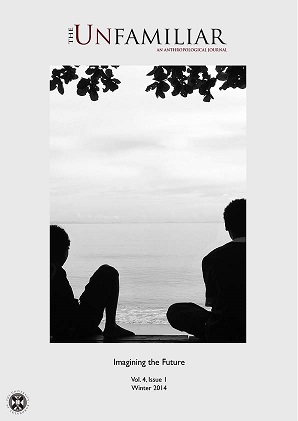
As with past issues, authors have used many of their own photographs to illustrate essays and poems.
This is the first issue produced by the new editorial team , so special congratulations go to executive editors, Inna Zlatimirova Yaneva-Toraman and Hakon Caspersen for all their hard work in taking on the role and producing another excellent issue of the journal.
About The Unfamiliar
The Unfamiliar is a student-run anthropological journal based at the University of Edinburgh. It is dedicated to publishing a wide variety of material, featuring not only academically informed articles and book reviews but creative work such as poetry, photographic essays, and audio-visual projects. Emphasis is on integrating creative and visual work, and publishing and editorial policies reflect the journals’ commitment to make anthropology more widely accessible. The Unfamiliar believes that anthropology should no longer be read and appreciated solely by anthropologists, but benefit broader audiences as well.
About the Journal Hosting Service
The University of Edinburgh Journal Hosting Service uses the open source software; Open Journal Systems (OJS), to support academics and student groups who want to publish online open access journals. Journal Hosting Service homepage.
Angela Laurins, Library Learning Services Manager
P6 Visitors from St Mary’s Primary
A few weeks ago the Library hosted two visits from the two P6 classes of St Mary’s school. Their topic was “Scotland’s Timeline” (I can interpret historical evidence from a range of periods to help to build a picture of Scotland’s heritage and my sense of chronology SOC2-02a) and were studying Kidnapped by Robert Louis Stevenson in order to find out more about Edinburgh and Scotland in the eighteenth century. As Robert Louis Stevenson was a graduate of the University of Edinburgh, this made a good starting point for their visit.
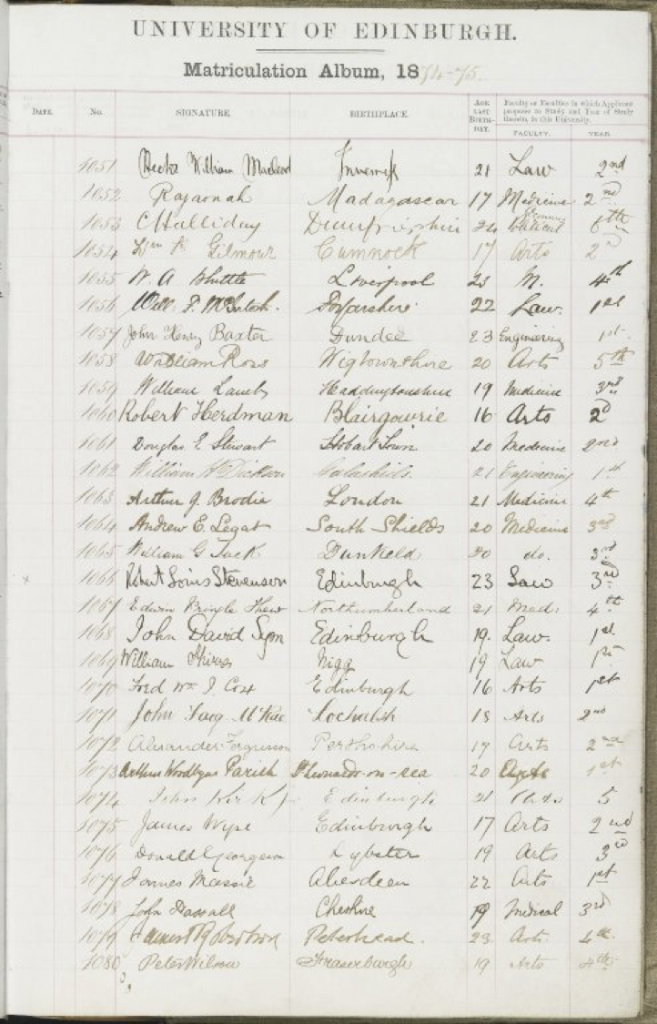
The Matriculation Album of 1874, showing Robert Louis Stevenson’s signature as he entered the 3rd year of his Law degree (he originally studied Engineering when he first joined the University)
As well as seeing a matriculation album with Robert Louis Stevenson’s signature, they examined an early copy of Kidnapped, some of source materials that were used as background for the book, the Barker panorama of Edinburgh, and Münster’s Cosmographia, by Elizabeth Quarmby Lawrence, the Library’s Assistant Rare Books Librarian.
Following this, they enjoyed a workshop led by Sarah Deters, our Learning and Engagement Curator. The workshop examined the development of bagpipes over time, and concluded with an exercise to turn a straw into a playable reed!
The children kindly wrote thank you letters for us, saying which parts of the visit they most enjoyed, and added a few extra questions. Rather than replying directly to the class, we thought we’d share the great questions and answers on this blog…
| Question | Answer |
| How old is the library? | The Library building that you visited is known as the Main Library. It was opened in 1967. However the University’s main Library service has operated from other buildings in the past, such as the Playfair Library which is part of the Old College building, built in 1827. The Library service dates back to 1583 when the University was opened, although the first collection of books was donated in 1580 by Clement Litill. |
| Can we visit again? | Yes! You would be very welcome to visit again. The Main Library, along with many other University buildings are open for visitors during the annual Doors Open Day event, whilst special group visits such as yours can be arranged. Please get in touch! The main library also has an exhibition gallery, which is open to the public and has different exhibitions in it all year round. When you visited one exhibition had just finished and the next one not yet started, so you didn’t see it. Look on our web pages to see what’s on. |
| What is your favourite book? | Elizabeth – Mine changes every week! But the Wode Psalter is pretty good, and you can look at it online. |
| What is your favourite instrument? | That is hard to answer! I love the sound of many different instruments, especially the piano and the trumpet, but my favourite instrument in our museum is a beautiful instrument from India. The instrument is shaped like a peacock, but is a type of string instrument called a mayuri. You can see a picture of it here: http://collections.ed.ac.uk/mimed/record/17372 |
| Why do you enjoy old books more than newer books, and which historic authors do you enjoy reading? | I like old books because I am fascinated by what people in the past knew, and how they thought about it. I also love learning about how books were made, and understanding how and why they were printed and bound as they were. This can often tell us almost as much as the text. Reading historical novels was one of the things which made me interested in this sort of thing. When I was young I used to read Rosemary Sutcliffe’s books, which are mostly about the Romans in Britain. Cynthia Harnett is another good one – she used books and objects from the past to get her inspiration, and was very good at explaining how people thought and how things worked. Try ‘The Woolpack’ or ‘A Load of Unicorn’ (which I really like because it is about printing!) |
| What do you like about music? | I like that music is something everyone can enjoy. Whether you sing, listen to music, or play an instrument that is a way of enjoying music. They say that music is a universal language and I think that is a wonderful thing. |
| Did you enjoy us visiting? | We were very glad that you visited. We enjoy explaining what the University does, and the role that the Library plays in University life. We support students as they learn, researcher as they make new discoveries, and the public as they find out more about what the University does. |
| What is the most interesting part of your job? | All of it! One of the most fun things is choosing books to buy – we are sent catalogues by booksellers and go through them looking for things we think fit into the collections and which someone might find interesting and want to study. |
| Why do you have a lot of students at lunch time but not many in the morning? | The Main Library is open from 7:30 in the morning until 2:30 at night. Each day we have over 5,000 people comes through the door. The building starts to get busy at 9am, but more students arrive each hour as lectures finish. 1pm is the busiest hour for people coming into the building. |
| Do you have any harps in the Library? | We do. We have 7 harps that were made in Europe in our collection as well as different types of harps from around the world. These harps from from Africa, Asia, and America. |
| What is the oldest book in the Library? | The oldest printed book is Chinese – ‘Zhou yi zhuan yi da quan’ [Complete commentaries on the Yi Jing], printed in 1440. We have manuscripts (that is books which were written by hand) going back to the 10th century. |
| How did you collect all the books and artifacts? | Some of the books the University has bought – since it was founded in 1580 a lot of the books which were originally ordinary books used by students have become very old and rare. Today the library buys most of its new books for students as e-books, but we do still buy special books for the rare books and manuscripts collections. The other way that books arrive is by being given to the library. When the University was founded, Clement Little, an Edinburgh lawyer, gave the library 276 volumes, to get it started. Lots of other people have given things since. There was also a time, about 200 years ago, when Edinburgh University Library was a “Copyright Deposit Library”, which meant that all British publishers were supposed to give one copy of everything they published. It didn’t work out as well as it sounds, and quite soon was stopped, but we still have a lot of the books. |
| What is the oldest object that you have? | Sarah – the oldest instrument in our collection is a recorder made in 1510. Elizabeth – we have some scraps of papyrus, which are about 2000 years old. |
Stuart Lewis – Deputy Director, Library & University Collections
Serena Fredrick – Student Support Officer
Elizabeth Quarmby Lawrence – Assistant Rare Books Librarian
Sarah Deters – Learning and Engagement Curator
Research Data Management – Workshop in Japan
In November I was privileged to be invited to Japan by the National Committee for the Promotion of Institutional Repositories, to speak at their meeting being held as part of the annual Library Fair and Forum in Yokohama. The subject of the workshop was the role of libraries in Research Data Management.
While visiting Japan, I was lucky to be looked after by many wonderful hosts, and was able to have tours of other university libraries. The first was Tokyo University, where I met the University Librarian (Kousuke Okabe), their Digital Library Manager, and several other senior support staff:
The General Library, which serves students and the faculty of all campuses, has roughly 1.2 million books and 1,144 seats, making it the largest library in the system. The present building was constructed in 1928 with a donation from John D. Rockefeller, Jr. after the old building was completely destroyed by the Great Kanto Earthquake. A red-carpeted grand stairway, sculpted arches, and other striking accoutrements lend the library a stately atmosphere. From: http://www.u-tokyo.ac.jp/en/about/library.html
Their collections amount to over 9 million books (almost three times as many as the University of Edinburgh!), and at present they are starting to build a new underground automated store which will be about 50 metres deep and will contain 48 kilometres of shelving. On top of this will be built a new Library Commons.
-
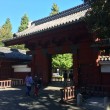
- Tokyo University Akamon Gate
-
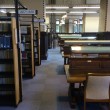
- Tokyo University Main Library
-

- New underground 48KM automated store being built
Following the tour I was taken to the University of Tsukuba by Professor Itsumura, and Ui Ikeuchi (PhD candidate at Graduate School of Library, Information and Media Studies) where we met Dr Mizuki Oka and Dr Kazutsuna Yamaj. The University of Tsukuba is a campus University, 4km long with four libraries. We visited the Main Library and met with the Deputy Librarian, and were given a tour by the Help Services Supervisor. Following this various library staff, along with staff from the Graduate School of Library, Information and Media Studies met to discuss issues relating to repositories, research data management, and open access publishing.
-
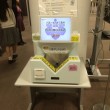
- Self-issue machine
-
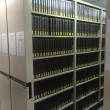
- Electronic automated compact shelving
-

- Tonkatsu meal
The next day consisted of a meeting with the workshop’s organising committee, including a rehearsal of my presentation. This was particularly important, as the talk was delivered simultaneously in English and Japanese and Keiko Matsuo, my interpreter, needed to make sure she understood the intricacies of some of the library-specific terminology. This was followed by a meal with the committee members. They used the meal to announce that two members will be able to attend the IDCC 2015 conference in London, where Research Data Management will be a major topic of the conference.
The following day was the conference itself, held in the Pacifico Yokohama conference facility. The presentations all centred around themes of Open Access and Research Data Management. My presentation described the RDM programme at the University of Edinburgh, the systems we use and have developed, and some of the lessons we have learned along the way. The was followed by a post-conference celebration, including an ‘escape quiz’ and drinking the present of a bottle of Talisker whiskey that I took as a present for the committee.
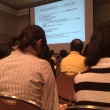
Overall the experience of visiting Japan and learning about their libraries, research data management, and open access was excellent. I am very grateful to the committee for inviting me (in particular Yui Nishizono and Shiori Nakamura for helping to arrange the trip), for everyone who hosted me and arranged visits (in particular Hiroshi Itsumura and Ui Ikeuchi who kindly drove me between Tokyo, Tsukuba, and Yokohama) and for the many people I met who made me feel very welcome!
Stuart Lewis, Research & Learning Services
Merry AnneXMAS!
Merry Christmas from Edinburgh’s Library Annexe!
Here are a few festive images from some of the books that can be found within our general lending collections:


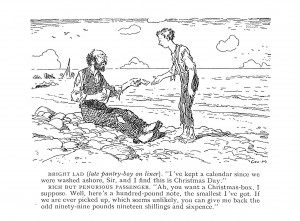

Images are taken from the following Library Annexe books:
I Saw Esau by Iona and Peter Opie
The Twelve Days of Christmas by Miles and John Hadfield
The New Punch Library: Round the year with Mr. Punch
Previously, in Conservation…
There have been many highlights in conservation over the last 12 months, but one of the most enjoyable for me has been the opportunity to take part in outreach activities, whether it’s been writing blog posts, participating in studio tours and visits, holding conservation training days, or representing the University’s conservation department at various local and national festivals.
In October of this year, we were able to leave our natural habitat of the studio when asked to take part in the Midlothian Science Festival. Emily Hick (LHSA project conservator) and Vanessa Johnson (a conservation student and previous blog contributor) ran a booth that demonstrated how conservators can use Ultra Violet light to identify pigments which in turn can assist in informing an artworks treatment plan or long-term preservation needs. Using various pigments that absorb, reflect or fluoresce under UV, the participants were encouraged to draw pictures and then examine them in a dark tent under UV and describe how they changed. As Emily says, the “kids loved seeing their paintings transformed, and learnt that science isn’t all about test tubes and chemicals, but can be used in art as well!” 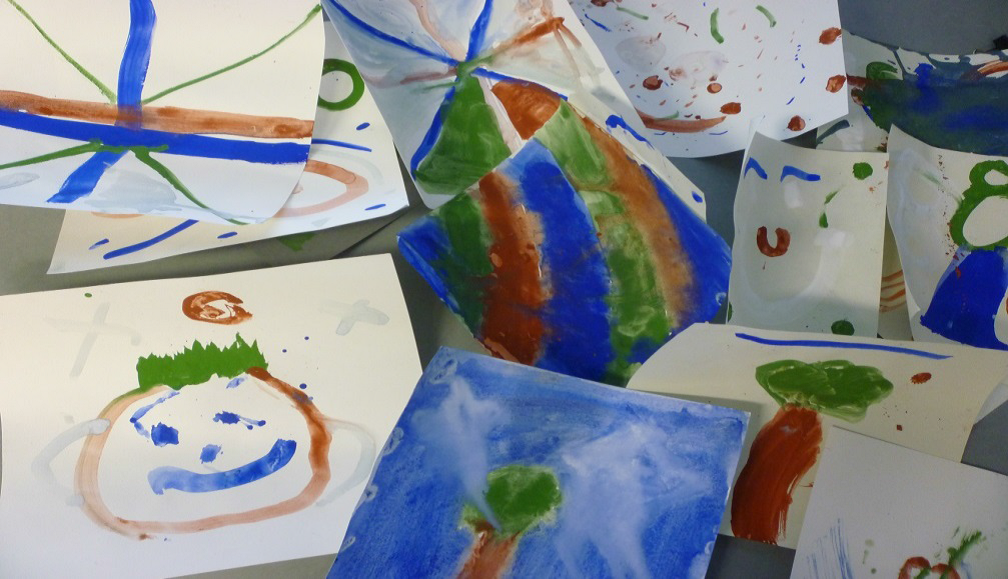
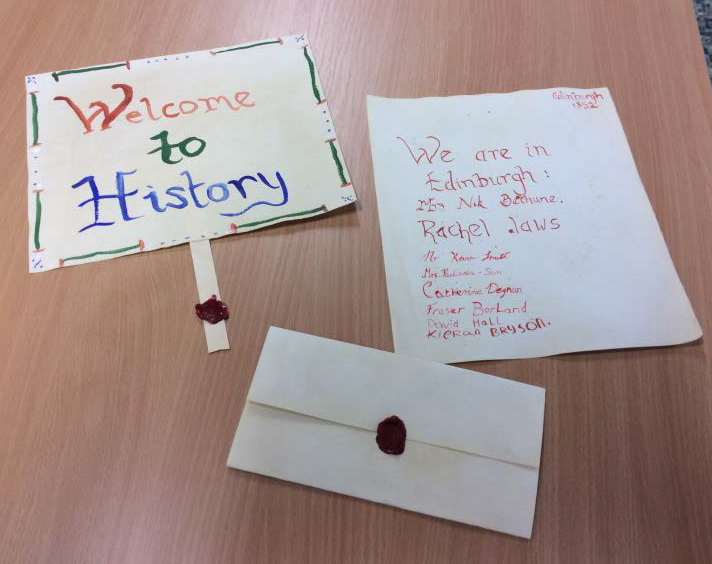
Last month, we were also delighted to be asked to hold a workshop – entitled ‘Making History: DIY medieval charters, title deeds and treasure maps’ – as part of Scotland’s Previously History Festival, which we held in our conservation studio at the Centre of Research Collections. The event proved popular, with partic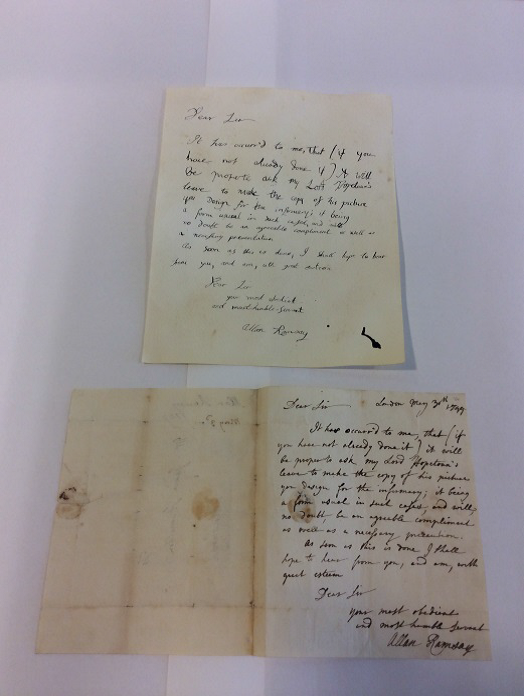 ipants of all ages enjoying the practical side – with tea-staining paper, wax seals, painting with pigments, and transcribing using ink and dip pens included – as well as being afforded the opportunity to see first-hand some of the University’s Special Collection and Lothian Health Services Archive Collection material, dating back to the eighteenth century, for inspiration for their creations. Below is an example of the handiwork produced by some High School History pupils during the session, including a replica of a letter written by the artist Allan Ramsay – can you spot which one is the fake?
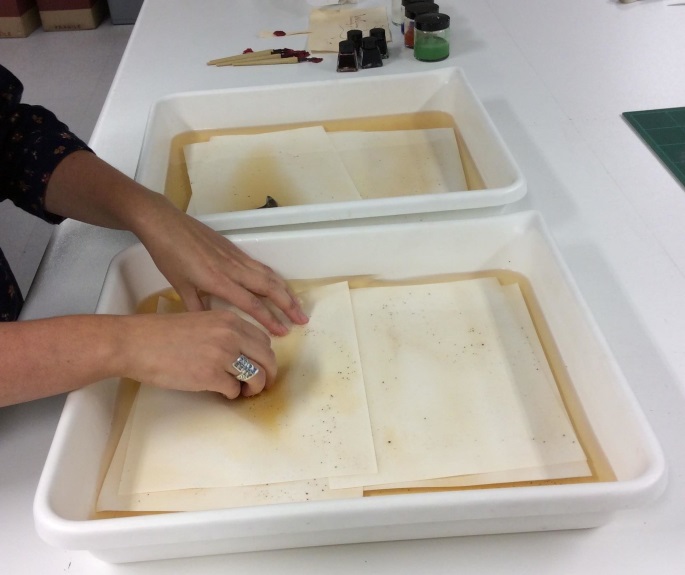
All our outreach efforts, and these sessions in particular, have been a great opportunity to bring conservation and collection care theory to a wider audience, both within the University and further afield, in what is hopefully a fun and engaging way. Perhaps we may even be influencing the next generation of conservators….
Lastly, I would like to wish everyone a Merry Christmas and Happy New Year from us all in conservation. We look forward to keeping you posted with all our conservation news throughout 2015!
Emma Davey, Conservation Officer
December E-Book News
We have additions to the following e-book packages.
 Berg Fashion Library – We have added 70 e-books to our catalogue in December. See a list of the Berg e-books (currently 80 are available) at the e-book page on the Berg Fashion Library.
 Cambridge Books Online – We have access to a further 477 e-books across most subject areas, these are in the process of being added to our catalogue. See the excel list here.

Dawsonera – We have purchased a further 151 e-books across most subject areas and from a variety of publishers. These are all on our catalogue. See the excel list of titles here.
 EBL – We have purchased a further 94 e-books from a variety of publishers across most subject areas. These have been added to our catalogue. See the list of titles here.
 Ebsco/MyILibrary –
  A further 68 titles have been added to our catalogue. See the list here.

Elsevier Science Direct – We have added a further 207 e-books across various subject disciplines to our catalogue. See the list here.
 Oxford Reference Online – We have replaced or added 20 titles published in 2014. Browse a list of our titles here.
Further info
Further information about our e-books is available from http://www.ed.ac.uk/schools-departments/information-services/library-museum-gallery/finding-resources/resource-types/ebooks
If a book you require is not held by the library, please visit our Library Resources Plus webpage.
Collections
 Hill and Adamson Collection: an insight into Edinburgh’s past
My name is Phoebe Kirkland, I am an MSc East Asian Studies student, and for...
Cataloguing the private papers of Archibald Hunter Campbell: A Journey Through Correspondence
My name is Pauline Vincent, I am a student in my last year of a...
Hill and Adamson Collection: an insight into Edinburgh’s past
My name is Phoebe Kirkland, I am an MSc East Asian Studies student, and for...
Cataloguing the private papers of Archibald Hunter Campbell: A Journey Through Correspondence
My name is Pauline Vincent, I am a student in my last year of a...
Projects
Cataloguing the private papers of Archibald Hunter Campbell: A Journey Through Correspondence
My name is Pauline Vincent, I am a student in my last year of a...
Archival Provenance Research Project: Lishan’s Experience
Presentation My name is Lishan Zou, I am a fourth year History and Politics student....