Home University of Edinburgh Library Essentials
December 15, 2025
How the Library can help you in Semester Two?
Need help using or discovering Library resources? Need advice on referencing and citing? Not sure where to start with your systematic literature review? Or just want to know how to best use Google in an academic context?
 The Academic Support Librarian team are running several courses this semester through IS Skills which you can book onto via MyEd. These (mostly) 1 hour sessions allow you to get expert advice and hands-on experience, so whether you are a returning to the University after the winter vacation or are a brand new student at the University why not book on and become an expert yourself?
Downtime alert – Asahi Shimbun Kikuzo
Kikuzo II Visual from Asahi Shimbun Kikuzo will be down for maintenance between 9am and 11am on Tuesday 13th January.
Frozen: The story of Frostie the calf
 Ian Wilmut is best known for his involvement with the team which cloned Dolly the sheep in 1996. However, his scientific career, which spans more than five decades, includes a variety of groundbreaking achievements and discoveries, which are being revealed as his papers are catalogued as part of the continuing ‘Towards Dolly’ and ‘The Making of Dolly’ projects.
Ian Wilmut initially wished to work as a farmer, but he ‘shuffled sideways into scientific research’*, as he puts it, and ultimately won a scholarship as an undergraduate at Nottingham University to work for two months under Chris Polge at the Animal Research Station in Cambridge. His role was to help out generally with experiments, but he soon became fascinated by embryos, and returned to work with Polge once he graduated. Wilmut’s PhD, awarded in 1971, was on the freezing of boar semen. Copies of Wilmut’s published papers exist in the archive from 1969 onwards, and a glance through the papers which appeared over the next decade reveal Wilmut’s wide-ranging research on the effects of freezing, thawing and warming on embryos and spermatozoa in mice, sheep and cattle.
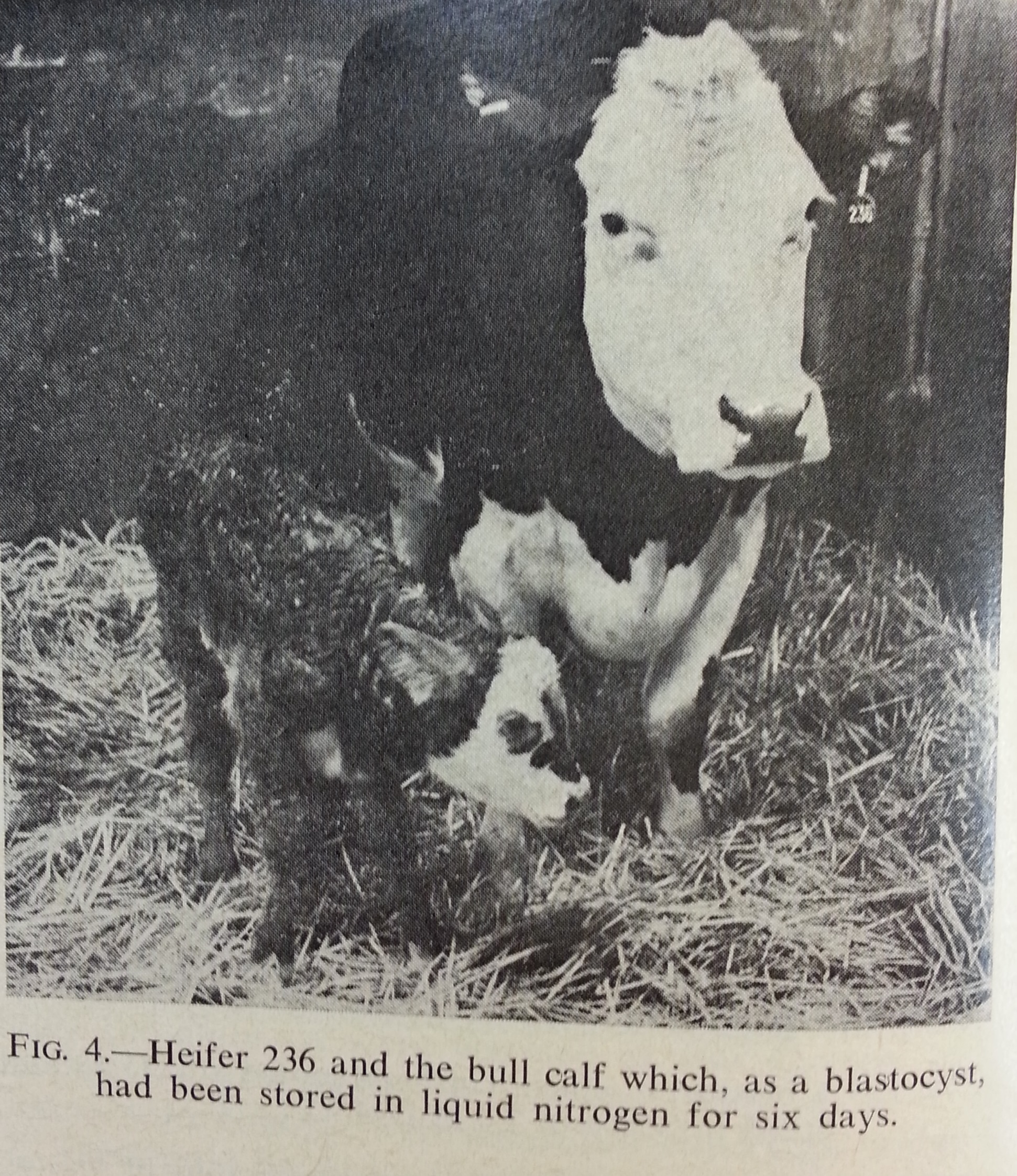
In 1973, Wilmut was the first scientist to successfully freeze a calf embryo (using liquid nitrogen), thaw it, and transfer it to a surrogate mother. This process led to the birth of a healthy red and white Hereford-Friesian cross calf, which Wilmut wryly named ‘Frostie’. Wilmut’s findings were published within a few weeks of Frostie’s birth in The Veterinary Record as ‘Experiments on the low-temperature preservation of cow embryos’ (June 30 1973, 686-690), and a copy of the reprint survives in the archives. Wilmut has remarked that this was ‘one of the fastest scientific publications ever’. It also led to some considerable interest from the world’s media, with Wilmut appearing on television and newspapers from as far away as New Zealand seizing upon the story. This media attention was a precursor to the storm which Wilmut, Keith Campbell and team would generate two decades later when Dolly the sheep was born. Wilmut’s discovery of the viability of frozen embryos to produce healthy offspring has since been used across many different species in agriculture and also for the conservation of rare breeds. The first human to be born from a frozen embryo was Zoe Leyland, born in Melbourne in 1984.
Wilmut’s work with Chris Polge equipped him with many of the techniques in reproductive physiology which would instruct his later work on cloning, nuclear transfer, stem cell and regenerative medicine in Edinburgh, where Wilmut moved in 1973. Throughout his career Wilmut has been inspired by the possibilities of advances in reproductive physiology and biotechnology for fertility treatments,practical applications to the farming industry and breakthroughs in treatments or cures for debilitating genetic diseases.
*All quotes taken from The Second Creation: the age of biological control by the scientists who cloned Dolly, I. Wilmut. K. Campbell and C. Tudge (London, 2000).
Clare Button
Project Archivist
‘Doing their bit’: the remarkable life of nurse Yvonne FitzRoy
Today’s blog is by Louise, archivist at Lothian Health Services Archive (LHSA), as she looks into a very singular wartime life:
On the surface, Yvonne FitzRoy (1891 – 1971) seemed an unlikely nurse. A privileged socialite (daughter of Sir Almeric FitzRoy and Katherine Farquhar), progressive and actress, she was in fact to serve on the battlefields of Russia and Romania as a nursing orderly to Elsie Inglis between 1916 and 1917 with the Scottish Women’s Hospitals (SWH).
The Scottish Women’s Hospitals were set up as soon as war broke out by Edinburgh clinician and suffragist Dr Elsie Inglis, with the financial support of the National Union of Women’s Suffrage Societies (NUWSS).

Dr Elsie Inglis (LHB8A/9)
The all-female SWH units were formed in order to offer medical support to front-line troops, and by the end of the war there had been units based in France, Corsica, Salonika, Serbia, Russia, Romania and Malta. Although rejected by the War Office in Scotland (the famous rebuke to Dr Inglis was that, as a woman, she should ‘go home and sit still’), the aid of the SWH was accepted first by the French Red Cross, and a hospital was set up in Calais to treat Belgian troops. A hospital in the abbey of Royaumant soon followed.
The SWH are perhaps best known through their units in Serbia (work that still links Scotland to the area today). However, the Serbian army’s defeat by Austrian troops forced their withdrawal – Dr Inglis was captured and was returned to Britain; others who could escape chose to retreat in treacherous conditions with the Serbian army. However, in 1916, the London Suffrage Society financed another SWH unit of 80 women to support the Serbian army in Russia and Romania, of which Yvonne FitzRoy was one. LHSA is lucky enough to hold two letter books (LHB8/12/6 and 7) and one scrapbook (LHB8/12/8) that trace Yvonne’s work on this eastern front.

Yvonne’s appointment letter to the SWH (LHB8/12/8)

Luggage label from Yvonne’s journey to serve with the SWH on a captured Austrian ship (LHB8/12/8). According to her memoirs, her luggage consisted of ‘one kit-bag, one haversack, and a rug.’
Although SWH archives are held by Glasgow City Archives and The Women’s Library, the pivotal role played by Elsie Inglis means that we have some intriguing material across LHSA collections (of which more as the weeks go on!): SWH work is reflected in archives from the Bruntsfield Hospital (where Dr Inglis was a surgeon), in the papers of the Elsie Inglis Memorial Maternity Hospital (opened as a memorial to Dr Inglis in 1925 with the remainder of the SWH funds) and in the personal collections of campaigners who fought to keep the memory of Dr Inglis alive. The letters and scrapbook created by Yvonne FitzRoy can be found in LHSA’s Bruntsfield Hospital collection.
Although not solely covering her time at the front, Yvonne’s scrapbook is dominated by the War and its aftermath. Reflecting her artistic and social life as well as her military one, the book is pasted with typed quotations, theatre scripts, postcards and programmes, indicating a love of words, the London stage and the idiosyncratic:

Memorabilia in Yvonne’s scrapbook (LHB8/12/8)
However, the levity of costume design, exhibitions and drama is soon punctuated by newspaper clippings of events in the theatre of war as European tensions grew in 1914.

A typical ‘text heavy’ page in Yvonne’s scrapbook (LHB8/12/8).
As a result of her services to the Russian sick and wounded, Yvonne FitzRoy was awarded a Russian medal for meritorious conduct, the ‘Order of Service’, which she was given government permission to wear:

Certificate of Yvonne FitzRoy’s ‘Order of Service’ medal (LHB8/12/8).
Her service throughout the war was also recognised by the British Red Cross and Order of St John organisations, which worked together during the war after forming a Joint War Committee:

Yvonne’s certificate for wartime services with the British Red Cross Society and the Order of St John of Jerusalem in England (LHB8/12/8).
Like others who served with SWH, Yvonne FitzRoy seemed to have been involved with the Voluntary Aid Detachments, women (who came to be known as VADs) who volunteered in county Red Cross hospitals. Yvonne seems to have used her literary skills in work for a hospital magazine, the Egginton Howl, the magazine of Egginton Hall Red Cross Hospital near Derby.
The Egginton Howl was even praised in this December 1916 article by The Spectator: http://bit.ly/1Ki26lQ. The letter by Rudyard Kipling mentioned in the article is in fact pasted into Yvonne’s scrapbook, indicating that at this time she must have been closely involved in the magazine’s production:

Letter from Rudyard Kipling to Yvonne FitzRoy (LHB12/8/8).
Not content with one literary autograph, Yvonne managed to collect another trophy, in the shape of a questionable pun and endearing sketch from author HG Wells:

HG Wells caricature (LHB8/12/8).
Following the war, Yvonne (like other SWH medical staff) chose to write a memoir of their experiences working on the front line. Her memoir, With the Scottish Nurses in Roumania, was published in 1918, giving an account of her life at the front – it was dedicated to Dr Inglis, who died from cancer on 26th November 1917 just as she had returned to Britain. Yvonne’s adventures did not end with peacetime, however. In 1921, she was appointed as Private Secretary to Alice, Marchioness of Reading, wife of the British Viceroy in India, a post that she occupied until 1926. Yvonne’s life in India can be pieced together through another memoir, Courts and Camps in India: Impressions of Viceregal Tours 1921 – 1924, or through her personal papers from this time held at the British Library. The cuttings and correspondence in her scrapbook also reflect this period of her life:

Greetings card sent from the Viceroy’s Camp, c. 1924 (LHB8/12/8).
Yvonne’s letters home to her parents are more directly focused upon her SWH period, covering September 1916 to January 1917, when she travelled between Russia and Romania with ‘Hospital A’, headed by Dr Inglis. From her journey east to life treating patients at the front and retreating and advancing in the wake of Allied campaigns, Yvonne’s collected letters cover her friendships, leisure time, daily life and the business of staying warm, including frequent mentions of ‘Swedish drill… all of us flat on our backs… waving our grey legs in the air’ (6th September 1916). Frequent references to the ‘Russian censor’ preclude any detailed references to military manoeuvres, victories or defeats, but on some occasions working conditions are mentioned in more detail:
‘Now we are about 10 miles from the firing line, and Hospital B has gone off to act as our clearing station. I am really glad to be in A. B won’t probably see more of the fighting than we shall, and from the medical point of view our work will be the most interesting as they simply dress the wounds and send the men straight on. Here they only stay a day or two if they are well enough but anyway that give us enough time to cope with things a little. Also I am with Dr Inglis and have got the pick of the sisters in my Ward headed by a Bart’s nurse – my word what a difference a big hospital training makes! We arrive just in time for the biggest rush of wounded they’ve yet had and got 100 in before we were half ready. Every soul worked like bricks but the first few days were just terrific. Now, in all the confusion, we are beginning to see daylight and in a day or two shall have our next two Wards open.’ (10th October 1916)
As the extract above hints, Yvonne’s letters also give her personal insight into Elsie Inglis. In a 1919 letter to Eva Shaw McLaren, who was to publish a history of the SWH and a biography of Elsie Inglis, Yvonne wrote:
‘You know it wasn’t at least an easy job to win the best kind of service from a mixed lot of women – the trained members of which had never worked under a woman before – and were ready with their very narrow outlook to seize on any and every opportunity for criticism. There was a tremendous amount of opposition, more or less grumblingly expressed at first. No-one hesitated to do what they were told – you wouldn’t with Dr Inglis as a chief, would you – but it was grudgingly done. In the end it was all for the best. If she had been the kind of person who took trouble to rouse an easy personal enthusiasm the whole thing would have fallen to pieces at the first stress of work – equally if she had never inspired more than respect she would never have won the quality of service she succeeded in doing.’ (9th November 1919)
Weighing up Dr Inglis’ ‘loveable personality that lay at the root of her leadership’ with her ‘strength and singleness of purpose’ (which did not always endear her to those around her at first sight), Yvonne provides a counter to the ‘fanatics’ (as she describes them) whose awe at the work of the SWH coloured their perceptions – also revealing Yvonne’s own individuality and strength, which must have carried her through a particularly harsh Russian winter.

Yvonne in her SWH uniform (LHB8/12/8).
Louise Williams, Archivist, Lothian Health Services Archive
Research Data Spring – blooming great ideas !
The University of Edinburgh have been busy putting ideas together for Jisc’s Research Data Spring project, part of the research at risk co-design challenge area, which aims to find new technical tools, software and service solutions, which will improve researchers’ workflows and the use and management of their data (see: http://researchdata.jiscinvolve.org/wp/2014/11/24/research-data-spring-let-your-ideas-bloom/).
Library and University Collections in collaboration with colleagues from the University of Manchester have submitted an idea to prototype and then develop ann open source data archive application that is technology agnostic and can sit on top of various underlying storage or archive technologies – see: http://researchatrisk.ideascale.com/a/dtd/Develop-a-DataVault/102647-31525)
EDINA & Data Library have submitted two ideas, namely:
A ‘Cloud Work Bench’ to provide researchers in the geospatial domain (GI Scientists, Geomaticians, GIS experts) with the tools, storage and data persistence they require to conduct research without the need to manage the same in a local context that can be fraught with socio-technical barriers that impede the actual research (see: http://researchatrisk.ideascale.com/a/dtd/Cloud-Work-Bench/101899-31525)
An exploration of the use of Mozilla Open Badges as certification of completion of MANTRA (Research Data Management Training), a well-regarded open educational resource (see: http://researchatrisk.ideascale.com/a/dtd/Open-Badges-for-MANTRA-resource/102084-31525)
Please register with ideascale (http://researchatrisk.ideascale.com/) and VOTE for our blooming great ideas!!
Stuart Macdonald
RDM Service Coordinator
Downtime alert – Emerald insight
 Emerald Insight will be unavailable for up to 2 hours on Friday 9 January 2015, between 23:00 GMT and 03:00 GMT. This affects both e-books and e-journals. If you access the website during this time you will receive a ‘connection timeout’, or similar message, within your browser.
Looking back, looking forward
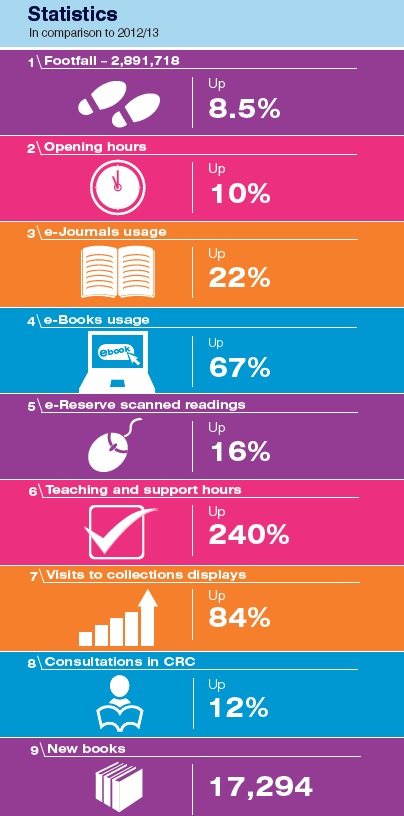
At the start of a new year, it is always nice to think back about the achievements of the previous year, and what lies ahead in the coming year. Not only is it good to think about what we have done, it is also important to consider the impact it has had. In order to do this, Library & University Collections published a Impact Report for 13/14 at the end of last year. It is great to be able to see the range of services the Library provides to the University, and how this contributes to the work of the institution.
Here are some highlights from the report, which can be viewed online as a PDF, or picked up from one of our libraries:
High Quality Collections
- University’s rare and unique collections now discoverable online at collections.ed.ac.uk
- Satisfying over 13,000 Interlibrary loan requests
- Providing access to over 50,000 e-journals and 365,400 e-books… any time, any place
- More than 15,600 books acquired in response to user requests
- Preserving and making accessible UNESCO- awarded HIV/AIDS collections
- 2,400 new hi-resolution photographs added to collections.ed.ac.uk
- The National Student Survey showed 90% of our students felt our physical and online collections met their study needs
Delivering Excellent Services
- Acquired more than 700 books and prepared over 5,000 journal articles for submission to REF 2014
- Helped the University achieve a 64% RCUK Open Access rate with 30,000+ full text items now held in our repositories
- HLF-funded collaboration with RNIB Scotland to improve access to archives for blind and partially sighted people
- Library opening hours extended in response to student feedback
First Rate Engagement
- Libraryblogs.is.ed.ac.uk: sharing our projects, services and collections
- @EdUniLibraries: building relationship networks on social media
- Engaging with students at Innovative Learning Week: seven events attended by over 100 people
- 24 interns and 70 volunteers gave us 15,000 extra hours’ work on our collections
- Rashid exhibition showcased the Library’s rarest manuscript
Attracting External Investment
- £820,000 secured from Heritage Lottery Fund for St Cecilia’s Hall redevelopment
- Five Wellcome Trust funded projects supported
- Europeana Cloud secured €37,000 in funding from EU programme
- £33,000 awarded by Jisc for the ‘Lessons in Open Access Compliance in Higher Education’ project
The coming year will be an exciting one for Library and University Collections. Many of our programmes will continue, and our exhibition schedule is already planned, including “Out of the Blue” – a celebration of the colour blue highlighting a mixture of interesting and thought provoking items from our collections. We will continue to provide access to a growing number of online collections through our showcase website collections.ed.ac.uk
We will also be undertaking some major projects, including the procurement and implementation of a new Library Management IT System. This will enable us to further enhance the student experience of Library course collections, utilising new approaches in how we provide access to e-resources. Such projects will enable us to review and streamline many of our internal processes, continually improving the library services that we offer.
Building work will begin on St Cecilia’s Hall early in the new year, embarking on a £6.5 million refit and renovation to create a world-class museum to house and display our important collection of historical musical instruments.
These are only a few of the highlights that we look forward to delivering over the coming, very exciting, year as we continue to provide high quality collections, and deliver excellent services and first-rate engagement.
Stuart Lewis
Acting Director of Library and University Collections
Jisc MediaHub – ETV collection reinstated
 We have received notification from JISC that the ETV (Educational and Television Films) Collection which had been removed from Jisc MediaHub following the end of the licence period has now been reinstated for a further 12 months.
The collection contains 100 hours of films from the political Left from around the world and can be accessed via the JISC MediaHub link on our database A-Z list.
The Unfamiliar: new issue published
The Unfamiliar has published its new issue, Imagining the Future, on the library-supported journal hosting service.
The Unfamiliar: Imagining the Future
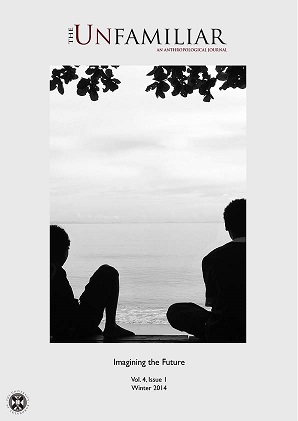
As with past issues, authors have used many of their own photographs to illustrate essays and poems.
This is the first issue produced by the new editorial team , so special congratulations go to executive editors, Inna Zlatimirova Yaneva-Toraman and Hakon Caspersen for all their hard work in taking on the role and producing another excellent issue of the journal.
About The Unfamiliar
The Unfamiliar is a student-run anthropological journal based at the University of Edinburgh. It is dedicated to publishing a wide variety of material, featuring not only academically informed articles and book reviews but creative work such as poetry, photographic essays, and audio-visual projects. Emphasis is on integrating creative and visual work, and publishing and editorial policies reflect the journals’ commitment to make anthropology more widely accessible. The Unfamiliar believes that anthropology should no longer be read and appreciated solely by anthropologists, but benefit broader audiences as well.
About the Journal Hosting Service
The University of Edinburgh Journal Hosting Service uses the open source software; Open Journal Systems (OJS), to support academics and student groups who want to publish online open access journals. Journal Hosting Service homepage.
Angela Laurins, Library Learning Services Manager
P6 Visitors from St Mary’s Primary
A few weeks ago the Library hosted two visits from the two P6 classes of St Mary’s school. Their topic was “Scotland’s Timeline” (I can interpret historical evidence from a range of periods to help to build a picture of Scotland’s heritage and my sense of chronology SOC2-02a) and were studying Kidnapped by Robert Louis Stevenson in order to find out more about Edinburgh and Scotland in the eighteenth century. As Robert Louis Stevenson was a graduate of the University of Edinburgh, this made a good starting point for their visit.
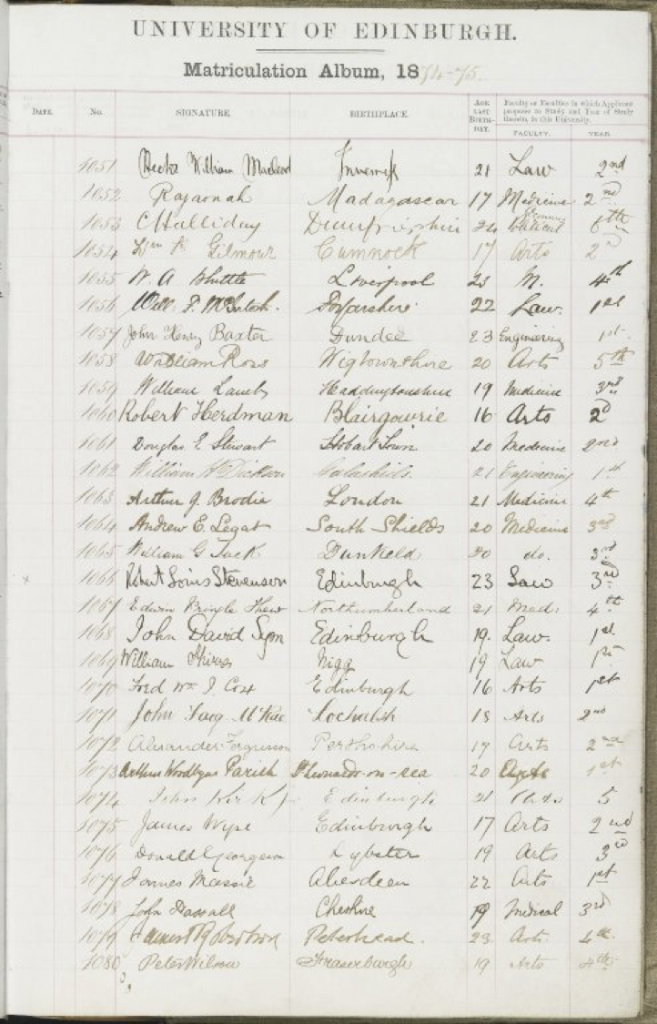
The Matriculation Album of 1874, showing Robert Louis Stevenson’s signature as he entered the 3rd year of his Law degree (he originally studied Engineering when he first joined the University)
As well as seeing a matriculation album with Robert Louis Stevenson’s signature, they examined an early copy of Kidnapped, some of source materials that were used as background for the book, the Barker panorama of Edinburgh, and Münster’s Cosmographia, by Elizabeth Quarmby Lawrence, the Library’s Assistant Rare Books Librarian.
Following this, they enjoyed a workshop led by Sarah Deters, our Learning and Engagement Curator. The workshop examined the development of bagpipes over time, and concluded with an exercise to turn a straw into a playable reed!
The children kindly wrote thank you letters for us, saying which parts of the visit they most enjoyed, and added a few extra questions. Rather than replying directly to the class, we thought we’d share the great questions and answers on this blog…
| Question | Answer |
| How old is the library? | The Library building that you visited is known as the Main Library. It was opened in 1967. However the University’s main Library service has operated from other buildings in the past, such as the Playfair Library which is part of the Old College building, built in 1827. The Library service dates back to 1583 when the University was opened, although the first collection of books was donated in 1580 by Clement Litill. |
| Can we visit again? | Yes! You would be very welcome to visit again. The Main Library, along with many other University buildings are open for visitors during the annual Doors Open Day event, whilst special group visits such as yours can be arranged. Please get in touch! The main library also has an exhibition gallery, which is open to the public and has different exhibitions in it all year round. When you visited one exhibition had just finished and the next one not yet started, so you didn’t see it. Look on our web pages to see what’s on. |
| What is your favourite book? | Elizabeth – Mine changes every week! But the Wode Psalter is pretty good, and you can look at it online. |
| What is your favourite instrument? | That is hard to answer! I love the sound of many different instruments, especially the piano and the trumpet, but my favourite instrument in our museum is a beautiful instrument from India. The instrument is shaped like a peacock, but is a type of string instrument called a mayuri. You can see a picture of it here: http://collections.ed.ac.uk/mimed/record/17372 |
| Why do you enjoy old books more than newer books, and which historic authors do you enjoy reading? | I like old books because I am fascinated by what people in the past knew, and how they thought about it. I also love learning about how books were made, and understanding how and why they were printed and bound as they were. This can often tell us almost as much as the text. Reading historical novels was one of the things which made me interested in this sort of thing. When I was young I used to read Rosemary Sutcliffe’s books, which are mostly about the Romans in Britain. Cynthia Harnett is another good one – she used books and objects from the past to get her inspiration, and was very good at explaining how people thought and how things worked. Try ‘The Woolpack’ or ‘A Load of Unicorn’ (which I really like because it is about printing!) |
| What do you like about music? | I like that music is something everyone can enjoy. Whether you sing, listen to music, or play an instrument that is a way of enjoying music. They say that music is a universal language and I think that is a wonderful thing. |
| Did you enjoy us visiting? | We were very glad that you visited. We enjoy explaining what the University does, and the role that the Library plays in University life. We support students as they learn, researcher as they make new discoveries, and the public as they find out more about what the University does. |
| What is the most interesting part of your job? | All of it! One of the most fun things is choosing books to buy – we are sent catalogues by booksellers and go through them looking for things we think fit into the collections and which someone might find interesting and want to study. |
| Why do you have a lot of students at lunch time but not many in the morning? | The Main Library is open from 7:30 in the morning until 2:30 at night. Each day we have over 5,000 people comes through the door. The building starts to get busy at 9am, but more students arrive each hour as lectures finish. 1pm is the busiest hour for people coming into the building. |
| Do you have any harps in the Library? | We do. We have 7 harps that were made in Europe in our collection as well as different types of harps from around the world. These harps from from Africa, Asia, and America. |
| What is the oldest book in the Library? | The oldest printed book is Chinese – ‘Zhou yi zhuan yi da quan’ [Complete commentaries on the Yi Jing], printed in 1440. We have manuscripts (that is books which were written by hand) going back to the 10th century. |
| How did you collect all the books and artifacts? | Some of the books the University has bought – since it was founded in 1580 a lot of the books which were originally ordinary books used by students have become very old and rare. Today the library buys most of its new books for students as e-books, but we do still buy special books for the rare books and manuscripts collections. The other way that books arrive is by being given to the library. When the University was founded, Clement Little, an Edinburgh lawyer, gave the library 276 volumes, to get it started. Lots of other people have given things since. There was also a time, about 200 years ago, when Edinburgh University Library was a “Copyright Deposit Library”, which meant that all British publishers were supposed to give one copy of everything they published. It didn’t work out as well as it sounds, and quite soon was stopped, but we still have a lot of the books. |
| What is the oldest object that you have? | Sarah – the oldest instrument in our collection is a recorder made in 1510. Elizabeth – we have some scraps of papyrus, which are about 2000 years old. |
Stuart Lewis – Deputy Director, Library & University Collections
Serena Fredrick – Student Support Officer
Elizabeth Quarmby Lawrence – Assistant Rare Books Librarian
Sarah Deters – Learning and Engagement Curator
Collections
 Hill and Adamson Collection: an insight into Edinburgh’s past
My name is Phoebe Kirkland, I am an MSc East Asian Studies student, and for...
Cataloguing the private papers of Archibald Hunter Campbell: A Journey Through Correspondence
My name is Pauline Vincent, I am a student in my last year of a...
Hill and Adamson Collection: an insight into Edinburgh’s past
My name is Phoebe Kirkland, I am an MSc East Asian Studies student, and for...
Cataloguing the private papers of Archibald Hunter Campbell: A Journey Through Correspondence
My name is Pauline Vincent, I am a student in my last year of a...
Projects
Cataloguing the private papers of Archibald Hunter Campbell: A Journey Through Correspondence
My name is Pauline Vincent, I am a student in my last year of a...
Archival Provenance Research Project: Lishan’s Experience
Presentation My name is Lishan Zou, I am a fourth year History and Politics student....