Home University of Edinburgh Library Essentials
December 18, 2025
China Local Gazetteers and China Economic Statistics – New E-Resources
 Following a successful trial on the Wanfangdata platform, we now subscribe to China Local Gazetteers and China Economic Statistics.
China Local Gazetteers is a collection of Chinese local gazetteers published after 1949, covering all regions of China. There are over 26,400 volumes of e-books included in this database which contain a range of information covering various aspects of local economic, social and political life.
China Economic Statistics offers time-series records on macro-economic data, industry and sector data, regional data with over 10,000 economic indicators.
Both e-resources have been added to our Databases A-Z list as well as the Economics and East Asian Studies A-Z subject lists. They will be listed on our catalogue and Searcher next week.
New books at New College Library – January

 An anthropological theme to our featured new books this month. The invention of God in indigenous societies / by James L. Cox. is now available in the Reserve section BL380 Cox. at New College Library. Food, sex and strangers : understanding religion as everyday life by Graham Harvey is also available at BL48 Har.
These titles were purchased for Religious Studies at the School of Divinity, Edinburgh University.
New College Library has a regular display of new books at the far end of the Library Hall, close to the door to the stacks.You can see an regularly updated list of new books for New College Library on the Library Catalogue – choose the New Books Search and limit your search to New College Library. Here’s a quick link to new books arriving in the last few weeks. A word of caution – some of the books listed here may still be in transit between the Main Library (where they are catalogued) and New College Library, so not on the shelf just yet.
Christine Love-Rodgers, Academic Support Librarian – Divinity
Katie Paterson – Future Library
Neil Lebeter, Art Curator, writes about how a forest in Norway and a new library collection in 2114 are linked
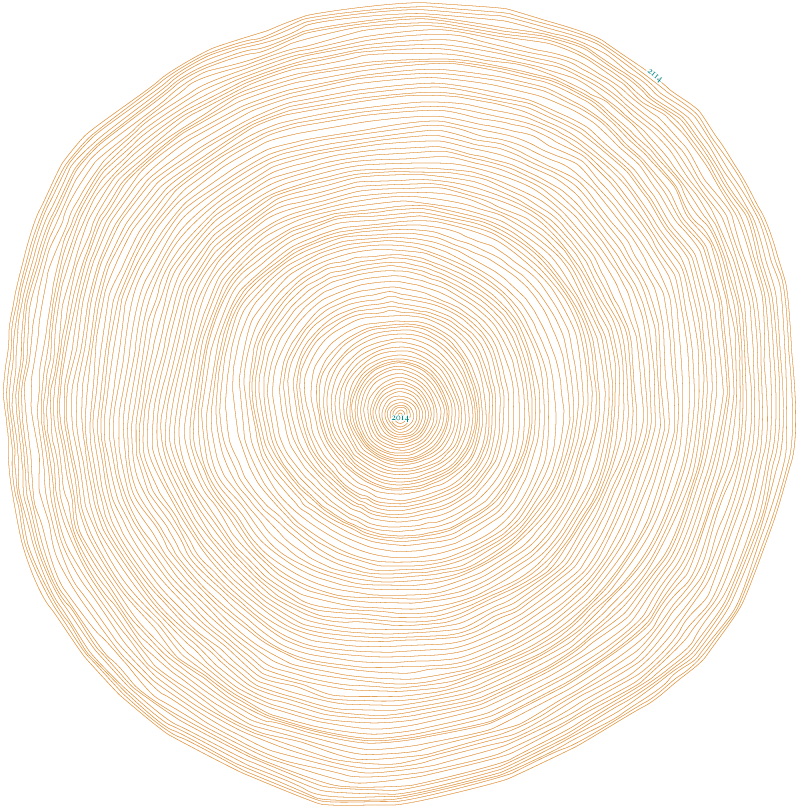
Future Library Tree.
We are very, very excited to announce that the University has acquired, or should I say will be acquiring, Future Library by Scottish artist Katie Paterson.
Future Library is an incredibly ambitious art work that currently takes the form of a single print and also a forest in Norway. Let me explain.
Katie, who graduated from Edinburgh College of Art in 2004, was gifted an area of forest in Norway, where trees have been planted. These will supply paper for a collection of books that will be printed in 100 years time. Between now and then, one writer every year will commissioned to write a text – Margaret Atwood was announced as the first author last year. The manuscripts will be held in trust, unpublished, until 2114.
The texts will be held in a specially designed room in the New Public Deichmanske Library, Oslo and a Trust has been set up to care for the project and the forest itself.
Until 2114 rolls round, we will have a very lovely print that Katie has just completed, pictured above. Having heard Katie speak about this work first hand, the aspect of this that has really stuck in my mind is the notion of time. For us, 100 years is tantalisingly just out of reach – it is unlikely that the majority of us will be alive when these books are published. 100 years, therefore, may as well be a 1,000 or 100,000 in terms of our perception. However, in the life of the forest, 100 years is nothing. A blink of an eye.
So, in 2114 – 100 specially commissioned, beautifully printed books will arrive at the University of Edinburgh. For a Curator – this is one of the most unusual things I have ever considered.
I’d best leave a note to warn people.
http://www.katiepaterson.org/futurelibrary/
Neil Lebeter, Art Curator.
3 Additions to the LUNA Book Reader Collection

We kick off 2015 with the addition of 3 new Book Readers added to LUNA. The first two are both music manuscripts that came down to the DIU as part of the Readers Orders trolley. It is not often that we receive volumes to be digitised in their entirety this way, so it seemed a good opportunity. As a result we spared a bit of time to do the additional work to prepare them for the book reader software after the High Resolution images had been delivered to the customers. Read More
Open up! On the scientific and public benefits of data sharing
Research published a year ago in the journal Current Biology found that 80 percent of original scientific data obtained through publicly-funded research is lost within two decades of publication. The study, based on 516 random journal articles which purported to make associated data available, found the odds of finding the original data for these papers fell by 17 percent every year after publication, and concluded that “Policies mandating data archiving at publication are clearly needed” (http://dx.doi.org/10.1016/j.cub.2013.11.014).
In this post I’ll touch on three different initiatives aimed at strengthening policies requiring publicly funded data – whether produced by government or academics – to be made open. First, a report published last month by the Research Data Alliance Europe, “The Data Harvest: How sharing research data can yield knowledge, jobs and growth.” Second, a report by an EU-funded research project called RECODE on “Policy Recommendations for Open Access to Research Data”, released last week at their conference in Athens. Third, the upcoming publication of Scotland’s Open Data Strategy, pre-released to attendees of an Open Data and PSI Directive Awareness Raising Workshop Monday in Edinburgh.
Experienced so close together in time (having read the data harvest report on the plane back from Athens in between the two meetings), these discrete recommendations, policies and reports are making me just about believe that 2015 will lead not only to a new world of interactions in which much more research becomes a collaborative and integrative endeavour, playing out the idea of ‘Science 2.0’ or ‘Open Science’, and even that the long-promised ‘knowledge economy’ is actually coalescing, based on new products and services derived from the wealth of (open) data being created and made available.
‘The initial investment is scientific, but the ultimate return is economic and social’
John Wood, currently the Co-Chair of the global Research Data Alliance (RDA) as well as Chair of RDA-Europe, set out the case in his introduction to the Data Harvest report, and from the podium at the RECODE conference, that the new European commissioners and parliamentarians must first of all, not get in the way, and second, almost literally ‘plan the harvest’ for the economic benefits that the significant public investments in data, research and technical infrastructure are bringing.
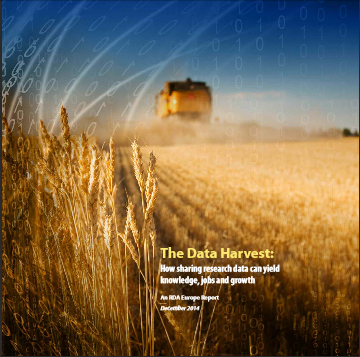 The report’s irrepressible argument goes, “Just as the World Wide Web, with all its associated technologies and communications standards, evolved from a scientific network to an economic powerhouse, so we believe the storing, sharing and re-use of scientific data on a massive scale will stimulate great new sources of wealth.” The analogy is certainly helped by the fact that the WWW was invented at a research institute (CERN), by a researcher, for researchers. The web – connecting 2 billion people, according to a McKinsey 2011 report, contributed more to GDP globally than energy or agriculture. The report doesn’t shy away from reminding us and the politicians it targets, that it is the USA rather than Europe that has grabbed the lion’s share of economic benefit– via Internet giants Google, Amazon, eBay, etc. – from the invention of the Web and that we would be foolish to let this happen again.
This may be a ruse to convince politicians to continue to pour investment into research and data infrastructure, but if so it is a compelling one. Still, the purpose of the RDA, with its 3,000 members from 96 countries is to further global scientific data sharing, not economies. The report documents what it considers to be a step-change in the nature of scientific endeavour, in discipline after discipline. The report – which is the successor to the 2010 report also chaired by Wood, “Riding the Wave: How Europe can gain from the rising tide of scientific data,” celebrates rather than fears the well-documented data deluge, stating,
“But when data volumes rise so high, something strange and marvellous happens: the nature of science changes.”
The report gives examples of successful European collaborative data projects, mainly but not exclusively in the sciences, such as the following:
- Lifewatch – monitors Europe’s wetlands, providing a single point to collect information on migratory birds. Datasets created help to assess the impact of climate change and agricultural practices on biodiversity
- Pharmacog – partnership of academic institutions and pharmaceutical companies to find promising compounds for Alzheimer’s research to avoid expensive late-stage failures of drugs in development.
- Human Brain Project – multidisciplinary initiative to collect and store data in a standardised and systematic way to facilitate modelling.
- Clarin – integrating archival information from across Europe to make it discoverable and usable through a single portal regardless of language.
The benefits of open data, the report claims, extends to three main groups:
- to citizens, who will benefit indirectly from new products and services and also be empowered to participate in civic society and scientific endeavour (e.g. citizen science);
- to entrepeneurs, who can innovate based on new information that no one organisation has the money or expertise to exploit alone;
- to researchers, for whom the free exchange of data will open up new research and career opportunities, allow crossing of boundaries of disciplines, institutions, countries, and languages, and whose status in society will be enhanced.
‘Open by Default’
If the data harvest report lays out the argument for funding open data and open science, the RECODE policy recommendations focus on what the stakeholders can do to make it a reality. The project is fundamentally a research project which has been producing outputs such as disciplinary case studies in physics, health, bioengineering, environment and archaeology. The researchers have examined what they consider to be four grand challenges for data sharing.
- Stakeholder values and ecosystems: the road towards open access is not perceived in the same way by those funding, creating, disseminating, curating and using data.
- Legal and ethical concerns: unintended secondary uses, misappropriation and commercialization of research data, unequal distribution of scientific results and impacts on academic freedom.
- Infrastructure and technology challenges: heterogeneity and interoperability; accessibility and discoverability; preservation and curation; quality and assessibility; security.
- Institutional challenges: financial support, evaluating and maintaining the quality, value and trustworthiness of research data, training and awareness-raising on opportunities and limitations of open data.
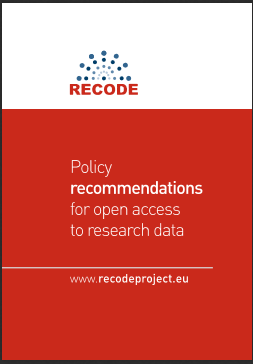 RECODE gives overarching recommendations as well as stake-holder specific ones, a ‘practical guide for developing policies’ with checklist for the four major stakeholder groups: funders, data managers, research institutions and publishers.
‘Open Changes Everything’
The Scottish government event was a pre-release of the open data strategy, which is awaiting final ministerial approval, though in its final draft, following public consultation. The speakers made it clear that Scotland wants to be a leader in this area and drive culture change to achieve it. The policy is driven in part by the G8 countries’ “Open Data Charter” to act by the end of 2015 on a set of five basic principles – for instance, that public data should be open to all “by default” rather than only in special cases, and supported by UK initiatives such as the government-funded Open Data Institute and the grassroots Open Knowledge Foundation.
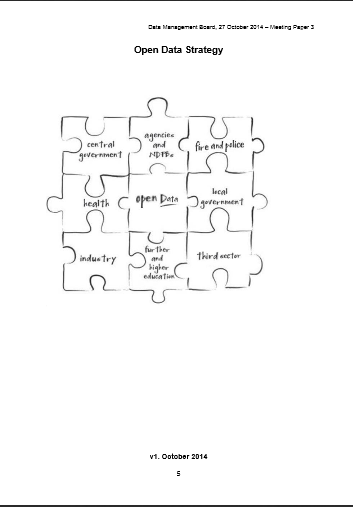
Improved governance (or public services) and ‘unleashing’ innovation in the economy are the two main themes of both the G8 charter and the Scotland strategy. The fact was not lost on the bureaucrats devising the strategy that public sector organisations have as much to gain as the public and businesses from better availability of government data.
The thorny issue of personal data is not overlooked in the strategy, and a number of important strides have been taken in Scotland by government and (University of Edinburgh) academics recently on both understanding the public’s attitudes, and devising governance strategies for important uses of personal data such as linking patient records with other government records for research.
According to Jane Morgan from the Digital Public Services Division of the Scottish Government, the goal is for citizens to feel ownership of their own data, while opening up “trustworthy uses of data for public benefit.”
Tabitha Stringer, whose title might be properly translated as ‘policy wonk’ for open data, reiterated the three main reason for the government to embrace open data:
- Transparency, accountability, supporting civic engagement
- Designing and delivering public services (and increasingly digital services)
- Basis for innovation, supporting the economy via growth of products & services
‘Digital first’
The remainder of the day focused on the new EU Public Service Information directive and how it is being ‘transposed’ into UK legislation to be completed this year. In short, the Freedom of Information and other legislation is being built upon to require not just publication schemes but also asset lists with particular titles by government agencies. The effect of which, and the reason for the awareness raising workshop is that every government agency is to become a data publisher, and must learn how to manage their data not just for their own use but for public ‘re-users’. Also, for the first time academic libraries and other ‘cultural organisations’ are to be included in the rules, where there is a ‘public task’ in their mission.
‘Digital first’ refers to the charging rules in which only marginal costs (not full recovery) may be passed on, and where information is digital the marginal cost is expected to be zero, so that the vast majority of data will be made freely available.
 Robin Rice
EDINA and Data Library
ARAS: The Archive for Research in Archetypal Symbolism – New E-Resource
 Following a successful trial, we now subscribe to ARAS: The Archive for Research in Archetypal Symbolism.
The ARAS archive contains about 17,000 photographic images, each cross-indexed, and accompanied by scholarly commentary. The commentary includes a description of the image with a cultural history that serves to place it in its unique historical and geographical setting. Often it also includes an archetypal commentary that brings the image into focus for its modern psychological and symbolic meaning, as well as a bibliography for related reading and a glossary of technical terms.
This online resource will be of particular interest to students and staff of Edinburgh College of Art, and the Schools of History, Classics and Archaeology, and Literature, Languages and Culture. It has been added to our database A-Z list, several subject A-Z lists, our catalogue and Searcher. Further information about our databases can be found at http://www.ed.ac.uk/schools-departments/information-services/library-museum-gallery/finding-resources/library-databases.
Dawsonera – unable to download e-books

One of our major e-book providers – Dawsonera is suffering from technical issues relating to downloading e-books for off-line use. E-books can still be read online.
They will post to https://twitter.com/dawsonera when they have updates – they have not been able to provide a time-scale for resolution.
Update – this is now resolved
Trial – Brill Encyclopedia of Hebrew Language and Linguistics

We have trial access to Brill Encyclopedia of Hebrew Language and Linguistics until the 18th February.
Brill Encyclopedia of Hebrew Language and Linguistics Online offers a systematic and comprehensive treatment of all aspects of the history and study of the Hebrew language from its earliest attested form to the present day. It features advanced search options, as well as extensive cross-references and full-text search functionality using the Hebrew character set. With over 850 entries and approximately 400 contributing scholars, the Encyclopedia of Hebrew Language and Linguistics Online is the authoritative reference work for students and researchers in the fields of Hebrew linguistics, general linguistics, Biblical studies, Hebrew and Jewish literature, and related fields.
Feedback and further info
We are interested to know what you think of this e-resource as your comments influence purchase decisions so please do fill out our feedback form.
A list of all trials currently available to University of Edinburgh staff and students can be found on our trials webpage.
Can RAB help you get the book you need?
Library doesn’t have a book that you want? Did you know as a student at the University you can request the Library buys books for its collections via the RAB (Request A Book) Service?
 Last academic year, 2013/14, the Library purchased 940 books in response to RAB requests. 134 books were ordered directly from requests from students in Social & Political Science, this made approximately 12% of the total requests from the College of Humanities and Social Sciences.
You can see a full list of all 940 titles bought by the Library through this service on the Request a book purchase for the Library.
A gutsy project: A heart to heart with the new girl
If you didn’t guess from the anatomical pun title, this blog post details the beginnings of my 10-week internship conserving the Thomson-Walker collection at The Centre for Research Collections conservation studio. As a recent MA graduate of art on paper conservation from Camberwell College of Arts I was looking for an internship that would give me the chance to gain project management experience as well as allowing me to become familiar with various printing techniques and how to treat them in innovative ways. This internship permits me to meet these aims as I am the first person to begin conservation work on this collection and shall be creating a treatment and rehousing program as well as undertaking research, experimentation and treatments to get the project underway.
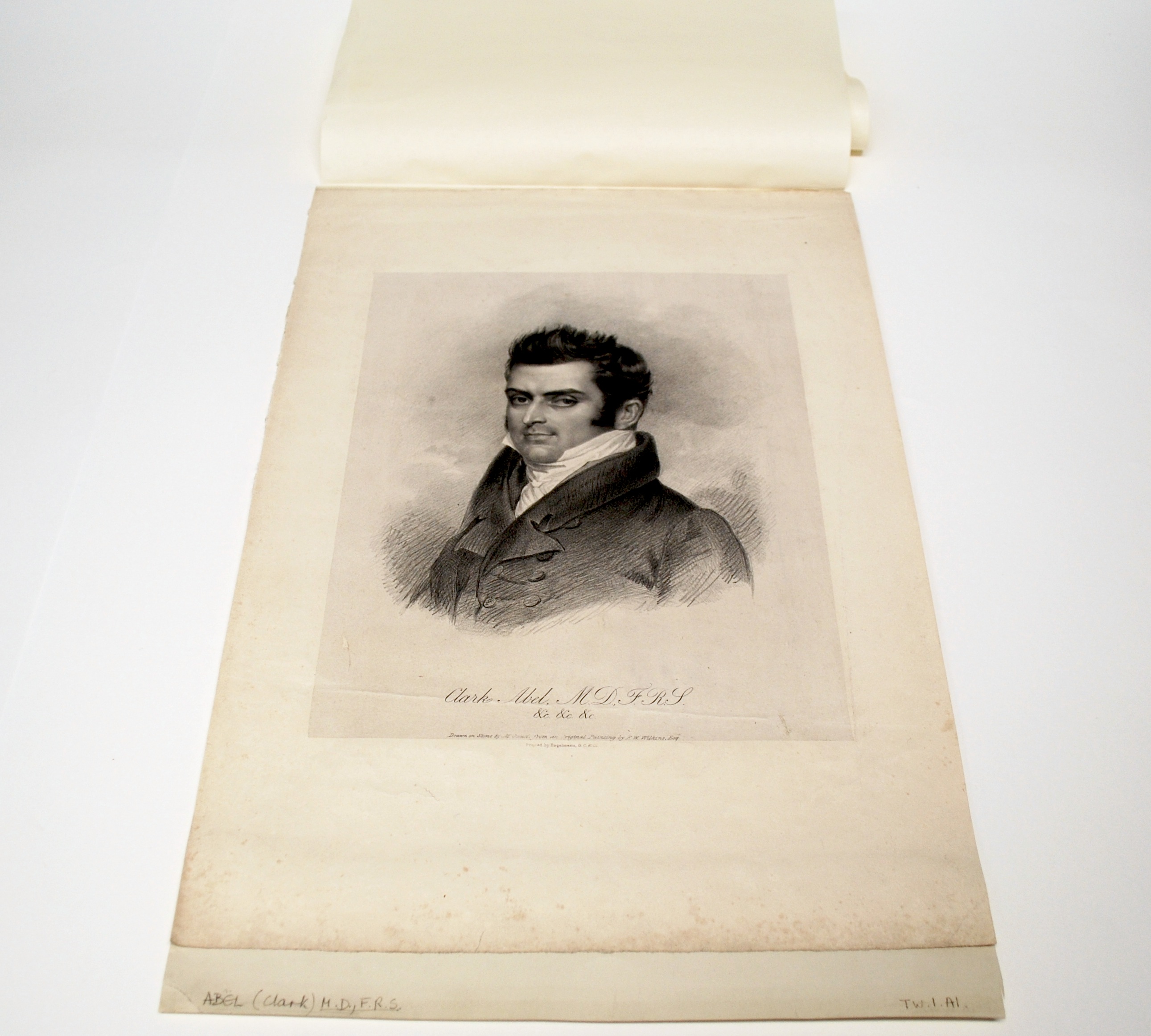
Print from the Thomson-Walker Collection
The Thomson-Walker collection includes some 2,500 prints, which were bestowed to the University of Edinburgh in 1939 by Sir John William Thomson-Walker (1871-1937), a surgeon and committed print collector. The collected prints are mostly in good condition and convey portraits of influential medical men from the UK and Europe ranging from the 16th-20th centuries. The main conservation issue for this collection are the backing boards that the prints have been adhered to; the board is of low grade quality, which is not only destructive to the primary support but also prohibits the prints from being exhibited, digitised, or used as a resource for teaching. The unattractive and damaging boards and the tape used to adhere them to the primary support will have to be removed; I shall be experimenting with various treatment methods in the coming weeks in order to create a fast and effective programme of conservation which can be carried out by myself and the interns that follow after me. Additionally, the print collection varies tremendously in size and so I will also be investigating various storage solutions to rehouse this large group of artworks in a way that is not only cost effective but also accommodates how they shall be used now and in the future. Wish me luck, let’s hope my efforts aren’t in vein….

Close-up of a print hinged onto a poor quality backing board
Post by Samantha Cawson, Conservation Intern
Collections
 Hill and Adamson Collection: an insight into Edinburgh’s past
My name is Phoebe Kirkland, I am an MSc East Asian Studies student, and for...
Cataloguing the private papers of Archibald Hunter Campbell: A Journey Through Correspondence
My name is Pauline Vincent, I am a student in my last year of a...
Hill and Adamson Collection: an insight into Edinburgh’s past
My name is Phoebe Kirkland, I am an MSc East Asian Studies student, and for...
Cataloguing the private papers of Archibald Hunter Campbell: A Journey Through Correspondence
My name is Pauline Vincent, I am a student in my last year of a...

Projects
Cataloguing the private papers of Archibald Hunter Campbell: A Journey Through Correspondence
My name is Pauline Vincent, I am a student in my last year of a...
Archival Provenance Research Project: Lishan’s Experience
Presentation My name is Lishan Zou, I am a fourth year History and Politics student....