Home University of Edinburgh Library Essentials
December 18, 2025
Archaeopress Digital Subscription Service
 Following a successful trial last year we now subscribe to the Archaeopress Digital Subscription Service.
This is a package of e-books in archaeology. Around 10-15 new books are added each month. Subscribed and open access e-books will be added to the library catalogue/Searcher. The current list of titles can be found here and future updated lists will be available from our A-Z lists on the library website.
Online access requires the use of our library link listed in the EASE protected password page and then the Archaeopress login listed there.
Further info
Further information about our e-books is available from http://www.ed.ac.uk/schools-departments/information-services/library-museum-gallery/finding-resources/resource-types/ebooks
If a book you require is not held by the library, please visit our Library Resources Plus webpage.
Tag It, Find It!: Pop Up Library on tour

Last week, Pop Up Library packed its bags for a three day tour of the university campus, bringing paintings from the art collection, our metadata tagging game and a 5kg tub of fizzy sweets to the Murray Library at KB, the Main Library on George Square and ECA Library.
The aims of the sessions were to show off items from our art collection, get students and staff to try out the latest version of our metadata game, and to raise awareness of the importance, and ubiquity, of descriptive metadata, particularly for digital objects.
Players of the game were given laptops on which were displayed a series of digital images from the art collection. They were asked to ‘say what they saw’ by tagging these and then voting on the quality of other players’ tags. Points were awarded for the best descriptive tags, and the leaderboard was displayed on TV screens and projected onto the Holopro above the Main Library Helpdesk, thus creating a healthy sense of competition amongst players. If you took part, have a look at the leaderboard below to see how you did!
STUDENTS: TOP 10 STAFF: TOP 10
Alongside the game, we displayed original works of art next to their digital surrogates in order to contextualise the tagging game: the digital images in our collections are representations of physical items and the information and details that can be seen in the digital object is often quite different to that which can be seen in the original. For digital collections, it is important that items are tagged correctly so that they can be found both in search engine results and within the image database itself.

The sessions were well attended, with almost 3,500 tags entered by over 50 staff and students. The tags obtained from theses sessions, once moderated, will be uploaded to our image database and used to improve the discoverability of our digital image collection.Why not play the game for yourself on the new Edinburgh Library Labs blog?

Downtime Alert – E-Journals
At 10pm tonight, our e-journals will become unavailable for about 1 hour via the e-journal A-Z links, Searcher and the catalogue. This maintenance work is expected to resolve recent instability issues affecting e-journal access.
During this time, please access the journals directly on campus or off campus via the VPN or by adding http://ezproxy.is.ed.ac.uk/login?url= to the front of a url eg for nature journal, the link is http://www.nature.com and then add http://ezproxy.is.ed.ac.uk/login?url= to make it http://ezproxy.is.ed.ac.uk/login?url=http://www.nature.com which will then work off campus. There is also the option to log in off campus via UKFederation/Shibboleth if offered by the publisher.
Highlights from the RDM Programme Progress Report: Nov – Dec 2014
Key results from the regular RDM Programme Progress Reports presented to both RDM Steering Committee and Action Group. Full RDM progress Reports can be viewed on the RDM programme Wiki (University of Edinburgh only).
- Equality Impact Assessment (EqIA) for the RDM programme was completed and published on the Estates and Buildings website (see: http://www.docs.csg.ed.ac.uk/EqualityDiversity/EIA/Research_Data_Management_Programme_%28RDM%29_%28IS%29.pdf)
- Stuart Macdonald and co-author Rory Macneil (RSpace) had a paper (Service integraiton to Enhance RDM: Electronic laboratory Notebook Case Study) accepted for presentation at the International Conference on Digital Curation (London, Feb. 2015).
- Work has commenced to update deadlines and deliverables in the RDM Project Plan.
- Successful meeting held with the Software Sustainability Institute to discuss software preservation used/generated in the research process resulting in a number of areas of investigation (see: https://libraryblogs.is.ed.ac.uk/2014/12/
- FOSTER EU proposal funded for a training event based on MANTRA to be given to the Scottish Social Science Graduate Summer School programme.
- All items in Datashare now have DataCite DOIs.
- Data Library have established a new online statistical analysis and visualisation service (SDA) which can provide an add-on service for DataShare.
- 39 RDM Training courses scheduled for Jan-June 2015. Training materials for two new courses is also being prepared.
- All data from College File servers complete with all data expected to have been migrated to Datastore by end of January 2015.
- Positive review and report received on the DataStore Infrastructure by external consultant.
Edinburgh DMP template revised based on Action group Feedback. - Visitors from Germany (Goettingen, November), Switzerland (Ecole Polytechnique Federal de Lausanne, December), and France (Sciences Po, December) met with IS colleagues to learn more about the RDM programme.
- “Research Data MANTRA: A Labour of Love” (by Robin Rice) was published to Journal of eScience Librarianship following invitation and a peer review process: http://escholarship.umassmed.edu/jeslib/vol3/iss1/4
- Two submissions to the Jisc Digital Festival event in March (RDM Training with MANTRA & RDM Programme @ Univ. of Edinburgh) have been accepted.
Stuart Macdonald
RDM Service Coordinator
An Exhibition in a Day
As part of the University of Edinburgh’s Innovative Learning Week, the Centre for Research Collections ran a joint event between Conservation, Exhibitions and Archives entitled ‘An Exhibition in a Day’. The aim of this event was to provide the participants with the basic skills required for curating and displaying an exhibition. Despite all our preparation, we entered the day with some sense of trepidation – was it even possible to create an exhibition in a day? We were certainly about to find out…
Using the fascinating and diverse archive collection from the University’s Moray House School of Education as inspiration and source material, the participants received a ‘behind-the-scenes’ experience of what goes in to creating an exhibition. This was as varied as learning how to curate, interpret, design, display and promote their own exhibition (with the aid of the CRC twitter page!), all of which was topped off by an exhibition opening in which we were able to present our day’s work. The day itself was led by Rachel Hosker (Archives Manager), Emma Smith (Exhibitions Officer) and Emma Davey (Conservation Officer), who all shared their own individual expertise and knowledge in this particular field.
The ethos behind the proposed event was to not only to demonstrate the tools and skills required in preparing for an exhibition, but also to provide an interesting and engaging way for participants to interact with the University’s rare and unique collections. The event aimed to engender a greater sense of ownership by students and staff alike of the University collections, and to encourage them to learn more about how these collections can inform or be incorporated into their own work and studies.
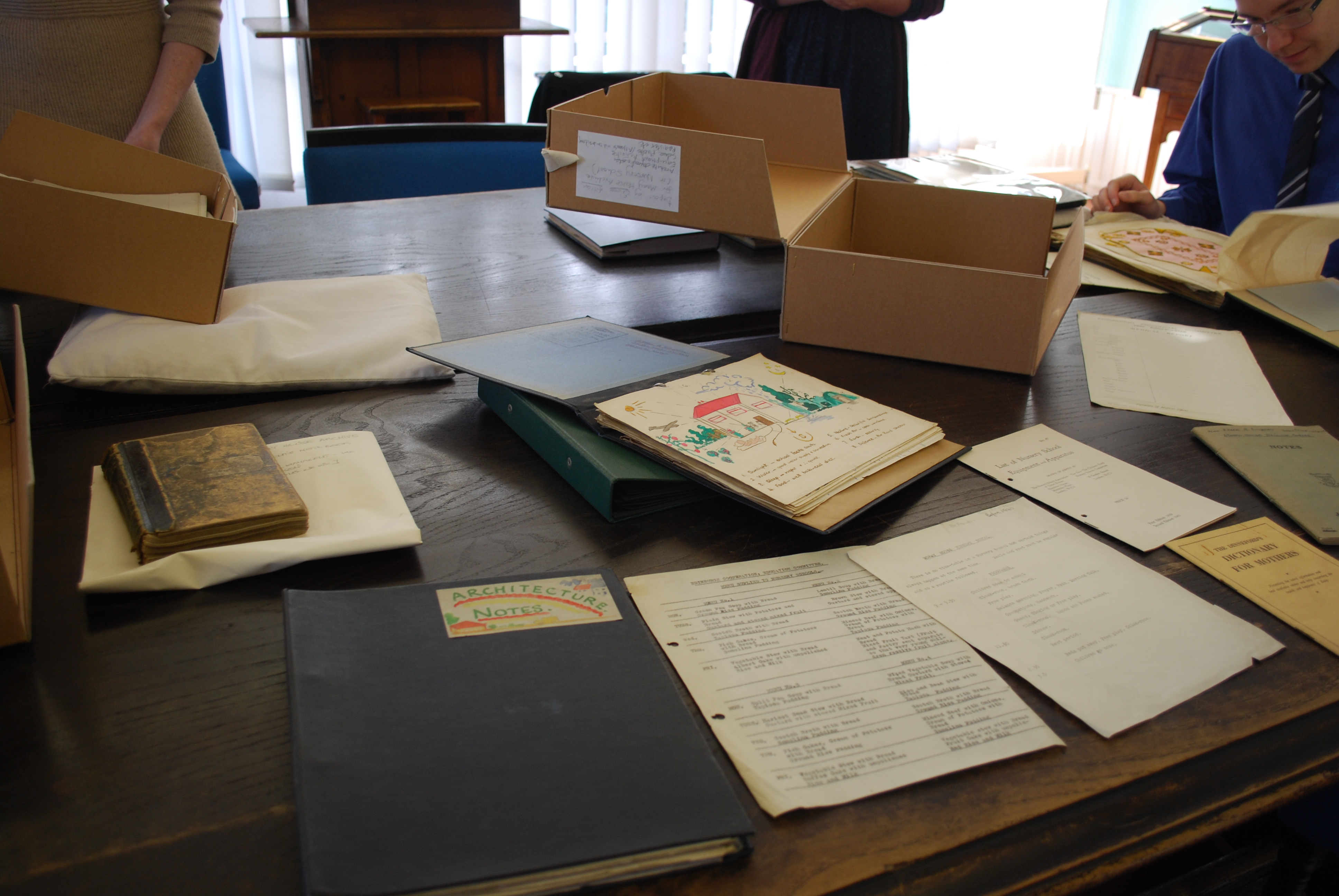
The Moray House Archive Collection

Choosing exhibition exhibits
As one of our attendees, Heather McFarlane, writes ” An Exhibition in a Day was a fascinating insight into the collections and a great way to learn how you can make objects and displays engaging. As Education Coordinator in the School of Chemistry I often visits schools, and trainee teachers so it was great to explore the Moray House historical collections and learn about teacher training and nursery care over the last 100 years. As well as exploring the collection, it gave me the chance to think about using exhibitions more. I am always looking for new ways to engage young people and adults in science and so getting experience of putting on exhibition has given me lots of ideas of what can be done using collections and how to make appealing displays. I look at the chemistry museum in a new light now!”
Also participating in the day’s events was our very own conservation Intern, Samantha, who discusses her experience of the day. “Before deciding upon a career in conservation I was working mainly as an artist and curator concerned with the interpretation and exploration of objects with a passion for community engagement. I was thrilled to be able to discover the Moray House School of Education archival collection and help others to appreciate and handle it correctly. The collection has some wonderfully insightful information regarding education in Edinburgh during the early 20th century with so many stories waiting to be discovered. My main role of the day was to assist CRC staff and those taking part, however I became just as absorbed with the collection as our innovative learners! Because we had to sift through such a large number of interesting documents it was very difficult to know what to include within the exhibition, and how to best tell the story of the nursery school. Nevertheless by the end of the day we had all became familiar with our chosen assortment of documents and objects giving us the confidence to forge ahead with how we wanted others to view them. It was great to see so many people engaging with the collection in this way and learning from it too!”

Video Corner!
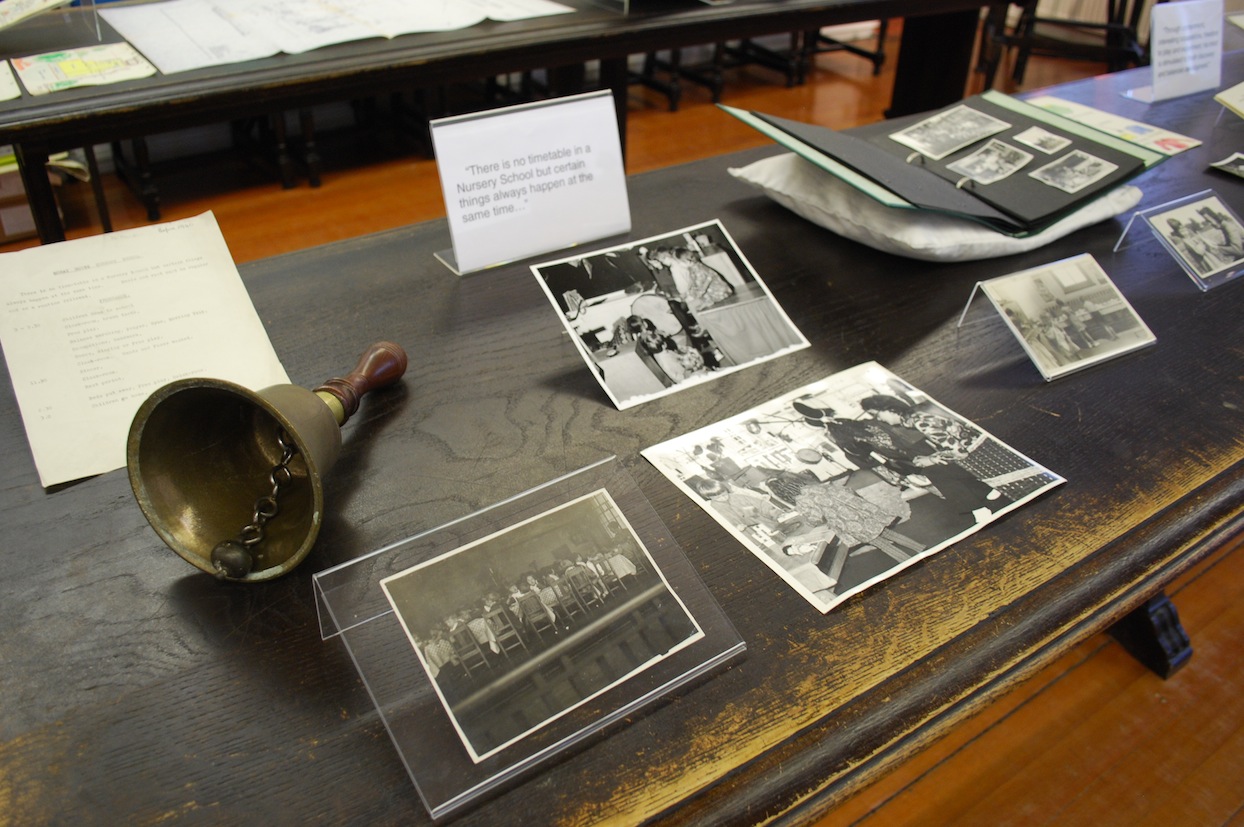
A display from the exhibition
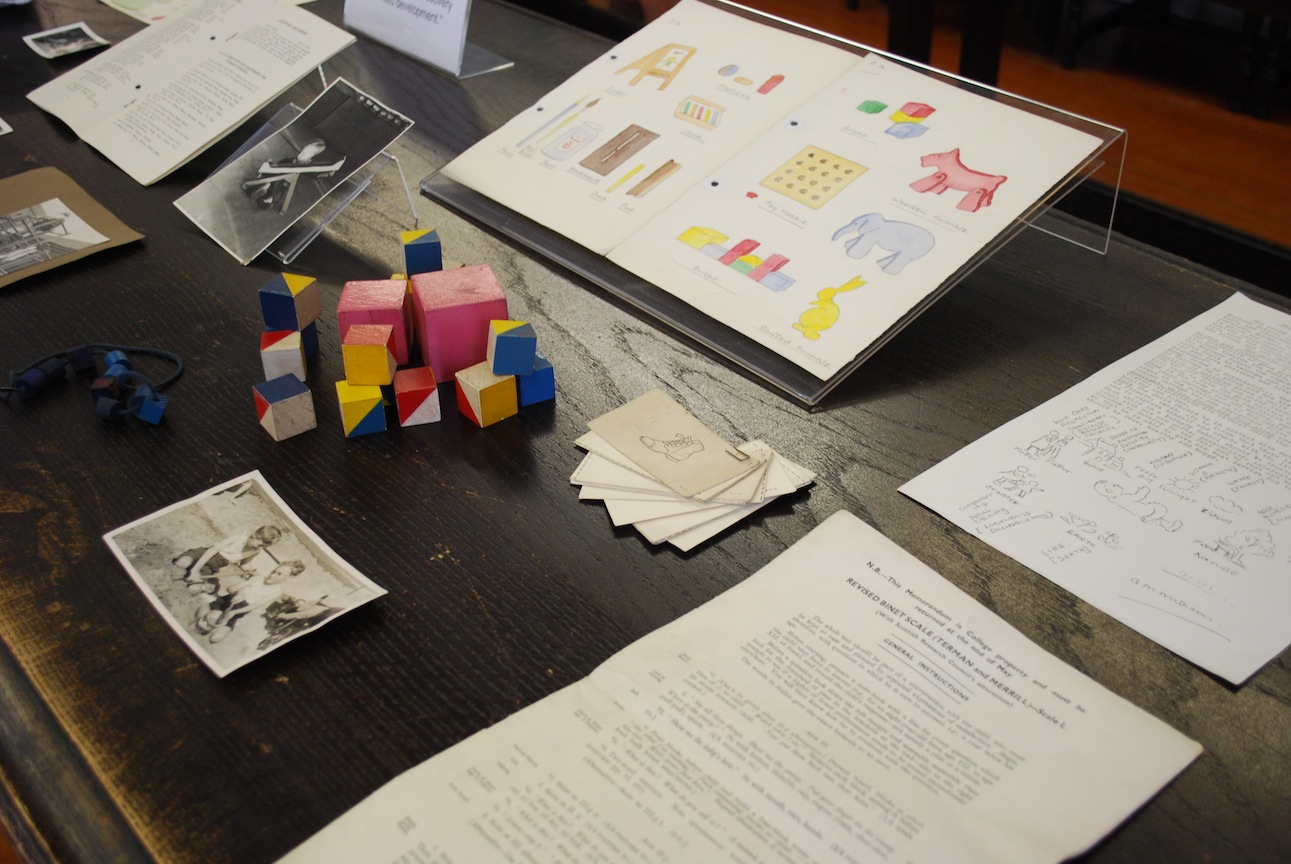
A display from the exhibition including children’s toys
Overall, the experience was tiring but very rewarding for everyone involved. And, as it turns out, it is possible to create an exhibition in a day…
Post by Emma Davey, Conservation Officer and Samantha Cawson, Conservation Intern
Google Cultural Institute
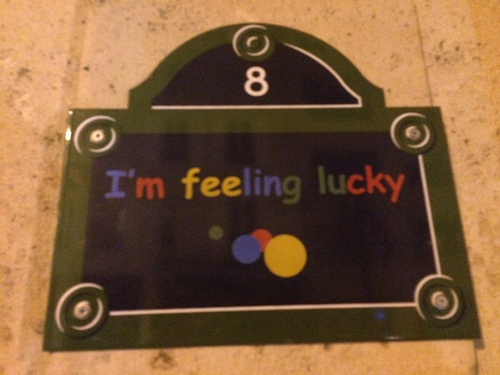
I was lucky enough to attend the Europeana loCloud Hackathon at the Google Cultural Institute in Paris, on February 11th. While I was too late to actually do any hacking with Europeana data, I did get to witness some of the interesting tools being developed using the loCloud API, and got a tour of the building.
The Google Cultural Institute has emerged from the Google Art Project, which has now digitised over 6 million artworks, and is effectively an umbrella for a number of digitisation projects in the cultural heritage sector. We were shown the AV suite, which really puts any other such room that I’ve been in to shame, with its high resolution imaging technology, developed for the Art Project. We were able to see, for example, tiny cracks in paint in Van Gogh oils, giving an insight into how he worked (apparently these cracks were caused by the lead he put in his white paint).

We were also given a souvenir to take away- a Google Cardboard Virtual Reality viewer. While still in its infancy, this is their solution to the prohibitive costs of such tools; put your android (or iOS, but this is Google, so don’t expect the branded apps on iOS!) smartphone into the cardboard, and tailored apps will allow virtual reality heritage viewing, YouTube videos, games and more. Damien Henry, star of the above video, was at work as we toured: his office is almost completely furnished in… cardboard.
Scott Renton- Library Digital Development
Reflections on IDCC 2015: How the 80/20 rule applies to Research Data Management tools
RDM Tools need to be usable by a defined and significant set of researchers
A key question for universities considering which RDM tools to adopt is how broadly useful each tool is and how widely it will be taken up by researchers across the institution. I was reminded of this when Robin Rice posed the question to Ian MacArdle and Torsten Reimer of Imperial College after listening to their presentation, ‘Green Shoots: RDM Pilot at Imperial College London’.
This is equally an issue for builders of tools. Some tools are designed to be used primarily by the people who designed them, to add value to their own research. Most of the six projects described in the Green Shoots presentation fall into that category. Other tools are designed to be used by a broader but still limited community, e.g. tools for researchers in a particular discipline. RDM tools, in contrast, need to be applicable to an even broader range of researchers, certainly across more than one discipline. I think the 80/20 rule is a good benchmark. For an RDM tool to be of interest at the institutional level it needs to be relevant to the needs of at least 80% of a defined and significant set of researchers at the institution.
Electronic lab notebook example
To illustrate this point let’s take the example of electronic lab notebooks. The target user group here includes biologists, chemists, biomedical researchers, and researchers in associated disciplines such as veterinary medicine, plant science, and food science. In a word, disciplines where the paper lab notebook is widely used. This is clearly a defined and significant set of researchers at major research institutions, so the target user group meets the minimum viable community definition.
What does an electronic lab notebook need to have and to do in order to meet the requirement of 80% of the users in this defined target group? One way of approaching this issue is to look at the reactions of ‘outliers’, i.e. researchers whose focus is so specific that a ‘generic’ offering, even one tailored to this particular set of researchers, may not be attractive. A large set of potential outliers is chemists. If there is no support for chemistry in an ELN chemists are likely to find it unsuitable for their needs. So one challenge is to build in sufficient support for chemists without having the ELN become so chemistry-focussed that other segments of the target user group find it unworkable. When this is done in most cases the majority of chemists go from being potential outliers to proponents of adoption.
A second set of outliers are bioinformaticians, who overlap with another set of outliers, researchers who build their own software as part of their research. Both of these groups tend to prefer ‘home-built’ solutions, and for this reason may not be inclined to adopt ELNs that in fact work well for” the 80%”. One way of increasing the likelihood that some members of these groups will make use of the ELN and hence become proponents is to build a good API. This enables these groups to integrate the ELN with the software and solutions they are developing, in which case they are more likely to (a) appreciate the ELN’s benefits, and (b) find that it adds value to their workflow.
A third set of outliers are those who are reluctant to adopt an ELN because for whatever reason they do not see it fitting into their workflow. In many cases this is a temporary barrier which can be overcome as the doubters come to understand the benefits of using an ELN. In other cases there is a specific issue relating to the use of a paper notebook. For example, some researchers work in labs where chemical spillage is likely. They are reluctant to bring their own tablet computer into the controlled area because they are afraid it will be damaged — they will only adopt the ELN, for use on a tablet, if the lab provides a dedicated tablet for them to use in the lab.
Applying the 80/20 rule
Sometimes the doubts raised by outliers like the ones identified above take on a higher profile than the views of the silent majority of researchers who may be willing or even keen to try out and eventually adopt an ELN, but lack effective or well-connected advocates. In this case the 80/20 rule may come in handy for those involved in RDM – take some soundings from the ‘average’ labs which don’t fall into any of the three categories of outliers noted above. If there is significant interest among this group, that could be an indication that a product trial is justified, and that, notwithstanding doubts expressed from some quarters, the 80/20 rule is in fact in operation.
Making the right RDM tools available is a joint responsibility
Reflecting on the above, it’s clear that neither developers of RDM tools or those involved in RDM management can, working in isolation, provide the RDM tools that researchers need. It’s up to tool providers to, first, design tools for the 80%, and then to be sensitive to those with specialist needs and attempt to build in capabilities that will make the tool useful to as many as possible of them, too. And it’s up to those involved in RDM management to be attentive to the needs of the ‘silent majority’ of researchers and to work with them, and with interested tools providers, to offer researchers tools that meet their needs, even when those needs may not initially be systematically or even very coherently expressed.
Explore the Geology with LUNA
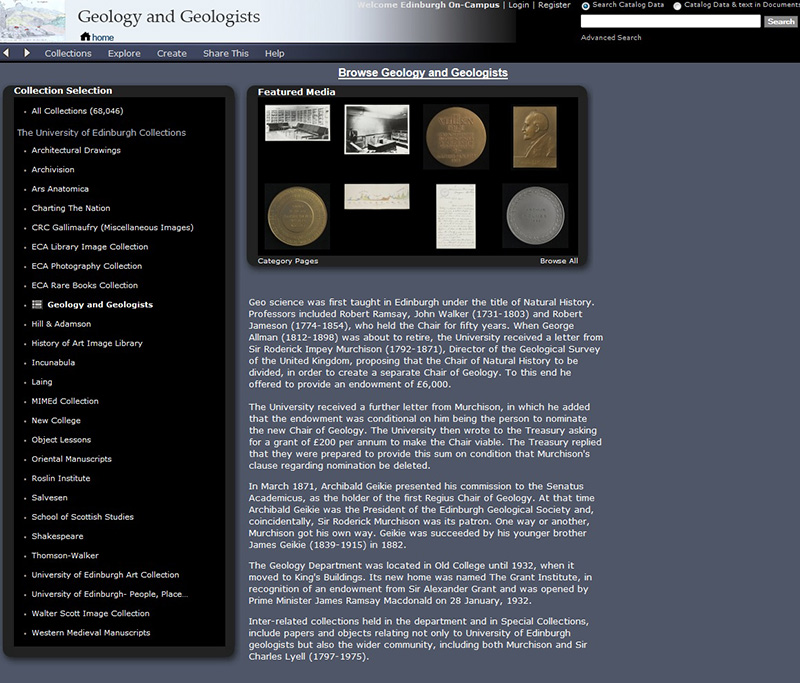
Last week we were very excited to see a new LUNA collection go live- ‘Geology & Geologists’. This brings together images from the CRC’s Lyell collection (a wonderful mixture of correspondence and drawings), Arthur Holmes Geology medals, as well as recent images from The Cockburn Museum, School of GeoSciences. The Cockburn collection contains photographs of past Professors, and historic photos of the department as well as plates of fossilised fish.
Recent acquisition – Small archive relating to ‘The Jabberwock’

Artwork from a poster advertising a 1958 issue of ‘The Jabberwock’. Coll-1611.
Assisted by the College, a small but interesting archive of material relating to the Edinburgh University literary review, The Jabberwock, has been acquired by the Centre for Research Collections (Special Collections) for Edinburgh University Library.

Letter-heading from correspondence of the Editorial office of ‘The Jabberwock’. Coll-1611.
The Jabberwock was an Edinburgh University literary journal, or review, starting in the 1940s and running to the late-1950s, and its editors have included Iain Ferguson, Ian F. Holroyd, Douglas Henderson, Barbara Macintosh and Alex Neish.

Cartoon describing the arrival of ‘The Jabberwock’, Edinburgh University. Coll-1611.
The archive contains manuscript and typescript work – literary and political – submitted to the title in the 1950s under the editorship of Ian Holroyd by Scottish literary figures such as: C. M. Grieve, or Hugh MacDiarmid; Robert Garioch; Martin Gray; Sydney Goodsir Smith; Bruce Etherington; Alan Riddell; Jonathan Mills; and, other contributors.

Note to the Editor of ‘The Jabberwock’ from Martin Gray telling about his submissions to the review. Coll-1611.
Also in the archive, there is correspondence to and from Ian F. Holroyd, posters for various editions of The Jabberwock and other printed ephemera, journal off-prints that would have assisted in the editing of some articles, scribbled accounts and sales figures, art-work, and some Jabberwock Committee Meeting minutes. Some typed lists of Jabberwock shop sales prompt recall of Edinburgh booksellers no longer with us – Thin’s, Baxendine’s, and Bauermeister’s.

Poster advertising the Volume 5. 1958 issue of ‘The Jabberwock’. Coll-1611.
Holroyd’s correspondents include, among others: Compton Mackenzie; Sean O’Casey; C. M. Grieve or Hugh MacDiarmid; Edwin Muir; Edith Sitwell; Jonathan Mills; Neil Gunn; and, Martin Gray.

Poster for an edition of ‘The Jabberwock’ featuring contributions by Compton Mackenzie and Helen Cruickshank. Coll-1611.
Submissions to The Jabberwock by Hugh MacDiarmid include autograph manuscripts: The Scottish Renaissance: the next step; R.B.Cunninghame Graham; and, The significance of Sydney Goodsir Smith. The archive holds a typescript piece by Compton Mackenzie, at the time aged 70 (so probably from 1953), in which he lauds twenty-somethings, writing ‘that the University magazine of today is a much more interesting production than it was half a century ago […] I find a magazine like Jabberwock much more lively than The Oxford Point of View. I can read it through from cover to cover with pleasure […] I am quite unable to grasp what inspires all this pessimism over modern youth’.

Letter dated 14 April 1952 to Ian Holroyd, Editor of ‘The Jabberwock’ from Compton Mackenzie promising a contribution. Coll-1611.

Letter dated 3 June 1952 to Ian Holroyd, Editor of ‘The Jabberwock’ from Compton Mackenzie again promising a contribution. Coll-1611.

Signature of Hugh MacDiarmid (C.M.Grieve) on a letter dated 23 November 1950 to Ian Holroyd, Editor of ‘The Jabberwock’. Coll-1611.

Signature of Edith Sitwell on a letter dated 23 October 1951 to Ian Holroyd, Editor of ‘The Jabberwock’. Coll-1611.

Signature of Sean O’Casey on a letter dated 24 April 1958 to Ian Holroyd, Editor of ‘The Jabberwock’. Coll-1611.

Signature of Neil Gunn on a letter dated 24 April 1958 to Ian Holroyd, Editor of ‘The Jabberwock’. Coll-1611.
Dr. Graeme D. Eddie, Assistant Librarian Archives & Manuscripts, Centre for Research Collections
Access alert – e-journals unavailable
Our e-journals are currently unavailable via A-Z library links, Searcher and the catalogue. This is being investigated by our IT staff.
In the meantime, please access the journals directly on campus or off campus via the VPN or by adding http://ezproxy.is.ed.ac.uk/login?url= to the front of a url eg for nature journal, the link is http://www.nature.com and then add http://ezproxy.is.ed.ac.uk/login?url= to make it http://ezproxy.is.ed.ac.uk/login?url=http://www.nature.com which will then work off campus. There is also the option to log in off campus via UKFederation/Shibboleth if offered by the publisher.
We will add an update to this post once access is restored. Access has been restored.
Collections
 Hill and Adamson Collection: an insight into Edinburgh’s past
My name is Phoebe Kirkland, I am an MSc East Asian Studies student, and for...
Cataloguing the private papers of Archibald Hunter Campbell: A Journey Through Correspondence
My name is Pauline Vincent, I am a student in my last year of a...
Hill and Adamson Collection: an insight into Edinburgh’s past
My name is Phoebe Kirkland, I am an MSc East Asian Studies student, and for...
Cataloguing the private papers of Archibald Hunter Campbell: A Journey Through Correspondence
My name is Pauline Vincent, I am a student in my last year of a...

Projects
Cataloguing the private papers of Archibald Hunter Campbell: A Journey Through Correspondence
My name is Pauline Vincent, I am a student in my last year of a...
Archival Provenance Research Project: Lishan’s Experience
Presentation My name is Lishan Zou, I am a fourth year History and Politics student....