Home University of Edinburgh Library Essentials
December 16, 2025
Saying Goodbye to Dr. Coffin
This week, we say farewell to our conservation intern, Samantha. To mark the end of her 10-week internship working on the Thomson-Walker collection, we put some questions to Samantha to find out more about her time working on the project: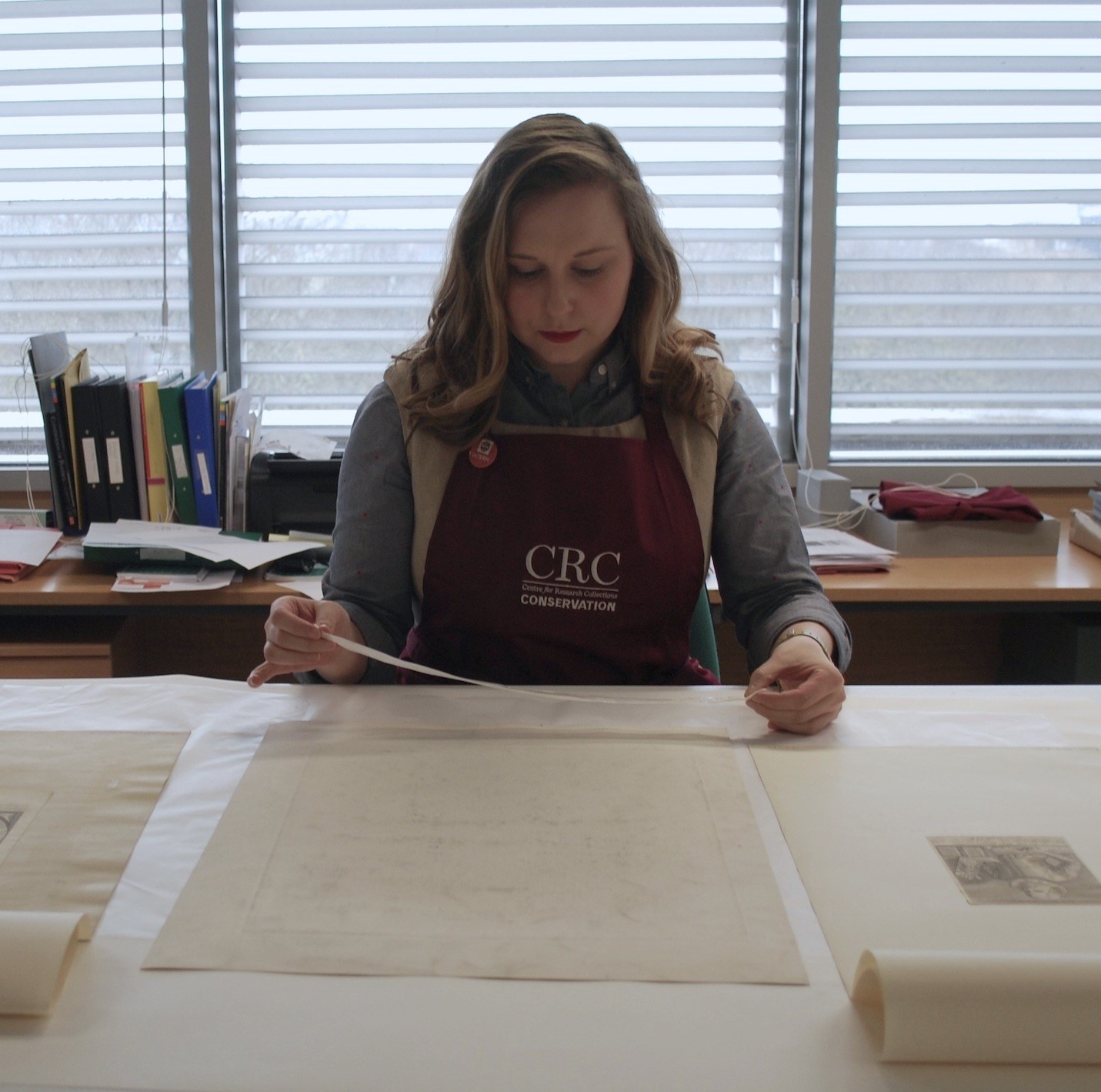
- Why did you decide to apply for the internship at the CRC?
When I graduated last June I decided to make a career plan. This included at least one year of work experience, which would allow me to put my education into practice, strengthen my skills set, and improve areas of weakness. This need to develop had been my main ambition when applying for opportunities. However this particular internship intrigued me for a couple of other reasons. I was interested in the idea of working for a University conservation studio and how this might compare with working for a museum for instance. Inviting also was the prospect of leading a big project during the first phase of conservation; when you train as a conservator it is unusual to work on a large collection independently and so this was an excellent opportunity to do so.
- What did you expect from the internship? Has anything surprised you?
I thought I would be working solely on the Thomson-Walker collection, but I very quickly recognised that this was not the case. I would indeed be occupied with the Thomson-Walker collection on a daily basis, however I would also be giving tours, supervising volunteers, teaching taster days, writing blog posts and assisting with an exhibition, which was a pleasant surprise.
- Tell us about what you’ve learnt over the past 10 weeks.
I now know how to survey a collection and create a project proposal. Creating a programme of conservation and preservation that doesn’t just benefit one print but over 2000 felt very daunting 10 weeks ago. But by taking small steps, and keeping in mind that my approach would have to be interpreted by interns after me I have been able to get through it by staying methodical, and making vigorous notes and to do lists!
- Can you describe for our blog readers a typical day within the CRC conservation studio?
The conservation treatment of the Thomson-Walker collection included removing old backing boards and using a carboxymethyl cellulose poultice to remove tape and adhesive. As this poultice is essential to the treatment I would prepare the CMC the previous evening and construct the poultices as soon as I arrived at the studio the following morning. Once these were ready I began the treatment. Because of the demanding nature of the project, I worked on a number of prints simultaneously, aiming to conserve and rehouse around 10-15 per day. Whilst this is going on I might assist with a tour of the conservation studio, discussing the project with visitors and giving demonstrations. And then during the second half of the day a volunteer would help me to create archival folders to rehouse prints that I’d previously conserved. The CRC has a number of dedicated volunteers, usually students with an interest in conservation wishing to gain experience before embarking upon a relevant degree. This partnership has been very successful for the Thomson-Walker collection, as it has allowed me to conserve more prints, whilst a volunteer has gained new skills and experience.
- What have you enjoyed most about your time with us?
Working within a University. I was unsure how this would compare with my previous experience of working within a museum or archive setting, but the difference has been huge. One of the main objectives of the CRC conservation studio is to make their collection more accessible and fun. I have really embraced this ideology during my time here, and hope to be an advocate of such aims during my future career. Working in such an open and exciting atmosphere has also done wonders for my confidence.
- What have you found most challenging?
Creating a rehousing programme for the Thomson-Walker collection. This wasn’t just difficult because of the sheer number of prints but because they are all completely different sizes! I started out by wrestling with measurements, conservation catalogues, budgets, time restrictions, calculations, and ordering forms. Once this was all worked out I could relax a little. That was until my order arrived…then I had to make sure that all those calculations had been correct and actually get the project underway.
- What shall you miss about the internship?
As an intern, it is not always possible to be self-directed, and projects aimed for interns are typically already set up and ready to go. For this reason I shall miss the independence I have experienced whilst working on the Thomson-Walker collection. I have enjoyed creating and following my own rules.
- Do you have a favourite print?
Yes! I recently discovered a print of Dr Albert Isaiah Coffin (1790–1866). Whilst the print itself isn’t spectacular I found the name rather amusing and decided to do some  research on the American herbalist. It turns out that Dr Coffin was a man ahead of his time and has even been called a revolutionary. Instead of paying extortionate fees for a conventional doctor, Dr Coffin advocated that one should learn the secrets of medical botany and be their own doctor. In the north of England, Coffin delivered lectures to working people and set up botany societies where people could meet to learn and discuss medicine, as well as sharing problems and tips. This idea was nicknamed, “coffinism.” In a way I feel that Coffin’s aims are echoed within the CRC conservation studio…well not quite, but we do offer conservation taster days!
- What advise would you give to the next intern working on the Thomson-Walker collection?
The conservation studio is currently a very exciting place to be working for all of the reasons I’ve mentioned above. Take advantage of all the extra activities on offer. Work hard but play harder!
From all of us in the conservation studio, and the CRC as a whole, we would like to thank Samantha for all her fantastic work, and wish her the best of luck in her future career. In the meantime, we will be sure to keep you updated on how the Thomson-Walker project developments….
Post by Samantha Cawson, Conservation Intern
‘Empire Kingsley’ – 70th anniversary of sinking on 22 March 1945
LAST LOSSES OF THE SECOND WORLD WAR, 1939-1945 – Christian Salvesen & Co.
22 March 2015 is the 70th anniversary of the sinking of the steam cargo vessel Empire Kingsley. Its sinking during the closing phase of the Second World War was the last maritime loss suffered by the general shipping and whaling firm Christian Salvesen & Co. of Leith during the War. Families couldn’t have known it at the time, but the ship’s destruction with the loss of 8 lives happened only 7-weeks before VE-Day (Victory in Europe).
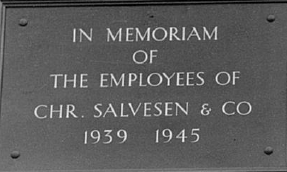
Memorial plate on homes built for the Scottish Veterans Association. Salvesen Archive. Coll-36 (2nd tranche. Photographs, ‘Garden cottages’, No.54)
The Empire Kingsley was one of a number of Empire vessels listed as Salvesen ships – other losses of these included the Empire Bruce, Empire Dunstan, and Empire Heritage (the latter being the firm’s greatest as far as lives were concerned with 60 crew dead) – and each was in fact owned by the Ministry of War Transport and managed on contract by Christian Salvesen & Co.
On Thursday 22 March 1945, on its way from Ghent to Manchester, the Empire Kingsley was sunk by a torpedo from the German submarine U-315 off Land’s End in Cornwall. U-315 surrendered at Trondheim in Norway a few weeks later in May 1945. It had hunted in several patrols since entering service with the German Kriegsmarine in July 1943, but had sunk only the Empire Kingsley and written off a Canadian frigate.
The British merchant marine suffered heavy losses during 1939-1945. Merchant ships and their crews suffered attack from submarines, surface raiders, mines and assault from the air. Christian Salvesen & Co. suffered no less than any other firm, indeed the whaling side of its business was all but suspended after the 1940-41 season. The firm’s transport ships and whale catchers were pressed into naval service under the control of the Ministry for War Transport, with its factory ships being used as tankers and heavy lift vessels.
Contained within the Salvesen Archive (1st tranche. B2. Box 4.) is a copy of a list of Chr. Salvesen & Co.’s Vessels Lost or Damaged by Enemy Action… a list that records the deaths of over 400 seamen between October 1939 and April 1945, and the loss of Salvesen tonnage all over the world and around the home waters of the British Isles…:


The firm suffered its first wartime loss at sea with the sinking of the Glen Farg – a coaster – by the German submarine U-23 on 4 October 1939. The ship was on its way home from Norway to Methil and Grangemouth with a cargo of pulp, carbide and ferro chrome when it was captured and sunk off the north of Scotland, west of Orkney and Duncansby Head. One seaman was lost, but there were 16 survivors who were picked up by a Royal Navy destroyer based at Scapa Flow, Orkney.

The Salvesen vessel ‘Salvestria’ sunk by an exploding mine in the Firth of Forth, 27 July 1940. Salvesen Archive. Coll-36 (2nd tranche. C1. Photographs, No.1)
The loss of the whale factory ship Salvestria in July 1940 – on Edinburgh’s own doorstep – brought the deaths of 10 seamen. On 22 July 1940, two miles east of Inchkeith in the Firth of Forth, the ship was sunk by a magnetic mine while on its way to the naval installation at Rosyth with a cargo of fuel oil.

The loss of the vessels ‘Salvestria’, and ‘Shekatika’, and the attack on ‘Coronda’ reported in the Minutes of Meeting of Directors of The South Georgia Co. Ltd. […] 28 October 1940

The same Minutes – 28 October 1940 – reported the loss of the ‘New Sevilla’
The same year, in September 1940, the whale factory ship New Sevilla was sunk off Northern Ireland – a bit out from Islay – on the way from Liverpool to Aruba and South Georgia.
‘New Sevilla’ sunk by a torpedo off Northern Ireland, 20 September 1940. Salvesen Archive. Coll-36 (2nd tranche. C1. Photographs, No.13 and 41)
The vessel was carrying a cargo of whaling stores when it was struck by a torpedo fired from the German submarine U-138. The attack could have had worse consequences as the human cost was 2 lives lost out of a total complement of 285.
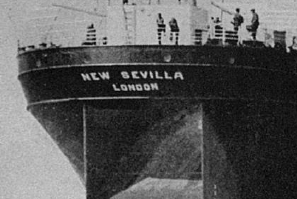
The Salvesen vessel ‘New Sevilla’ sunk by a torpedo off Northern Ireland, 20 September 1940. Salvesen Archive. Coll-36 (2nd tranche. C1. Photographs, No.13 and 41)
Further west of Ireland, and south of Iceland, the Sirikishna was lost in February 1941. This steam cargo ship was on its way from Glasgow to Halifax, Nova Scotia, and had become separated from a convoy. It was attacked by the submarine U-96.

Pages from the Minutes of Meeting of Directors of The South Georgia Co. Ltd. […] 17 December 1941, reporting the loss of several vessels… ‘Sirikishna’, ‘Sevra’, ‘Sarna’, and ‘Stora’.

‘Coronda’ , bombed but not sunk. Salvesen Archive. Coll-36 (2nd tranche. C1. Photographs, ‘Old Salvesen ships’, No.41)
Coronda suffered the loss of 21 seamen and suffered heavy fire-damage, and was beached on Kaimes Bay, Tighnabruaich, in the Kyles of Bute. P.L.M. XIV was torpedoed on Smith’s Knoll (part of the Haisborough Sands, off Norfolk) in October 1940 with the loss of 10 crew, and the vessel was towed to Immingham. In November 1940, Folda was bombed off the Thames estuary with the deaths of 3 seamen, and then the ship was towed to Harwich. Then, in March 1941, the vessel Daphne II was torpedoed off the Humber with no human loss, and towed to Grimsby.

The Salvesen vessel ‘Folda’ bombed in November 1940 and towed to Harwich. Salvesen Archive. Coll-36 (2nd tranche. C1. Photographs, Envelope ‘Norwegian lines and coasters’, No.45)
Not all the attacks on Salvesen’s ships ended in the deaths of crew. Between September and October 1940 the Crown Arun, Shekatika, Strombus and Snefjeld were each mined or torpedoed. The Crown Arun, known earlier as Hannah Böge, and taken into British service as war booty, then placed under Salvesen management by the Ministry of Shipping, sank off north west Ireland with a cargo of pit-props while in a convoy. Shekatika was sunk near Rockall en route to Hartlepool carrying steel and pit-props. Strombus broke up near Swansea after being attacked just as it was setting off for South Georgia, and Snefjeld sank north west of Ireland, also while in a convoy. None suffered human loss, and as has already been told Daphne II was attacked in 1941 with no losses either. Then, in March 1942, the tanker Peder Bogen was torpedoed, shelled and sunk south east of Bermuda by the Italian submarine Morosini, and again all crew were saved. The crews of the Indra lost in the Atlantic just above the equator in November 1942 and the Empire Bruce lost off the coast of Sierra Leone in April 1943 were also saved.

The Salvesen vessel ‘Peder Bogen’ torpedoed and sunk near Bermuda in March 1942, though all men saved. Salvesen Archive. Coll-36 (2nd tranche. C1. Photographs, No.18)
However, a few months after the loss of the Peder Bogen in March 1942 – and the saving of all the crew – the Saganaga was lost at anchor in Wabana Harbour, Newfoundland, in September 1942 with the loss of up to 30 lives. The steam cargo vessel loaded with iron-ore was sunk by a torpedo from the German submarine U-513.

The Salvesen vessel ‘Saganaga’ torpedoed and sunk in September 1942 with the loss of up to 30 lives. Salvesen Archive. Coll-36 (2nd tranche. C1. Photographs, No.47). Photograph by W. Ralston, Glasgow, and acknowledged by request
The Salvesen vessel Saganaga was reported in the Minutes of the Meeting of Directors of the Salvesen enterprise, The South Georgia Co. Ltd., on 30 December 1942, as having an insurance value of £155,000, which at today’s values would be circa £6.5-million. The Sourabaya which was lost earlier – in October 1942 – had an insurance value of £220,000, or £9.2-million today. Sourabaya was a whale factory ship and it was steaming in convoy from New York to Liverpool with a cargo of fuel oil, war stores and landing craft. It was torpedoed and sunk by the German submarine U-436 in the mid-Atlantic. 30 crew lost their lives.
![Notes on the 'Svana', 'Saganaga' and 'Sourabaya' in the Minutes of Meeting of Directors of The South Georgia Co. Ltd. [...] 30th December 1942. Salvesen Archive. Coll-36 (3rd tranche)](https://libraryblogs.is.ed.ac.uk/edinburghuniversityarchives/files/2015/03/Minutes_losses_30-12-42.png)
Notes on the ‘Svana’, ‘Saganaga’ and ‘Sourabaya’ in the Minutes of Meeting of Directors of The South Georgia Co. Ltd. […] 30th December 1942. Salvesen Archive. Coll-36 (3rd tranche. Minute Book)

The Salvesen vessel ‘Southern Empress’ sunk after an attack from 3 torpedoes fired by U-221off Newfoundland in October 1942. Salvesen Archive. Coll-36 (2nd tranche. C1. Photographs, No.41)
The greatest loss of life came in September 1944 when the tanker Empire Heritage, managed by Salvesen, was sunk by a torpedo north west of Malin Head, Ireland, on its way to Liverpool from New York. The vessel was carrying a cargo of fuel oil and a deck cargo including Sherman tanks when it was met by German submarine U-482. Over 100 lives were lost (of which 60 were crew). On 3 March 1945, the Salvesen vessel Southern Flower, formerly a whale catcher and which had been requisitioned for Admiralty service in anti-submarine duties, was torpedoed and sunk off the Icelandic coast by U-1022 patrolling between Bergen in Norway and southern Iceland. The Southern Flower had been owned by Salvesen since 1941 the year in which the firm acquired the Southern Whaling and Sealing Co. Ltd. from Unilever (Lever Bros.) along with its two whale factory-ships and fifteen whale-catchers.
![From the Minutes of Meeting of Directors of The South Georgia Co. Ltd. [...] 10th July 1945. Chaired by Capt. H. K. Salvesen. Salvesen Archive. Coll-36 (3rd tranche)](https://libraryblogs.is.ed.ac.uk/edinburghuniversityarchives/files/2015/03/Minutes_losses_10-July-1945.png)
Notice of the vessels ‘Southern Flower’ and ‘Empire Kinglsey’ which had been lost to enemy action, from the Minutes of Meeting of Directors of The South Georgia Co. Ltd. […] 10th July 1945. Chaired by Capt. H. K. Salvesen. Salvesen Archive. Coll-36 (3rd tranche. Minute Book)

Correspondence files concerning honours and awards to officers and men serving on Salvesen vessels during the Second World War. Salvesen Archive. Coll-36 (2nd tranche. E2)
Many of Salvesen’s officers and men received awards for gallantry and for meritorious service at sea during the War, and others were commended.

Pamphlet literature of the Scottish Veterans’ Garden City Association, 1940s. Salvesen Archive. Coll-36 (1st tranche. H14. File 1919-67)
Appreciation of the efforts and sacrifice of the seamen during the War years was met by Christian Salvesen & Co. through the establishment of a fund to assist the families of those whose lives were lost.
Memorial plate on homes built for the Scottish Veterans Association. Salvesen Archive. Coll-36 (2nd tranche. Photographs, ‘Garden cottages’, No.54)
Money was also made available from various members of the Salvesen family for the building of homes for veterans through the Scottish Veterans’ Garden City Association.

Homes built in Muirhouse, Edinburgh, were similar to those shown in the pamphlet literature of the Scottish Veterans’ Garden City Association, 1940s. Salvesen Archive. Coll-36 (1st tranche. H14 File 1919-67)
Construction of the houses designed in a ‘garden village’ style in Muirhouse, Edinburgh, was begun in 1946, and the houses were occupied by 1948. Streets were named Salvesen Crescent, Salvesen Gardens, Salvesen Grove, and Salvesen Terrace.
Dr. Graeme D. Eddie, Assistant Librarian – Archives & Manuscripts, Centre for Research Collections (Special Collections)
Sources used in this piece:
Salvesen of Leith. Wray Vamplew. Edinburgh: Scottish Academic Press, 1975; A whaling enterprise. Gerald Elliot; as well as internet wreck sites, and material contained in the Salvesen Archive
William Ronald Dodds Fairbairn: an archivist’s perspective
The papers of Edinburgh-based psychoanalyst, William Ronald Dodds Fairbairn (more usually known simply as Ronald) are held here, in the National Library of Scotland.

I’m Karla, an archivist, and since January 2015 I have been lucky enough to work with Ronald Fairbairn’s papers. So far, I have examined and rearranged the collection and I will soon be working alongside our conservation department who will be ensuring its long-term physical survival. However, the main aim of my six-month, Wellcome Trust funded post is to promote access to, and facilitate use of, this collection, through detailed, online cataloguing. In order to achieve this I have been working with fellow professionals from the University of Edinburgh Library, which is home to Fairbairn’s own library. Our intention is to re-establish the relationships that exist between his papers and his books and to create a website through which both collections can be accessed.
The first three months of this project have been a revelation to me. Ronald Fairbairn’s papers roughly span the period of 1891-1964, a period that I happen to know quite a bit about through other archives I have worked with. However, the documents in this collection have provided me with a new window to this world: one that reveals some of its darker psychological spaces as well as those that are reassuringly familiar.
Fairbairn’s papers have a research interest for a wide variety of mental health professionals and researchers, after all, some of his most important published papers continue to influence psychoanalytical thought today. Much of the collection provides an insight into Fairbairn’s working methodologies and the constantly evolving nature of his research interests.
However, the collection is comprised of a variety of materials – including newspaper cuttings, photographs (such as the one of Ronald Fairbairn, c 1895, below) personal papers and drawings – as well as, occasionally, totally unexpected material.

During the remainder of this project I intend to share with you some of the stories you might expect to see but also, many that you won’t! Plus, I also hope you will be able to help me by solving some of the ‘archival mysteries’ I have come across in the past three months.
Trials – New E-Resources on Trial
These trials are now available…
 AMA Manual of Style is on trial until the 1st April. It is a guide to publishing medical or scientific research findings. More than just a style manual, it offers guidance on how to navigate the dilemmas that authors, researchers, medical editors, publishers, and members of the news media who cover scientific research confront on a daily basis.
 Archives Unbound -The Mafia in Florida and Cuba is on trial until the 17th April. This collection comprises materials on Santo Trafficante, Jr., Meyer Lansky, and Lucky Luciano, including FBI surveillance and informant reports and correspondence from a variety of offices including, Miami, Tampa, Jacksonville, New York City, New Orleans, Atlanta, New Haven, New York City, Philadelphia, and Chicago; Justice Department memoranda, correspondence, and analyses; News-clippings and articles; Domestic Intelligence Section reports; Transcriptions of wiretaps, typewriter tapes, and coded messages; Memoranda of conversations. Date Range: 1946-1977. Content: 11,290 pages.
Canterbury Dictionary of Hymnology – on trial until 31st March. Full details on the New College Librarian blog.
 Taylor & Francis Fresh Collection – over 140 “young” titles (between 3 and 7 years old) are on trial until the December 31st 2015 with 40 e-journal titles in Science and Technology and 70 e-journal titles in Social Sciences and Humanities. See http://www.tandf.co.uk/libsite/pdf/productInfo/freshCollection/Fresh-Collection-Title-List.pdf for a full list as well as on campus links. These titles have also been added to our e-journals A-Z list.
Feedback and further info
We are interested to know what you think of these e-resources as your comments influence purchase decisions so please fill out our feedback form.
A list of all trials currently available to University of Edinburgh staff and students can be found on our trials webpage.
Rediscover: The Torrie Collection
Rediscover is a new initiative that allows postgraduate students of History of Art to put their original research and knowledge into practice through three displays in Talbot Rice Gallery over March and April 2015. Following a new taught-course working directly from the University’s Torrie collection the students have explored the history of these artworks to uncover the social and political circumstances in which they were made or acquired. Their projects will contribute towards a major show of The Torrie Collection planned for 2016.
- Living With Art, Saturday 14 March – Saturday 28 March
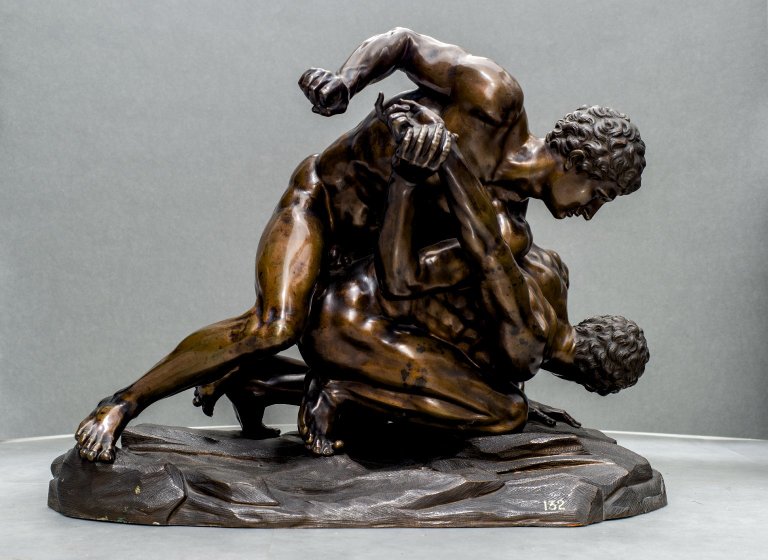
Massimiliano Soldani (1656-1740), The Wrestlers, bronze, 36.8
Art collections may have long and eventful histories of their own. It is easy to forget how historic artworks have not always been on show in a museum or a gallery. This exhibition calls attention to the display and viewing experience of artworks in the early nineteenth century British home of Sir James Erskine, 3rd Baronet of Torrie (1772–1825). Sir Erskine bequeathed a large portion of his art collection to the University of Edinburgh, where it is now known as the Torrie Collection.
Through the display of two pieces from the Torrie collection, ‘Living with Art’ explores the juxtaposition between calm landscape paintings and action-filled bronze sculpture; Massimiliano Soldani’s (1656-1740) expert imitation of the classical sculpture of the Wrestlers, and Jacob Isaacksz van Ruisdael’s (1628-1682) painting, A Wood Scene, invite different modes of spectatorship. This exhibition will consider the concept of multi-angle viewing and fixed perspective to reflect the original display of these artworks within Torrie House in Fife, Scotland.
- Powers of a Flag: Dutch Seascapes in the Torrie Collection Tuesday 31 March – Saturday 11 April
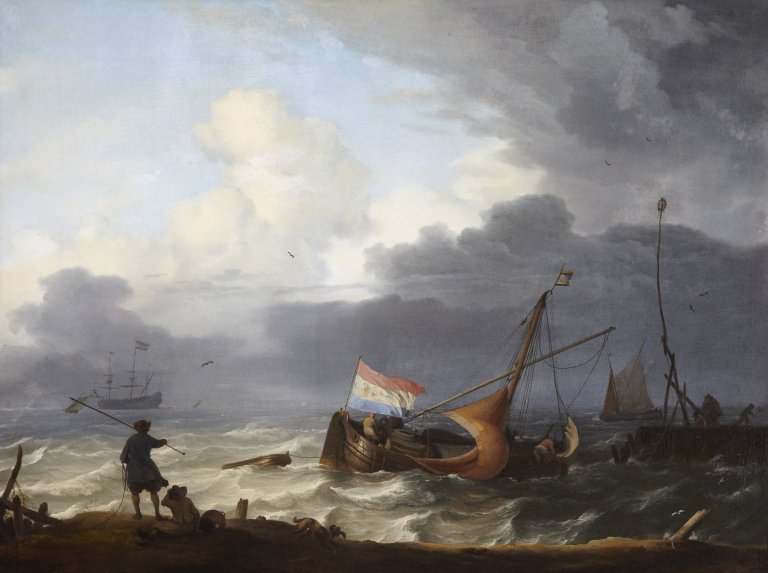
Ludolf Backhuysen (1630-1708), A Squall: A lugger running into harbour, oil on canvas, 46.4 x 61cm
Flags can inspire a nation as powerfully as they can define a nation. After two centuries of Spanish rule, the Dutch emerged from their fight for independence during the 80 Year’s War as the United Provinces in 1648. Searching for a national identity became a priority for citizens and artists alike. Artists looked to the shorelines, as the Dutch prided themselves on manufacturing the best ships throughout the world. William Van de Velde the Younger (1633-1707) depicted his patrons’ vessels in exact likeness from calculated studies. His contemporary, Ludolf Backhuyzen (1630-1708) emphasized the atmospheric effects of the Dutch skyline. These two artists were the most prolific marine painters of the Dutch school.
This exhibition addresses these artist’s attempts to capture the era’s sense of patriotism and nationalism through maritime scenes. Van de Velde’s Fishing Boats in a Calm (1658) provides a record of the day-to-day Dutch economy, while A Squall: A lugger running into harbour is a politically charged response by Backhuyzen to national attitudes of the time. In either case, the Dutch flag was incorporated as an important national icon. But how far can our interpretation push these artists as representatives of their country depicting a portrait of Holland?
- Athens of the North Tuesday 14 April – Saturday 2 May
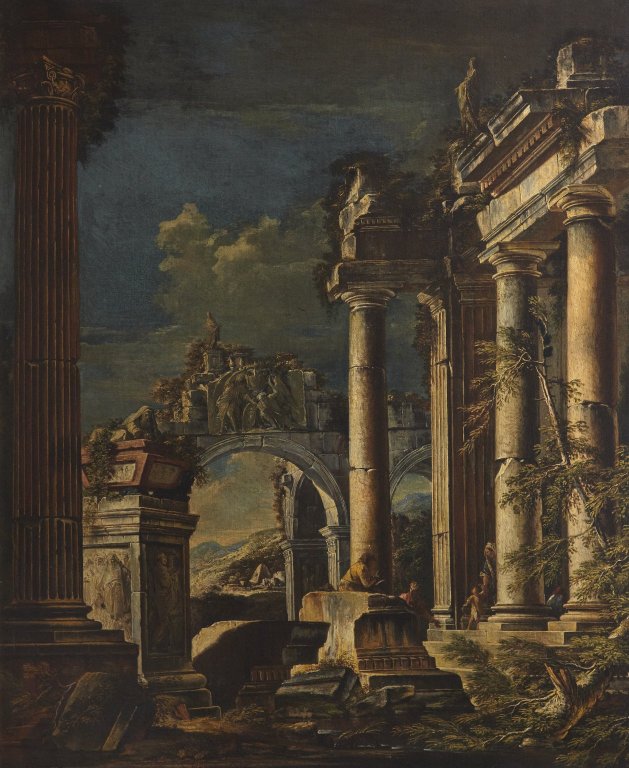
Giovanni Ghisolfi, Ruins and Figures oil on canvas, 97 x 118 cm
This display highlights interrelations between paintings of classical architecture and the NeoClassical architectural fabric of Edinburgh. This exhibition aims to demonstrate the Scottish Enlightenment taste for the Neoclassical in both architecture and art collecting.
This exhibition features two capriccio paintings by the seventeenth-century painter Giovanni Ghisolfi (1632-1683). Capriccio paintings of illusionistic classical ruins were a popular genre collected on Grand Tours in the late eighteenth century.
Athens of the North takes place in the Old College’s Georgian Gallery, which reflects the architectural style of Ghisolfi’s paintings. Old College was designed by William Henry Playfair (1790-1857), who was also responsible for designing much of Edinburgh’s most iconic NeoClassical architecture.
William Henry Playfair designed much of Calton Hill, which brings together classical ruins and romantic atmosphere. Similarly, Ghisolfi’s paintings exhibit a romantic vision of an idealised past while retaining a classical idea of architecture, foreshadowing the Romanticism of the nineteenth century.
By connecting these paintings to Edinburgh’s architecture, this exhibition once again brings exteriors into the interior, a central aim of NeoClassical decorating. Ghisolfi’s paintings, much like Playfair’s architecture, reflect the yearning for a lost world and the endeavour to make the present live up to an idealised past.
Top 5 library resources for Social Work
Today is #WorldSocialWorkDay! We thought we’d give you a taster of social work resources available to students and staff here at the University of Edinburgh Library.
1. Have you seen Social Services Abstracts? This database provides bibliographic coverage of current research focused on social work, human services and related areas, including social welfare, social policy and community development. The database abstracts and indexes thousands of serials publications and includes abstracts of journal articles and dissertations and citations to book reviews.
Coverage includes community and mental health services; crisis intervention; the family and social welfare; gerontology; poverty and homelessness; professional issues in social work; social services in addiction; social work education; social work practice; violence, abuse, neglect.
You can access this and other relevant databases at databases for social work.

Stirling Work
Last week, a contingent from conservation left their natural habitat of the studio to embark on a day trip up North. Stirling University was our destination, more specifically their conservation studio, in order to learn more about their special collections, and the conservation work they’re doing. Stirling University is currently part way through a Wellcome Trust funded project to conserve and re-house the records from the Royal Scottish National Hospital. Working on this project are conservator Elizabeth Yamada, with interns Kat Saunt and past University of Edinburgh conservation intern Erika Freyr (who you may remember from her work on the Laing project: https://libraryblogs.is.ed.ac.uk/conservation/2014/06/20/conserving-laing-iii/). We had previously been delighted to have had the chance to show Elizabeth, Kat and Erika our own studio at the Main Library and introduce them to the work we are doing and the collections we hold. We were therefore pleased to have the opportunity pay them a reciprocal visit and learn more about their own project.
First stop was a visit to their conservation space, and to find out more about the project and their approach to conserving the Hospital’s records. Having converted an old bindery for use as a studio, space was at a premium and with so many records requiring attention, they certainly had their work cut out! The aim of their project is to stabilise the records – through surface cleaning, flattening, tear repair and rehousing – focusing on making them accessible to readers and researchers. It was interesting to learn about how they manage their time, and their thoughts behind deciding what level of treatment they should carry out. It was apparent that time, space and resource constraints made project management so important – something that many people, of all professions, will be able to identify with!
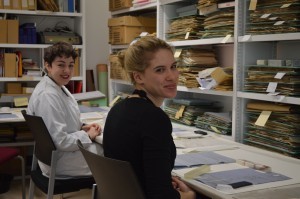
Erika and Kat working in their studio
We also had the opportunity to take a closer look at examples from both the University’s wider special collections and those from the Royal Scottish National Hospital. We got a fascinating, and sometimes harrowing, insight into the human stories contained within the archives and, the photographs in particular, gave a glimpse into the daily lives of those that were housed at the hospital.
However, what came as the biggest surprise to us was that, despite not running any History of Art or Fine Art courses, Stirling University has a vast and important art collection with works ranging from paintings by the Scottish Colourist, J.D. Ferguson to a sculpture by Barbara Hepworth. Housed within the Pathfoot Building, there are works by world famous, and home-grown, artists around every corner and in the numerous courtyard spaces. The art collection, and the temporary and permanent exhibitions they hold, are open to the public and I would certainly recommend a visit…
As conservators, we do not work in isolation and visits such as these are important in forging those links with other institutions and to learn how other studios and conservators work. It is a great opportunity to share knowledge and skills thus developing the profession as a whole.
It just leaves me to say big thank you to the conservators at Stirling University for taking the time to show us their work and collections. If you would like to learn more about their project, you can read their blog at:
http://archives.wordpress.stir.ac.uk/2015/01/22/work-placements-in-conservation-2015/
Post by Emma Davey, Conservation Officer
Edinburgh Research Archive : a new look
We are pleased to announce a new look and feel to the Edinburgh Research Archive (ERA). Over the past few weeks our Library Digital Development team have been busy upgrading ERA to a newer version of DSpace.
The main differences you might notice are:
- a responsive user interface design
- an improved discovery search/browse option which allows new filtering options
- several improvements to help Google Scholar better index the content
- lots of under the bonnet improvements and bug fixes

Full screen v smartphone view
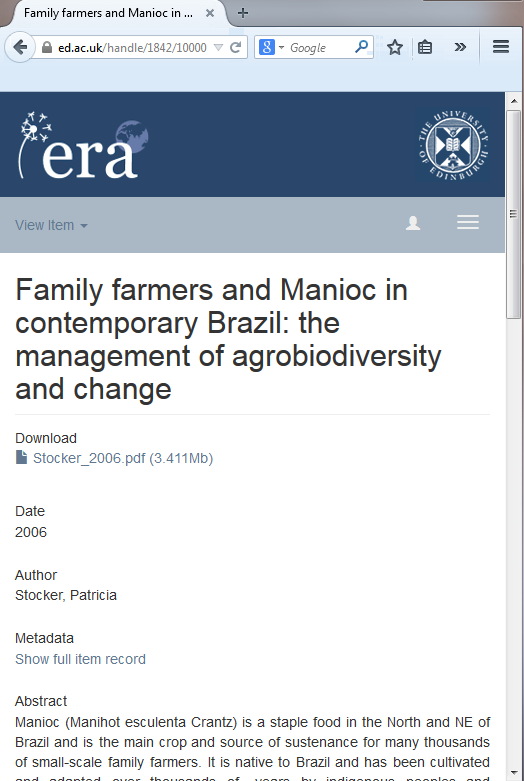
The responsive user interface design helps to make ERA look good on screens of all sizes from widescreen monitors to smartphones. Instead of squeezing everything from the large screen onto smaller screen size displays some information is dropped. Can you spot all the differences?
The text is dropped from the dark blue banner, the breadcrumb links in the light blue bar under the banner are condensed, the left hand side navigation panel is collapsed by default but can be toggled by the list icon, and the item abstract is re-positioned underneath the download and main metadata display.
For those that are interested ERA is now running DSpace version 4.2 (with some local mods including security updates), whilst running the Mirage 2 theme.
Musical Instruments on the Today programme
On Thursday, March 12, the collection of the distinguished keyboard player and conductor Christopher Hogwood was sold at auction. As part of the lead to this, Collection Curator Jenny Nex, along with harpsichordist Sophie Yates, appeared on the Radio 4 Today programme to discuss the collection and its sale. The segment can be heard at http://www.bbc.co.uk/programmes/b054t3s0 starting about 52 minutes in.
Musical Instrument Museums Edinburgh has benefitted greatly – particularly in the last decade – from private collectors who have made gifts or bequests to the Collection. In particular we have the Rodger Mirrey Collection of early keyboard instruments – a collection which complemented the existing keyboard collection and now has given Edinburgh instruments unsurpassed in scope; the Sir Nicholas Shackleton Collection of clarinets – the finest privately assembled collection of woodwinds, and the Frank Tomes Collection, predominantly of brass instruments.
As with all of our instruments, they are used in teaching from undergraduate to PhD level, and are made available to scholars for research and to allow makers to produce reproductions for practicing musicians. Nowadays reproductions of instruments from the University’s Collection are heard daily on national radio (Radio 3 and Classic FM), and the Museum gets regular visits from makers to carry out examinations of objects.
It was a particular wish of Christopher Hogwood that the funds raised by the sale of his instruments went to support students of music and educational charities he has long been associated with. It is obviously too soon to know where the instruments have gone, but early reports suggest that the sale was very successful with the objects selling for their estimate or higher.
One of the issues that was brought up is whether collections of this nature should be preserved together given the importance of the collector, or whether dispersal allows the creation of future collections.
open.ed report
Lorna M. Campbell, a Digital Education Manager with EDINA and the University of Edinburgh, writes about the ideas shared and discussed at the open.ed event this week.
Earlier this week I was invited by Ewan Klein and Melissa Highton to speak at Open.Ed, an event focused on Open Knowledge at the University of Edinburgh. A storify of the event is available here: Open.Ed – Open Knowledge at the University of Edinburgh.
“Open Knowledge encompasses a range of concepts and activities, including open educational resources, open science, open access, open data, open design, open governance and open development.”
– Ewan Klein
Ewan set the benchmark for the day by reminding us that open data is only open by virtue of having an open licence such as CC0, CC BY, CC SA. CC Non Commercial should not be regarded as an open licence as it restricts use. Melissa expanded on this theme, suggesting that there must be an element of rigour around definitions of openness and the use of open licences. There is a reputational risk to the institution if we’re vague about copyright and not clear about what we mean by open. Melissa also reminded us not to forget open education in discussions about open knowledge, open data and open access. Edinburgh has a long tradition of openness, as evidenced by the Edinburgh Settlement, but we need a strong institutional vision for OER, backed up by developments such as the Scottish Open Education Declaration.

I followed Melissa, providing a very brief introduction to Open Scotland and the Scottish Open Education Declaration, before changing tack to talk about open access to cultural heritage data and its value to open education. This isn’t a topic I usually talk about, but with a background in archaeology and an active interest in digital humanities and historical research, it’s an area that’s very close to my heart. As a short case study I used the example of Edinburgh University’s excavations at Loch na Berie broch on the Isle of Lewis, which I worked on in the late 1980s. Although the site has been extensively published, it’s not immediately obvious how to access the excavation archive. I’m sure it’s preserved somewhere, possibly within the university, perhaps at RCAHMS, or maybe at the National Museum of Scotland. Where ever it is, it’s not openly available, which is a shame, because if I was teaching a course on the North Atlantic Iron Age there is some data form the excavation that I might want to share with students. This is no reflection on the directors of the fieldwork project, it’s just one small example of how greater access to cultural heritage data would benefit open education. I also flagged up a rather frightening blog post, Dennis the Paywall Menace Stalks the Archives, by Andrew Prescott which highlights the dangers of what can happen if we do not openly licence archival and cultural heritage data – it becomes locked behind commercial paywalls. However there are some excellent examples of open practice in the cultural heritage sector, such as the National Portrait Gallery’s clearly licensed digital collections and the work of the British Library Labs. However openness comes at a cost and we need to make greater efforts to explore new business and funding models to ensure that our digital cultural heritage is openly available to us all.
Ally Crockford, Wikimedian in Residence at the National Library of Scotland, spoke about the hugely successful Women, Science and Scottish History editathon recently held at the university. However she noted that as members of the university we are in a privileged position in that enables us to use non-open resources (books, journal articles, databases, artefacts) to create open knowledge. Furthermore, with Wikpedia’s push to cite published references, there is a danger of replicating existing knowledge hierarchies. Ally reminded us that as part of the educated elite, we have a responsibility to open our mindsets to all modes of knowledge creation. Publishing in Wikipedia also provides an opportunity to reimagine feedback in teaching and learning. Feedback should be an open participatory process, and what better way for students to learn this than from editing Wikipedia.
Robin Rice, of EDINA & Data Library, asked the question what does Open Access and Open Data sharing look like? Open Access publications are increasingly becoming the norm, but we’re not quite there yet with open data. It’s not clear if researchers will be cited if they make their data openly available and career rewards are uncertain. However there are huge benefits to opening access to data and citizen science initiatives; public engagement, crowd funding, data gathering and cleaning, and informed citizenry. In addition, social media can play an important role in working openly and transparently.

James Bednar, talking about computational neuroscience and the problem of reproducibility, picked up this theme, adding that accountability is a big attraction of open data sharing. James recommended using iPython Notebook for recording and sharing data and computational results and helping to make them reproducible. This promoted Anne-Marie Scott to comment on twitter:
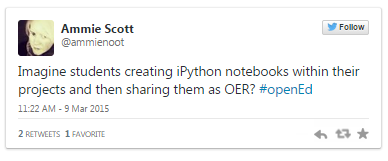
“Imagine students creating iPython notebooks… and then sharing them as OER #openEd”
Very cool indeed.
James Stewart spoke about the benefits of crowdsourcing and citizen science. Despite the buzz words, this is not a new idea, there’s a long tradition of citizens engaging in science. Darwin regularly received reports and data from amateur scientists. Maintaining transparency and openness is currently a big problem for science, but openness and citizen science can help to build trust and quality. James also cited Open Street Map as a good example of building community around crowdsourcing data and citizen science. Crowdsourcing initiatives create a deep sense of community – it’s not just about the science, it’s also about engagement.

After coffee (accompanied by Tunnocks caramel wafers – I approve!) We had a series of presentations on the student experience and students engagement with open knowledge.
Paul Johnson and Greg Tyler, from the Web, Graphics and Interaction section of IS, spoke about the necessity of being more open and transparent with institutional data and the importance of providing more open data to encourage students to innovate. Hayden Bell highlighted the importance of having institutional open data directories and urged us to spend less time gathering data and more making something useful from it. Students are the source of authentic experience about being a student – we should use this! Student data hacks are great, but they often have to spend longer getting and parsing the data than doing interesting stuff with it. Steph Hay also spoke about the potential of opening up student data. VLEs inform the student experience; how can we open up this data and engage with students using their own data? Anonymised data from Learn was provided at Smart Data Hack 2015 but students chose not to use it, though it is not clear why. Finally, Hans Christian Gregersen brought the day to a close with a presentation of Book.ed, one of the winning entries of the Smart Data Hack. Book.ed is an app that uses open data to allow students to book rooms and facilities around the university.
What really struck me about Open.Ed was the breadth of vision and the wide range of open knowledge initiatives scattered across the university. The value of events like this is that they help to share this vision with fellow colleagues as that’s when the cross fertilisation of ideas really starts to take place.
This report first appeared on Lorna M. Campbell’s blog, Open World: lornamcampbell.wordpress.com/2015/03/11/open-ed
P.S. another interesting talk came from Bert Remijsen, who spoke of the benefits he has found from publishing his linguistics research data using DataShare, particularly the ability to enable others to hear recordings of the sounds, words and songs described in his research papers, spoken and sung by the native speakers of Shilluk, with whom he works during his field research in South Sudan.
Collections
 Hill and Adamson Collection: an insight into Edinburgh’s past
My name is Phoebe Kirkland, I am an MSc East Asian Studies student, and for...
Cataloguing the private papers of Archibald Hunter Campbell: A Journey Through Correspondence
My name is Pauline Vincent, I am a student in my last year of a...
Hill and Adamson Collection: an insight into Edinburgh’s past
My name is Phoebe Kirkland, I am an MSc East Asian Studies student, and for...
Cataloguing the private papers of Archibald Hunter Campbell: A Journey Through Correspondence
My name is Pauline Vincent, I am a student in my last year of a...
Projects
Cataloguing the private papers of Archibald Hunter Campbell: A Journey Through Correspondence
My name is Pauline Vincent, I am a student in my last year of a...
Archival Provenance Research Project: Lishan’s Experience
Presentation My name is Lishan Zou, I am a fourth year History and Politics student....