Japanese art – painting album – gassaku-jo

LIBER AMICORUM OF TOKYO ARTISTS

On behalf of Edinburgh University Library, the Centre for Research Collections has recently acquired an example of a Japanese painting album – gassaku-jo or liber amicorum.

Cover board of the Japanese painting album - Centre for Research Collections

Cover board of the Japanese painting album – Centre for Research Collections

There are three main groups of Japanese painting albums: jiteki-jo, being painting albums made by a single artist; gassaku-jo , being albums contributed to by different artists; and, shuga-jo, being albums with paintings done by different artists and calligraphers brought together by a collector.

Decorated paper from the Japanese painting album - Centre for Research Collections

Decorated paper from the Japanese painting album – Centre for Research Collections

Gassaku-jo or liber amicorum (‘album of friends’) contain paintings often in combination with pages of calligraphy. Sometimes they belong to the same school of artists, but more commonly they are from different schools or done by amateur painters and poets from different cultural groups or circles.

Calligraphy from the Japanese painting album - Centre for Research Collections

Calligraphy from the Japanese painting album – Centre for Research Collections

The recently acquired album contains 22 paintings by a group of Tokyo artists who lived between 1796 and 1917.

Swallow - from the album of Japanese paintings - Centre for Research Collections

Swallow – from the album of Japanese paintings – Centre for Research Collections

In addition to an illustration of a swallow, the album contains paintings of a peony, a waterfall, a monkey, autumn leaves…

Waterfall - from the album of Japanese paintings - Centre for Research Collections

Waterfall – from the album of Japanese paintings – Centre for Research Collections

…a mandarin duck, a chrysanthemum, a sparrow on a flowering twig, a lobster, heavy rain, a flock of sparrows…

Autumn leaves - from the album of Japanese paintings - Centre for Research Collections

Autumn leaves – from the album of Japanese paintings – Centre for Research Collections

…a tea bowl and camellia, a shrimp, houses in the snow, a fan and handscroll, a white rabbit, and a basket… with a number of others.

Mandarin duck - from the album of Japanese paintings - Centre for Research Collections

Mandarin duck – from the album of Japanese paintings – Centre for Research Collections

A number of the other illustrations are shown below:

Sparrow on a flowering twig - from the album of Japanese paintings - Centre for Research Collections

Sparrow on a flowering twig – from the album of Japanese paintings – Centre for Research Collections


Flock of sparrows - from the album of Japanese paintings - Centre for Research Collections

Flock of sparrows – from the album of Japanese paintings – Centre for Research Collections


Heavy rain - from the album of Japanese paintings - Centre for Research Collections

Heavy rain – from the album of Japanese paintings – Centre for Research Collections

Dr. Graeme D. Eddie – Assistant Librarian Archives and Manuscripts, Centre for Research Collections

This post drew on information at the Chikurin Gallery and its painting albums pages.

Posted in Collections | Comments Off on Japanese art – painting album – gassaku-jo

Roslin Slide Collection – Composition

Black Japanese Bull, 4 as 5 Years, 1090 lbs'. Photograph of a Black Japanese bull, 4 as 5 years old and weighing 1090 lbs standing in a lane with a man holding its rope lead in the early 20th century.

Over the course of digitising the Roslin Slide Collection, amongst all the slides of tables, charts and the like, it has been the images of people, and their animals, that have grabbed my attention most of all. I have noticed two particular styles of photographic composition that are common throughout; the group shot (still popular today of course!) and the ‘one man and his animal’ shot. These images provide a sort of typology where the composition often remains the same with the people and environment changing. Read More

Posted in Art Collections, Edinburgh College of Art, LLC general, School of Philosophy, Psychology and Language Sciences, School of Social and Political Science | Comments Off on Roslin Slide Collection – Composition

AAAS/Science Classic now available

SCL_subscip_Access_Logo-150x180Jisc has partnered with AAAS to provide institutions of higher and further education in the United Kingdom with sitewide access to Science Classic, the digital archives of Science (1880-1996).

Science Classic delivers more than a century’s worth of full-text content from the annals of the world’s largest general scientific journal. The archives are fully integrated with the current content of Science which makes it easier to search the entire collection.

Our e-journal A-Z list has been updated to reflect this extra content.


Posted in New e-resources, Updates | Tagged , , , | Comments Off on AAAS/Science Classic now available

Trials – new e-resources on trial

logo-japan-timesWe have trial access to The Japan Times Online until 31st May.

Japan Times Online is the oldest English-language newspaper in Japan, founded in March 1897 (Meiji 30). It has been published to promote mutual understandings between Japan and other countries. This newspaper includes unique articles which cannot be read in Japanese-language newspapers. Japan Times Online includes articles from 1999-present. (We are also trialling the archive which contains content from 1897-2013).


VB_human_anatomy_atlas_PORTAL_btnWe have trial access to Visible Body until 22nd May.

Visible Body is a suite of online programs that cover anatomy, physiology, muscles, the skeleton and the circulatory system through interactive 3D models, animations, quizzes and more.


Feedback and further info

We are interested to know what you think of these e-resources as your comments influence purchase decisions so please fill out our feedback form.

A list of all trials currently available to University of Edinburgh staff and students can be found on our trials webpage.


Posted in Library, Online library resources | Tagged , , , , , | Comments Off on Trials – new e-resources on trial

Fairbairn Archive Unexpected Item of the Month

One of the great pleasures of working with archives is the propensity they have to surprise. Hidden amongst the vast records of organisations, or the more petite collections of individuals, you are almost guaranteed to stumble upon something you would never have imagined to find. Items such as these help to add colour to the picture extant records create of the people who have left them, and they add colour to the world they occupied.

There are quite a few such items in the W Ronald D Fairbairn Archive. These items help to support the evidence we have of the wide-ranging interests Fairbairn had, both within and without the world of psychoanalysis. For example, at university he studied philosophy, theology and Hellenic studies, before embarking upon his medical qualifications and he was a member of a number of societies including the Scottish Anthropological and Folklore Society.

A small, yellowing newspaper cutting from 1932, in the Fairbairn Archive, holds the distinction of telling one of the most unusual stories I have ever come across in the ten years I have worked with archives.

Newspaper cutting

This macabre and disturbing incident is shocking to read but, unfortunately perhaps, the journalistic style of the time renders it mildly humorous too.

It is obvious why this story would have interested Fairbairn: the unexpected nature of this cutting is that the event happened at all.

Posted in Archives, Featured, Projects, W Ronald D Fairbairn archive | Tagged , , , , , , | Comments Off on Fairbairn Archive Unexpected Item of the Month

Data Vault project kickoff meeting

Last week, members of the Data Vault project got together for the kickoff meeting.  Hosted at the University of Manchester Library, we were able to discuss the project plan, milestones for the three month project, agreed terminology for parts of the system, and started to assign tasks to project members for the first month.

Being only three months long, the project is being run in three one-month chunks. These are defined as follows:

  1. Month 1: Define and Investigate: This phase will allow us to agree what the Data Vault should do, and how it does it,  Specifically it will look at:
    1. What are the use cases for the Data Vault
    2. How do we describe the system (create overview diagrams)
    3. How should the data be packed (metadata + data) for long term archival storage
    4. Develop example workflows for how the Data Vault could be used in the research process
    5. Examine the capabilities of archival storage systems to ensure they can support the proposed Data Vault
  2. Month 2: Requirements and Design: This phase will create the requirements specification and initial design of the system:
    1. Define the requirements specification
    2. Use the requirement specification to design the Data Vault system
  3. Month 3: Develop a Proof of Concept: This phase will seek to develop a minimal proof of concept that demonstrates the concept of the Data Vault:
    1. Deliver a working proof of concept that can describe and archive some data, and then retrieve it

At the end of month three, we will prepare for the second Jisc Data Spring sandpit workshop where we will seek to extend the project to take the prototype and develop it into a full system.

All of this is being documented in the project plan, which is a ‘living document’ that is constantly evolving as the project progresses.  The plan is online as a Google Document:

Look out for further blog posts during the month as we undertake the definitions and investigations!
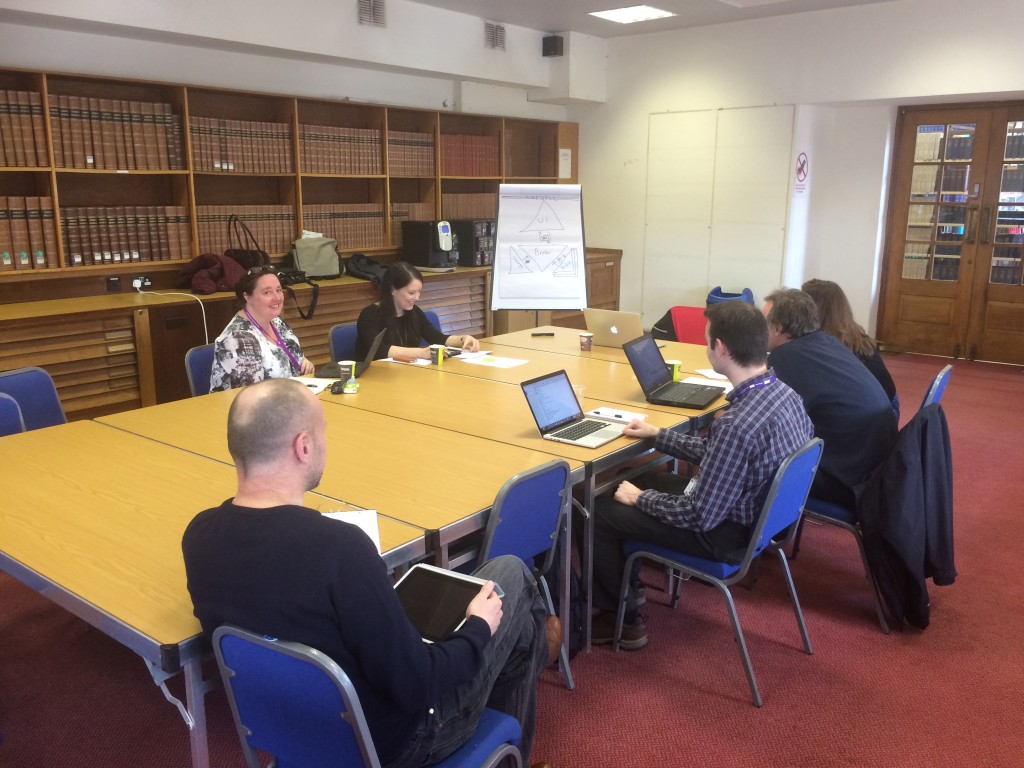
Kickoff meeting

Originally posted on the Jisc Data Vault blog, April 7, 2015 by Stuart Lewis, Deputy Director, Library & University Collections.
Posted in Uncategorized | Comments Off on Data Vault project kickoff meeting

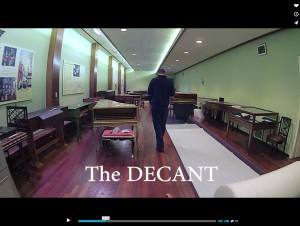
Keyboards Prestissimo!

decant

As previously reported, the instruments have all been removed from St Cecilia’s Hall to allow building work to start. The keyboards were one of the last group of instruments to leave and their removal was caught on my film by the Library’s Digital Imaging Unit using time lapse photography.

You can see the results here – https://vimeo.com/125235362

Posted in Collections, Featured, St Cecilia's Hall | Comments Off on Keyboards Prestissimo!

Bluetooth beacons at …Something Blue

GG3 GG1 Images courtesy of Stewart Cromar (@stubot)

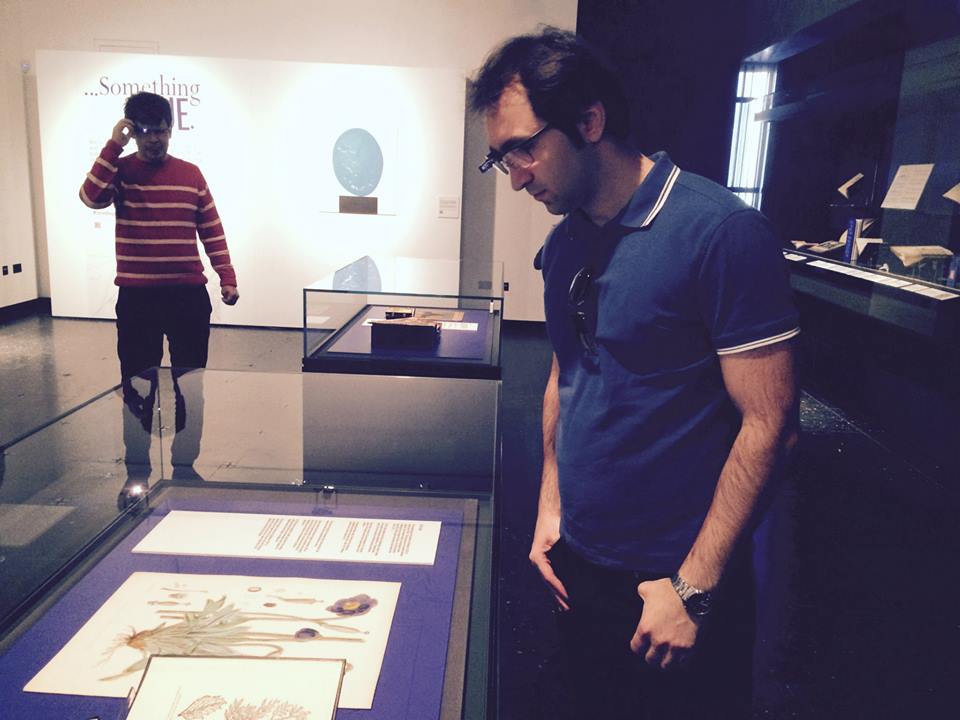
On Friday we trialled the use of Bluetooth beacons in our exhibition space, using Google Glass and the Guidigo app to provide an immersive tour of the Something Blue exhibition. Beacons work by emitting a small Bluetooth signal which activates content installed on visitors’ mobile devices. Four of these were placed at locations throughout the exhibition and, when users came within range, music, videos and voice recordings relating to specific exhibits were activated on the Glass headsets.

Users standing near the Blob 05 (Blue) exhibit, for example, were able to access an interview with Art Curator Neil Lebeter talking about the painting, while those in close proximity to the Vienna Horn could watch a video of Curator Sarah Deters playing the instrument.

There was a strong novelty factor as many people had not tried out Google Glass before, but on the whole it was felt that using the technology with the beacons in this way was an effective way of delivering content. The exhibition room is a relatively narrow space and because of space restrictions, some of the beacons were situated very close together. As a result, the signals from different beacons often interfered with each other, meaning content delivery was sometimes quite erratic. On more than one occasion someone standing next to one beacon received content from another one located several metres away on the other side of the room. As well as this, when too many people were standing close to a beacon the signal could be blocked or dulled.

In order to combat this for future sessions, it would be more effective to spread the beacons evenly throughout the space and have specific signs on the floor or walls saying something like “stand here to hear an interview with the curator”. Aside from these issues, the Google Glass worked really well: the Guidigo app overcame many of the well-known problems associated with the technology (poor battery life, overheating, and headaches) by putting Glass into sleep mode whenever the user was outside the beacons’ range. On the whole, it was an interesting experiment to take part in and we hope to have a more public trial of the technology at our next exhibition, so please do get in touch if you would like to be involved!

We are also exploring further ways of using beacons with other mobile devices to provide self-guided library tours: watch this space for further updates.

Gavin Willshaw | Digital Curator


Posted in Exhibitions, Projects | Comments Off on Bluetooth beacons at …Something Blue

Research visits to MIMEd

Although St Cecilia’s Hall is closed to the public, it does not mean that the objects are placed in storage and left until they are reinstalled. Collection business still goes on with teaching and with visits from scholars who are researching instruments in the collection. This semester sees postgraduate teaching for the MMus Musical Instrument Research programme, which will concentrate on Keyboard Organology. For this class the appropriate instruments are removed from the storage shelves and made available for students to examine in detail.
As a leading international collection, with many iconic instruments, we have requests from visiting scholars to carry out research. Such visits are always informative for collection staff as well as the visitor. There is discourse in which aspects of research are discussed and often various theories are passed backwards and forwards in an attempt to get a fuller understanding of the object.
Although we need to respond in a different manner to research requests when the objects are stored in a location away from the staff, it is still an important part of the Collection’s work to further the creation and dissemination of knowledge.
We recently had a visit from the Belgian harpsichord maker and researcher Ellen Denolf, who wished to examine the knee lever mechanism of our Goermans/Taskin harpsichord. Certainly one of the best known instruments in the collection, it was built by Jean Goermans in 1764, and altered in 1783/4 by Pascal Taskin – the most important maker in late-eighteenth century Paris.
Taskin made a number of changes to the instrument. He added an extra register of jacks which were used to pluck the string with soft leather, providing a contrast to the harder bird quill. He also strengthened the framing inside the case – something the visitor never normally sees – had the instrument redecorated with chinoiserie on the exterior and lid interior and added knee levers in place of handstops. Players could then use the knees to get different sounds while continuing to play. One knee lever even allowed a diminuendo effect by reducing the sound from all of the quill registers to just the soft leather (known as peau de buffle).
The images show Ellen and MIMEd Conservator Jonathan Santa Maria Bouquet examining and discussing aspects of the knee lever mechanism at the instrument’s spine and the back of the keyboard.

denolf1denolf2

It should be mentioned that Taskin perhaps didn’t do everything quite above board. Other work on the instrument included removing Goerman’s name from the soundboard, staining the whole soundboard and cutting the serif from the lead rose in the soundboard which normally displays the maker’s initials – in this case “IG”. By changing it to “IC” Taskin could perhaps pass the instrument off as being by Ioannes Couchet – a member of the famous Ruckers family whose instruments went for many times what a recent French example might sell for!

Posted in Collections | Comments Off on Research visits to MIMEd

Auden, Dame Edna and Bletchley Park

Welcome to the first Rare Books & Manuscripts blog of the University of Edinburgh’s Centre for Research Collections. And what better way to start than a post on W.H. Auden’s Poems (1928) …


One of the University of Edinburgh Library’s rarest 20th-century printed items is W.H. Auden’s Poems (1928). This item was part of the Archibald Hunter Campbell collection which was presented to the Library in 1984. Campbell studied at Oxford and was a contemporary and friend of Stephen Spender, Christopher Isherwood and W.H Auden. During the Second World War he served at Bletchley Park as a codebreaker and, on returning to Edinburgh, he held the post of the University’s Regius Chair of Public Law and the Law of Nature and the Nations from 1945 to 1972.

Printed by Auden’s fellow undergraduate at Oxford, Stephen Spender, Poems purports to be number 11 of “about 45 copies” subsequently Spender admitted that the actual number of copies was nearer 30.

Although a large part of the book was printed by Spender in his parents’ house on an Adana label printer, it would seem that either the printer or Spender (or possibly both!) weren’t up to the task and the book was finished and bound in its strong reddish orange wrapper by the Holywell Press. Evidence of the handover from Spender to Holywell is apparent in the immediate improvement in printing quality from page 23 onwards.

Some of the poems were never republished and Auden himself excluded most of the contents from the canon establishing Collected Shorter Poems, 1927-1957 (Faber, 1966).

The University of Edinburgh’s copy has few annotated corrections but has been signed by both Auden and Spender on the title page and is in remarkably good condition.

It truly is one of the University’s finest rare books and a fitting subject for the first Rare Books blog.

The library has a collection of W.H. Auden material, which we have recently completed cataloguing. This was purchased in 1982 from Barry Bloomfield (co-editor with Edward Mendelson of W.H. Auden: A Bibliography, 1924-1969), and has been added to by generous donations from Mendelson and others as well as purchases from book sales. Although Poems is not part of that collection we have taken the opportunity to improve the cataloguing of Auden material elsewhere in the collections.

Oh, and Dame Edna? Stephen Spender’s daughter married Barry Humphries!

Finlay West: Rare Book Cataloguer
Posted in 20th Century, Collections, Rare Books | Comments Off on Auden, Dame Edna and Bletchley Park

Follow @EdUniLibraries on Twitter

Collections

Default utility Image Hill and Adamson Collection: an insight into Edinburgh’s past My name is Phoebe Kirkland, I am an MSc East Asian Studies student, and for...
Default utility Image Cataloguing the private papers of Archibald Hunter Campbell: A Journey Through Correspondence My name is Pauline Vincent, I am a student in my last year of a...

Projects

Default utility Image Cataloguing the private papers of Archibald Hunter Campbell: A Journey Through Correspondence My name is Pauline Vincent, I am a student in my last year of a...
Default utility Image Archival Provenance Research Project: Lishan’s Experience Presentation My name is Lishan Zou, I am a fourth year History and Politics student....

Archives

Subscribe to Blog via Email

Enter your email address to subscribe to this blog and receive notifications of new posts by email.