Home University of Edinburgh Library Essentials
May 9, 2026
Highlights from the RDM Programme Progress Report: Jan – Feb 2015
The Library and University Collections (L&UC) in association with project partner Manchester University received funding from the Jisc “Research Data Spring” programme to define and develop an open source Data Vault application which will allow data creators to describe and store data safely in one of the growing number of archival storage options. Phase 1 of the project started in March 2015.
The University of Edinburgh (UoE) were invited to contribute to a series of EPSRC (Engineering and Physical Sciences Research Council) Compliance Case Studies. Stuart MacDonald, RDM Service Coordinator, was interviewed by Jisc and the DCC in relation to the RDM programme and institutional compliancy with forthcoming EPSRC research data expectations. The case study will be published on the Jisc website in May 2015.
RDM Service Coordinator Stuart MacDonald co-presented with Rory Macneil (RSpace) their practice paper “Service Integration to Enhance RDM: RSpace electronic laboratory notebook (ELN) case study” at the International Conference on Digital Curation (IDCC) in London (Feb 2015). The paper has been published in the International Journal of Digital Curation (http://www.ijdc.net/index.php/ijdc/article/view/10.1.163), open access.
The RDM Service Coordinator also presented on ‘RDM Training Initiatives @ Edinburgh’ at the “Comparing Notes: Training Librarians for Research Data Management and Open Science Support” workshop at IDCC.
An EPSRC Expectations Awareness Survey was sent out to 98 EPSRC grant holders of which 38 responded. 9** grant holders agreed to participate in a follow-up interview. The findings of the interviews will follow shortly. Dr Evamaria Krause (Marburgh University, Germany) completed a 6 week internship with L&UC where she assisted with the EPSRC Expectations Awareness Survey and EPSRC grant holder interview exercises.
All Schools in the College of Humanities and Social Science (CHSS) have now added links to RDM Programme website and other RDM pages via their intranets. RDM Project Plan deadlines and deliverables which underpin the RDM Roadmap have been updated.* For more details visit the RDM Programme wiki (some content only available to UoE staff).
Four tailored Data Management Plans sessions have been organised with research groups in the College of Medicine and Veterinary Medicine and CHSS, and two workshops for the European Association for Health Information and Libraries (EAHIL) conference in Edinburgh are scheduled to run in June 2015.
Edinburgh DataShare release 1.71 has been announced with new features including faceted browsing, SOLR usage statistics, size limit on assisted deposit of items increased from 5Gb to 10Gb.
DataSync (a Dropbox-like service in development) was themed and made available for beta testing to Information Services colleagues.
Links:
- “Research Data Spring” Jisc funding – Develop a Data Vault
- International Conference on Digital Curation (IDCC) – London 2015
- MacDonald, S. and Macneil, R. (2015) ‘Service Integration to Enhance Research Data Management: RSpace Electronic Laboratory Notebook Case Study’ in The International Journal of Digital Curation, doi:10.2218/ijdc.v10i1.354
- EPSRC Expectations Awareness Survey – blog post
- RDM Programme wiki – Project planning and Roadmap
- European Association for Health Information and Libraries 2015 conference
- Edinburgh DataShare – multi-disciplinary institutional open access repository
* IT Infrastructure input pending
** 1 PhD student who was forwarded the survey agreed to be interviewed
Stuart Macdonald
RDM Service Coordinator
China National Knowledge Infrastructure (CNKI) database platform access issue
Access to the China National Knowledge Infrastructure (CNKI) database platform via http://eng.oversea.cnki.net and http://gb.oversea.cnki.net is temporarily unavailable. This includes access to the following databases:
China Academic Journals (CAJ)
Century Journals Project (CJP)
China Doctors/Masters Dissertations (CDMD)
China Core Newspapers (CCND)
Conference Proceedings of China (CPCD)
China Reference Works Online (CRWO)
China Yearbooks Fulltext Database (CYFD)
China Statistical Yearbooks Database (CSYD)
China Monographic Series Database (CMSD)
The publisher apologises for the interruption in services, and we will send out a notice as soon as access is restored. ACCESS RESTORED.
Musical Marginalia in Textus Logices
We are delighted to be sharing a guest blog post by Elizabeth Cary Ford and Vivien Estelle Williams of Glasgow University who have recently been studying the marginalia of item De.8.83 in the CRC collections.
James Douglas’ copy of Thomas Bricot’s Textus Logices and its musical marginalia
Kenneth Elliott, the late eminent scholar, identified a basse danse written in the margins of a sixteenth-century book. The existence of the score of the basse danse was quite a well-known fact in academia; but the original source for it was not. We are pleased to say that we have been able to track the book in which the marginalia appears to the University of Edinburgh Special Collections, item De.8.83. The field of the basse danse in Scotland is certainly understudied, and we hope this finding will add a piece, however small, to the wider picture.
Basse danses were very popular in Europe in the fifteenth and sixteenth century. This type of dance probably originated in Burgundy. It quickly travelled to other European courts and was certainly known in Scotland after King James V’s second marriage in 1538 to Marie de Guise, if not before. It is reasonable to assume that this basse danse was part of the repertoire of the French musicians who travelled with the queen.
Kenneth Elliott transcribed the tune from the source and shared it with John Purser, who published a portion of it in Scotland’s Music. Elliott described the tune as “[a]n anonymous instrumental composition possibly of Scottish authorship and related to the basse-danse is recorded in an early-sixteenth-century source”. According to Purser’s note, the book was passed from Hector Boece to Theophilus Stewart and to James Douglas. This is confirmed by an inspection of the book, as well as the University of Edinburgh’s records of the book.
All we knew about this dance was that it was marginalia, and that Kenneth Elliott was the first person to call attention to it. Thanks to Dr Theo Van Heijnsbergen and Dr Nicola Royan we discovered that the volume in question was a little publication by Thomas Bricot: Textus Logices, c. 1513.


The author of the book, Bricot, from the diocese of Amiens, studied in Paris during the late 1470s, where he went on to teach philosophy. His major publications were dedicated to the discipline of logics, as is our Textus Logices. The small volume, re-bound in the nineteenth century, was possibly intended as a teaching aid or a textbook; 136 beautifully-printed leaves on the subjects of logics, as well as Aristotelian and Porphyrian works. The various handwritings of the marginalia, and in the flyleaves and end-papers show that the book has passed through various hands.
Amongst the calligraphies and signatures a few are more clearly discernible: on the title-page there is a “Codex Hector Boethi” and a “Hethor Bethius”. Hector Boece, c.1465–1536, was born into a prominent Dundonian family. He was a historian and the first principal of the University of Aberdeen. He most probably came in contact with Bricot’s publication in Paris as a student at the Collège de Montaigu. The annotations in the volume are extensive, which may well indicate the mark of an informed reader. We doubt whether Boece would have written the score himself, as given his known persona a casual treatment of a book would be unlikely.


On the fly-leaves are other ownership marks; this may indicate they were added after binding. Theophilus Steuart is mentioned in the Fasti Aberdoniensis as a “gramaticus”, as well as the Analecta Scotica, as “Maister theophelus stuart, master of the gremer skuill of ald Aberdeen”. This Aberdeen connection links Steuart with Boece, as both were based at King’s College.
It could be that James Douglas, potential source of the tune, was the Earl of Morton (c. 1516 – 1581) as he had dealings with the University of Aberdeen. David Stevenson points out that “The general assembly in 1574 requested that the then regent, the 4th Earl of Morton, to take orders that doctors may be placed in the Universities and stipends granted unto them”.


The book contains two sections of musical notation. The first is a snippet of what could be a basse danse. The dance in full is scribbled in the back of the book, between annotations. The handwriting of the score would appear to date from the sixteenth century. Does this mean the dance was current and popular at the time? Did James Douglas himself compose it? As there is no searchable index of tunes for basse danse, unfortunately we have not been able to verify whether or not the tune was known and popular. What comes as no surprise is that French music was popular in Scotland in the sixteenth century, owing to the cultural ties of the Auld Alliance.
This marginalia is early evidence for the basse danse in a Scottish source, no matter who the author may have been. We will never know why this dance was scribbled in the fly-leaves of a philosophical treatise. It would be nice to think that, perhaps, the tune was popular amongst the students of the University of Aberdeen as a dance or a song – maybe we could picture a young James Douglas jotting it down, as his mind wanders, while at his desk during a lecture on logics!
For our finding and assistance with it we wish to thank: Denise Anderson, Francesca Baseby, Warwick Edwards, Luca Guariento, David McGuinness, Nicola Royan, Evelyn Stell, Theo Van Heijnsbergen, Janet Williams, Allan Wright.
This piece is dedicated to John Purser, our druid in the West.
Jewish scholarship on display at New College Library

Babylonian Talmud. Sulzbach,1766. Folio, in 12 volumes. Longforgan Collection.
In celebration of the public lecture on The Bible and the Mishnah by Professor Shaye J D Cohen, Harvard University on Tuesday 5 May, we currently have Jewish texts from our Special Collections on display in New College Library.
This Babylonian Talmud is part of the Longforgan Free Church Ministers Library, an extremely well preserved example of a Manse library which came to New College in the 1960s. It is currently being catalogued as part of the Funk Donation projects. As well as this 12 volume Babylonian Talmud, works by Maimonides and Isaac ben Jacob Alfasi ha-Cohen are evidence of the importance of Hebrew scholarship to the Scottish Church.

Seder Ṭohorot Mishnayot mi-Seder Kodashim im perush / ha-Rambam. Venice : Daniel Bomberg, 1528. New College Library Dal-Chr 58
This image is from Maimonides’s commentary on the Mishnah which was one of the first to be published. It is part of the the Dalman-Christie Collection, which was transferred to New College Library in 1946 from the Church of Scotland Hospice in Jerusalem. This collection was recently catalogued as part of the Funk Donation Projects.

Mischna, sive, Totius Hebraeorum juris : rituum, antiquitatum, ac legum oralium systema. Amsterdam : Gerardus & Jacobus Borstius, 1698. New College Library Dal-Chr 45
This is the frontispiece from one of the volumes in this six volume set of the Mishnah with text in Hebrew and Latin. It also contains commentaries of Maimonides and Bertinoro in Latin. New College Library holds copies in both the Dalman-Christie and the Longforgan Collections.
Christine Love-Rodgers, Academic Support Librarian – Divinity
An Atheistic Surprise
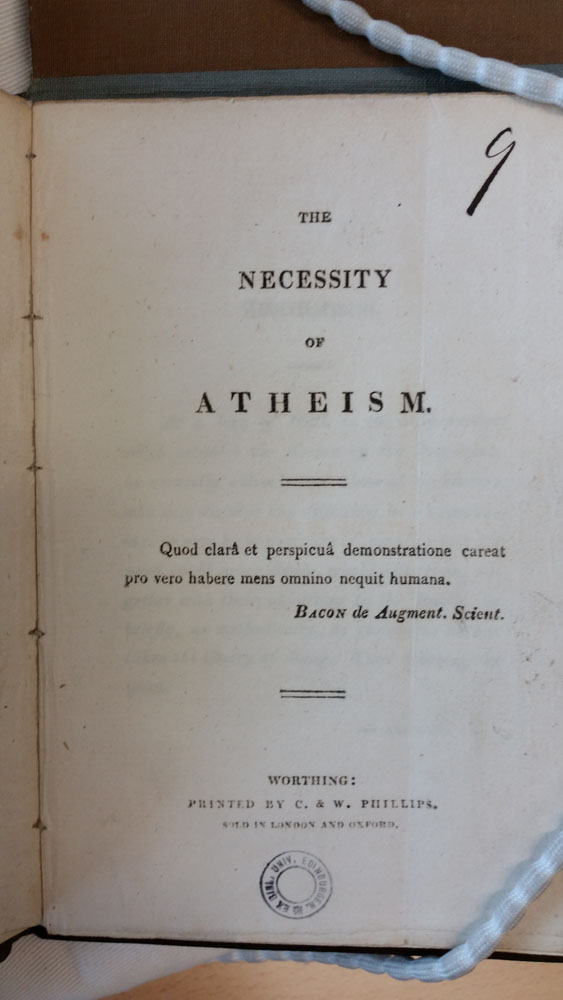 We keep finding things we didn’t know we had! Special Collections has been playing host to experts from the London firm of specialist booksellers, Bernard Quaritch. During their investigations they unearthed this little pamphlet which turns out to be an uncatalogued and unrecorded copy of poet Percy Bysshe Shelley’s first publication, “The Necessity of Atheism”, printed in 1811. This cheeky little tract dismisses the entire history of theology and belief in 13 small pages, concluding triumphantly “Every reflecting mind must allow that there is no proof of the existence of a Deity. Q.E.D.”. Shelley was at the time 19 and a student at University College, Oxford. As a result of circulating this within the University (and to the Anglican Bishops!) he was expelled and the pamphlet suppressed. There are only 2 surviving copies listed on COPAC (and another 3 in E.B. Murray’s standard edition of The Prose Works). Our copy seems to have come from the Dugald Stewart bequest in 1910. We will now get it catalogued, hopefully without any dangerous consequences.
Rare New College Library book is an international success
![Perush ha-Torah / leha-Rav rabenu Mosheh bar Nahman ... [1514]](https://libraryblogs.is.ed.ac.uk/newcollegelibrarian/files/2014/08/Dal-Chr-15ar.jpg)
Perush ha-Torah / leha-Rav rabenu Mosheh bar Nahman … [1514]
This work, Perush-ha Torah, is just one of the early works of Jewish scholarship in the Dalman-Christie collection of Hebrew books, which was recently catalogued as part of the Funk Donation Projects at New College Library. The Dalman-Christie Collection was transferred to New College Library in 1946 from the Church of Scotland Hospice in Jerusalem.
Christine Love-Rodgers, Academic Support Librarian – Divinity
Hand-finished Printed Books
Our blog post today comes from History of the Book student and CRC volunteer Allie Newman.
The University of Edinburgh Centre for Research collections holds a veritable treasure trove of early printed books, also known as incunabula or incunables. Numbering over 200 items, the collection houses everything from the apparently mundane to the richly decorated, both in terms of type ornament and colours. Today I would like to showcase Inc.49.2, a delightfully illustrated Bible printed by Anton Koberger in Berlin in 1483, that is a wonderful illustration of a particular period of book history.
 The advent of the printing press in the West, begun by Gutenberg’s moveable type press in 1440, heralded a new era in book production. Suddenly, instead of taking weeks, months, or even years to copy out a book by hand, books could be produced relatively quickly and in larger numbers by moveable type presses. This naturally put manuscript production into an immediate spiral of decline, eventually leading to the triumph of print over hand-written books… Or did it?
Contrary to popular belief, the two forms of production actually continued to exist side by side for nearly 200 years, printed works only overtaking manuscripts in terms of popularity in the 1600s; even then, a big reason for that overtake was due to the fact that printing a book was just plain cheaper than hand-copying a book, not because manuscripts were seen as inferior or old-fashioned. Evidence of this can be seen in the Koberger Bible, where the pages were printed in such a way that they left space for an artist to later come in and add decorative initials by hand!

 This is not an uncommon practice – it even happens in the Gutenberg Bible, though its initials are much less embellished. Because manuscripts were still somewhat of a status symbol and occupied a position of prestige in the world of books, this hand-finishing was a way of adding legitimacy to the printed book. And it didn’t just happen to initials! This Bible is full of woodblock prints, such as the one below, that, although printed on a press, were later hand-coloured (most likely at an extra cost!).
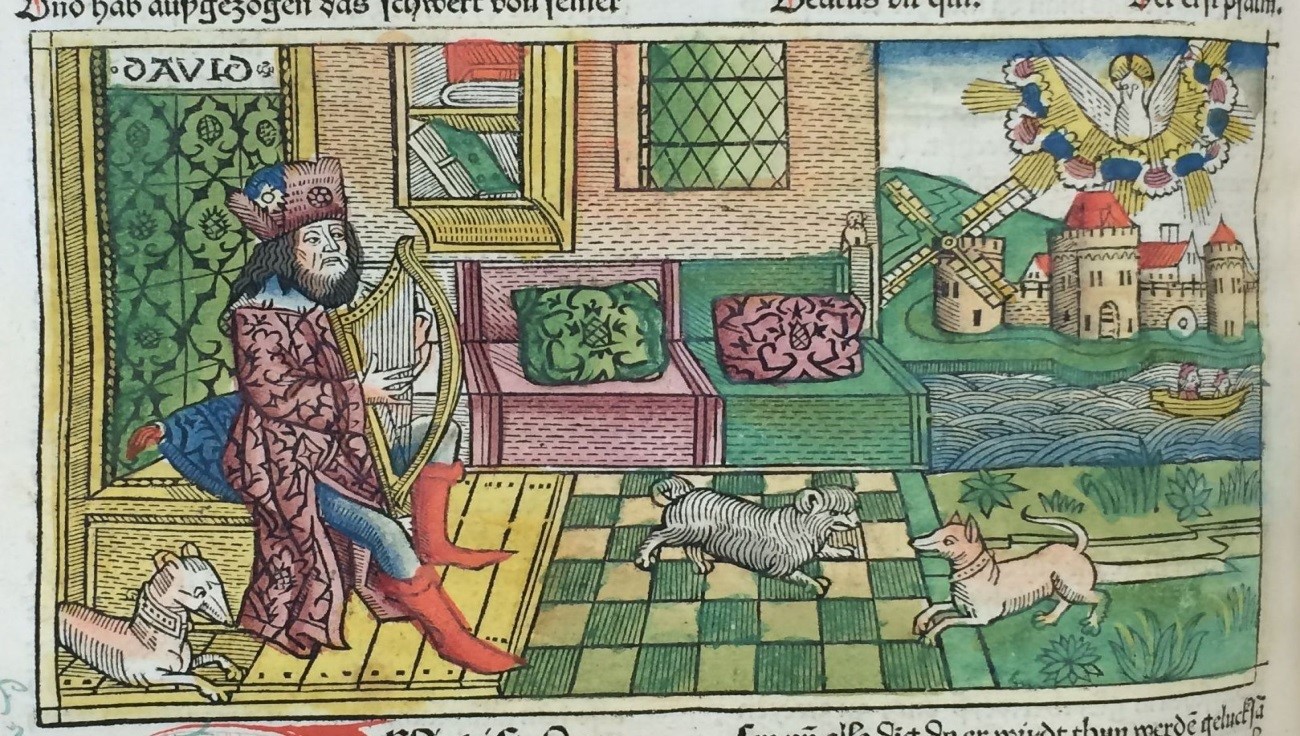 Hand-finishing of printed text eventually faded away as a widely practiced stage of book production by the late 17th century, for the same reason that manuscripts became the less common form of book: it was just too expensive and time consuming. However, the intersection of manuscript techniques and printing press technology left its mark (literally) on the way we write today- ever wonder why the first line of a new paragraph is indented? Why, to make room for a hand-finished first initial, of course!
New digital access to Divinity theses collection
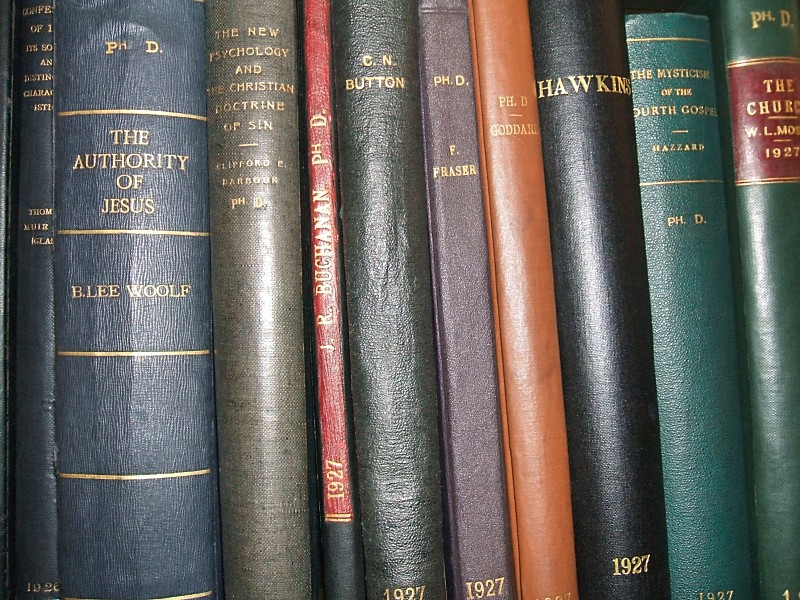
I’m delighted to announced that nearly two hundred and fifty theses dating from 1921-1950 from the New College Library collection are now available online in the Edinburgh Research Archive, part of the Divinity Dissertation and Thesis Collection. While later theses are held in 2 copies, one at the Main Library, we believe that New College Library holds the only copy of theses from this early period. The New College Theses collection was catalogued online in 2012 as part of the Funk Projects.
– Gavin Willshaw, Digital Curator
– Christine Love-Rodgers, Academic Support Librarian – Divinity
New books for Social and Political Science: April 2015
Thanks to recommendations from members of staff and requests via RAB from students the Library is continually adding new books to its collections both online and in print. Here are just a small number of the books that have been added to the Library’s collections in April 2015 for Social and Political Science.
 The city is ours : squatting and autonomous movements in Europe from the 1970s to the present edited by Bart van der Steen, Ask Katzeff and Leendert van Hoogenhuijze (shelfmark: HD7287.96.E85 Cit.)
Small states and international security : Europe and beyond edited by Clive Archer, Alyson J.K. Bailes and Anders Wivel (shelfmark: JC365 Sma. Also available as e-book.)
The Day the Earth Moved
This week, conservation went global – in a very literal sense. Our task: to package and transport sections of a wooden globe, no mean feat considering the globe in question was nearly 1.5 metres in width.
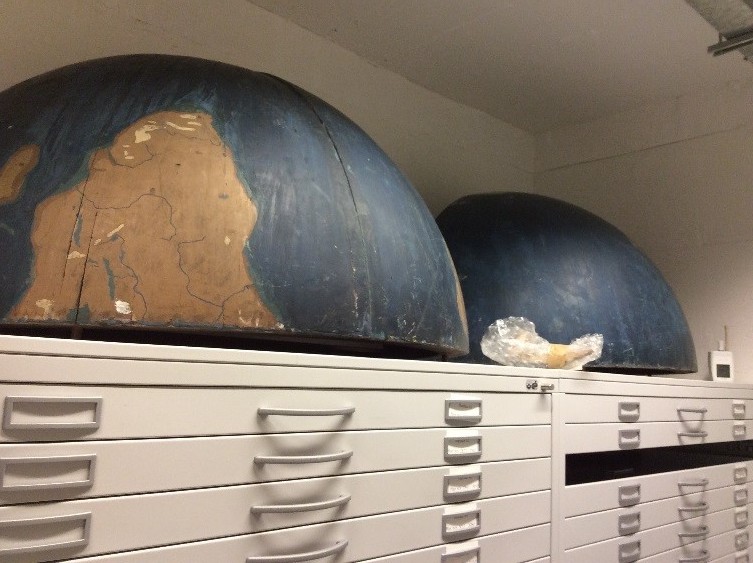
Sections of the Geddes globe in their original location
This globe is one of two made by Jacques Elisée Reclus, a French geographer, both of which are held in the Patrick Geddes collection. In 1895, with the support of Alfred Russel Wallace and Patrick Geddes, Reclus proposed the construction of a huge relief globe approximately 420 feet in diameter, but this was never realised.
Geddes’ proposed Institute of Geography in Edinburgh was to incorporate the Reclus globe within it. We think the two globes we have here, which came from the Outlook Tower and were made for Geddes by Reclus, may have been models made for that project.
These globes, now in sections, were required to be packed for storage and transported to a new location (luckily for us, still in the same building!). For this purpose, it is important to choose appropriate housing methods and materials as this will act as a good preventive measure, helping to ensure the long-term preservation of the object. As well providing physical support for items, suitable storage will have the added benefits of providing an extra layer of protection from accidental damage during handling and transportation. It will also act as a buffer to atmospheric pollutants, dust, and light, and guard against any fluctuations in environmental conditions. Appropriate packaging will also come into its own if there was ever to be a flood or water ingress, acting as a barrier and thus protecting the contents from more serious damage.
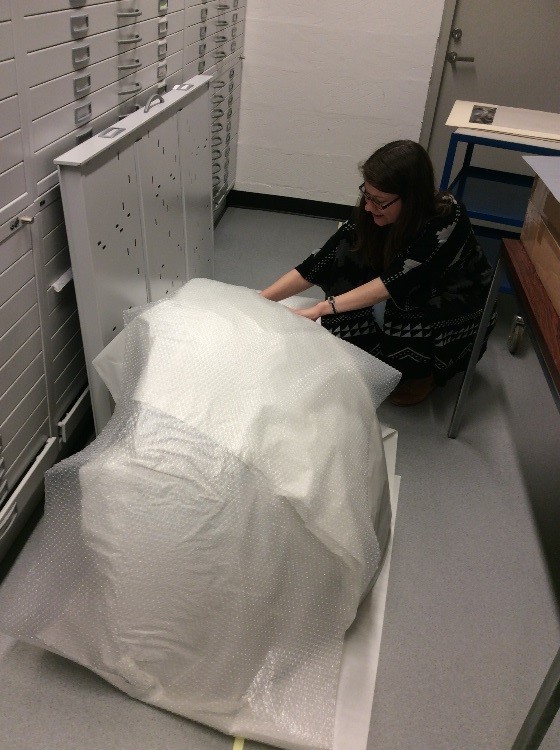
Emily (paper conservator) helping to package the globe
Due to its weight and size, boxing the first globe was not an option. It was decided therefore to soft-wrap its individual sections, using acid-free tissue paper and bubble-wrap. Bubble-wrap was used to provide protective cushioning to the item but it is important that it is used correctly (yes, there is a right and wrong way to use bubble-wrap!). In most cases, it is recommended that the ‘bubbles’ face away from the object – this reduces the risk of creating indentations or marks up the item, particularly if the surface or media is vulnerable, friable or has surface dirt. It is not recommended, however, for bubble-wrap to be placed in direct contact with an object as it is not a recognised conservation-grade material.
Acid-free tissue was therefore used as an interleaving layer between the surface of the globe sections and the bubble-wrap. As the name suggests, it is acid-free and thus a material that we use often, whether for interleaving, wrapping and cushioning objects or padding out excess space in the form of tissue ‘puffs’ or ‘sausages’.
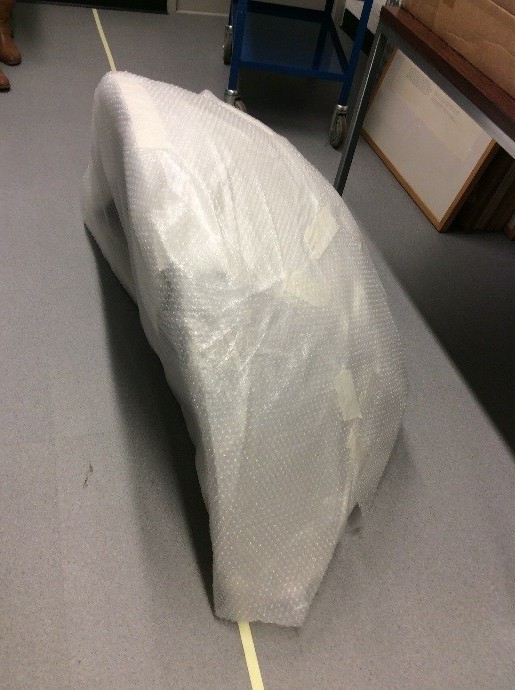
A rehoused section of the globe
Once safely packaged, we were able to move the globe sections into one of our environmental controlled stores. This will ensure that the temperature and relative humidity conditions are kept stable, and protect against any global warming….
Post by Emma Davey, Conservation Officer
Collections
 Hill and Adamson Collection: an insight into Edinburgh’s past
My name is Phoebe Kirkland, I am an MSc East Asian Studies student, and for...
Cataloguing the private papers of Archibald Hunter Campbell: A Journey Through Correspondence
My name is Pauline Vincent, I am a student in my last year of a...
Hill and Adamson Collection: an insight into Edinburgh’s past
My name is Phoebe Kirkland, I am an MSc East Asian Studies student, and for...
Cataloguing the private papers of Archibald Hunter Campbell: A Journey Through Correspondence
My name is Pauline Vincent, I am a student in my last year of a...
Projects
Cataloguing the private papers of Archibald Hunter Campbell: A Journey Through Correspondence
My name is Pauline Vincent, I am a student in my last year of a...
Archival Provenance Research Project: Lishan’s Experience
Presentation My name is Lishan Zou, I am a fourth year History and Politics student....