Home University of Edinburgh Library Essentials
April 6, 2026
The Art of Asking: Requesting Loans for Exhibition
By Morven Rodger, Collections Registrar, Heritage Collections
As the Collections Registrar, one of my core responsibilities is coordinating loans from the University’s Heritage Collections to external exhibitions. Whenever an item from our collections is requested by another institution, I work with our conservators, curators, and technicians, while liaising with the borrowing institution, to manage the risks and help make the process as smooth as possible.
I am always excited by new loan requests, and the prospect of sharing our collections with broader audiences, but no loan is without risk, and lenders must balance the risks and benefits to justify their decision to lend. The loan request is a borrower’s opportunity to make their case, explain why they want to borrow, show that they understand the practicalities, and demonstrate the value our items will add to their exhibition.
Esther Inglis 2024: Project Introduction

Welcome to the Project!
This post is written by Anna-Nadine Pike, Project Curator of “Esther Inglis 2024”. Alongside this position, Anna is an AHRC-funded PhD student at the University of Kent’s Centre for Medieval and Early Modern Studies. Read more about Anna’s doctoral research here.
Welcome to the new blog for “Esther Inglis 2024”. This project will run at Edinburgh University Library throughout 2024, to mark 400 years since the death of Esther Inglis (c.1570-1624). Esther Inglis was a remarkable calligrapher, author, artist, and manuscript-maker of the late-sixteenth and early-seventeenth centuries, who for much of her life was based in Edinburgh. The intention of the project is to raise Esther Inglis’ profile, nationally and internationally, bringing her story to new and varied audiences. The project will mark Esther’s quatercentenary by celebrating the life and work of this exceptional woman, and locating her scribal and artistic productions within a broader cultural heritage, in Scotland and beyond. This blog will be a place to record the progress of the project, while also providing space for guest posts, wider discussions, and spotlights on particular elements of Inglis’ work. As Project Curator of “Esther Inglis 2024”, my primary output will be the development of an online exhibition which will tell Inglis’ story, and situate her work within wider cultural and historical contexts. The exhibition will bring together digital manifests of the Inglis’ manuscripts which are currently held in libraries and institutions throughout the world. The hope is for the exhibition to become a lasting scholarly and public resource, through which Esther’s story and her books can be known more widely.
In this first post, it seems fitting to introduce Esther Inglis, with an outline of her life and her manuscripts.
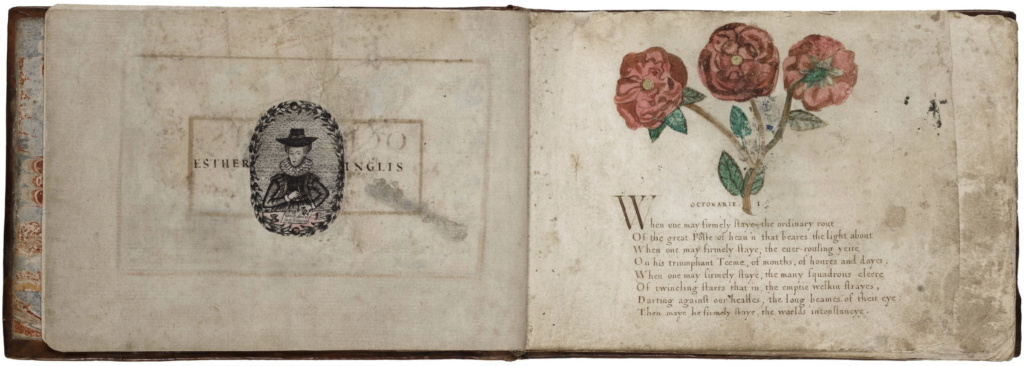
Esther Inglis, Octonaries upon the vanitie and inconstancie of the world, 1600. Washington: Folger Shakespeare Library, MS V.a.91, fol. 2.
Esther Inglis was the daughter of French Huguenot refugees, Nicolas Langlois and Marie Presot, who emigrated from Dieppe to Britain close to 1570, to escape religious persecution. The family moved first to London, and then settled in Edinburgh, where Nicolas Langlois became master of the French school. Esther Inglis’ first surviving manuscript dates to 1586, when she was around 16 years old, and is a copy of two Psalms written in five different kinds of script. Her ability to work in multiple different forms of writing would come to distinguish her as a scribe. Across Esther’s corpus, her range of scripts includes letters which are reversed, zigzagging, or interlaced, miniature writing, and imitation of print. Marie Presot was a calligrapher, and it is likely that she first taught her daughter how to write. But Esther also learned her forms of writing from several ‘writing-manuals’, a genre of early-modern manuscript or printed books produced as teaching tools. These books provide examples of different handwriting styles, with sample-texts to copy from. Such books were produced throughout Europe in the second half of the sixteenth century, but Esther seems to have used those particularly produced by French writing-masters: Pierre Hamon’s Alphabet de plusieurs sortes de lettres (1567), and A Booke containing diverse sortes of handes (1571) by Jean de Beauchesne, another Huguenot scribe working in London. In total, 65 manuscripts produced by Esther Inglis are known today. For a woman working in the sixteenth and seventeenth centuries, this is an astonishing quantity of surviving works, and there are likely to be others; many new manuscripts by Esther Inglis have come to light since scholarly interest in her work was revived in the late twentieth century.
Nearly all of Esther Inglis’ manuscripts are bound books, and many of these were produced as gifts, which were presented to their chosen recipients with the probable hope of patronage. The vast majority contain devotional texts — either texts copied from the Geneva Bible, works of paraphrase, or other religious verse. As an author as well as a scribe, Inglis also composed some of the works which she copies into her manuscripts; she was bilingual in French and Anglo-Scots. Close to one-third of Inglis’ corpus is composed of floral, illuminated manuscripts; many of her manuscripts are truly miniature; others imitate different kinds of early-modern printed book with an accuracy that makes it hard to believe these are truly works of the pen. The variety and richness of Inglis’ manuscripts becomes a challenge when seeking to do justice to her corpus, but the hope is for “Esther Inglis 2024” to assist in celebrating the range of her skills and the interweaving of the many different influences which are brought together within the books she makes.
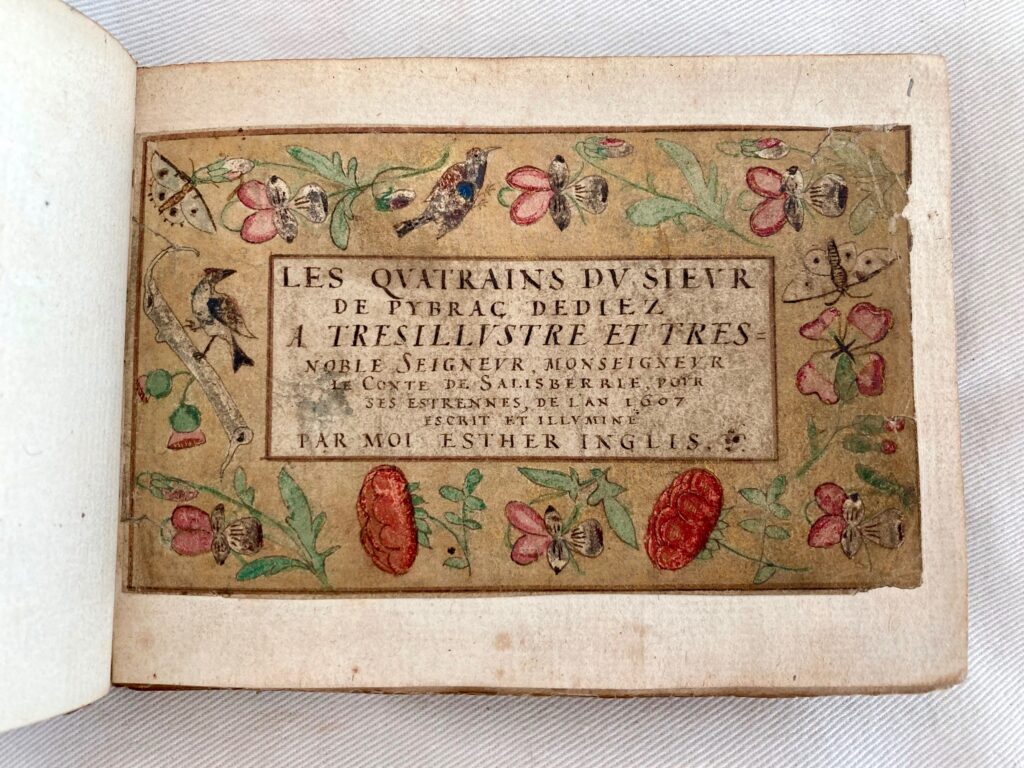
Esther Inglis, Les Quatrains du Sieur de Pybrac, 1607. Edinburgh: Edinburgh University Library, MS La.III.439, fol. 1.
As the project will also emphasise, Esther Inglis was deeply integrated into the social, political, religious, and textual cultures of early-modern Edinburgh. Around 1596, Esther married a Scotsman named Bartilmo or Bartholomew Kello (c.1564-1631), who trained within the Scottish Kirk and who was part of the spy network surrounding Anthony Bacon (1558-1601). Esther Inglis’ involvement not only with the royal court of King James VI, but also with networks of scholars, literary authors, religious reformers, and other scribes working in Edinburgh and its surroundings, will all become central focus-points of the research underpinning this project.
As the project gets underway, an important first step is facilitating the digitisation of the six Esther Inglis manuscripts held in Edinburgh University Library, so that they can be included in the project’s online exhibition. These Inglis manuscripts were all once owned by the Scottish antiquary David Laing, an important early collector of Esther Inglis’ work. In preparation for this digitisation, I have been working on fuller descriptions of these Edinburgh-held manuscripts. A sample of this work can be seen here, while the full range of the Inglis-associated manuscripts held in Edinburgh University Library can be found here. Ahead of their digitisation, several of these manuscripts will require some conservation work, and I hope to share this process on the blog as the work progresses in the next few months.
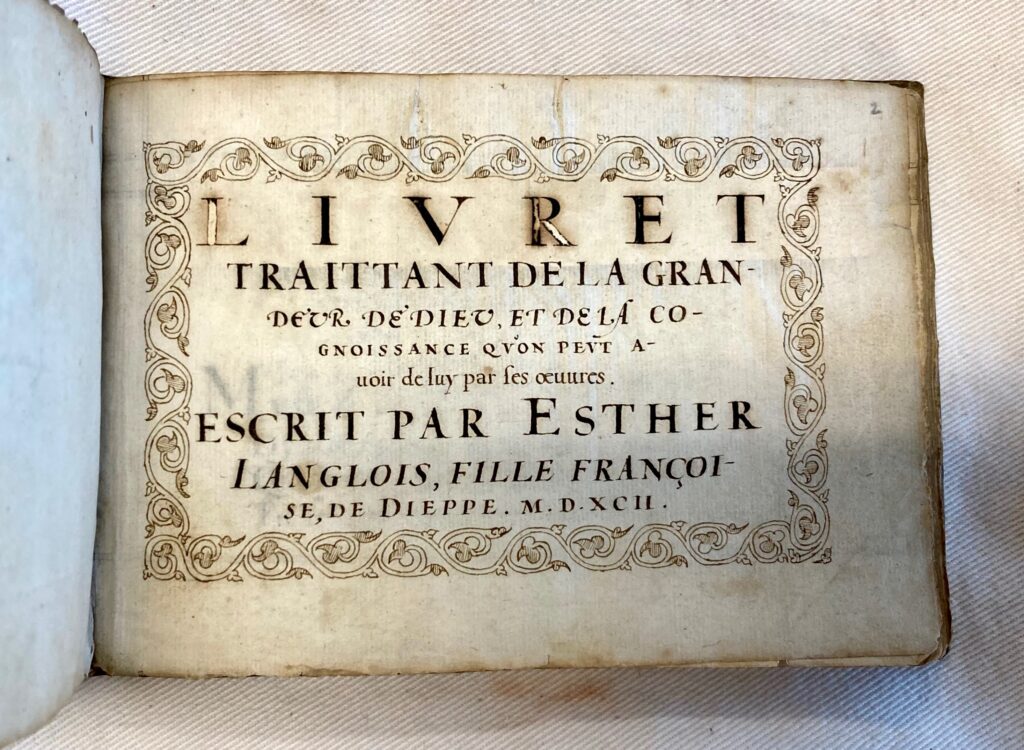
Esther Inglis, Livret Traittant de la Grandeur de Dieu…, 1592. Edinburgh: Edinburgh University Library, MS La.III.440, fol. 2.
If you would like to hear more about the research, discoveries, and progress of “Esther Inglis 2024”, make sure to follow its social media channels; the project can currently be found on Instagram and on X. And for the most up-to-date record of Esther Inglis’ known manuscripts, see the listing compiled here by Dr Georgianna Ziegler (Folger Shakespeare Library).
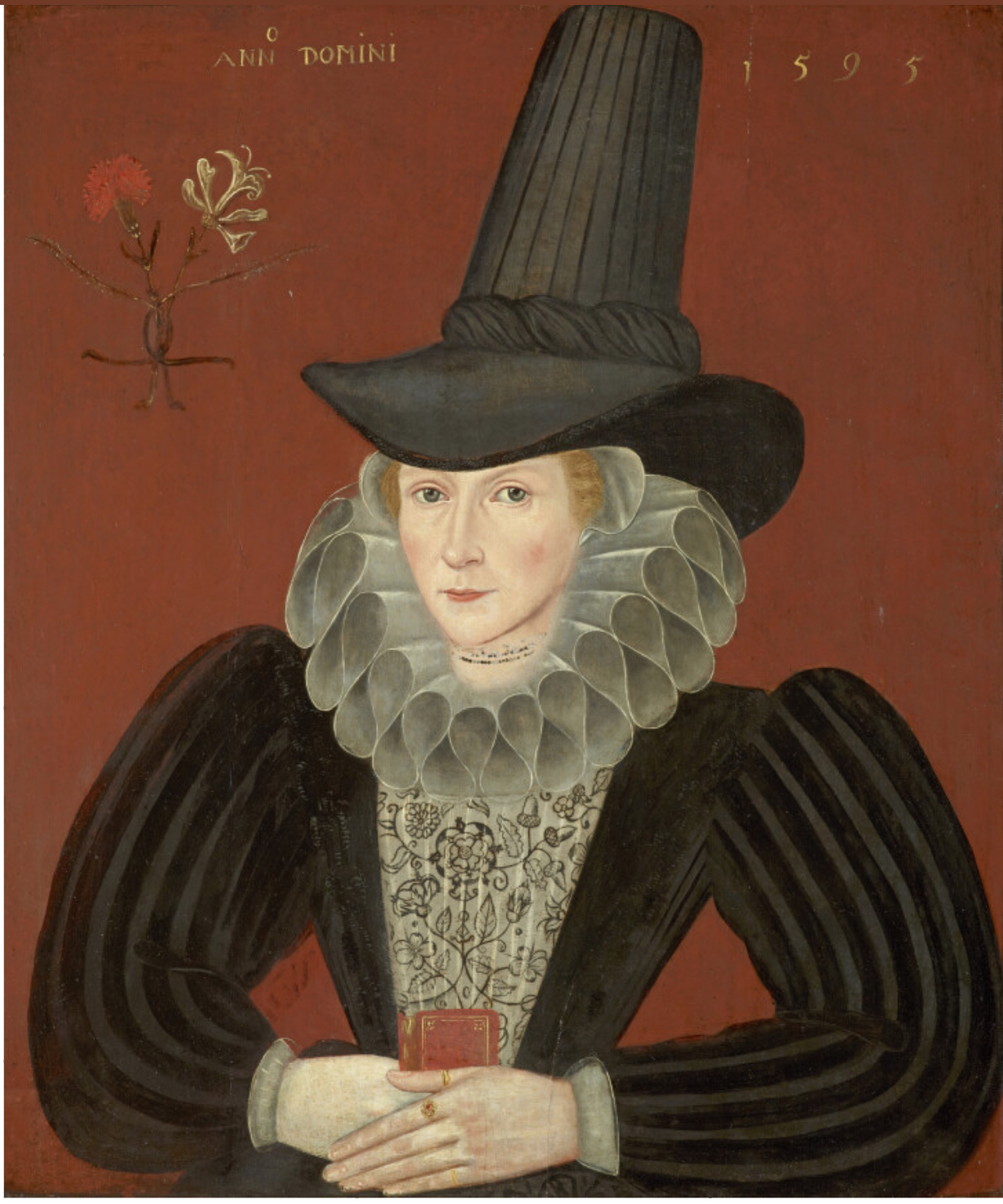
Unknown, Esther Inglis, 1569 – 1624. Calligrapher and miniaturist, 1595. Copyright National Portrait Gallery, Edinburgh.
Library Tours for Staff 2024
Are you a new or existing staff member who would like to find out more about the University’s libraries?
Join an Academic Support Librarian on a 20 to 30-minute in-person tour of one of our ten Library sites. Find out about key library services including EdHelp, borrowing, printing, and study spaces. Discover the general print collections at the Library and explore the subjects covered. These tours are suitable for staff in all roles across the university and staff can visit as many of our libraries as they wish.
The currently scheduled dates are listed below. To book a tour, visit Event Booking.
Schedule of library tours:
 Main Library
22 January @ 09:30, 6 February @ 10:30, 6 March @ 14:00, 2 April @ 10:30, 8 May @ 14:00, 12 June @ 14:00 (additional tours to be confirmed)

Art and Architecture Library
5 March @ 09:15
Edinburgh College of Art Library
6 February @ 09:15, 9 April @ 09:15, 7 May @ 09:15, 11 June @ 09:15

Law Library
12 February @ 10:00, 21 March @ 11:00 (additional tours to be confirmed, or email law.librarian@ed.ac.uk for more info).

Moray House Library
25 Jan @ 11:00, 22 Feb @ 11:00, 21 Mar @ 11:00, 25 Apr @ 11:00, 23 May @ 11:00, 20 June @ 11:00
 Noreen and Kenneth Murray Library
14 Feb @ 15:00 (additional tours to be confirmed)

New College Library
30 Jan @ 16:00, 27 Feb @ 16:00, 26 Mar @ 16:00 (additional tours to be confirmed)

Royal Infirmary Library
26 Jan @ 10:00, 7 Feb @ 10:00, 26 March @ 09:30 (additional tours to be confirmed)

The Lady Smith of Kelvin Veterinary Library
24 Jan @ 14:00 (additional tours to be confirmed)

Western General Hospital Library
25 Jan @ 10:00, 19 Mar @ 12:30, 22 May @ 13:00
Library Tours for Staff 2024
Are you a new or exisitng staff member who would like to find out more about the University’s libraries?
Join an Academic Support Librarian on a 20 to 30-minute in-person tour of one of our ten Library sites. Find out about key library services, including EdHelp, borrowing, printing, and study spaces. Discover the general print collections at the Library and explore the subjects covered. Suitable for staff in all roles.
To book a tour, visit Event Booking.
Schedule of library tours:
Main Library
17 January @ 14:00, 22 January @ 09:30, 6 February @ 10:30, 6 March @ 14:00, 2 April @ 10:30, 8 May @ 14:00, 12 June @ 14:00 (additional tours to be confirmed)
Art and Architecture Library
5 March @ 09:15
Edinburgh College of Art Library
18 January @ 09:15, 6 February @ 09:15, 9 April @ 09:15, 7 May @ 09:15, 11 June @ 09:15
Law Library
19 January @ 11:00, 12 February @ 10:00, 21 March @ 11:00 (additional tours to be confirmed)
Moray House Library
25 Jan @ 11:00, 22 Feb @ 11:00, 21 Mar @ 11:00, 25 Apr @ 11:00, 23 May @ 11:00, 20 June @ 11:00
Noreen and Kenneth Murray Library
14 Feb @ 15:00 (additional tours to be confirmed)
New College Library
30 Jan @ 16:00, 27 Feb @ 16:00, 26 Mar @ 16:00 (additional tours to be confirmed)
Royal Infirmary Library
26 Jan @ 10:00, 7 Feb @ 10:00, 26 March @ 09:30 (additional tours to be confirmed)
The Lady Smith of Kelvin Veterinary Library
24 Jan @ 14:00 (additional tours to be confirmed)
Western General Hospital Library
25 Jan @ 10:00, 19 Mar @ 12:30, 22 May @ 13:00
Lunchtime Seminar Series – digestible bites of knowledge on data and computing tools at the University of Edinburgh
For 2023/2024, Digital Research Services have organised a new iteration of the Lunchtime Seminar Series. These one-hour hybrid seminars will examine different slices of the research lifecycle and introduce you to the data and computing expertise at the University of Edinburgh.
The seminars have been designed to answer the most common questions we get asked, offering valuable bite-sized learning opportunities for research staff, postgraduate research students, and professional staff alike. You will gain an understanding of how digital research fits in with wider research support teams and good research practices. Your sessions will cover research funding, research planning, tailored skill development, data management and advancements in AI.
Oh, and did we mention there is free lunch for in-person attendees? That is truly the cherry on top.
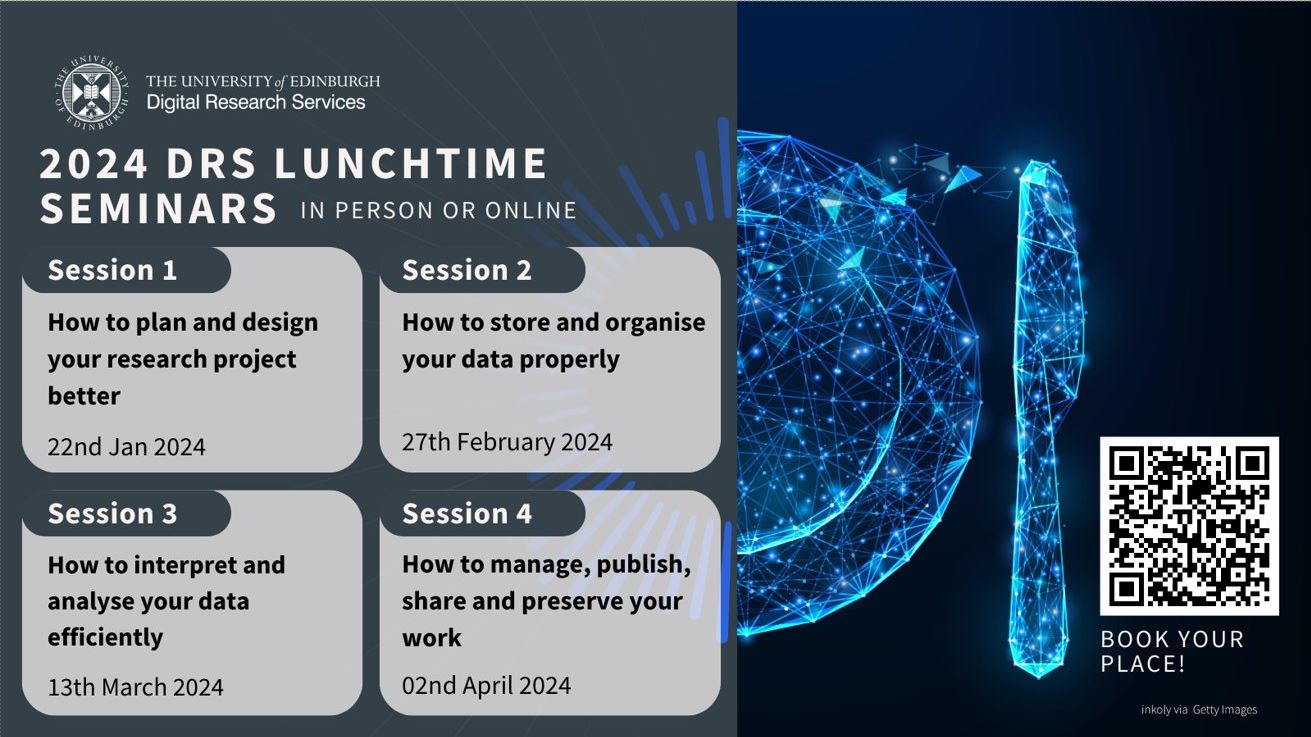
DRS Lunchtime Seminars – 2024 Calendar
Have a look at the upcoming seminars:
Seminar 1: How to plan and design your research project better. 22nd January 12:00 – 13:00
This session is all about making sure researchers head off with a strong start. Did you know that the University has tools that help you optimise your data management plan, with funder specific templates and in-house feedback? We will make sure you get the best use out of DMPOnline and the Resource Finder Tool. We will also introduce you to some key concepts in data management planning, research funding and digital skill development.
Seminar 2: How to store and organise your data properly. 27th February 12:30-13:30.
Discover how to best store and organise your data using University of Edinburgh’s tools: DataStore, DataSync and GitLab. If you work in a wet lab, you might be particularly interested in electronic lab notebooks. We will introduce you to the functionalities of RSpace and protocols.io. Finally, the University has just launched an institutional subscription to the Open Science Framework (OSF). You will discover that it is much more than a tool for data storage, as it can help manage complex workflows and projects as well.
Seminar 3: How to interpret and analyse your data efficiently. 13th March 12:00-13:00
This seminar is mainly about big computers, such as UoE’s Eddie and Eleanor. Through EPCC, researchers can get also access to large scale national supercomputers, such as Archer and Cirrus. At the same time, we will show a glimpse on some developments on the AI front.
Seminar 4: How to manage, publish, share and preserve your work effectively. 2nd April 12:00-13:00
The final seminar is all about making sure your work is published and preserved in the best way. We will talk you through different (open access) publishing pathways such as Journal Checker, Edinburgh Research Archive, Read & Publish journal list, Edinburgh Diamond. We will also be talking about data repositories (e.g. DataVault, DataShare) and our research output portal, Pure.
For info and booking:
https://digitalresearchservices.ed.ac.uk/training/drs-seminars
Blog post by Dr Sarah Janac
Research Facilitator – The University of Edinburgh
New E-resources Trials
The Library has two new E-resources Trials running following requests from staff in HCA, ProQuest Historical Newspapers: ABC (1903 – 2010) and Codices Vossiani Latini Online.
Trial access to both databases ends 11th February 2024. You can access these two databases via the E-resources Trials page.
ProQuest Historical Newspapers: ABC (1903 – 2010)

Charles Lyell’s archaeological specimens at the University of Edinburgh
Will Adams completed his MA Archaeology dissertation at the University of Edinburgh Summer 2023 looking at Lyell’s archaeological specimens – achieving an impressive 78% and winning an award to boot! Read on to find out more about his spectacular findings…
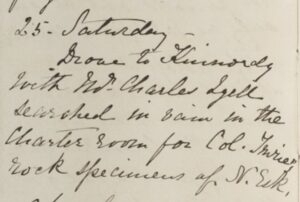
Scientific Notebook 266 page 14
Many specimens from Charles Lyell’s private collection were donated to the University of Edinburgh in 1927 and came directly from his family home and birthplace of Kinnordy House. In the very last Scientific Notebook, number 266, dated 17 July-23 November 1874, Lyell, in advancing age, is driven to Kinnordy to search “in vain in the Charter Room for Colonel Imrie rock specimens of N. Esk”.
This indicates that any finding aids to access what must have been a voluminous personal collection, even during Lyell’s lifetime, were problematic. No detailed documentation about the specimens at the time of the gift in 1927 appears to have survived, and the absolute authentication as having been part of Lyell’s specimen collection, is reliant on the existence of original labels. Subsequent use by staff of the University also had an impact on the specimens – a split occurred in the collection, with specimens now held by both the Cockburn Geological Museum and the Vere Gordon Childe Collection.
This paper is a study of the archaeological flint tool, VGC1363, held in the Vere Gordon Childe Collection and shows how it can be irrefutably reunited with Lyell through studying the object alongside his printed publications and recently acquired notebooks. This work highlights how an interdisciplinary approach utilising archive, library and museum evidence is essential for provenance research in scientific collections.
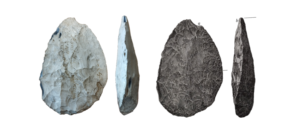
Figure 1. Illustration by Adams (2023) showing a match of specimen EUCM.0001.2022 with a figure in Lyell’s The Geological Evidences of the Antiquity of Man (1863) realised by Dr Gillian McCay, Curator of the Cockburn Geological Museum
Using Lyell’s books as source material, Gillian McCay, Curator of the Cockburn Museum had confirmed that specimen reference EUCM.0001.2022, in Figure 1, had been ‘figured’ and included as an illustration in Lyell’s last major work, The Geological Evidences of the Antiquity of Man (1863), which had huge public success with almost all of the 4000 copies sold in its first week of publication (Cohen, 1999, 90).
Looking at the rest of the collection, I was intrigued to find out if I could reveal any more, and was particularly interested in a set of flint hand axes in a draw labelled “Misc. French Flints” in the Vere Gordon Childe Collection, that have ‘Sir C Lyell’ written directly on them or on the object label.
VGC1363: An indication of Lyell
Collecting evidence was critical for Lyell – surely more specimens could be found and identified, using his books? From developments in the human antiquity debate by Joseph Prestwich and John Evans in 1859, Lyell conducted his own research in the Somme Valley to provide an authoritative judgement.
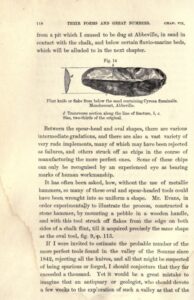
Figure 2. Page 118 Antiquity of Man
Figure 2 shows page 118 of Lyell’s Antiquity. Studying this page carefully and using my knowledge of archaeological illustration I could see that this flint tool displayed in Lyell’s “Fig 14” has been broken in half from the “b” and “c” line in the original illustration and the section shown at “d”. Out of all the miscellaneous French flints in this draw, I could now narrow down my search to broken flint tools to provide a positive match.
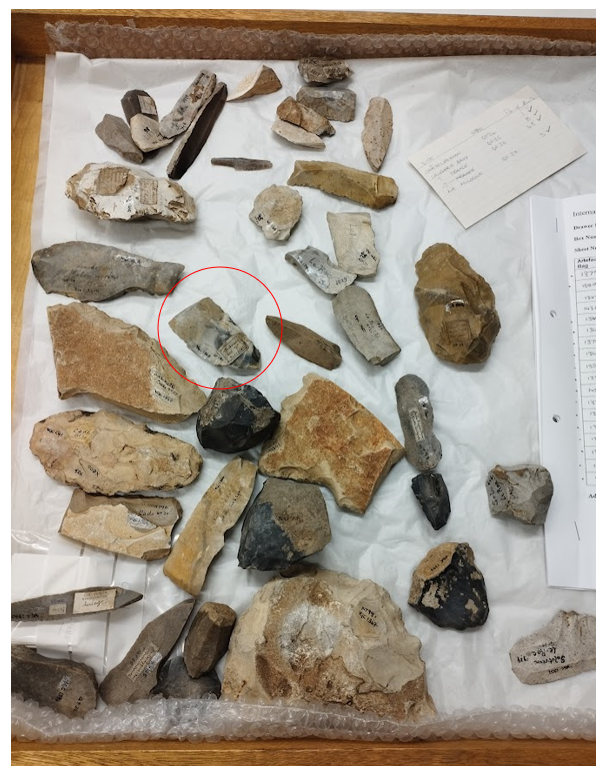
Figure 3. Photograph by Adams (2023) of a drawer in the Vere Gordon Childe Collection labelled as “…Misc. French Flints” with specimen VGC1363 highlighted by a red circle
The flint tool circled in Figure 3 is broken in half, making it a candidate. It is fortunate to retain its label which reads “Sir C. Lyell, Menchecourt bed – ‘e’, March 1861” this connects it to Lyell. The connection is further supported by Lyell’s description of “Fig.14” as being a flint knife from Menchecourt (Lyell, 1863, 118).
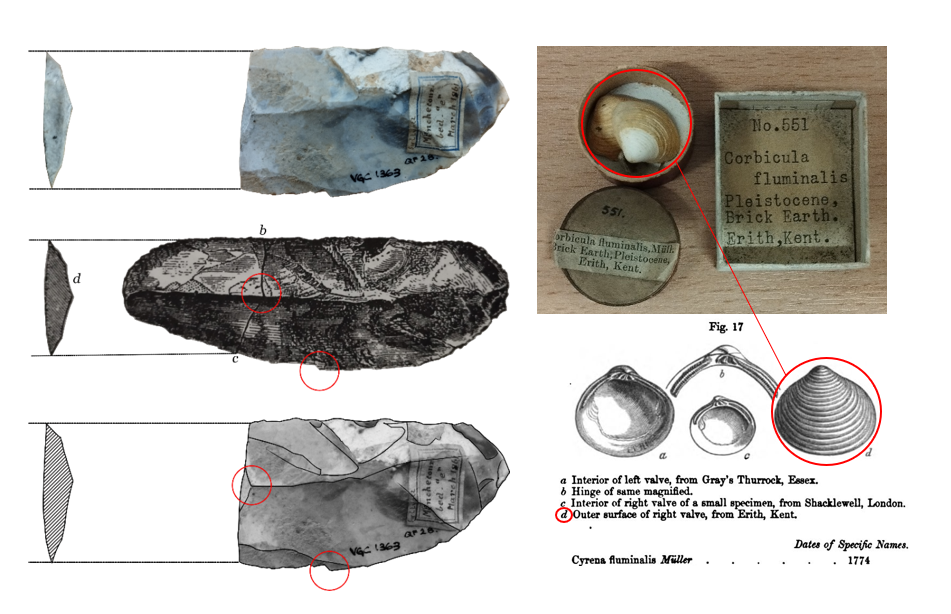
Figure 4(a): Illustration by Adams (2023) comparing VGC1363 with “Fig.14.” through correspondence points; and on the righthand side Figure 4(b): Illustration by Adams (2023) showing a match of the specimen of Cyrena (Corbicula) fluminalis, EUCM.0222.2023, from Erith, Kent to illustration “d” in “Fig.17” of …Antiquity of Man (1863)
Furthermore, the illustration in Figure 4(a) shows how the object matches morphologically to Lyell’s “Fig. 14.”, through the transverse section and from the front view of the object.
This is an important object because of its context of being found “below the sand containing Cyrena fluminalis, Menchecourt, Abbeville” (Lyell, 1863, 124). Later in the book, Lyell goes on to explain that Cyrena (Corbicula) fluminalis is now an extinct species of freshwater shell in modern Europe, suggesting that the presence of a human modified flint tool in a stratigraphic layer below this shell supports human antiquity (Lyell, 1863, 124).
In Figure 4(b) a specimen of Cyrena (Corbicula) fluminalis held in the Cockburn Geological Museum collection appears to match the illustration and place name description of “Erith, Kent” typed in the extant label, in illustration “d” in “Fig.17.” of Antiquity of Man (Lyell, 1863, 124).
Turning away from the source material of books, and object labels – I was also able to consult Lyell’s rich archive, including the 294 notebooks. Knowing the time frame, and location I was able to establish that Lyell’s Notebook 245 records him being on site in Menchecourt in March 1861.
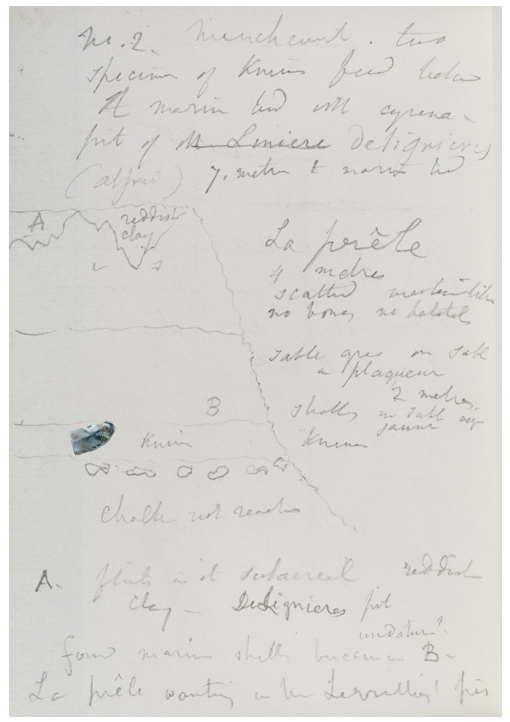
Figure 5. Figure 5: Edited photograph taken by Adams (2023) of Lyell’s notebook showing the flint knives place in the stratigraphy with a photograph of VGC1363 superimposed into the stratigraphy.
Figure 5 shows an edited version of Lyell’s stratigraphic drawing during his time there, showing flint knives found below a layer containing Cyrena (Corbicula) fluminalis. Lyell’s note at the top of the page 138 reads “Menchecourt. Two specimen of knives found below a marine bed with cyrena” which is the conclusive proof placing Lyell at the right place and time to uncover VGC1363.
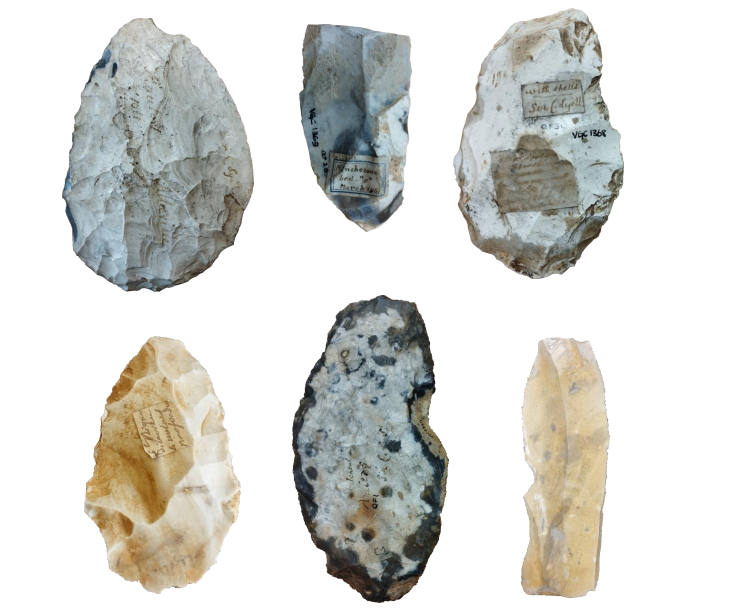
Figure 6. Figure 6 The six archaeological specimens from University of Edinburgh conclusively connected to Charles Lyell. From top left to bottom right: EUCM.0001.2022; VGC1363; VGC1368; EUCM.0311.2009; VGC0860; VGC1366 (Adams, 2023)
Lyell’s specimens confirmed
Through my 4th year MA Archaeology dissertation, I conclusively identified another five archaeological specimens in the University of Edinburgh’s collections, shown in Figure 6, as belonging to Charles Lyell, and, through archival research, was able to create detailed object biographies for each. Although there are more flint hand axes with Lyell’s name attached which have not yet received the same detailed analysis, the trends seen in the object labelling system of the six specimens are consistent with the others in the collection. This makes it highly likely that the ‘Sir C Lyell’ labelled hand-axes in the Cockburn and Vere Gordon Childe collections belonged to the private collection of Lyell. An interdisciplinary approach was essential for determining the provenance of all six of these specimens – I had to apply both my archaeological knowledge and skills as well as newly acquired archival skills such as palaeography to fully understand what I was seeing. Piecing together this information was further complicated, due to a lack of relationships created between the different collections. As I embark on my working career, I’ll definitely advocate for establishing relationships between archive, museum and library catalogue entries to avoid a loss of provenance and the dispersal of materials.
Thank you, Will, for all your efforts – you should take great satisfaction for your part in identifying and repatriating a set of ‘miscellaneous French flints’ as being crucial to Lyell and his role in the Antiquity of Man debate, from which all future users will benefit!
Further reading
Cohen, C. 1998. Charles Lyell and the evidences of the antiquity of man. Geological Society Publications 143, pp. 83-93.
Lyell, C. 1863. The Geological Evidence for the Antiquity of Man (3rd Ed). London: John Murray.
Who Made the MIMEd 4477 Double Manual Flemish Harpsichord? (Part1)
In the first post of this two part series, our Musical Instrument Care Technician (and former conservation intern), Esteban Mariño Garza, discusses his Musical Instrument Research and Documentation Internship project to try and discover who made one of the harpsichords in the Musical Instrument Collections of the University. Read More
New Open Research Tool: Open Science Framework
Awesome news! The Research Data Service has a fantastic new addition to its Open Research toolbox! Fresh from the Centre for Open Science (COS) comes our institutional membership to Open Science Framework (http://osf.io): a powerful tool for supporting staff and students at the University of Edinburgh.

OSF is a free, open platform that provides full integration and sharing across the entire data lifecycle. Among many other things, it streamlines workflows with customisable project organisation and automated version control. It also enhances collaborative research, making it easy to find and connect with other UoE users and their research projects. But wait, there’s more! OSF enables easy management of private and public aspects of a project, so sharing with project teams as well as the wider research community couldn’t be simpler; it’s ideal for sharing preprints and preregistered reports. Best of all, with centralised storage for documents, data, and code, it eliminates the need to scramble around hunting for that one file you need right now: no more trawling through email chains to recover lost data!
To launch the new platform we’ve been running Free Lunch Lunchtime sessions, with Free Lunch in the Main Library. The Centre for Research Collections were kind enough to let us use their rooms on the 6th floor, so obviously, all our attendees used the stairs and worked up a proper appetite for their Free Lunch.
The first event was held on August 30th to a packed house, or room. After the Free Lunch and a bit of professional mingling, Gretchen Gueguen from the Centre for Open Science Zoomed in to give us a brief introduction to and overview of OSF: what it is, how it works, and why it’s such an excellent addition to any research toolbox. Gretchen was followed by Emma Wilson, PhD student, UoE representative for ReproducibiliTea, and Open Research Intern extraordinaire. Emma provided the first of two user-perspectives, talking about her experience of using OSF for her projects, presentations, and posters. The second pair of boots on the ground belonged to Mark Lawson, Data Governance Manager for the Childlight project currently being run out of Moray House School of Education and Sport. Being another long time-user of OSF, as well as being a fan of such tools, Mark spoke with great enthusiasm about the use of OSF to support the data management and project management aspects of his work.
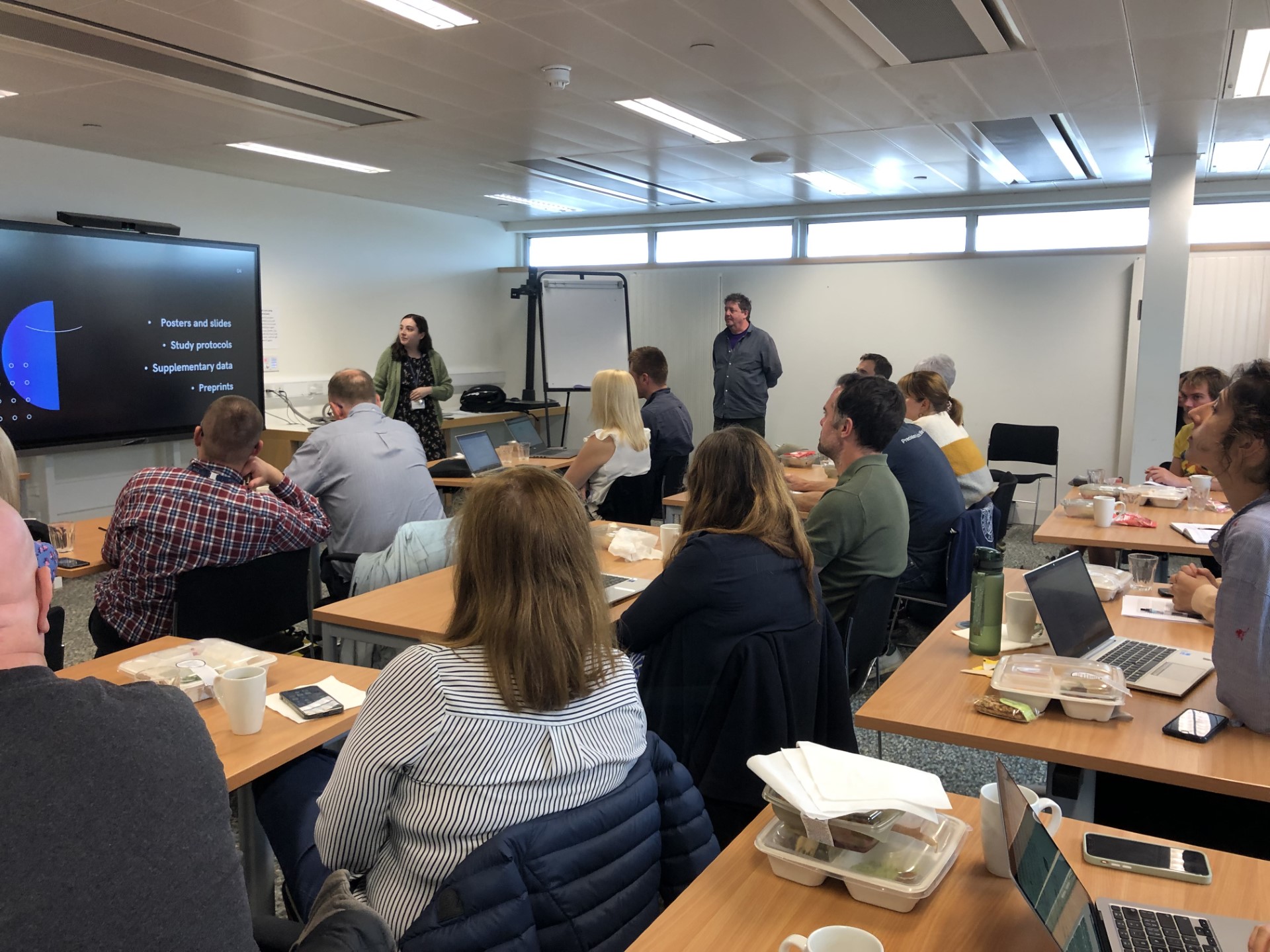
Emma Wilson presenting during the OSF introduction event in August.
The second event wasn’t quite as packed as the first, but it was still nice to see those who managed to make it through the December wind and rain. Once again, Gretchen was there to provide the introduction and overview; and Emma, likewise, returned to talk about her experience as an OSF user. This time, the afternoon was rounded off by Gillian Currie who outlined the OSF training she and Eirini Theofanidou were ready and able to deliver. Before the close of the session Gillian had secured several bookings for her training sessions. Sadly, and despite having organised the event – and the Free Lunch – RDS won’t receive any commission for these bookings.
However, we will soon be in vigorous competition with Gillian and Eirini because we’re preparing to offer OSF Winter and Summer Schools. These sessions will be delivered remotely by COS to an in-person cohort of researchers over two or three days. If all goes to plan, we may even be recording the session recordings for future use. And yes, in case you’re wondering, there will, once again, be a Free lunch for attendees.
To learn more about the University OSF membership go to: https://edin.ac/47aGU0S. Questions about OSF? Email us: data-support@ed.ac.uk.
Dr Simon Smith – Research Data Support Officer
Research Data Support, Library & University Collections
AHFAP 2023: A Snapshot
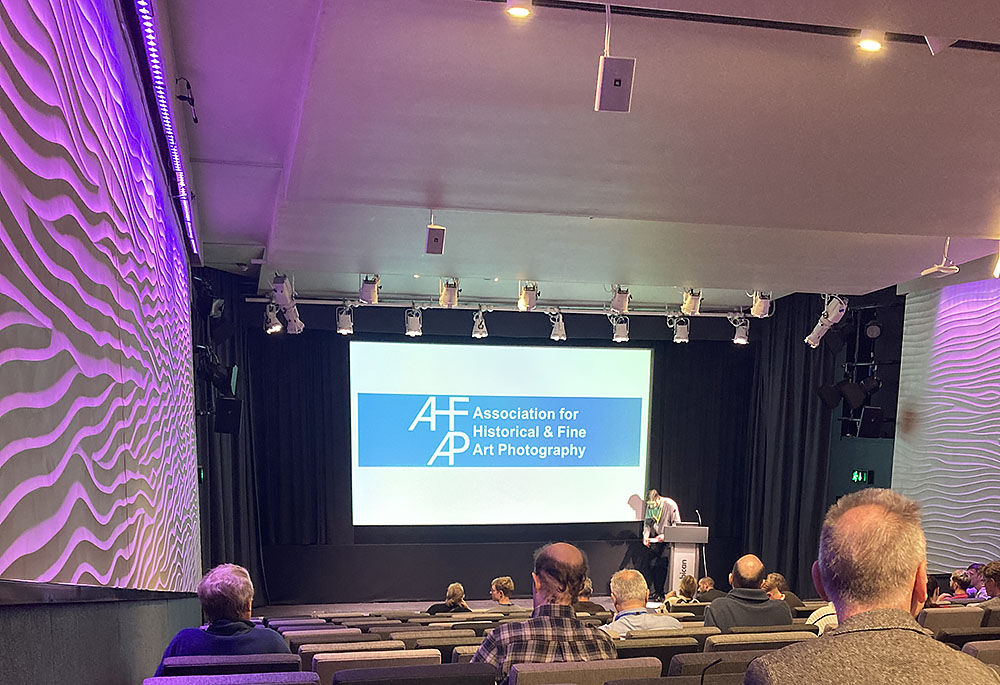
Getting ready for the conference to start
At the beginning of November, I was given the opportunity to attend the Association of Historical and Fine Art Photography (AHFAP) Conference 2023 at the Barbican Centre in London. The keynote speech by Catherine Croft from The Twentieth Century Society gave an overview of the history of the development of the Barbican, and its relationship with the photographers who have attempted to capture it – each approaching it from a unique perspective. I found all the talks fascinating, but I wanted to highlight a few in this blog that I felt captured some of the main themes I noticed in the conference this year.
Collections
 Hill and Adamson Collection: an insight into Edinburgh’s past
My name is Phoebe Kirkland, I am an MSc East Asian Studies student, and for...
Cataloguing the private papers of Archibald Hunter Campbell: A Journey Through Correspondence
My name is Pauline Vincent, I am a student in my last year of a...
Hill and Adamson Collection: an insight into Edinburgh’s past
My name is Phoebe Kirkland, I am an MSc East Asian Studies student, and for...
Cataloguing the private papers of Archibald Hunter Campbell: A Journey Through Correspondence
My name is Pauline Vincent, I am a student in my last year of a...
Projects
Cataloguing the private papers of Archibald Hunter Campbell: A Journey Through Correspondence
My name is Pauline Vincent, I am a student in my last year of a...
Archival Provenance Research Project: Lishan’s Experience
Presentation My name is Lishan Zou, I am a fourth year History and Politics student....