Home University of Edinburgh Library Essentials
May 9, 2026
Dealing with Data 2015 – Call For Papers

Date: Monday 31 August 2015, 9:30 – 16:00 (lunch provided)
Location: Informatics Forum, University of Edinburgh
Themes:
Data creation, including non-traditional data types
Data analysis
Data visualisation
Data security
Working with sensitive data
Archiving and sharing data, including preservation, re-use, and licensing
Infrastructure and tools, for example Electronic Lab Notebooks
Research software development and preservation
Linked open data for research, working with government data
Big Data and data mining
Meeting funder requirements for research data management
Format:
Presentations will be 15 minutes long, with 5 minutes for questions. Depending on numbers, thematic parallel strands may be used. Presentations will be aimed at an academic audience, but from a wide range of disciplines. Opening and closing keynote presentations will be given.
Call for proposals:
Leading edge research is reliant upon data that are produced or collected during the research process, or on existing data that is being analysed and re-used in new research questions. It is important to effectively manage research data throughout the lifecycle, from data management planning through to archiving and sharing. Requirements for managing data are increasingly being adopted by institutions and funders in order to foster good research data management practices.
Following on from the successful ‘Dealing with Data 2014’ half-day conference, Information Services are pleased to announce that we will be hosting a one-day conference covering a broad range of research matters from all disciplines on the subject of ‘Dealing with Data’.
The aim of the conference is for researchers of all levels at the University of Edinburgh to share good practice, emerging techniques and technologies, and practical examples in working with data across the research lifecycle.
We welcome proposals for presentations on any aspect of the challenges and advances in working with data, particularly research with novel methods of creating, using, storing, visualising or sharing data. A list of themes is given above, although proposals that cover any aspect of working with research data will be considered.
Please send abstracts (maximum 500 words) to dealing-with-data-conference@mlist.is.ed.ac.uk before Monday 6th July 2015. Proposals will be reviewed and the programme compiled by Friday 31st July 2015.
Cuna Ekmekcioglu
Library and University Collections
Trials – e-resources on trial this week
 Dead Sea Scrolls Electronic Library Biblical Texts is on trial until 24th June. It presents a complete Hebrew transcription and English translation of the Biblical texts, together with high-resolution images (scalable). Access is available for all biblical fragments, including photos of the fragments, texts derived from the fragments in Masoretic order (bible books), English translation from the texts on the fragments and full Hebrew Scripture.
 Parliament Rolls of Medieval England database is on trial until 20th June. The rolls of parliament were the official records of the meetings of the English parliament from the reign of Edward I (1272 – 1307) until the reign of Henry VII (1485 – 1509), after which they were superseded by the journals of the lords and, somewhat later, of the commons. The rolls, which amount in total to over four million words, were first edited in the eighteenth century and published in 1783 in six folio volumes entitled Rotuli Parliamentorum ( RP ) under the general editorship of the Reverend John Strachey.
Feedback and further info
We are interested to know what you think of these e-resources as your comments influence purchase decisions so please fill out our feedback form.
A list of all trials currently available to University of Edinburgh staff and students can be found on our trials webpage.
Art and Psychoanalysis
As mentioned briefly in a previous post (Unexpected Item of the Month) the Edinburgh-based psychoanalyst, William Ronald Dodds Fairbairn, was notable for the diversity of subjects he pursued with a psychoanalytical eye. One of the best represented subjects in the Fairbairn Archive is art.
The first evidence we have for Fairbairn’s interest in this subject is from 1937. The item in question is a talk, written and delivered by Fairbairn at a meeting of the Scottish Branch of the British Psychological Society and entitled ‘Prolegomena to a Psychology of Art’. This little-known paper was published in ‘From Instinct to Self’, the 1994 compilation of Fairbairn’s papers, co-edited by David Scharff and Fairbairn’s daughter, Ellinor Fairbairn Birtles. In it, ‘Prolegomena’ is described as being, ‘written largely from the standpoint of the pleasure principle…Fairbairn described art as play; thus artistic activity is making something for fun’. This starting point is important, because it would later bring Fairbairn into conflict with members of the artistic world who objected to what was viewed as a superficial treatment of the subject.
‘Prolegomena’ was quickly followed by ‘The Ultimate Basis of Aesthetic Experience’, also read at a British Psychological Society, Scottish Branch meeting, in 1938. Fairbairn re-worked both papers which were then subsequently published in the ‘British Journal of Psychology’, in 1938.
Although Fairbairn’s ideas on art did undoubtedly offend some in the art world – if his correspondence is anything to go by – they nevertheless received unexpected support from the then Director of the National Gallery of Scotland, Stanley Cursiter. In what could be one of the greatest letters in the Fairbairn Archive, Cursiter reassures Fairbairn that fun was indeed the correct attitude for the appreciation for a work of art and,
‘I am glad you take this line because to serious-minded people seeking the meaning of art, I have always contended that the fundamental meaning of a picture was the fundamental meaning of a plum pudding – and have been counted frivolous for it!’
Perhaps buoyed by such high-profile vindication, by the 1950s Fairbairn had hopes of writing a book on the subject. The working titles was ‘Art and Psychoanalysis’ and Fairbairn had undertaken quite detailed preparatory work in advance of its hoped-for publication. This included not only collecting items such as this picture postcard of the statue ‘Church and Synagogue’ in Munster Cathedral:

but also compiling this list of illustrations:

Fairbairn corresponded with a wide-range of people and organisations in relation to this proposed book, including Stanley Cursiter and T Elder Dixon, Vice-Principal of Edinburgh School of Art. Fairbairn was clearly attempting to learn more about the minefield that is ownership and copyright in relation to reproducing works of art. He also sought companies who had the requisite skills to reproduce the works, once permission had been secured. However, the book was not to be and Fairbairn’s contribution to this field has been largely, and perhaps not surprisingly, overshadowed by his work on object-relations. However, few papers in the Archive demonstrate such personal enthusiasm for a subject; art was clearly something of great importance to William Ronald Dodds Fairbairn.
New digital resources for Puritan thought

Herbert, John Rogers. Assertion of Liberty of Conscience by the Independents of the Westminster Assembly of Divines (c) Palace of Westminster; Supplied by The Public Catalogue Foundation
I’m pleased to report that we now have access to digital collections from Oxford Scholarly Editions, including the seventeenth-century prose collection. This contains several titles of interest to researchers in Puritan history and thought, including the Minutes and Papers of the Westminster Assembly 1643–1652 and the Calendar of the Correspondence of Richard Baxter, Vol. 1 & 2. Scholarly editions of the works of John Bunyan – Pilgrim’s Progress, Grace Abounding and the Holy War as well as thirteen volumes of smaller works by this Puritan writer are also now available. All titles can be access via the online library catalogue.
Christine Love-Rodgers – Academic Support Librarian, Divinity
Old Books, New Discoveries: The Tale of a Feather
Our blog post today comes from History of the Book student and CRC volunteer Allie Newman.
The University of Edinburgh’s Centre for Research Collections (CRC) is home to over 300 examples of Western medieval manuscripts, ranging from single leaves and fragments to large bound tomes. While it can certainly be said that this collection represents some of the oldest material in the library, it cannot be said that everything in the collection has been exhaustively examined, even given the items’ relatively long existences. Despite the great age of the items, they are still producing new discoveries in terms of textual content and physical structure, both of which inform our understanding of their individual histories and book history as a whole. I recently made a very interesting, if very tiny, discovery that could hopefully shed some more light on the medieval scribal and artistic processes.
MS 33, a 15th century illuminated Dutch gradual (or songbook), is a large and somewhat unwieldy volume, and is known as the source of the illuminated piper that graces the logo of the Friends of Edinburgh University Library. The piper is actually part of a richly decorated floral border that surrounds a page of music, further embellished by a large illuminated initial (folio 10 verso).

2 and 3D Reflections
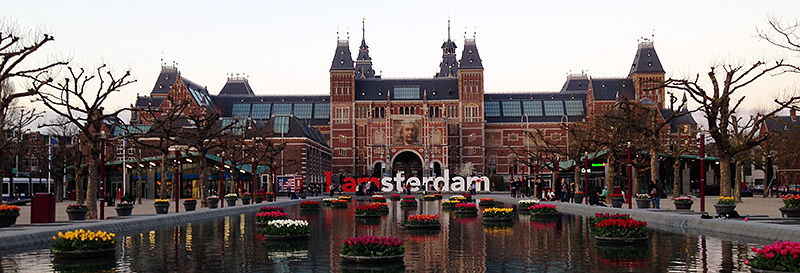 It is hard to believe that more than a month has passed since the fantastic “2 and 3D: Practice and Prophecies” Conference at the Rijksmuseum in April. So much was packed into those 2 short days: standardisation in colour and targets (who knew standards were so non-standard?), mass-digitisation and bespoke object specific photography techniques, panoramas, multispectral and 3D imaging, digital asset management and the role of photography in heritage institutions. This was a heritage photography event not to be missed, which is why I was delighted when the Association for Historical and Fine Art Photographers (AHFAP) offered me their competition bursary to attend. I gathered so much information in Amsterdam that I am still sifting through the notes and links and chasing up my post –conference ‘to do’ list! However, I would like to share a few of my highlights from the conference. Read More
Researching the Free Church of Scotland at New College Library
 New College’s origins lie in the Disruption of 1843, when over a third of the ministers in the Church of Scotland left to form the new Free Church of Scotland. Over 170 years later New College, and New College Library still have an active relationship with the Free Church of Scotland, whose Edinburgh Theological Seminary students come to use New College Library. As you would expect from our shared history, we have rich historical collections for the Free Church, but we also continue to collect some current material from them.
To research current issues in the Free Church, the Reports to the General Assembly of the Free Church of Scotland are now held in Stack II at Per F, side by side with the recent Principal Acts. The Principal Acts of the General Assembly of the Free Church of Scotland 1900-2014 are available free to download at http://freechurch.org/. Recent Free Church Assembly Reports are also available to download from http://freechurch.org/resources/assembly-reports.
New College Library Free Church holdings are probably most comprehensive for the earlier period of Free Church history. The Acts of the General Assembly of the Free Church of Scotland 1843-1900 are available in Stack I at sLY 50 A, alongside the Assembly proceedings and debates at sLY 50 B. This material is available on open access – please note that the online library catalogue also lists additional copies with individual entries by date which are kept in Special Collections. Researchers looking for browsing access may prefer the General Collections copies available in Stack I.
New College Library also holds the historic periodicals of the Free Church, including The monthly record of the Free Church of Scotland at Per M and the Free Church Magazine at Per F in Stack II. For University of Edinburgh users, these titles, including The Home and Foreign Missionary Record for the Free Church of Scotland and The Free Church Monthly and Missionary Record are also available online via Gale Newsvault.

New College students, late 19thC
When researching Free Church ministers, the key work for the early period is the Annals of the Free Church of Scotland, 1843-1900, held in the New College Library Reference section at Ref. BX9084 Fre. The matriculation records of New College students 1843-1943 are also searchable online at http://www.archives.lib.ed.ac.uk/alumni/. This data is a combination of two different lists drawn up by J. Robb and Hugh Watt and held at New College Library. Together they provide the master list of students who matriculated at New College Edinburgh for the first 100 years of its existence. These have been augmented with information drawn from Annals of the Free Church of Scotland, Annals of the United Free Church of Scotland 1900-1929 and the Fasti Ecclesiae Scoticanae. Useful information about ministers may also be gleaned from the Dictionary of National Biography (available in print and online) and from searching the online archives of historic newspapers such as the Times and the Scotsman (tip : try limiting your search to obituaries).
The Conservation of the Musical Instruments of the MIMEd Collection
The collections of Musical Instrument Museums of Edinburgh (MIMEd) comprise an extensive array of musical instruments from very different periods, geographical regions, and social contexts. Contrary to some of the comparable collections in the world, MIMEd maintains a significant portion of the instruments in playable condition. This provides an invaluable resource for musicians, researchers, and the general public to better understand and appreciate the music played on historical instruments, nonetheless, this involves a great responsibility, and a significant work load to keep the instruments in optimal conditions.
The preservation of such a large and diverse collection involves many challenges: from the understanding and knowledge of numerous materials and their properties; techniques of instrument manufacture through history; treatments to better protect the objects of the collection; to the history of music, musical instruments, and art history.

Jonathan Santa Maria Bouquet, MIMEd Conservator
Previous to my appointment as the MIMEd Conservator, I trained as a musical instrument maker and conservator, as well as a musician. I completed conservation internships and fellowships in distinguished institutions like the Metropolitan Museum of Art in New York, the Museo degli Strumenti Musicali in Milan, and the National Music Museum in South Dakota, where I worked as the Conservation Research Assistant. Currently I am working on a PhD in Organology at the University of Edinburgh.
As the MIMEd Conservator my responsibilities include the preservation, conservation, and maintenance of all the objects in the collection. Since undertaking the conservation of the collection, I have had numerous challenging and diverse projects, from cleaning and removing tarnish from trumpets and trombones, getting bagpipes ready for display, to major treatments of a Ruckers harpsichord made in 1609, and a severely damaged mandolin made in 1775.
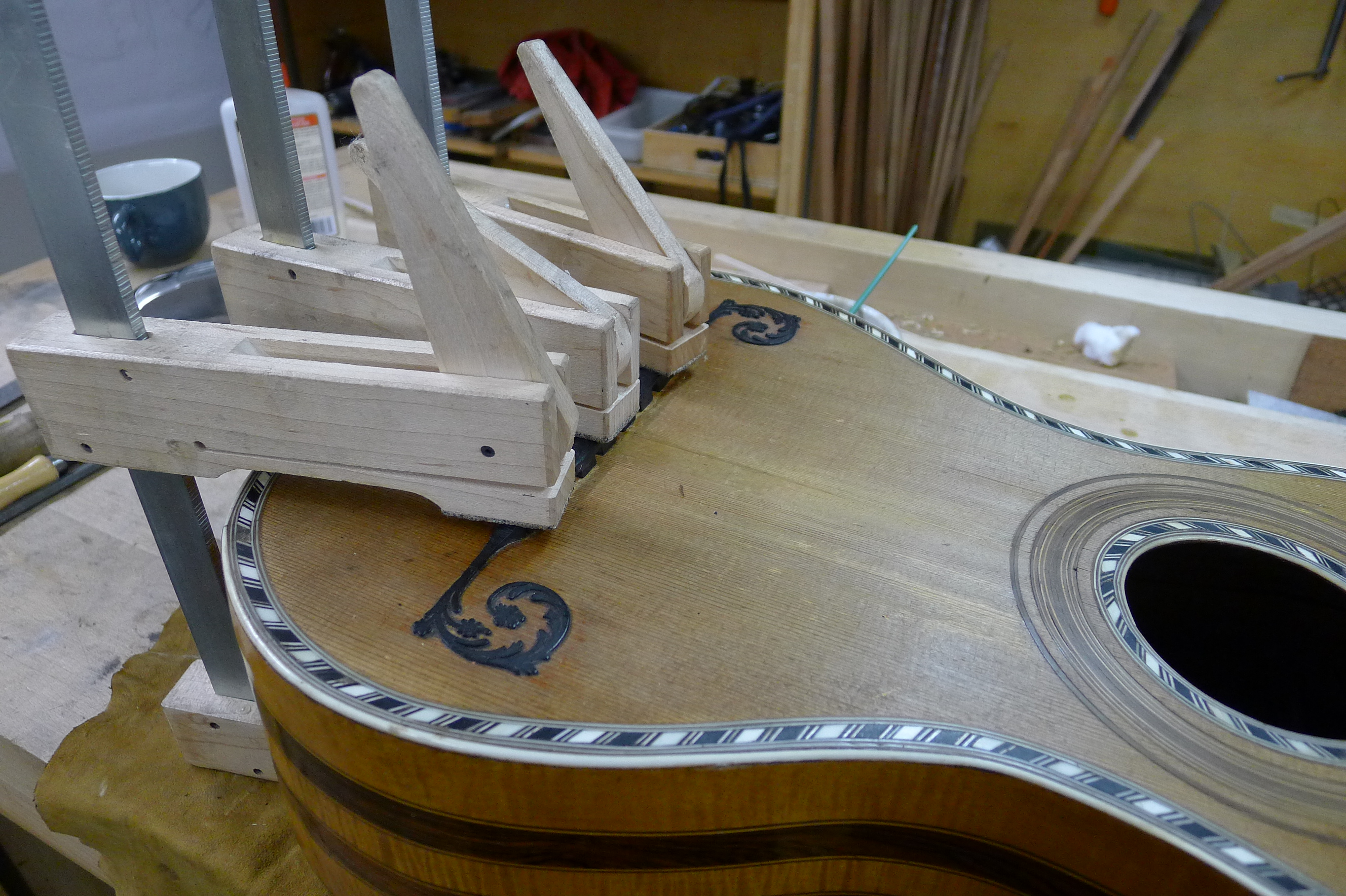
18th Century Guitar during conservation treatment
At present the main focus of my work is directly linked to the Saint Cecilia’s Hall Redevelopment Project. The new displays and layout of the museum will exhibit several hundred objects of MIMEd’s collections, and all of them need to be ready to be displayed for the re-opening of the museum in September 2016. Whilst the museum is closed to the public, I have undertaken the gargantuan task of treating every single object to be displayed: anything from dusting, cleaning, and changing strings, to full treatments that can involve several weeks of delicate and intensive work. To achieve this I have been working with volunteers and interns who can help to carry out those simple but time-consuming tasks, whilst learning and building up their curricula. By the time Saint Cecilia’s Hall re-opens its doors to the public, the instruments will reflect all this work by looking as good as they deserve.
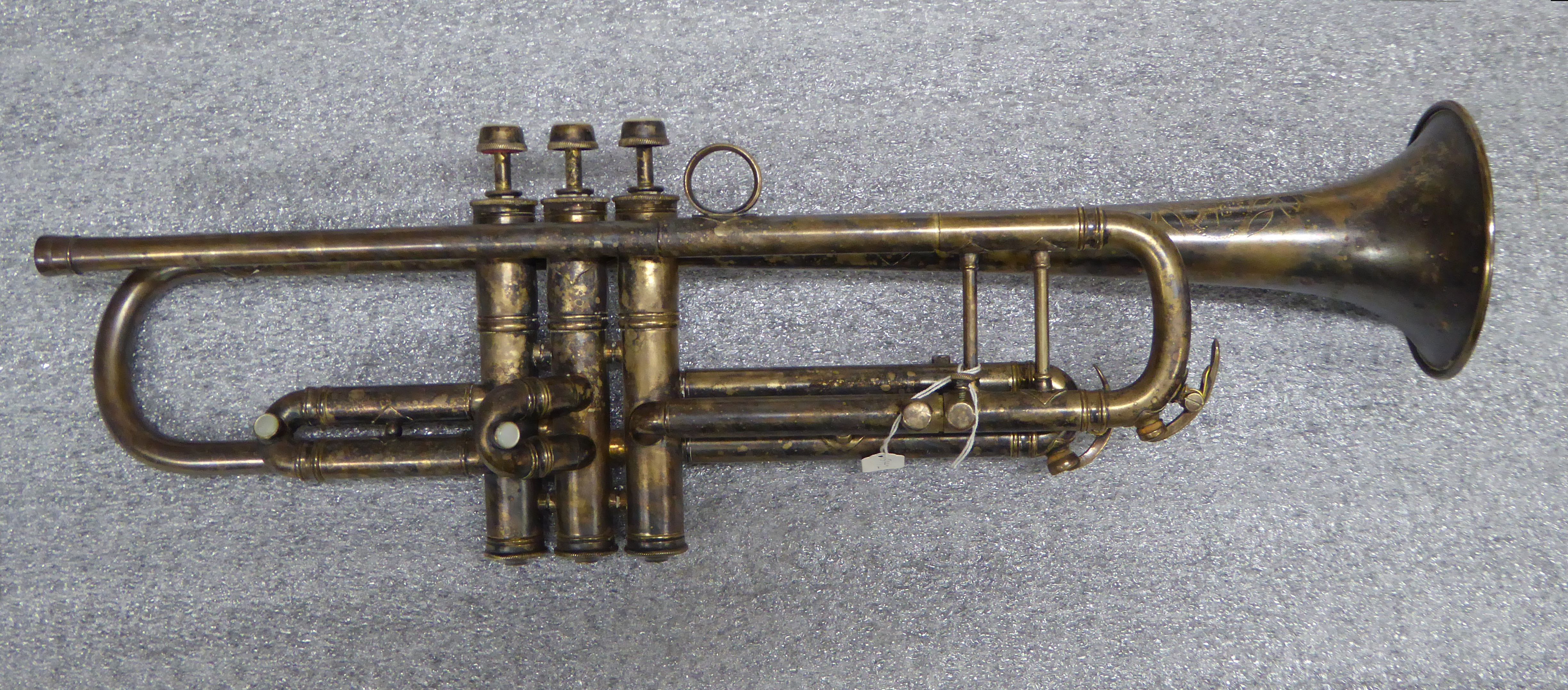
Trumpet before conservation treatment
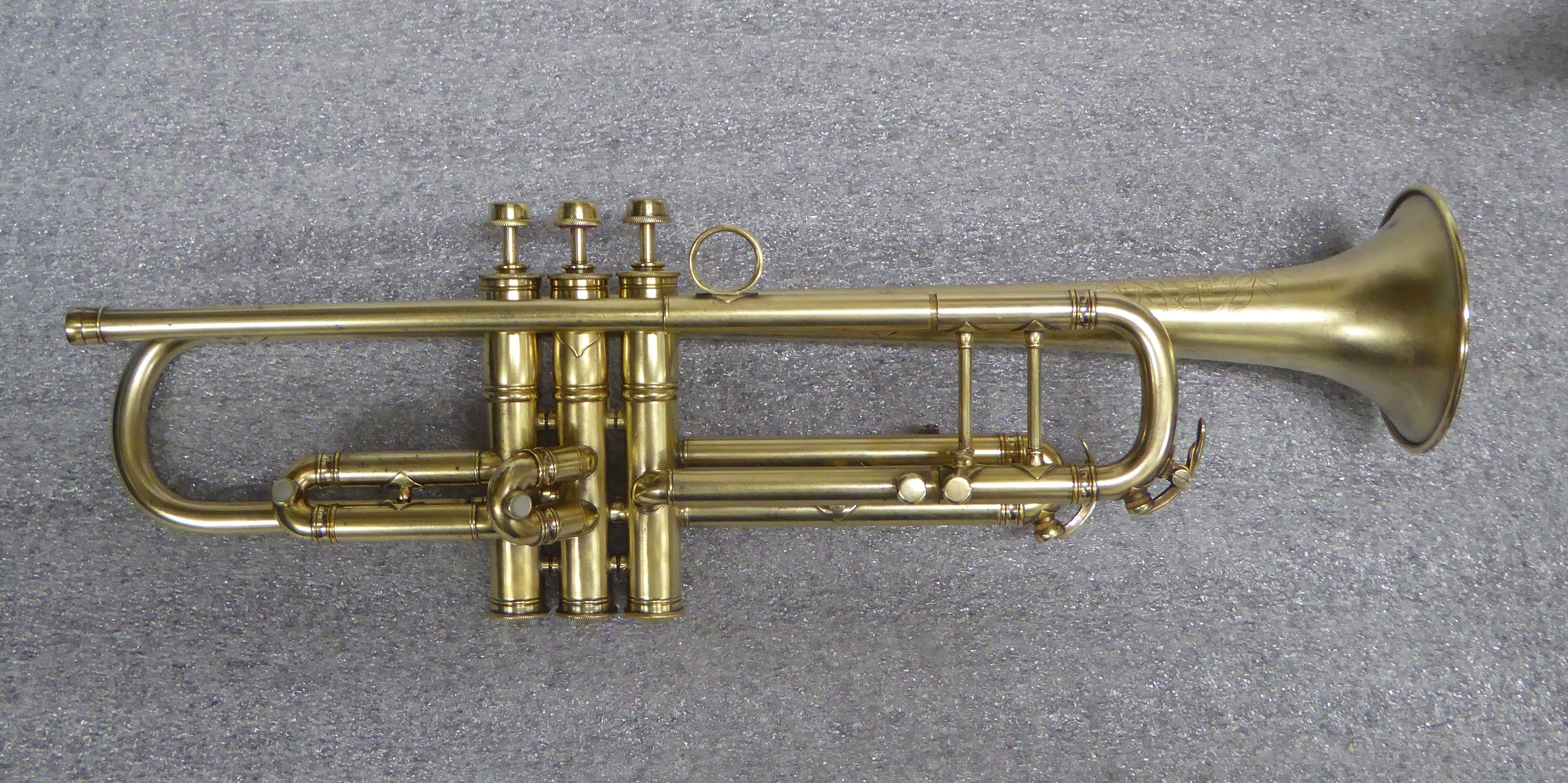
Trumpet after conservation treatment
To be the conservator of such an important collection is a great responsibility, St Cecilia’s Hall and MIMEd have an extensive common history, and exciting changes will take place in the near future with the redevelopment plan. To form part of the staff team of this great institution is both an honour and a pleasure, and I am looking forward to the many projects yet to come.
Post by Jonathan Santa Maria Bouquet, MIMEd Conservator
Edinburgh DataShare – new features for users and depositors
I was asked recently on Twitter if our data library was still happily using DSpace for data – the topic of a 2009 presentation I gave at a DSpace User Group meeting. In responding (answer: yes!) I recalled that I’d intended to blog about some of the rich new features we’ve either adopted from the open source community or developed ourselves to deliver our data users and depositors a better service and fulfill deliverables in the University’s Research Data Management Roadmap.
Edinburgh DataShare was built as an output of the DISC-UK DataShare project, which explored pathways for academics to share their research data over the Internet at the Universities of Edinburgh, Oxford and Southampton (2007-2009). The repository is based on DSpace software, the most popular open source repository system in use, globally. Managed by the Data Library team within Information Services, it is now a key component in the UoE’s Research Data Programme, endorsed by its academic-led steering group.
An open access, institutional data repository, Edinburgh DataShare currently holds 246 datasets across collections in 17 out of 22 communities (schools) of the University and is listed in the Re3data Registry of Research Data Repositories and indexed by Thomson-Reuters’ Data Citation Index.
Last autumn, the university joined DataCite, an international standards body that assigns persistent identifiers in the form of Digital Object Identifiers (DOIs) to datasets. DOIs are now assigned to every item in the repository, and are included in the citation that appears on each landing page. This helps to ensure that even after the DataShare system no longer exists, as long as the data have a home, the DOI will be able to direct the user to the new location. Just as importantly, it helps data creators gain credit for their published data through proper data citation in textual publications, including their own journal articles that explain the results of their data analyses.
 The autumn release also streamlined our batch ingest process to assist depositors with large and voluminous data files by getting around the web upload front-end. Currently we are able to accept files up to 10 GB in size but we are being challenged to allow ever greater file sizes.
Making the most of metadata
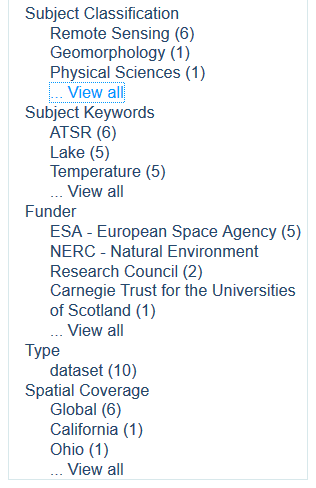
Example from Geosciences community
Every landing page (home, community, collection) now has a ‘Discover’ panel giving top hits for each metadata field (such as subject classification, keyword, funder, data type, spatial coverage). The panel acts as a filter when drilling down to different levels, allowing the most common values to be ‘discovered’ within each section.
The usage statistics at each level are now publicly viewable as well, so depositors and others can see how often an item is viewed or downloaded. This is useful for many reasons. Users can see what is most useful in the repository; depositors can see if their datasets are being used; stakeholders can compare the success of different communities. By being completely open and transparent, this is a step towards ‘alt-metrics’ or alternative ways measuring scholarly or scientific impact. The repository is now also part of IRUS-UK, (Institutional Repository Usage Statistics UK), which uses the COUNTER standard to make repository usage statistics nationally comparable.
What’s coming?
Stay tuned for future improvements around a new look and feel, preview and display by data type, streaming support, bittorent downloading, and Linked Open Data.
Robin Rice
EDINA and Data Library
LibraryLabs Pop Up at Central
 Following on from the success of our Pop Up Library Metadata Games sessions during Innovative Learning Week, this week we took Metadata Games to the City of Edinburgh Council’s Central Library, the first time the game has been taken off campus since its initial pilot back in August. We battled through the inclement weather and set up stall in the library’s ground floor foyer area then, poised with laptops and lollypops, set about recruiting people to take part in our tagging game.
We were keen to spread awareness of our work – and the university’s collections – beyond the confines of campus and we were also interested in to see if there was any noticeable difference between the sorts of tags that members of the public contributed in comparison to those provided by students, academics and staff (that analysis is yet to be done!). Over the course of the two hour session, 15 players, ranging from teenagers to pensioners, provided us with 776 tags (more than 50 per person) – an impressive total considering there was no free coffee on offer for participants on this occasion!

These tags will now be moderated and then uploaded to our image database, ultimately helping to make our collections more discoverable online. You can see an example of how the tags we have harvested from the game have directly contributed to the improved description of one of our iconic items, Rashid al-Din’s History of the World (http://collections.ed.ac.uk/iconics/record/51419). The crowdsourced tags ‘horses’ and ‘knights’, which were harvested from the game, complement the existing formal descriptive metadata showing author, date shelfmark etc.

We enjoyed taking the game on tour: many thanks to Bronwen Brown, Fiona Myles and all the staff at Central Library for all their help with the event, and to all players who contributed their time to help us improve the description of our images.
Keep on playing at http://librarylabs.ed.ac.uk/games/ (EASE login required)!
Gavin, Claire, Charlie and Paul
Collections
 Hill and Adamson Collection: an insight into Edinburgh’s past
My name is Phoebe Kirkland, I am an MSc East Asian Studies student, and for...
Cataloguing the private papers of Archibald Hunter Campbell: A Journey Through Correspondence
My name is Pauline Vincent, I am a student in my last year of a...
Hill and Adamson Collection: an insight into Edinburgh’s past
My name is Phoebe Kirkland, I am an MSc East Asian Studies student, and for...
Cataloguing the private papers of Archibald Hunter Campbell: A Journey Through Correspondence
My name is Pauline Vincent, I am a student in my last year of a...
Projects
Cataloguing the private papers of Archibald Hunter Campbell: A Journey Through Correspondence
My name is Pauline Vincent, I am a student in my last year of a...
Archival Provenance Research Project: Lishan’s Experience
Presentation My name is Lishan Zou, I am a fourth year History and Politics student....