Home University of Edinburgh Library Essentials
December 16, 2025
Literacy, Religion and Popular Politics
The Statistical Account presents a fascinating picture of eighteenth-century Scotland. It gives a rich and often detailed view of the working lives of ordinary people, and was of particular importance to my area of research which was concerned with the origins of eighteenth-century popular political consciousness and the relationship between Presbyterianism, literacy and political activity. Hence sources of information relating to occupations and social status were vital, and the OSA provided considerable insight as to the range of occupations in which heads of families were employed in villages and towns throughout Scotland. The on-line version of the OSA with its text searching facility was invaluable in pinpointing specific information and saved hours of manual searching.
As one aspect of my thesis was the relationship between religious controversy and popular political consciousness expressed through patronage disputes, it was important to determine what kind of people involved themselves in such disputes. Patronage disputes were widespread across eighteenth-century Scotland and were significant, in part because they displayed clear opposition to the élite and to government policy, but also because they involved whole communities, with opposition from heritors, elders, and heads of families, essentially including people from every stratum of society, and every occupation.

Little Dunkeld Kirk Perthshire Scotland, built 1798
Using the on-line search facility I was able to search by occupation and place, and by comparing the occupations in the OSA with the occupations on book subscription lists, it became evident that the types of occupation followed by heads of families had not changed over the century. This provided a clear guide to the kind of people who were at the heart of eighteenth-century patronage disputes and later political activity. For example, at Campsie in Stirlingshire, where there was a disputed presentation in 1784, there were ninety-six heads of families: twenty-eight were feuers who farmed their own lands, fifty were tenants, seven of whom were chiefly employed in grazing, and the remaining eighteen were masons, carriers or road makers. At Crieff in Perthshire, heads of families included apothecaries, physicians and surgeons, mantua makers, bakers, masons, slaters, barbers, shopkeepers, butchers, carriers, carters, messengers, clergymen, midwives, clockmakers, millers, coopers, saddlers, dyers, schoolmasters, distillers, excise-officers, shoemakers, farmers, smiths, spinsters, stocking makers, fiddlers, tailors, gardeners, weavers, wrights, hecklers, writers, inn-keepers, labourers, manufacturers, and gentry. The variety of occupations underline the social status of those involved.
The OSA also offered numerous examples of ordinary peoples determination to access education, books, pamphlets and newspapers, as well as their desire to associate, meeting together in clubs for discussion and debate. The accounts from parish ministers testify again and again to their parishioners’ over-fondness for books about ’controversial divinity’, as well as a wider interest in books generally. Many ministers commented on the range of people expressing interest in newspapers and current affairs, for example, the Revd Andrew Duncan of Wigton noted that, ‘An attention to publick (sic) affairs, a thing formerly unknown among the lower ranks, pretty generally prevails now. Not only the farmers, but many of the tradesmen, read the newspapers, and take an interest in the measures of government’. The Revd John Bruce remarked that, in Forfar, ‘A spirit of enquiry and a taste for reading … (with) subscriptions to the Encyclopedia Britannica, the Bee, and several periodical and other publications, scientific, religious, moral and political, are more numerous of late’. The minister at Little Dunkeld in Perthshire, noted that ‘Newspapers and other periodical publications find their way to every corner of the parish’, and this interest in current affairs was not a recent phenomenon but one which had existed since at least the time of the American War of Independence. He also commented on the formation of several reading clubs. Such observations emphasised the significance of reading, and many ordinary people’s involvement in political activity was enabled by the coincidence of widespread literacy encouraged by a Calvinist education, from which they had not only gained that skill, but the ability to reflect, form opinions, and question authority, capacities which could be brought to bear in the wider context of assessing their position in Scottish society. Ministers’ observations throughout the OSA highlighted the availability and variety of reading material, and how common the practice of reading and book buying was, a practice which encouraged debate, and contributed to popular involvement in the radical political movement of the 1790s.
I hope this brief description has highlighted what a wonderful resource the OSA is with its wealth of information and ease of use through on-line access and search facilities.
Dr Val Honeyman
We hope you have enjoyed this post: it is characteristic of the rich historical material available within the ‘Related Resources’ section of the Statistical Accounts of Scotland service. Featuring essays, maps, illustrations, correspondence, biographies of compliers, and information about Sir John Sinclair’s other works, the service provides extensive historical and bibliographical detail to supplement our full-text searchable collection of the ‘Old’ and ‘New’ Statistical Accounts.
Highlights from the RDM Programme Progress Report: Mar. & Apr. 2015
9 EPSRC grant holders and researchers were interviewed as follow-up to the EPSRC Expectations Awareness Survey conducted in February.
A new leaflet detailing all systems in the RDM portfolio is being created, which will explain the Data Asset Register, and the use of PURE, in the context of all the systems available across the research lifecycle.
The PURE system now has a module that allows the datasets to be described. This fulfils EPSRC Research Data Expectations requiring datasets to be described and those descriptions made available online. Datasets described in PURE are shown as part of staff online profiles in Edinburgh Research Explorer alongside other research outputs.
The RDM Service Coordinator gave an invited presentation at the “Open access and research data management: Horizon 2020 and beyond” FOSTER Workshop, University College Cork, Eire (15 Apr. 2015) – https://www.fosteropenscience.eu/content/looking-after-your-data-rdm-edinburgh-institutional-approach
DCC and RDM programme staff to meet with key contacts in selected schools to discuss local support and draft guidance.
DataShare release 1.7.2 went live in April with a new default open licence – Creative Commons International Attribution, 4.0 (CC-BY 4.0) to replace the Open Data Commons Attribution licence.
Discussion is on-going between UNC-Chapel Hill, Data Library and colleagues in Web, Learning, and Teaching Division about collaborating on ‘MANTRA as a MOOC’ to be delivered next autumn.
ITI / Research Services are to investigate provision of a hosted GIT service for research software generated for research at the university.
RDM programme webpages in Polopoly are being checked for accuracy and compliance for their planned migration to Drupal.
All Schools in CHSS have now added links to the RDM Programme website and other RDM pages through their intranets. GeoSciences, Chemistry, Informatics and Mathematics in CSE have also added said links via their intranets.
Content has been finalised for the new ‘Working with personal and sensitive data’ RDM course.
Stuart Macdonald
RDM Service Coordinator
Fairbairn’s Dream Drawings #2
A recent post on this blog, Fairbairn’s Dream Drawings #1, explored the subject of William Ronald Dodds Fairbairn’s dream drawings, which date from the 1950s. The focus of that first post were Fairbairn’s drawings of landscapes. For this return to the subject, I will be focusing on the drawings in which Fairbairn brings to life a cast of interesting characters.

When looking through the drawings in the William Ronald Dodds Fairbairn Archive it becomes immediately apparent that many of the characters in Fairbairn’s dreams made regular appearances. The men, women and children are drawn wearing distinctive clothing or they perform distinctive activities. Some of the recurring characters include a middle-aged women, often in Edwardian looking dress, redolent of Mary Poppins, a child in traditional Scottish dress, often with a dog, and a seated male figure. It is likely that the child represents Fairbairn himself, and the man and woman are perhaps his parents, however, it is not my intention here to offer explanations or interpretations of these characters; I’m sure you will form your own opinions about that.
The female character is often depicted leading the child from a chain around his neck, or brandishing a weapon, typically a sword or stick:

However, on occasion she is portrayed in a slightly less menacing way, such as below.
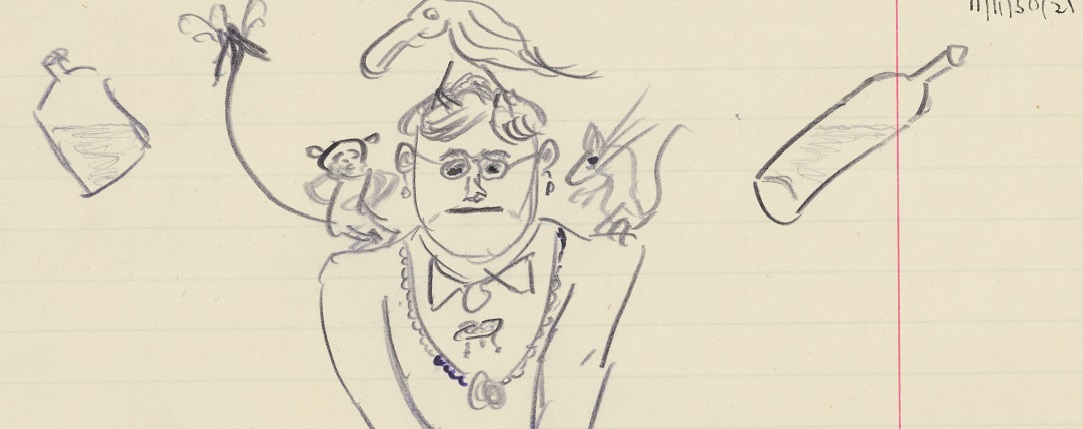
As with the first image on this post, the image below includes the majority of the pantheon of Fairbairn’s dream characters.

Whilst the majority of the characters in Fairbairn’s dream drawings are recognisable as humans, there are a few that have a more abstract feel. What do you think Fairbairn’s subconscious was trying to tell him here?

Science during Wartime
We have a more detailed analysis of the University’s response to the experience and aftermath of WW1 to come later on. This article looks instead highlights a few of the changes in Science in and around the wartime years.
Campus changes
The Faculty of Science was founded in 1893. By 1906, pressure on space saw Engineering and Natural Philosophy move from the confines of the Old College campus to new accommodation at High School Yards. Shortly before the outbreak of war, further pressure on space saw Mathematics move to Chambers Street and Agriculture & Forestry to 10 George Square. Plans to build a new home for Chemistry at High School Yards were however interrupted other than a bit of additional basement space. These changes were the precursors to the permanent shift of Science from the central campus to the new Kings Buildings campus, which began shortly after the war.

Natural Philosophy: Junior Laboratory, c1910
200th anniversary of the Battle of Waterloo – 18 June 2015
THE BATTLE OF WATERLOO REFLECTED IN OUR ARCHIVE COLLECTIONS
 On Sunday 18 June 1815, on the muddy fields of Waterloo just outside Brussels in today’s Belgium, Napoleon Bonaparte with his French Imperial Guard faced off the Duke of Wellington and the British and Allied army. The course of the Battle of Waterloo, notable officers and men, and the battle outcome can all be referred to elsewhere. Instead, on this 200th anniversary of Waterloo, we focus on some of the material curated by the Centre for Research Collections which reflect these hours of 18 June 1815 and the aftermath of battle.
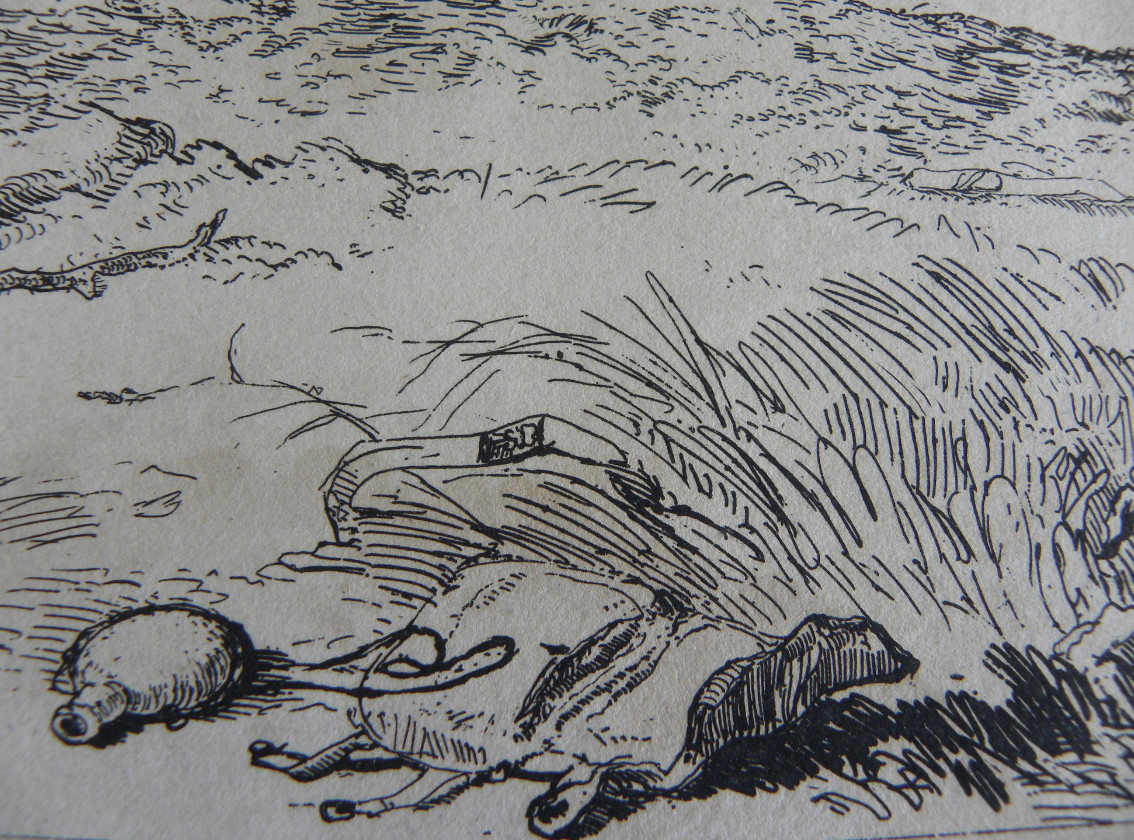
Drinking bottle and personal effects on the field of battle in scene No.7 of the Barker Panorama of Waterloo (produced in 1816), shown at Leicester Square, London. (Coll-1101 – Barker Panorama of Waterloo, CRC)
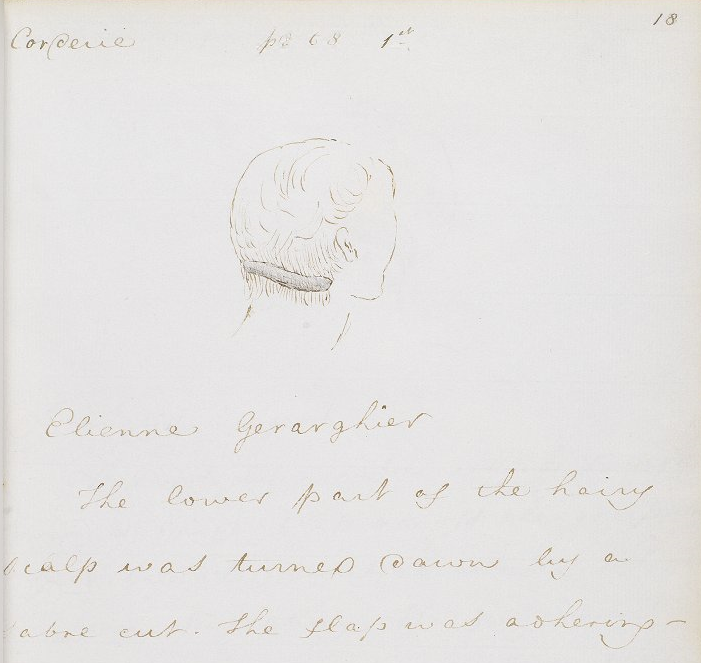
Wound sustained by Etienne Gerarghier during the Battle of Waterloo and appearing in the case-notes of Dr. Thomson and Dr. Somerville. (On p. 18 of Gen.594, in Coll-530 – Collection of sketches and reports of wounded at the Battle of Waterloo, CRC)
The collections profiled are: scenes from the panorama of the field of battle at Waterloo drawn by Henry Aston Barker (Coll-1101); and, sketches and reports by Dr. John Thomson and Dr. William Somerville of the wounded at Waterloo (Coll-535).
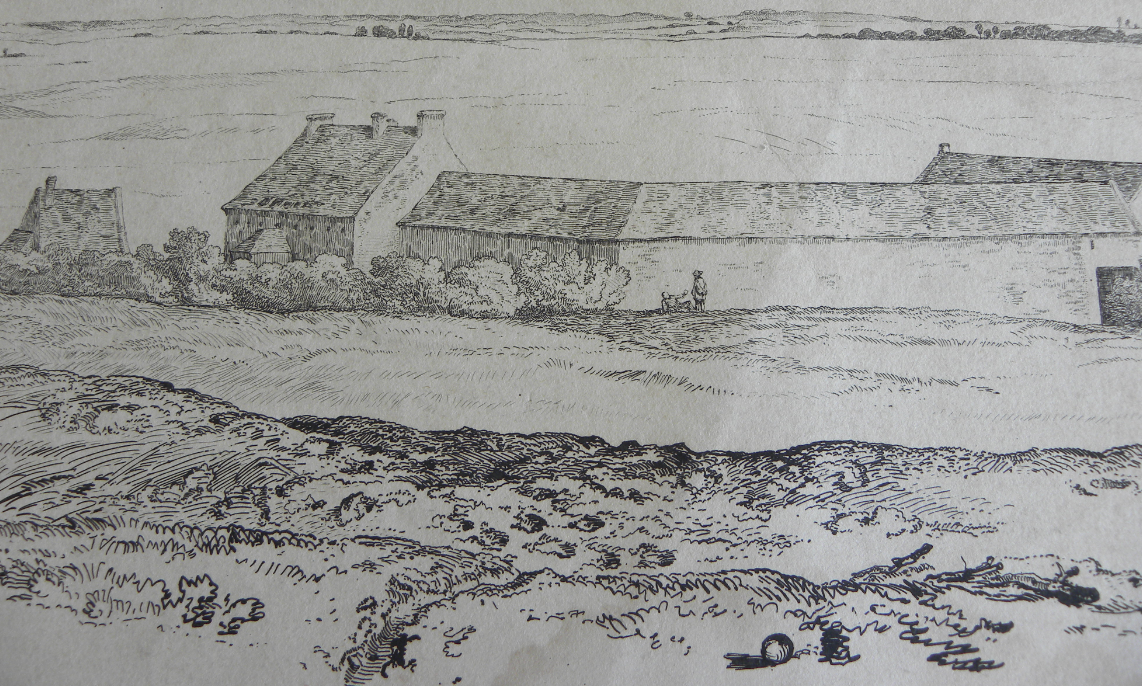
The farm of La Haye Sainte ‘where the Life Guards charged the Cuirassiers’ of the French Imperial Army (armour and firearm equipped cavalry). In part No.1 of the panorama. (Coll-1101 – Barker Panorama of Waterloo, CRC)
Firstly… scenes from the panorama of the field of battle at Waterloo (Coll-1101).
Henry Aston Barker (1774-1856) was the younger son of Robert Barker (1739-1806), the panorama painter. Aged 12, he was sent by his father to take outlines of Edinburgh from the city’s Calton Hill for the world’s first 360 degree exhibition panorama.
Barker panoramas were exhibited at an establishment in Castle Street, off Leicester Square, London, and the first was a view of London from the roof of the Albion Mills in 1791, the drawings for which were made by the young Henry. Later on, from 1793, Barker panoramas moved to the first purpose-built panorama building in the world, in Leicester Square itself.
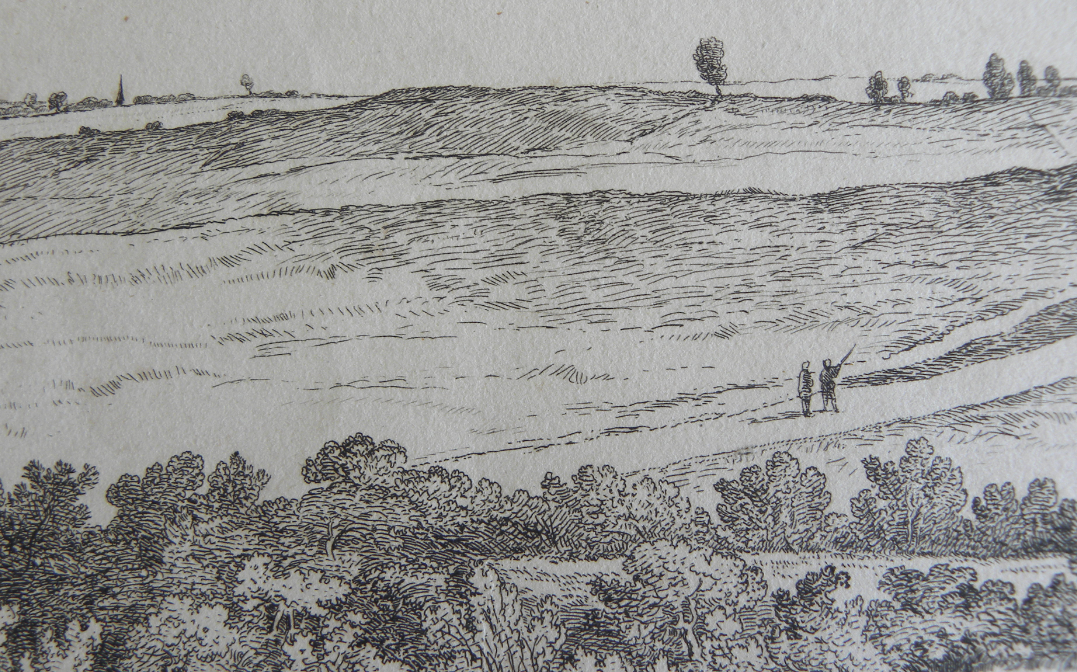
Scene showing the distant spire of Planchenoit (top left) ‘where Bonaparte slept the night before the Action’. In part No.2 of the panorama. (Coll-1101 – Barker Panorama of Waterloo, CRC)
The scenes for the panorama of the field of battle at Waterloo were drawn by Barker on the Plateau of Mont St. Jean, the escarpment which provided Napoleon’s name for the battle – La bataille de Mont-Saint-Jean.
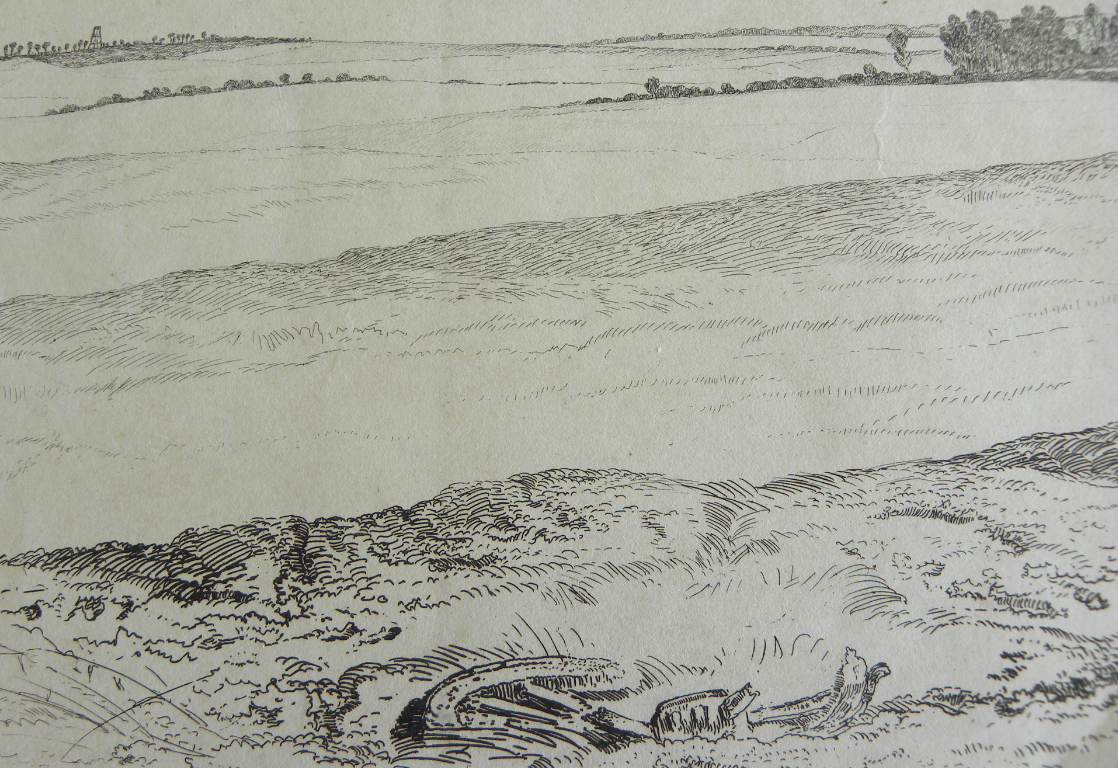
Scene showing distant platform or scaffold (top left) ‘near which Bonaparte gave his orders in the early part of the Action’. In part No.3 of the panorama. (Coll-1101 – Barker Panorama of Waterloo, CRC)
Barker had also visited Paris to research the project and to interview officers who participated in the battle. The scenes were etched by J. Burnet, and they were produced in 1816 for sale to visitors to the panorama building at Leicester Square. The credit to both Burnet and Barker is printed on each of the eight components of the ‘souvenir’ panorama.
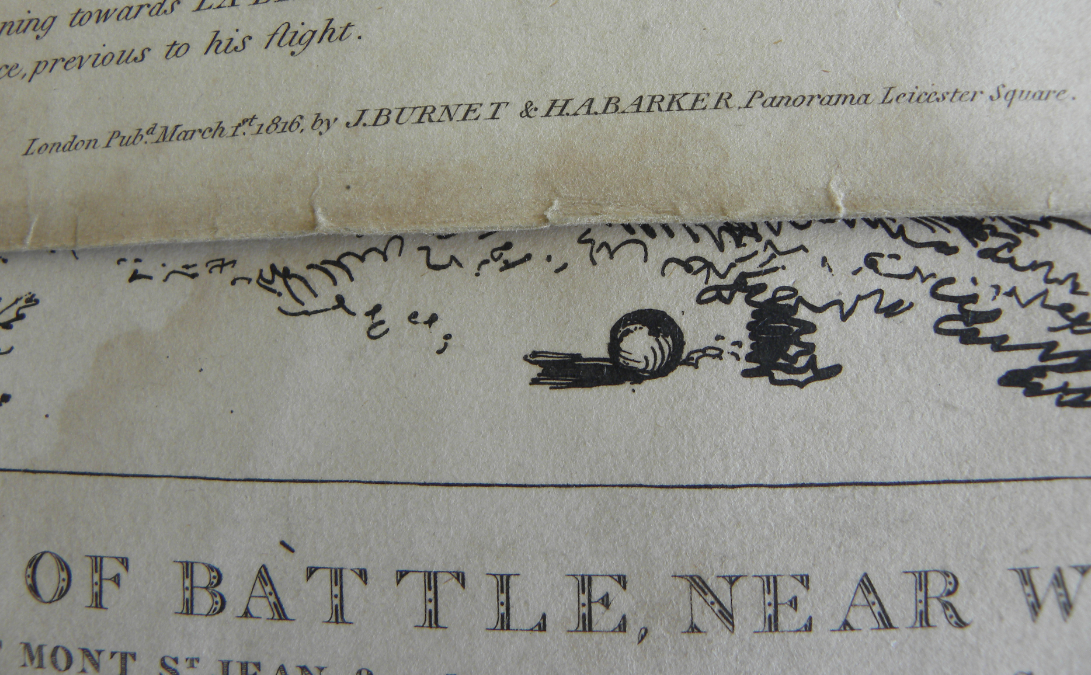
The drawings were initially done by Henry A. Barker, and then etchings were made by J. Burnet. (Coll-1101 – Barker Panorama of Waterloo, CRC)

This scene showing the trees and field that approximately ‘mark the Right of the edge of the British position’. In part No.4 of the panorama. (Coll-1101 – Barker Panorama of Waterloo, CRC)
It was intended that the eight parts of the panorama be joined together to form a complete circle. The viewer would then stand in the centre and have a panoramic view of the entire scene of Battle.
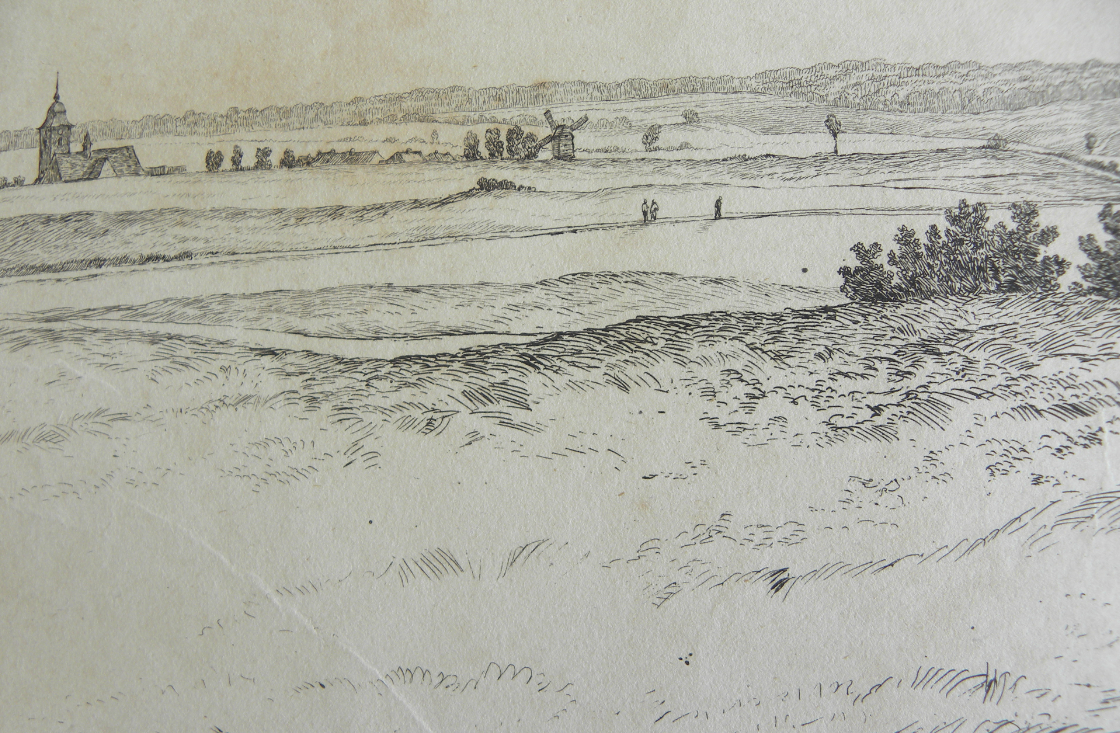
The church and windmill of the village of Braine La Leude on the battle site. In part No.5 of the panorama. (Coll-1101 – Barker Panorama of Waterloo, CRC)
Each component is around 60cm x 29cm in size and together they show principally: 1 -The farm at La Haye Saint; 2 – Around the orchard of La Haye Sainte; 3 – Prominent part of the Plateau of Mont St. Jean; 4 – The crest of the hill on which the Imperial Guards were charged; 5 – The village of Braine La Leude; 6 – The village of Mont St. Jean; 7 – The Forest of Soigne; and, 8 – Road and hedge leading to Ter La Haye.

Distant Dome of the Church of Waterloo in Brabant (Église Saint-Joseph de Waterloo) and the village of Mont St. Jean. In part No.6 of the panorama. (Coll-1101 – Barker Panorama of Waterloo, CRC)
At Waterloo, the French army of around 72,000 faced the outnumbering 113,000 allied British, Low Countries, German and Prussian forces. Napoleon lost around 25,000 men either killed or wounded, and 9,000 captured, while the allies lost around 23,000. Napoleon abdicated four days later.
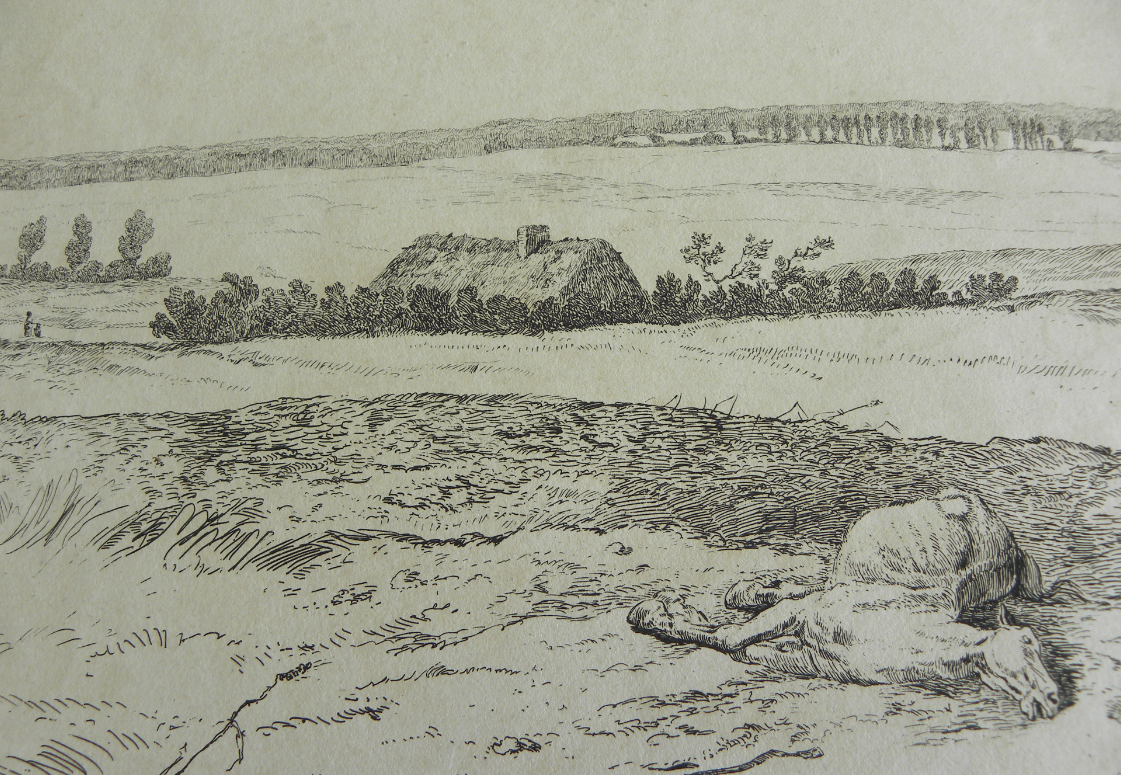
Part of the distant Forest of Soigne on the site of battle. In part No.7. of the panorama. (Coll-1101 – Barker Panorama of Waterloo, CRC)
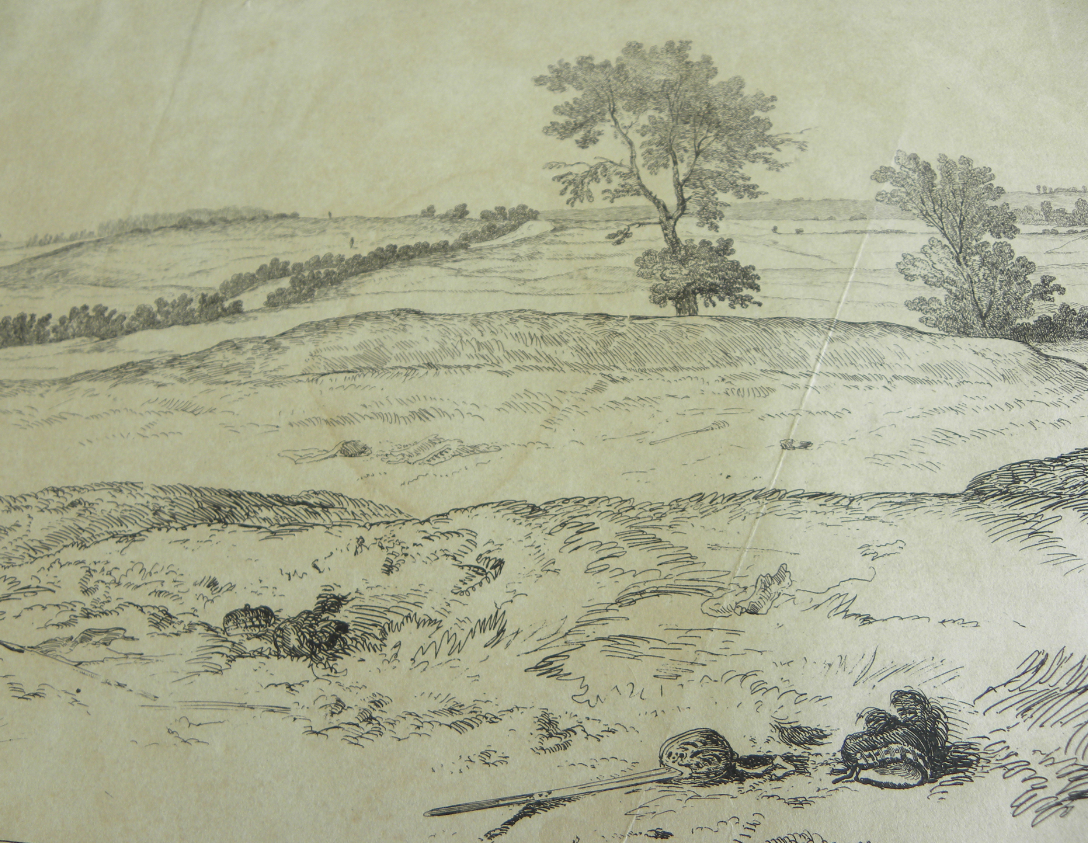
Scene showing personal effects on a part of the site ‘where the Highlanders suffered so severely’. In part No.8 of the panorama. (Coll-1101 – Barker Panorama of Waterloo)
So then… secondly… emphasising the human loss and injury… sketches and reports and case-notes of the wounded at Waterloo (Coll-535).
The wounds of French and Allied alike were described and reported on – as case-notes and sketches – by Dr John Thomson, Professor of Military Surgery at Edinburgh, and Dr William Somerville, the principal medical officer in Scotland. In the summer of 1814, Thomson had toured medical schools in France, Italy, Austria, Saxony, Prussia, Hanover and Holland, and in 1815 he was a staff-surgeon in Brabant and was at the Battle of Waterloo.
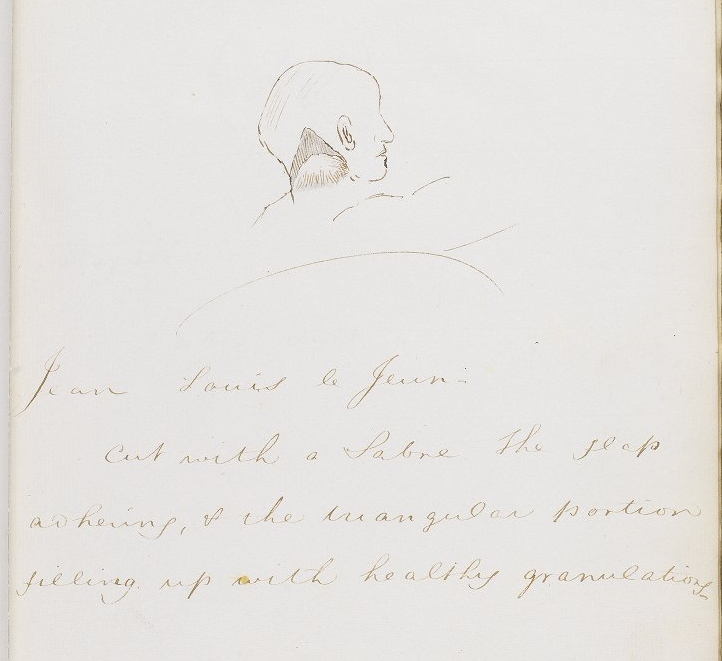
Wounds suffered by Jean Louis le Jeun who was cut with a sabre. (On p.21 of Gen.594, in Coll-535 – Collection of sketches and reports of wounded at the Battle of Waterloo, CRC)
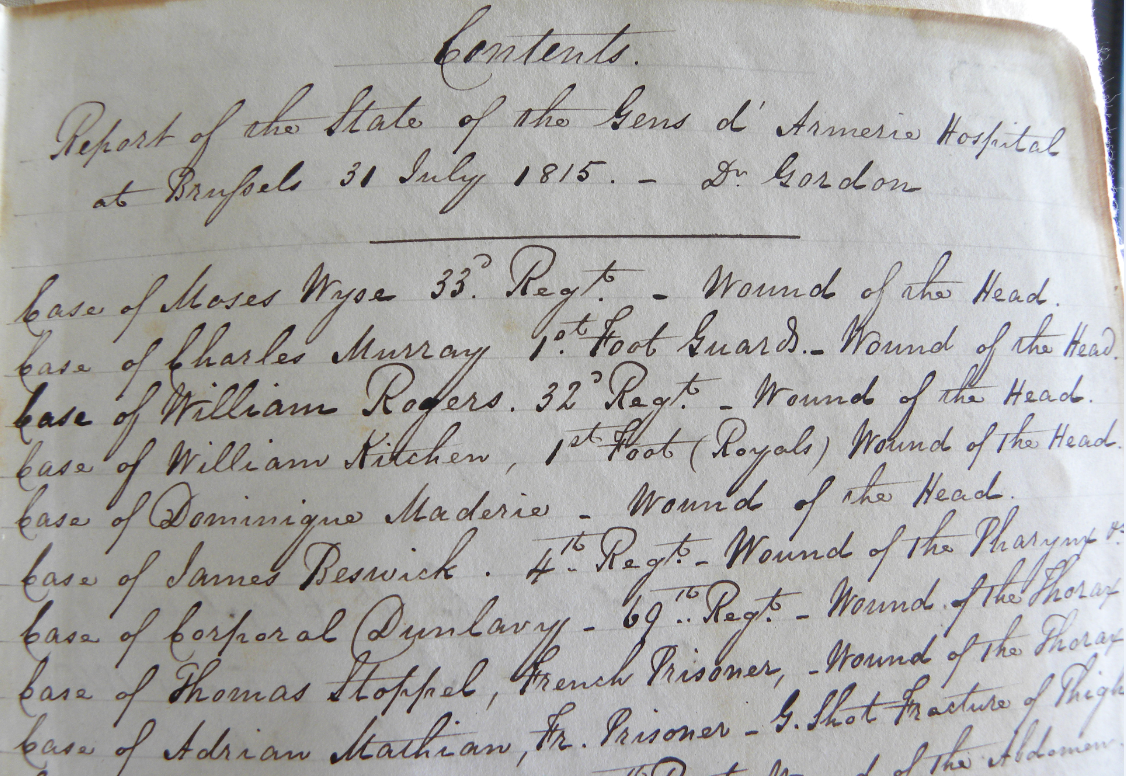
Contents pages at the beginning of the volume containing reports and cases at Gens d’Armerie Hospital in Brussels. (In the volume Gen.595, in Coll-535 – Collection of sketches and reports of wounded at the Battle of Waterloo, CRC)
The two-volume work profiled here was probably done in 1815. One also contains statistical tables of the wounded at the site – Reports cases and returns of the wounded at Waterloo (Gen. 595).

Index of the names of soldiers, description of wounds, and place of wounds, from the volume of sketches of the wounded. (In the volume Gen.594, in Coll-535 – Collection of sketches and reports of wounded at the Battle of Waterloo, CRC)
The other is illustrated with sketches of specific wounds of the soldiers, their names, their regiments, and details of their injuries – Sketches of the wounded at Waterloo. Drs. Thomson & Somerville (Gen. 594). Along with a number of other items both of the ‘Waterloo wounds’ volumes were transferred Edinburgh University Library from the Library of the Anatomical Museum, Edinburgh University, in June 1962.
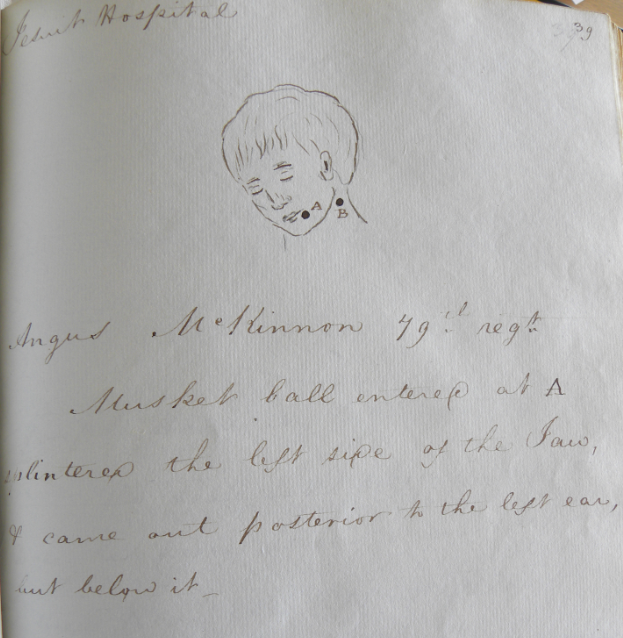
Description of the wounds suffered by Angus McKinnon (On p. 39 of Gen.594, in Coll-535 – Collection of sketches and reports of wounded at the Battle of Waterloo, CRC)
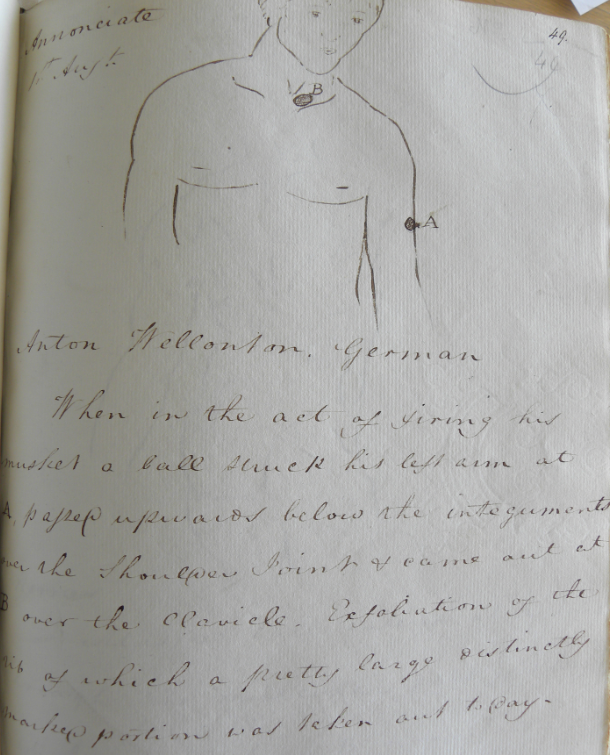
Description of the wounds suffered by Anton Wallenton (On p.49 of Gen.594, in Coll-535 – Collection of sketches and reports of wounded at the Battle of Waterloo, CRC)
The sketches show the kind of sabre wounds suffered by Etienne Gerarghier and Jean Louis le Jeun, and also wounds caused by firearms and cannon… e.g. the musket-ball wounds of Angus McKinnon, 79th Regiment, and the accidental wound of the German soldier Anton Wellonton. The sketches show the entry points at ‘A’ and the exit points at ‘B’.
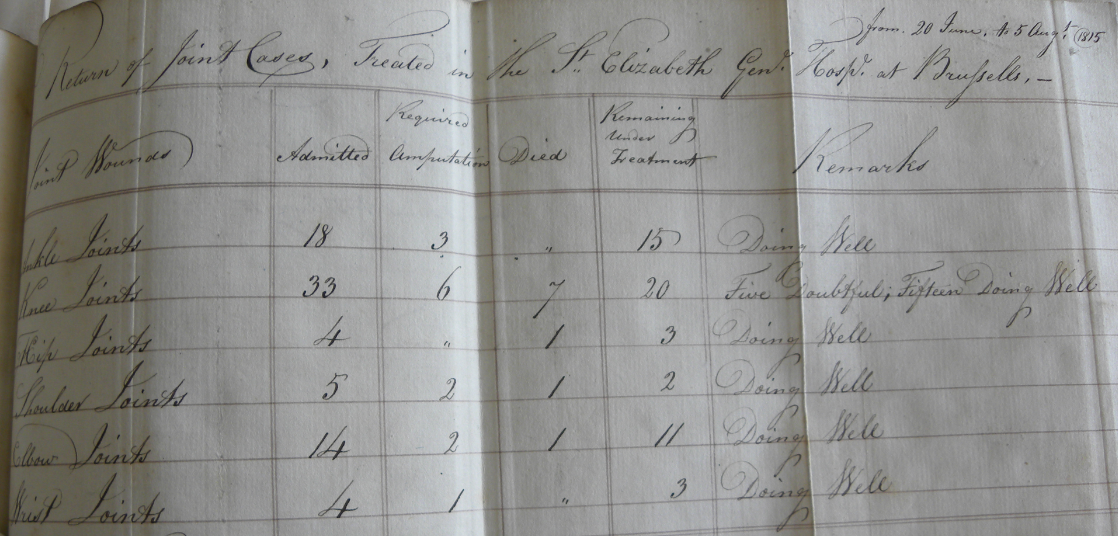
Return for joint cases treated at the St. Elisabeth General Hospital, Brussels, from 20 June to 5 August 1815. (From volume known as Gen.595, in Coll-535 – Collection of sketches and reports of wounded at the Battle of Waterloo, CRC))
In addition to the work of Thomson and Somerville, reports in the volumes have also been written by: J. Gordon, Surgeon to the Forces in charge of Gens d’Armerie Hospital; Henry Home Blackadder; J. Cole, Surgeon to the Forces; W. Blick, Surgeon to the Forces; Roderick MacLeod, Hospital Assistant; Charles Collier, Surgeon to the Forces; and J. Roche, Surgeon to the Forces; and others. The sketches and reports are of cases in several of the hospitals accommodating the wounded around Brussels – these being the Jesuits’, the Annonciate, Gens d’Armerie, and St. Elisabeth – and in Antwerp, at the Corderie and the Facon.

Return of operations performed at the St. Elisabeth General Hospital, Brussels, 1 August 1815. (From volume known as Gen.595, in Coll-535 – Collection of sketches and reports of wounded at the Battle of Waterloo, CRC)
Today in 2015, the battle site of Waterloo is a popular attraction for visitors to Brussels and to Belgium generally. The site is dominated by the artificial Butte du Lion created in the 1820s in the earliest days of Waterloo tourism and before the founding of modern Belgium. The Butte du Lion is an artificial earth-mound topped by a large giant sculpted lion commemorating the location where William II of the Netherlands, Prince of Orange, was knocked from his horse by a musket-ball to the shoulder during the battle. Adjacent to the Butte and to the new tourist facilities built for the 200th anniversary, stands a panorama building offering a large vista of the events of 18 June 1815. The Waterloo panorama building was designed by Franz Van Ophem in 1911 for the then forthcoming 100th anniversary of the Battle. It houses a 360° panoramic oil-on-canvas painting completed by the French artist Louis-Jules Dumoulin in 1912.
Dr. Graeme D. Eddie, Assistant Librarian Archives & Manuscripts, Centre for Research Collections
This blog post was compiled with the help of some information contained on pp.307-308 of The Edinburgh professoriate 1790-1826 and the University’s contribution to nineteenth century British society. Anand Chidamber Chitnis. Ph.D. 1968. Edinburgh… and also on pp.39-50 of ‘British Medical Arrangements during the Waterloo Campaign’, by Colonel H. A. L. Howell, in Proceedings of the Royal Society of Medicine. (Sect. Hist. Med.). 1924 (17).
Ministry and medicine
Today we’re welcoming a group from the EAHIL + ICAHIS + ICLC 2015 Workshop to New College Library. The Workshop is a collaboration between the European Association for Health Information and Libraries (EAHIL), the International Conference of Animal Health Information Specialists (ICAHIS) and the International Clinical Librarian Conference (ICLC). Along with a tour of the library we have brought out some Special Collections items on a medical theme to display.

Avicenna, 980-1037. Liber Avicenna. Venice : 1500. New College Library Inc. 22
This is a detail from Liber Avicenna, a work from the Incunabula Collection. Avicenna was a Persian scholar whose medical texts became standard works at medieval universities.

Piperno, Pietro. De effectibus magicis libri sex … Naples : 1647. New College Library TR.395
Part of the TR Collection currently being catalogued as part of the Funk Projects, De effectibus magicis libri sex is a seventeenth century work on medicine, magic and the occult.

Sibbald, Robert. Scotia illustrata, sive, Prodromus historiae naturalis … Edinburgh : 1684. New College Library DPL 9
Robert Sibbald was an Edinburgh physician and later the first professor of medicine at the University of Edinburgh. This work, Scotia illustrata, is a descriptive regional guide to Scotland’s natural history, with reference to the health of the inhabitants of each region. It once belonged to another doctor, Dr John Hutton, who was court physician at the court of William and Mary. He gifted his library to the Presbytery of Dumfries, from where it came to New College Library where it is now part of the Dumfries Presbytery Library.
Christine Love-Rodgers, Academic Support Librarian – Divinity
Christ or Confucius, Which?
Christ or Confucius, Which? is just one of the book titles now on display in New College Library, in honour of the conference being held on James Legge and Scottish Missions to China at New College on 11-13 June 2015.

Macgowan, John. Christ or Confucius, Which? Or, the story of the Amoy Mission. London : London Missionary Society, 1889. New College Library sMR 5 McG

Henry, B.C. The Cross and the Dragon ; or, Light in the Broad East. London: S.W. Partridge & Co, 1885. New College Library sMR 5 Hen
The authors of these works were contemporaries of James Legge (1815-1897), who was a missionary and scholar of Chinese. He became Principal of the Anglo-Chinese College in Malacca established in 1818 by the pioneering protestant missionary Robert Morrison (1782–1834). In 1842 he was put in charge of the London Missionary Society’s mission house in Hong Kong where he spent a third of his life. He became an accomplished translator of Chinese Classical texts. Returning home to Scotland in 1873, he then took up the newly endowed chair of Chinese at Oxford University. Many editions of his works are held in the University of Edinburgh Library, with several at New College Library.

Legge, James. The notions of the Chinese concerning God and spirits : with an examination of the defense of an essay, on the proper rendering of the words Elohim and Theos, into the Chinese language, by William J. Boone … / Hongkong : Printed at the “Hongkong Register” office, 1852. New College Library Z.1763

Legge, James. The sacred books of China : the texts of Confucianism / Part 1, The Shû King The religious portions of the Shih King The Hsiâo King.
Oxford : Clarendon, 1899. New College Library C2/a4
Christine Love-Rodgers, Academic Support Librarian – Divinity
ScienceDirect website down
The ScienceDirect website is currently unavailable due to an outage. Elsevier are aware of the issue and are urgently working to restore access to their website.
ACCESS RESTORED
E-Resources Access Alert – EZProxy downtime
Access to E-Resources using EZProxy will be unavailable on Tuesday 9th June between 8.30am and 9.30am followed by a further 1 hour at risk period. This is to allow our EZProxy service to be upgraded and improve off campus access to our e-resources.
Please see http://edin.ac/1bjVuCC for details of how to access E-Resources during this time. Further updates may also appear on the IS Alerts page http://reports.is.ed.ac.uk/alerts/.
We apologise for any inconvenience during this time.
Rare Mass for the Dead from the MH Collection
A guest post from Paul Nicholas, Funk Projects Cataloguer

Missae defunctorum, iuxta usum Ecclesiae Romanae, cum ordine et canone extensae. Tulli Leucorum : Ex officina Ioannis Laurentii, et Ioannis Francisci Laurentii, typographorum Regiorum & Episcopalium, MDCLXXI. New College Library MH.83.
We were delighted this week to discover a rare Mass for the Dead in the MH Collection at New College Library. This folio volume is a Roman Catholic priest’s ‘handbook’ published in 1671 and intended to be used during a ceremonial mass for the dead. The printed text in black would be spoken out loud, the text printed in red forms ceremonial instructions for the priest. The musical notation shows Gregorian chant, scripted in square notation.

At the time of writing, we have not identified another copy of this item in any of the bibliographic databases of the world’s library collections – so we are hoping it may be unique! This item was catalogued as part of the Funk Cataloguing Projects at New College Library.
 Paul Nicholas – Funk Projects Cataloguer
With thanks to Elizabeth Lawrence, Assistant Rare Books Librarian
Collections
 Hill and Adamson Collection: an insight into Edinburgh’s past
My name is Phoebe Kirkland, I am an MSc East Asian Studies student, and for...
Cataloguing the private papers of Archibald Hunter Campbell: A Journey Through Correspondence
My name is Pauline Vincent, I am a student in my last year of a...
Hill and Adamson Collection: an insight into Edinburgh’s past
My name is Phoebe Kirkland, I am an MSc East Asian Studies student, and for...
Cataloguing the private papers of Archibald Hunter Campbell: A Journey Through Correspondence
My name is Pauline Vincent, I am a student in my last year of a...
Projects
Cataloguing the private papers of Archibald Hunter Campbell: A Journey Through Correspondence
My name is Pauline Vincent, I am a student in my last year of a...
Archival Provenance Research Project: Lishan’s Experience
Presentation My name is Lishan Zou, I am a fourth year History and Politics student....