Home University of Edinburgh Library Essentials
April 7, 2026
Cataloguing on Alma

Since Alma go-live on Monday June 29th, the Metadata Team have been working with colleagues in Acquisitions Services and Electronic Resources to develop new, streamlined workflows for managing new acquisitions. Alma treats the acquisition and cataloguing of new resources as a single integrated process and allows staff to assign records to each other and generate work lists within the system.
To date, we have workflows in place for new print acquisitions, with ongoing work to develop procedures for managing individual e-book purchases and subscription based packages. Although workflow development required access to the full live system and migrated metadata, the cataloguing of donated material was possible as soon as Alma was up and running on June 29th. The first new catalogue record on Alma was created by Alason Roberts (pictured) for: Catalogue des peintures, dessins, cartons, aquarelles exposés dans des galeries du Musée Gustave Moreau, Paris.
Alasdair MacDonald
Metadata Co-ordinator
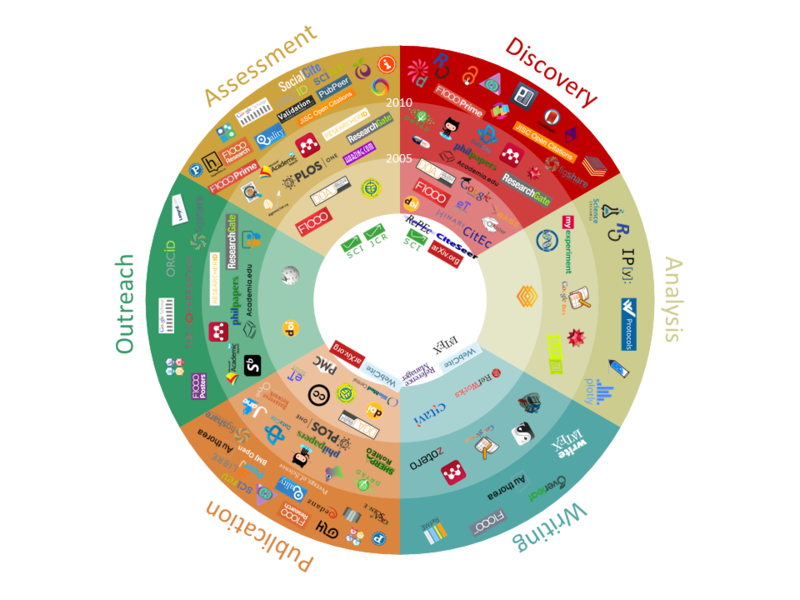
Finding, managing, writing and sharing research – what tools do you use?

Do you use Google Drive or Word? Mendeley or Endnote? Google Scholar or Scopus? Open access or traditional journals? ResearchGate or repositories?
New tools are constantly being developed, as reflected in the list of 400+ scholarly communication tools (http://bit.ly/innoscholcomm-list).
Help us understand your current workflows and the tools you use for scholarly and research activities at University of Edinburgh by completing this survey, created by researchers at the University of Utrecht. The survey is aimed at anyone carrying out research (from Master’s students to professors), or supporting research (such as librarians, publishers and funders).
Survey link: https://innoscholcomm.typeform.com/to/Csvr7b?source=4u4O0E
(this link is only intended for University of Edinburgh: please don’t distribute it further. If you want to share the survey with someone outside UoE, please use the generic link https://101innovations.wordpress.com/)
The survey is easy and fun to fill it out by just clicking the tools you use. It takes 8-12 minutes to complete and you can opt to receive a visual characterization of your workflow compared to that of your peer group
The survey will run until February 2016.
Preliminary results
Preliminary results have been published: https://101innovations.wordpress.com/
On this site, you can also find background information on the survey. Eventually all (thoroughly anonymised) will be made publicly available.
The Utrecht University Library researchers behind this survey
- Bianca Kramer @MsPhelps b.m.r.kramer@uu.nl
- Jeroen Bosman @jeroenbosman j.bosman@uu.nl
Hawick and Roxburghshire, February 1915: On a war footing…
THE HAWICK EXPRESS & ADVERTISER AND ROXBURGHSHIRE GAZETTE, 5 FEBRUARY 1915
 Known by other earlier titles, the Hawick Express and Advertiser and Roxburghshire Gazette would later on become absorbed by the Southern Reporter.

Call for men for the 4th K.O.S.B., reported in the ‘Hawick Express & Advertiser and Roxburghshire Gazette’ on p.2. (Sarolea Collection 80, Coll-15).
In the wider world by Friday 5 February 1915, when this particular issue of the Hawick local paper was distributed, Turkish forces had just reached the Suez Canal after crossing the Sinai Desert and were engaging British troops, the Turkish forces had also recently attacked Aden (now in Yemen), the German government had announced that they would begin a blockade of Britain on 18 February, and the British, French and Russian governments had announced that agreement had been reached on pooling their financial resources.
The war was becoming a truly World War, with Eastern and Western Fronts, and a Middle Eastern theatre of war.
So it was then that on 5 February, the Hawick Express and Advertiser and Roxburghshire Gazette reported that the 4th King’s Own Scottish Borderers (K.O.S.B.) needed 200 more soldiers. ‘There are hundreds of Young Men on the Borders who have not yet answered the call’, the notice stated.
MIMEd abroad! Two members of the MIMEd staff travel to Boston to spread the news about the SCH redevelopment.
In June, Jonathan Santa Maria Bouquet and Sarah Deters travelled to Boston to attend the 44th Annual Meeting of the American Musical Instrument Society (AMIS) Conference, hosted by the musical instrument department of the Museum of Fine Arts. AMIS is one of the most important conferences in the field of organology and the annual conference brings together researchers, museum professionals, and collectors from across the world to gather and discuss the latest advancements and discoveries in organology.

Professor Donaldson throws a party when he is appointed the Chair of Music.
Read More
Last day
Today is my final day working with the William Ronald Dodds Fairbairn Archive, as my six-month, Wellcome Trust funded post comes to an end.
The main aim of my post was to reorganise and then catalogue the archive, in advance of associated conservation work, so that the records can be made available via a new website, created and hosted by the University of Edinburgh, our Fairbairn Project partners. I am delighted to be able to say this work is now almost complete and the records will be available to researchers when the website goes live later this year.
Since I am not a researcher, and this is not a scholarly article, I thought I might share some of my non-scientific interpretations of Fairbairn, as gleaned through his extant papers.
The vast majority of the papers in Fairbairn’s archive relate to his profession. This includes manuscripts and offprints for over 70 articles and lectures written by Fairbairn, some of which appear never to have been published. There are about as many reviews, written by Fairbairn, of the works of other authors, and a collection of offprints Fairbairn kept of the articles of others, which complement his library, held at Edinburgh University Library. As well as this, there are copious notes, in which Fairbairn seemingly poured forth his ceaseless thoughts, theories and re-conceptualisations (which seemed to come almost faster than he could write them down) of what psychoanalysis could be. And of course, there are the papers that relate to his private practice and his own self-analysis, including his dream drawings. All of this builds a picture, often remarked upon by those that knew him, of an extremely hard-working, focused and determined man who was almost entirely absorbed by his chosen field.
Indeed, for a time in the 1920s, Fairbairn appears to have become interested in graphology, and a friend, unidentified at this point, records what a practitioner made of a sample of Fairbairn’s own writing.

However, by comparison, the relatively small amount of more personal material in the archive offers glimpses into another aspect of Fairbairn’s personality. Here we see a more vulnerable and highly self-aware side to his personality, typically surrounded by his family in the photographs we have, but aware of the limitations of his own upbringing.

Here also is a man who records in his personal diaries his experience of the First World War – including his participation in the Battle of Jerusalem – partly captured in the crumpled, manuscript remains of a play Fairbairn had started to write based on his experiences of the Middle-Eastern front.

These same diaries reveal Fairbairn to us as a schoolboy, seemingly more interested in sport, particularly cricket, than in academia.
Fairbairn comes across as a meticulous, hard-working, kindly person, and as with all the people I have come to know through their papers, I only wish I had known him.
School’s in for Summer!
At the beginning of June I began working with the Moray House Archive at the CRC. It’s been a fantastic collection to work with, as every box I have opened has contained something new and presented different conservation problems.
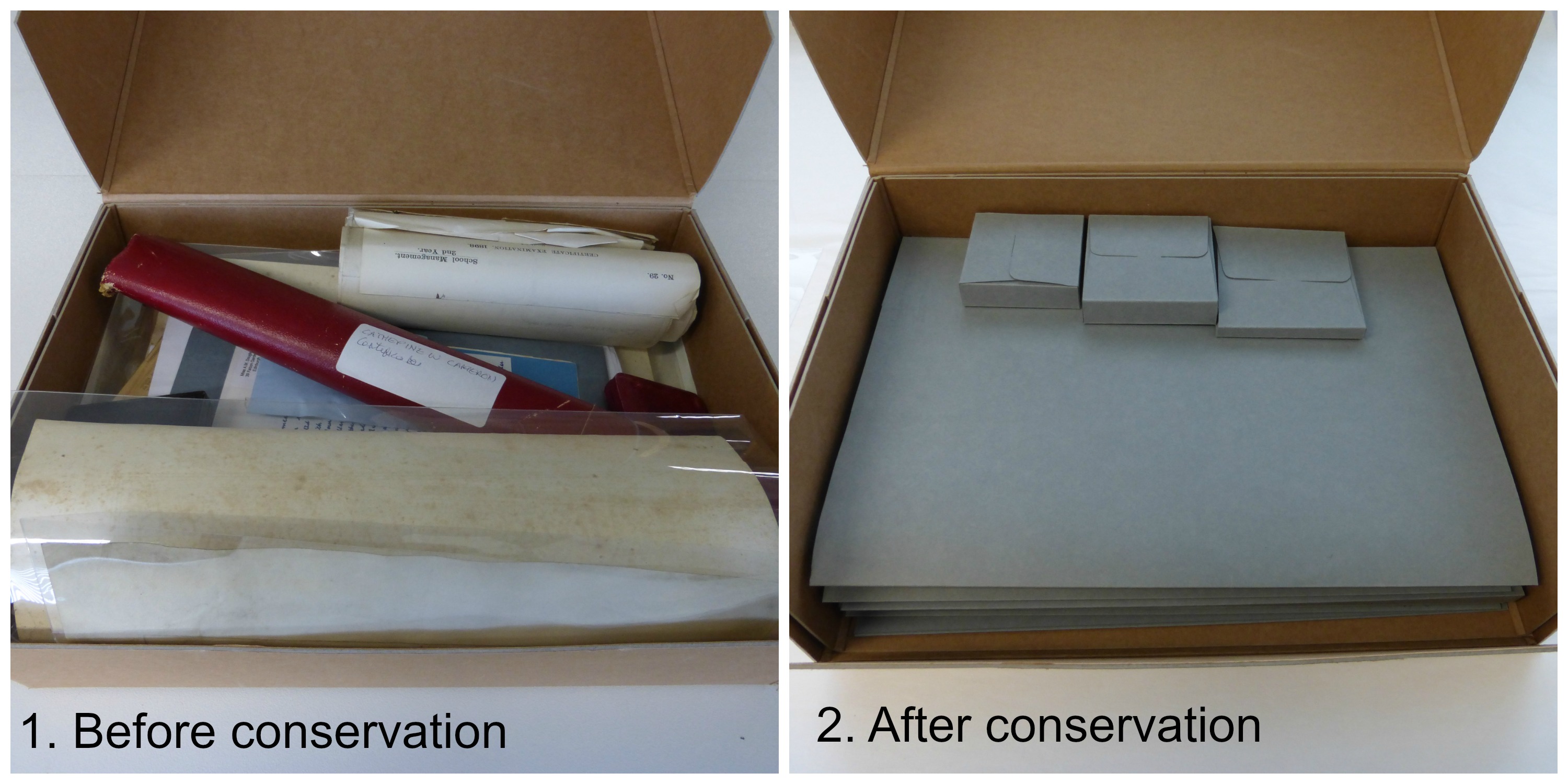
A box from the Moray House Archive, before and after conservation
My favourite so far has been a box containing craft work donations. It held five needlework samples, a cotton dress and an embroidery piece. The needlework samples were mounted on a piece of faux leather, which had been rolled tight and stiffened over time, so that it was difficult to view. Since these items were relatively small, I decided it would be best to store them flat so reduce excessive handling of the samples which could lead to further damage.

Box of craft work donations
First the samples needed to be flattened as they had a tendency to curl at the edges. To do this, I carefully held the corners down with glass weights and left them overnight, after which they remained flat by themselves.

Needlework sample, rolled before conservation
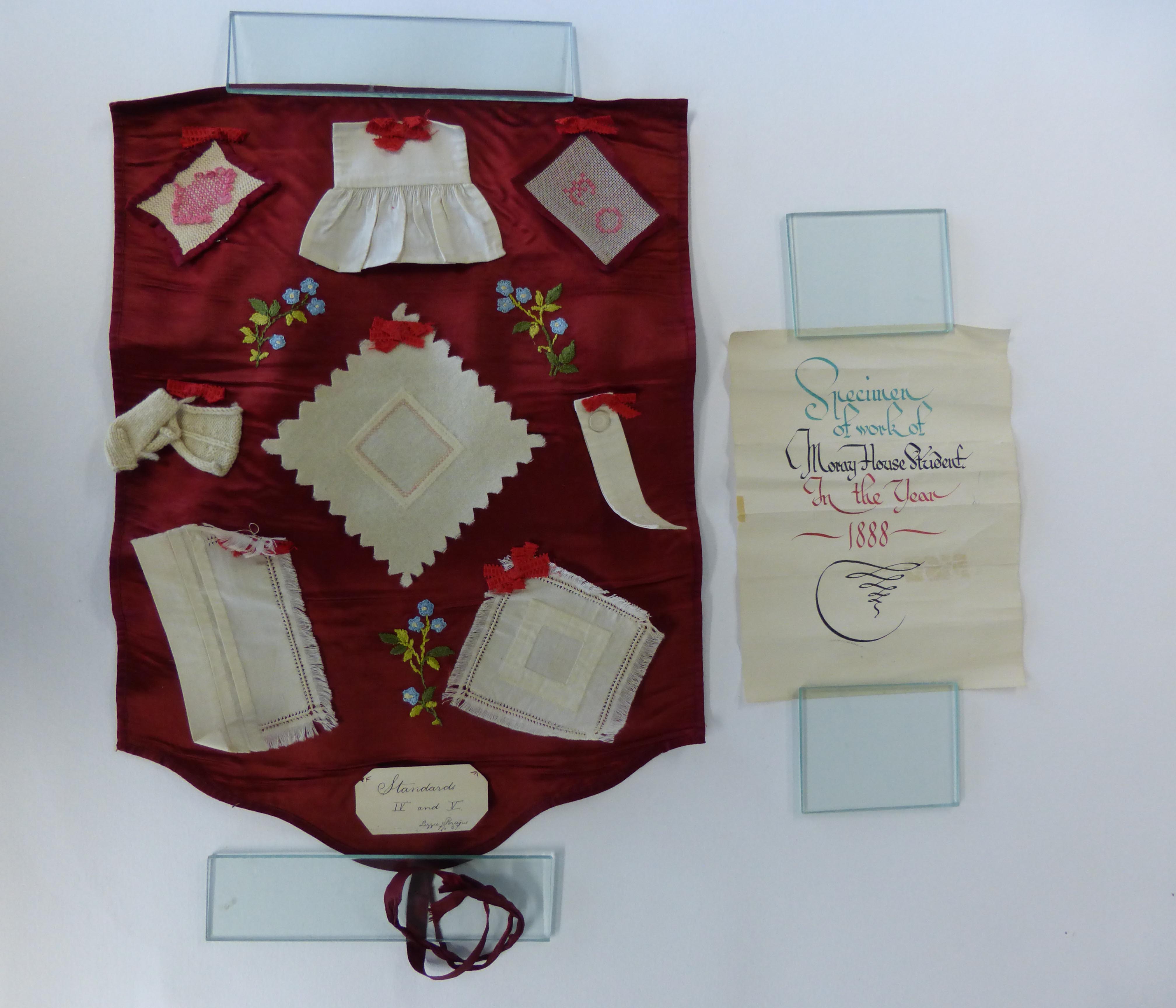
Needlework sample held down with glass weights to flatten
I then made a bespoke folder for each item. The folders were made from unbuffered mount board, with a domette and calico cotton layer to provide cushioned support for the samples. The edges were built up using strips of mount board and sealed with linen tape. The cushioned support can be made for the upper and lower side of the folder so that the items can be closed, flipped over, and then opened up again to view the back, without touching the item at all.
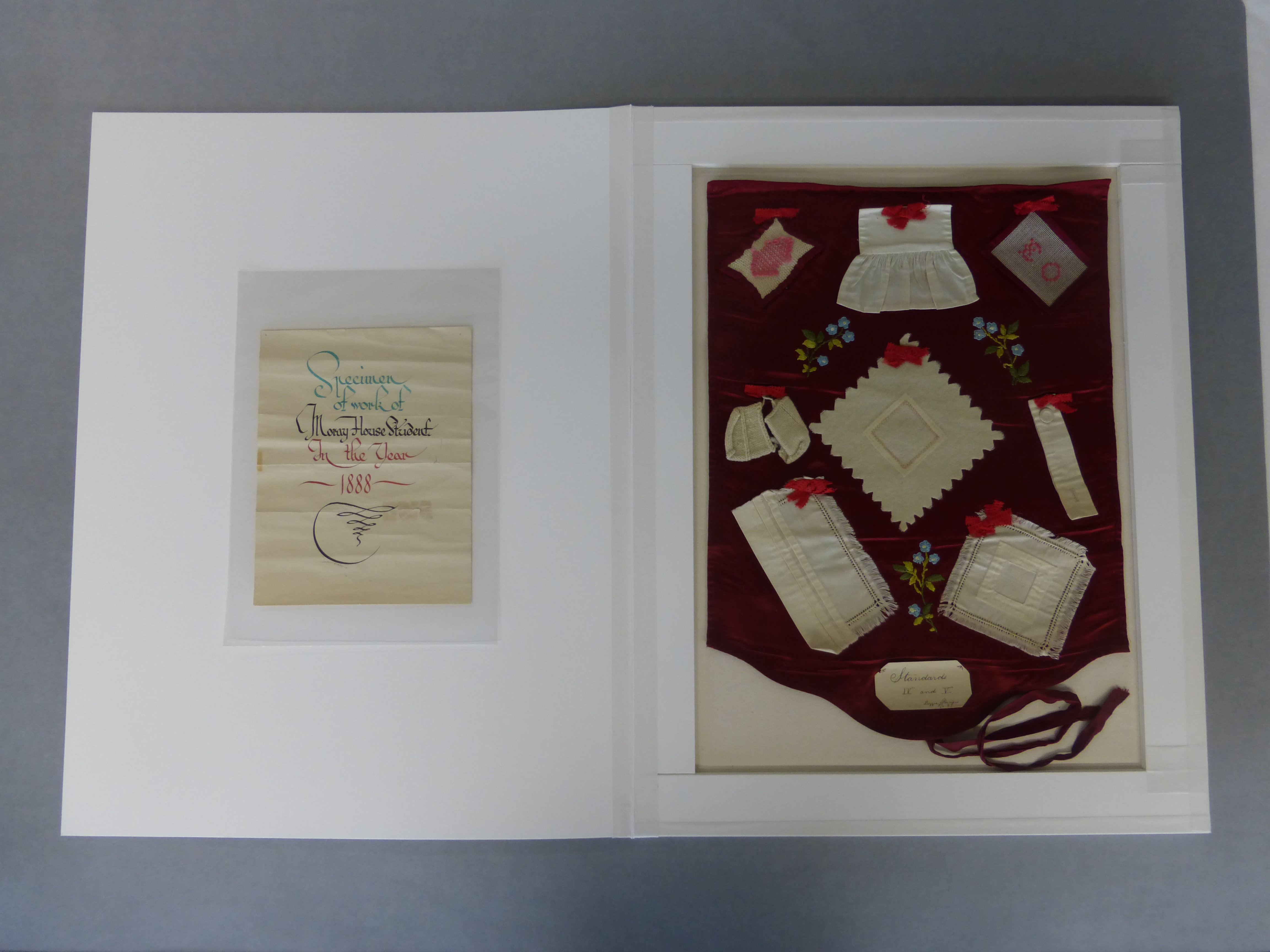
Needlework sample in bespoke folder, after conservation
This new housing will prolong the life of these textiles and provide an easy way for them to be displayed in the future.
As a part of my time working with the archives collections, I have also hosted two conservation workshops for CRC staff. In the first workshop, I described basic conservation techniques that archivists could use at their desk to improve the condition of the collection. During the session staff had a go at surface cleaning, removing metal fasteners (staples and paper clips) and rehousing techniques such as making a book shoe. The second session focused on the using archival material in outreach workshops. I described ways of protecting objects when using them with groups of people and also how to present them in ways to avoid excessive handling.
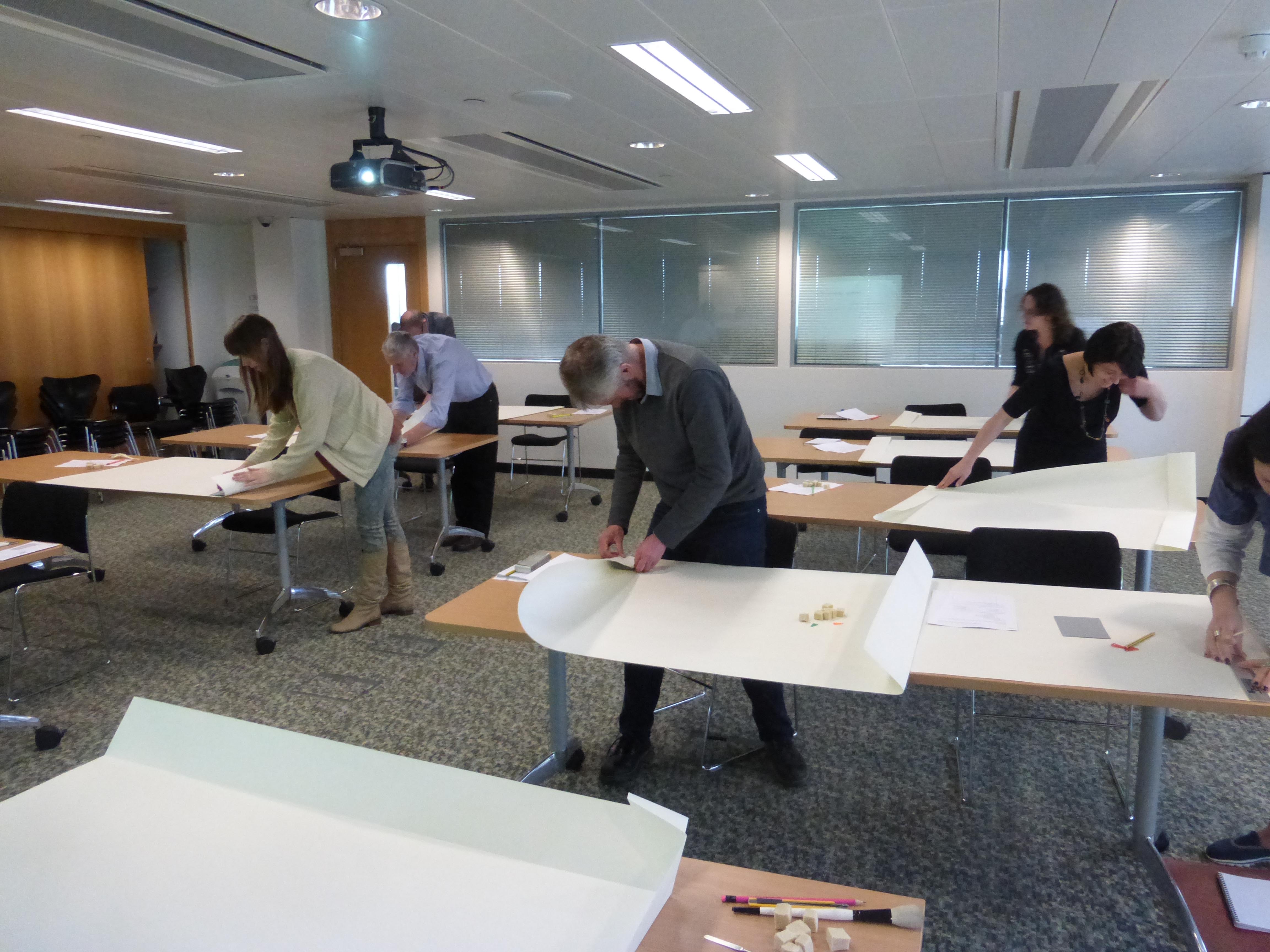
‘Conservation for Archivists’ workshop
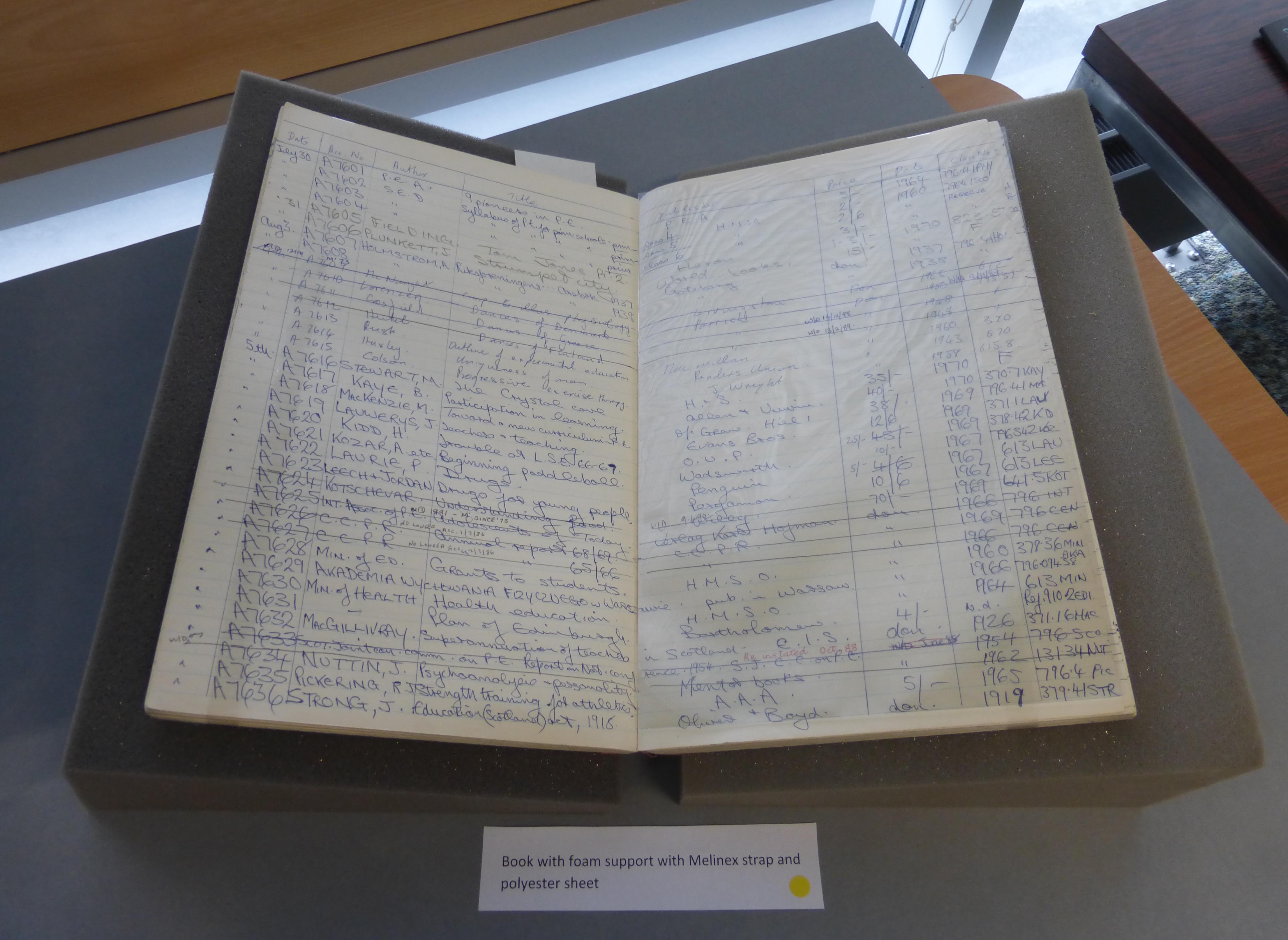
‘Use and Display of Archival Materials’ workshop
I have really enjoyed working with this collection. The diversity of objects and the range of activities involved have been very interesting. Throughout the collection there are humorous and curious items that have always made me smile when working through the shelves. I’ll leave you with a couple of my favourite to enjoy!

Sick note from the Moray House Archive

Exam paper from the Moray House Archive
Emily Hick
Project Conservator
Do it like they do on the DiscoverEd channel

DiscoverED, the University of Edinburgh’s new one step information, discovery and delivery service, is now on-line and fully operational. You can request Library Annexe items using the new service; all you have to do is sign in and find the items using the search bar. As well as books, DiscoverEd will search ebooks, ejournal articles and more.
The first request for a Library Annexe item was placed by non-other than our staff member Dominic Tate. Congrats Dominic, we know how important this is to you. [You will receive your diploma in the mail shortly.]
You can read all about DiscoverED at the links below.
Search for Library Annexe items and more
Marko Mlakar, Library Annexe Assistant
LUNA 7 goes live!
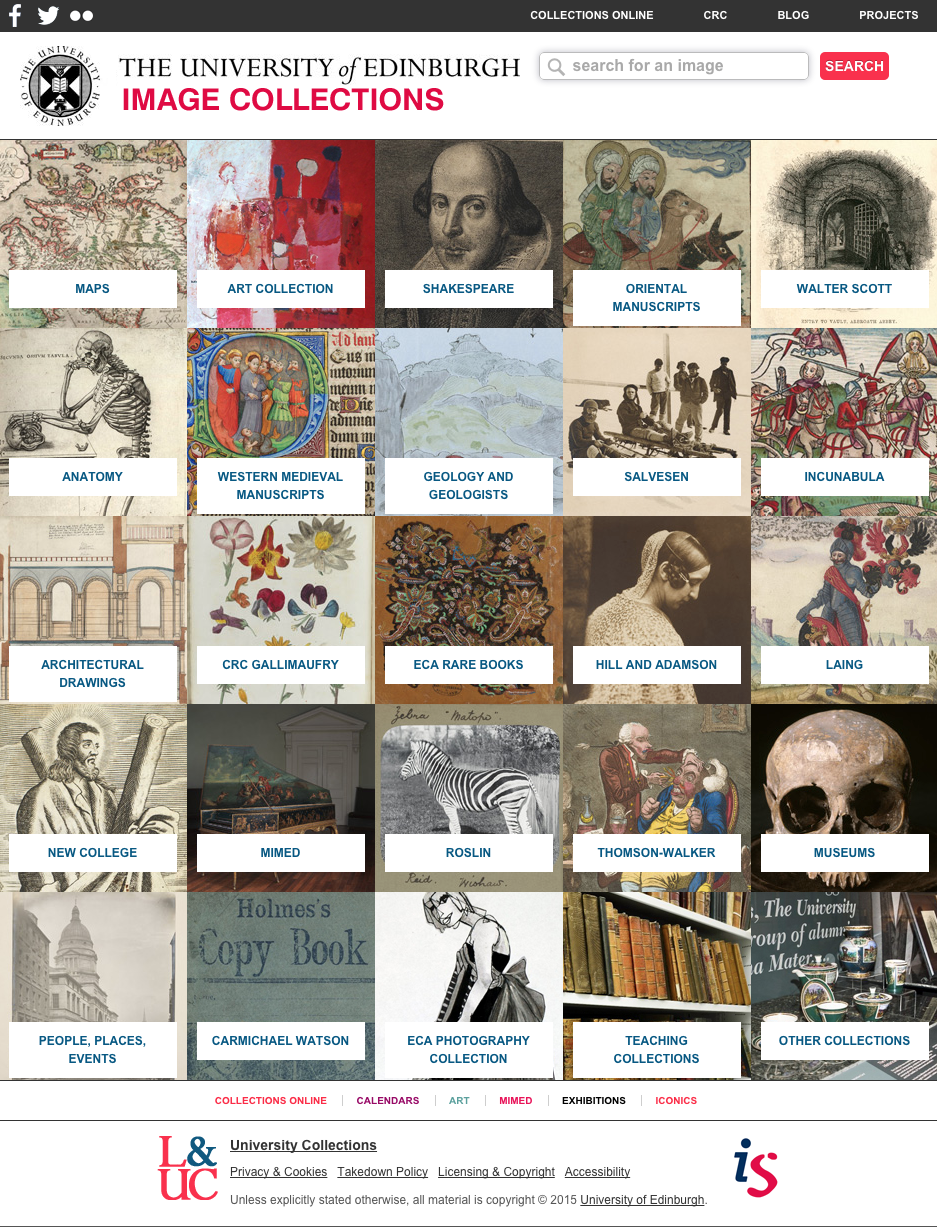 Our imaging platform (http://images.is.ed.ac.uk) has been given a keenly-awaited revamp with the upgrade to the LUNA 7 software. Those of you that are familiar with the old version may not notice much difference, as most of the changes are to the back-end of the product; for the photographers, though, it is a godsend, as the new system allows them to streamline their workflow in such a way that they can work with fewer applications, and do their own uploads to the front end with a frequency not previously possible. It should also give the front-desk staff in the CRC a way to search across all images- public and private- which is purely web-based, and thus allows multiple users to work concurrently.
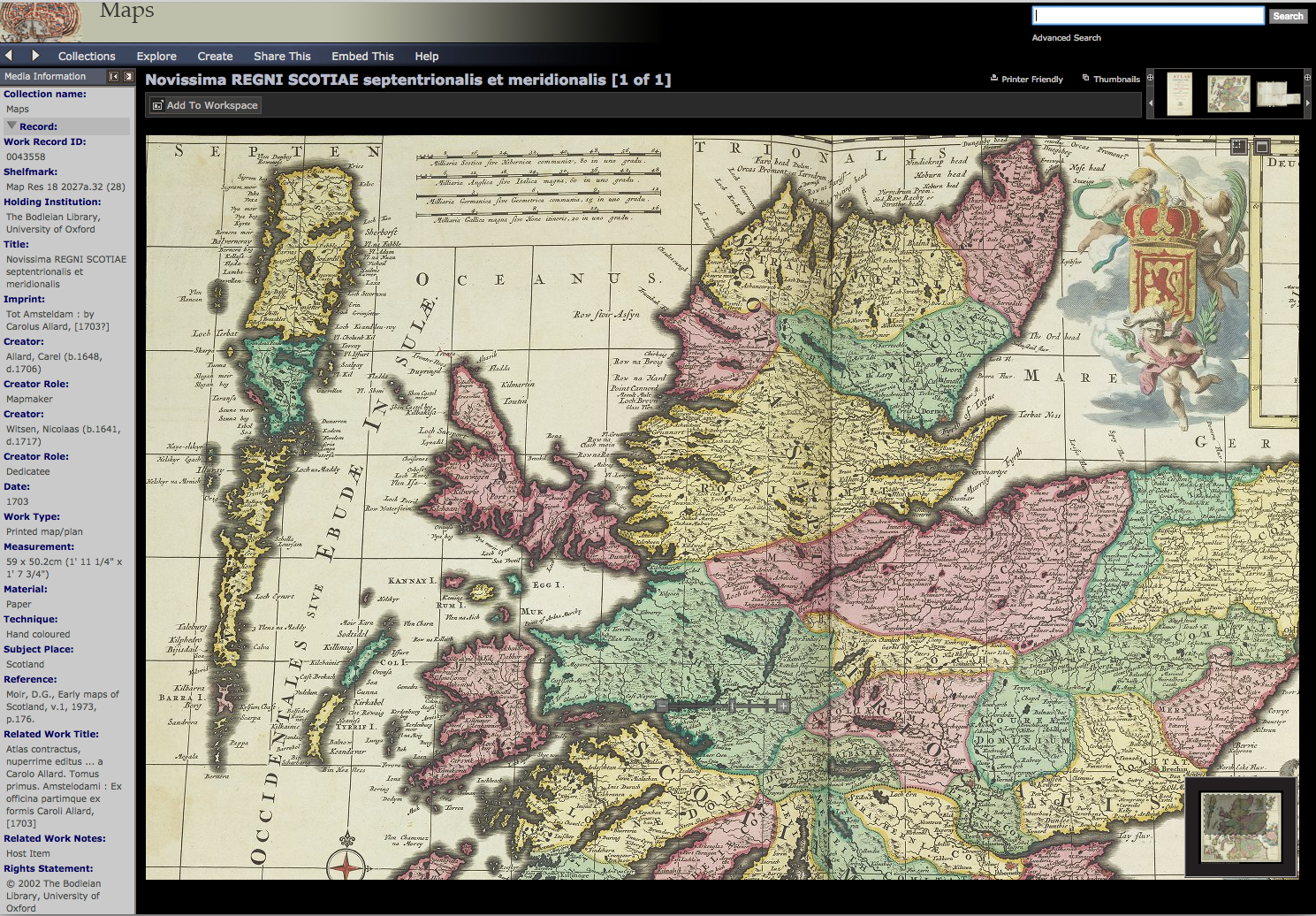
The front-end has had some work done to it- largely regarding our organisation of the collections. We’ve decided that the main LUNA site should only feature images we own, for access requests as well as more meaningful search results. This means that our teaching collections, and the Charting The Nation and Ars Anatomica project outputs have moved to a separate site (http://images-teaching.is.ed.ac.uk/luna/servlet), but we’ve kept our own material for these in the Maps and Anatomy collections, which will hopefully grow. We have also introduced 1760 images related to the recognised Carmichael Watson collection, and have developed “Museums”, where we’ll host Museums-related content which doesn’t belong in one of the larger museums sets (eg Fine Art, MIMEd).
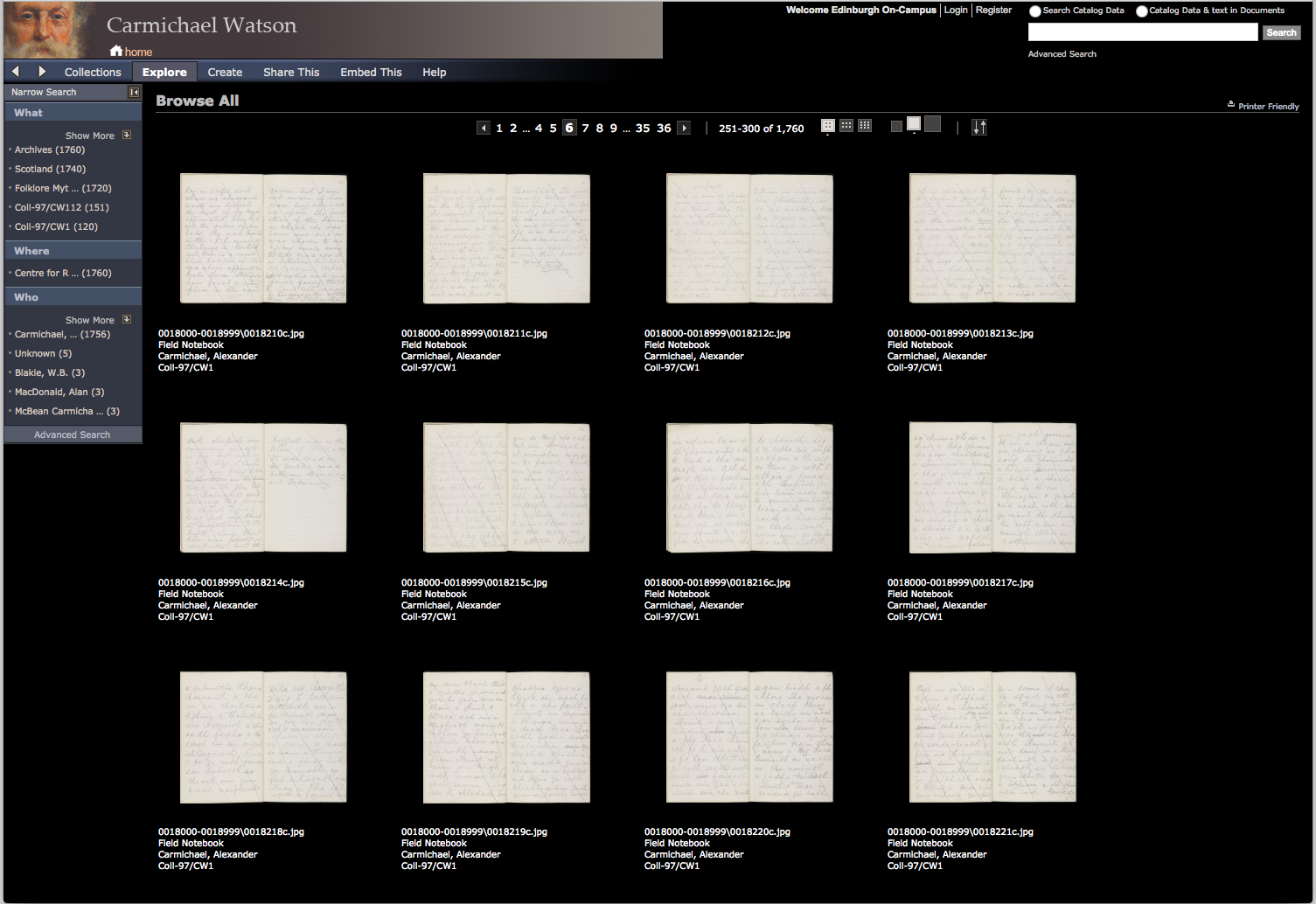
Please have a play with it, and if you have any feedback, don’t hesitate to let us know, at lddt@mlist.is.ed.ac.uk
Thanks to Susan, Claire, Norman, and everyone who’s given us any testing or infrastructure-related help, for their efforts on this!
Scott Renton- Digital Development
Analytics platform trial
Information Services is evaluating a new collaborative platform for data-science and analytics as part of its expanding portfolio of services for researchers. We are looking for researchers with suitable problems who expect to achieve results in the one-year trial. We will be able to work closely with a small number of projects to help them get the most out of the platform, and training will be available. In addition, we encourage further researchers to use the platform with less formal support.
The Aridhia AnalytiXagility Platform
AnalytiXagility is a purpose-built, user-friendly, collaborative platform for data science and analytics. It allows your team to easily create, discuss, modify and share analyses in a single, secure system accessed conveniently through a web browser.
The platform handles routine data management tasks such as confidentiality, availability, integrity and audit, reducing time to insight and discovery. In particular, it is ideally suited for:
- Exploring, comparing and linking structured datasets including data quality profiling
- Supporting data management, accountability and provenance
- Processing large datasets that do not fit in memory
Bring your team
Project members collaborate through a private workspace configured with compute, storage and analytical tools. Embedded social media tools allow teams to post and share questions, updates, comments and insights, building an active record of the research undertaken.
Bring your data
Users import their datasets using the secure and reliable file transfer mechanism, SFTP. Working files (documents, images, analysis scripts) can be uploaded directly through the web interface, and tagged for easy management and retrieval by the team.
Bring your analysis
AnalytiXagility provides an analysis platform, based on R, which can be accessed through a web browser. Combining R with an SQL database and an associated access library allows researchers to analyse their data in a faster and more scalable way than with R alone.
Generate your output
The platform supports generation of PDF reports for communication and publication using LaTeX templates, such as those provided by many leading journals, in which users can embed active analytical scripts to auto-generate images and tabular data within the report at runtime.
More information
If you are interested in participating in the trial, please email IS.Helpline@ed.ac.uk with the subject “XAP Trial”.
Further information can be found at:
- http://www.aridhia.com
- http://analytixagilitylab.com
- https://www.wiki.ed.ac.uk/display/ecdfwiki/Aridhia
Steve Thorn
Research Services
IT Infrastructure
A Life Cut Short: Stephanie’s Story
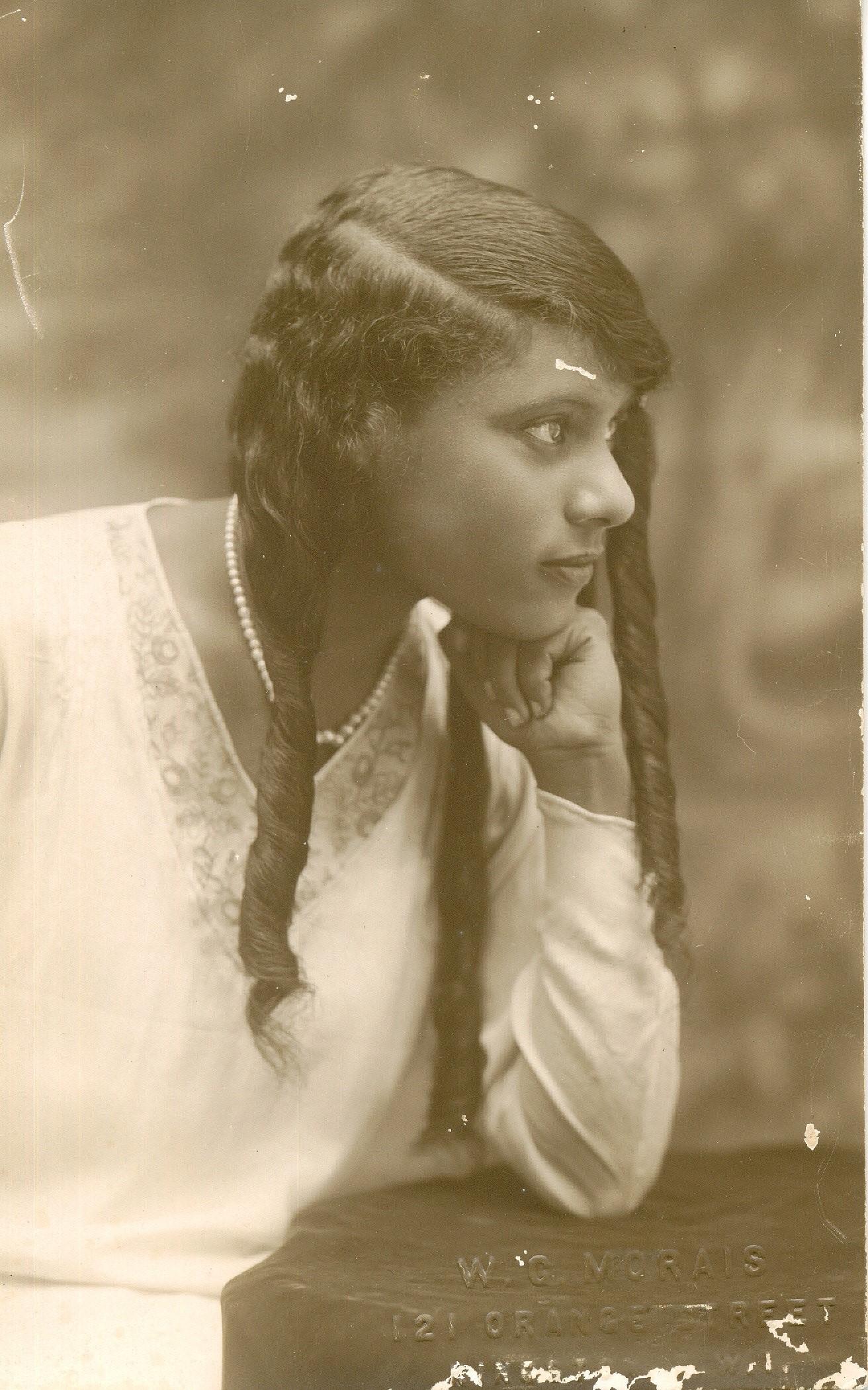
Stephanie (courtesy of Lauren McGregor)
In 1936, Julia Stephanie Evadne McGregor was in the final year of a five-year medical degree and showed all the signs of a highly motivated and conscientious student who would do well. In January 1936, she was admitted to the Royal Infirmary of Edinburgh, again in May and then June. She died on 4th July of rheumatic fever. On the anniversary of her death this year, the University is awarding a posthumous degree, with her family in attendance.
Stephanie (as she was known) was born in Gayle St. Mary, Jamaica on 9th April 1911, the daughter of Peter James McGregor and his wife Julianna Drucilla Marsh. She attended Wolmer’s Girls High School in Kingston, Jamaica from 1923-1929 and matriculated at the University of Edinburgh to study medicine in April 1931, having obtained her matriculation certificate at the University of London the previous August. On 21 October 1931 she registered as a student member of the General Medical Council.
Her first year of study saw her study under (amongst others) Professors James Hartley Asworth (Zoology), George Barger (Chemistry) and William Wright Smith (Botany), passing her first professional exams in 1932. In her second year her Professors were Edward Sharpey-Schafer (Physiology) and James Couper Brash (Anatomy). She passed her second professional exams in 1933.
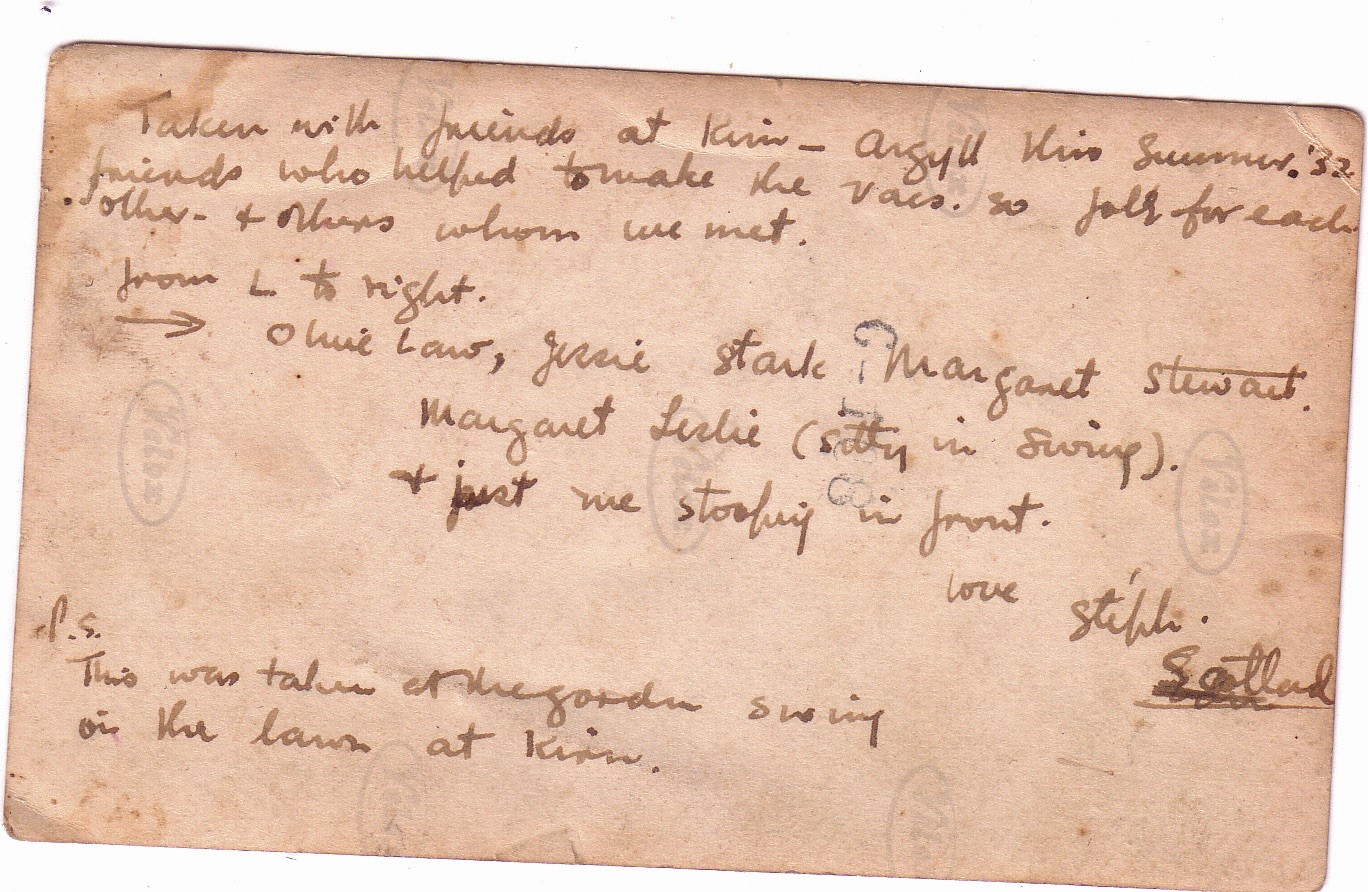
On holiday at Kirn, Argyll, 1932 (courtesy of Lauren McGregor)
In October 1933, Marjorie Rackstraw in her capacity as Adviser of Women Students, wrote to Professor Sir Sidney Smith, Dean of the Faculty of Medicine, informing him that Stephanie was in financial difficulties, having received no allowance since the previous August, due to her family being in financial difficulties themselves. As a result, she was able to gain an award of £25 from the Medical Bursaries Fund. By the following February, this plus money Stephanie had managed to raise elsewhere was once again exhausted and Miss Rackstraw wrote again to Prof. Smith to explore other options, specifically a loan
She described Stephanie as capable and sensible, “one of the best of her class and has gained merit certificates in four of her subjects and one prize in Botany”. The letter also recorded that Stephanie was planning to apply for a Vans Dunlop Scholarship and, “if the banana harvest is satisfactory she should be able to meet her expenditure during the next two years”. A further grant of £50 from the Medical Bursaries Fund was awarded.
Further troubles arose in late 1934. On 29th October Miss Rackstraw wrote again to Prof. Smith, explaining that Stephanie’s father had died a few weeks earlier, presenting more financial problems over and above dealing with the bereavement. She was to receive further small pots of money.
By 1935, Stephanie was living in Masson Hall of Residence, where Marjorie Rackstraw was warden. The building no longer exists, having been demolished in the 1960s to make way for the Main Library building. However there are extensive records, including photographs, and one that includes Stephanie survives.
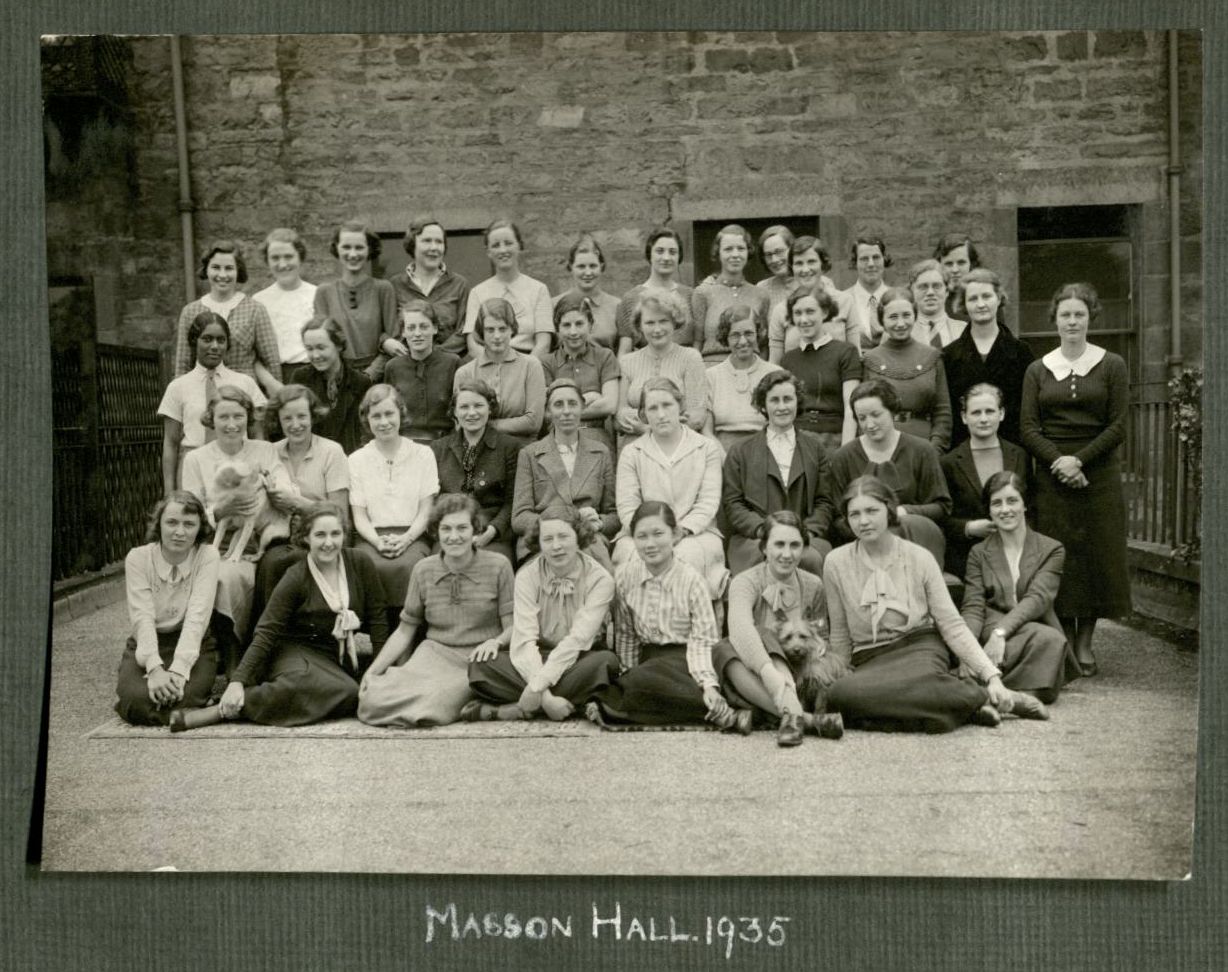
Group photograph of residents and others at Masson Hall of Residence, 1935
1936 did not start well for Stephanie. She fell ill on the 17th January and ended up in the Royal Infirmary but was let out after 15 days on the condition that she go away for convalescence. She went to say with a Mrs Corrigall at “Stromness, Kirn, Argyll”, but the ordeal journey there resulted in a week in bed and further time away from study. She wrote to Prof. Smith to explain her situation.
Mrs. Corrigall, with whom I am staying, called in her family Doctor and I have been under his care ….. I am still quite unfit to face classes and work ….. I am very troubled about my attendance and classes ….. This is the first time in the five years of my academic life, Sir, that I have for any reson or other been forced to miss my classes
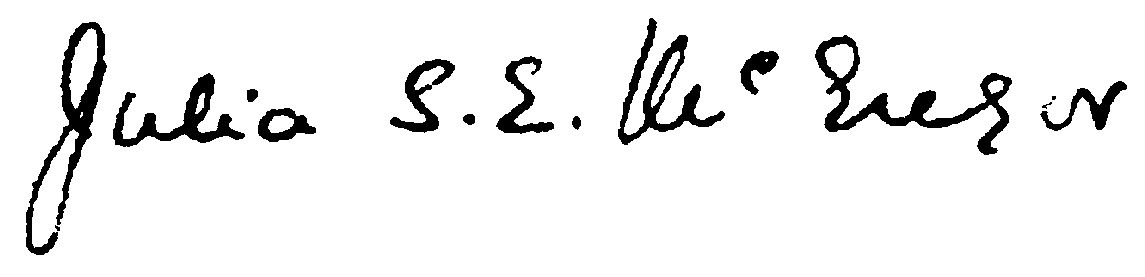
Signature, from letter in her student file
On 5 July 1936, Marjorie Rackstraw again wrote to Prof Smith but this time she was not looking for financial assistance. Instead she had the task of informing him that Stephanie had died the day before, a victim of “rheumatic fever following tonsillitis which affected her heart”. Her funeral was held at St. John’s Episcopal, where she had been a member of the congregation, and she was buried at Piershill Cemetery.
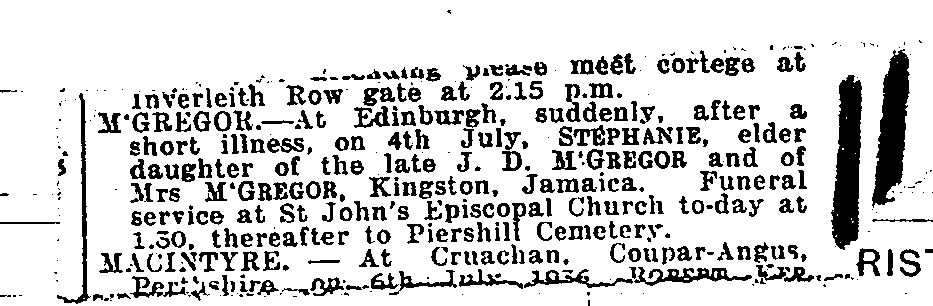
Funeral notice (copy from her student file)
Since the later 19th century, women students had been battling to gain parity with their male counterparts. It was not until the 1890s that women were able to matriculate as students and it was only in 1915 that they gained an equal status to men within the Faculty of Medicine. Even by the time Stephanie was studying, numbers of female students were very small compared to men, having only just edged over 10%. Had Stephanie graduated, she would have made up one of only 19 women who were awarded a degree of MBChB that year. Although she probably never saw herself as such, Stephanie can be seen as a contributor towards a major change within medical education, paving the way for those who followed.
At the graduation ceremony which takes place on 4th July 2015, coincidentally on the 79th anniversary of Stephanie’s death, the University of Edinburgh is awarding her a posthumous degree.
Collections
 Hill and Adamson Collection: an insight into Edinburgh’s past
My name is Phoebe Kirkland, I am an MSc East Asian Studies student, and for...
Cataloguing the private papers of Archibald Hunter Campbell: A Journey Through Correspondence
My name is Pauline Vincent, I am a student in my last year of a...
Hill and Adamson Collection: an insight into Edinburgh’s past
My name is Phoebe Kirkland, I am an MSc East Asian Studies student, and for...
Cataloguing the private papers of Archibald Hunter Campbell: A Journey Through Correspondence
My name is Pauline Vincent, I am a student in my last year of a...
Projects
Cataloguing the private papers of Archibald Hunter Campbell: A Journey Through Correspondence
My name is Pauline Vincent, I am a student in my last year of a...
Archival Provenance Research Project: Lishan’s Experience
Presentation My name is Lishan Zou, I am a fourth year History and Politics student....