Home University of Edinburgh Library Essentials
April 7, 2026
Project makeover
Now that the Data Vault project has received second round finding, we thought it was time for a makeover!
We’ve been working hard with our designers, and now have a project logo and URL:

Data Vault receives round 2 funding!
We’re pleased to announce that following the second round of project pitching in London on the 13th and 14th of July, the Data Vault project has been awarded further funding.
The first round of funding provided three months of effort, during which time the project developed a working proof of concept system that could archive and restore data. At the pitching session, team members demonstrated the prototype, and explained what would be achieved in the second round:
- Critical success factor: Deliver a first version of a complete data vault platform
- Implement the remaining requirements:
- Authentication and authorisation
- Integration with more storage options
- Management / monitoring interface
- Example interface to CRIS (PURE)
- Development of retention and review policy
- Scalability testing
- Two community engagement events (Manchester: 7th October, Edinburgh: 5th November)
We are grateful to Jisc for providing this second round of funding which will provide effort from August to November.
Second General Military Hospital, Craigleith
In this edition of Untold Stories, Louise (Archivist at Lothian Health Services Archive) looks at the history of one of the many military hospitals in our region:
During the current centenary of the First World War, LHSA has received a number of requests for records of patients in the many military hospitals in and around Edinburgh: from Red Cross auxiliary hospitals to specialist units and existing medical facilities that were requisitioned by the authorities. Due to the fact that medical records of service patients were returned to the custody of the Public Record Office in London (many of which were subsequently destroyed in a Second World War bombing raid), we are unable to help with these enquiries, even if we have custody of patient records generated by requisitioned local hospitals in peacetime. If you are researching the individual records of a forces’ patient or member of military medical staff, there are some resources that may help you at the end of the blog. However, LHSA holds a number of privately donated resources that uncover the realities of hospital life for First World War patients and medical staff alike, supplementing the ‘official’ military record.
One of Edinburgh’s military hospitals was the Second General Military Hospital, Craigleith. The hospital was run by a Territorial Unit, who requisitioned the hospital wing of the Craigleith Hospital and Poorhouse. The first patient was received as early as August 1914, and the hospital was handed back to Edinburgh Town Council in Spring 1919. When the Local Government (Scotland) Act (1929) came into force, control of poorhouses and poorlaw hospitals transferred to the municipal authorities. The poorhouse at Craigleith became an institution that is still very much alive today – the Western General Hospital (WGH).

Exterior of the Second General Military Hospital, Craigleith (GD28)
LHSA is lucky enough to hold a number of items that bring the days of the Second General Military Hospital more sharply into focus for researchers. In addition to his specialism of gastroenterology, WGH Consultant Dr Martin Eastwood was also a hospital historian – in 1995, a book on the development of the WGH was published, written by Eastwood and his secretary, Anne Jenkinson. The sources used by Dr Eastwood were donated to us in 2009, and form a largely visual collection on the history of the hospital, starting from its opening as a poorhouse in 1867.
Among Dr Eastwood’s donation was a photograph album from the Second General Military Hospital. We do not know who gave the album to Dr Eastwood, but its images give a unique insight into hospital life.

The Craigleith photograph album (GD28/8/1)
For example, we can see the operating theatre that was built for the new military patients, and used by the WGH up to 1950 (though hopefully conditions had moved on a bit by then!):

New operating theatre in action, c. 1914 (GD28/8/1)
The hospital was headed by Colonel Sir Joseph Fayrer and its clinical staff made up of Edinburgh doctors, many of whom had (or were to have) distinguished medical careers (such as neurologist Edwin Bramwell and pioneer of modern dentistry William Guy). Nurses were for the most part untrained – local women who were members of Voluntary Aid Detachments (VADs):


Nurses and male medical staff at Craigleith in the Eastwood album (GD28/8/1)
Recuperation was not always solely medical – the hospital laid on various activities in order to make the soldier patients’ time more pleasurable. We have evidence of this in surviving copies of the hospital magazine, the Craigleith Hospital Chronicle. You can see a complete edition on the LHSA website, here. The Chronicle was a monthly publication started in 1914 by Craigleith nurse Annie Paulin. The copies that LHSA hold show images of hospital life, patients and staff, publish informational pieces on Scottish regiments, tell of social occasions at the hospital, showcase story serials and commemorate major events in the war, such as the rail disaster at Quintinshill (Gretna), which claimed the lives of 216 Royal Scots soldiers and 12 civilians:
 Poem to the victims at Gretna, June 1915 edition (GD28/6/1)
The Chronicle also had a regular feature (cue plug for my last blog!) titled A Nurse’s Notes from Serbia written by ‘M.T.F’ (one of the infuriating things about trying to trace authors in this magazine is that many contributions were only signed by initials!). M.T.F wrote about life at the front as a Scottish Women’s Hospital nurse:
 Craigleith Hospital Chronicle, December 1915 (GD1/82/11)
If you’d like to guess the identity of M.T.F, the excellent nursing history website Scarlet Finders lists all Scottish Women’s Hospital nurses.
However, not all Chronicle articles took such a serious note. For example, comic poems and occasionally cartoons took a turn to supplement more ‘educative’ material:


Lighter material from the same December 1915 edition (GD1/82/11)
Unless patients signed articles or poems in the Chronicle, we have little idea of who they actually were from the material that we hold at LHSA. Fortunately, we do hold another piece of evidence in an autograph book created by Craigleith nurse Sister Ethel Miller from 1916 to 1919.
Rather than the celebrity signatures that fill autograph books of the modern day, these small volumes were passed from nurses to soldier patients on the wards, who contributed sketches, cartoons, anecdotes and poetry. Keeping these books appears to have been common practice for nurses, and many survive in archive collections across the United Kingdom (including this one in the National Museum of Scotland).
Born in 1888 in Edinburgh, Ethel was a professional nurse before the war, qualifying from the Royal Infirmary of Edinburgh School of Nursing and from the wartime Territorial Nursing Service in 1916. Along with photographs, printed material and nursing certificates, Ethel’s scrapbook was generously bequeathed to LHSA in 2012 by her son.
 Sister Ethel Miller (Acc12/025)
Sister Miller issued instructions to her potential contributors: according to a poem in the volume, she wanted ‘not just a name’, but ‘something else besides’, a more personal contribution from her charges in the form of a verse, a joke or a drawing. The result of her instructions is a fascinating insight into the often battle-scarred and weary ordinary ‘Tommy’ – we know that most contributors in the book were from the rank of private by the signatures after each drawing, poem or anecdote
Although not all of the completed pages are signed, there were at least 43 different contributors. The soldiers (for the contributors were largely from the army) wrote poems, limericks, drew original cartoons, traced published images with blotting papers and sketched regimental badges and front-line experience. Some praised the bravery of their regiment, as did Private A. Lane of the Kings Own Scottish Borderers in October 1916, which was ‘a credit to his friends and a terror to his foes’. However, the main themes of the book do not concentrate on heroism on the field of battle, but on war’s drudgery and the after effects of conflict, whether that was the domestic regimes of hospital life, reaction from civilians at home to returning war wounded (as new technologies of battle left maimed soldiers as physical reminders of the effects of war) and the misery of life in the trenches.


Cartoons from Ethel’s autograph book (Acc12/025)
In 2013, LHSA Research Intern Kirstin Cunningham saw the potential of Ethel Miller’s book for use in education, as an object that could bring the war directly to students through ordinary soldiers’ experiences. As a photography and film graduate, Kirstin painstakingly re-created the scrapbook page by page through digital imaging, fixing each image into a modern, similar sized book that she distressed to resemble its original. Soldiers’ stories can now be literally taken out of the archive, even if we will never know all of their names.
 Craigleith soldier patients at a concert in the recreation room (GD28/8/1)
Further resources on tracing military records from the First World War:
http://bit.ly/1NUdbde
http://bit.ly/1NUdrZR
http://www.scarletfinders.co.uk/125.html
http://bit.ly/1U6maz1
Elsevier E-Books – new titles available

We have added over 600 new Elsevier E-Books into DiscoverEd. These new titles cover most subject areas. A list of the new titles can be found here.
Further info
Further information about our e-books is available from http://www.ed.ac.uk/information-services/library-museum-gallery/finding-resources/ebooks
If a book you require is not held by the library, please visit our Library Resources Plus webpage.
Trial Access to Oxford International Encyclopedia of Peace
 We have trial access to the Oxford International Encyclopedia of Peace until 23/9/15.
This innovative and comprehensive encyclopedia charts the interdisciplinary field of peace studies from ancient times to the present day, offering a comprehensive survey of the full range of historical, political, theoretical and philosophical issues relating to peace and conflict. All major figures are covered, as well as major events, organizations, theories, and much more.
Feedback and further info
We are interested to know what you think of this e-resource as your comments influence purchase decisions so please do fill out our feedback form.
A list of all trials currently available to University of Edinburgh staff and students can be found on our trials webpage.
Foreign Office Files For China – extra collections now available!
We have recently purchased two extra collections within Foreign Office Files for China.
Foreign Office Files for China, 1949-1980: 1957-1966, The Great Leap Forward

Foreign Office Files for China, 1949-1980: 1967-1980, The Cultural Revolution

Further Info
Both of these collections are listed on our East Asian Studies A-Z list and History A-Z list as well as our main database A-Z list and DiscoverEd.
Chagall You Need is Love (and Conservation)
One of the most interesting parts of my job as the University’s Conservation Officer is working on the CRC’s exhibitions programme. Whether it be condition checking, installing works, framing and mounting exhibits or consulting on display conditions such as temperature, relative humidity and light, one thing I can be always sure of, is the work is always varied. Due to ever-changing nature of the exhibitions and exhibits, I can never be quite sure what will come through the doors of the conservation studio, which was certainly the case when assisting with the installation of the recent ‘…Something Blue’ exhibition.
As Emma Smith, Exhibitions Officer and curator of the exhibition explains “In spring of this year the University’s Special Collections presented a wide ranging exhibition in the Main Library Gallery, on the colour and concept of blue. This was a great opportunity for the various expertise within the department to come together to showcase the variety of the University’s collections. It was during one conversation with Dr Andy Grout, Honorary Research Fellow at the Centre for Research Collections, that the work of Russian born artist Marc Chagall (1887 – 1985) was first mentioned. “When I think of blue, I think of Marc Chagall.”
A simple search through the library catalogue http://collections.ed.ac.uk/art confirmed two holdings attributed to the artist in the University’s art collection. Abraham and Sarah (1956) and Rehab and the Spies of Jericho (1960) are colour lithographs from Chagall’s Bible Series which was first commissioned by the important French dealer Ambroise Vollard (1866 – 1939) in 1930. To include the work of such a prominent figure in the landscape of Modern art was to be an excellent addition to the exhibition, but then to discover through the photographic records of the works, that they were both washed in a beautiful rich shade of blue, was a delightful bonus!
Both works were hanging in a faraway corner of the University, and were found to both have the frames they were bought in when they were acquired by the university in the 1970s. Neither of which were ‘display ready’, and the decision was made to reframe the works and fit them with UV filter glass.”
The two Chagall lithographs were therefore passed to conservation to undertake this process. The first step was to remove the prints from their frames and window mounts, an important step due to the fact they remained as they had been when framed in the 1970s. The window mount, and the method by which the prints were hinged, were therefore likely to be of a poorer quality which can ultimately be the cause of long-term damage to the object. Acidity in poor quality materials has to potential to migrate to the collection items and cause discolouration and embrittlement and hasten their deterioration. It is therefore important that these issues are identified so action can be taken which, in this case, consisted of replacing the poor quality materials with acid-free mount board hinged with Japanese tissue and wheat starch paste, thus minimising the risk of any further deterioration.
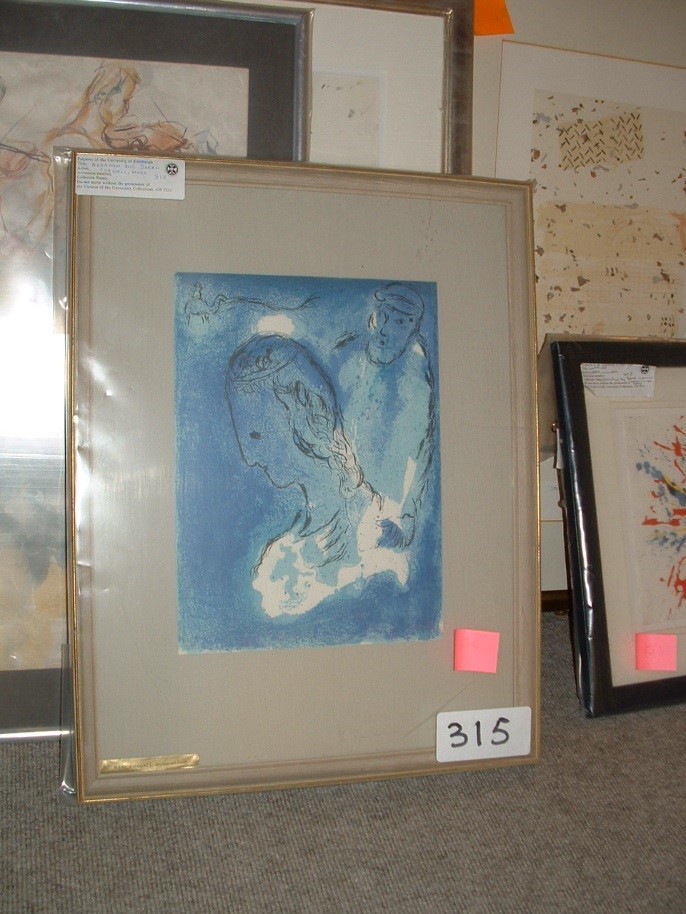
Chagall’s ‘Abraham and Sarah’ in its previous frame
Although pressure sensitive tape had been used to position the prints in their window mounts, it was thankfully relatively simple and easy to remove due to the natural degradation and ageing process causing the tape to become brittle and lose its adhesive qualities. Using a metal spatula, the tape could be lifted from the paper, with any more stubborn areas being removed by the gently application of heat to soften the adhesive.

Unframing the Chagall Prints
Upon removing the print from its mount, we were to find a nice (and rather unexpected) surprise! A previously hidden Chagall image – most likely a lithograph – on the reverse which was duly photographed and documented for future record.

Previously hidden image on the reverse
The decision was taken to float mount the prints in their new frames – allowing the edges of the print to be shown – and hinged to the mount board along the top and bottom edge using Japanese tissue and wheat starch paste; a process which can be easily reversed if necessary with no adverse effects to the object. Once in their new frames, with the added protection of UV filtered glass to minimise risk the risk from ultra violet light, the prints were ready to be displayed in the exhibition.
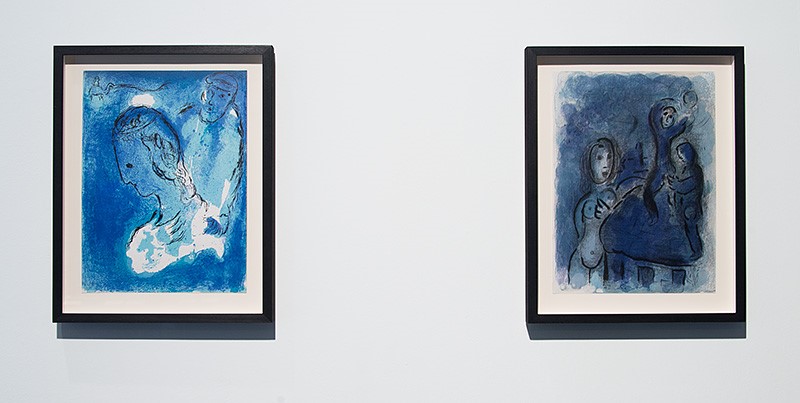
Chagall’s on display in the ‘…Something Blue’ exhibition, Main Library
The old 1970s frames were not significant in themselves, however they did have some very important features that had to be preserved, namely the labels on the reverse. These labels, which are commonly found on the reverse of frames, are an important part of any object as they can help determine the provenance of the work. In the case of the Chagall’s, the labels demonstrated where it had previously been framed and sold before coming the University. This documentation can be greatly important information in tracing its history, and ultimately determining its authenticity and value.
It was therefore important that when reframing the Chagall’s, these labels were kept for future reference. The old 1970s frames were no longer required which meant that the labels that were adhered upon the verso of the backing board would have to be removed and transferred to the new frames. This was achieved by slowly introducing moisture to the labels thus softening the adhesive and allowing the label to be gently lifted from the backing board. A wetted piece of capillary matting was placed upon the label with a sheet of Gore-tex acting as an interleaving layer; its micro-porous nature allowing moisture to slowly penetrate the label without saturating the paper and possibly disturbing any moisture sensitive media. Finally, a layer of transparent polyester was placed over the label and weights placed around the edge to ensure a humid environment was maintained. Once the adhesive had been suitably softened, the label could be lifted from the backing and pressed under weight to ensure they remain flat whilst drying.
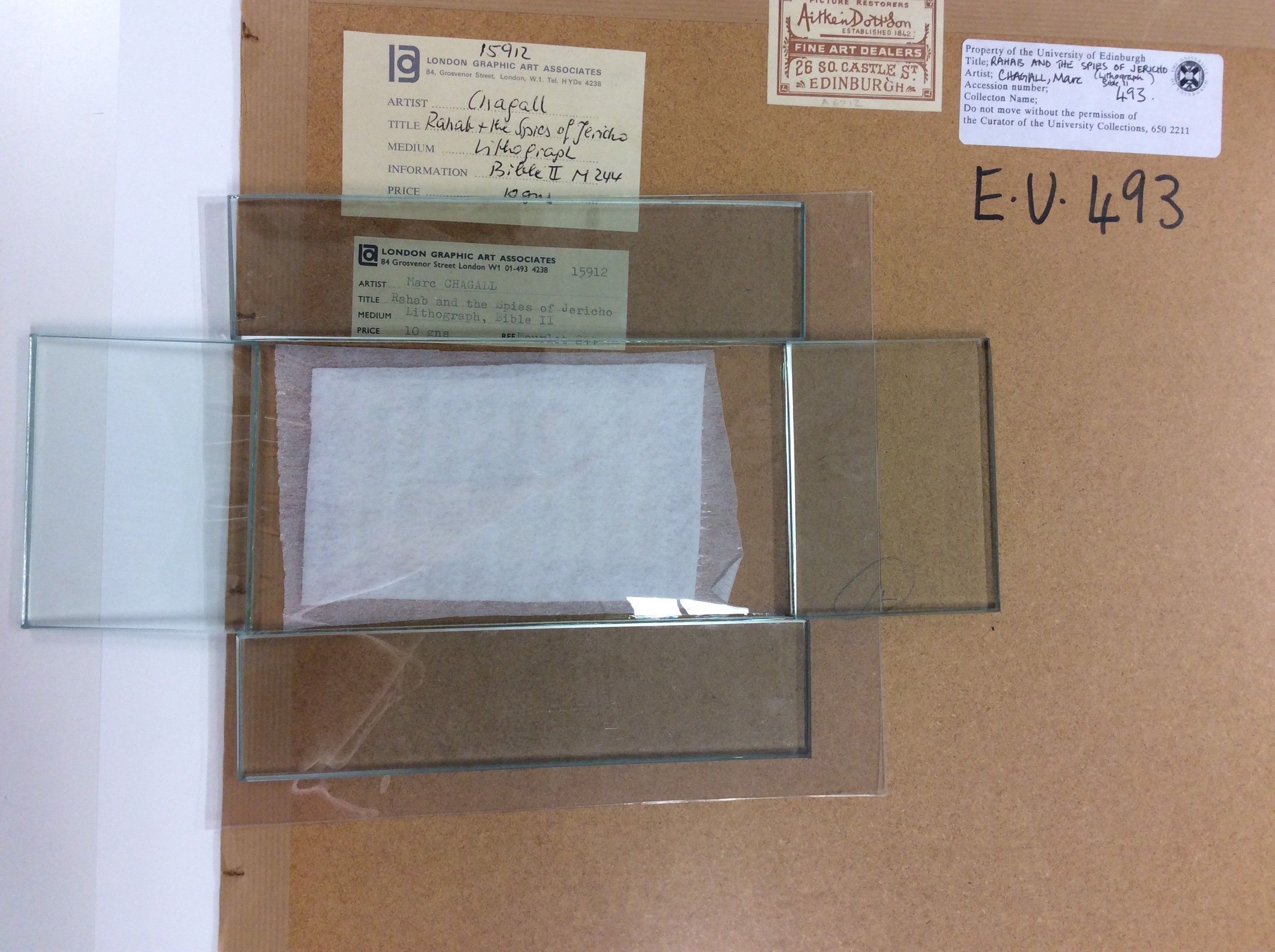
Label during the humidification process
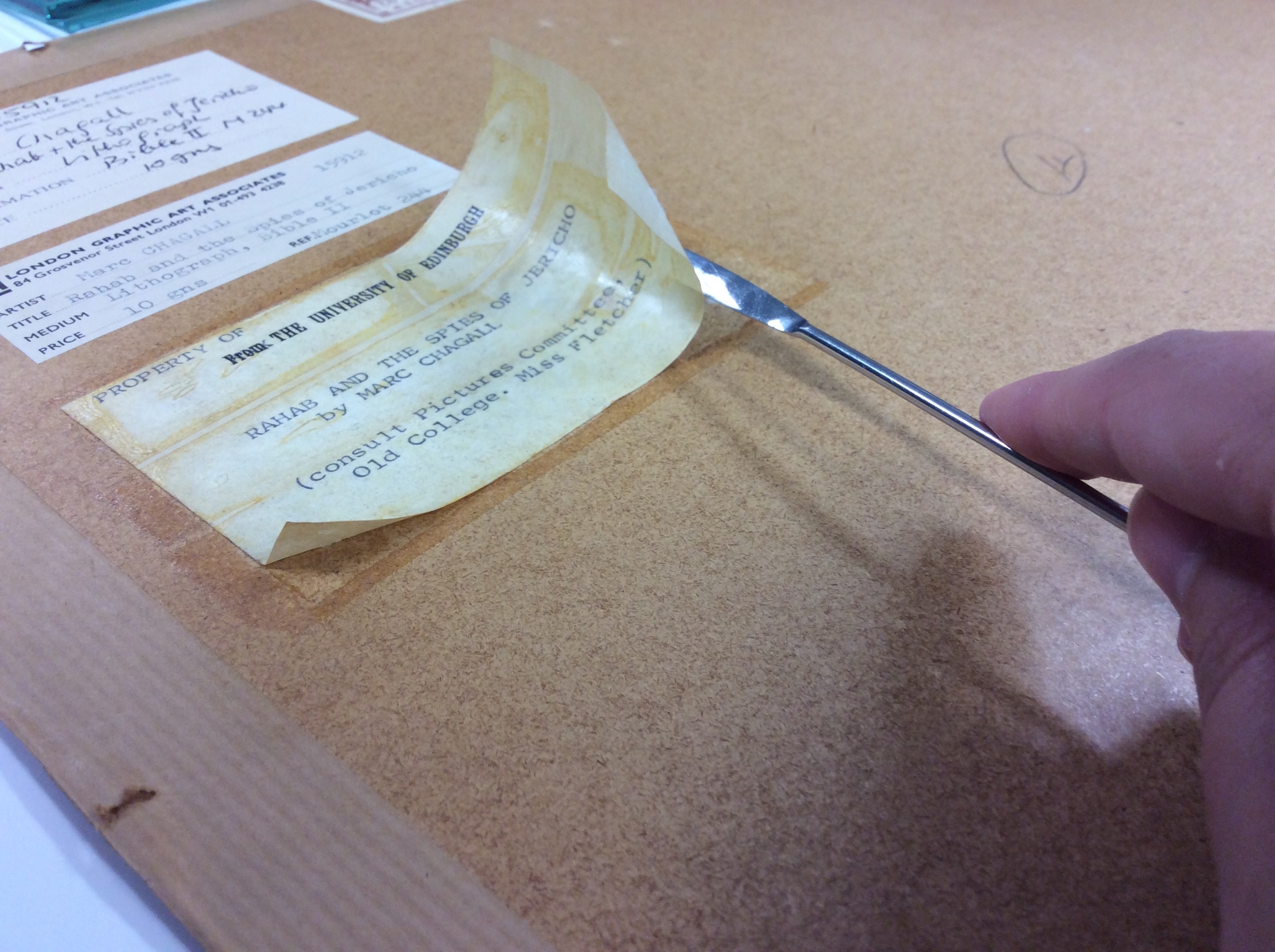
Lifting the label off the backing board once the adhesive has been softened
Now that the labels have been removed, they are ready to be transferred and kept with the new frames, with all the appropriate records updated to document how the Chagall’s were previously framed. So although its housing may have changed, its “back” story endures…
Post by Emma Davey, Conservation Officer
Irish Newspaper Archive Trial ending soon

Trial access to Irish Newspaper Archive ends soon on Monday 31st August.
Irish Newspaper Archives contains electronic versions of Irish newspapers from the 1700’s to current day. See the title list at https://www.irishnewsarchive.com/plist_static/
Feedback and further info
We are interested to know what you think of this e-book package and platform as your comments influence purchase decisions so please do fill out our feedback form.
A list of all trials currently available to University of Edinburgh staff and students can be found on our trials webpage.
Statistical Accounts at the Fringe: Back to the Statistical Future
As always, August in Edinburgh is abuzz with lots of exciting theatre and shows. We were delighted to have the opportunity to present our own show again this year, once more as part of the Beltane network’s Cabaret of Dangerous Ideas. Written and presented by EDINA’s Nicola Osborne and Helen Aiton, a member of the Statistical Accounts editorial board, ‘Back to the Statistical Future’ explored parallels between the ‘New’ Statistical Accounts of Scotland (1834-1845) and our contemporary cultural and political contexts. The wonderful comedian Susan Morrison was master of ceremonies and ‘minister of the parish’ as the discussion ranging over topics such as education, social deprivation and welfare and libraries.

Helen Aiton, Nicola Osborne and Susan Morrison on stage.
With the aid of a time machine and the fantastically-imagined ‘hover-board of social policy’ (a reference for the film buffs!) we posed the question of how different Scotland in 2015 is to Scotland in 1835. Might we be returning to a time, we asked, when libraries are only sustained by subscriptions? Is it possible that, as some of our ancestors believed, the poor are being ‘corrupted, by being taught to read and write’? As good education becomes increasingly costly and inaccessible, are our modern ‘lords and gentlemen’ motivated once more by the belief that the masses would be ‘more obedient and dutiful, were [we] more ignorant, and had no education’?
Pondering such subversive suggestions, the audience came up with some rather brilliant proposals including introducing dancing sessions to libraries, building more sustainable energy-driven social housing, allowing ordinary people to sit in parliament, and even taxing celebrities based on the column inches they generate.
Many thanks to all who made it possible, and to those who came and contributed their own dangerous ideas!
Archives Unbound – Extra Collections Purchased
 We have purchased two additional Archives Unbound modules following a trial earlier this year.
The Mafia in Florida and Cuba: FBI Surveillance of Meyer Lansky and Santo Trafficante, Jr
This collection comprises materials on Santo Trafficante, Jr., Meyer Lansky, and Lucky Luciano, including FBI surveillance and informant reports and correspondence from a variety of offices including, Miami, Tampa, Jacksonville, New York City, New Orleans, Atlanta, New Haven, New York City, Philadelphia, and Chicago; Justice Department memoranda, correspondence, and analyses; Newsclippings and articles; Domestic Intelligence Section reports; Transcriptions of wiretaps, typewriter tapes, and coded messages; Memoranda of conversations.
The collection contains a wealth of primary materials documenting the Spanish Republican period (1931-1939), the Spanish Civil War (1936-1939), and the post-War era of Franco’s rule (1939-1975). The collection’s greatest strengths are the Civil War itself and the immediate post-War years of the 1940s. Included are publications by Republicans, Falangists, Catholics, anarchists, communists, socialists, agrarian reformers, and regional political parties, as well as Spanish exiles and partisans outside Spain.
Both of these collections are listed on our History A-Z list as well as our main database A-Z list and DiscoverEd.
Collections
 Hill and Adamson Collection: an insight into Edinburgh’s past
My name is Phoebe Kirkland, I am an MSc East Asian Studies student, and for...
Cataloguing the private papers of Archibald Hunter Campbell: A Journey Through Correspondence
My name is Pauline Vincent, I am a student in my last year of a...
Hill and Adamson Collection: an insight into Edinburgh’s past
My name is Phoebe Kirkland, I am an MSc East Asian Studies student, and for...
Cataloguing the private papers of Archibald Hunter Campbell: A Journey Through Correspondence
My name is Pauline Vincent, I am a student in my last year of a...
Projects
Cataloguing the private papers of Archibald Hunter Campbell: A Journey Through Correspondence
My name is Pauline Vincent, I am a student in my last year of a...
Archival Provenance Research Project: Lishan’s Experience
Presentation My name is Lishan Zou, I am a fourth year History and Politics student....