Home University of Edinburgh Library Essentials
April 6, 2026
Where’s Dolly? Another metadata game

The Towards Dolly project, showcasing research from genetics at the Roslin Institute, has helped surface lots of interesting material within the library, not least at the current exhibition. One of its outputs was the Science On A Plate subproject, a Wellcome-funded digitisation of 3,500 glass plate slides.
We’ve put these into our metadata games infrastructure, to allow social tagging of the slides, and- while they are well-described- improve their keywording to allow superior faceting in the LUNA application, making the collection more searchable. The game follows the same methodology as the Tag It! Find It! art game- tag ten images, and vote on ten, and build up a high score. It has the additional incentive though, of a hidden Dolly The Sheep image. The lucky user who comes across this image first will be lavishly rewarded (i.e. they will almost certainly get an L&UC calendar!)!!
The game was launched in time for a talk given by Gavin Willshaw, Clare Button and Claire Knowles at The Central Library– a great example of our Library engaging with the wider community- on Tuesday September 29, and will be featured again at Ada Lovelace Day on October 13. You don’t need to be at these events to play the game though- it’s there for you to have a go at any time you like, at librarylabs.ed.ac.uk. You’ll need to login via EASE.
Scott Renton- Digital Development

The Anatomy of a Background

In the studio, with a very limited access to backdrops and props, it can be difficult to enliven the more creative shots of objects. We are well set up now for standard record images against a neutral grey background and it is easy when you need to close in on the details of objects, however, these can start to look a bit ‘samey’ when you have lots of images to do for a project. This is the position I found myself in recently when working on the MIMED collection of musical instruments (see http://images.is.ed.ac.uk/luna/servlet/s/s4mynr). Thankfully, at the University we are blessed with some stunning locations to use instead, but with both of the obvious choices – St Cecilia’s Music Hall and the Reid Concert Hall – off limits for redevelopment, an alternative location required a bit of forethought and planning. Our colleagues at the Anatomy School very kindly agreed to let us use their beautiful Rowand Anderson designed building which provided sympathetic architectural details to arrange the instruments against and Malcolm and I decamped from the studio for 2 days to continue with the project.
Divinity Approaches to Research – Resources for Jewish Studies
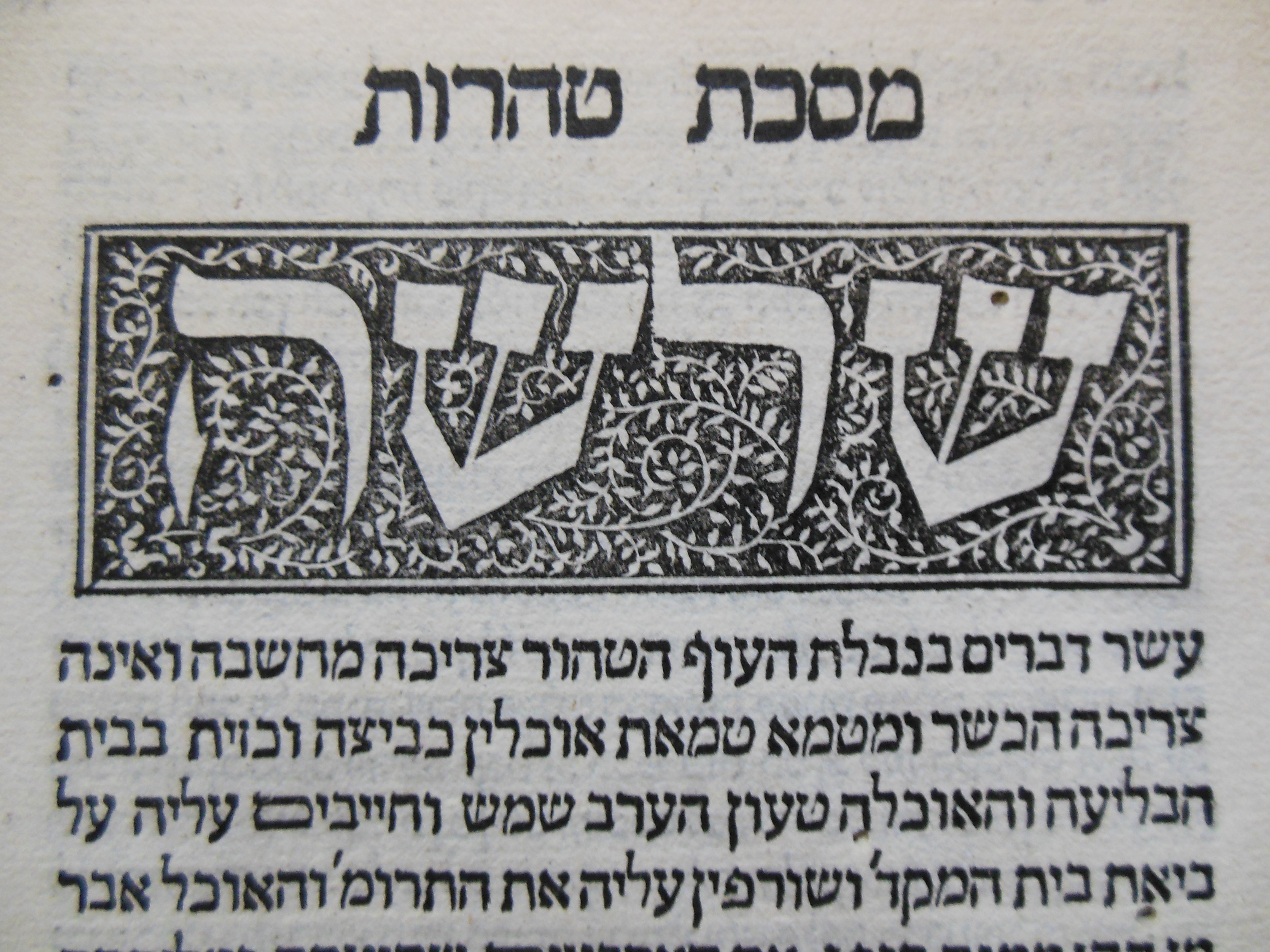
Image from Seder Ṭohorot Mishnayot mi-Seder Kodashim im perush – Commentary by Maimonides. New College Library Dal-Chr 58a
Jewish sacred texts, biblical scholarship and devotional works in Hebrew can be discovered throughout New College Library’s Special Collections. Read More
Bloomsbury E-Books added to DiscoverEd

All of our recent Bloomsbury e-book collection purchases have now been added to DiscoverEd. See the full list here.
Collections purchased include: Anthropology Archive 1993-2013, Anthropology 2014, Biblical Studies 2013, 2014, Christian Doctrines Archive 1988-2013, Christology Archive 1982-2011, Churchill Collection, International Critical Commentary 1901-2014, International Relations Archive 1998-2013, Political Theory and Philosophy Archive 1998-2013, Politics and International Relations 2014, Politics Archive 1993-2013, Religious Studies Archive 2008-2012, Religious Studies 2013, 2014 and 2015. Religious Studies 2015 collection titles will be added to DiscoverEd as new titles become available.
Platform features
Further info
Further information about our e-books is available from http://www.ed.ac.uk/information-services/library-museum-gallery/finding-resources/ebooks
If a book you require is not held by the library, please visit our Library Resources Plus webpage.
From Devon to Bombay: F.A.E. Crew’s war

F.A.E. Crew, 1918
Francis Albert Eley Crew (1886-1973) had a distinguished career at the University of Edinburgh as director of the Institute of Animal Genetics and Buchanan Professor of Animal Genetics, and later as Professor of Public Health and Social Medicine. But at the time of the First World War he was a newly qualified medic with a small rural practice in Devon and a young family. His war experience profoundly affected his future career, spurring him to leave medicine behind to follow his real passion: genetics. Crew provided a vivid account of his war years both in oral history form and in a written memoir, both of which are held here in EUL Special Collections.
When war broke out in August 1914, Crew was at summer camp in East Devon with the Devonshire Regiment 6th Battalion of the Territorial Army, with whom he had been enthusiastically involved in his local village. What began as a summer holiday ended in a flurry of intense activity as men rushed forward to be recruited into the army. Crew and thirteen of his fellow men from his village, became the 2nd 6th Devons, bound for India. Although Crew was medically qualified, and therefore eligible to join the Royal Army Medical Corps, he wanted to see ‘active service’ and so kept his qualifications a secret.
Crew quickly formed the opinion that the organisation and training were a ‘ragbag of inefficiency’ and ‘complete chaos’. Many of his senior officers were ‘of the Boer War vintage’ with outmoded ideas; at the age of 28, Crew found himself rapidly promoted to the rank of Major and in command of a company. His battalion sailed for Bombay on 12 December 1914, leaving his wife Helen heavily pregnant with their second child. Conditions on board were somewhat chaotic: ‘The overcrowding was such that no kind of training could be undertaken and the voyage was so long that by the time we reached the Ballard Pier, Bombay, the troops were in a sorry state and found the march to the barracks at Colaba far beyond their powers.’
Once in India, the batallion came under the orders of the 6th (Poona) Divisional Area at Bombay, and Crew was sent to Deolali, where he was made responsible for field training and for the maintenance of law and order in the area. After the elderly Commanding Officer was sent home on medical grounds, Crew duly became second-in-command of a wing of the battalion, ‘with somewhat vague duties.’ Crew had enough on his hands playing ‘mother’ and ‘father’ to the young men who had come along with him, and all of whom (except one ) had never left Devon before and were totally lost in this foreign land. He spoke of his feelings of loneliness and isolation which came with promotion: ‘if you’re in command of a couple of companies of troops or a battalion or of a field ambulance, then you are isolated from all your colleagues, I mean you’re responsible for them and they can share very little with you.’

Crew in India, 1915
Crew was then sent to Muttra, south of Delhi, with two companies, and then up the Khyber Pass, where they commanded a fort. By this time, Crew was growing frustrated that his duties were confined to training men to fight while not seeing active service himself. But change was on the horizon. Crew developed amoebic dystentry – ‘quite deliberately’ he later wryly remarked – and became seriously ill. He was sent to Bombay to the embarkation authorities, for return to the UK. At this point, his medically qualified status was discovered, and, after a short period of rest and recuperation, Crew was posted to France, where he took over control of the stretcher-bearers in the No. 3 Field Ambulance at Arras. It was intensely dangerous work, Crew received his first wound on his second day, at Bern-Villiers, south-east of Arras:
I was sent up into the line to take over from a Major Anderson, who was running the forward work of the ambulance doing all the clearing, and he took me round all the eight-posts in front and we came back and I was marking them on my map in a small Armstrong hut, I think they called them – little cardboard thing, struck up against the face of a hill. And he was sitting down on a table and I was bending toward him as we made the marks on the map, and all of a sudden there was a terrific flare, glare, crash, noise and everything disappeared in smoke and fume and I found myself – when I came to – jammed under the seat. I’d been blown under the seat for some reason or another. I got out with great difficulty – I was wounded rather badly – and there was poor Anderson sitting on the seat…and he’d got a sliver of shell casing that long and that wide sticking out of his chest. I got that out and tried to do something for him but it was hopeless, hopeless, hopeless. So he died there promptly in my arms, and that’s not a good introduction to a war by any means.
Crew was to receive two more wounds during his time in France. These harrowing experiences naturally affected him profoundly, and he became convinced that he would not survive: ‘I didn’t bother about tomorrow and the day after tomorrow, I didn’t think there was going to be one.’ It was not until the war was reaching its end and victory seemed likely that Crew was suddenly assailed by the realisation that he might indeed have a life to return to – what was he going to do when he returned to normality?
There was no doubt at all that we were winning, and winning fast, and consequently I began to think that possibly there was a future. And so, when once that question asked itself, the second question followed: what do I do? You see, I’d been five years away from anything. Complete waste, complete waste – from my point of view. There was hardly a book, there was hardly a thing you could get hold of. And I was sitting, I was living in a hole in the ground, hanging my accoutrements upon the skeleton hand of somebody who’d been buried there years before, and under those completely gruesome conditions, one began to wonder what one was, what one wanted, what one wanted to be and so on and so forth. And it was very interesting, the speed and the clarity with which I reached my decision. I was going to be a geneticist.

Crew received his demobilisation in early 1919, after a demoralising experience overseeing anti-venereal work in Cologne. The war had filled him with a sense of urgency: an awareness of wasted years, a lack of intellectual stimulation and the constant threat of annihilation. Now it was all over, he was filled with a new sense of purpose:
I had discovered much about myself under the stresses of great fear, of intense boredom, of much disillusionment. I came to know that I could find satisfaction only in the academic world and in activities connected with the genetics and reproductive physiology of animals.
Crew returned eagerly to Edinburgh with the intention of studying genetics at the University under Arthur Darbishire. Unexpectedly however, Crew discovered that Darbishire had died during the war. Even more unexpectedly, Crew was suddenly offered the post intended for Darbishire: that of director of a new Animal Breeding Research Station in Edinburgh. Despite his own concerns that he was scarcely qualified in genetics, Crew went on to develop the Station into the internationally renowned Institute of Animal Genetics.
Divinity Approaches to Research – Top tips for finding Bibles
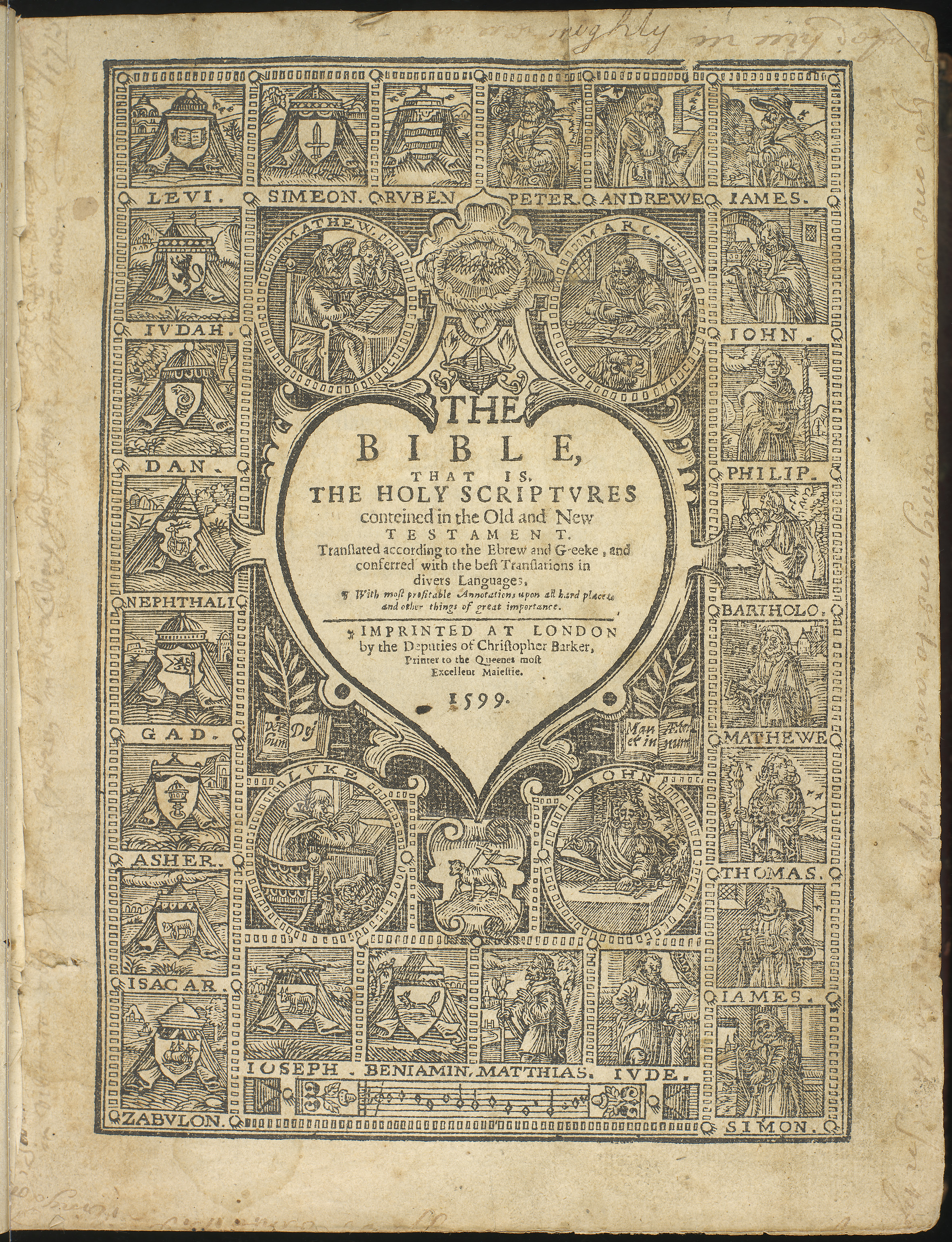
Geneva Bible, 1599. New College Library B.r.417
The University of Edinburgh Library holds extensive and rich collections of Bibles. At New College Library, you will find of early Bibles from the Scottish Reformation, Bibles in languages from all over the world and current editions of study Bibles used for course teaching. However the sheer number of items we have in the collection can make finding details of the specific Bible you want on DiscoverEd seem challenging. Here’s 3 tips to help you:
- If you have the full details of the version and edition you want (e.g. New Oxford Annotated Bible (2010)) use the Advanced Search on DiscoverEd to narrow down your search using as many details as possible.
- A search for ‘Holy Bible’ will bring up many results from our digital collections of pre-1800 early books. To exclude these digital versions, refine your search down by ‘Books’ or ‘Physical item’
- You can also refine down a large result set by library location (New College Library), date and language.
Today’s question for postgraduate students on the Divinity Approaches to Research course is :
“At what shelfmark would you find the principal collections of Greek New Testaments at New College Library? Use DiscoverEd to help you find the answer, or come into New College Library to explore.”
[Example : BJ is the shelfmark for Ethics]
Tweet me your answer at NewCollegeLibrarian@cloverodgers or email me on Christine.Love-Rodgers@ed.ac.uk
A winner will be drawn on Friday 2 Oct from all correct answers received and they will receive a mystery prize!
Christine Love-Rodgers – Academic Support Librarian, Divinity
Divinity Approaches to Research – Library Resources for Islam
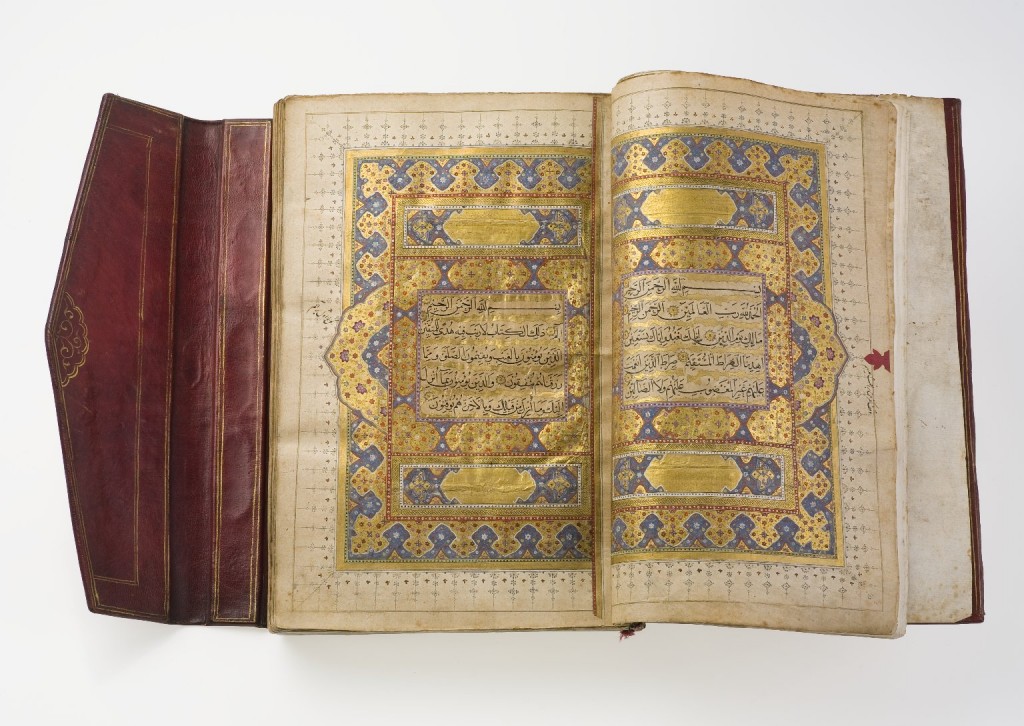
- View of pages from the Qur’an of Tipu Sultan. Shows text in the centre, surrounded by gold and blue illumination. Tipu Sultan was the Muslim ruler of Southern India’s Mysore province (now part of Karnataka) during the late eighteenth century. Edinburgh University Library Or.Ms 148

New College Library holds book collections to support the current courses and research by the School of Divinity in the area of Islam. A wide range of online resources is also available, such as Early Western Korans Online, the Encyclopaedia of Islam and Oxford Islamic Studies Online.
For a full introduction to the range to Library Resources for Islam at the University of Edinburgh, please see the Subject Guide for Islamic and Middle Eastern Studies at:
http://www.ed.ac.uk/information-services/library-museum-gallery/finding-resources/subject-guides/islamic-middle-east
Today’s question for Divinity postgraduate students on the Divinity Approaches to Research course is :
“At what shelfmark would you find the principal collection of books on Islamic Law at New College Library? Use DiscoverEd to help you find the answer, or come into New College Library to explore”
[Example : BJ is the shelfmark for Ethics]
Tweet me your answer at NewCollegeLibrarian@cloverodgers or email me on Christine.Love-Rodgers@ed.ac.uk.
Questions are also posted on the Learn course for Approaches to Research.
A winner will be drawn on Friday 2 Oct from all correct answers received and they will receive a mystery prize!
Christine Love-Rodgers, Academic Support Librarian – Divinity
Centre for Research Collections Pop-up at the LLC School
1-3pm, Tuesday 29 September
Languages and Humanities Centre
50 George Square
Staff from the CRC will be at the Language and Humanities Centre of the LLC School, 50 George Square, to promote the University’s heritage and cultural collections, and provide practical advice about how to explore the collections, where to consult them, and how to find digital resources for assignments.
With over 400,000 rare books and 6km of archive material, there is something for everyone!

Clement Littil ‘Thair to Remain’ Treasures room, CRC 5th Floor, December 2011.
Access issue – Springer website
As reported earlier on twitter, there are access issues to Springer content – both e-books and e-journals. The publishers have now restored Shibboleth authentication which means all users can now access content again.
To access the Springer content via Shibboleth authentication, click the sign up/log in link located at top right corner of any Springer webpage and follow the on-screen instructions for Shibboleth.

Springer continue to work on IP address/EZProxy authentication. UPDATE – all technical problems fully resolved 29/9/15
Cambridge University Press E-Book Additions – September
 A further 130 monographs and 32 coursebooks have been made available in September. A list of the additions can be found at the links below. These are now available via DiscoverEd.
September Coursebooks Additions
Further info
Further information about our e-books is available from http://www.ed.ac.uk/information-services/library-museum-gallery/finding-resources/ebooks
If a book you require is not held by the library, please visit our Library Resources Plus webpage.
Collections
 Hill and Adamson Collection: an insight into Edinburgh’s past
My name is Phoebe Kirkland, I am an MSc East Asian Studies student, and for...
Cataloguing the private papers of Archibald Hunter Campbell: A Journey Through Correspondence
My name is Pauline Vincent, I am a student in my last year of a...
Hill and Adamson Collection: an insight into Edinburgh’s past
My name is Phoebe Kirkland, I am an MSc East Asian Studies student, and for...
Cataloguing the private papers of Archibald Hunter Campbell: A Journey Through Correspondence
My name is Pauline Vincent, I am a student in my last year of a...
Projects
Cataloguing the private papers of Archibald Hunter Campbell: A Journey Through Correspondence
My name is Pauline Vincent, I am a student in my last year of a...
Archival Provenance Research Project: Lishan’s Experience
Presentation My name is Lishan Zou, I am a fourth year History and Politics student....