Home University of Edinburgh Library Essentials
April 5, 2026
Keeping in with the old
One of the delights of the New College Library archives is that it contains information on an array of subjects not just theological or religious topics. This is thanks in part to the original composition of New College Library from donations of libraries, which were given more often than not without worrying too much about content.
There are several places where records relating to the study and understanding of languages other than English can be found. This image is from a volume of polyglot vocabulary (ref.BIN5) written by Robert Blair Munro Binning (http://www.docs.is.ed.ac.uk/docs/lib-archive/bgallery/Gallery/records/eighteen/binning.html). According to the catalogue the languages represented are English, Arabic, French, Hebrew, Persian, Greek, Sanskrit, Latin, Turkish, Telugu, Gaelic and Hindi.
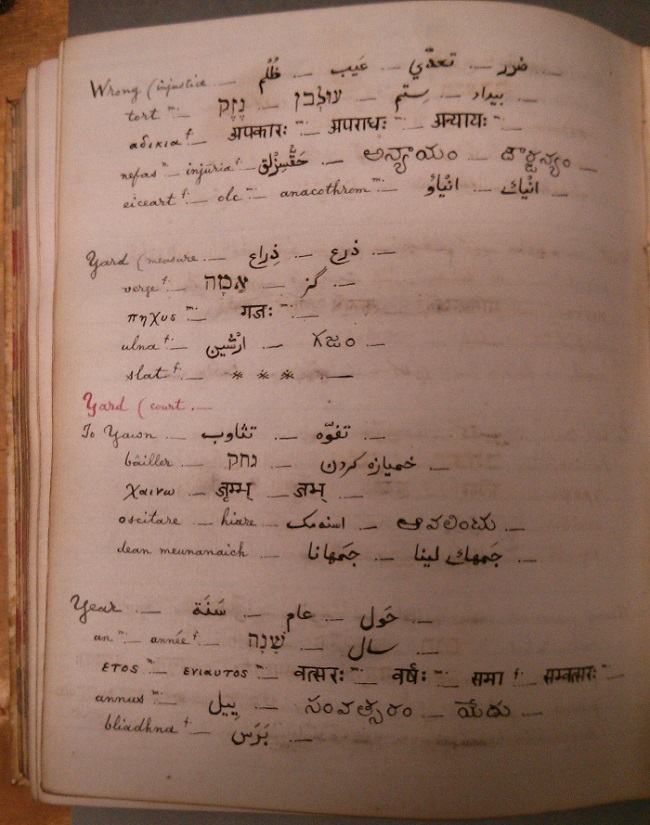
Aside from being a useful tome, I thought that the mix of scripts gave it a certain beauty. The page I have chosen, struck me as appropriate for this time of year, containing as it does the words ‘year’ and ‘yawn’.
Happy New Year! Bliadhna Mhath Ùr! A Guid New Year! Bonne Année! etc etc…
Kirsty M Stewart, New College Collections Curator
Further information: catalogue of items in the Binning collection.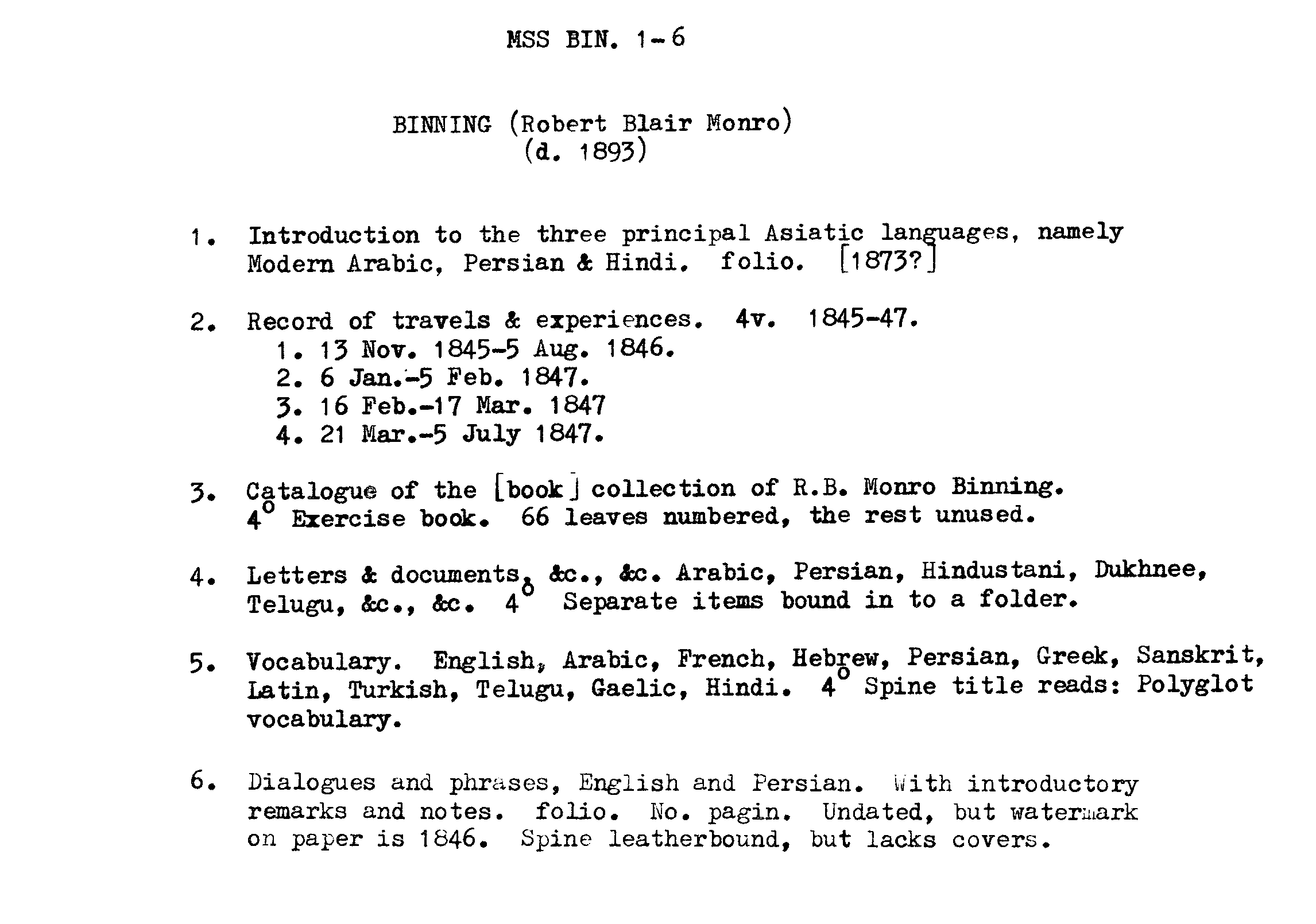
Compliments of the Season

All the Season’s blessings
Did you know that the Christmas card is an English invention? John Calcott Horsley, painter and illustrator designed the very first card for the commission of Sir Henry Cole, the first director of the Victoria and Albert Museum.
It seems that we got both the Christmas tree and the Christmas card from the Victorians!
The Library Annexe Team wishes everyone a Happy Christmas!

A Merry Christmas and a Happy New Year to you

Wishing you a Bright and Happy Christmas
I
Images from “Compliments of the Season” by L. D. Ettlinger and R. G. Holloway
Available at Library Annexe (shelf mark .74168 Ett.)
Viktoria Varga, Library Annexe Assistant
New Oxford Medical Handbooks available

We have now added the following Oxford Medical Handbooks to DiscoverEd:

Oxford Handbook of Medical Imaging

Oxford Handbook of Medical Statistics

IIIF – International Image Interoperability Framework

Inspirational quote on the side of a University of Ghent building, St. Pietersnieuwstraat 33.
The adoption of IIIF (International Image Interoperability Framework) has been gaining momentum over the past few years for digitised images. Adoption of IIIF for serving images allows users to rotate, zoom, crop, and compare images from different institutions side by side. Scott and I attended the IIIF conference in Ghent earlier this month to learn more about IIIF, so we can decide how we can move forward at the University of Edinburgh to adopt IIIF for our images.
On the Monday we attended a technical meeting at the University of Ghent Library, this session really helped us to understand the architecture of the two IIIF APIs (image and presentation) and speak to others who have implemented IIIF at their institutions.
The main event was on Tuesday at the beautiful Ghent Opera House, where there were lots of short presentations about different use-cases for IIIF adoption and the different applications that have been developed. If you are interested in adoption IIIF at your institution I recommend looking at Glen Robson’s slides on how the National Library of Wales has implemented IIIF. I can see myself coming back to these slides again and again, along with those on the two APIs.
Whilst we were in Ghent there was a timely update from LUNA Imaging, whose application we use as an imaging repository on their plans to support IIIF.
Thanks to everyone we met in Ghent who was willing to share with us their experiences of implementing IIIF and to the organisers for a great event in a beautiful city (and our stickers).

IIIF Meeting in Ghent Opera House
If you want to keep up to date with IIIF development please join the Google Group iiif-discuss@googlegroups.com
Claire Knowles and Scott Renton
Library Digital Development Team
MacDiarmid in ‘Thistleonica’: A Poem from a Forgotten Front
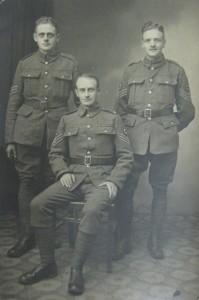
MacDiarmid (left) with fellow officers (Gen. 2236/3/11)
The Papers of Andrew Graham Grieve (Gen. 2236) include a poem from a forgotten front of the First World War written by his older brother Christopher Murray Grieve, later to achieve fame as Hugh MacDiarmid.
Grieve/MacDiarmid had initially opposed the war as a capitalist adventure running counter to the interests of the working classes. The death of school-friend John Bogue Nisbet at the Battle of Loos caused a change of heart, however, and he enlisted in the Royal Army Medical Corps in July 1915. Following training in England, he was posted as ‘Sergeant-Caterer of the Officer’s Mess’ to the 42nd General Hospital in Thessaloniki, Greece (then more widely known as Salonika), where an Allied expeditionary force had established a base for operations against pro-German Bulgaria. Arriving in summer 1916, MacDiarmid joined a Scottish contingent so great that wags nicknamed the city ‘Thistleonica’.
Statistical Accounts Online Service Redevelopment
![Christmas tree, from ‘Rutherfurd's Southern Counties Register... being a supplement to the almanacs; containing […] much useful information connected with the counties of Roxburgh, Berwick and Selkirk’ Published in Kelso, by J. and J.H. Rutherfurd, in 1858](https://libraryblogs.is.ed.ac.uk/files/2015/12/14782967772_b57b7932e8_n.jpg)
Christmas tree, from ‘Rutherfurd’s Southern Counties Register… being a supplement to the almanacs; containing […] much useful information connected with the counties of Roxburgh, Berwick and Selkirk’ Published in Kelso, by J. and J.H. Rutherfurd, in 1858 (courtesy of the National Library of Scotland)
- an improved search mechanism, which will be much more flexible than the current search tool, include new features such as ‘related terms’, and offer more efficient ways of filtering and sorting results
- new map features which allow alternative navigation to and through the accounts, and which help readers to geographically locate the parish they are reading about
- new modes of presenting contextual information, such as introductions to counties and parishes, and new modes of showcasing the content of the accounts through changing exhibitions
- revised help texts and case studies that help you get the most out of the service
- improved citation assistance
We’re currently working on a prototype, which will allow for user testing over the next six months, and we hope to launch the refreshed service in the late summer of 2016. If you’d like to give us feedback on the current service, or to be involved in the user testing of the new service, then please drop us a line at edina@ed.ac.uk.
So with that good news, we wish everyone a Merry Christmas and a Happy Hogmanay!
MANTRA @ Melbourne
The aim of the Melbourne_MANTRA project was to review, adapt and pilot an online training program in research data management (RDM) for graduate researchers at the University of Melbourne. Based on the UK-developed and acclaimed MANTRA program, the project reviewed current UK content and assessed its suitability for the Australian and Melbourne research context. The project team adapted the original MANTRA modules and incorporated new content as required, in order to develop the refreshed Melbourne_MANTRA local version. Local expert reviewers ensured the localised content met institutional and funder requirements. Graduate researchers were recruited to complete the training program and contribute to the detailed evaluation of the content and associated resources.
The project delivered eight revised training modules, which were evaluated as part of the pilot via eight online surveys (one for each module) plus a final, summative evaluation survey. Overall, the Melbourne_MANTRA pilot training program was well received by participants. The content of the training modules generally gathered high scores, with low scores markedly sparse across all eight modules. The participants recognised that the content of the training program should be tailored to the institutional context, as opposed to providing general information and theory around the training topics. In its current form, the content of the modules only partly satisfies the requirements of our evaluators, who made valuable recommendations for further improving the training program.
In 2016, the University of Melbourne will revisit MANTRA with a view to implement evaluation feedback into the program; update the modules with new content, audiovisual materials and exercises; augment targeted delivery via the University’s LMS; and work towards incorporating Melbourne_MANTRA in induction and/or reference materials for new and current postgraduates and early career researchers.
The current version is available at: http://library.unimelb.edu.au/digitalscholarship/training_and_outreach/mantra2
Dr Leo Konstantelos
Manager, Digital Scholarship
Research | Research & Collections
Academic Services
University of Melbourne
Melbourne, Australia
Trial access to Shen Bao Digital Archive

We have trial access to Shen Bao Digital Archive until 31st December 2015. This has been added to our E-Resources Trials webpage.
The Shen Bao newspaper (1872-1949) was the most influential and longest lasting commercial Chinese newspaper published in Shanghai before the establishment of the People’s Republic. The digital archive presents the complete collection of all issues, containing 2 million articles. The database is full-text searchable and the articles can be displayed with in text and image formats. Further info at http://www.eastview.com/files/EVShenBao.pdf
Feedback and further info
We are interested to know what you think of this e-resource as your comments influence purchase decisions so please do fill out our feedback form.
A list of all trials currently available to University of Edinburgh staff and students can be found on our trials webpage.
Oh Christmas Tree!

Christmas has well and truly arrived at the Main Library with the installation of a 12 foot Christmas tree. This year we decided to use images from the CRC collections to decorate the tree – a selection of images (taken by the Digital Imaging Unit) was printed and library staff crafted them into beautiful paper decorations. The tree was then decorated by Exhibitions Officer, Emma Smith.
There is a poster on display next to the tree explaining what the images are, but if you’re unable to visit you can take a look at them after the jump… Read More
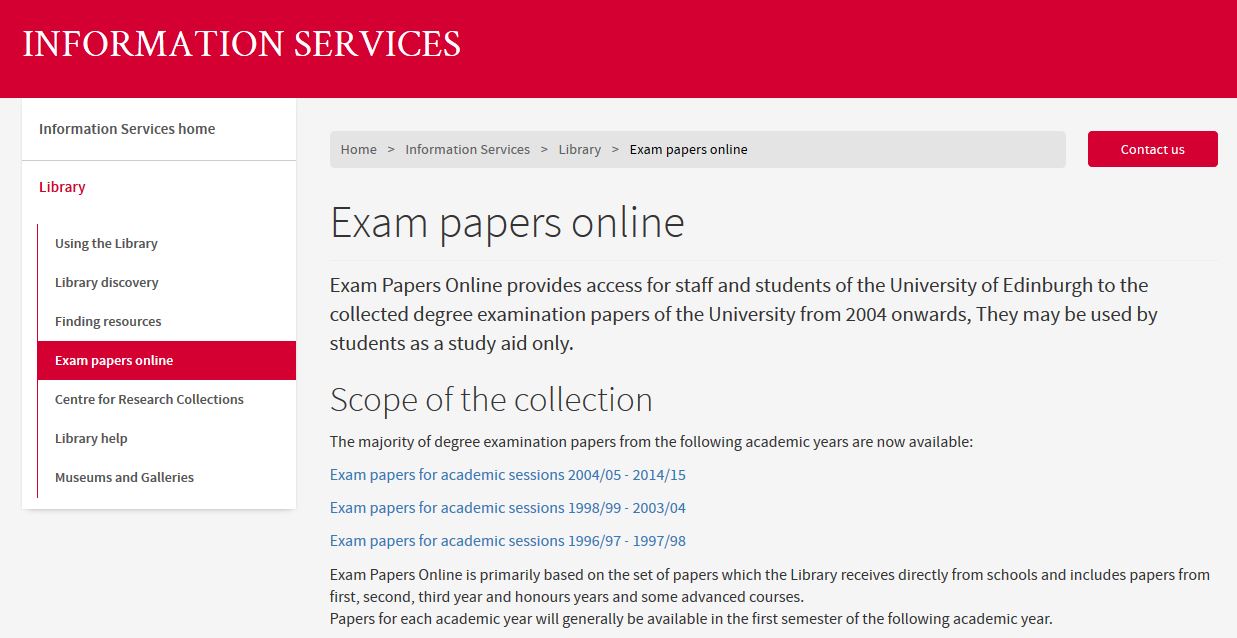
Exam Papers Online
During exam time you may find it useful to look at recent past exam papers for your course.
Our Exam Papers Online web page http://www.ed.ac.uk/information-services/library-museum-gallery/exam-papers provides on and off-campus access for staff and students of the University of Edinburgh to the collected degree examination papers of the University from 2004 onwards.
Following the links to the exam papers you require, you will be prompted for your EASE username and password. Remain within the same browser window and access should be seamless.
If you have any questions or comments about any aspect of Exams Online, please get in touch. Email: exam.papers@ed.ac.uk
Collections
 Hill and Adamson Collection: an insight into Edinburgh’s past
My name is Phoebe Kirkland, I am an MSc East Asian Studies student, and for...
Cataloguing the private papers of Archibald Hunter Campbell: A Journey Through Correspondence
My name is Pauline Vincent, I am a student in my last year of a...
Hill and Adamson Collection: an insight into Edinburgh’s past
My name is Phoebe Kirkland, I am an MSc East Asian Studies student, and for...
Cataloguing the private papers of Archibald Hunter Campbell: A Journey Through Correspondence
My name is Pauline Vincent, I am a student in my last year of a...
Projects
Cataloguing the private papers of Archibald Hunter Campbell: A Journey Through Correspondence
My name is Pauline Vincent, I am a student in my last year of a...
Archival Provenance Research Project: Lishan’s Experience
Presentation My name is Lishan Zou, I am a fourth year History and Politics student....