Home University of Edinburgh Library Essentials
December 16, 2025

Nashriyah: digital Iranian history
 The University of Manchester Library has just launched today, 1 Feb 2016, their digital project Nashriyah: digital Iranian history. It provides free access to 12,000 pages of digital versions of Iranian newspapers and periodicals capturing key historical events as they happened.
These newspapers and periodicals, many of which have been only partially accessible inside Iran, cover the defining moments from the following three eras:
- The premiership of Mohammad Mossadegh and the August 1953 coup d’état against his government (1950-53).
- The 1979 Revolution.
- The late 1990s/early 2000s ‘reform era’ of former President Mohammad Khatami.
For more details and access, please follow click here.
What can your library do for you?
Did you know that reading is one of the best ways to relax? Even as little as six minutes of quiet reading can be enough to make a difference! The type of reading that people do in this library is usually more geared towards study than relaxation, but taking some time to have a break is really important.
That’s why we’re going to be popping up in the Main Library foyer in the next few weeks and months, running short activities to inspire, relax, distract, and motivate anyone that is using the library. We know how hard and stressful it can be to be a student, and we want you to know that the library is here for you!
One of the things we’ll be starting with is a little distraction activity – we’ve made a few examples already:

Want to come and have a go? You can make some friends like these in the Main Library foyer on Wednesday, February 10th. Keep an eye on our Facebook and Twitter for other fun distractions!
Arkyves – new subscription

Following a successful trial last year, we now subscribe to Arkyves.
Arkyves: A Reference tool for the History of Culture is a database, treasure trove and toolbox for those interested in the History of Culture. It is a single access point for thematic searches across a wide variety of cultural heritage collections, contributed by partners like the Dutch Rijksmuseum, the Netherlands Institute for Art History, the Herzog August Bibliothek, and the university libraries of Milan, Utrecht, Glasgow, and Illinois. Ordering and re-ordering motifs, themes, stories and iconographic details in kaleidoscopic fashion, Arkyves will make you find many things you did not realize you were looking for.
Access Arkyves via the Databases AZ list or DiscoverED.
Playfair Revealed
The architect William Henry Playfair was born in Russell Square, London, July 1789. On the death of his father, Playfair was sent to reside with his uncle in Edinburgh. Professor John Playfair, mathematician and geologist and a leading figure in the Edinburgh Enlightenment, took control of his nephew’s education. Following his father’s profession, the young Playfair studied under William Starke of Glasgow. His first public appointment was the laying out of part of the New Town in Edinburgh in 1815.
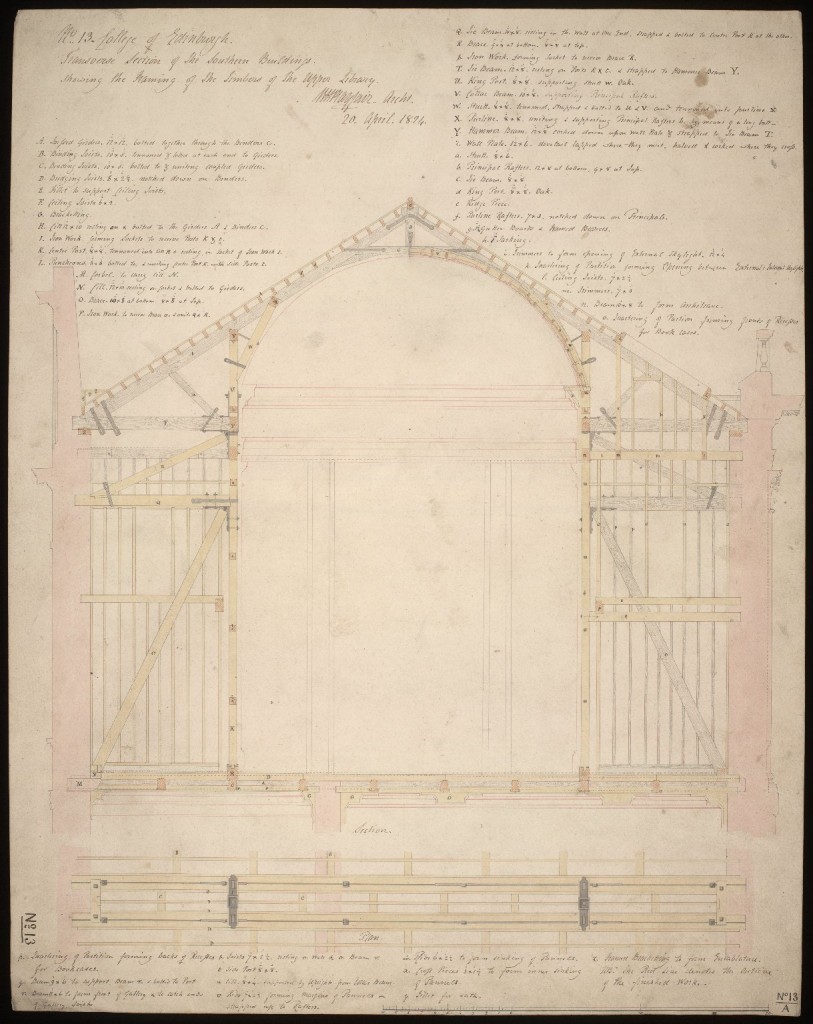
University of Edinburgh (Old College): Transverse section through southern range
Then, after a visit to France in 1816, he established himself professionally by winning the commission in 1817 to complete the unfinished University buildings (leaving the front as designed by Robert and James Adam). He also designed the city’s Royal Terrace and Regent Terrace on the Calton Hill estate; the unfinished National Monument on Calton Hill; and, the Royal Scottish Academy and the National Gallery on the Mound. While Playfair’s most important works in Edinburgh have been executed in the Greek revivalist or classical style – earning for Edinburgh the title of ‘Athens of the North’ – he was competent in other styles too. He designed New College for the ten newly established Free Church of Scotland, a jagged-lined rendering of the Gothic style. He also built country houses and mansions in the Italianate and Tudor styles.
Playfair died in Edinburgh after a long illness on 27 May 1857. His Trustees donated his drawings to the University the following year.
Containing over 5,000 drawings, and with largely only a typescript catalogue of the briefest of descriptions, the collection presents many challenges. Despite these it is one of our most frequently consulted collections. As part of our move to ArchivesSpace, we managed to get a the overarching structure of the catalogue keyed and online.
Late last year we hosted a very productive seminar on Playfair, where academics, curators and others discussed Playfair, the collection and issues around both. This month sees the start of a project where we have two architecture students on placement who are going to make a detailed study of a subset of the drawings, identifying key information within them. This will be both general information (e.g. date, scale, type of drawing etc.) and also detail more specific to Playfair and the buildings. This will allow us to both improve the existing catalogue almost immediately and also draft an overarching schema for cataloguing the collection as a whole. This will then allow us to more accurately estimate the resource that would be required.
Due to both the arrangement of the collection and familiarity (at least to some degree) with the building in question, the project will focus on drawings of Old College. We began with drawings covering the west range and south-west corner. These originally housed Chemistry, Practice of Physic and the Natural History Museum and, even at first glance, the drawings are yielding all sorts of information, such as Playfair’s work pattern – he was generally producing one drawing per day. He also produced a number of detailed drawings at 1:1 scale. There is also much evidence of his innovative use of structural iron work.
This project is a collaboration with Dr Richard Anderson (School of Architecture and Landscape Architecture), whose students, Federica and Xue, are contributing their expertise to a fascinating exploration of one of our most treasured collections.
British Politics

The Library has recently purchased back issue access to the e-journal British Politics. This now ensures that the Library has full access to this e-journal from 2006 (vol. 1) onwards.
 Published by Palgrave Macmillan, British Politics is a peer-reviewed academic journal designed to promote research in British political studies. It incorporates a range of research papers and review articles from all theoretical perspectives, and on all aspects of British politics.
The Library already had access to several years of this journal via other e-journal collections, however, this purchase ensures the Library has full and permanent access to this e-journal from it’s first volume and issue onwards.
You can access British Politics via DiscoverEd.
Caroline Stirling – Academic Support Librarian for Social and Political Science
German prisoners in Britain, 1916 – at Donington Hall near Derby, in Dorchester, in Handforth, and at Eastcote
IMAGES FROM A BOOK IN OUR COLLECTIONS ENTITLED GERMAN PRISONERS IN GREAT BRITAIN (published circa 1916 by Tillotson & Son Ltd., Printers, Bolton & London)
 The photographs in the volume had been taken ‘in response to a request made by the American Ambassador in Berlin’.

Cover of the work ‘German prisoners in Great Britain’, c.1916. (from book held at Centre for Research Collections, RB.P.1034)
Apparently they were to ‘form part of the Wurtemberg War Exhibition’ (Württembergische Kriegs-Ausstellung), held in Stuttgart, May-September 1916.

Donington Hall – German officers assembling for roll-call (from book held at Centre for Research Collections, RB.P.1034)
The exhibition had been organised by the Württemberg Red Cross, under the auspices of the king and queen of Württemberg and the Royal Württemberg War Ministry. Württemberg at the time retained considerable autonomy within Germany and had its own royal family, with its capital at Stuttgart.

Donington Hall – the dining-hall (from book held at Centre for Research Collections, RB.P.1034)
This fact reflected the complex political structure of Imperial Germany – Württemberg being a kingdom (formerly a duchy) that had become part of the German Empire in 1871.

Donington Hall – one of the dormitories (from book held at Centre for Research Collections, RB.P.1034)
The foreword to the book claims that ‘the prisoners were left entirely free to choose whether they would be photographed or not’. The text continues:
The photographers had explicit instructions that no prisoner was to be photographed without his content, and that neither compulsion nor persuasion was to be employed to induce anyone to form part of a group

Dorchester Camp – a general view of the site (from book held at Centre for Research Collections, RB.P.1034)
The photographs which appeared in the book illustrate 6 of the largest prisoners’ camps in Great Britain: Donington Hall, Alexandra Palace, Dorchester Handforth, Lofthouse Park, and Eastcote.

Dorchester Camp – group of prisoners, some of whom have come from the Somme (from book held at Centre for Research Collections, RB.P.1034)
Donington Hall is an 18th century ‘gothic’ house near Derby which had been requisitioned by the War Office of the British government during the Great War for use as a prisoner of war camp.

Dorchester Camp – prisoners and their pet rabbits (from book held at Centre for Research Collections, RB.P.1034)
It housed German officers who were waited on and served by their lower military ranks who were billeted in huts in the grounds.

Handforth – Unter-Offiziers’ gardens (from book held at Centre for Research Collections, RB.P.1034)
One of Donington Hall’s celebrated in-mates was the German aviator, aerial explorer, and author, Gunther Plüschow (1886-1931) who had explored and filmed Patagonia and Tierra del Fuego from the air.

Handforth – parcels arriving from home (from book held at Centre for Research Collections, RB.P.1034)
As an imprisoned German naval pilot (May 1915) Plüschow successfully escaped from Donington Hall during a storm (July 1915) and made for the neutral Netherlands.

Handforth – model ship built by Kaiserliche Marine prisoners (from book held at Centre for Research Collections, RB.P.1034)
Dorchester Camp, Dorset, received its first prisoners of war in August 1914. The camp was set up at the town’s empty artillery barracks at Poundbury. At its height, the camp housed 4,500 men – equivalent to almost half of the town’s resident population.

Eastcote – bakery (from book held at Centre for Research Collections, RB.P.1034)
A print-works in Handforth, near Wilmslow, Cheshire, became a prison camp for Germans with 1,000 housed their by November 1914, and 2,000 by April 1915.
Eastcote prisoner of war camp was in Northamptonshire, and was also known as Pattishall Camp. It would eventually come to house more than 4500 German prisoners of war.
 Dr. Graeme D. Eddie, Assistant Librarian Archives & Manuscripts, Centre for Research Collections
This blog-post was created by using the volume itself, and with information found on BBC pages and those of the Imperial War Museum and the National Army Museum
A Fond Farewell
For the last ten weeks I have been working with Project Conservator, Emily Hick to conserve and rehouse a collection of rare Greek books. The weeks have gone racing by and now my internship has come to an end. In light of this, I would like to share a bit more about my internship experience at the Centre for Research Collections.
Working on the Blackie project with Emily has been a great way to gain insight into the planning and management of conservation projects. One of my responsibilities as intern was to record the time it took me to complete each task and the materials I used in the process. This was a really useful exercise as it made me think of how I could work more efficiently and be more resourceful with materials. I now feel that I am better equipped to plan and manage conservation projects myself in the future.
One of the great advantages of working on a project involving Greek books is that I can’t stop and read them! However, I have occasionally found some quirky things in the collections to distract me. My favourite by far is this doodle on the endpaper of an eighteenth century book. The image is of George Dunbar, professor of Greek at Edinburgh University from 1807 to 1851. It looks as if it may have been drawn by one of his students!?
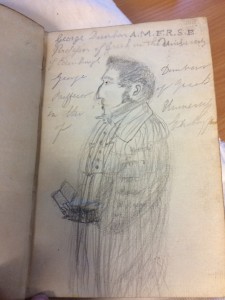
Sketch of George Dunbar, Professor of Greek at Edinburgh University from 1807 -1851
My background is in Preventive Conservation so the internship has been an excellent opportunity to become more familiar with paper conservation. I have been able to learn a lot more about the interventive treatments of paper just by observing Emily and the other conservators at work. As most cultural heritage collections contain paper objects and books, the value of this knowledge cannot be understated. I thoroughly enjoyed having a go at some basic interventive conservation treatments during a Conservation Taster Day held at the CRC, where I learned to do tear repairs and infills on de-accessioned documents.
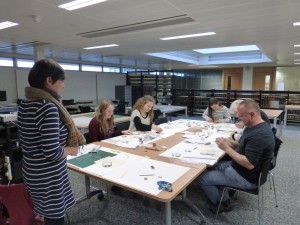
Having fun making tear repairs during the conservation taster day
As a Preventive Conservator, I feel it is important to have a broad understanding of all materials and objects found in cultural heritage collections. Therefore, it has been particularly helpful for me to visit different parts of the University’s collections to learn how they are cared for. I have been able to visit the Musical Instrument Collections, the Anatomy Museum and the Art Collections. I was fascinated to learn about the treatments and techniques employed in the conservation of musical instruments. During my visit to the anatomy museum I was interested to learn about the practical ethical challenges in caring for collections of human remains.
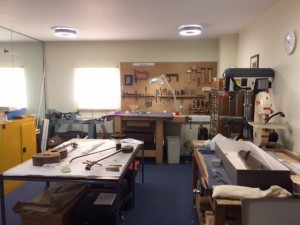
Musical instrument conservation studio
Throughout the internship I have had access to training, which has significantly improved my knowledge and skills in both preventive and remedial conservation. I have received training on rehousing, disaster planning and designing collections databases. The training will undoubtedly improve my chances of finding employment once the internship concludes. I have also been able to get an idea of what is involved in running a staff training day by assisting Emma Davey, Conservation Officer, in preparing for the disaster response and salvage training.
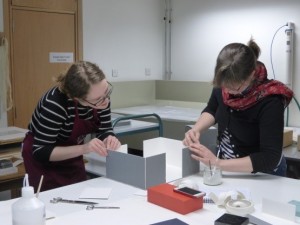
Learning to make temporary boxes for books
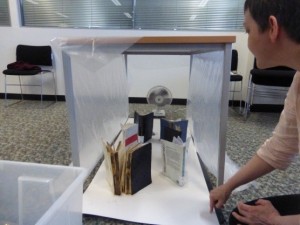
Building wind tunnels during salvage training
I have thoroughly enjoyed my time working with the Conservation Department at the CRC. I have been encouraged to get involved in all aspects of the Department’s work, from conservation and collections care, to public engagement activities. As a new graduate, the internship has allowed me to put the knowledge gained from my Masters degree into practice and given me more confidence in my abilities. The conservation team have all been very supportive and have given me lots great advice on career development. All in all, I think an internship with the CRC is an excellent opportunity for a new graduate, and I would strongly recommend it to anyone starting out in conservation.
American National Biography Online (for trial)
We have been offered a free trial of American National Biography Online until 11th Feb 2016. To access the trial, please go to the Library’s E-resources Trials webpage and select this resource from the list, or go directly to American National Biography Online, or simply search for American National Biography in DiscoverEd and follow the link http://discovered.ed.ac.uk/44UOE_VU1:default_scope:44UOE_ALMA51149999870002466 for the e-book entry. You can use Trial Feedback Form to send your comments.
 American National Biography offers portraits of more than 19,000 men and women — from all eras and walks of life — whose lives have shaped American history and culture. From astronauts to missionaries, chemists to musicians, and cowboys to Vikings, the portraits combine to reflect the rich diversity of American life, from pre-colonial times onward. More than a decade in preparation, the American National Biography is the first biographical resource of this scope to be published in more than sixty years.
The Main Library has a full 24-volume set of the printed version of American National Biography which can be found in DiscoverEd. Two supplements are also on order.
You in your small corner
The New College Library has a marvellous series of manuscript sermon notebooks dating as far back as the 1640s (ref. MS SER). It is quite common within manuscript holdings to have collections made of document type (maps, photographs, postcards etc) although that approach to archives is largely defunct now with the emphasis being on record creators and context. The provenance of the sermon notebooks varies widely and, perhaps unsurprisingly, there are sermon notebooks scattered throughout the New College archives. Some notebooks are the work of the preacher, some are copies of those who were there listening and some are copies of sermons or lectures written down by someone else.
One such notebook comes from the records of Robert Wodrow (1679-1734) (ref. MS WOD 3). Wodrow was part of a famous family of ministers, was for a time librarian at the University of Glasgow, and is an ancestor of the former President of America, Thomas Woodrow Wilson. In 1721-22, Wodrow published an important work entitled The History of the Sufferings of the Church of Scotland from the Restoration to the Revolution. Dealing with the persecution of the Covenanters after the Restoration, he coined the phrase “The Killing Time”, a phrase which persists to this day.
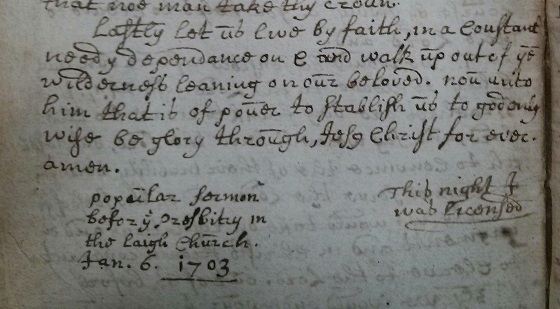
Part of the sermon notebook of Rev Robert Wodrow, ref. MS WOD 3.1.
As you can see from the above image, taken from one of Robert Wodrow’s notebooks (ref. MS WOD 3.1), he has a neat hand and, as he did for many of his sermons, he has noted the date and place of preaching. However, the part which stood out was the short, personal note: ‘This night I was licensed’. Ministers of the Church of Scotland are given a license to preach before they can be ordained so that this must have been quite an occasion for him and of importance enough to record it in a small corner of his notebook. Working with archives, it is easy to become blasé about how old the material is or how famous or significant the person who created the document was, but moments like his make documents personal again. Not only do they remind you how special and valuable the archives are but that the famous and important of long ago were human too. Had it been today, might this have constituted Wodrow’s Facebook status?
Kirsty M Stewart, New College Collections Curator
Transcription
Lastly let us live by faith, in a constant
need & dependence on C[hrist] and walk up out of the
wilderness leaning on our beloved. nou unto
him that is of pouer to stablish us to god only
wise be glory through, Jesus Christ for ever.
amen.
popular sermon
befor the Presbitry in
the Laigh Church
Jan. 6. 1703.
The Laigh Church was a name for the Tron Kirk, Glasgow.
Laigh or laich is Scots for low.
Wikipedia: #1Lib1Ref campaign
Research and Learning Services took part in the #1Lib1Ref campaign this morning, celebrating Wikipedia’s 15th birthday by adding 32 new citations to the online encyclopaedia!

“Zacheta wordmark” by Halibutt – Own work. Licensed under CC0 via Wikimedia Commons – https://commons.wikimedia.org/wiki/File:Zacheta_wordmark.svg#/media/File:Zacheta_wordmark.svg
Many Wikipedia articles have a ‘citation needed’ tag (350,000 in the English language version alone), meaning they contain assertions which are not backed up by evidence. We used the Citation Hunt tool to locate these articles and added citations using reliable sources such as journals, books and official websites. As the tool provides the editor with a completely random article, our citations covered a diverse and occasionally bizarre range of topics, including:
- Footballer Paul Dalton’s £20,000 move to Hartlepool from Manchester United in 1988
- The release of a 2-disc special edition of the 1951 film Quo Vadis in 2008, following a long photochemical restoration process
- Caldwell County High School’s victory in the 1963 state football championships
- CBS journalist Eric Sevareid’s involvement in the foundation of Burgundy Farm Country Day School
As well as editing random articles like these, we also identified existing pages for University of Edinburgh alumni, such as Dame Honor Fell, and added links to their digitised PhD theses in ERA, our online repository.
We’ll be doing more Wikipedia editing with colleagues from across the University of Edinburgh during Innovative Learning Week:, so make sure you join us! http://www.innovativelearning.ed.ac.uk/creating-open-body-knowledge-history-medicine-wikipedia-editathon-1
Articles edited today:
https://en.wikipedia.org/wiki/Princeton,_Kentucky#Education
https://en.wikipedia.org/wiki/Elsie_Stephenson
https://en.wikipedia.org/wiki/Paul_Dalton
https://en.wikipedia.org/wiki/Kingsley_Dunham
https://en.wikipedia.org/wiki/Honor_Fell#Early_life_and_education
https://en.wikipedia.org/wiki/Miami-Dade_County_Fair_%26_Exposition#Scholarships
https://en.wikipedia.org/wiki/Burgundy_Farm_Country_Day_School
https://en.wikipedia.org/wiki/Julia_Bailey-Serres
https://en.wikipedia.org/wiki/Conor_McBride
https://en.wikipedia.org/wiki/Baseball_New_Zealand
https://en.wikipedia.org/wiki/SWORD_(protocol)
https://en.wikipedia.org/wiki/Quo_Vadis_(1951_film)
https://en.wikipedia.org/wiki/Nick_Stone_(author)
https://en.wikipedia.org/wiki/Rosalyn_(song)
https://en.wikipedia.org/wiki/Crossmyloof
https://en.wikipedia.org/wiki/Les_Allen
https://en.wikipedia.org/wiki/Miracle_Goodnight
https://en.wikipedia.org/wiki/One_Hit_(To_the_Body)
https://en.wikipedia.org/wiki/4th_of_July,_Asbury_Park_%28Sandy%29
https://en.wikipedia.org/wiki/War_%28Edwin_Starr_song%29
https://en.wikipedia.org/wiki/The_Ghost_of_Tom_Joad_%28song%29
https://en.wikipedia.org/wiki/Prove_It_All_Night
https://en.wikipedia.org/wiki/Nigel_Shadbolt
https://en.wikipedia.org/wiki/Eugenio_Moggi
https://en.wikipedia.org/wiki/Gordon_Plotkin
https://en.wikipedia.org/wiki/List_of_University_of_Edinburgh_people
https://en.wikipedia.org/wiki/Stephen_Muggleton
https://en.wikipedia.org/wiki/Donald_Michie
https://en.wikipedia.org/wiki/Li_Wei_%28scientist%29
https://en.wikipedia.org/wiki/Michael_J._C._Gordon
Collections
 Hill and Adamson Collection: an insight into Edinburgh’s past
My name is Phoebe Kirkland, I am an MSc East Asian Studies student, and for...
Cataloguing the private papers of Archibald Hunter Campbell: A Journey Through Correspondence
My name is Pauline Vincent, I am a student in my last year of a...
Hill and Adamson Collection: an insight into Edinburgh’s past
My name is Phoebe Kirkland, I am an MSc East Asian Studies student, and for...
Cataloguing the private papers of Archibald Hunter Campbell: A Journey Through Correspondence
My name is Pauline Vincent, I am a student in my last year of a...

Projects
Cataloguing the private papers of Archibald Hunter Campbell: A Journey Through Correspondence
My name is Pauline Vincent, I am a student in my last year of a...
Archival Provenance Research Project: Lishan’s Experience
Presentation My name is Lishan Zou, I am a fourth year History and Politics student....