Home University of Edinburgh Library Essentials
April 4, 2026
DataVault Project updates
It’s been a while since we last posted a project update, so here is a round-up of recent progress:
- We are currently at the 11th International Digital Curation Conference in Amsterdam, and will be presenting a paper on the Data Vault project to the conference in the ‘digital preservation’ stream of the conference.
- A demo system is now available where you can see how the system works, and deposit + retrieve some example data sets.
- Jisc have generously provided phase three funding to the Data Vault project. This funding will last for six months, and will provide resources to complete the development of the first complete version of the Data Vault software.
South Asian Newspapers on trial
The Library currently has trial access to South Asian Newspapers (1864-1922). This unique collection provides online access to a select group of South Asian newspapers from the 19th and early 20th centuries.

South Asian Newspapers (1864-1922) coverage includes: Read More
Medieval Manuscripts from the Dirt Ages
February saw the start of a new project to surface clean and rehouse the CRC’s most important collection of Western medieval manuscripts, which were bequeathed to the library by David Laing in 1878. His collection contains 121 Western manuscripts, most of which are very finely illuminated or textually important.

Figure 1. Details of illuminations found in the manuscripts
Due to the age and past storage of the material, many items have accumulated a large amount of surface dirt. As well as reducing the aesthetic quality of the manuscripts, surface soiling can potentially be very damaging to paper and parchment artefacts.

Figure 2. Accumulation of surface dirt on a manuscript
Firstly, dirt particulates can have an abrasive action on a microscopic level, causing a weakening of the fibres. Dust can also become acidic due to the absorption of atmospheric pollutants. Sulphur dioxide and nitrous oxides present in the environment, in combination with moisture and the metallic impurities found in dirt, can be converted to sulphuric acid and nitric acid respectively. This is absorbed by the pages and results in a loss of strength and flexibility. Dust can also provide a food source for insects and mould. Mould spores in the air can settle on the manuscripts and live on the organic material in the dust. At a high relative humidity, these moulds can thrive. Surface dirt can also cause staining of the item. Dirt can readily absorb moisture which causes the particulates to sink deeper into the paper or parchment fibres, making it impossible to remove by surface cleaning methods.

Figure 3. Example of ingrained surface dirt on a manuscript
To remove loose particulates, a museum vac is firstly used to quickly hoover up large amounts of dirt. It has adjustable suction levels, so it can be used on fragile items if needed. A range of attachments can be used to reach dirt in all the nooks and crannies of the manuscripts. The museum vac also has filters to prevent any mould spores removed from the book getting back out into the studio.

Figure 4. A museum vac (left) with attachments (right)
A chemical sponge is then used to remove ingrained dirt. This is a block of vulcanised natural rubber which picks up dirt and holds it in its substrate. It was originally developed to remove soot from fire damaged objects.

Figure 5. Using chemical sponge to surface clean a manuscript
Many of the manuscripts pages are extremely cockled. This has resulted in the ingress of dust further into the text block. Due to this, the manuscripts must be examined page by page to ensure all dirt is removed, which can be very time consuming, especially for the larger volumes. However, all the hard work is worth it. Knowing we are making a difference to the condition of the collection, and seeing the change in the books is very satisfying!

Figure 6. Stages of surface cleaning. Before treatment (left), cleaned with museum vac (middle), cleaned with chemical sponge (right)
Were the Tudors terrible?
*The Library has access to The Cecil Papers until 31st July 2024 as part of ProQuest Access 350.*
The Library currently has trial access to The Cecil Papers, which may help you find out.
This fascinating archive offers you crucial insights into the events of one of the most dynamic periods of history.

The Cecil Papers cover the period 1520-1668 and are a privately held archive of around 30,000 16th and 17th century manuscripts. In the main, these consist of the correspondence of William Cecil, Lord Burghley (1520-1598) and his son Robert, the 1st Earl of Salisbury (1563-1612). Read More
100 Great Ideas
We’re always thinking of ways to improve the library, and today we’ve been asking for your ideas. As part of Innovative Learning Week, we’ve been in the foyer today trying to get 100 ideas for what could make this space better.
We even made a little Lego model of the foyer – do you recognise it?

We want to hear any ideas that you have, and some of them have been a little bit crazy! Anyone fancy a slide from the first floor down to the ground? Or maybe a Library yurt?


There have been lots of great suggestions though, how about some library beanbags? Or some thought provoking challenges to get your brain working as you come in to the Library before you have to study?

There is still time to contribute your ideas, either visit the library today, or contact us on Facebook or Twitter and let us know what you’d like to see here!
5 library databases you didn’t know you needed in your life…
…until now.
The many bibliographic and indexing databases you can access through the Library are fantastic and essential resources for your research and study whether you are an undergraduate, postgraduate or member of staff.
However, the Library subscribes to a large number of different kinds of databases that can be just as useful for your learning, teaching and research needs and we wanted to highlight just a small number of these that you may not have been aware of and might want to explore.
All databases can be accessed via the Databases A-Z list, unless otherwise noted.
In no particular order…
1. Box of Broadcasts (BoB) Read More
All you need is library love
As Valentine’s Day approaches this weekend, we want to let all students know that their library loves them!
We were down in the Library Foyer today handing out origami hearts that we made this week, and inviting students to give it a go:

Origami is a great way to take a break from studying, and it only takes six minutes of quiet activity to relax you. The hearts are so easy that you could make a couple in that time! You can find the instructions for the bigger hearts here, and the little bookmark hearts here.
These students all had a great time doing it!

If you do make a heart, take a photo and show us on Facebook or Twitter! Make sure to follow us as well, because we will be posting about more fun events in the Library Foyer in the coming weeks! Library love is all around!

Copyright waffle and the illusion of choice.
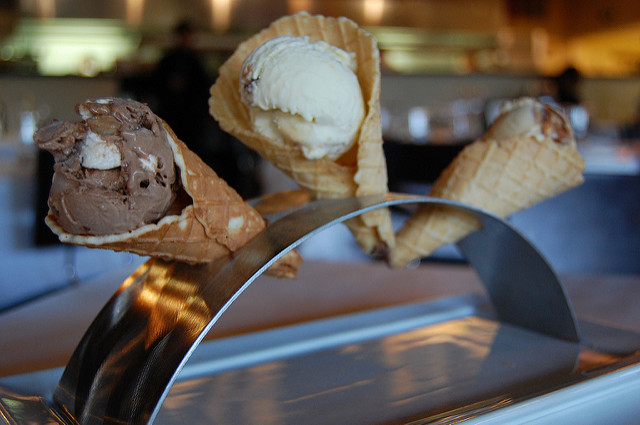
ice cream cone trio by stu_spivack : http://edin.ac/1Rm0wEi
An academic colleague of mine recently had an article accepted for publication in a journal. As usual they were emailed by the publisher who asked them to sign an Author Publishing Agreement which would transfer copyright to them. However, the author noticed that the publisher also allowed authors to retain their own copyright by instead signing a Licence to Publish.
Keep your copyright!
The researcher wasn’t sure whether to assign copyright to the publisher, or if it would be preferable for them to retain copyright. On the face of it, it seems like a no-brainer – keep your copyright rather than signing it away. This is the mantra that open access advocates have been saying for years.
BUT more importantly.
Always read the small print – or get someone else to do it for you – and understand what you are getting yourself into.
The illusion of choice
In this particular case, if you read both the standard Publishing Agreement (to transfer copyright) and the Licence Agreement (to keep copyright) with a fine-tooth comb you will find that they pretty much contain the same language verbatim. There is no practical difference between them both in the end results. Both the author and the publisher will end up with exactly the same rights for exactly the same duration. There is the illusion of choice but it literally doesn’t matter which piece of paper is signed. This is an example of Copyright Waffle and it sidetracks from the important things.
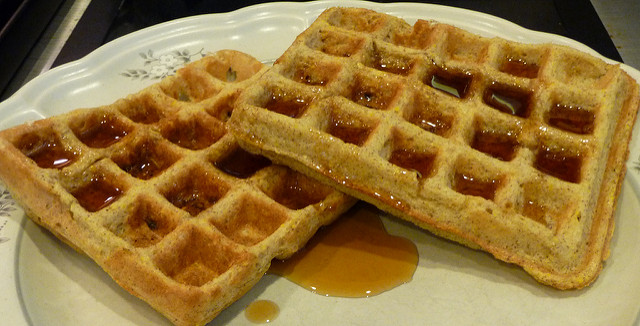
Waffles by Brenda Wiley: http://edin.ac/1Rm13Gq
Important things:
- By hook, or by crook, make your work open access.
- If you don’t know how, then ask someone who does; generally speaking Librarians will always be able to help you.
- If you have the option, publish your work with a Creative Commons licence; CC-BY is our favourite flavour.
New Subscription to Duke University Press E-Journals Collection

Following a successful trial last year to additional e-journal content from Duke University Press, we now subscribe to the e-Duke Journals Scholarly Collection
There are now 45 titles in the collection and these have been added to DiscoverEd.
| Journal | ISSN | eISSN | HighWire Availability | HighWire URL |
| American Literary Scholarship | 0065-9142 | 1527-2125 | 2000-2015 | http://als.dukejournals.org |
| American Literature | 0002-9831 | 1527-2117 | 2000-Current | http://americanliterature.dukejournals.org |
| American Speech | 0003-1283 | 1527-2133 | 2000-Current | http://americanspeech.dukejournals.org |
| boundary 2 | 0190-3659 | 1527-2141 | 2000-Current | http://boundary2.dukejournals.org |
| Camera Obscura | 0270-5346 | 1529-1510 | 1976-Current | http://cameraobscura.dukejournals.org |
| Common Knowledge | 0961-754X | 1538-4578 | 2002-Current | http://commonknowledge.dukejournals.org |
| Comparative Literature | 0010-4124 | 1945-8517 | 2000-Current | http://complit.dukejournals.org |
| Comparative Studies of South Asia, Africa and the Middle East | 1089-201X | 1548-226X | 1981-Current | http://cssaame.dukejournals.org |
| Cultural Politics | 1743-2197 | 1751-7435 | 2005-Current | http://culturalpolitics.dukejournals.org |
| differences | 1040-7391 | 1527-1986 | 1999-Current | http://differences.dukejournals.org |
| East Asian Science, Technology and Society | 1875-2160 | 1875-2152 | 2007-Current | http://easts.dukejournals.org |
| Eighteenth-Century Life | 0098-2601 | 1086-3192 | 2000-Current | http://ecl.dukejournals.org |
| Environmental Humanities (new for 2016) | 2201-1919 | TBD | TBD | |
| Ethnohistory | 0014-1801 | 1527-5477 | 2000-Current | http://ethnohistory.dukejournals.org |
| French Historical Studies | 0016-1071 | 1527-5493 | 2000-Current | http://fhs.dukejournals.org |
| Genre | 0016-6928 | 2160-0228 | 2000-Current | http://genre.dukejournals.org |
| GLQ | 1064-2684 | 1527-9375 | 1993-Current | http://glq.dukejournals.org/ |
| Hispanic American Historical Review | 0018-2168 | 1527-1900 | 2000-Current | http://hahr.dukejournals.org |
| History of Political Economy | 0018-2702 | 1527-1919 | 1969-Current | http://hope.dukejournals.org |
| Journal of Chinese Literature and Culture | 2329-0048 | 2329-0056 | 2015 | http://jclc.dukejournals.org |
| Journal of Health Politics, Policy and Law | 0361-6878 | 1527-1927 | 1976-Current | http://jhppl.dukejournals.org |
| Journal of Medieval and Early Modern Studies | 1082-9636 | 1527-8263 | 2000-Current | http://jmems.dukejournals.org |
| Journal of Middle East Women’s Studies | 1552-5864 | 1558-9579 | 2005-Current | http://jmews.dukejournals.org |
| Journal of Music Theory | 0022-2909 | 1941-7497 | 1999-Current | http://jmt.dukejournals.org |
| Labor | 1547-6715 | 1558-1454 | 2004-Current | http://labor.dukejournals.org |
| Mediterranean Quarterly | 1047-4552 | 1527-1935 | 2000-Current | http://mq.dukejournals.org |
| Modern Language Quarterly | 0026-7929 | 1527-1943 | 1940-Current | http://mlq.dukejournals.org |
| New German Critique | 0094-033X | 1558-1462 | 2006-Current | http://ngc.dukejournals.org |
| Nka | 1075-7163 | 2152-7792 | 1994-Current | http://nka.dukejournals.org |
| Novel | 0029-5132 | 1945-8509 | 1999-Current | http://novel.dukejournals.org |
| Pedagogy | 1531-4200 | 1533-6255 | 2001-Current | http://pedagogy.dukejournals.org |
| Poetics Today | 0333-5372 | 1527-5507 | 2000-Current | http://poeticstoday.dukejournals.org |
| positions | 1067-9847 | 1527-8271 | 1993-Current | http://positions.dukejournals.org |
| Public Culture | 0899-2363 | 1527-8018 | 1988-Current | http://publicculture.dukejournals.org |
| Radical History Review | 0163-6545 | 1534-1453 | 1975-Current | http://rhr.dukejournals.org |
| Small Axe | 0799-0537 | 1534-6714 | 2001-Current | http://smallaxe.dukejournals.org |
| Social Text | 0164-2472 | 1527-1951 | 2000-Current | http://socialtext.dukejournals.org |
| South Atlantic Quarterly | 0038-2876 | 1527-8026 | 2000-Current | http://saq.dukejournals.org |
| the minnesota review | 0026-5667 | 2157-4189 | 2005-Current | http://minnesotareview.dukejournals.org/ |
| The Philosophical Review | 0031-8108 | 1558-1470 | 2000-Current | http://philreview.dukejournals.org |
| Theater | 0161-0775 | 1527-196X | 1968-Current | http://theater.dukejournals.org |
| Tikkun | 0887-9982 | 2164-0041 | 2000-Current | http://tikkun.dukejournals.org |
| TSQ: Transgender Studies Quarterly | 2328-9252 | 2328-9260 | 2014-Current | http://tsq.dukejournals.org |
| Twentieth-Century Literature | 0041-462X | 2325-8101 | 2009-Current | http://tcl.dukejournals.org |
| World Policy Journal | TBD | TBD | TBD | Starts 2016 |
*New* Medieval Family Life
The Library has recently purchased access to Medieval Family Life, a collection of letters and manuscripts from c1400-1490. Only five major letter collections exist from fifteenth century England and they are all available for the first time in this resource.
These letter collections and associated manuscripts take you into the world of medieval family, business, relationships, trade, politics and community.

Medieval Family Life contains the letter collections of the Paston, Stonor, Cely, Plumpton and Armburgh families. Read More
Collections
 Hill and Adamson Collection: an insight into Edinburgh’s past
My name is Phoebe Kirkland, I am an MSc East Asian Studies student, and for...
Cataloguing the private papers of Archibald Hunter Campbell: A Journey Through Correspondence
My name is Pauline Vincent, I am a student in my last year of a...
Hill and Adamson Collection: an insight into Edinburgh’s past
My name is Phoebe Kirkland, I am an MSc East Asian Studies student, and for...
Cataloguing the private papers of Archibald Hunter Campbell: A Journey Through Correspondence
My name is Pauline Vincent, I am a student in my last year of a...
Projects
Cataloguing the private papers of Archibald Hunter Campbell: A Journey Through Correspondence
My name is Pauline Vincent, I am a student in my last year of a...
Archival Provenance Research Project: Lishan’s Experience
Presentation My name is Lishan Zou, I am a fourth year History and Politics student....